Every reaction of an aldehyde or a ketone — whether it is a nucleophilic addition, an aldol condensation, a Cannizzaro disproportionation or a simple oxidation — is decided long before the reagents are added. The verdict is written into the geometry and electronics of a single functional group: the carbonyl, a carbon–oxygen double bond that behaves as one of the most versatile electrophilic centres in organic chemistry. Understanding why that carbon is so hungry for electron density, and why that hunger varies from one molecule to the next, is the intellectual hinge on which the entire study of aldehydes and ketones turns.
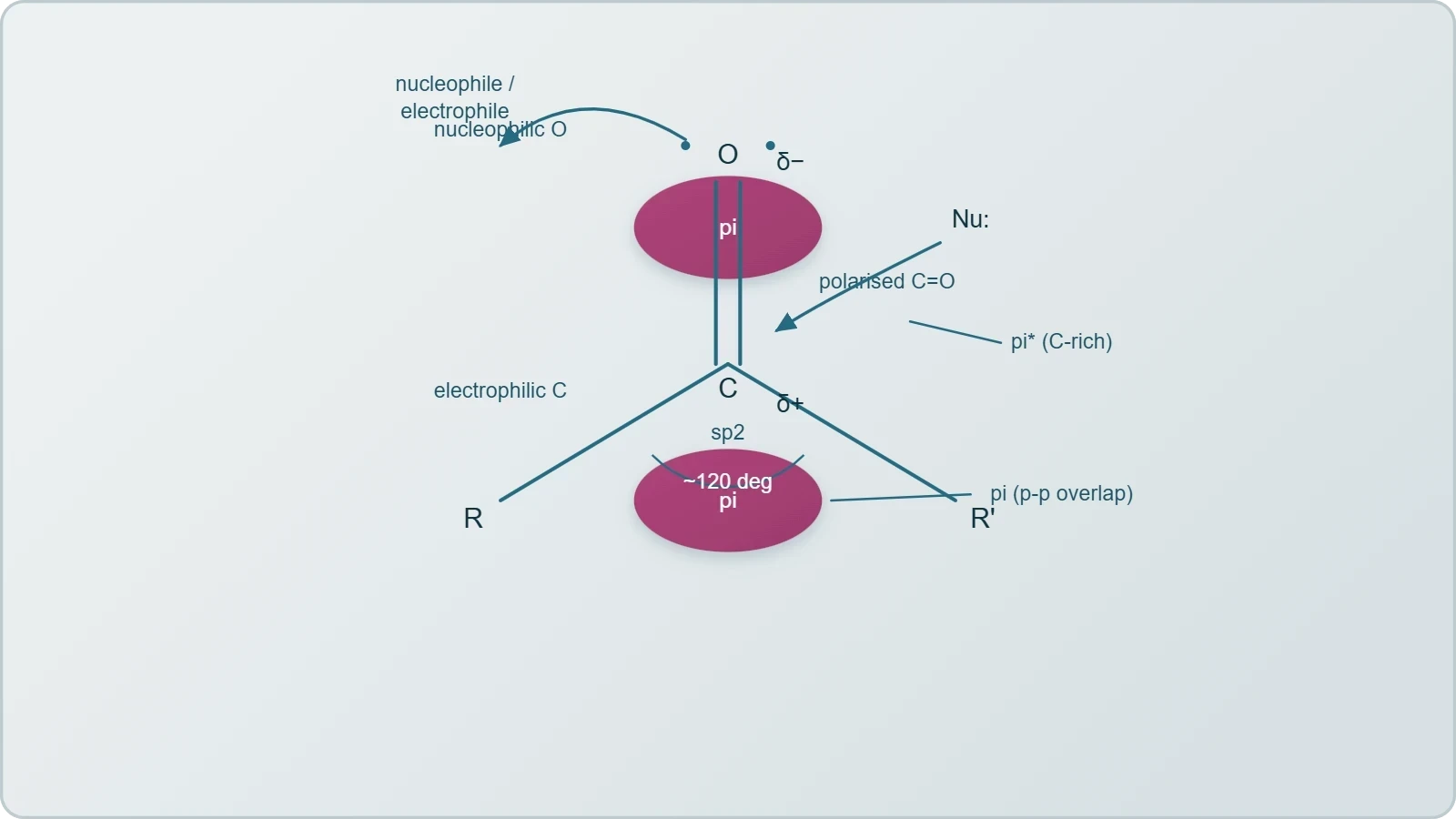
This lesson moves deliberately beyond naming conventions into the physical reality of the group. Having established in the previous session how aldehydes and ketones are named, we now examine the ##\ce{sp^2}## hybridisation of the carbonyl carbon, the trigonal planar geometry it imposes, and the polarised ##\ce{C=O}## bond that creates a simultaneous electrophile and nucleophile within the same functional unit. From there we build a quantitative picture of reactivity: how substituents, resonance, inductive effects and solvent all modulate the electrophilicity of that carbon, and how spectroscopic and kinetic evidence makes those effects measurable rather than merely descriptive.
The treatment is designed for CBSE Class 11–12 students working at an intermediate to advanced level, and it assumes fluency with hybridisation, resonance structures and basic reaction mechanisms. Expect molecular orbital reasoning alongside the simpler valence-bond picture, infrared stretching frequencies as a diagnostic window into bond strength, and rate data that converts "more reactive" from a slogan into a number. By the end, the carbonyl group should feel less like a memorised symbol and more like a physical object with a measurable personality.
On This Page
The Architecture of the Carbonyl Group
The carbonyl group consists of a carbon atom doubly bonded to an oxygen atom, and its architecture follows directly from the electron configuration of carbon. In the group, the carbon uses three of its four valence electrons to form sigma bonds — two to hydrogen or carbon substituents and one to oxygen — while the fourth remains in an unhybridised p orbital. The oxygen, similarly, contributes a p orbital to the pi framework. This arrangement forces the carbonyl carbon into ##\ce{sp^2}## hybridisation, and the consequences of that choice ripple through every property we will discuss.
Hybridisation, Geometry and the Sigma Framework
An ##\ce{sp^2}## hybrid orbital is formed by mixing one s and two p orbitals, yielding three equivalent hybrids separated by approximately 120°. Around the carbonyl carbon, these three hybrids point toward the three attached atoms, so the carbonyl carbon and its three neighbours lie in a single plane — a trigonal coplanar arrangement. The bond angles are close to 120°, though electron repulsion from the double bond compresses them slightly; in formaldehyde, for instance, the ##\ce{H-C-H}## angle is about 116° rather than a perfect 120°.
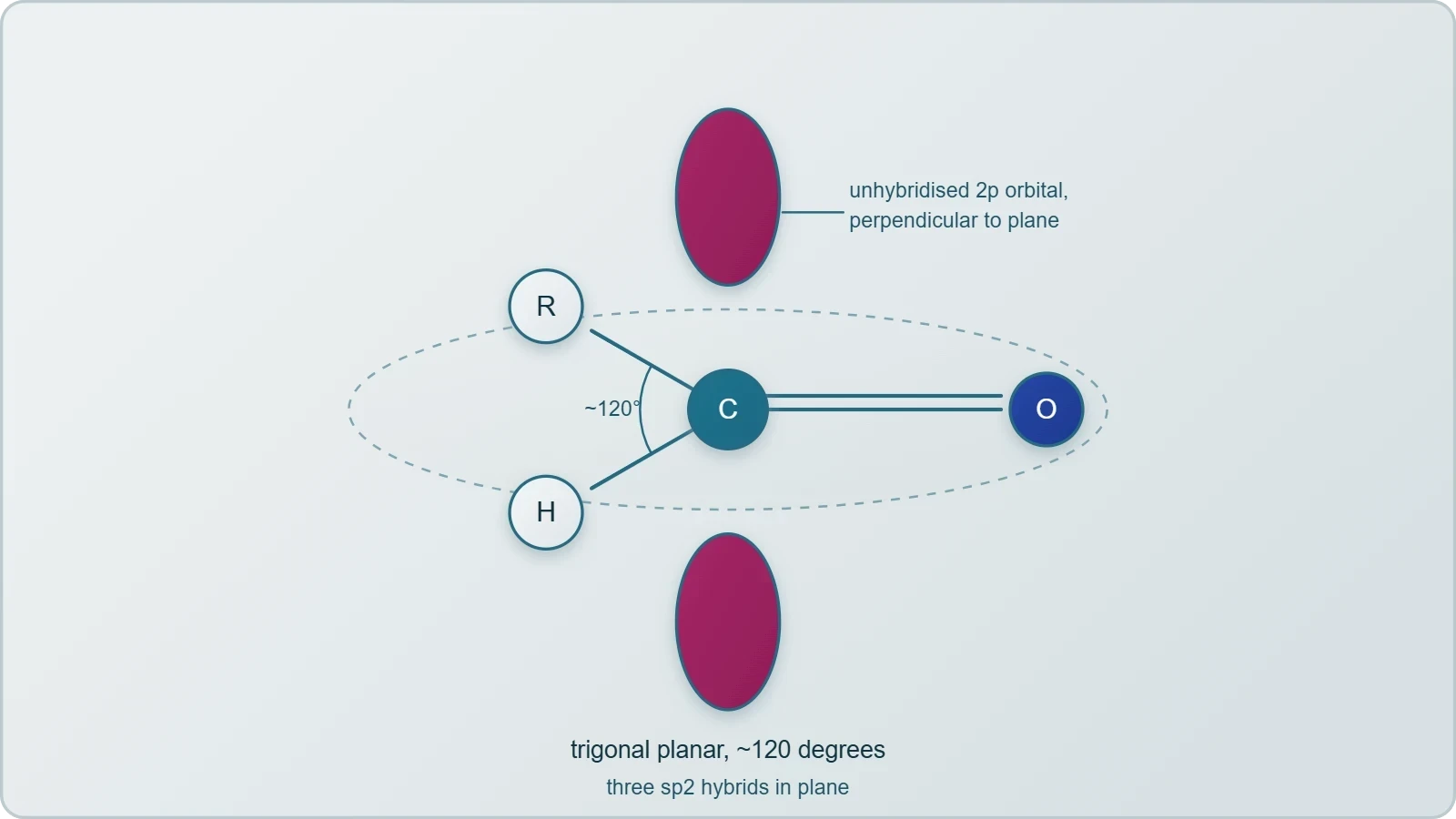
The remaining p orbital on carbon, perpendicular to this plane, overlaps side-on with a p orbital on oxygen to form the pi bond. The pi electron cloud therefore sits above and below the molecular plane, exactly as the orbital diagram in the reference material shows. This separation of sigma framework and pi cloud is not a cosmetic detail: it explains why the carbonyl group is planar, why nucleophiles approach from above or below the plane rather than along it, and why the group can participate in conjugation with adjacent pi systems without disrupting its own geometry.
Molecular Orbital Description of the Pi Bond
Valence-bond language calls the ##\ce{C=O}## linkage a double bond, but molecular orbital theory gives a sharper picture. The two p orbitals combine to form two molecular orbitals: a bonding ##\pi## orbital, in which the lobes on carbon and oxygen share the same phase, and an antibonding ##\pi^*## orbital with a node between the nuclei. Because oxygen is more electronegative, its atomic orbital lies lower in energy, so the bonding ##\pi## orbital is oxygen-rich while the antibonding ##\pi^*## orbital is carbon-rich.
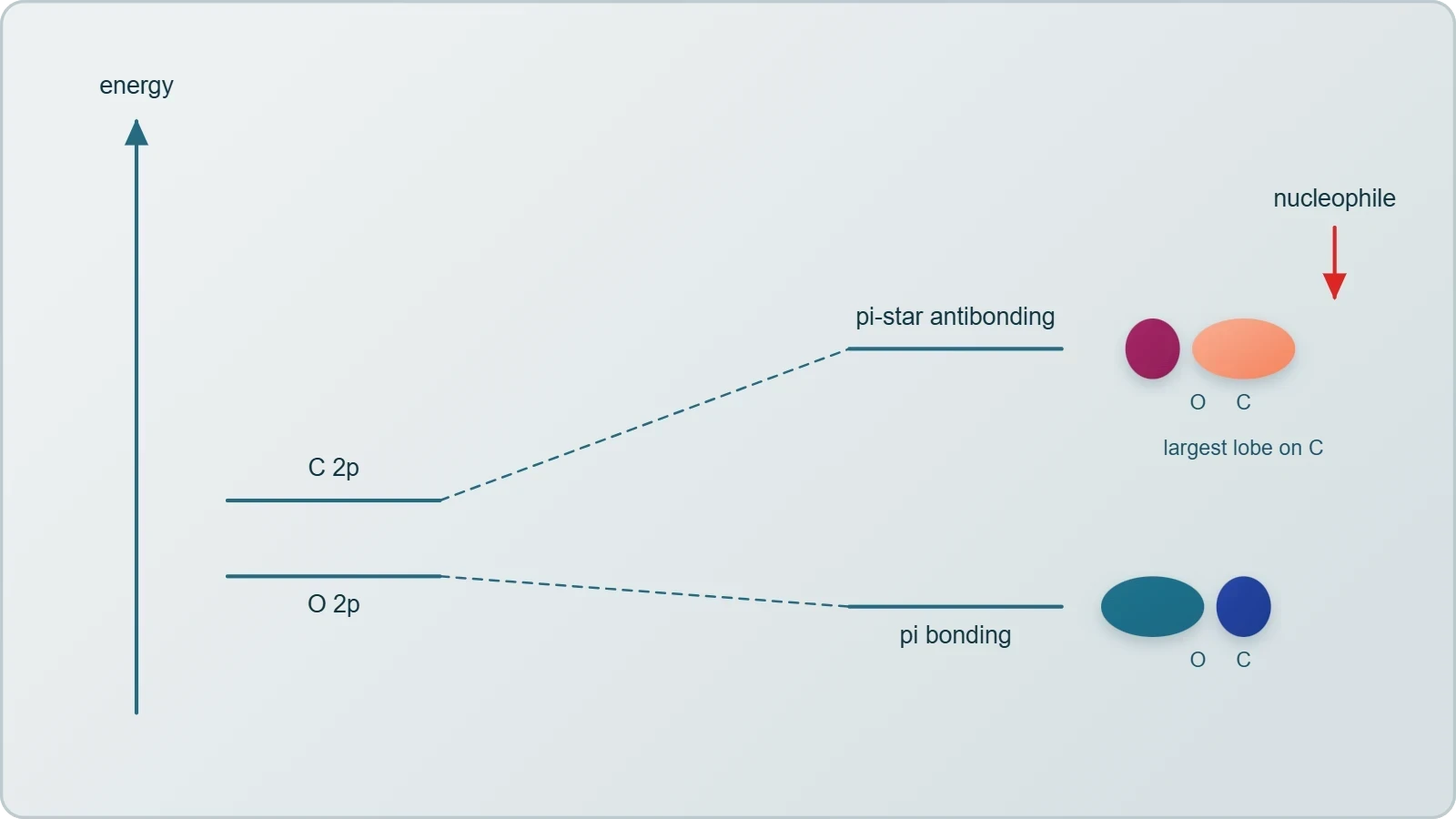
That asymmetry is the electronic origin of carbonyl reactivity. When a nucleophile donates electron density, it does so into the low-lying ##\pi^*## orbital, whose largest lobe resides on carbon — which is precisely why nucleophiles attack carbon and not oxygen. The energy gap between the filled ##\pi## orbital and the empty ##\pi^*## orbital, ##\Delta E##, governs how easily this donation occurs. Anything that lowers ##\pi^*## or raises ##\pi## narrows the gap and increases electrophilicity, giving us a predictive handle on reactivity.
Polarity, Resonance and the Electrophilic Carbon
Oxygen's greater electronegativity (3.44 on the Pauling scale, against 2.55 for carbon) pulls the shared pi electrons toward itself, so the ##\ce{C=O}## bond is strongly polarised: the carbon carries a partial positive charge and the oxygen a partial negative charge. This single fact defines the functional group's dual character. The carbonyl carbon is an electrophile — a Lewis acid that accepts electron pairs — while the carbonyl oxygen is a nucleophile and a Lewis base that donates them. Every addition reaction you will meet is simply a nucleophile finding the carbon and an electrophile finding the oxygen.
Resonance Structures and Dipole Moments
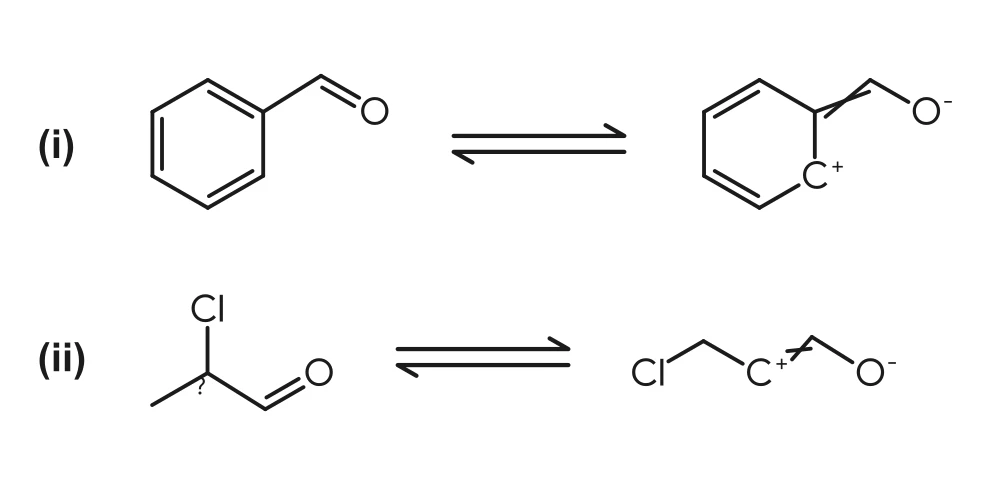
The polarity is best represented by two resonance contributors: a neutral structure with a double bond, and a dipolar structure in which the pi electrons have moved fully onto oxygen, leaving carbon positive and oxygen negative. The true molecule is a hybrid weighted heavily toward the neutral form, but the dipolar contributor is significant enough to produce substantial dipole moments. This is why carbonyl compounds are markedly more polar than ethers, where the ##\ce{C-O}## single bond is polarised but cannot delocalise charge through a pi system.
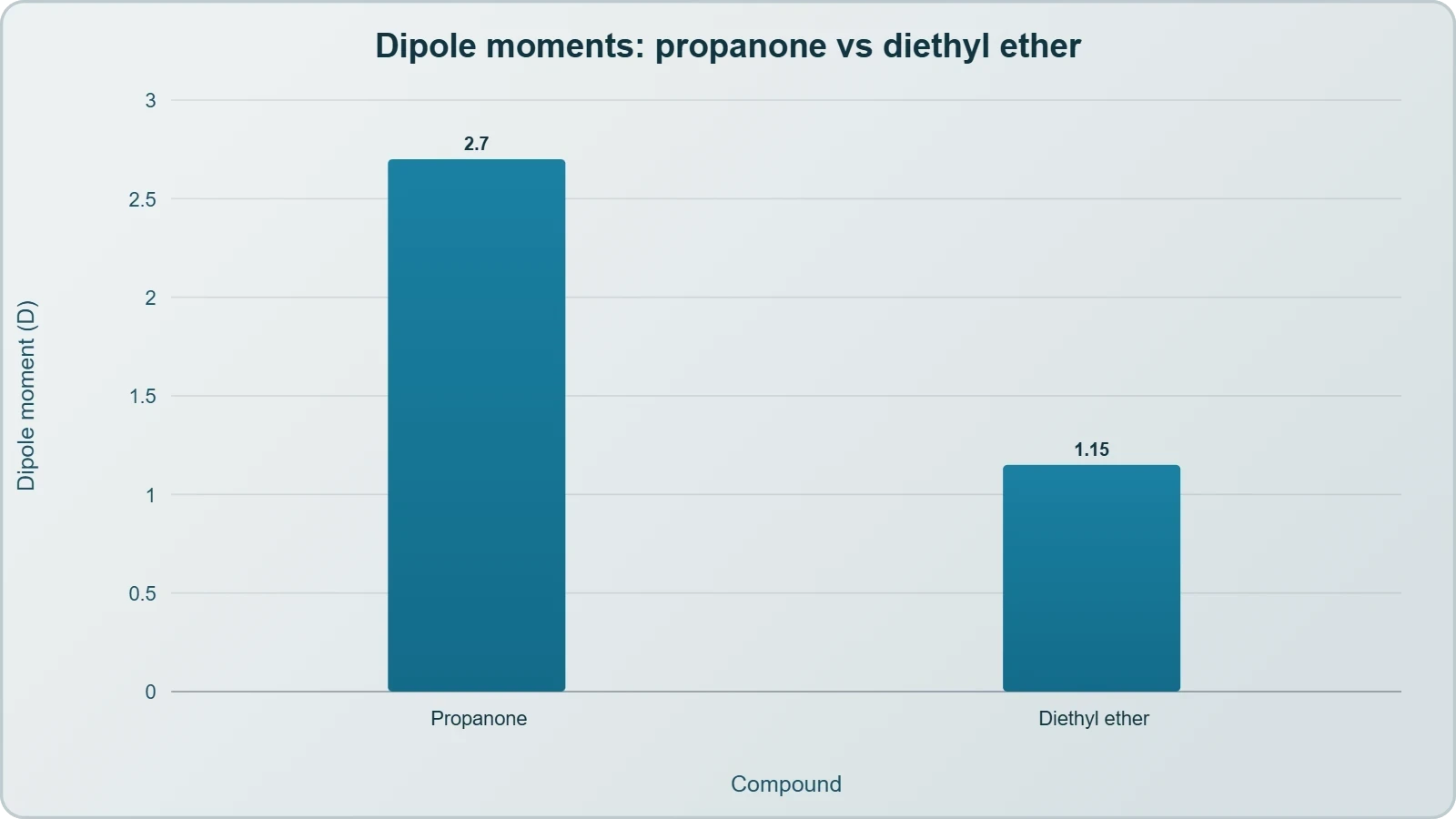
The numbers make the point concretely. The dipole moment of propanone is about ##2.7\ \text{D}##, whereas that of diethyl ether is only about ##1.15\ \text{D}##. The difference arises because the dipolar resonance contributor places formal charges on adjacent atoms, concentrating charge separation far more effectively than a single polarised sigma bond. This elevated polarity raises boiling points relative to comparable alkanes and makes carbonyl compounds excellent solvents for polar and ionic species, while also shaping how they orient themselves in a reaction medium.
Hard and Soft Electrophiles
Not all carbonyl carbons are equally accommodating to every nucleophile. The concept of hard and soft electrophiles, developed by Pearson, classifies electrophilic centres by their charge density and polarisability. A hard electrophile is small, highly charged and weakly polarisable; a soft electrophile is larger, more polarisable and less charge-dense. Hard nucleophiles prefer hard electrophiles and soft nucleophiles prefer soft ones, a pairing rule that predicts selectivity in complex molecules.
Within carbonyl chemistry, the bare aldehyde carbon is a relatively hard electrophile because its positive character is concentrated and sterically accessible. As substituents add bulk and donate electron density, the carbon becomes softer and less reactive toward hard nucleophiles such as hydride or hydroxide. This framework explains why formaldehyde undergoes nucleophilic addition far more readily than a hindered ketone, and why soft nucleophiles like thiolate or cyanide can still attack even deactivated carbonyls where harder nucleophiles fail.
We Also Published
Substituent Effects on Reactivity
The intrinsic electrophilicity of the carbonyl carbon is only the starting point; what a molecule actually does depends on what is attached to it. Two electronic mechanisms operate in parallel. The inductive effect transmits charge through sigma bonds and depends on the electronegativity and distance of substituents, while the resonance effect delocalises electron density through adjacent pi systems. Alkyl groups are electron-donating by induction and by hyperconjugation, whereas groups bearing lone pairs or pi bonds can donate by resonance. The balance of these effects sets the reactivity of each carbonyl compound.
Inductive and Resonance Contributions
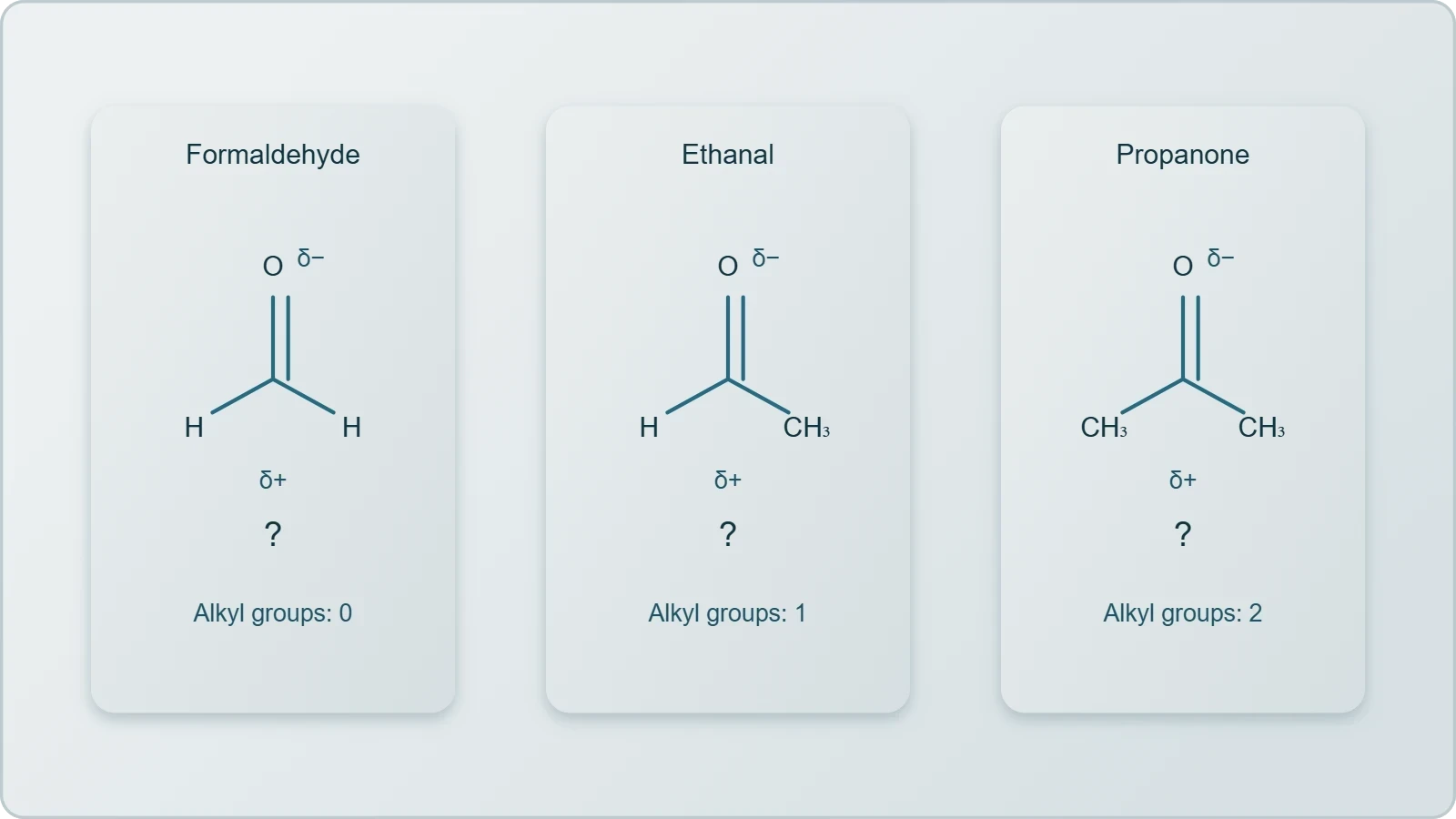
Alkyl substituents push electron density toward the carbonyl carbon, partially neutralising its positive charge and raising the energy of the ##\pi^*## orbital. The result is a less electrophilic carbon. This is why, in the series formaldehyde, ethanal, propanone, the reactivity toward nucleophiles falls steadily as methyl groups accumulate. Each additional alkyl group also adds steric bulk around the carbon, further hindering the approach of a nucleophile, so electronic and steric effects reinforce one another in the same direction.
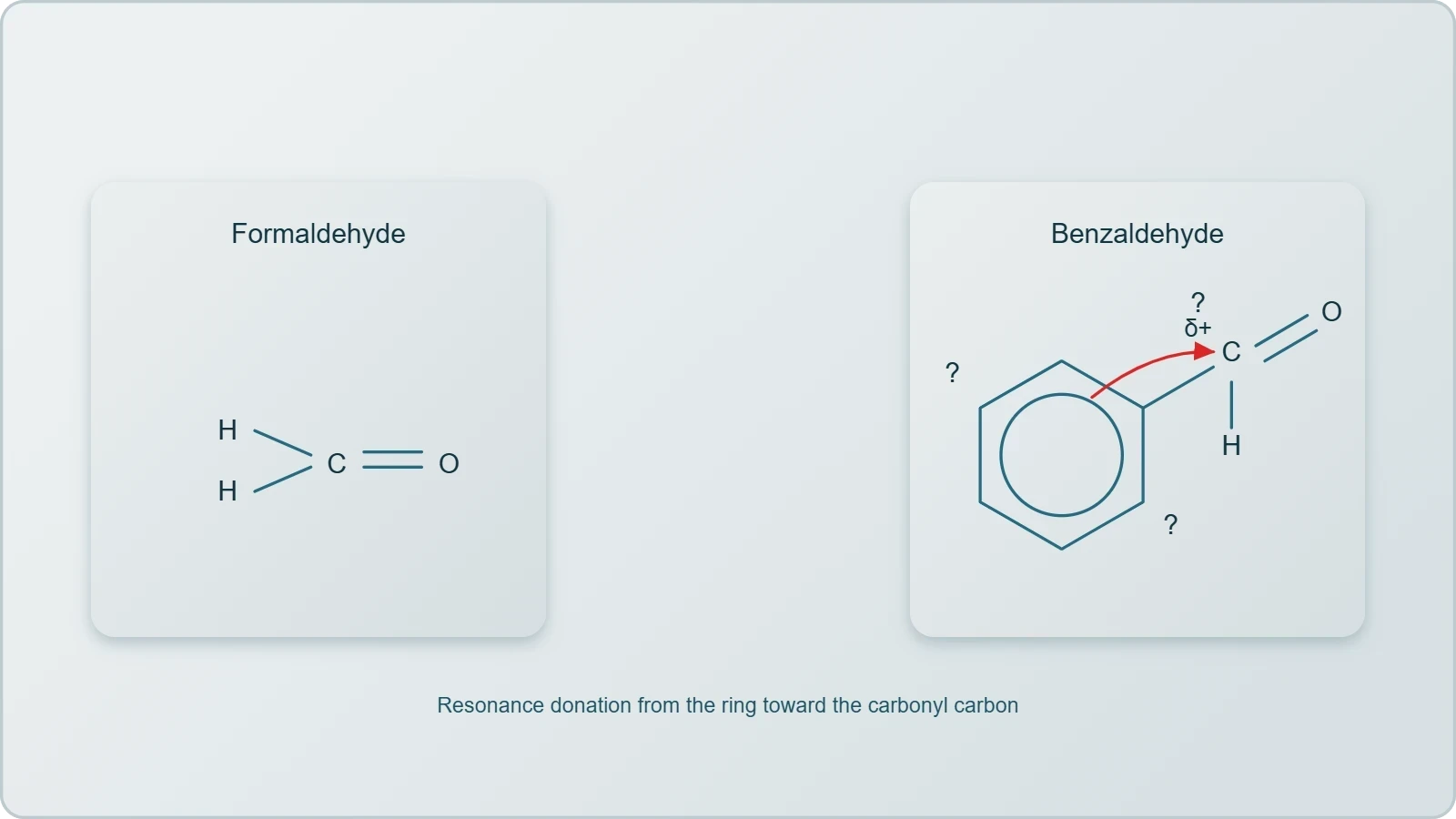
Electron-withdrawing groups do the opposite. A chlorine atom on the alpha carbon, or a carbonyl group in an alpha-keto acid, pulls density away by induction, deepening the positive character of the carbonyl carbon and lowering ##\pi^*##. Conjugation adds another layer: when the carbonyl is attached to a benzene ring, as in benzaldehyde, the ring can donate electron density by resonance, reducing the electrophilicity of the carbonyl carbon relative to formaldehyde but leaving the ring itself open to electrophilic attack. The interplay of these effects is the central skill of carbonyl chemistry.
Quantitative Reactivity: Rate Data
Claims about reactivity become convincing when expressed as numbers. Relative rates of nucleophilic addition, measured under identical conditions with a standard nucleophile such as hydrogen cyanide or sodium borohydride, show a clear hierarchy. Formaldehyde reacts fastest, ethanal is slower, and propanone slower still, with the trend continuing for higher ketones. The differences are not marginal: relative rates can span two or three orders of magnitude across a short series, reflecting the exponential sensitivity of activation energy to small electronic changes.

These rate differences follow the Arrhenius relationship, in which the rate constant depends exponentially on the activation energy. A modest increase in ##E_a## produced by electron donation from an alkyl group translates into a large drop in rate. This is why exam questions that ask you to "arrange in order of reactivity" are really asking you to reason about electron density and steric access, not to recall a list. The same logic extends to substituted benzaldehydes, where electron-withdrawing substituents accelerate addition and electron-donating ones retard it.
Spectroscopic Signatures of the Carbonyl Group
Infrared spectroscopy offers a direct experimental probe of the carbonyl bond, because the ##\ce{C=O}## stretching vibration absorbs strongly in a characteristic region of the spectrum. The position of that absorption depends on the strength of the bond: a stronger, stiffer bond vibrates at higher frequency, while a weaker bond vibrates at lower frequency. Because substituents and conjugation alter bond order, the infrared stretching frequency becomes a sensitive reporter of the electronic environment around the carbonyl group, complementing the reactivity trends we have already discussed.
Interpreting Carbonyl Stretching Frequencies
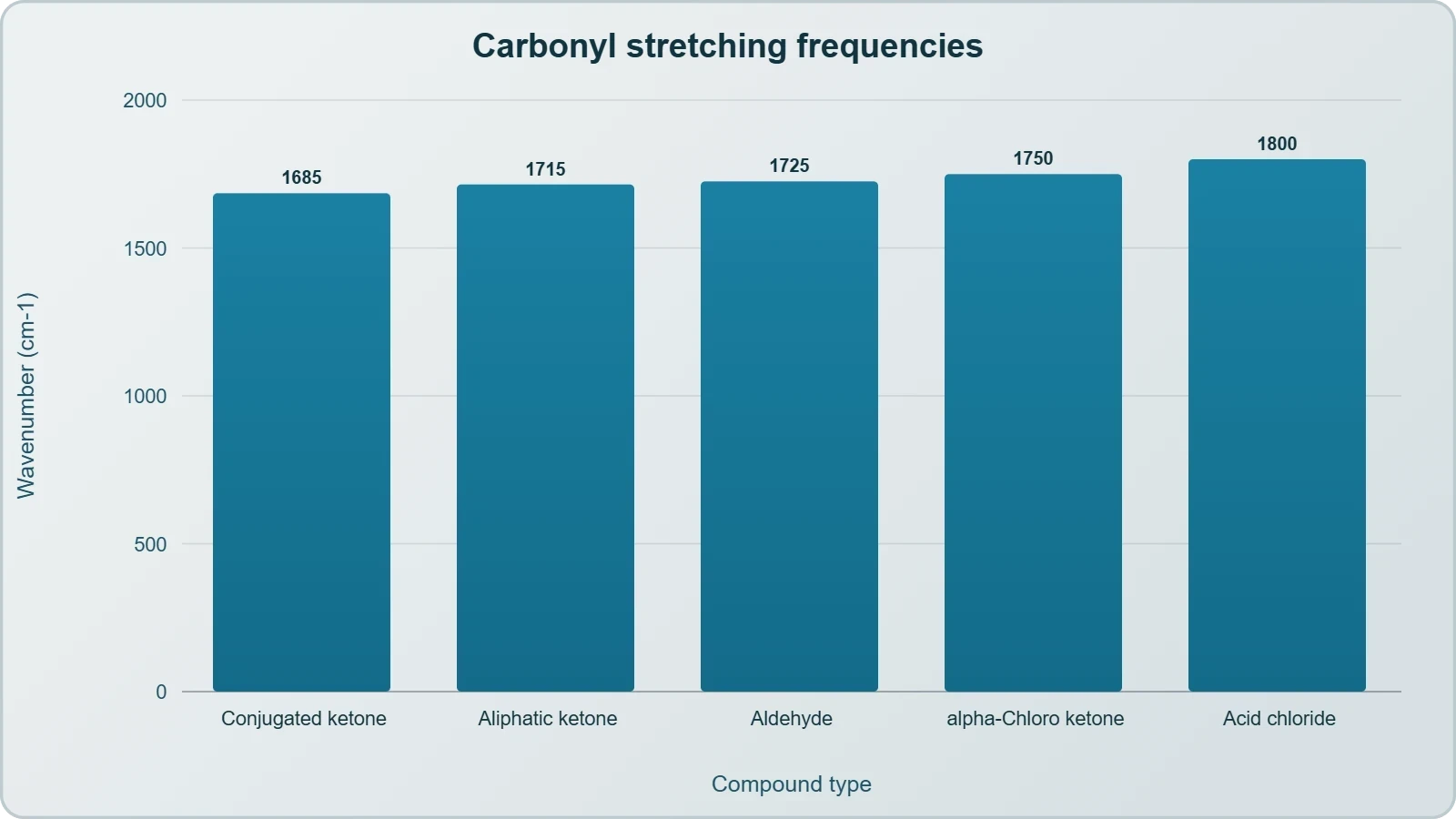
A typical saturated aliphatic ketone absorbs near ##1715\ \text{cm}^{-1}##, while an aldehyde appears slightly higher, around ##1725\ \text{cm}^{-1}##. Conjugation with a double bond or aromatic ring lowers the frequency to about ##1685\ \text{cm}^{-1}##, because resonance donation into the ##\pi^*## orbital reduces the bond order of the ##\ce{C=O}## linkage. This is the same resonance effect that reduces electrophilicity, so the infrared shift and the reactivity change share a common electronic origin — a satisfying consistency between two apparently different observations.
Electron-withdrawing substituents raise the frequency. An alpha-chloro ketone absorbs near ##1750\ \text{cm}^{-1}##, and acid chlorides, where the carbonyl is bonded to a strongly electronegative chlorine, appear near ##1800\ \text{cm}^{-1}##. Ring strain in cyclic ketones also raises the frequency, since the ##\ce{sp^2}## carbon resists the compressed angles and the bond stiffens. Reading these shifts correctly lets you infer structure from a spectrum, and it reinforces the idea that bond order, electrophilicity and vibrational frequency are three views of one underlying electronic reality.
Solvent Effects on the Carbonyl Group
The reaction medium is not a passive spectator. Polar protic solvents such as water and alcohols hydrogen-bond to the carbonyl oxygen, stabilising the dipolar resonance contributor and increasing the partial negative charge on oxygen. This solvation withdraws electron density from the carbonyl carbon, making it more electrophilic and accelerating nucleophilic addition. The effect is measurable: cyanohydrin formation proceeds faster in water than in non-polar solvents, and the position of the ##\ce{C=O}## stretch shifts slightly when the solvent changes.
Aprotic polar solvents such as dimethyl sulfoxide and acetonitrile solvate cations strongly but leave anions relatively free, which can accelerate reactions involving anionic nucleophiles. The interplay of solvent and substituent effects means that a reactivity series measured in one medium may not transfer perfectly to another. For examination purposes, the key insight is that solvation stabilises charge separation, and any factor that stabilises the developing charges along the reaction pathway lowers the activation energy and speeds the reaction.
Worked Examples and Common Pitfalls
Applying these principles requires practice in translating structure into electronic prediction. The exercises below mirror the kind of reasoning expected in CBSE examinations and in competitive entrance tests, where students must justify an ordering rather than simply state it. Each example isolates one variable — hybridisation, inductive effect, resonance or steric hindrance — so that the underlying logic remains visible. Working through them systematically builds the habit of asking, for any carbonyl compound, where the electron density sits and how easily a nucleophile can reach the carbon.
Guided Problems
Example 1. Arrange formaldehyde, ethanal and propanone in order of decreasing reactivity toward nucleophilic addition, and justify the order. Formaldehyde has no alkyl substituent, so its carbonyl carbon bears the least electron donation and the least steric hindrance; it is the most reactive. Ethanal has one methyl group, which donates electron density and adds bulk, so it is intermediate. Propanone has two methyl groups and is the least reactive. The order is formaldehyde ##>## ethanal ##>## propanone, and the reasoning rests on both electronic and steric factors acting together.
Example 2. Explain why benzaldehyde is less reactive than formaldehyde toward nucleophilic addition but undergoes electrophilic aromatic substitution readily. In benzaldehyde, the aromatic ring donates electron density into the carbonyl ##\pi^*## orbital by resonance, reducing the positive character of the carbonyl carbon and lowering its electrophilicity relative to formaldehyde. At the same time, the carbonyl group withdraws electron density from the ring, deactivating it toward electrophilic substitution while directing incoming electrophiles to the meta position. One functional group thus plays two electronic roles simultaneously.
Common Mistakes to Avoid
A frequent error is to describe the carbonyl carbon as "positive" rather than "partially positive". The dipolar resonance contributor is a minor one, so the carbon carries only a partial charge; writing a full positive sign misrepresents the electronic structure and can lead to incorrect mechanistic arrows. Another common slip is to ignore steric effects entirely and attribute all reactivity differences to induction. In hindered ketones, steric shielding of the carbonyl carbon can dominate, and a purely electronic explanation will fail to account for the observed slowness of addition.
Students also often confuse the direction of the inductive effect with that of resonance. Alkyl groups donate by both mechanisms, but a group such as ##\ce{-NO2}## withdraws by induction and by resonance, while a halogen withdraws by induction but donates weakly by resonance. Failing to separate these contributions leads to incorrect predictions for substituted benzaldehydes. Finally, remember that the ##\ce{C=O}## stretching frequency and the reactivity of the carbonyl carbon are linked: both reflect bond order, so a compound with a low-frequency stretch is generally less electrophilic.
From Structure to Synthesis: Looking Ahead
The structural principles developed here are the foundation for everything that follows. Once you can predict which carbonyl carbon is more electrophilic, you can anticipate which compound will react faster with a Grignard reagent, which will resist nucleophilic attack, and which will favour enolisation instead. The next lesson turns to preparation: oxidation of alcohols, dehydrogenation over hot copper, ozonolysis of alkenes, and the hydration of alkynes that generates carbonyl compounds directly. Each of those methods produces a carbonyl group whose subsequent behaviour is governed by the very factors examined in this lesson.
Connecting Reactivity to Reaction Types
Nucleophilic addition is the archetypal carbonyl reaction, and its rate depends on the electrophilicity of the carbon and the steric access to it. Aldol condensation requires the formation of an enolate, which depends on the acidity of the alpha hydrogen — itself influenced by the electron-withdrawing power of the carbonyl group. The Cannizzaro reaction, in which an aldehyde without alpha hydrogens disproportionates, is favoured for aromatic aldehydes whose carbonyl carbon is stabilised by resonance. Every named reaction in this course can be traced back to the electronic structure of the carbonyl group.
This unity is what makes the topic satisfying rather than merely memorisable. A student who understands why the carbonyl carbon is electrophilic, why alkyl groups reduce that electrophilicity, and why solvent and substituents modulate it can derive the behaviour of unfamiliar compounds rather than recall a list. The worked examples and pitfalls above are intended to build exactly that transferable reasoning, so that the preparation methods and reaction mechanisms of later lessons arrive as consequences rather than surprises.
Summary of Key Principles
The carbonyl carbon is ##\ce{sp^2}## hybridised, trigonal planar, and bonded to oxygen through a sigma bond and a pi bond formed by p-orbital overlap. The ##\ce{C=O}## bond is strongly polarised, making the carbon an electrophile and the oxygen a nucleophile, with dipole moments substantially larger than those of ethers. Molecular orbital theory locates the reactive empty orbital on carbon, explaining the regiochemistry of nucleophilic attack. Substituents modulate reactivity through inductive and resonance effects, and these changes are visible in both reaction rates and infrared stretching frequencies.
Solvent stabilises the polarised group and influences reaction rates, while the hard–soft framework helps predict which nucleophiles will attack which carbonyls. The quantitative rate data confirm that small electronic changes produce large kinetic consequences, and the spectroscopic shifts provide independent confirmation of the same electronic trends. Mastery of these principles prepares the ground for the preparation methods and reaction mechanisms that follow, and it equips the student to reason confidently about any carbonyl compound encountered in the examination hall or the laboratory.
From our network :
- 98% of Global MBA Programs Now Prefer GRE Over GMAT Focus EditionExplore why 98% of global MBA programs now prefer the GRE over GMAT Focus. Learn about the shorter GRE format, verbal logic importance, and strategic versatility for students.
- 10 Physics Numerical Problems with Solutions for IIT JEEPrepare for IIT JEE with 10 physics numerical problems, complete with detailed solutions and conceptual explanations. Ideal for mastering kinematics, thermodynamics, electromagnetism, and optics.
- EV 2.0: The Solid-State Battery Breakthrough and Global Factory ExpansionDiscover the impact of the Solid-State Battery Breakthrough on the EV market. Learn about CATL and BYD stock growth, global factory expansion in Europe, and the future of EV 2.0 technology.
- Where to Put Your Wireless Router for Better CoverageA practical, physics-grounded guide to router placement: why the centre of the home beats the corner, how walls and metal sap signal, and how to run a simple survey that proves the improvement.
- AI-Powered 'Precision Diagnostic' Replaces Standard GRE Score ReportsDiscover the new GRE Precision Diagnostic. Learn how AI-powered behavioral analytics and time-to-solve tracking are replacing standard GRE score reports to empower students.
- Do You Need a New Router or Is Your Internet Plan the Problem?A practical comparison of the signs that point to router limits versus signs your broadband speed or provider is the bottleneck, so you can decide what to replace before spending money.
- Trump Political Strategy How Geopolitical Stunts Serve As Media Diversions
- Analyzing Trump Deportation Numbers Insights Into The 2026 Immigration Crackdown
- How to Print Cheaply: Cutting the Cost per PageA practical, measured guide to lowering what each printed page costs — duplex and draft modes, third-party ink, yield mathematics, and knowing when a new printer beats refills.