Naming an aldehyde or a ketone is one of the first genuinely chemical skills a student acquires, because the name is not a label pasted onto a molecule after the fact — it is a compressed structural statement. When you write 3-methylbutanal, you have already declared a four-carbon chain, an aldehyde terminus at carbon one, and a methyl branch on carbon three. The name encodes connectivity, and connectivity governs reactivity. This is why the nomenclature lesson sits where it does in the carbonyl sequence: the previous lesson established what a carbonyl group is, and the next will explain why that group is so eager to accept a nucleophile. Before either discussion can proceed with precision, the class needs a shared, unambiguous vocabulary.
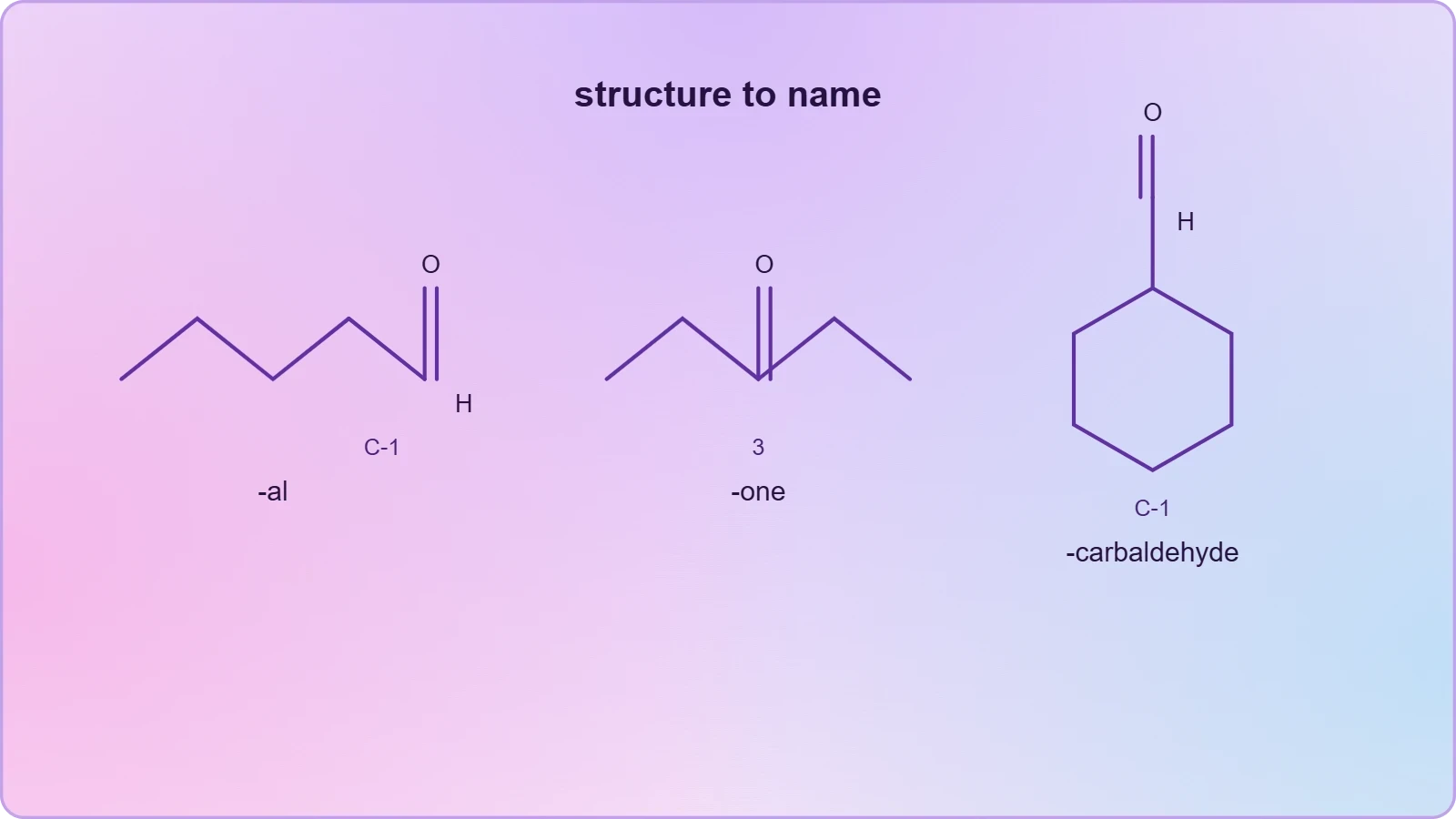
Two naming systems coexist in carbonyl chemistry, and both remain in active professional use. The common or trivial system preserves history: formaldehyde, acetone, benzaldehyde, vanillin. These names survive because they are short, universally recognised, and embedded in trade, regulation and laboratory habit. The IUPAC system, by contrast, is generative — it can name a molecule that has never been synthesised. A competent chemist moves between the two without friction, and an examiner expects exactly that fluency. The lesson below builds both systems side by side, then extends them to rings, aromatic aldehydes, unsaturated chains, dialdehydes and molecules carrying competing functional groups.
What follows is deliberately practical. Every rule is paired with worked structures, and every worked structure is paired with the kind of error students actually make — numbering from the wrong end, forgetting that the aldehyde carbon is always C-1, or writing 2-butanone when the systematic name demands butan-2-one. By the end, you should be able to look at a skeletal formula and produce a name in seconds, and to read a name and draw the structure without hesitation. That two-way fluency is the real objective, and it is the foundation on which the mechanism lessons of this course will rest.
On This Page
- The Logic Behind Common Names for Aldehydes and Ketones
- IUPAC Rules for Aldehydes and Ketones
- Cyclic and Aromatic Aldehydes and Ketones
- Unsaturated Chains, Dialdehydes and Functional-Group Priority
- Drawing Structures from Names: A Systematic Method
- Systematic Versus Common Names in Industry and Practice
- Consolidating the Naming Toolkit
The Logic Behind Common Names for Aldehydes and Ketones
The trivial nomenclature of aldehydes grew out of the carboxylic acids, because the earliest reliable route to an aldehyde was the oxidation of the corresponding acid or alcohol. Chemists therefore took the acid name, dropped the ending -ic, and appended -aldehyde. Acetic acid became acetaldehyde; butyric acid became butyraldehyde; valeric acid became valeraldehyde. The pattern is mechanical and, once recognised, allows a student to reconstruct dozens of trivial names from acid names they already know. The Latin and Greek roots embedded in these words often describe the natural source — formica for ants, acetum for vinegar — which is why the names feel arbitrary until the etymology is supplied.
Ketone common names follow a different logic entirely: they simply list the two hydrocarbon groups attached to the carbonyl carbon, followed by the word ketone. Methyl ethyl ketone, diethyl ketone, methyl phenyl ketone. When the two groups are identical the prefix di- appears; when they differ, the smaller group is usually cited first. Position within a chain is indicated not by numerals but by Greek letters, with the carbon adjacent to the carbonyl designated ##\alpha##, the next ##\beta##, and so on. This Greek-letter convention survives in modern mechanistic writing, where chemists still speak of "##\alpha##-hydrogens" and "##\alpha##-halogenation" because those labels describe reactivity, not merely position.
Where the Historical Names Come From
Formaldehyde takes its name from formic acid, itself named from the Latin formica because it was first isolated by distilling red ants. Acetaldehyde descends from acetic acid and ultimately from acetum, vinegar. Acetone is a contracted form of acetic ketone, reflecting its preparation by heating acetate salts — the simplest ketone and the only one whose trivial name is universally preferred over its systematic equivalent, propan-2-one. Benzaldehyde derives from the benzoin resin of the Styrax tree, and cinnamaldehyde from cinnamon bark, where it supplies the characteristic aroma.
These etymologies are not trivia. They explain why certain names resist replacement: a solvent sold by the tonne as acetone will not be relabelled propan-2-one on a purchase order, and a flavour house will specify vanillin rather than 4-hydroxy-3-methoxybenzaldehyde. Recognising this commercial reality is part of chemical literacy. The systematic name guarantees precision in a journal; the trivial name guarantees recognition in a warehouse, a pharmacopoeia or a recipe. Both are correct, and the skilled student knows which register each belongs to.
The Greek-Letter Locator System
In the common system, the carbon atoms of an aldehyde chain are labelled ##\alpha##, ##\beta##, ##\gamma##, ##\delta## outward from the carbonyl, and substituents are cited with these letters. Thus ##\ce{CH3CH(OCH3)CHO}## is ##\alpha##-methoxypropionaldehyde. For ketones the two branches are distinguished with primes: ##\alpha## and ##\alpha'## for the carbons immediately flanking the carbonyl, ##\beta## and ##\beta'## for the next pair. A methyl on one adjacent carbon is therefore an ##\alpha##-methyl group, and the notation tells a reader instantly that the substituent sits next to the reactive centre.
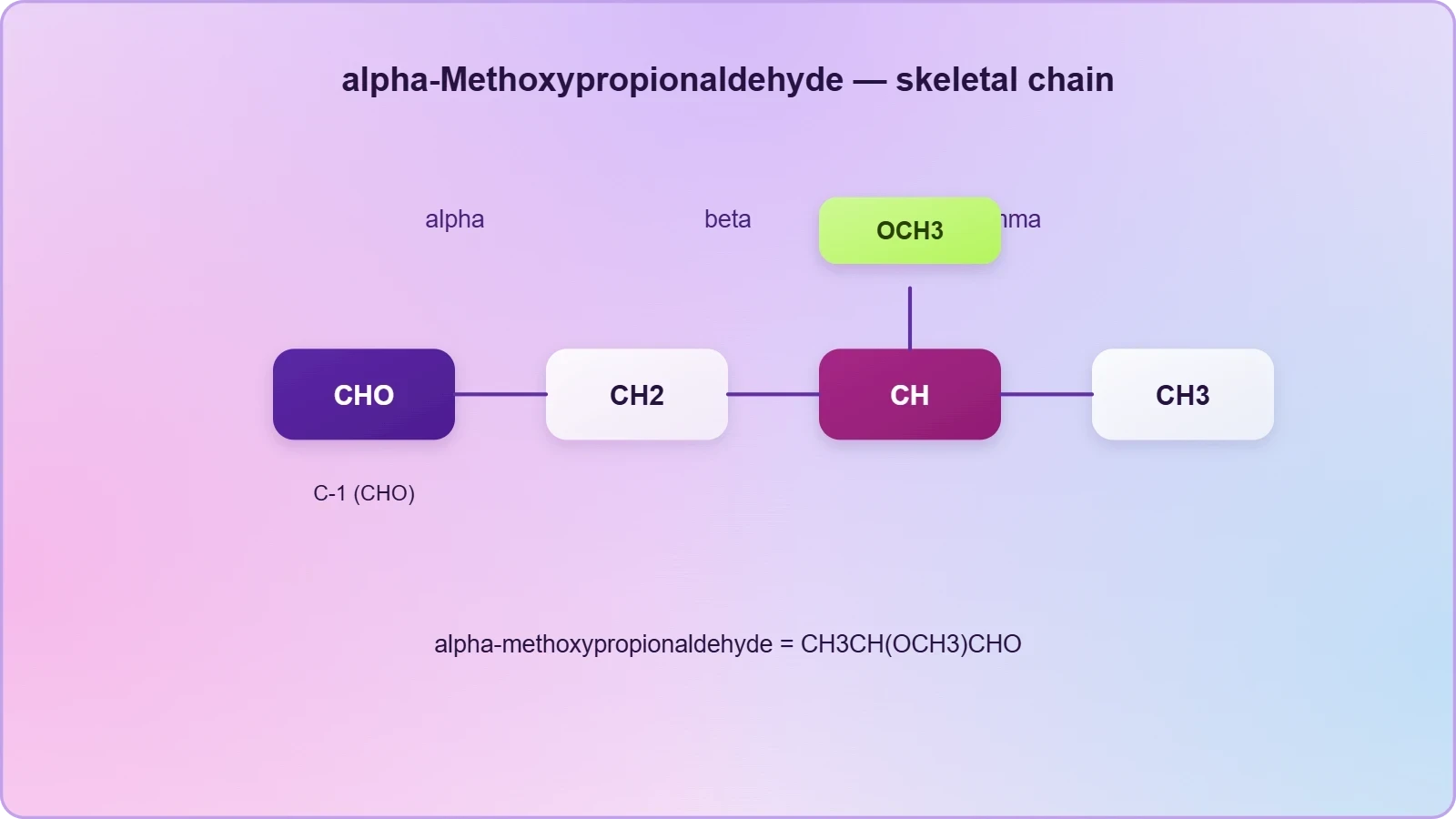
This locator system is worth mastering even though IUPAC numerals supersede it, because mechanistic literature still uses it heavily. When a textbook states that enolisation requires an ##\alpha##-hydrogen, it is invoking the common-name framework to make a reactivity claim. Students who treat Greek letters as obsolete decoration lose access to a large body of explanatory writing. Treat them instead as a parallel coordinate system: numerals for the systematic name, Greek letters for the reactivity discussion, and both describing the same molecular geometry.
IUPAC Rules for Aldehydes and Ketones
The systematic system derives every name from the parent alkane. For an aldehyde, the terminal -e of the alkane is replaced by -al; for a ketone, by -one. Methane gives methanal, ethane gives ethanal, propane gives propanal and propanone. The longest continuous carbon chain containing the carbonyl group supplies the parent, and every other carbon becomes a substituent. This single principle — find the longest chain through the functional group — resolves the majority of examination questions, provided the student resists the temptation to count the longest chain in the molecule rather than the longest chain that actually contains the carbonyl carbon.
Numbering is where marks are most frequently lost. In an aldehyde the carbonyl carbon is always C-1, because the group sits at the end of the chain by definition; no choice exists. In a ketone the carbonyl carbon takes the lowest number achievable, so numbering begins at the end nearer to it. Substituents are then prefixed alphabetically with their locants, and punctuation follows a strict convention: hyphens separate numerals from letters, commas separate numerals from numerals. The modern elision style writes butan-2-one rather than 2-butanone, and both appear in print, but consistency within a single answer matters more than which convention you adopt.
Numbering, Alphabetising and Punctuating
Consider ##\ce{(CH3)2CHCOCH(CH3)2}##. The longest chain through the carbonyl contains five carbons, so the parent is pentan-3-one. Two methyl groups sit on C-2 and C-4, giving 2,4-dimethylpentan-3-one. Now consider ##\ce{CH3COCH2CH2CH3}##: the chain has five carbons, the carbonyl is nearest the left end, so the name is pentan-2-one, not pentan-4-one. The rule is not aesthetic preference but a deterministic algorithm, and applying it mechanically eliminates ambiguity.
Alphabetical ordering of prefixes follows the substituent name itself, ignoring multiplying prefixes such as di- and tri- unless they are part of the substituent's own name. Ethyl precedes methyl; bromo precedes chloro. When two different numbering schemes give the same locant set for the principal group, the lower locant goes to the substituent cited first alphabetically. These tie-breaking rules rarely appear in school examinations but are standard in IUPAC recommendations, and knowing them prevents the quiet errors that accumulate in advanced work.
Worked Naming Exercises
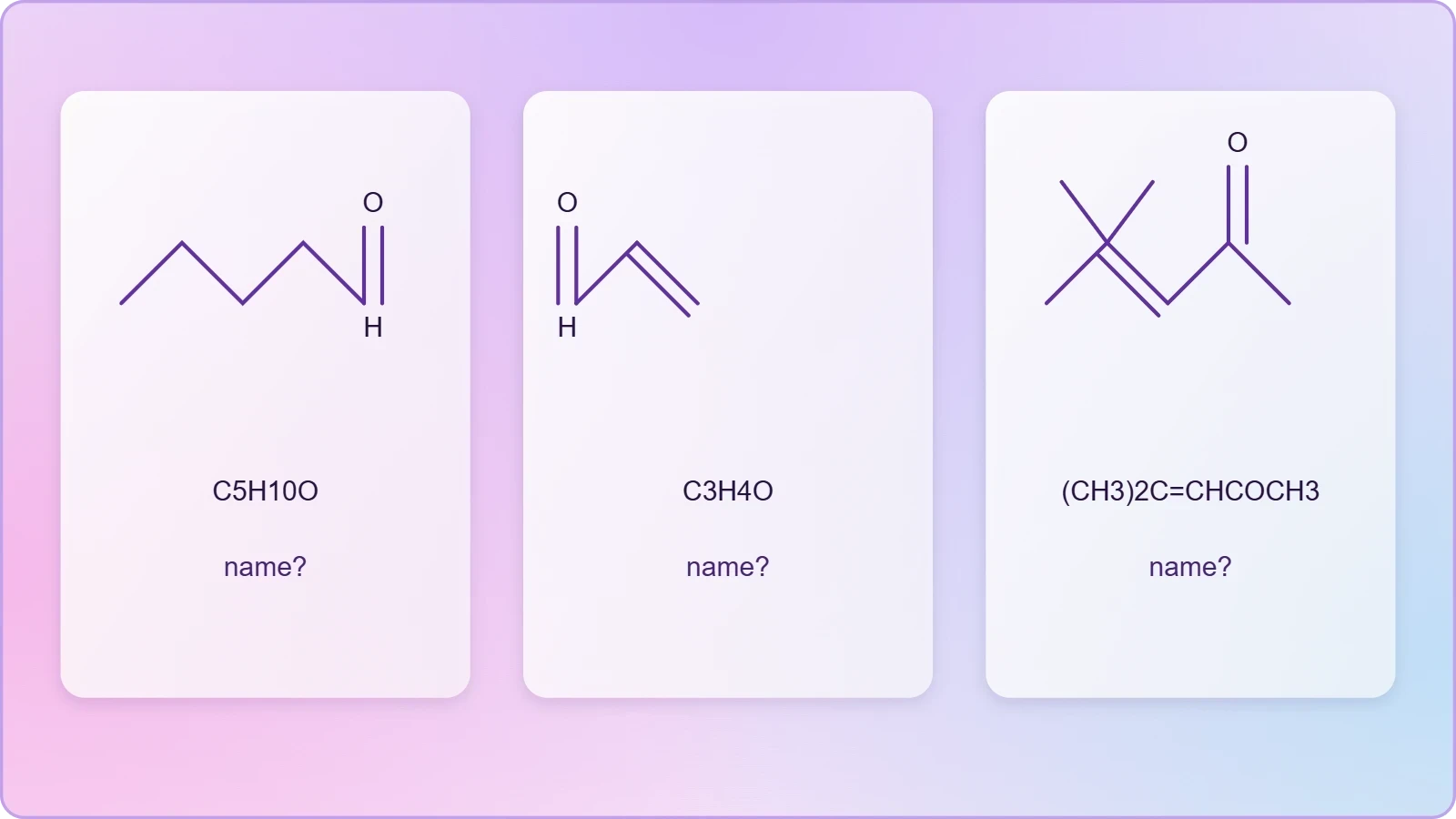
Take ##\ce{CH3CH2CH2CH2CHO}##. Five carbons, aldehyde terminus, no substituents: pentanal, trivially valeraldehyde. Take ##\ce{CH2=CHCHO}##. Three carbons with a double bond between C-2 and C-3 and an aldehyde at C-1: prop-2-enal, trivially acrolein. Take ##\ce{(CH3)2C=CHCOCH3}##. The chain through the carbonyl runs from the methyl on the right through C-2, C-3, C-4 to the terminal methyl, giving five carbons; the double bond sits between C-3 and C-4 and a methyl on C-4, so the name is 4-methylpent-3-en-2-one, trivially mesityl oxide.
Now reverse the process. From the name 3-hydroxybutanal, draw a four-carbon aldehyde chain, place a hydroxyl on C-3, and confirm the structure ##\ce{CH3CH(OH)CH2CHO}##. From 2-hydroxycyclopentanecarbaldehyde, draw a cyclopentane ring, attach the aldehyde-bearing carbon as C-1, and place the hydroxyl on C-2. This bidirectional drill — name to structure and structure to name — is the single most efficient revision technique for this topic, and it exposes misunderstandings that passive reading conceals.

Cyclic and Aromatic Aldehydes and Ketones
When the carbonyl group sits on a ring rather than in a chain, the naming logic shifts. A cyclic ketone is straightforward: the ring supplies the parent, the carbonyl carbon is numbered C-1, and numbering proceeds around the ring so that substituents receive the lowest possible locants. Cyclohexanone, cyclopentanone, 2-methylcyclohexanone. The carbonyl is treated as part of the ring skeleton, so no suffix change beyond -one is required, and the numbering direction is chosen to minimise substituent locants rather than to follow any fixed clockwise convention.
An aldehyde attached to a ring cannot use the -al suffix directly, because the aldehyde carbon is not part of the ring and cannot be numbered within it. IUPAC resolves this with the suffix -carbaldehyde, appended to the full name of the cycloalkane or arene. Cyclohexanecarbaldehyde, cyclopentanecarbaldehyde, benzenecarbaldehyde. The ring carbon bearing the aldehyde becomes C-1, and substituents are numbered from there. This is the single most commonly misapplied rule in school nomenclature, and it deserves deliberate practice rather than a passing glance.
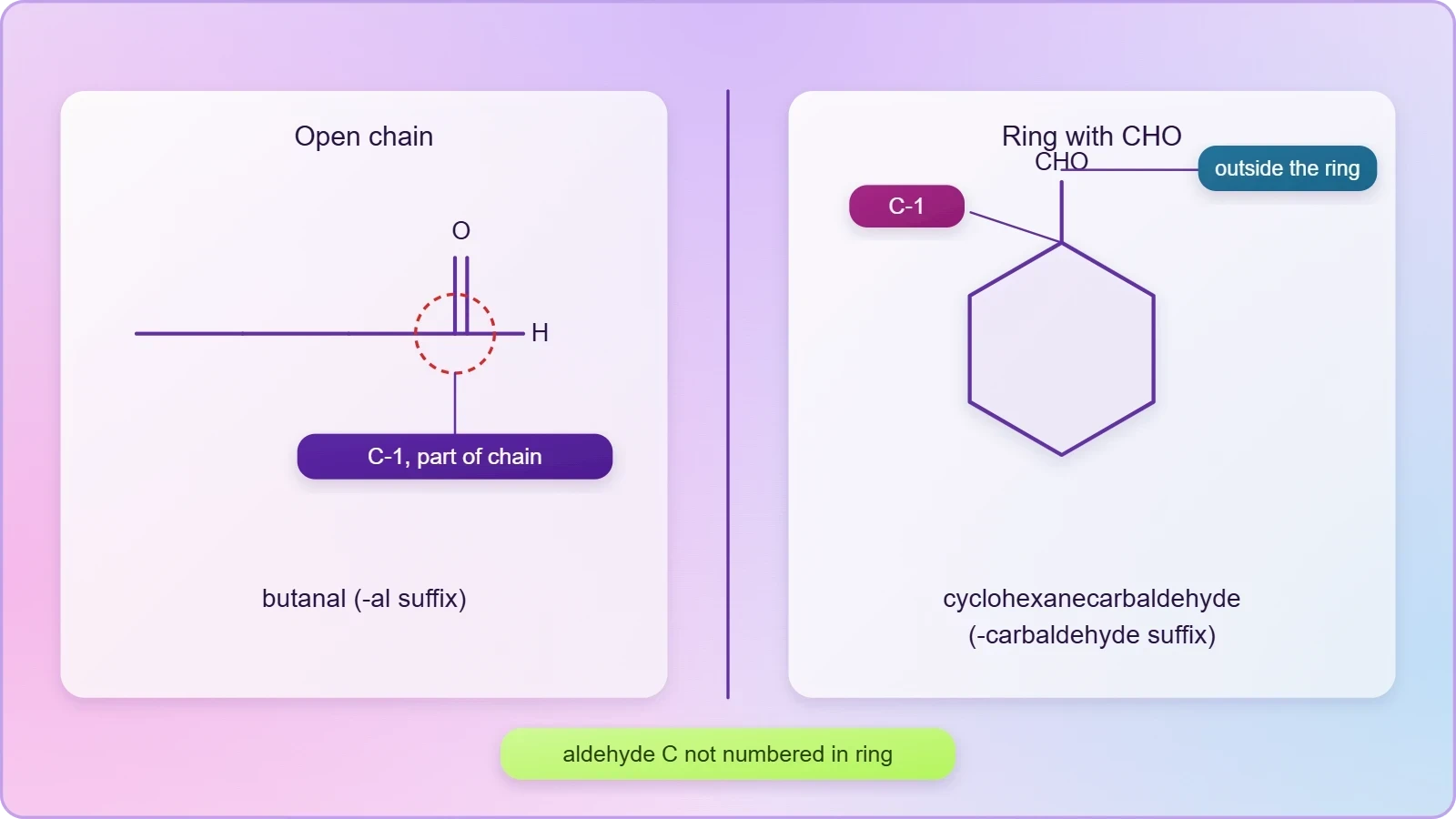
Ring Numbering and the Carbaldehyde Suffix
Consider a cyclohexane ring bearing a methyl group and an aldehyde. If the methyl sits three carbons away from the attachment point, the name is 3-methylcyclohexanecarbaldehyde. The aldehyde-bearing carbon is C-1 by definition, and the methyl takes the lower of the two possible locants, 3 rather than 5. For a benzene ring with a bromine meta to the aldehyde, the systematic name is 3-bromobenzenecarbaldehyde, though 3-bromobenzaldehyde is equally acceptable and far more common in practice.

Dicarbaldehydes on a benzene ring use the suffix -dicarbaldehyde with locants. The ortho isomer of benzene with two aldehyde groups is benzene-1,2-dicarbaldehyde, trivially phthaldehyde. Note the elision: the final -e of benzene is retained before a consonant-initial suffix but dropped before a vowel-initial one, which is why the name reads benzene-1,2-dicarbaldehyde rather than benzenedicarbaldehyde. These small orthographic conventions are examined, and they are the difference between a full-mark answer and a near-miss.
Aromatic Aldehydes and Retained Names
Benzaldehyde occupies a privileged position. IUPAC explicitly retains it as an acceptable name, and substituted derivatives are named as substituted benzaldehydes rather than as substituted benzenecarbaldehydes. Thus 4-hydroxybenzaldehyde, 2-methoxybenzaldehyde, 3-nitrobenzaldehyde. The retention reflects the enormous commercial and historical importance of the benzaldehyde family, which includes vanillin, salicylaldehyde and cinnamaldehyde — the fragrance compounds that give vanilla, meadowsweet and cinnamon their characteristic scents.
Students should be alert to a subtlety: when the aldehyde is not the principal functional group, the prefix formyl- is used instead of the suffix. A benzene ring bearing both a carboxylic acid and an aldehyde is named as a carboxybenzaldehyde, with the acid taking priority. This priority question is treated more fully below, but it is worth flagging here because aromatic nomenclature is where competing groups most often collide.
We Also Published
Unsaturated Chains, Dialdehydes and Functional-Group Priority
Unsaturated aldehydes and ketones require the parent alkane name to be modified twice: once for the double bond and once for the carbonyl. The double bond receives the infix -en- with its locant, and the carbonyl suffix follows. Prop-2-enal, but-2-enal, pent-3-en-2-one. The carbonyl carbon retains priority for numbering in aldehydes, so the double bond locant is calculated from C-1 regardless of where the unsaturation falls. In ketones the carbonyl still takes the lowest feasible locant, and the double bond is numbered accordingly, with the ene locant placed immediately before the suffix.
Molecules containing more than one aldehyde group use the multiplying prefix di- with the suffix -dial, and the two carbonyl carbons are numbered as part of the parent chain. Ethanedial, propanedial, butanedial. When the two aldehyde groups sit at the ends of a chain, both terminal carbons are C-1 and C-##n##, and any substituents are numbered from the nearer end. This is the systematic route to glyoxal, the trivial name for ethanedial, a compound used industrially as a crosslinking agent and textile finishing reagent.
Naming Molecules with Both Aldehyde and Ketone Groups
When a molecule carries both an aldehyde and a ketone, the aldehyde takes priority for the suffix, and the ketone is expressed as the prefix oxo-. The parent chain must contain both carbonyl carbons, the aldehyde carbon is C-1, and the ketone carbonyl is located by its numeral. Thus ##\ce{CH3COCH2CH2CHO}## is 4-oxopentanal: five carbons, aldehyde at C-1, ketone oxygen at C-4. The prefix oxo- is reserved for a ketone carbonyl acting as a substituent, and confusing it with the suffix -one is a frequent error.
Practice with the reverse direction. From 3-oxobutanal, draw a four-carbon chain, place the aldehyde at C-1, and put the ketone carbonyl at C-3, giving ##\ce{CH3COCH2CHO}##. From 2-oxopropanal, draw three carbons with the ketone at C-2 and the aldehyde at C-1, giving ##\ce{CH3COCHO}##, trivially methylglyoxal. These exercises train the student to treat the two carbonyl environments as distinct functional groups rather than as interchangeable oxygen atoms, which is precisely the distinction the next lesson will exploit mechanistically.
Priority Order and the Formyl Prefix
IUPAC establishes a hierarchy of principal functional groups, and the carbonyl family sits below carboxylic acids, esters, amides and nitriles but above alcohols, amines and halides. A molecule containing both a carboxylic acid and an aldehyde is named as an aldehyde-substituted acid, with the aldehyde expressed as formyl-. A molecule containing an aldehyde and a hydroxyl group is named as a hydroxy aldehyde, with the alcohol as prefix. The principal group determines the suffix; everything else becomes a prefix, and the numbering follows the principal group's requirements.

This hierarchy explains why the same structural fragment can appear under different names in different molecules. A ##\ce{-CHO}## group is an aldehyde when it is the senior group, a formyl substituent when it is not, and part of a -carbaldehyde suffix when it hangs from a ring. Recognising which role the group is playing is the conceptual core of the priority rules, and it is far more reliable than memorising isolated examples without understanding the ordering principle behind them.
Drawing Structures from Names: A Systematic Method
Converting a name into a structure is a mechanical procedure that rewards discipline. First identify the parent chain length from the root and draw that many carbons in a straight line. Second, place the principal functional group at the position the suffix and locant demand, remembering that an aldehyde is always terminal. Third, add the unsaturation indicated by any -en- or -yn- infix. Fourth, attach substituents at their numbered positions. Fifth, satisfy the remaining valencies with hydrogen. Following these five steps in order eliminates almost every drawing error, because each decision is made only after the preceding one is fixed.
The method also works in reverse for checking an answer. Once a structure is drawn, re-derive the name from scratch and compare it with the original. If the two disagree, the discrepancy identifies exactly which rule was misapplied. This self-checking loop is far more valuable than comparing against a printed answer key, because it trains the student to audit their own reasoning rather than to recognise a correct answer after the fact.
Step-by-Step Construction Examples
Take 2-methoxypropanal. The root propan gives three carbons; -al fixes an aldehyde at C-1; the methoxy group sits on C-2. The structure is ##\ce{CH3CH(OCH3)CHO}##. Now take 4-fluorobenzaldehyde. The parent is benzaldehyde, a benzene ring with an aldehyde; fluorine sits at position 4, para to the aldehyde. Now take 2-methylcyclopentanone: a five-membered ring, ketone at C-1, methyl at C-2, with the ring numbered so the methyl receives the lower locant of its two possible positions.
Finally, take di-sec-butyl ketone, a common name. Two sec-butyl groups flank the carbonyl, each being ##\ce{-CH(CH3)CH2CH3}##. The longest chain through the carbonyl contains seven carbons, so the systematic name is 3,5-dimethylheptan-4-one. This example demonstrates why systematic names matter: the common name requires the reader to decode sec-butyl, while the systematic name specifies the skeleton unambiguously. Both are correct; only one is self-explanatory.
Common Mistakes and How to Avoid Them
The most frequent error is numbering an aldehyde from the wrong end. Because the aldehyde carbon is always C-1, a student who numbers to give a substituent the lowest locant will produce a name that is systematically wrong. The second most frequent error is omitting the locant in a ketone name, writing pentanone when pentan-2-one or pentan-3-one is meant. The third is confusing oxo- with -one, producing names such as 4-one-pentanal instead of 4-oxopentanal.
A fourth error concerns the carbaldehyde suffix: students write cyclohexanal instead of cyclohexanecarbaldehyde, treating the ring as though it could absorb the aldehyde carbon. A fifth is alphabetical misordering, placing dimethyl before ethyl because d precedes e, when the correct comparison is methyl against ethyl. Each of these errors is predictable, and each is eliminated by applying the rules in sequence rather than by intuition. Deliberate practice on ten structures per sitting is sufficient to make the procedure automatic.
Systematic Versus Common Names in Industry and Practice
In the laboratory notebook and the journal article, the systematic name is the default because it is unambiguous and generative. In the factory, the purchase order and the safety data sheet, the common name often prevails because it is short, historically embedded and universally recognised by the workforce handling the material. A drum of acetone is labelled acetone, not propan-2-one, and a flavour specification will cite vanillin rather than 4-hydroxy-3-methoxybenzaldehyde. This division is not a failure of rigour but a pragmatic accommodation between precision and communication.
Regulatory frameworks reflect the same duality. Chemical inventories list both a systematic identifier and any retained trivial names, and a substance may be indexed under several synonyms. For a student, the practical consequence is that both names must be learned, and neither can be dismissed as obsolete. The examination rewards the systematic form; the workplace rewards recognition of both. Fluency across the two registers is therefore a genuine professional skill rather than an academic formality.
Where Each System Earns Its Place
Systematic names excel when a molecule is novel, when a database must be searched by structure, or when a patent must define a compound precisely enough to withstand legal challenge. Common names excel in speech, in commerce and in the historical literature, where a search for "acetone" will retrieve a century of papers that a search for "propan-2-one" would miss. A researcher who knows only one system is partially blind to the literature, and a student who knows only one system is partially prepared for the examination.
The fragrance and pharmaceutical industries illustrate the point vividly. Vanillin, cinnamaldehyde and salicylaldehyde are traded by their trivial names, and their organoleptic properties are catalogued under those names. Yet the same compounds appear in regulatory dossiers under systematic identifiers. The chemist who can move between the two without hesitation is the one who can read a supplier's certificate of analysis, cross-reference it against a regulatory database, and confirm that the material in the drum is the material the reaction requires.
Preparing for Structure and Reactivity
Nomenclature is not an end in itself; it is the grammar that makes the next lesson intelligible. When the following lesson explains that the carbonyl carbon is electrophilic because oxygen withdraws electron density, the explanation will refer to specific named compounds — ethanal, propanone, benzaldehyde — and the student must be able to picture each structure instantly. When the mechanism of nucleophilic addition is drawn, the ##\alpha##-carbon and its hydrogens will be invoked by name, and the Greek-letter convention introduced here becomes the working vocabulary of the mechanistic discussion.
The bridge between the two lessons is therefore structural visualisation. A student who can convert any name in this lesson into a correct skeletal formula, and back again, is ready to ask why that formula behaves as it does. The carbonyl group's planarity, its ##sp^2## hybridisation and its polarised ##\pi## bond will be the subject of the next session, and every one of those features will be discussed using the names mastered here. Nomenclature, properly learned, is not memorisation but the acquisition of a precise descriptive language.
Consolidating the Naming Toolkit
The nomenclature of aldehydes and ketones rests on a small number of principles applied consistently. Find the longest chain containing the carbonyl. Number to give the carbonyl the lowest locant, remembering that an aldehyde carbon is always C-1. Replace the alkane ending with -al or -one. Cite substituents alphabetically with their locants. Use -carbaldehyde for ring aldehydes, oxo- for a junior ketone, formyl- for a junior aldehyde, and -dial for two aldehyde termini. Every examination question in this topic is a recombination of those rules.
Beyond the rules lies the vocabulary of the discipline. Formaldehyde, acetaldehyde, acetone, benzaldehyde, vanillin, cinnamaldehyde — these names carry history, commerce and mechanism in equal measure. A student who learns only the systematic forms can pass an examination but will struggle to read a supplier catalogue or a nineteenth-century paper. A student who learns only the trivial forms will fail the examination. The complete chemist holds both, and knows precisely when each is appropriate.
A Final Checklist for Examination Answers
Before submitting any nomenclature answer, verify five things. Confirm that the parent chain contains the carbonyl carbon. Confirm that the numbering gives the carbonyl the lowest possible locant. Confirm that the suffix matches the senior functional group. Confirm that substituents are alphabetised correctly, ignoring multiplying prefixes. Confirm that hyphens and commas are placed according to convention. These five checks catch the overwhelming majority of errors, and they take less than thirty seconds to apply.
For structure-drawing questions, reverse the checklist. Confirm that the chain length matches the root. Confirm that the principal group sits at the stated position. Confirm that unsaturation is placed correctly. Confirm that every substituent is attached at its numbered carbon. Confirm that all remaining valencies are satisfied with hydrogen. A structure that survives all five checks is almost certainly correct, and the habit of running them builds the automatic accuracy that advanced work demands.
Looking Ahead to Structure and Reactivity
The next lesson turns from naming to behaviour. The carbonyl carbon is ##sp^2## hybridised, forms three sigma bonds in a plane, and shares a ##\pi## bond with oxygen whose electron density is drawn toward the more electronegative atom. That polarisation makes the carbon electrophilic and the oxygen nucleophilic, and it explains why aldehydes and ketones undergo nucleophilic addition rather than substitution. Every compound named in this lesson will reappear there as an example, and the names will function as shorthand for a specific electronic environment.
Students who have internalised the nomenclature can therefore concentrate on the mechanism rather than on decoding the labels. That is the purpose of this lesson: to remove the linguistic obstacle so that the chemical reasoning can proceed unimpeded. The carbonyl group is one of the most important functional groups in organic chemistry, appearing in fabrics, flavourings, plastics and drugs, and the ability to name its compounds precisely is the first step toward understanding why it behaves as it does.
From our network :
- Trump Political Strategy How Geopolitical Stunts Serve As Media Diversions
- EV 2.0: The Solid-State Battery Breakthrough and Global Factory ExpansionDiscover the impact of the Solid-State Battery Breakthrough on the EV market. Learn about CATL and BYD stock growth, global factory expansion in Europe, and the future of EV 2.0 technology.
- How to Print Cheaply: Cutting the Cost per PageA practical, measured guide to lowering what each printed page costs — duplex and draft modes, third-party ink, yield mathematics, and knowing when a new printer beats refills.
- Do You Need a New Router or Is Your Internet Plan the Problem?A practical comparison of the signs that point to router limits versus signs your broadband speed or provider is the bottleneck, so you can decide what to replace before spending money.
- Where to Put Your Wireless Router for Better CoverageA practical, physics-grounded guide to router placement: why the centre of the home beats the corner, how walls and metal sap signal, and how to run a simple survey that proves the improvement.
- Analyzing Trump Deportation Numbers Insights Into The 2026 Immigration Crackdown
- 10 Physics Numerical Problems with Solutions for IIT JEEPrepare for IIT JEE with 10 physics numerical problems, complete with detailed solutions and conceptual explanations. Ideal for mastering kinematics, thermodynamics, electromagnetism, and optics.
- AI-Powered 'Precision Diagnostic' Replaces Standard GRE Score ReportsDiscover the new GRE Precision Diagnostic. Learn how AI-powered behavioral analytics and time-to-solve tracking are replacing standard GRE score reports to empower students.
- 98% of Global MBA Programs Now Prefer GRE Over GMAT Focus EditionExplore why 98% of global MBA programs now prefer the GRE over GMAT Focus. Learn about the shorter GRE format, verbal logic importance, and strategic versatility for students.