The carbonyl group is the chemical hinge on which the entire behaviour of aldehydes and ketones turns, and nowhere is that hinge more instructive than in its reduction and oxidation. A carbonyl carbon sits at an intermediate oxidation level: it can be pushed downward toward an alcohol or a hydrocarbon, or pushed upward toward a carboxylic acid. Mastering both directions is what separates a student who merely memorises reactions from one who can predict, on sight, what a given reagent will do to a given molecule. This lesson builds directly on the nucleophilic addition chemistry you have already studied, where hydride, cyanide, bisulphite and nitrogen nucleophiles attacked the electrophilic carbonyl carbon.
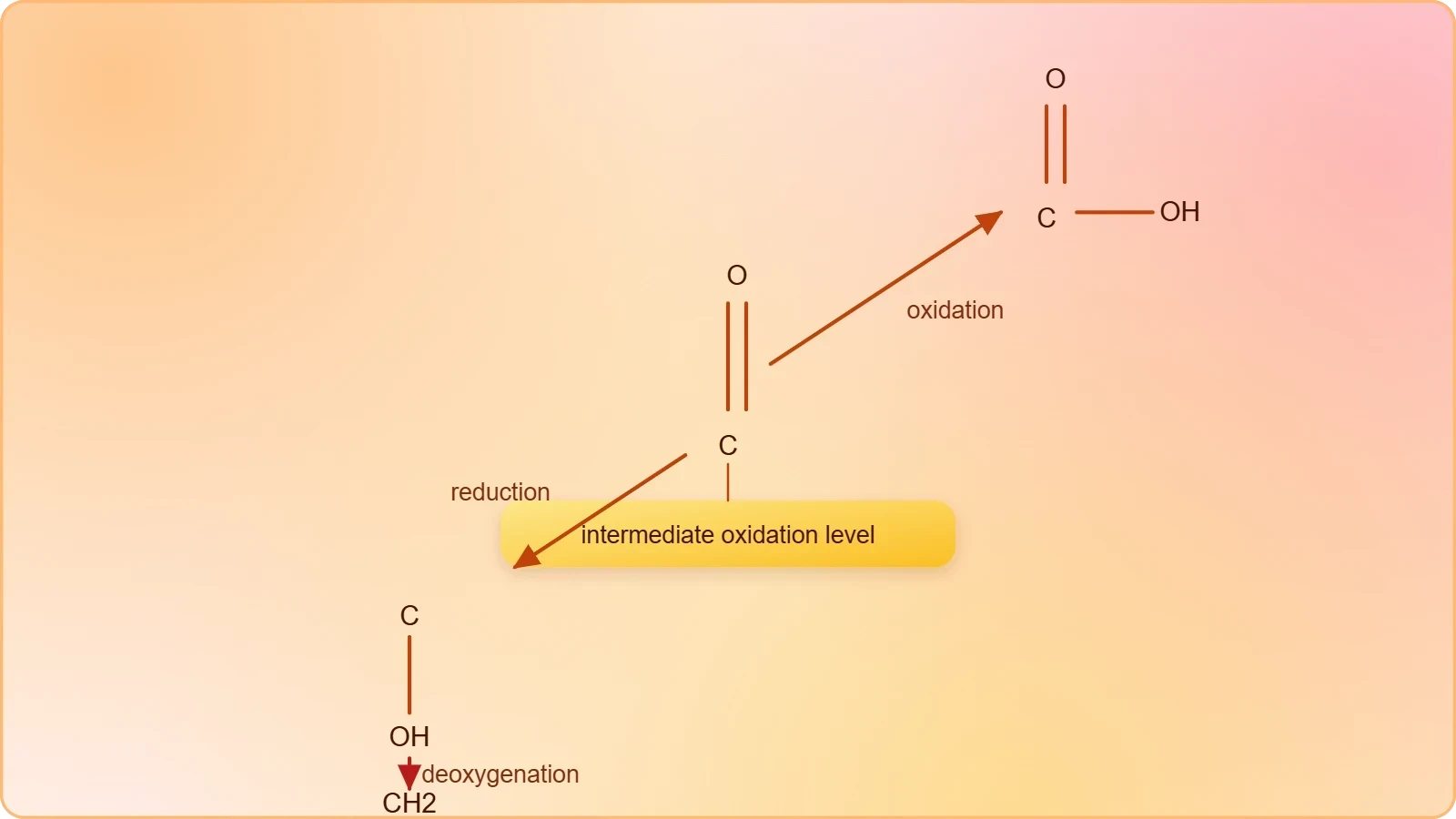
Reduction and oxidation are, at heart, the same mechanistic story told in reverse. In reduction, a nucleophile delivers hydride to the carbonyl carbon; in oxidation, the carbonyl carbon is attacked by an oxygen-centred species and the tetrahedral intermediate collapses to eject a hydride. Recognising this symmetry transforms a long list of named reactions into a small set of transferable principles. We will move from the mild, chemoselective hydride donors such as ##\ce{NaBH4}## and ##\ce{LiAlH4}##, through the deoxygenation methods that convert ##\ce{C=O}## into ##\ce{CH2}##, and finally to the diagnostic oxidation tests that allow an aldehyde to be told apart from a ketone in a single test tube.
The practical stakes are considerable. Tollens' reagent once silvered the mirrors in every household and still underpins modern electroless plating; the haloform reaction remains a workhorse for synthesising carboxylic acids one carbon shorter and for detecting methyl ketones in unknown samples; and the choice between Clemmensen and Wolff-Kishner reduction can make or break a synthesis when acid- or base-sensitive groups are present. Alongside this, we must confront the environmental cost of chromium reagents and the greener alternatives that are steadily replacing them. Every concept here is examinable, and every one has a real laboratory consequence.
On This Page
Reduction of Aldehydes and Ketones to Alcohols
Reduction of a carbonyl compound to an alcohol is the most direct way to lower the oxidation state of the carbonyl carbon, and it is achieved by delivering hydride to that electrophilic centre. Aldehydes yield primary alcohols, while ketones yield secondary alcohols, because the number of carbon substituents on the carbonyl carbon determines how many hydrogen atoms can be added. The two workhorse reagents are sodium borohydride, ##\ce{NaBH4}##, and lithium aluminium hydride, ##\ce{LiAlH4}##, and catalytic hydrogenation over nickel, platinum or palladium offers a third route. The choice among them is governed less by the product than by what else is present in the molecule.
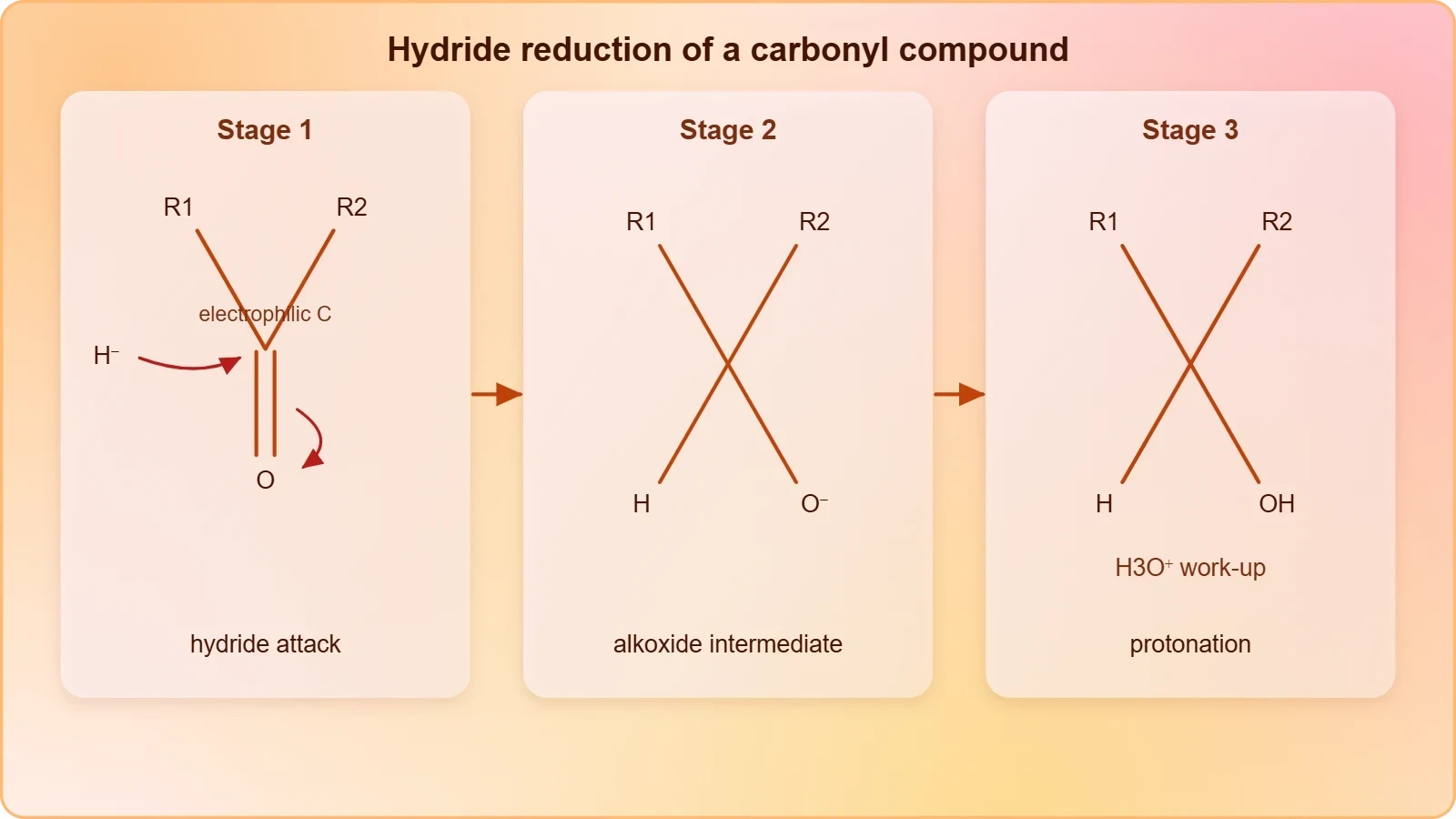
The mechanism follows the familiar nucleophilic addition pattern. The hydride ion, ##\ce{H-}##, acts as the nucleophile and attacks the partially positive carbonyl carbon, pushing the ##\pi##-electrons onto oxygen to form an alkoxide intermediate. Aqueous work-up then protonates the alkoxide to give the alcohol. With ##\ce{LiAlH4}##, the initial product is an aluminium alkoxide that releases the alcohol only on hydrolysis, which is why a separate acidic or aqueous quench is mandatory. This is a common examination trap: students who omit the work-up step lose marks because the free alcohol is never actually formed until protonation occurs.
Chemoselectivity: Choosing the Right Hydride Donor
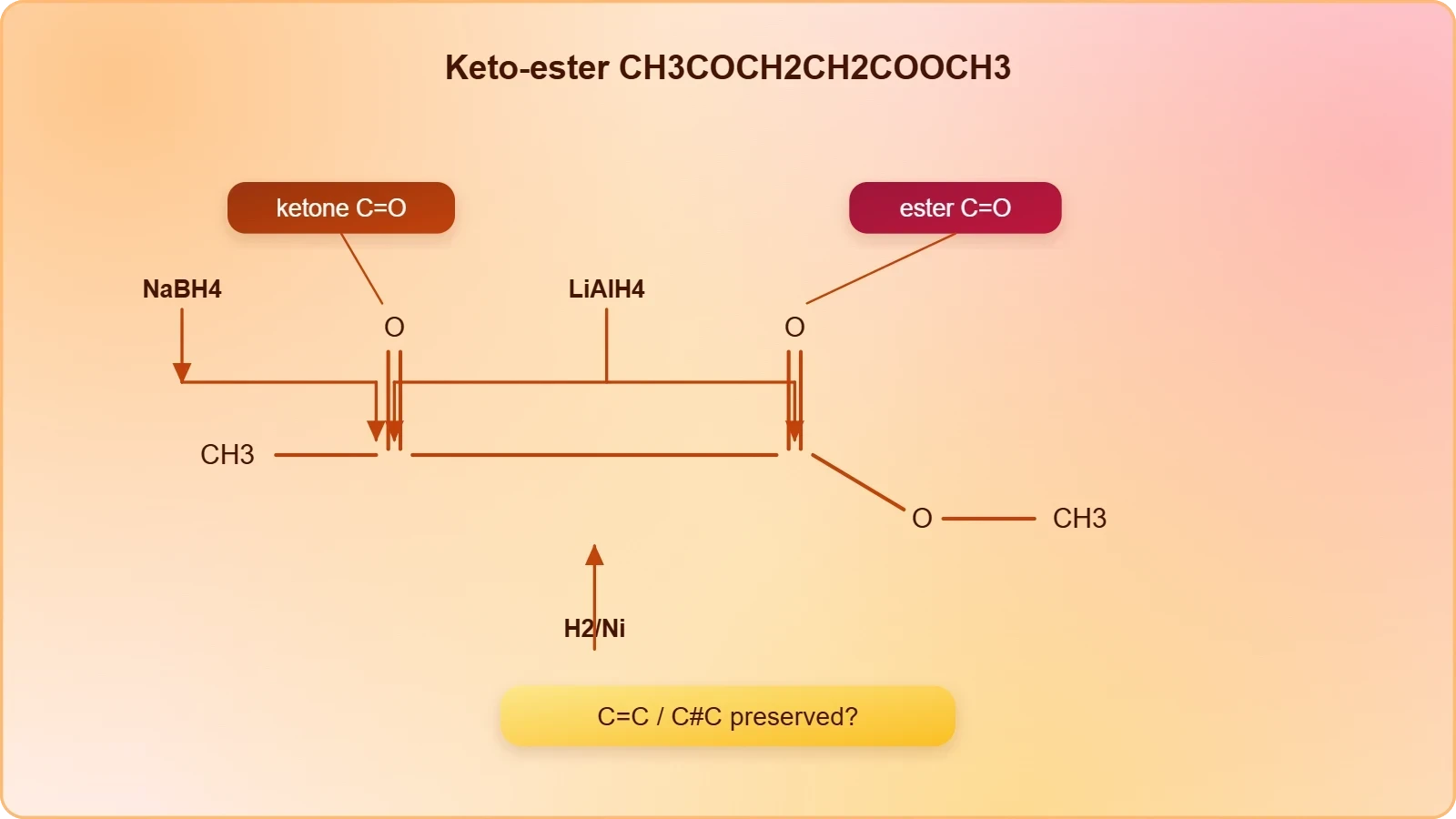
Sodium borohydride is a comparatively gentle reagent that reduces aldehydes and ketones but leaves esters, amides and carboxylic acids essentially untouched. Lithium aluminium hydride is far more powerful and will reduce esters, carboxylic acids, amides and nitriles as well, so it is the reagent of choice only when those groups are meant to react. This difference in reactivity is the foundation of chemoselective synthesis, where one functional group is transformed while another, more delicate one survives intact. A molecule containing both a ketone and an ester, for instance, can be reduced cleanly at the ketone with ##\ce{NaBH4}##.
Consider ##\ce{CH3COCH2CH2COOCH3}##, a keto-ester. Treatment with ##\ce{NaBH4}## in methanol reduces only the ketone, giving the corresponding hydroxy-ester, whereas ##\ce{LiAlH4}## would reduce both carbonyls to yield a diol. Catalytic hydrogenation adds a further dimension: it reduces ##\ce{C=C}## and ##\ce{C#C}## bonds alongside the carbonyl, so it is unsuitable when an alkene must be preserved. The lesson is that reagent selection is a strategic decision, not a reflex, and the examinable skill is matching reagent strength to the sensitivity of the substrate.
Mechanistic Detail and Stereochemical Consequences
Because the hydride attack creates a new tetrahedral carbon, reduction of an unsymmetrical ketone can generate a new stereocentre, and the face of the carbonyl that the hydride approaches determines which diastereomer predominates. In rigid cyclic systems, hydride preferentially attacks from the less hindered face, a principle known as stereoelectronic control. This is why reduction of substituted cyclohexanones gives a predictable major alcohol, and it links directly to the conformational analysis you have met elsewhere. The carbonyl is planar, so the two faces are diastereotopic whenever the rest of the molecule is chiral.
It is also worth noting that reduction is reversible in a conceptual sense: the reverse process, oxidation of an alcohol, regenerates the carbonyl. This is why the oxidation section later in this lesson mirrors the reduction chemistry so closely. Recognising that alcohols and carbonyls are interconvertible through controlled redox manipulation is one of the most powerful organising ideas in organic synthesis, and it explains why the same reagents appear repeatedly across different chapters. The direction you push the equilibrium depends entirely on the reagent and conditions you choose.
Deoxygenation: Reduction of Carbonyls to Hydrocarbons
Sometimes the goal is not an alcohol but the complete removal of the carbonyl oxygen, converting ##\ce{C=O}## into a methylene group, ##\ce{CH2}##. This is a deeper reduction than hydride addition and requires specialised conditions. Two classical methods dominate: the Clemmensen reduction, using zinc-amalgam and concentrated hydrochloric acid, and the Wolff-Kishner reduction, using hydrazine followed by heating with sodium or potassium hydroxide in a high-boiling solvent such as ethylene glycol. Both achieve the same net transformation, yet their mechanisms and compatibility profiles differ sharply, and choosing between them is a genuine synthetic decision.
The Clemmensen reduction proceeds in strongly acidic media. The zinc metal, activated by mercury amalgam, transfers electrons to the protonated carbonyl, and the oxygen is ultimately lost as water. Because the conditions are acidic, substrates bearing acid-sensitive groups such as acetals, ketals or tertiary alcohols will decompose. The Wolff-Kishner reduction, by contrast, runs under strongly basic conditions. The first step is formation of a hydrazone, ##\ce{C=NNH2}##, which then loses nitrogen and is protonated to give the hydrocarbon. Because it is base-catalysed, it tolerates acid-sensitive groups but destroys base-sensitive ones.
Mechanistic Comparison of the Two Methods
In the Wolff-Kishner sequence, the carbonyl first condenses with hydrazine to form a hydrazone, exactly the kind of nucleophilic addition-elimination product you met in the previous lesson. Base then deprotonates the terminal nitrogen, and the resulting anion extrudes nitrogen gas in a concerted rearrangement that places a proton on the carbon. The driving force is the evolution of ##\ce{N2}##, which is why the reaction requires high temperatures and a solvent that boils above 200 °C. The Clemmensen route is less cleanly defined mechanistically but is generally understood to involve successive electron transfers from zinc to the protonated carbonyl.
The practical consequence is a simple rule of thumb: use Clemmensen when the molecule tolerates acid, and Wolff-Kishner when it tolerates base. A compound containing an acetal protecting group must be reduced by Wolff-Kishner, since acid would cleave the acetal. Conversely, a molecule with an ester that must survive cannot use Wolff-Kishner, because hot hydroxide would saponify it. This complementarity is a favourite examination theme, and it rewards students who think about functional-group compatibility rather than simply memorising two reagent lists.
Worked Example: Reducing a Substituted Aryl Ketone
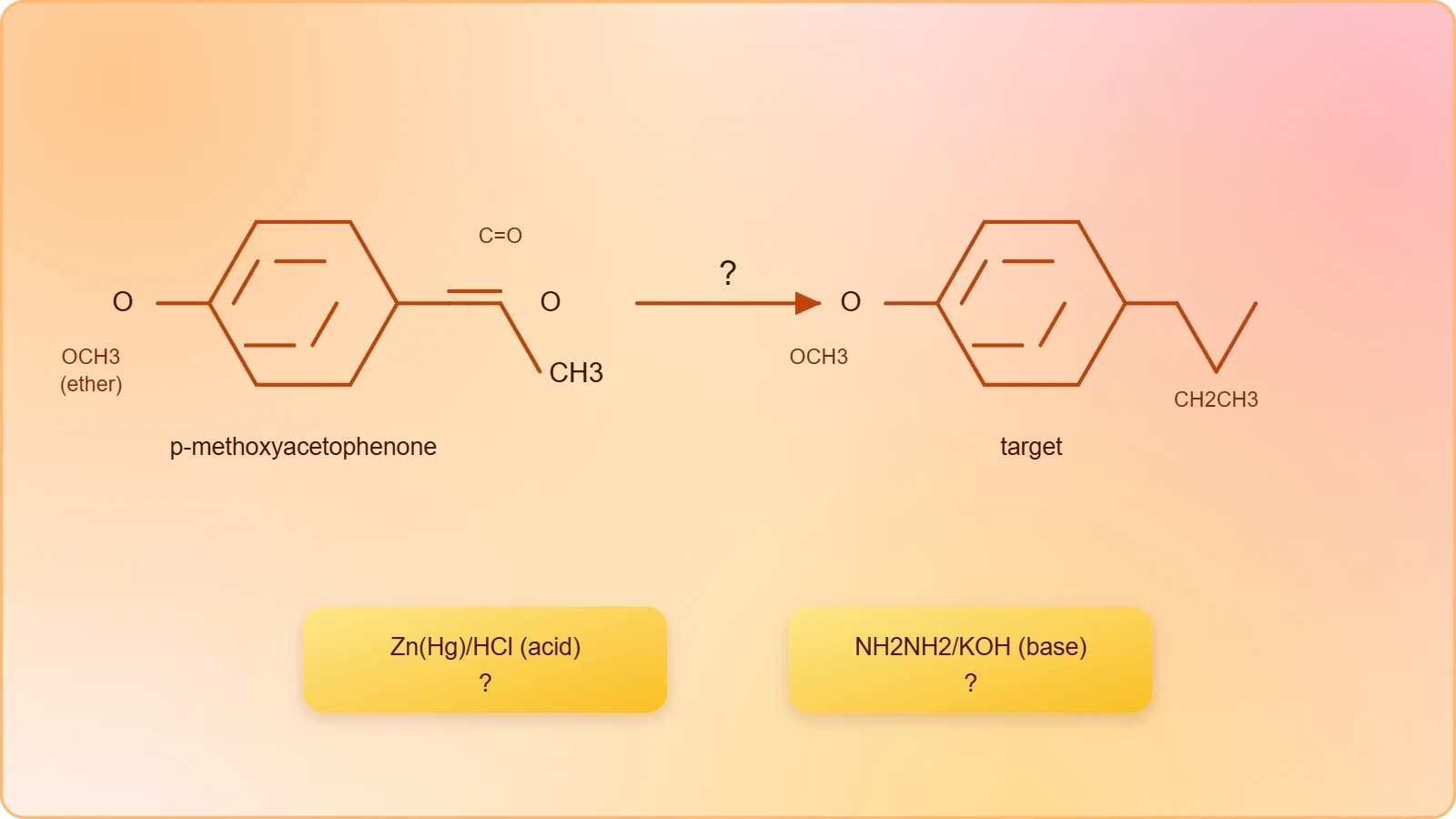
Suppose you must convert ##p##-methoxyacetophenone, ##\ce{CH3OC6H4COCH3}##, into ##p##-methoxyethylbenzene. The methoxy group is an ether, which is cleaved by hot concentrated acid, so the Clemmensen conditions would risk demethylation. The Wolff-Kishner reduction is therefore the correct choice, since the ether survives strongly basic conditions. The hydrazone forms first, then decomposes on heating with ##\ce{KOH}## in ethylene glycol to give the deoxygenated product. This example illustrates how a single functional group elsewhere in the molecule dictates the entire reaction strategy.
A second example reinforces the point in reverse. Reducing a ketone that bears a base-labile ester demands the Clemmensen method, provided no acid-sensitive group is present. The zinc-amalgam in hydrochloric acid reduces the ketone while the ester, though slowly hydrolysed by strong acid over long periods, is generally preserved under the shorter reaction times used. The examiner's expectation is that you can justify the choice, not merely name it, so always state which group would be damaged by the rejected method and why.
We Also Published
Oxidation of Aldehydes: The Diagnostic Tests
Oxidation is the mirror image of reduction, and it is here that aldehydes and ketones part company most dramatically. Aldehydes are readily oxidised to carboxylic acids by common oxidising agents such as nitric acid, potassium permanganate and potassium dichromate. Crucially, even mild oxidising agents, principally Tollens' reagent and Fehling's reagent, oxidise aldehydes. Ketones, lacking the aldehydic hydrogen, resist these mild reagents and require vigorous conditions. This difference is the basis of the classic qualitative tests that allow an unknown carbonyl compound to be identified by simple bench chemistry.
The underlying reason is structural. The aldehydic hydrogen sits on the carbonyl carbon and is abstracted during oxidation, allowing the carbon to be attacked by an oxygen nucleophile and the tetrahedral intermediate to collapse with hydride expulsion. A ketone has no such hydrogen, so the mild oxidative pathway is blocked. This is why the tests are not merely convenient but mechanistically meaningful: they probe for the presence of that single hydrogen atom, and their results are a direct readout of molecular structure.
Tollens' Test and the Silver Mirror
Tollens' reagent is freshly prepared ammoniacal silver nitrate, containing the diamminesilver(I) complex ##\ce{[Ag(NH3)2]+}##. On warming with an aldehyde, the silver ion is reduced to metallic silver, which deposits as a bright mirror on the glass. The aldehyde is simultaneously oxidised to the corresponding carboxylate anion, and the reaction occurs in an alkaline medium. The half-reaction can be summarised as the reduction of silver(I) to silver(0), balanced by the oxidation of the aldehyde to the carboxylate. The test is exquisitely sensitive and gives a visually unmistakable positive result.
The silvering of mirrors is the historical application that gave the test its fame. Before the advent of modern vacuum deposition, mirrors were coated by depositing silver onto glass using precisely this chemistry, and the process is still used in electroless plating and in the manufacture of certain optical components. In the laboratory, the test distinguishes aldehydes from ketones and from most other carbonyl-containing compounds, though it must be performed on a clean tube, since grease or fingerprints can produce a misleading false mirror.
Fehlings' Test and the Aromatic Exception
Fehling's reagent consists of two solutions mixed immediately before use: Fehling A, aqueous copper(II) sulphate, and Fehling B, alkaline sodium potassium tartrate, known as Rochelle salt. The tartrate keeps copper(II) in solution as a soluble complex. On heating with an aldehyde, copper(II) is reduced to copper(I) oxide, which appears as a reddish-brown precipitate, while the aldehyde is oxidised to the carboxylate. The tartrate is essential; without it, copper(II) hydroxide would precipitate and the reagent would be useless.
Aromatic aldehydes do not respond to Fehling's test, and this exception is frequently examined. The reason lies in the reduced electrophilicity of the aromatic carbonyl carbon, which is stabilised by conjugation with the ring, and in the relative stability of the aromatic aldehyde toward the mild oxidative conditions. Benzaldehyde, for instance, gives a negative Fehling's test but a positive Tollens' test, so the two tests together provide a more complete picture. This is why a careful analyst never relies on a single test to identify an unknown.
The Haloform Reaction and Methyl Ketones
Aldehydes and ketones that carry at least one methyl group attached to the carbonyl carbon, known as methyl ketones, are oxidised by sodium hypohalite to the sodium salt of a carboxylic acid containing one carbon fewer than the parent carbonyl compound. The methyl group itself is converted into a haloform, ##\ce{CHX3}##. This is the haloform reaction, and it is remarkable for its selectivity: it does not affect a carbon-carbon double bond elsewhere in the molecule, making it a valuable synthetic tool as well as an analytical test.
The reaction proceeds in three stages. First, base-catalysed halogenation replaces all three methyl hydrogens with halogen atoms, giving a trihalomethyl ketone. Second, hydroxide attacks the carbonyl carbon, and the trihalomethyl group, now a good leaving group, departs as ##\ce{CX3-}##. Third, the resulting carboxylate is protonated on work-up, and the haloform is formed. With iodine, the product is iodoform, ##\ce{CHI3}##, a yellow precipitate with a characteristic smell, which is the basis of the iodoform test.
Application in Synthesis and Structure Determination
The synthetic value of the haloform reaction lies in its ability to shorten a carbon chain by exactly one carbon while converting a methyl ketone into a carboxylic acid. This is a clean, predictable degradation that has been used to prepare carboxylic acids from readily available methyl ketones. Because the reaction tolerates alkenes, it can be applied to unsaturated substrates without fear of side reactions at the double bond, a selectivity that many harsher oxidants lack. The carboxylate salt is isolated after acidification, and the haloform by-product is easily separated.
Analytically, the iodoform test detects the ##\ce{CH3CO}## group directly, and also detects a ##\ce{CH3CH(OH)}## group, because such a secondary alcohol is oxidised in situ to the methyl ketone before the haloform step proceeds. This dual sensitivity is a common source of confusion: a positive iodoform test does not prove the presence of a methyl ketone, only of a group that can generate one under the reaction conditions. Ethanol and acetaldehyde also give positive results for the same reason, which is why the test must be interpreted alongside other evidence.
Worked Example: Identifying an Unknown from Combined Tests
Consider a compound with molecular formula ##\ce{C8H8O}## that forms an orange-red precipitate with 2,4-DNP, gives a yellow precipitate with iodine and sodium hydroxide, but does not reduce Tollens' or Fehling's reagent and does not decolourise bromine water. The 2,4-DNP result confirms a carbonyl compound. The failure to reduce Tollens' and Fehling's identifies it as a ketone rather than an aldehyde. The iodoform result shows it is a methyl ketone. The failure to decolourise bromine water indicates that the unsaturation is aromatic rather than an alkene.
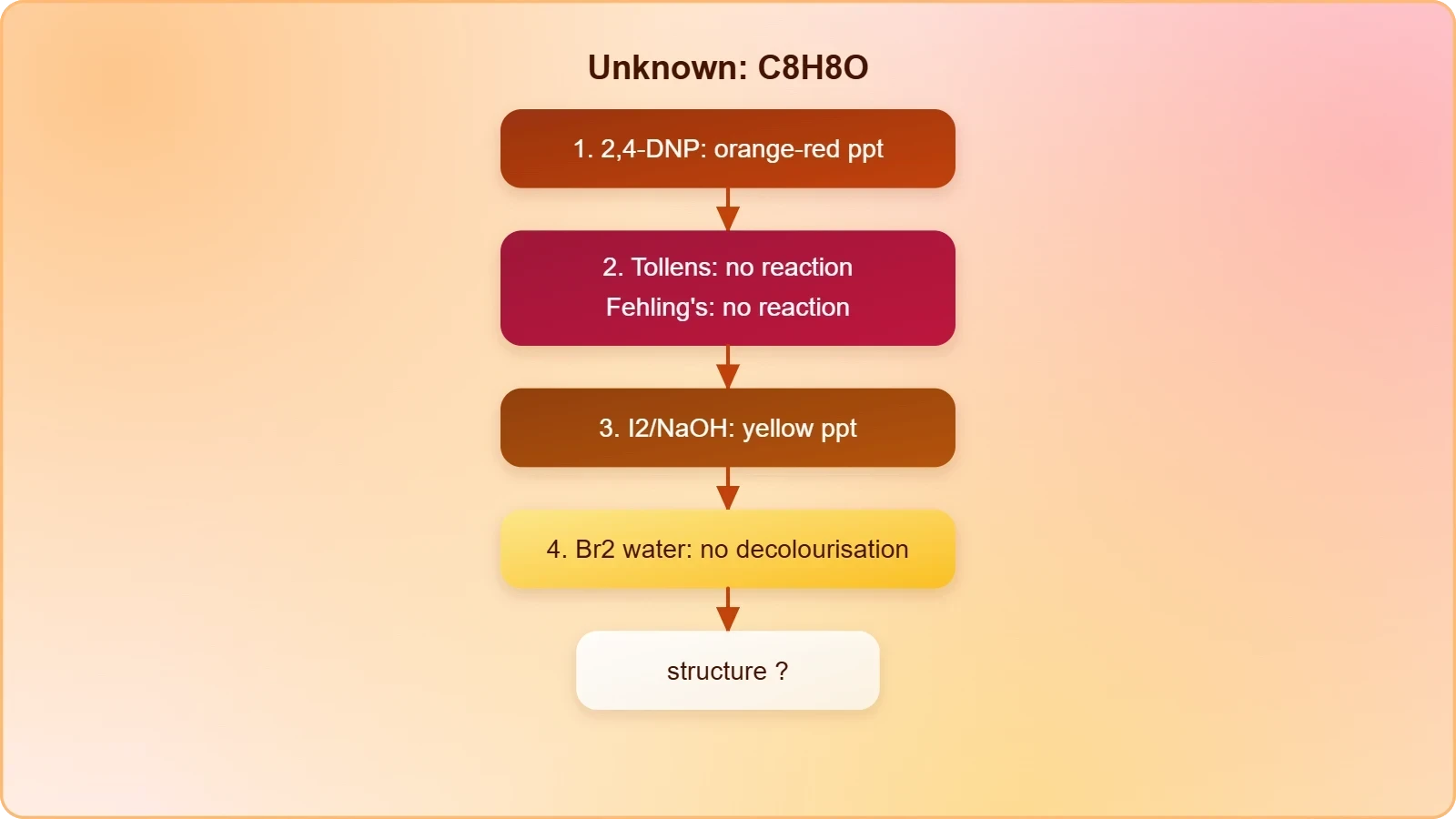
Drastic oxidation with chromic acid gives a carboxylic acid of formula ##\ce{C7H6O2}##, which is benzoic acid. Working backwards, the original compound must be a monosubstituted aromatic methyl ketone, namely acetophenone, ##\ce{C6H5COCH3}##. The oxidation cleaves the methyl group from the carbonyl, leaving the aromatic ring intact and producing benzoic acid. This worked example, drawn from the classic examination repertoire, shows how a sequence of simple tests, each probing a different structural feature, converges on a single unambiguous structure.
Environmental Impact and Greener Alternatives
The classical oxidants used in carbonyl chemistry carry a significant environmental burden. Potassium dichromate and chromic acid, in particular, generate chromium(VI) species, which are highly toxic, carcinogenic and persistent in the environment. Chromium(VI) compounds are also powerful oxidants that can contaminate water supplies if improperly disposed of, and their reduction to the far less harmful chromium(III) is a standard waste-treatment step in laboratories. The pressure to move away from chromium reagents has driven the development of greener alternatives across both teaching and industrial practice.
Among the replacements, potassium permanganate is still widely used but generates manganese dioxide sludge, which must be managed. Hydrogen peroxide, activated by a catalyst, offers a cleaner profile because its only by-product is water. Catalytic aerobic oxidation, using air or oxygen over a metal catalyst, is increasingly favoured in industry because it is atom-economical and produces minimal waste. For the diagnostic tests, Tollens' and Fehling's reagents remain in use because they are mild and their by-products are relatively benign, though silver waste still requires recovery.
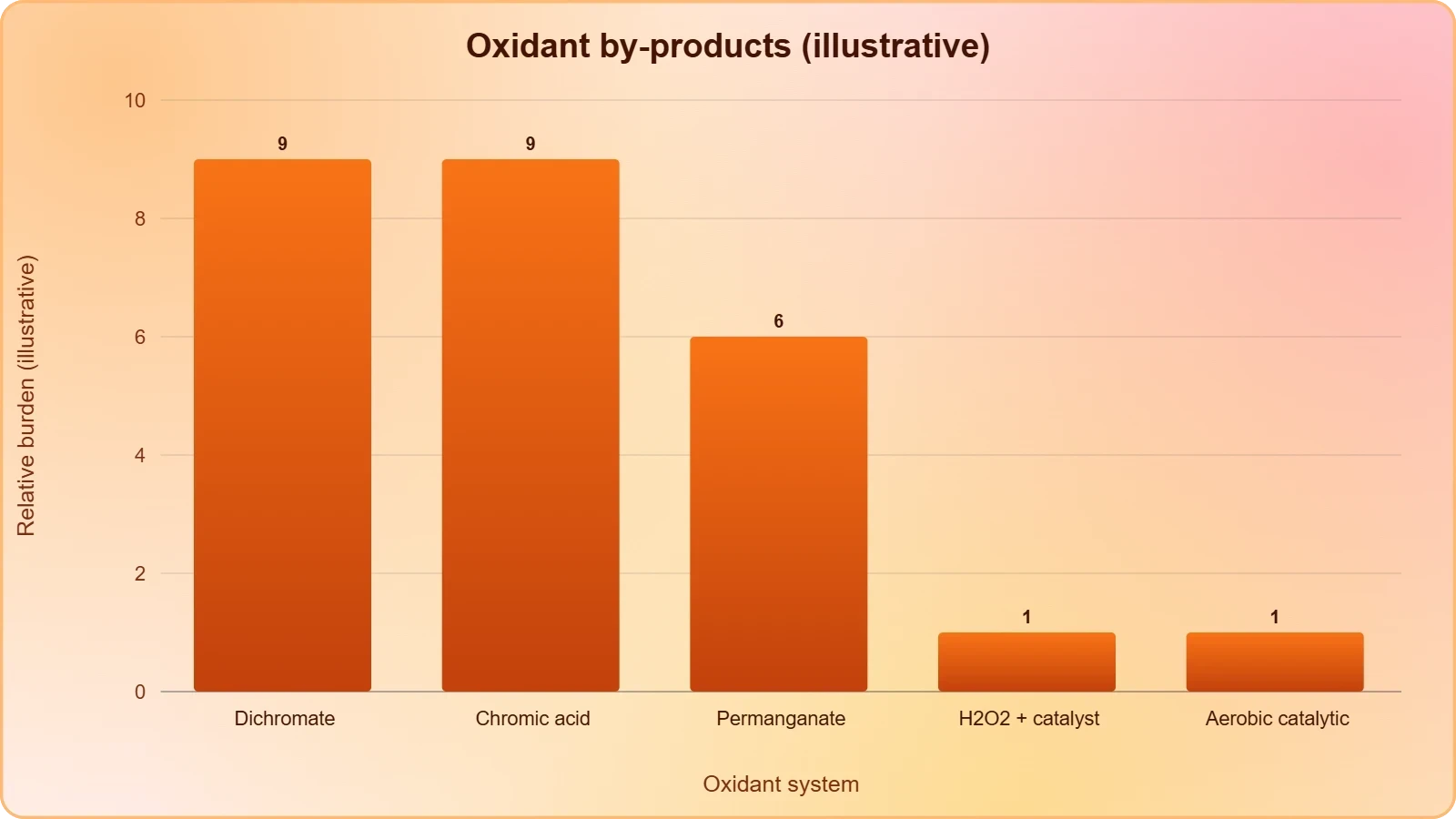
Green Chemistry Principles in Practice
The shift away from chromium illustrates several green chemistry principles at once: the design of safer chemicals, the use of catalytic rather than stoichiometric reagents, and the minimisation of hazardous waste. In an educational setting, this is an opportunity to connect bench chemistry to real environmental responsibility. Students should understand that a reaction which works beautifully in a test tube may be unacceptable at scale if its waste stream is toxic, and that the choice of oxidant is therefore an ethical as well as a chemical decision.
Modern synthetic routes often replace stoichiometric chromium with catalytic systems that use oxygen as the terminal oxidant, generating only water as a by-product. This is a meaningful improvement, but it introduces new considerations such as catalyst cost, selectivity and the risk of over-oxidation. The lesson is not that one reagent is simply better than another, but that reagent selection involves a trade-off between yield, selectivity, safety and environmental cost, and that a well-trained chemist weighs all four.
Common Mistakes and Examination Pitfalls
Several errors recur in examinations. Students frequently forget the aqueous work-up after ##\ce{LiAlH4}## reduction, or wrongly claim that ##\ce{NaBH4}## reduces esters. They confuse the colours of the positive tests, attributing the reddish-brown precipitate to Tollens' rather than Fehling's, or forgetting that aromatic aldehydes fail Fehling's. They also misapply the iodoform test, assuming it detects aldehydes generally rather than the specific ##\ce{CH3CO}## group. Each of these mistakes stems from a shallow grasp of mechanism rather than a failure of memory.
Another frequent error is choosing Clemmensen reduction for a substrate that contains an acid-sensitive group, or Wolff-Kishner for one containing a base-sensitive ester. The remedy is to inspect the whole molecule before selecting a reagent, asking which functional groups would survive each set of conditions. Finally, students often write unbalanced equations for the Tollens' and Fehling's tests, forgetting that the aldehyde is oxidised to the carboxylate anion and that the silver or copper species is reduced. Careful attention to the redox balance resolves this.
Consolidating the Redox Toolkit
With reduction and oxidation now mapped out, the carbonyl group emerges as a remarkably versatile functional handle. It can be pushed down to an alcohol with ##\ce{NaBH4}## or ##\ce{LiAlH4}##, stripped entirely to a methylene with Clemmensen or Wolff-Kishner conditions, or pushed up to a carboxylic acid with Tollens', Fehling's or the haloform reaction. Each transformation is governed by the same underlying logic of nucleophilic attack and leaving-group departure, and each has a characteristic set of conditions that determines when it can be applied. The skill being tested is not recall but judgement.
This judgement becomes especially important as you move into the next lesson, where the acidity of ##\alpha##-hydrogens opens up the aldol and cross-aldol condensations. Those reactions also begin with the carbonyl group, but they exploit a different site of reactivity: the carbon adjacent to the carbonyl rather than the carbonyl carbon itself. Understanding the redox chemistry thoroughly ensures that you will not confuse the two, and that you can recognise when a proposed transformation would inadvertently oxidise or reduce a group you meant to leave alone.
Summary of Key Transformations
The reduction of aldehydes gives primary alcohols and the reduction of ketones gives secondary alcohols, both achievable with hydride donors or catalytic hydrogenation. Deoxygenation to hydrocarbons requires the specialised Clemmensen or Wolff-Kishner methods, chosen according to acid or base compatibility. Oxidation of aldehydes gives carboxylic acids, with Tollens' and Fehling's serving as mild diagnostic reagents, while ketones require vigorous conditions and undergo carbon-carbon cleavage. The haloform reaction selectively converts methyl ketones to carboxylic acids one carbon shorter, and the iodoform variant serves as a sensitive test.
Each of these transformations has a diagnostic counterpart, and the pairing is deliberate. Tollens' and Fehling's distinguish aldehydes from ketones; the iodoform test identifies methyl ketones; and the failure of aromatic aldehydes to reduce Fehling's highlights the subtle influence of conjugation on reactivity. Together, these tests form a coherent analytical toolkit that any competent chemist should be able to apply to an unknown sample, reasoning from observation back to structure with confidence and precision.
Preparing for Alpha-Hydrogen Chemistry
The next lesson turns to the ##\alpha##-hydrogens, whose acidity arises from the electron-withdrawing carbonyl group and the resonance stabilisation of the resulting enolate. That acidity is the key that unlocks aldol condensation, where an enolate attacks another carbonyl to form a ##\beta##-hydroxy aldehyde or ketone, and cross-aldol condensation, where two different carbonyl compounds combine to give a mixture of products. The redox chemistry you have just studied provides the foundation, because both the enolate and the hydride are nucleophiles generated from the same carbonyl group.
Before moving on, consolidate the distinctions that matter most: mild versus strong reductants, acidic versus basic deoxygenation, and mild versus vigorous oxidation. Practise writing balanced equations for the Tollens' and Fehling's tests, and rehearse the reasoning that identifies an unknown from a sequence of test results. These habits will serve you well not only in the aldol chemistry ahead but in every subsequent chapter where the carbonyl group reappears, from carboxylic acid derivatives to the complex molecules of biochemistry.
From our network :
- Analyzing Trump Deportation Numbers Insights Into The 2026 Immigration Crackdown
- Do You Need a New Router or Is Your Internet Plan the Problem?A practical comparison of the signs that point to router limits versus signs your broadband speed or provider is the bottleneck, so you can decide what to replace before spending money.
- Where to Put Your Wireless Router for Better CoverageA practical, physics-grounded guide to router placement: why the centre of the home beats the corner, how walls and metal sap signal, and how to run a simple survey that proves the improvement.
- How to Print Cheaply: Cutting the Cost per PageA practical, measured guide to lowering what each printed page costs — duplex and draft modes, third-party ink, yield mathematics, and knowing when a new printer beats refills.
- 10 Physics Numerical Problems with Solutions for IIT JEEPrepare for IIT JEE with 10 physics numerical problems, complete with detailed solutions and conceptual explanations. Ideal for mastering kinematics, thermodynamics, electromagnetism, and optics.
- Trump Political Strategy How Geopolitical Stunts Serve As Media Diversions
- 98% of Global MBA Programs Now Prefer GRE Over GMAT Focus EditionExplore why 98% of global MBA programs now prefer the GRE over GMAT Focus. Learn about the shorter GRE format, verbal logic importance, and strategic versatility for students.
- AI-Powered 'Precision Diagnostic' Replaces Standard GRE Score ReportsDiscover the new GRE Precision Diagnostic. Learn how AI-powered behavioral analytics and time-to-solve tracking are replacing standard GRE score reports to empower students.
- EV 2.0: The Solid-State Battery Breakthrough and Global Factory ExpansionDiscover the impact of the Solid-State Battery Breakthrough on the EV market. Learn about CATL and BYD stock growth, global factory expansion in Europe, and the future of EV 2.0 technology.