Every chemistry classroom eventually reaches the moment when a reaction stops being an abstraction and becomes a product someone can hold, smell, or apply. Aldehydes and ketones occupy precisely that threshold. Their carbonyl group, a carbon doubly bonded to oxygen, is one of the most versatile functional units in organic synthesis, and the same polarity that makes ##\ce{C=O}## reactive in the laboratory also makes these compounds indispensable in factories, pharmacies, kitchens, and hospital pathology rooms. Understanding their uses is therefore not a decorative appendix to the chapter but the point where structure, mechanism, and economics converge.
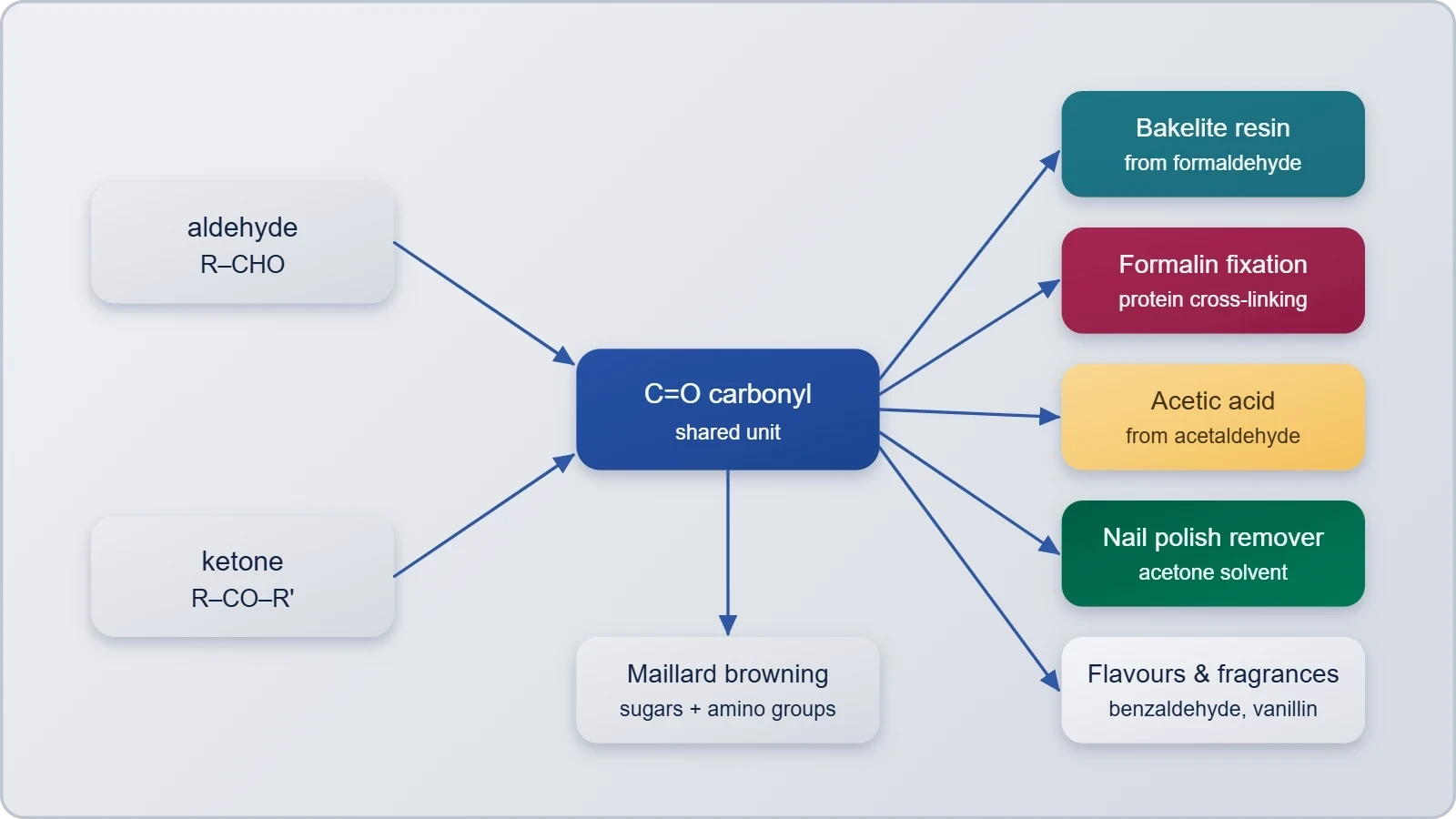
This lesson builds directly on the Cannizzaro reaction and the other carbonyl transformations studied earlier, and it prepares the ground for the carboxylic acid family that follows. Here the emphasis shifts from how aldehydes and ketones react to why the world needs them to react. Formaldehyde hardens resins and preserves tissue; acetaldehyde feeds the acetic acid industry; benzaldehyde perfumes and flavours; acetone dissolves; camphor soothes; vanillin delights. Each application traces back to a specific structural feature, and each carries its own safety, environmental, and regulatory considerations that a serious student must learn to weigh.
By the end of this lesson you should be able to connect a named compound to its industrial role, explain the chemistry behind that role, recognise the hazards that accompany it, and appreciate how green chemistry is reshaping solvent and reagent choices. The treatment moves from bulk industrial chemistry through flavours, pharmaceuticals, and biology, closing with the principles of safer design. Worked reasoning, common examination pitfalls, and advanced insights are woven throughout so that the material stands on its own as a complete reference.
On This Page
- Industrial Foundations: Solvents, Resins and Bulk Chemicals
- Acetone and Ketone Solvents in Everyday Life
- Flavours, Fragrances and the Maillard Reaction
- Medicine, Biology and Pharmaceutical Ketones
- Green Chemistry and the Future of Carbonyl Solvents
- Worked Reasoning: Connecting Structure to Application
- Consolidation: From Carbonyl Chemistry to Carboxylic Acids
Industrial Foundations: Solvents, Resins and Bulk Chemicals
In the chemical industry aldehydes and ketones serve three broad functions: they act as solvents, as starting materials, and as reagents for synthesising other products. This triad organises almost every commercial application you will meet. The solvent role exploits their ability to dissolve both polar and non-polar substances; the feedstock role exploits the reactivity of the carbonyl carbon toward nucleophiles; the reagent role exploits condensation and addition reactions that build larger molecular frameworks. Recognising which role a given compound plays in a given process is the first step toward genuine industrial literacy.
Formaldehyde: Resins, Preservation and Polymer Chemistry
Formaldehyde, ##\ce{HCHO}##, is the simplest aldehyde and one of the highest-volume industrial organic chemicals. Its principal outlet is polymer chemistry. When formaldehyde condenses with phenol under controlled conditions it forms bakelite, the first fully synthetic thermosetting resin, whose cross-linked network made it a landmark material for electrical insulation and household goods. Condensation with urea yields urea-formaldehyde glues, widely used in plywood and particleboard, while melamine-formaldehyde resins supply durable laminates and surface coatings. The common thread is the electrophilic carbonyl carbon, which accepts attack from the aromatic ring of phenol or from the nitrogen lone pair of urea.
Formalin, a roughly 40% aqueous solution of formaldehyde, is familiar to every biology student as a preservative for biological specimens. Its action is chemical rather than merely physical: formaldehyde cross-links proteins by bridging amino groups, fixing tissue architecture so that cells retain their shape for dissection and histology. The same cross-linking ability explains its use in disinfectants and in the hardening of gelatin films. In examination answers, always distinguish formaldehyde the gas from formalin the solution, and note that the percentage refers to mass of dissolved gas in water.

Acetaldehyde and the Acetic Acid Chain
Acetaldehyde, ##\ce{CH3CHO}##, is used primarily as a starting material in the manufacture of acetic acid, ethyl acetate, vinyl acetate, polymers and drugs. The industrial oxidation of acetaldehyde to acetic acid, historically performed with manganese or cobalt catalysts and air, illustrates how a two-electron oxidation converts an aldehyde into a carboxylic acid. Ethyl acetate, an ester formed with ethanol, is a widely used solvent in coatings and adhesives, while vinyl acetate polymerises to polyvinyl acetate, the basis of many emulsion paints and wood glues. Each downstream product preserves the two-carbon skeleton of the original aldehyde.
The pharmaceutical connection deserves emphasis. Acetaldehyde is a building block for heterocyclic and aromatic drug intermediates, and its controlled condensation with amines and other nucleophiles generates the nitrogen-containing rings common in medicinal chemistry. Students should also note the biological dimension: acetaldehyde is the primary metabolite of ethanol in the human liver, produced by alcohol dehydrogenase, and it is responsible for much of the toxicity associated with alcohol consumption. This dual identity, industrial feedstock and metabolic intermediate, makes acetaldehyde a favourite examination example linking organic chemistry to biochemistry.
We Also Published
Acetone and Ketone Solvents in Everyday Life
Acetone, ##\ce{CH3COCH3}##, and ethyl methyl ketone are the common industrial solvents named in the standard treatment, and their solvent power follows from a simple structural fact: the carbonyl group is polar enough to interact with polar solutes, while the two methyl groups provide a hydrocarbon surface that dissolves non-polar materials. This amphiphilic character lets acetone dissolve resins, cellulose derivatives, fats, and many polymers that water cannot touch. It is miscible with water in all proportions, evaporates rapidly because of a low boiling point near 56 °C, and leaves no residue, three properties that explain its ubiquity.
Nail Polish Remover and Laboratory Glassware
The most familiar domestic encounter with acetone is nail polish remover, where it typically constitutes the bulk of the formulation. Nail polish is essentially a solution of nitrocellulose and other film-forming polymers in a volatile solvent; acetone dissolves the dried film by disrupting the intermolecular interactions holding the polymer network together, allowing the lacquer to be wiped away. The same dissolving power makes acetone a standard rinse for laboratory glassware, particularly after greasy or resinous experiments, and a carrier solvent in the manufacture of photographic films and specialty coatings.
Acetone also serves as a chemical feedstock in its own right. Its condensation with phenol produces bisphenol A, the monomer for polycarbonate plastics and epoxy resins, and its reduction or condensation products feed the synthesis of methyl methacrylate and other industrial intermediates. In the laboratory, acetone is the classic solvent for the iodoform test, where methyl ketones react with iodine and alkali to give the yellow precipitate of iodoform, ##\ce{CHI3}##. Students should remember that acetone itself gives a positive iodoform test because it contains the ##\ce{CH3CO{-}}## unit.
Ethyl Methyl Ketone and Industrial Solvent Selection
Ethyl methyl ketone, also called butanone, ##\ce{CH3COCH2CH3}##, is a close relative of acetone with a slightly higher boiling point and a somewhat greater solvency for certain resins. It is favoured in surface coatings, printing inks, and adhesive formulations where a slower evaporation rate improves film formation. The choice between acetone and butanone in an industrial process is rarely arbitrary; engineers balance evaporation rate, flash point, toxicity, cost, and regulatory status. This decision-making process is where the chemistry of the carbonyl group meets the practical discipline of process design.
Ketones generally offer a useful safety advantage over aldehydes of similar molecular mass because they lack the reactive aldehydic hydrogen that participates in oxidation and in some toxicological pathways. This does not make them harmless, since all volatile organic solvents carry inhalation and flammability hazards, but it does explain why ketone solvents dominate certain coating and cleaning applications. A well-trained student should be able to compare acetone, butanone, and an aldehyde solvent on the axes of polarity, volatility, reactivity, and hazard, and justify a selection with chemical reasoning rather than memory.
Flavours, Fragrances and the Maillard Reaction
Many aldehydes and ketones are celebrated for their odours and flavours, and the standard list includes butyraldehyde, vanillin, acetophenone and camphor. The molecular basis of smell is subtle: olfactory receptors respond to shape and functional group, so small structural changes can transform a pleasant aroma into an unpleasant one. Butyraldehyde contributes the characteristic note of rancid butter, vanillin supplies the vanilla aroma, acetophenone carries a sweet, floral, orange-blossom character used in perfumery, and camphor provides the penetrating medicinal scent familiar from balms and moth repellents. These examples teach an important lesson: odour is a chemical property, not an accident.
Benzaldehyde, Almonds and Cherries
Benzaldehyde, ##\ce{C6H5CHO}##, is used in perfumery and in the dye industries, and it is also the principal flavouring agent responsible for the characteristic taste of bitter almonds and cherries. In nature it is released from cyanogenic glycosides such as amygdalin when plant tissue is damaged, which is why bitter almonds carry both their aroma and their toxicity. Synthetic benzaldehyde is far cheaper and is the standard commercial source for almond and cherry flavourings. Its pleasant marzipan-like note makes it a staple of confectionery, and its reactivity makes it a valuable intermediate for dyes and pharmaceuticals.
Vanillin, the principal flavour component of the vanilla pod, is an aromatic aldehyde bearing hydroxyl and methoxy substituents on the ring. Its synthesis from guaiacol and its biosynthetic production from ferulic acid are both important industrial routes, and the global demand for vanilla flavouring far exceeds what the orchid can supply. Students should appreciate that the same functional group, an aromatic aldehyde, underlies both benzaldehyde's almond note and vanillin's creamy sweetness, yet the substituents on the ring tune the odour dramatically. This is structure-property reasoning at its most tangible.
The Maillard Reaction: Chemistry on the Plate
The browning of bread crust, roasted coffee, seared meat, and toasted nuts is largely the work of the Maillard reaction, a cascade of condensations between the carbonyl group of reducing sugars and the amino groups of proteins and amino acids. The initial step forms a Schiff base, which rearranges and fragments into a bewildering family of reactive aldehydes and ketones that then polymerise into brown melanoidin pigments and generate hundreds of aroma compounds. The reaction is named after Louis-Camille Maillard, who described it in the early twentieth century, and it is distinct from caramelisation, which involves sugars alone.
Aldehydes are both products and participants in this chemistry. Furfural, derived from pentose sugars, and various dicarbonyl compounds contribute toasted and nutty notes, while Strecker degradation of amino acids releases aldehydes such as acetaldehyde and 2-methylbutanal that shape the flavour of chocolate and bread. Cooks manipulate the reaction through temperature, moisture, and pH, which is why a brushed egg wash or an alkaline pretzel bath deepens browning. The Maillard reaction is a superb illustration of carbonyl chemistry operating in a kitchen rather than a flask, and it links this lesson directly to food science.
Medicine, Biology and Pharmaceutical Ketones
Aldehydes and ketones appear throughout medicine, both as therapeutic agents and as biological intermediates. The carbonyl group is a privileged pharmacophore because it can accept hydrogen bonds, participate in reversible covalent bonding with enzyme nucleophiles, and modulate the lipophilicity of a drug molecule. Many pharmaceuticals contain a ketone or an aldehyde function, and understanding their behaviour helps explain both drug action and drug metabolism. This section moves from the pharmacy shelf to the cell, showing how the same chemistry operates in very different settings.
Haloperidol and Other Ketone Drugs
Haloperidol, a widely used antipsychotic, contains a butyrophenone skeleton in which a ketone carbonyl links an aromatic ring to a piperidine-containing side chain. The carbonyl is not merely structural decoration; it participates in the hydrogen-bonding network that positions the drug within the dopamine ##\text{D}_2## receptor binding pocket. Other ketone-containing drugs include the analgesic ketoprofen, the anti-inflammatory nabumetone, and the steroid hormones such as cortisone and progesterone, whose biological activity depends on the precise placement of ketone groups within the steroid framework. Recognising the carbonyl in a drug structure is therefore a useful first step in predicting its interactions.
Biological systems also rely on aldehydes and ketones as signalling and metabolic molecules. Retinal, the aldehyde of vitamin A, undergoes light-driven isomerisation in the rod cells of the retina, triggering the visual cascade. Pyridoxal phosphate, an aldehyde-containing coenzyme, mediates transamination reactions central to amino acid metabolism. Acetone is produced in small quantities during fat metabolism and gives the characteristic odour of ketosis in uncontrolled diabetes. These examples show that carbonyl chemistry is not confined to industry; it is the chemistry of vision, metabolism, and hormonal regulation.
Formaldehyde Toxicity and Laboratory Safety
Formaldehyde is a recognised human carcinogen and a potent irritant of the eyes, skin, and respiratory tract. Its toxicity arises from its ability to cross-link proteins and nucleic acids, forming stable methylene bridges that disrupt enzyme function and damage DNA. Occupational exposure limits are therefore strict, and laboratories handling formalin must use fume hoods, gloves, and eye protection. Formalin should never be treated casually as a harmless preservative; the same cross-linking that fixes tissue also damages living tissue. Students should be able to state the hazard, the route of exposure, and the control measures in a structured answer.
Safety extends beyond the individual worker to the environment. Formaldehyde is released from some building materials and combustion sources, and its presence in indoor air is regulated in many countries. Substitution is the preferred control: where possible, less hazardous preservatives and resins are used. This principle, that hazard should be designed out rather than merely managed, is the essence of green chemistry and connects directly to the next section. A well-prepared student should be able to discuss formaldehyde's benefits and hazards in the same balanced paragraph, because both are real.
Green Chemistry and the Future of Carbonyl Solvents
The environmental burden of volatile organic solvents has prompted a sustained effort to redesign industrial processes around safer alternatives. Green chemistry, articulated through principles such as waste prevention, safer solvents, and design for degradation, asks chemists to consider hazard alongside function. Aldehydes and ketones sit at the centre of this conversation because some of them are excellent solvents and reagents but carry real toxicity, flammability, and persistence concerns. The goal is not to abandon them but to use them more intelligently, recover them more efficiently, and replace them where a genuinely safer substitute exists.
Safer Solvent Selection and Process Design
Solvent selection guides now rank candidates by health, safety, and environmental criteria, and acetone often scores reasonably well because it is biodegradable, of low acute toxicity, and producible from biomass-derived routes. Formaldehyde, by contrast, is tightly regulated and is being replaced in many applications by less hazardous preservatives and binder systems. Continuous-flow reactors, closed-loop solvent recovery, and catalytic methods that reduce reagent excess all lower exposure. These engineering choices are as much a part of the chemistry lesson as any equation, because a reaction that cannot be run safely at scale is not a practical reaction.

Biomass-derived aldehydes such as furfural and 5-hydroxymethylfurfural are attracting interest as platform molecules for renewable polymers and fuels, turning the Maillard-type chemistry of sugars into an industrial asset. Meanwhile, water-based and supercritical fluid processes reduce the demand for organic solvents altogether. Students preparing for advanced study should be able to argue both sides: why carbonyl compounds remain indispensable, and why their use must be governed by hazard awareness. That balanced judgement is exactly what modern chemistry education aims to cultivate.
Common Mistakes and Examination Guidance
A frequent error is to confuse formalin with pure formaldehyde, or to state that acetone is an aldehyde because it has a carbonyl group. Acetone is a ketone, and it gives a positive iodoform test because of its methyl ketone unit, not because it is an aldehyde. Another common slip is to describe benzaldehyde as safe because it smells pleasant; it is an irritant and its natural counterpart in bitter almonds coexists with cyanogenic compounds. Students should also avoid vague statements such as "aldehydes are used in industry" without naming a compound, a product, and the chemical reason for its use.
When writing answers, structure them around the three industrial roles: solvent, starting material, and reagent. For each named compound, give the structure, the application, and the underlying chemistry. For safety questions, state the hazard, the exposure route, and the control measure. For green chemistry questions, compare alternatives on function and hazard rather than declaring one universally superior. This disciplined approach earns marks because it demonstrates understanding rather than recall, and it prepares you for the carboxylic acid lesson that follows, where acidity and substituent effects will build on the carbonyl chemistry mastered here.
Worked Reasoning: Connecting Structure to Application
The most valuable skill in this lesson is the ability to move from a structure to a justified application. Consider the question of why formaldehyde is chosen for resin manufacture while acetone is chosen for cleaning. Formaldehyde is a small, highly electrophilic molecule with two reactive positions, making it an ideal cross-linking agent that builds rigid three-dimensional networks. Acetone is a stable, volatile ketone with excellent solvency and low residue, making it an ideal temporary medium. The structures dictate the roles, and the roles dictate the commercial choices. Practising this reasoning transforms memorised lists into transferable understanding.
Sample Problem: Identifying an Unknown Carbonyl Compound
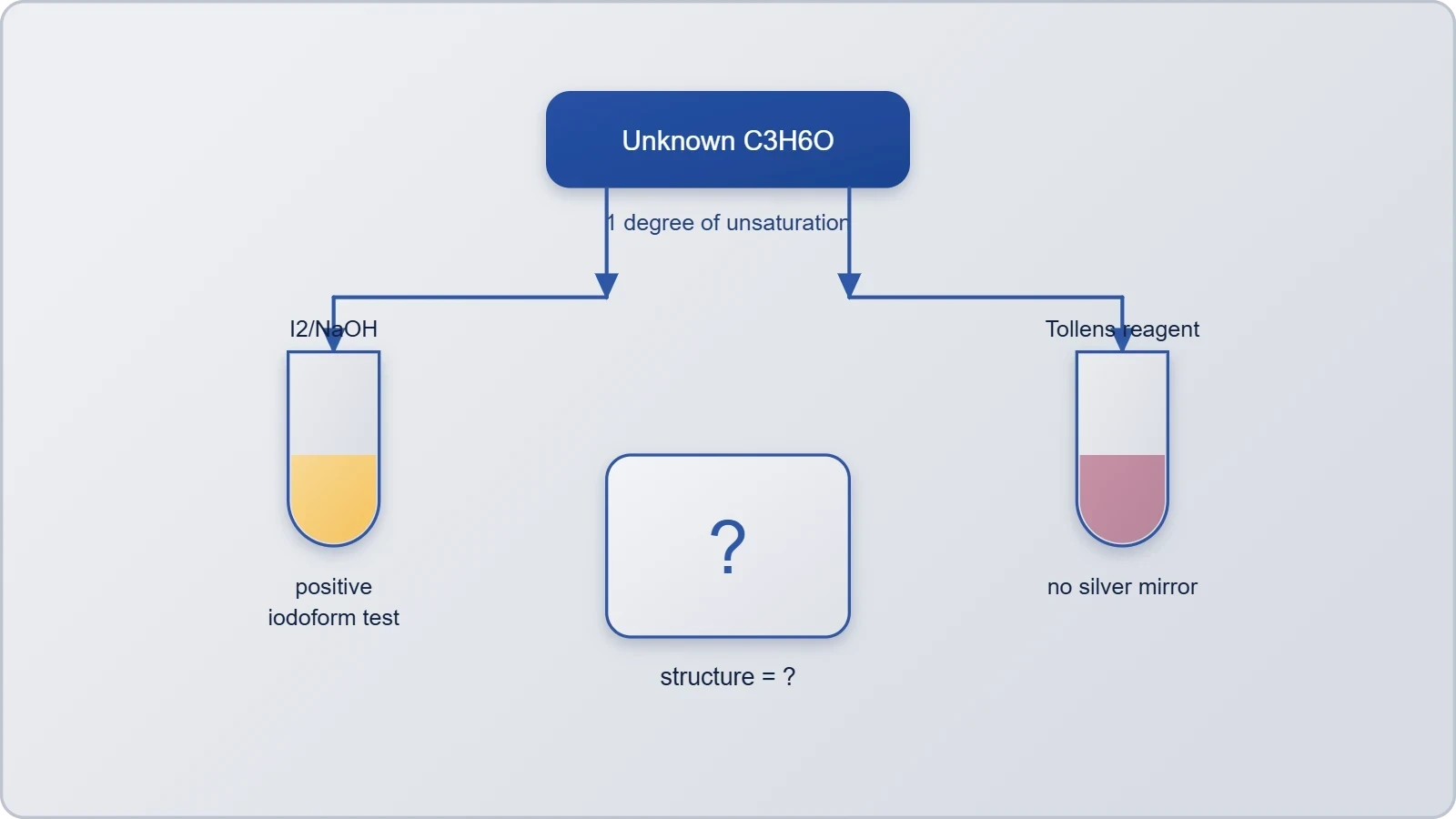
Suppose an unknown compound ##\ce{C3H6O}## gives a positive iodoform test and does not reduce Tollens' reagent. The molecular formula indicates one degree of unsaturation, consistent with a carbonyl. A positive iodoform test requires a ##\ce{CH3CO{-}}## unit, and failure to reduce Tollens' reagent rules out an aldehyde. The only structure satisfying all constraints is acetone, ##\ce{CH3COCH3}##. This short deduction illustrates how chemical tests, functional group analysis, and structural reasoning combine. In examinations, always state the inference drawn from each test before naming the compound, so that partial credit is secured even if the final name is wrong.
A second example concerns distinguishing benzaldehyde from acetophenone. Both are aromatic carbonyls, but only benzaldehyde reduces Tollens' reagent and Fehling's solution, because it retains an aldehydic hydrogen. Acetophenone, a methyl ketone, gives a positive iodoform test instead. The pair therefore separates cleanly on two simple tests. Beyond the examination, the same logic explains why aromatic aldehydes are used as reducing agents in some industrial processes while aromatic ketones are preferred as stable solvents and intermediates. Structure, reactivity, and application form a single continuous chain of reasoning.

Advanced Insight: Substituent Effects on Industrial Behaviour
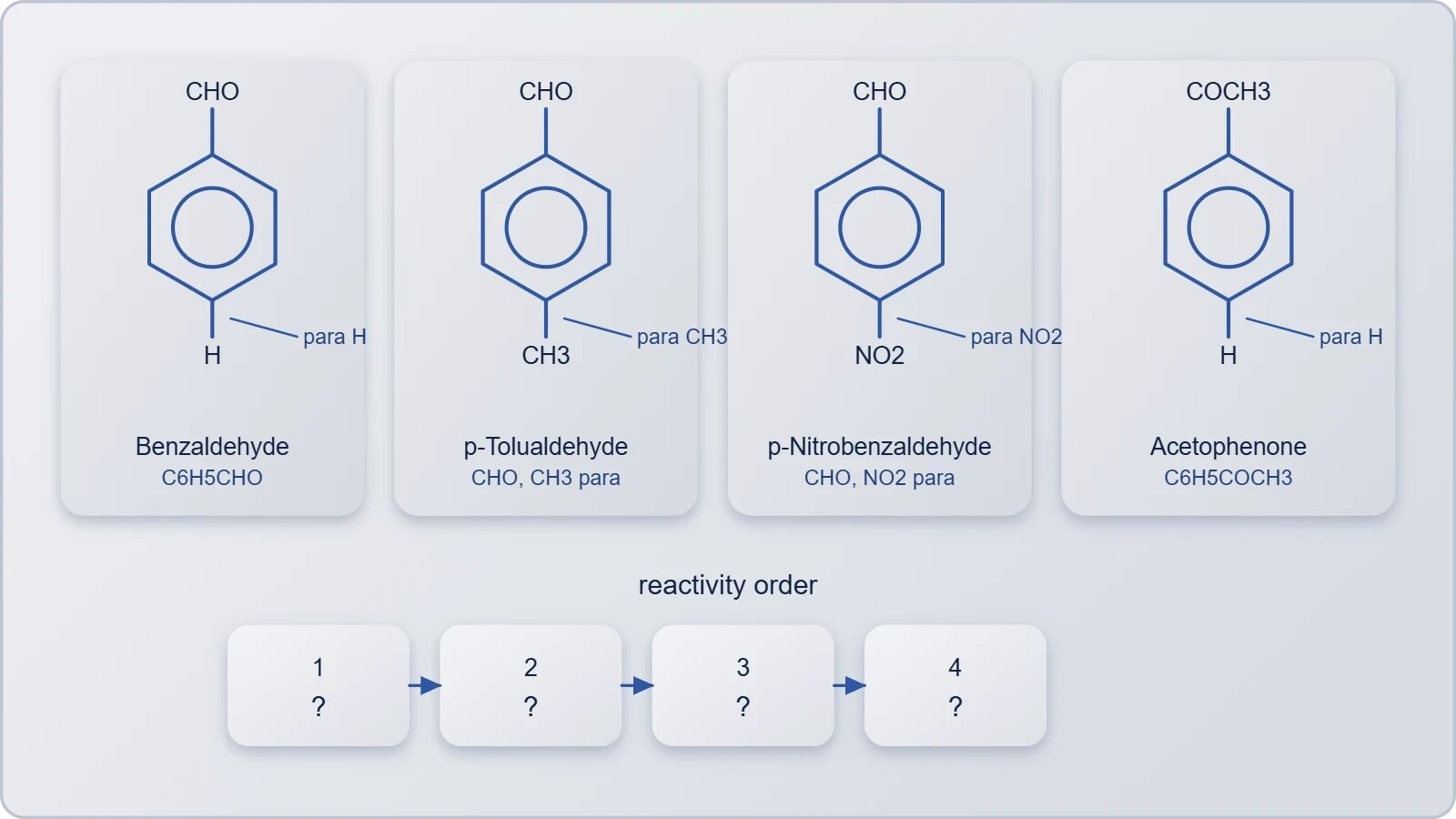
Substituents on the aromatic ring alter both reactivity and stability, and this matters commercially. Electron-withdrawing groups such as nitro increase the electrophilicity of the carbonyl carbon, accelerating nucleophilic addition, while electron-donating groups such as methyl or methoxy reduce it. In the standard exercise, benzaldehyde, p-tolualdehyde, p-nitrobenzaldehyde and acetophenone are arranged by reactivity, and the correct order reflects both electronic and steric effects. Such reasoning guides the choice of aldehyde for a condensation step in a synthesis, and it explains why some aromatic aldehydes oxidise readily in storage while others remain stable for years.
Steric effects are equally important. The two alkyl groups of a ketone shield the carbonyl carbon, which is why ketones are generally less reactive than aldehydes toward nucleophilic addition. This reduced reactivity is sometimes an advantage, allowing a ketone to survive conditions that would destroy an aldehyde. Industrial chemists exploit this selectivity when designing multi-step syntheses, protecting one carbonyl while transforming another. The lesson is that reactivity is not simply a hurdle to overcome but a tool to be used, and the same structural features that make a compound useful also make it predictable.
Consolidation: From Carbonyl Chemistry to Carboxylic Acids
This lesson has traced aldehydes and ketones from the reactor to the kitchen, the pharmacy, and the pathology laboratory. Formaldehyde builds resins and preserves tissue; acetaldehyde feeds the acetic acid chain; benzaldehyde perfumes and flavours; acetone and butanone dissolve; vanillin, camphor, and acetophenone delight the senses; haloperidol and retinal demonstrate the biological reach of the carbonyl group. The Maillard reaction shows the same chemistry browning our food, and the green-chemistry discussion shows how hazard awareness must accompany every application. Together these threads demonstrate that functional group chemistry is the grammar of the material world.
The next lesson turns to carboxylic acids, where the carbonyl group acquires a hydroxyl neighbour and a new set of properties emerges. The acidity of the carboxyl group, the effect of substituents on that acidity, and the interconversion of acids with their derivatives all build on the reactivity patterns established here. Students who understand why aldehydes oxidise readily will immediately grasp why carboxylic acids are the stable end point of that oxidation. The conceptual bridge is short, and crossing it confidently depends on the industrial and biological context developed in this lesson.
Before moving on, consolidate the three industrial roles, the named compounds and their uses, the safety profile of formaldehyde, the Maillard reaction, and the principles of green solvent selection. Practise writing short, structured answers that name a compound, describe its application, and explain the chemistry. That habit, more than any list of facts, is what distinguishes a student who has understood the chapter from one who has merely read it. The carbonyl group is a small structural feature with an enormous commercial and biological footprint, and recognising it everywhere is the mark of a genuinely trained chemist.
From our network :
- 98% of Global MBA Programs Now Prefer GRE Over GMAT Focus EditionExplore why 98% of global MBA programs now prefer the GRE over GMAT Focus. Learn about the shorter GRE format, verbal logic importance, and strategic versatility for students.
- 10 Physics Numerical Problems with Solutions for IIT JEEPrepare for IIT JEE with 10 physics numerical problems, complete with detailed solutions and conceptual explanations. Ideal for mastering kinematics, thermodynamics, electromagnetism, and optics.
- Do You Need a New Router or Is Your Internet Plan the Problem?A practical comparison of the signs that point to router limits versus signs your broadband speed or provider is the bottleneck, so you can decide what to replace before spending money.
- How to Print Cheaply: Cutting the Cost per PageA practical, measured guide to lowering what each printed page costs — duplex and draft modes, third-party ink, yield mathematics, and knowing when a new printer beats refills.
- AI-Powered 'Precision Diagnostic' Replaces Standard GRE Score ReportsDiscover the new GRE Precision Diagnostic. Learn how AI-powered behavioral analytics and time-to-solve tracking are replacing standard GRE score reports to empower students.
- Where to Put Your Wireless Router for Better CoverageA practical, physics-grounded guide to router placement: why the centre of the home beats the corner, how walls and metal sap signal, and how to run a simple survey that proves the improvement.
- Analyzing Trump Deportation Numbers Insights Into The 2026 Immigration Crackdown
- Trump Political Strategy How Geopolitical Stunts Serve As Media Diversions
- EV 2.0: The Solid-State Battery Breakthrough and Global Factory ExpansionDiscover the impact of the Solid-State Battery Breakthrough on the EV market. Learn about CATL and BYD stock growth, global factory expansion in Europe, and the future of EV 2.0 technology.