Carboxylic acids occupy a distinctive position among organic molecules because a single functional group, ##\ce{-COOH}##, conceals two chemically opposite sites of reactivity. The ##\ce{O-H}## bond behaves like a weak acid, surrendering a proton to form a resonance-stabilised carboxylate anion, while the ##\ce{C-OH}## bond behaves like an acylating centre, allowing the hydroxyl group to be replaced by alkoxide, chloride, ammonia or another carboxylate. Understanding this duality is the intellectual hinge on which the entire carbonyl chapter turns, and it is precisely the distinction that separates a competent examination answer from a genuinely confident one.

This lesson examines both cleavage pathways in sequence. It begins with the acid–base chemistry of the ##\ce{O-H}## bond, revisits the structural logic behind ##\mathrm{p}K_a## values, and then moves decisively into the nucleophilic acyl substitution reactions that define the ##\ce{C-OH}## bond: anhydride formation, Fischer esterification, conversion to acid chlorides and amidation. Along the way, the discussion extends beyond the textbook core into the mechanism of esterification in fine detail, the role of coupling agents such as DCC, the industrial synthesis of aspirin and polyesters, and the biological significance of amide bonds in peptides and proteins.
Because the preceding lesson established why carboxylic acids are more acidic than alcohols and phenols, the treatment here deliberately builds forward rather than repeating that ground. The emphasis falls on mechanism, on the practical consequences of leaving-group ability, and on the diagnostic reasoning that lets a student predict which bond will break under which conditions. Reduction, decarboxylation and ##\alpha##-halogenation are reserved for the following lesson, so the boundary between the two is kept clean and purposeful.
On This Page
The O-H Bond: Salt Formation and the Chemistry of Acidity
The ##\ce{O-H}## bond of a carboxylic acid is polarised by the adjacent carbonyl group, and this polarisation is what makes proton loss energetically accessible. When ##\ce{RCOOH}## dissolves in water, it dissociates to give the carboxylate anion ##\ce{RCOO-}## and the hydronium ion ##\ce{H3O+}##, and the equilibrium constant for this process is the acid dissociation constant ##K_a##. Because the carboxylate ion is stabilised by two equivalent resonance structures in which the negative charge resides on electronegative oxygen atoms, the conjugate base is unusually comfortable, and the parent acid is correspondingly willing to donate its proton.
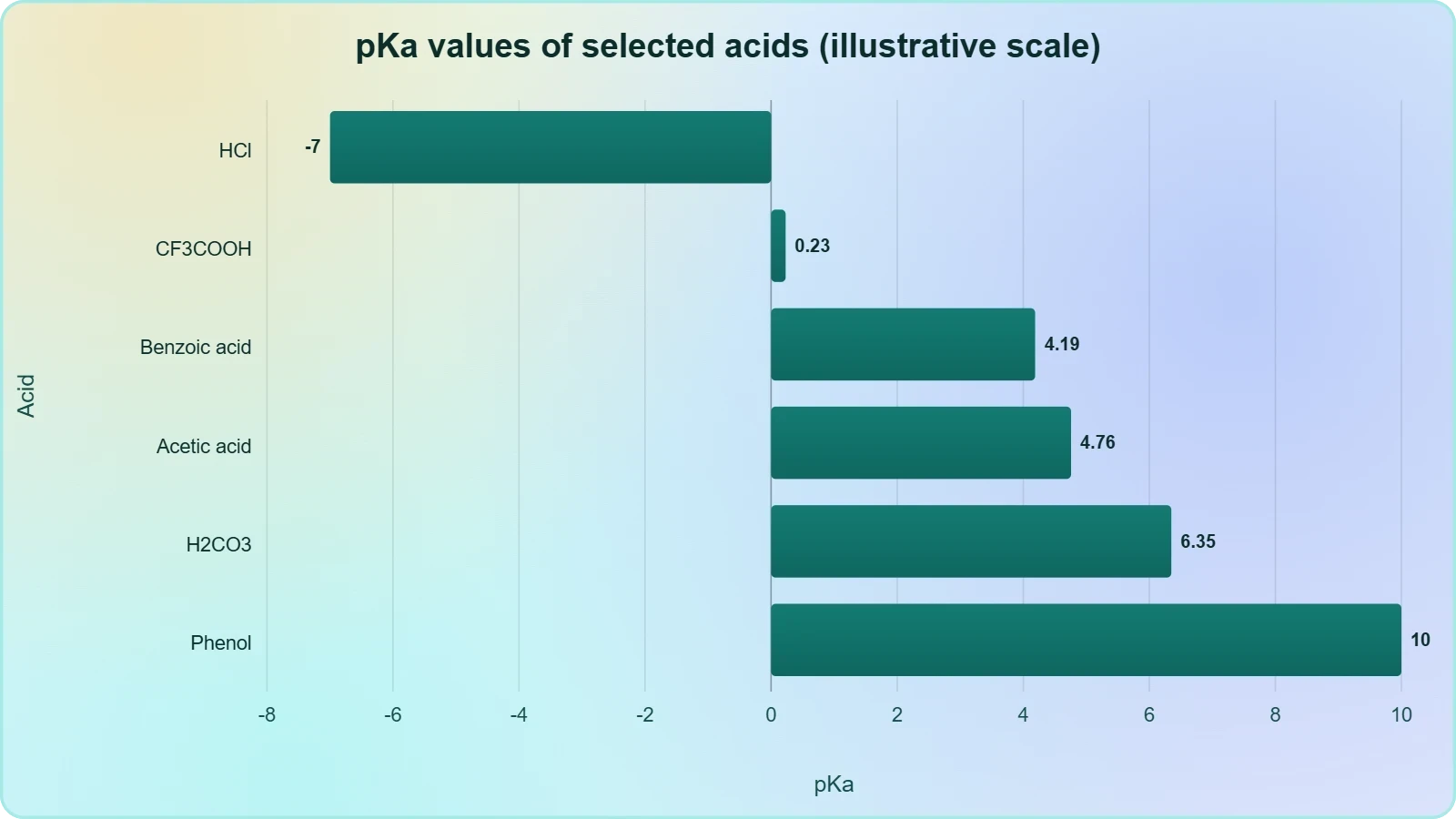
For convenience, acid strength is expressed as ##\mathrm{p}K_a = -\log K_a##, and the smaller the value, the stronger the acid. Hydrochloric acid has a ##\mathrm{p}K_a## of about ##-7.0##, trifluoroacetic acid, the strongest simple carboxylic acid, sits at 0.23, benzoic acid at 4.19 and acetic acid at 4.76. Strong acids have ##\mathrm{p}K_a < 1##, moderately strong acids fall between 1 and 5, weak acids between 5 and 15, and extremely weak acids above 15. Ethanol, at roughly 16, and phenol, at about 10, illustrate why carboxylic acids rank among the most acidic organic compounds encountered at this level.
Reactions with Metals, Alkalies and Carbonates
Carboxylic acids evolve hydrogen gas with electropositive metals such as sodium, magnesium and zinc, forming the corresponding carboxylate salt. They also neutralise alkalies in the manner of phenols, but they differ from phenols in one diagnostically vital respect: they react even with weaker bases such as sodium carbonate and sodium hydrogencarbonate, liberating carbon dioxide. This effervescence is the classical test for a carboxyl group in an unknown organic compound, and it distinguishes a carboxylic acid cleanly from a phenol, which cannot displace carbon dioxide from hydrogencarbonate.
The salt-forming reaction is also the basis of several practical preparations. Sodium benzoate, the sodium salt of benzoic acid, is a widely used food preservative, while sodium acetate finds use in buffer systems and in the synthesis of acetic anhydride. Calcium and potassium salts of carboxylic acids appear in pharmaceutical formulations where aqueous solubility must be improved without altering the parent acid's biological behaviour. In each case, the transformation is a simple proton transfer, reversible and rapid, requiring no catalyst and no heat.
Substituent Effects on Acid Strength
Anything that stabilises the carboxylate anion strengthens the acid, and anything that destabilises it weakens the acid. Electron-withdrawing groups delocalise the negative charge through inductive or resonance effects and therefore increase acidity, while electron-donating groups concentrate charge and decrease it. The inductive effect order for halogens and related groups is ##\ce{Ph < I < Br < Cl < F < CN < NO2 < CF3}##, and this ordering translates directly into the observed acidity sequence of substituted acetic acids.
The resulting hierarchy is instructive: ##\ce{CF3COOH > CCl3COOH > CHCl2COOH > NO2CH2COOH > NCCH2COOH > FCH2COOH > ClCH2COOH > BrCH2COOH > HCOOH > ClCH2CH2COOH}##. Note how the effect decays with distance, so that ##\ce{ClCH2CH2COOH}## is barely more acidic than formic acid itself. Among aromatic acids, ##\ce{C6H5COOH > C6H5CH2COOH > CH3COOH > CH3CH2COOH}##, and a nitro group at the para position of benzoic acid lowers the ##\mathrm{p}K_a## to 3.41, whereas a methoxy group raises it to 4.46.

Anhydride Formation and the Logic of Leaving Groups
Turning from the acidic proton to the acyl carbon, the first reaction of the ##\ce{C-OH}## bond is dehydration to an anhydride. When a carboxylic acid is heated with a mineral acid such as concentrated ##\ce{H2SO4}## or with phosphorus pentoxide, two molecules condense with the loss of water to give the corresponding anhydride. The transformation is an equilibrium, and it is driven forward by removing water, which is why dehydrating agents are employed rather than simple heating alone in most laboratory procedures.
The reaction is most useful for dicarboxylic acids, where intramolecular dehydration produces a cyclic anhydride with particular ease. Succinic acid, on heating, gives succinic anhydride; glutaric acid gives glutaric anhydride; phthalic acid gives phthalic anhydride, an industrial intermediate of considerable importance in the manufacture of plasticisers and polyester resins. For monocarboxylic acids, the intermolecular anhydride is often volatile enough to be distilled from the reaction mixture, which provides a second practical driving force.
Mechanistic Picture of Dehydration
Mechanistically, the hydroxyl oxygen of one acid molecule attacks the protonated carbonyl carbon of a second, generating a tetrahedral intermediate that collapses by expelling water. The product is a mixed species in which one ##ce{-OH}## has been replaced by an ##ce{-OC(=O)R}## group, and this new group is itself an excellent leaving group. That observation is the key to understanding why anhydrides are such powerful acylating agents: the departing carboxylate is resonance-stabilised and therefore leaves readily, making anhydrides far more reactive than the parent acids.
This reactivity hierarchy, acid chloride greater than anhydride greater than ester greater than amide, governs the entire acyl substitution landscape. An acid chloride will acylate an amine, an alcohol or a carboxylate salt without difficulty; an anhydride requires mild warming; an ester needs acid or base catalysis; an amide is essentially inert under ordinary conditions. Students who internalise this ladder can predict reaction outcomes without memorising individual transformations, because the question simply becomes which leaving group is present and how stable it is.
Acid Chlorides as Activated Intermediates
The conversion of a carboxylic acid to an acid chloride is achieved with phosphorus pentachloride, phosphorus trichloride or thionyl chloride. Thionyl chloride is preferred in practice because the by-products, ##\ce{SO2}## and ##\ce{HCl}##, are both gaseous and escape the reaction mixture, leaving the acid chloride in unusually pure form. The reaction proceeds through a chlorosulfite intermediate that decomposes with loss of sulfur dioxide, and the evolution of gas provides a convenient visual indication that the transformation is proceeding.
Acid chlorides are among the most reactive carboxylic acid derivatives and serve as versatile synthetic hubs. Acetyl chloride reacts vigorously with water to regenerate acetic acid, with ethanol to give ethyl acetate, and with ammonia to give acetamide, in each case releasing hydrogen chloride. Benzoyl chloride, similarly, converts alcohols to benzoate esters and amines to benzamides, and it is the classical reagent in the Schotten–Baumann acylation, where the reaction is run in aqueous base to neutralise the ##\ce{HCl}## as it forms.
Fischer Esterification: Mechanism in Full
Esterification is the reaction of a carboxylic acid with an alcohol or phenol in the presence of a mineral acid catalyst such as concentrated ##\ce{H2SO4}## or dry ##\ce{HCl}## gas. The overall transformation is a nucleophilic acyl substitution, and its mechanism repays close study because it illustrates every principle of carbonyl reactivity in a single sequence. The reaction is reversible, and the equilibrium constant is usually close to unity, so practical yields depend on removing water or using an excess of one reactant.
The first step is protonation of the carbonyl oxygen, which increases the electrophilicity of the carbonyl carbon and invites nucleophilic attack. The alcohol then adds to this activated carbonyl, generating a tetrahedral intermediate in which the original carbonyl oxygen carries a proton and the incoming alkoxy group is bonded to carbon. This intermediate is the pivotal species: its subsequent fate determines whether an ester forms or the starting materials are simply regenerated.
From Tetrahedral Intermediate to Ester
Within the tetrahedral intermediate, a proton transfer converts the hydroxyl group into a ##\ce{-OH2+}## group. This is the decisive manoeuvre, because water is a far better leaving group than hydroxide, and the intermediate can now collapse by expelling a neutral water molecule while the carbonyl ##\pi## bond reforms. The product at this stage is a protonated ester, which simply loses a proton to give the neutral ester and regenerates the acid catalyst.
Two features of this mechanism deserve emphasis. First, the catalyst is genuinely catalytic: it is consumed in protonation and restored in the final deprotonation, so a small quantity suffices. Second, the reaction is an equilibrium, and Le Chatelier's principle governs the yield. In the laboratory, water is often removed by azeotropic distillation with a Dean–Stark apparatus, or the alcohol is used in large excess, and either strategy shifts the position of equilibrium towards the ester.

Coupling Agents and the DCC Alternative
Fischer esterification is unsuitable for acid-sensitive substrates, for thermally fragile alcohols, and for cases where the carboxylic acid and alcohol are precious. A modern alternative employs a coupling agent that activates the carboxyl group under mild, neutral conditions. Dicyclohexylcarbodiimide, universally abbreviated DCC, is the archetype: it reacts with the carboxylic acid to form an O-acylisourea, a highly reactive species that the alcohol can attack directly, with dicyclohexylurea precipitating as a by-product.
The elegance of DCC lies in its ability to promote ester and amide bond formation at room temperature without strong acid, which is precisely why it became indispensable in peptide synthesis. Related reagents such as EDC, which is water-soluble and generates a urea by-product that is easily removed, and HATU or HBTU, which are used with hindered or epimerisation-prone substrates, extend the same principle. In solid-phase peptide synthesis, coupling agents of this family allow amino acids to be joined one at a time with high fidelity.
Industrial Esters and the Synthesis of Aspirin
On an industrial scale, esters are produced in enormous quantities by direct esterification with continuous removal of water, or by transesterification, in which an ester is exchanged with an alcohol under acid or base catalysis. Ethyl acetate, butyl acetate and the phthalate esters are manufactured this way, the last serving as plasticisers for polyvinyl chloride. Biodiesel, a mixture of fatty acid methyl esters, is produced by transesterifying triglycerides with methanol, a process that converts renewable oils into a usable fuel.
Aspirin, or acetylsalicylic acid, illustrates ester chemistry in a pharmaceutical setting. Salicylic acid, which bears both a phenol and a carboxylic acid, is treated with acetic anhydride, and the phenolic hydroxyl is acetylated to give the ester. The reaction is an O-acylation rather than an O-H acid–base process, and it is typically catalysed by a trace of concentrated sulfuric acid. The product retains the carboxylic acid group, which is essential for its anti-inflammatory activity, while the acetyl group improves tolerability.
Amidation and the Biological Significance of Amides
Carboxylic acids react with ammonia to give the ammonium carboxylate salt, and heating this salt at high temperature drives dehydration to the corresponding amide. The direct route is limited by the harsh conditions required, so in practice amides are more often prepared from acid chlorides or anhydrides, which react with ammonia or amines under mild conditions. Acetyl chloride with ammonia gives acetamide immediately, and benzoyl chloride with methylamine gives N-methylbenzamide, both reactions releasing hydrogen chloride.
The amide bond is the single most important linkage in biochemistry. Amino acids are joined through ##\ce{C-N}## bonds formed between the carboxyl group of one residue and the amino group of the next, and the resulting polymer is a peptide or protein. The amide linkage is planar, with partial double-bond character arising from resonance between the carbonyl and the nitrogen lone pair, and this rigidity constrains the geometry of the polypeptide backbone in ways that ultimately determine protein folding.
Why Amides Resist Hydrolysis
The same resonance that gives the amide bond its rigidity also makes it chemically robust. The nitrogen lone pair is delocalised into the carbonyl, so the carbonyl carbon is less electrophilic than in an ester or acid chloride, and the amide nitrogen is a poor leaving group. Consequently, amides require strong acid or strong base and prolonged heating to hydrolyse, which is precisely why peptide bonds survive the aqueous environment of the cell long enough for proteins to function.
Enzymes circumvent this kinetic stability with proteases, which use catalytic residues to activate water and stabilise the tetrahedral intermediate. In the laboratory, peptide synthesis faces the mirror-image problem: forming an amide bond requires activation of the carboxyl group, which is exactly the role played by DCC and its successors. The interplay between stability and activation is therefore the central design tension in both biological and synthetic peptide chemistry.
Common Errors and Examination Traps
A frequent mistake is to confuse the two cleavage pathways when predicting products. Reagents such as ##\ce{NaHCO3}## and ##\ce{NaOH}## attack the ##\ce{O-H}## bond and give salts, leaving the acyl carbon untouched, whereas ##\ce{SOCl2}##, ##\ce{PCl5}## and alcohols under acid catalysis attack the ##\ce{C-OH}## bond. Students who write an ester when asked for the product with sodium hydroxide, or a salt when asked for the product with thionyl chloride, have misidentified which bond is breaking.
Another trap concerns the acidity of substituted benzoic acids. A phenyl or vinyl group attached directly to the carboxyl carbon increases acidity because the ##sp^2## carbon is more electronegative than an ##sp^3## carbon, even though resonance would suggest the opposite. Students who apply the resonance argument alone predict the wrong order. Finally, the reversibility of esterification is often forgotten: writing a single forward arrow for Fischer esterification is a mark-losing error, since the equilibrium must be acknowledged.
We Also Published
Worked Examples and Quantitative Reasoning
Applying these ideas to numerical and structural problems consolidates understanding far more effectively than memorising reaction lists. The examples below move from a straightforward ##\mathrm{p}K_a## comparison to a multi-step synthesis, and each is designed to model the reasoning a student should reproduce under examination conditions. The emphasis throughout is on justification: why a particular product forms, not merely what it is.
Consider first the comparison of acid strengths. Given ##\mathrm{p}K_a## values of 4.76 for acetic acid, 4.19 for benzoic acid and 0.23 for trifluoroacetic acid, the order of increasing acidity is acetic, benzoic, trifluoroacetic. The reasoning rests on the stability of the conjugate base: the three fluorine atoms withdraw electron density strongly by induction, dispersing the negative charge and making the trifluoroacetate ion exceptionally stable, while the phenyl ring in benzoate provides modest stabilisation through the ##sp^2## carbon.
Calculating the Degree of Dissociation
For a weak acid of concentration ##c## and dissociation constant ##K_a##, the degree of dissociation ##\alpha## satisfies the approximate relation ##K_a \approx c\alpha^2## when ##\alpha## is small. For acetic acid at ##0.1\ \mathrm{M}## with ##K_a = 1.8 \times 10^{-5}##, this gives ##\alpha \approx 1.34 \times 10^{-2}##, or about 1.34% dissociation. The corresponding ##\mathrm{pH}## is approximately 2.87, which confirms that even a moderately strong organic acid remains largely undissociated in dilute solution.

This calculation also explains why the hydrogencarbonate test works. The relevant comparison is between the acid strength of the carboxylic acid and that of carbonic acid, for which ##\mathrm{p}K_{a1} \approx 6.35##. Since acetic acid at 4.76 is stronger than carbonic acid, it can donate a proton to hydrogencarbonate, and the resulting carbonic acid decomposes to carbon dioxide and water. Phenol, at 10.0, is weaker and cannot accomplish this, which is the basis of the distinction.
A Multi-Step Conversion
Suppose the task is to convert ethanol into ethyl acetate using only inorganic reagents and a carboxylic acid. The sequence is straightforward: oxidise ethanol to acetic acid with acidified potassium dichromate, then esterify the acetic acid with a further quantity of ethanol in the presence of concentrated sulfuric acid. Alternatively, convert the acetic acid to acetyl chloride with thionyl chloride and treat it with ethanol, which proceeds rapidly at room temperature and avoids the equilibrium limitation of direct esterification.

The second route illustrates a general synthetic principle: when an equilibrium reaction gives poor conversion, replace it with a kinetically favourable pathway through a more reactive intermediate. The same logic underlies the use of acid chlorides and anhydrides throughout organic synthesis, and it explains why coupling agents such as DCC are valuable when the acid chloride route would damage other functional groups in the molecule.
Consolidating the Two Cleavage Pathways
The lesson's central insight can now be stated compactly. A carboxylic acid presents two reactive bonds, and the reagent determines which one is engaged. Brønsted bases, whether hydroxide, carbonate or hydrogencarbonate, seek the acidic proton and cleave the ##\ce{O-H}## bond, producing a carboxylate salt. Nucleophiles and dehydrating or chlorinating agents seek the acyl carbon and cleave the ##\ce{C-OH}## bond, producing anhydrides, esters, acid chlorides or amides. Recognising this dichotomy converts a long list of reactions into a single decision.
The mechanistic thread running through the second pathway is nucleophilic acyl substitution. In every case, a nucleophile adds to the carbonyl carbon to form a tetrahedral intermediate, which then collapses by expelling a leaving group. The identity of that leaving group, whether chloride, carboxylate, alkoxide or amide nitrogen, determines the reactivity of the derivative and the conditions required for the reaction to proceed. Mastery of this single template is worth more than memorising a dozen separate equations.
Looking Ahead to Reduction and Decarboxylation
The next lesson turns to reactions that engage the ##\ce{-COOH}## group as a whole rather than one of its bonds. Lithium aluminium hydride reduces carboxylic acids to primary alcohols, and diborane accomplishes the same transformation while leaving esters, nitro groups and halogens untouched, a selectivity that makes it valuable in complex syntheses. Sodium borohydride, by contrast, is too mild to reduce a carboxyl group at all, a distinction that frequently appears in examination questions.
Decarboxylation, the loss of carbon dioxide from a carboxylate, occurs when sodium salts are heated with soda lime, a mixture of sodium hydroxide and calcium oxide in a ##3:1## ratio, and it provides a route from a carboxylic acid to a hydrocarbon with one fewer carbon atom. Electrolytic decarboxylation of aqueous alkali metal carboxylates, known as Kolbe electrolysis, instead couples two alkyl groups and yields a hydrocarbon with twice the number of carbon atoms in the alkyl chain. Both reactions will be developed fully in the following lesson.
Practical Wisdom for the Laboratory and the Examination
In the laboratory, the choice between direct esterification and the acid chloride route depends on the sensitivity of the substrate and the scale of the operation. Direct esterification is cheap and simple but slow and equilibrium-limited; the acid chloride route is fast and high-yielding but requires careful handling of a moisture-sensitive reagent. Coupling agents such as DCC occupy a middle ground, offering mild conditions at the cost of a more expensive reagent and a urea by-product that must be removed.
In the examination, precision of language earns marks. State that esterification is reversible and acid-catalysed; note that thionyl chloride is preferred because its by-products are gaseous; explain that amides resist hydrolysis because of resonance delocalisation of the nitrogen lone pair. These are not decorative details but the substance of the chemistry, and they distinguish an answer that demonstrates understanding from one that merely recalls a name.
From our network :
- Where to Put Your Wireless Router for Better CoverageA practical, physics-grounded guide to router placement: why the centre of the home beats the corner, how walls and metal sap signal, and how to run a simple survey that proves the improvement.
- 10 Physics Numerical Problems with Solutions for IIT JEEPrepare for IIT JEE with 10 physics numerical problems, complete with detailed solutions and conceptual explanations. Ideal for mastering kinematics, thermodynamics, electromagnetism, and optics.
- 98% of Global MBA Programs Now Prefer GRE Over GMAT Focus EditionExplore why 98% of global MBA programs now prefer the GRE over GMAT Focus. Learn about the shorter GRE format, verbal logic importance, and strategic versatility for students.
- Trump Political Strategy How Geopolitical Stunts Serve As Media Diversions
- EV 2.0: The Solid-State Battery Breakthrough and Global Factory ExpansionDiscover the impact of the Solid-State Battery Breakthrough on the EV market. Learn about CATL and BYD stock growth, global factory expansion in Europe, and the future of EV 2.0 technology.
- How to Print Cheaply: Cutting the Cost per PageA practical, measured guide to lowering what each printed page costs — duplex and draft modes, third-party ink, yield mathematics, and knowing when a new printer beats refills.
- AI-Powered 'Precision Diagnostic' Replaces Standard GRE Score ReportsDiscover the new GRE Precision Diagnostic. Learn how AI-powered behavioral analytics and time-to-solve tracking are replacing standard GRE score reports to empower students.
- Do You Need a New Router or Is Your Internet Plan the Problem?A practical comparison of the signs that point to router limits versus signs your broadband speed or provider is the bottleneck, so you can decide what to replace before spending money.
- Analyzing Trump Deportation Numbers Insights Into The 2026 Immigration Crackdown