Carboxylic acids occupy a quiet but indispensable place in the chemistry of everyday life. Their defining ##\ce{-COOH}## group combines a carbonyl centre with a hydroxyl unit, and this dual character makes them simultaneously acidic, hydrogen-bonding, and structurally versatile. That single functional group underpins the sourness of vinegar, the preservation of food, the action of aspirin, the cleansing power of soap, and the metabolic chemistry that keeps every living cell running. Understanding their uses means seeing how molecular structure translates directly into function across food, industry, medicine, and biology.
This lesson builds deliberately on the reduction, decarboxylation, and substitution chemistry you have already studied. Where those reactions explained how carboxylic acids behave, this lesson explains why that behaviour matters commercially and biologically. We will move from the food industry through industrial manufacturing, pharmaceutical design, soap and detergent chemistry, cleaning products, and finally the central role of carboxylic acids in cellular respiration. Each application is grounded in the same structural logic: the acidity of the ##\ce{-COOH}## proton, the reactivity of the carboxyl carbon, and the hydrophobic character of long hydrocarbon chains.
By the end of this lesson you should be able to justify, rather than merely recall, why methanoic acid appears in leather tanning, why sodium benzoate preserves soft drinks, why ibuprofen is a carboxylic acid rather than an alcohol, and why the Krebs cycle would collapse without citrate, isocitrate, and the other carboxylate intermediates. These connections transform a list of uses into a coherent chemical narrative, and they prepare you directly for the integrated problems and advanced applications in the final lesson of this course.
On This Page
- Carboxylic Acids in the Food Industry: Preservation and Acidulation
- Industrial Applications: Textiles, Leather, Polymers and Perfumery
- Carboxylic Acids in Medicine and Pharmaceuticals
- Soaps, Detergents and the Chemistry of Cleaning
- Cleaning Products, Chelation and Everyday Chemistry
- Carboxylic Acids in Biology: Membranes and the Krebs Cycle
- Common Mistakes, Exam Strategy and Looking Ahead
Carboxylic Acids in the Food Industry: Preservation and Acidulation
The food industry relies on carboxylic acids for two distinct functions that are often confused: preservation and acidulation. Preservation works because a low pH suppresses microbial growth, and acidulation works because the same protons shape flavour, texture, and stability. The two effects share a common origin in the dissociation equilibrium ##\ce{RCOOH <=> RCOO- + H+}##, but they are optimised differently. A preservative must remain effective at the concentrations permitted by law, while an acidulant must taste clean and integrate into the product's sensory profile. Understanding this distinction explains why manufacturers choose particular acids for particular foods.
Preservatives: Benzoic, Sorbic and Propanoic Acids
Sodium benzoate, the sodium salt of benzoic acid, is one of the most widely used food preservatives, particularly in soft drinks, jams, and salad dressings. Its effectiveness depends on the equilibrium between the benzoate ion and the undissociated acid: it is the undissociated ##\ce{C6H5COOH}## molecule that penetrates microbial cell membranes and inhibits enzymes. Because this equilibrium shifts toward the active undissociated form as pH falls, sodium benzoate works best in acidic foods below about pH 4.5. This is a direct, practical consequence of acid–base equilibrium that you can reason about from first principles.

Sorbic acid and its potassium salt serve a similar role in cheese, baked goods, and beverages, while propanoic acid and its calcium and sodium salts are especially valued in bread because they inhibit mould and the bacterium responsible for rope spoilage. Propanoic acid is a short-chain fatty acid, and its antimicrobial action again depends on the undissociated molecule crossing the microbial membrane. These examples reinforce a general principle: the preservative power of a weak carboxylic acid is governed by ##\mathrm{pH}## and ##\mathrm{p}K_a##, not simply by concentration.
Acidulants: Citric, Lactic, Acetic and Malic Acids
Citric acid, a tricarboxylic acid, is the dominant acidulant in beverages, confectionery, and jams, prized for its bright, clean sourness and its ability to chelate metal ions that would otherwise catalyse oxidation and discolouration. Lactic acid contributes the characteristic tang of yoghurt and fermented foods, while malic acid provides the sharpness of apples and certain sweets. Acetic acid, in the form of vinegar, is used both as a flavouring and as a preservative in pickles and sauces. Each acid brings a distinct taste profile and buffering behaviour.
The choice among these acidulants is rarely arbitrary. Citric acid buffers effectively across a useful range and sequesters trace metals; lactic acid is mild and contributes to texture in dairy systems; acetic acid is volatile and pungent, which suits pickling but limits its use elsewhere. Ethanoic acid is explicitly used as a solvent and as vinegar in the food industry, and this dual role illustrates how a single compound can serve as both processing aid and flavour component. Recognising these trade-offs is exactly the kind of applied reasoning that examiners reward in extended answers.
Industrial Applications: Textiles, Leather, Polymers and Perfumery
Beyond food, carboxylic acids are workhorses of heavy and fine industry. Methanoic acid, the simplest carboxylic acid, is used in rubber, textile, dyeing, leather, and electroplating industries, where its acidity and reducing character are both exploited. Ethanoic acid serves as a solvent in industrial processes and as a chemical feedstock. Hexanedioic acid, a dicarboxylic acid, is the key monomer in the manufacture of nylon-6,6, while esters of benzoic acid lend their aromas to perfumery. These applications show how the carboxyl group's reactivity can be tuned by chain length and by the presence of a second functional group.
Methanoic Acid, Ethanoic Acid and Hexanedioic Acid
Methanoic acid is unusual among carboxylic acids because it also carries an aldehyde-like hydrogen on the carboxyl carbon, giving it reducing properties that simple acids lack. This is why it finds use in leather treatment, where it helps in deliming and pH adjustment, and in textile processing. Ethanoic acid, produced industrially by carbonylation of methanol, is a versatile solvent and the precursor to acetate esters, cellulose acetate, and vinyl acetate. Its role as vinegar in food is only one facet of a much broader industrial footprint.
Hexanedioic acid, commonly called adipic acid, is a dicarboxylic acid with the formula ##\ce{HOOC-(CH2)4-COOH}##. It reacts with hexamethylenediamine in a polycondensation to form nylon-6,6, a polyamide used in fibres, engineering plastics, and carpets. The reaction releases water as the amide bonds form, and the regular alternation of acid and amine units gives the polymer its strength and crystallinity. This is a striking example of how a small, simple dicarboxylic acid becomes the backbone of a major synthetic material.

Benzoic Acid Esters and Fine Chemicals
Esters of benzoic acid are used in perfumery, where their pleasant, fruity, or balsamic odours contribute to fragrances and flavourings. Methyl benzoate, for instance, has a sweet, fruity aroma, while other benzoate esters appear in floral accords. The esterification reaction you studied earlier, ##\ce{C6H5COOH + ROH <=> C6H5COOR + H2O}##, is the synthetic route to these compounds. The same chemistry that produces ethyl ethanoate in the laboratory produces the aroma chemicals of the fragrance industry, scaled up and carefully purified.
Benzoic acid itself is also a precursor to preservatives, plasticisers, and pharmaceutical intermediates. Its aromatic ring allows electrophilic substitution, though the carboxyl group is deactivating and meta-directing, a point emphasised in the study of aromatic carboxylic acids. This directing effect is not merely academic: it governs which substituted benzoic acids can be made efficiently and therefore which derivatives are commercially accessible. Industrial chemists exploit this regiochemistry when designing routes to substituted aromatic fine chemicals.
Carboxylic Acids in Medicine and Pharmaceuticals
Some of the most familiar medicines in the world are carboxylic acids. Aspirin, ibuprofen, naproxen, and many others contain a ##\ce{-COOH}## group that is central to their pharmacological action. The carboxyl group is not incidental: it often anchors the drug to its target enzyme, modulates solubility and absorption, and determines how the molecule is distributed in the body. Studying these drugs therefore reinforces the acid–base and structural principles you have already met, while showing how those principles translate into therapeutic effect and into the side effects that must be managed.
Aspirin, Ibuprofen and the Propionic Acid Class
Aspirin, or acetylsalicylic acid, is an ester of salicylic acid and acetic acid. It acts by acetylating a serine residue in the cyclooxygenase enzymes, thereby reducing the synthesis of prostaglandins that mediate pain, fever, and inflammation. Its carboxylic acid group contributes to its acidity and to its interaction with the enzyme active site. Because aspirin is an ester as well as an acid, it can hydrolyse in moist conditions to salicylic acid and acetic acid, which is why stored aspirin may smell of vinegar and why formulation stability matters.
Ibuprofen belongs to the propionic acid class of non-steroidal anti-inflammatory drugs. Its structure features a ##\ce{-CH(CH3)COOH}## unit attached to an aromatic ring, and the carboxyl group is essential for binding to cyclooxygenase. The molecule is chiral, and the active (S)-enantiomer is the more potent inhibitor, though the (R)-form can be converted in the body. This example connects carboxylic acid chemistry to stereochemistry and to the broader principle that drug design depends on precise molecular shape and functional group placement.
Acidity, Absorption and the Ionisation Trap
The acidity of a drug's carboxyl group influences how it is absorbed and distributed. In the acidic environment of the stomach, a carboxylic acid is largely protonated and uncharged, which can favour passage across lipid membranes. In the more basic environment of the blood, it is largely deprotonated and charged, which traps it in the circulation. This "ionisation trap" is a direct application of the Henderson–Hasselbalch relationship, ##\mathrm{pH} = \mathrm{p}K_a + \log\dfrac{[\ce{A-}]}{[\ce{HA}]}##, and it explains why the ##\mathrm{p}K_a## of a drug is a critical design parameter.
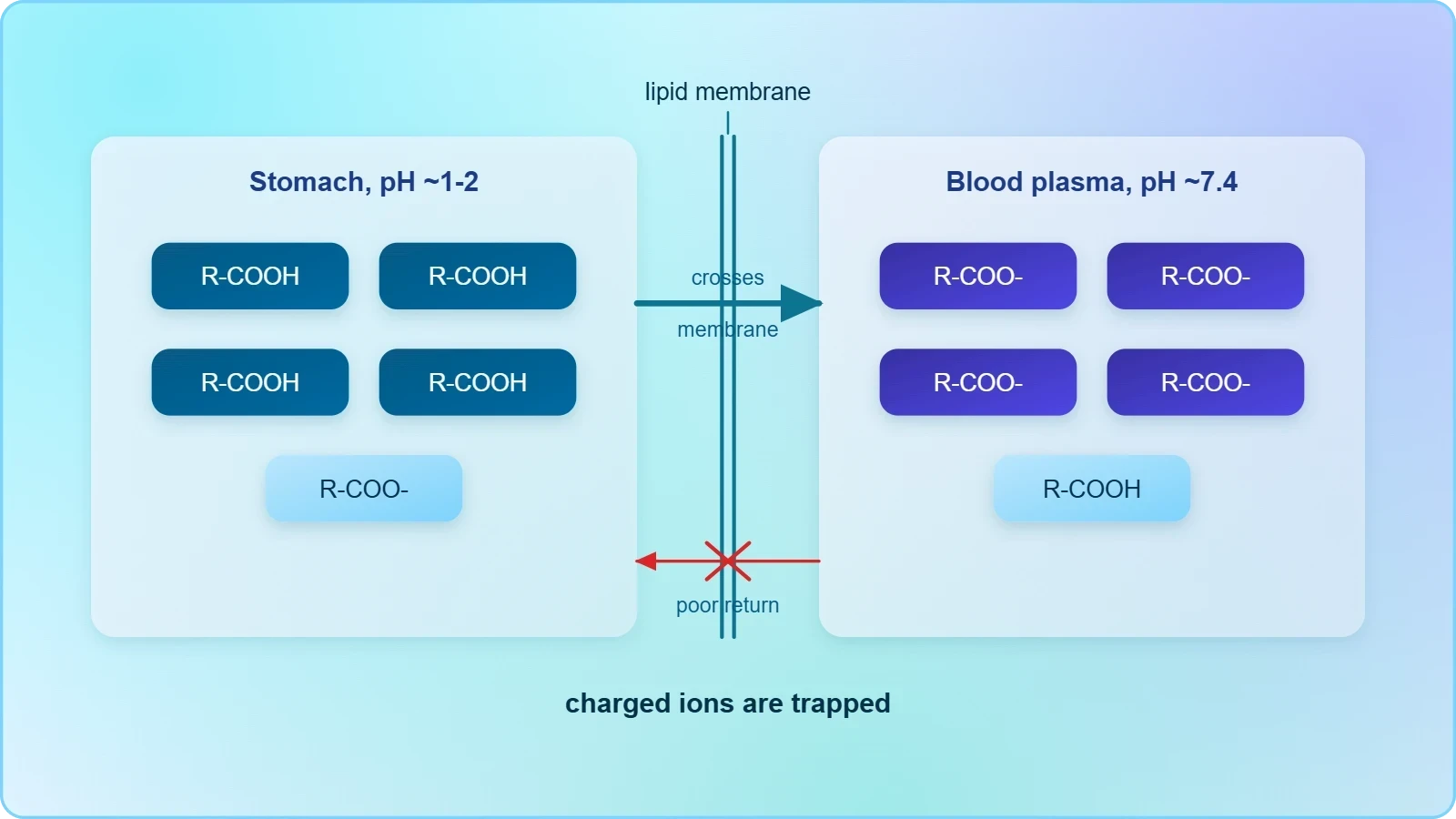
Understanding this equilibrium also explains why carboxylic acid drugs can irritate the stomach lining: their acidity and their ability to partition into gastric tissue contribute to local damage. Medicinal chemists therefore often modify the carboxyl group, for example by forming an ester prodrug that is hydrolysed after absorption, or by converting it to a salt to improve solubility. These strategies show that the same functional group can be tuned for delivery while retaining the pharmacophore needed for activity.
We Also Published
Soaps, Detergents and the Chemistry of Cleaning
Higher fatty acids are used for the manufacture of soaps and detergents, and this application is one of the oldest and most instructive examples of applied carboxylic acid chemistry. Soap is made by saponification, the alkaline hydrolysis of a triglyceride to give glycerol and the sodium or potassium salts of long-chain fatty acids. The resulting carboxylate salts are amphiphilic: they possess a long hydrophobic hydrocarbon tail and a hydrophilic carboxylate head. This dual nature is the physical basis of their cleansing action, and it follows directly from the structure of the fatty acid from which they are derived.
Saponification and the Structure of Soap
Saponification can be represented in simplified form as the reaction of a triglyceride with sodium hydroxide. A representative equation for a generic triglyceride is shown below, where ##\ce{R}## denotes a long hydrocarbon chain.
The product mixture is soap, and the carboxylate ion ##\ce{RCOO-}## is the active cleansing species. In water, soap molecules aggregate into micelles, with the hydrophobic tails clustered inward and the carboxylate heads facing the water. Grease and oil, being nonpolar, dissolve into the hydrophobic interior of the micelle, while the charged surface keeps the assembly dispersed in water. Rinsing carries the micelle and its trapped grease away, which is why soap removes oily stains that water alone cannot.

Hard Water, Scum and the Move to Detergents
Soap has a well-known limitation: in hard water, the carboxylate ions react with calcium and magnesium ions to form insoluble salts, often called scum. This wastes soap and leaves deposits on fabrics and surfaces. The reaction can be summarised as ##\ce{2RCOO- + Ca^2+ -> (RCOO)2Ca v}##, where the precipitate is the calcium salt of the fatty acid. This problem motivated the development of synthetic detergents, whose sulfonate or sulfate head groups remain soluble in hard water and do not form such precipitates.
Detergents are not carboxylic acids in the strict sense, but they are the direct descendants of soap chemistry and are frequently discussed alongside it. Their branched or linear hydrocarbon tails and sulfonate heads perform the same amphiphilic function while tolerating hard water. Understanding why soap fails in hard water, and why detergents succeed, is a valuable exercise in applying solubility rules and ionic equilibria to a real formulation problem. It also illustrates how a single limitation can drive an entire industry to redesign a molecule.
Cleaning Products, Chelation and Everyday Chemistry
Citric acid illustrates how a carboxylic acid can be useful far beyond food. Its three carboxyl groups make it a tricarboxylic acid, and its ability to chelate metal ions such as calcium, magnesium, and iron underlies its use in cleaning products, descalers, and water treatment. When citric acid binds a metal ion, it forms a soluble complex, preventing the metal from catalysing unwanted reactions or from forming scale. This chelating action is the same property that makes citric acid valuable in food, where it protects against metal-catalysed oxidation and discolouration.
Citric Acid as a Descaler and Chelating Agent
In household cleaning, citric acid dissolves limescale, the calcium carbonate deposit that accumulates in kettles, coffee machines, and bathroom surfaces. The reaction is an acid–carbonate neutralisation, producing a soluble citrate salt, carbon dioxide, and water. A simplified equation is ##\ce{CaCO3 + 2H+ -> Ca^2+ + CO2 + H2O}##, where the protons are supplied by the citric acid. Because citric acid is a weak acid, it acts more gently than strong mineral acids, which makes it safer for domestic use while still effective against carbonate scale.
Beyond descaling, citric acid appears in dishwasher detergents, surface cleaners, and laundry products, where it helps to sequester hardness ions and improve the performance of surfactants. It is also used to adjust pH in formulations and to remove rust and mineral stains. The versatility of citric acid stems from the combination of three carboxyl groups and a hydroxyl group on a small, water-soluble skeleton, allowing multiple points of interaction with metal ions and surfaces. This is a clear case where molecular structure directly determines practical function.
Everyday Products and Lesser-Known Uses
Carboxylic acids appear in many everyday products that students rarely associate with chemistry. Ethanoic acid is used in vinegar for cooking and cleaning; lactic acid appears in skincare products as a mild exfoliant; and salicylic acid is used in acne treatments because of its keratolytic action. Oxalic acid, a dicarboxylic acid, is used to remove rust stains, and tartaric acid contributes to the acidity of wine and some baking powders. Each of these uses depends on the acidity, chelating ability, or reactivity of the carboxyl group.
Even the smell of vinegar, the tang of citrus, and the fizz of an antacid tablet dissolving in water are connected to carboxylic acid chemistry. Recognising these connections helps students see chemistry as an explanatory framework rather than a list of isolated facts. The same functional group that appears in a textbook equation also appears in the kitchen, the bathroom cabinet, and the pharmacy shelf, and understanding its behaviour allows you to predict how these products will act and why they are formulated as they are.
Carboxylic Acids in Biology: Membranes and the Krebs Cycle
Carboxylic acids are not merely industrial and pharmaceutical molecules; they are fundamental to life. Fatty acids form the hydrophobic core of cell membranes, and carboxylate intermediates drive the Krebs cycle, the central pathway of cellular respiration. These biological roles connect directly to the chemistry you have studied: the acidity of the carboxyl group, the amphiphilic character of long-chain fatty acids, and the ability of carboxylates to participate in enzyme-catalysed reactions. Recognising these connections shows that the same functional group operates across the laboratory, the factory, and the living cell.
Fatty Acids and the Architecture of Cell Membranes
Fatty acids are long-chain carboxylic acids, typically with 12 to 20 carbon atoms, and they are the building blocks of phospholipids. In a phospholipid, two fatty acid chains are esterified to glycerol, while the third position carries a phosphate group linked to a polar head group. The resulting molecule is amphiphilic: the fatty acid tails are hydrophobic, and the phosphate head is hydrophilic. In water, phospholipids spontaneously assemble into bilayers, with the tails facing inward and the heads facing the aqueous environment on both sides.
This bilayer is the structural basis of every cell membrane. The hydrophobic core formed by the fatty acid tails acts as a barrier to polar and charged molecules, while proteins embedded in the bilayer carry out transport, signalling, and catalysis. The fluidity of the membrane depends on the length and saturation of the fatty acid chains: unsaturated chains with cis double bonds pack less tightly and increase fluidity. This is a direct structural consequence of fatty acid chemistry, and it explains why membrane composition adapts to temperature and environment.
The Krebs Cycle: Carboxylates at the Heart of Metabolism
The Krebs cycle, also called the citric acid cycle or tricarboxylic acid cycle, is a series of enzyme-catalysed reactions that oxidise acetyl-CoA to carbon dioxide while generating reduced coenzymes for the electron transport chain. Several of its intermediates are carboxylic acids or carboxylate anions. Citrate, formed when acetyl-CoA condenses with oxaloacetate, is a tricarboxylic acid; it is then isomerised to isocitrate, oxidatively decarboxylated to ##\alpha##-ketoglutarate, and further decarboxylated to succinyl-CoA. Succinate, fumarate, and malate are also carboxylates.
The cycle illustrates how carboxylate chemistry underpins energy metabolism. The decarboxylation steps release ##\ce{CO2}## and generate reduced ##\ce{NADH}##, which later drives ATP synthesis. The carboxyl groups of the intermediates are not passive spectators: they participate in binding to enzyme active sites, in the chemistry of decarboxylation, and in the regulation of flux through the pathway. When students learn the reactions of carboxylic acids, they are learning the same chemistry that operates in mitochondria, and this connection gives the topic a biological significance that extends far beyond the examination syllabus.
Common Mistakes, Exam Strategy and Looking Ahead
Students often lose marks on this topic not because they lack knowledge but because they confuse related ideas. A frequent error is to assume that all carboxylic acids are equally effective preservatives, ignoring the crucial role of ##\mathrm{pH}## and the undissociated acid. Another is to describe soap as an acid rather than a salt, or to forget that soap precipitates in hard water while detergents do not. A third is to treat the uses of carboxylic acids as a disconnected list rather than as consequences of structure. Correcting these misconceptions is as important as memorising the examples.
Frequent Errors and How to Avoid Them
One common mistake is to write that sodium benzoate itself is the active antimicrobial species. In fact, it is the undissociated benzoic acid formed at low pH that is most effective, so the salt is a convenient source of the acid in acidic foods. Another error is to claim that aspirin is a carboxylic acid only; it is also an ester, and its hydrolysis to salicylic acid and acetic acid explains its instability and its vinegar-like odour on ageing. Precision about functional groups prevents these errors and earns marks in structured questions.
A further pitfall is to confuse saponification with esterification. Saponification is the base-promoted hydrolysis of an ester or triglyceride, producing a carboxylate salt and an alcohol, whereas esterification is the acid-catalysed formation of an ester from a carboxylic acid and an alcohol. The two are reverse processes under different conditions, and describing them accurately demonstrates genuine understanding. Similarly, students should distinguish the chelating action of citric acid from simple neutralisation, since chelation involves coordination to a metal ion rather than mere proton transfer.
Preparing for Integrated Problems and Advanced Applications
This lesson has shown that the uses of carboxylic acids span food, industry, medicine, cleaning, and biology, and that each use can be traced back to structure and reactivity. The final lesson of the course will draw these threads together in integrated problems that combine nomenclature, preparation, reactions, acidity, and applications. To prepare, practise linking a given structure to its likely uses, and practise explaining a use in terms of the functional group involved. This habit of connecting structure to function is the single most valuable skill you can carry into advanced study.
As you revise, keep the reference examples close at hand: methanoic acid in rubber, textile, dyeing, leather, and electroplating; ethanoic acid as solvent and vinegar; hexanedioic acid in nylon-6,6; benzoate esters in perfumery; sodium benzoate as a food preservative; and higher fatty acids in soaps and detergents. Around these, build the wider context of pharmaceutical acids, chelating cleaners, membrane fatty acids, and Krebs cycle intermediates. Together they form a coherent picture of why carboxylic acids are among the most useful classes of organic compounds.
From our network :
- 98% of Global MBA Programs Now Prefer GRE Over GMAT Focus EditionExplore why 98% of global MBA programs now prefer the GRE over GMAT Focus. Learn about the shorter GRE format, verbal logic importance, and strategic versatility for students.
- AI-Powered 'Precision Diagnostic' Replaces Standard GRE Score ReportsDiscover the new GRE Precision Diagnostic. Learn how AI-powered behavioral analytics and time-to-solve tracking are replacing standard GRE score reports to empower students.
- 10 Physics Numerical Problems with Solutions for IIT JEEPrepare for IIT JEE with 10 physics numerical problems, complete with detailed solutions and conceptual explanations. Ideal for mastering kinematics, thermodynamics, electromagnetism, and optics.
- Do You Need a New Router or Is Your Internet Plan the Problem?A practical comparison of the signs that point to router limits versus signs your broadband speed or provider is the bottleneck, so you can decide what to replace before spending money.
- How to Print Cheaply: Cutting the Cost per PageA practical, measured guide to lowering what each printed page costs — duplex and draft modes, third-party ink, yield mathematics, and knowing when a new printer beats refills.
- Analyzing Trump Deportation Numbers Insights Into The 2026 Immigration Crackdown
- EV 2.0: The Solid-State Battery Breakthrough and Global Factory ExpansionDiscover the impact of the Solid-State Battery Breakthrough on the EV market. Learn about CATL and BYD stock growth, global factory expansion in Europe, and the future of EV 2.0 technology.
- Where to Put Your Wireless Router for Better CoverageA practical, physics-grounded guide to router placement: why the centre of the home beats the corner, how walls and metal sap signal, and how to run a simple survey that proves the improvement.
- Trump Political Strategy How Geopolitical Stunts Serve As Media Diversions