Building an aldehyde or a ketone from a simpler molecule is one of the most instructive exercises in organic synthesis, because every route carries a hidden lesson about selectivity. The carbonyl group is reactive, and the very reactivity that makes it valuable also makes it fragile: a careless oxidant will push an aldehyde all the way to a carboxylic acid, and a careless hydride will reduce an acid chloride past the aldehyde stage into an alcohol. The methods surveyed in this lesson are therefore not a random catalogue but a set of controlled compromises, each engineered to stop the reaction at exactly the right oxidation level.

This lesson sits deliberately between two neighbours. The previous session established why the carbonyl carbon is electrophilic and why the ##\ce{C=O}## bond is polarised; that electronic picture now becomes a design tool, because every preparation method below is essentially a way of generating or preserving that electrophilic centre. The next lesson will examine the physical properties that follow from the same polarity. Here, the focus is purely on construction: oxidation, dehydrogenation, ozonolysis, alkyne hydration, and the named reactions — Rosenmund, Stephen, Etard, Gattermann–Koch and Friedel–Crafts acylation — that examiners return to year after year.
What separates a competent answer from an excellent one is mechanistic fluency. A student who writes "Rosenmund reduction converts acid chlorides to aldehydes" has memorised a fact; a student who explains that ##\ce{BaSO4}## deliberately poisons the palladium catalyst to prevent over-reduction has understood the chemistry. Throughout this lesson, each transformation is paired with its mechanism, its selectivity logic, its industrial context and its common failure points, so that the material can be reconstructed from first principles rather than recalled by rote.
On This Page
- Oxidation and Dehydrogenation of Alcohols: The Foundational Routes
- From Hydrocarbons: Ozonolysis and Alkyne Hydration
- Rosenmund Reduction and the Chemistry of Controlled Poisoning
- Aromatic Aldehydes: Etard, Gattermann–Koch and Side-Chain Routes
- Ketone Synthesis: Acyl Chlorides, Nitriles and Grignard Chemistry
- Worked Examples, Common Mistakes and Advanced Insights
- Consolidating the Routes: A Synthesis Decision Framework
Oxidation and Dehydrogenation of Alcohols: The Foundational Routes
The oxidation of alcohols remains the most direct and most widely examined route to carbonyl compounds, and it follows a simple oxidation-level logic. A primary alcohol sits one oxidation step below an aldehyde, while a secondary alcohol sits one step below a ketone; tertiary alcohols have no hydrogen on the carbinol carbon and therefore resist oxidation under normal conditions. The choice of oxidant determines whether the reaction stops cleanly at the aldehyde or continues to the carboxylic acid, and that choice is the single most important decision in the entire procedure.
Dehydrogenation offers a complementary, catalyst-driven approach. Alcohol vapour is passed over a heated metal catalyst, typically silver or copper, and hydrogen is eliminated rather than abstracted by a chemical oxidant. Because the method is suitable for volatile alcohols and produces a clean gaseous by-product, it has genuine industrial application, particularly where large volumes of simple aldehydes or ketones are required and where avoiding stoichiometric oxidant waste matters economically.

Selective Oxidation with PCC and Related Reagents
Pyridinium chlorochromate, ##\ce{C5H5NH+CrO3Cl-}##, commonly abbreviated PCC, is the reagent of choice when a primary alcohol must be converted to an aldehyde without over-oxidation. In aqueous acidic media, the aldehyde formed hydrates to a gem-diol, which is then oxidised further to the acid; PCC operates in anhydrous dichloromethane, so the hydrate never forms and the aldehyde survives. This is a textbook illustration of how solvent and water content, not merely the identity of the oxidant, control the reaction outcome.
By contrast, anhydrous ##\ce{CrO3}## in aqueous acid, or the classic Jones reagent, will oxidise a primary alcohol through to the carboxylic acid. For secondary alcohols the distinction matters less, since ketones cannot be oxidised further without breaking carbon–carbon bonds. Students should also recognise that PCC converts allylic and benzylic alcohols efficiently, and that it tolerates many functional groups that harsher chromium(VI) systems would destroy, which is why it appears so frequently in multi-step synthetic sequences.
Industrial Dehydrogenation and Its Economic Logic
Passing alcohol vapour over silver or copper at elevated temperature delivers the carbonyl compound and hydrogen gas, with no stoichiometric oxidant consumed and no heavy-metal waste stream to treat. Industrially this matters enormously: formaldehyde and acetone are commodity chemicals, and a catalytic route that avoids chromium or permanganate effluent is both cheaper and environmentally preferable. The reaction is endothermic and equilibrium-limited, so the hydrogen is usually swept away to drive conversion forward.
Students should note the parallel with laboratory oxidation rather than treating the two as unrelated. Both remove two hydrogen atoms overall from the carbinol carbon, one from the carbon and one from the oxygen; the difference lies in whether a chemical oxidant accepts those electrons or a hot metal surface simply releases them as ##\ce{H2}##. Recognising this equivalence makes the oxidation-level bookkeeping far more intuitive and prevents the common error of writing a dehydrogenation as though oxygen were somehow involved.
From Hydrocarbons: Ozonolysis and Alkyne Hydration
Carbon–carbon double and triple bonds are convenient entry points to carbonyl chemistry because they can be cleaved or hydrated with high predictability. Ozonolysis of an alkene, followed by reductive work-up with zinc dust and water, breaks the ##\ce{C=C}## bond and places a carbonyl on each former alkene carbon. Whether the products are aldehydes, ketones or a mixture depends entirely on the substitution pattern of the alkene, which makes this a reliable and highly examinable method for locating a carbonyl group at a known position.
Hydration of alkynes follows Markovnikov's rule and therefore discriminates sharply between substrates. Water addition to ethyne in the presence of ##\ce{H2SO4}## and ##\ce{HgSO4}## gives acetaldehyde, because the initial enol formed is the simplest possible one. Every other alkyne, having at least one alkyl substituent, gives a ketone. The intermediate enol tautomerises rapidly to the more stable carbonyl form, and that tautomerisation is the mechanistic heart of the transformation.
Ozonolysis: Predicting Products from Alkene Substitution
The reductive work-up is not optional decoration. Ozonolysis generates an ozonide intermediate, and if that ozonide is treated with hydrogen peroxide instead of zinc, the aldehydes produced are oxidised further to carboxylic acids. Zinc dust in water cleaves the ozonide reductively and preserves the aldehyde. This distinction between oxidative and reductive work-up is a favourite examination trap, and it reinforces the lesson's central theme: the same carbon skeleton can be delivered at different oxidation levels depending on the work-up chosen.
Consider 2-methylbut-2-ene. Cleavage of the double bond gives acetone from the more substituted carbon and acetaldehyde from the less substituted one, illustrating how a single alkene can yield two different carbonyl products. Students should practise drawing the alkene, inserting the cleavage line, and capping each fragment with oxygen before assigning names, because this mechanical discipline eliminates most errors in product prediction.

Alkyne Hydration and the Enol Pathway
When ethyne is hydrated, the enol ##\ce{CH2=CHOH}## forms transiently and tautomerises to ##\ce{CH3CHO}##. For propyne, Markovnikov addition places the hydroxyl on the more substituted carbon, giving the enol ##\ce{CH3C(OH)=CH2}##, which tautomerises to acetone. The rule is therefore simple and worth committing to memory: terminal alkynes other than ethyne give methyl ketones, while internal alkynes give ketones with the carbonyl flanked by the two original substituents.
The mercury(II) catalyst activates the alkyne toward nucleophilic attack by water, and the acid medium ensures the enol can tautomerise. Modern practice increasingly favours gold or other catalysts for environmental reasons, but the mechanistic logic is unchanged. A useful check is to verify that the total number of carbon atoms and the degree of unsaturation are conserved between starting material and product, which catches most careless errors immediately.
Rosenmund Reduction and the Chemistry of Controlled Poisoning
Acid chlorides are among the most reactive carbonyl derivatives, and reducing them cleanly to aldehydes requires a catalyst that is active enough to perform the hydrogenation but not so active that it continues to the alcohol. The Rosenmund reduction solves this with an elegant trick: palladium supported on barium sulphate, where the sulphate partially poisons the metal surface. This moderated activity allows the acid chloride to be hydrogenated to the aldehyde while leaving the aldehyde largely untouched, since aldehydes are reduced by palladium far more slowly than acid chlorides.
The mechanism proceeds through adsorption of the acid chloride onto the palladium surface, oxidative addition of the ##\ce{C-Cl}## bond, and reductive elimination of hydrogen to release the aldehyde and ##\ce{HCl}##. The hydrogen chloride produced can itself deactivate the catalyst, and in practice a small amount of catalyst poison or a controlled hydrogen flow is used to keep the reaction from running away. Boiling the reaction mixture is often necessary to drive the aldehyde off the catalyst surface before it can be reduced further.
Why BaSO4 Poisoning Works
Barium sulphate is essentially inert as a support but binds strongly enough to the palladium to occupy a fraction of the active sites. This reduces the surface concentration of dissociated hydrogen, so the aldehyde, once formed, desorbs faster than it can be re-adsorbed and reduced. The technique is a classic example of selectivity achieved through kinetic control rather than thermodynamic preference, and it generalises to many catalytic hydrogenations where over-reduction is a problem.
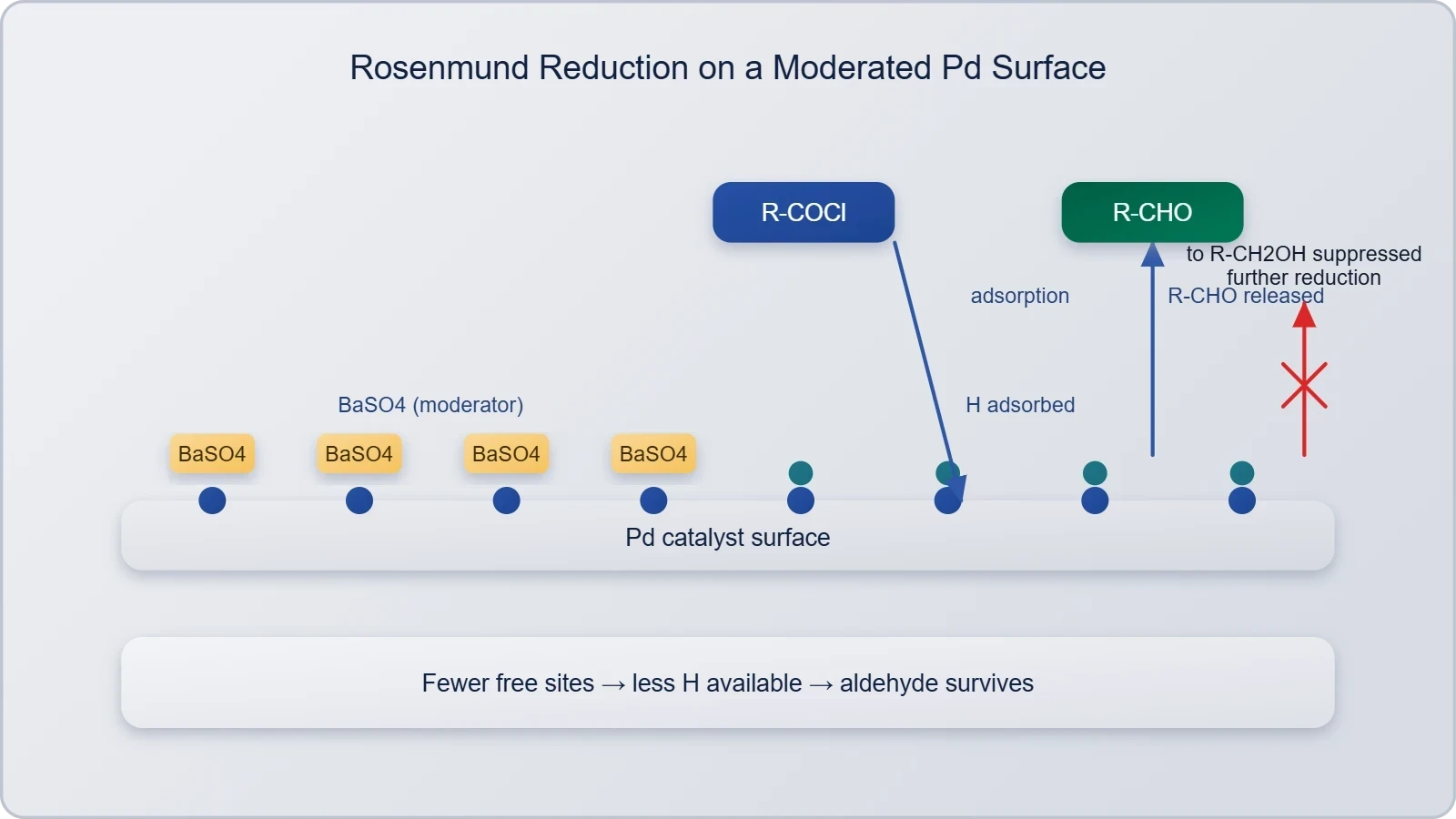
A common examination error is to describe the ##\ce{BaSO4}## as a "catalyst promoter" or to omit it entirely. Neither is correct. It is a moderator, deliberately included to suppress the second reduction step. Students should also remember that Rosenmund reduction is specific to acid chlorides; it does not convert carboxylic acids or esters to aldehydes, and it fails on substrates containing groups that poison palladium irreversibly, such as thiols or certain sulfur heterocycles.
Stephen Reduction and the Nitrile Route
Nitriles offer a second controlled path to aldehydes. Treatment with stannous chloride in hydrochloric acid reduces the nitrile to an imine, which hydrolyses on work-up to the aldehyde; this is the Stephen reaction. The imine intermediate is the key: because the carbon–nitrogen double bond is less readily reduced than the nitrile triple bond, the reaction halts at the aldehyde stage rather than continuing to the amine, provided the acid hydrolysis is performed carefully.
A more modern and far more selective alternative uses diisobutylaluminium hydride, DIBAL-H, which delivers a hydride to the nitrile carbon and generates an imine that hydrolyses to the aldehyde. The same reagent reduces esters to aldehydes at low temperature, because the tetrahedral intermediate collapses only on aqueous work-up. This temperature dependence is a beautiful example of how reaction conditions, not just reagents, define selectivity.
DIBAL-H versus LiAlH4: A Selectivity Comparison
Lithium aluminium hydride is a powerful, unselective reducing agent. It converts esters, acid chlorides and nitriles all the way to alcohols or amines, because the intermediate aluminium alkoxide is itself reduced further. DIBAL-H, by contrast, is a bulky, electrophilic hydride donor that transfers a single hydride and then stalls, especially at low temperature, allowing the aldehyde to be released only upon hydrolysis. The contrast is one of the most important selectivity lessons in the entire carbonyl chapter.

Practically, DIBAL-H is used at around ##-78\ ^\circ\mathrm{C}## in toluene or dichloromethane, and the reaction is quenched with aqueous acid or a mild proton source. Students should be able to predict that an ester ##\ce{RCOOR'}## treated with excess ##\ce{LiAlH4}## gives ##\ce{RCH2OH}##, whereas the same ester with one equivalent of DIBAL-H at low temperature gives ##\ce{RCHO}##. This single comparison answers a large fraction of examination questions on controlled reduction.
We Also Published
Aromatic Aldehydes: Etard, Gattermann–Koch and Side-Chain Routes
Benzaldehyde and its derivatives cannot be made by the simple aliphatic routes, because the aromatic ring changes both the available chemistry and the stability of the products. Three classical methods dominate. Oxidation of toluene with chromyl chloride, the Etard reaction, proceeds through a chromium complex that hydrolyses to benzaldehyde. Side-chain chlorination to benzal chloride followed by hydrolysis is the commercial manufacturing route. The Gattermann–Koch reaction introduces a formyl group directly onto the ring using carbon monoxide, hydrogen chloride and anhydrous aluminium chloride or cuprous chloride.
Each method reflects a different strategic idea. Etard and side-chain chlorination both functionalise an existing methyl group, so they require a methyl-substituted arene as starting material. Gattermann–Koch performs direct formylation and therefore works on benzene itself. Understanding which strategy applies to which substrate is more valuable than memorising the equations, because examination questions frequently present an unfamiliar arene and ask for a plausible route.
Etard Reaction and the Chromium Complex
Chromyl chloride, ##\ce{CrO2Cl2}##, reacts with toluene in carbon disulfide or dichloromethane to form a dark chromium complex at the methyl group. Hydrolysis of this complex liberates benzaldehyde. The genius of the method is that the methyl group is converted into an intermediate that resists further oxidation, so the reaction stops at the aldehyde rather than proceeding to benzoic acid, which is what strong oxidants such as hot ##\ce{KMnO4}## would deliver.
The Etard reaction is limited to methylarenes and works best on activated or neutral rings. Electron-poor rings react sluggishly, and the reagent is toxic and moisture-sensitive, so it is a laboratory method rather than an industrial one. Students should be able to write the overall transformation and explain why the chromium intermediate is the key to selectivity, rather than simply reciting the name.
Gattermann–Koch and Friedel–Crafts Acylation Compared
Both reactions are electrophilic aromatic substitutions mediated by a Lewis acid, but they install different groups. Gattermann–Koch installs a formyl group, ##\ce{-CHO}##, using carbon monoxide and hydrogen chloride, which together generate the formyl cation equivalent. Friedel–Crafts acylation installs an acyl group, ##\ce{-COR}##, using an acid chloride. The former gives aldehydes, the latter ketones, and both require an activated or at least neutral aromatic ring to proceed efficiently.
The critical limitation shared by both is failure on strongly deactivated rings. Nitrobenzene, for instance, does not undergo Friedel–Crafts acylation, because the Lewis acid catalyst coordinates to the nitro group and the ring is too electron-poor to attack the electrophile. Students should also note that Friedel–Crafts acylation avoids the polyalkylation problem of Friedel–Crafts alkylation, since the acyl group deactivates the ring toward further substitution.
Ketone Synthesis: Acyl Chlorides, Nitriles and Grignard Chemistry
Ketones occupy a middle oxidation level that is often easier to reach than aldehydes, because the carbonyl carbon bears no hydrogen and therefore cannot be oxidised further without bond cleavage. Three routes dominate the syllabus. Acyl chlorides react with dialkylcadmium reagents, themselves prepared from cadmium chloride and a Grignard reagent, to give ketones. Nitriles treated with a Grignard reagent followed by hydrolysis also yield ketones. And benzene or a substituted benzene treated with an acid chloride in the presence of anhydrous aluminium chloride undergoes Friedel–Crafts acylation.
The dialkylcadmium route deserves attention because it illustrates why organocadmium reagents were historically useful. Grignard reagents react with acid chlorides to give tertiary alcohols, since the ketone intermediate is itself attacked by a second equivalent of Grignard. Organocadmium compounds are far less reactive toward ketones, so the reaction stops cleanly at the ketone. Modern practice prefers organocuprates or Weinreb amides, but the selectivity principle is identical.
Grignard Additions to Nitriles and the Hydrolysis Step
A Grignard reagent adds to the nitrile carbon to give an imine salt, which on acidic hydrolysis yields a ketone. The carbon chain of the Grignard reagent becomes one of the two substituents on the carbonyl, while the original nitrile carbon becomes the carbonyl carbon itself. This makes the method a powerful way to assemble unsymmetrical ketones from two independently available fragments, and it is frequently tested in synthesis-design questions.
For example, ethanenitrile treated with methylmagnesium bromide followed by hydrolysis gives propanone. Students should practise mapping which carbon ends up where, because the bookkeeping is the main source of error. A useful habit is to label the nitrile carbon explicitly before and after the reaction, confirming that it has become the carbonyl carbon and that the Grignard alkyl group is now attached to it.

Friedel–Crafts Acylation: Scope and Its Hard Limits
Friedel–Crafts acylation is the standard route to aryl ketones such as acetophenone and benzophenone. The acid chloride and aluminium chloride generate an acylium ion, which attacks the aromatic ring. Because the acyl group is electron-withdrawing, the product ring is deactivated and further acylation does not occur, so the reaction is naturally mono-selective — a significant advantage over Friedel–Crafts alkylation, which suffers from polyalkylation and rearrangement.
The limitations are equally important. Strongly deactivated rings such as nitrobenzene fail entirely, and the reaction does not occur on rings bearing amino groups unless the amine is first protected, since the Lewis acid coordinates to nitrogen. Aniline therefore cannot be acylated directly under these conditions. Students should also remember that the reaction requires anhydrous conditions, because water destroys the aluminium chloride catalyst, and that it is incompatible with acid-sensitive functional groups.
Worked Examples, Common Mistakes and Advanced Insights
The transformation questions that appear in examinations almost always reduce to reagent selection rather than structure drawing. Hexan-1-ol to hexanal requires PCC in dichloromethane; cyclohexanol to cyclohexanone requires anhydrous ##\ce{CrO3}##; p-fluorotoluene to p-fluorobenzaldehyde requires ##\ce{CrO3}## in acetic anhydride, the Etard-type conditions; ethanenitrile to ethanal requires DIBAL-H; allyl alcohol to propenal requires PCC; and but-2-ene to ethanal requires ozonolysis followed by zinc and water. Each answer is a selectivity decision, not a memorised string.
Beyond the syllabus, students should appreciate that modern synthesis increasingly replaces stoichiometric chromium and mercury reagents with catalytic systems. Gold-catalysed alkyne hydration, TEMPO-based catalytic oxidations and enzymatic reductions all achieve the same transformations with far less waste. Recognising the underlying logic — control the oxidation level, control the selectivity, minimise the reagent burden — prepares students to understand why the classical methods are still taught even as greener alternatives displace them in practice.
Diagnosing the Most Frequent Errors
The single most common mistake is over-oxidation: using hot ##\ce{KMnO4}## or aqueous ##\ce{CrO3}## when an aldehyde is wanted, which delivers the carboxylic acid instead. The second is forgetting the reductive work-up in ozonolysis, which converts the intended aldehyde into an acid. The third is omitting the ##\ce{BaSO4}## moderator in Rosenmund reduction, which allows the aldehyde to be reduced further to the alcohol. Each error stems from the same root cause: ignoring the oxidation-level bookkeeping that governs the entire chapter.
A fourth frequent error concerns Friedel–Crafts acylation on deactivated or amino-substituted rings, where students write a product that cannot form. A fifth is confusing the Stephen and Rosenmund reductions, which use entirely different substrates and reagents. Careful students annotate every answer with the oxidation state of the carbonyl carbon before and after, which makes these mistakes almost impossible to commit under examination pressure.
Advanced Perspective: Selectivity as the Central Skill
Every method in this lesson is a study in selectivity. PCC versus Jones reagent, DIBAL-H versus ##\ce{LiAlH4}##, organocadmium versus Grignard, reductive versus oxidative ozonolysis — the pairs recur because the underlying problem recurs. A synthetic chemist does not ask "what reagent converts an alcohol to an aldehyde?" but "what reagent converts this alcohol to this aldehyde in the presence of these other groups?" That reframing is what distinguishes a student who has learned the chapter from one who can use it.
Looking ahead, the physical properties examined in the next lesson — boiling points, solubility and the characteristic carbonyl stretching frequency near ##1700\ \mathrm{cm^{-1}}## — follow directly from the polarised ##\ce{C=O}## bond established earlier. The methods of preparation described here determine which carbonyl compounds are readily available, and therefore which physical data students will most often encounter. The chapter is a single argument about electrophilicity, and preparation is simply the art of building that electrophilic centre where you want it.
Consolidating the Routes: A Synthesis Decision Framework
With the individual methods established, the final task is to organise them into a decision framework that can be applied to unfamiliar problems. The first question is always the oxidation level of the target: aldehyde, ketone or acid. The second is the availability of starting materials: alcohol, alkene, alkyne, acid chloride, nitrile or arene. The third is the presence of sensitive functional groups that restrict reagent choice. Answering these three questions in order narrows the field to one or two viable routes almost immediately.
This framework also explains why the chapter is structured as it is. Oxidation and dehydrogenation handle the alcohol-to-carbonyl step. Ozonolysis and alkyne hydration build carbonyls from unsaturated hydrocarbons. Rosenmund, Stephen and DIBAL-H deliver aldehydes from acid derivatives and nitriles. Etard, Gattermann–Koch and side-chain chlorination serve the aromatic aldehydes. Organocadmium, Grignard–nitrile and Friedel–Crafts acylation serve the ketones. Each family occupies a distinct strategic niche, and together they cover essentially every carbonyl compound a student will meet.
Building a Route from Retrosynthetic Logic
Retrosynthetic thinking reverses the question: instead of asking what a reagent does, ask what precursor would give the target. For an aldehyde, the precursor is usually a primary alcohol, an acid chloride, a nitrile or a methylarene. For a ketone, it is usually a secondary alcohol, an acid chloride with an organometallic, a nitrile with a Grignard, or an arene with an acid chloride. Working backwards in this way makes the forward synthesis almost self-evident and is far more reliable than trying to recall a list of reactions.
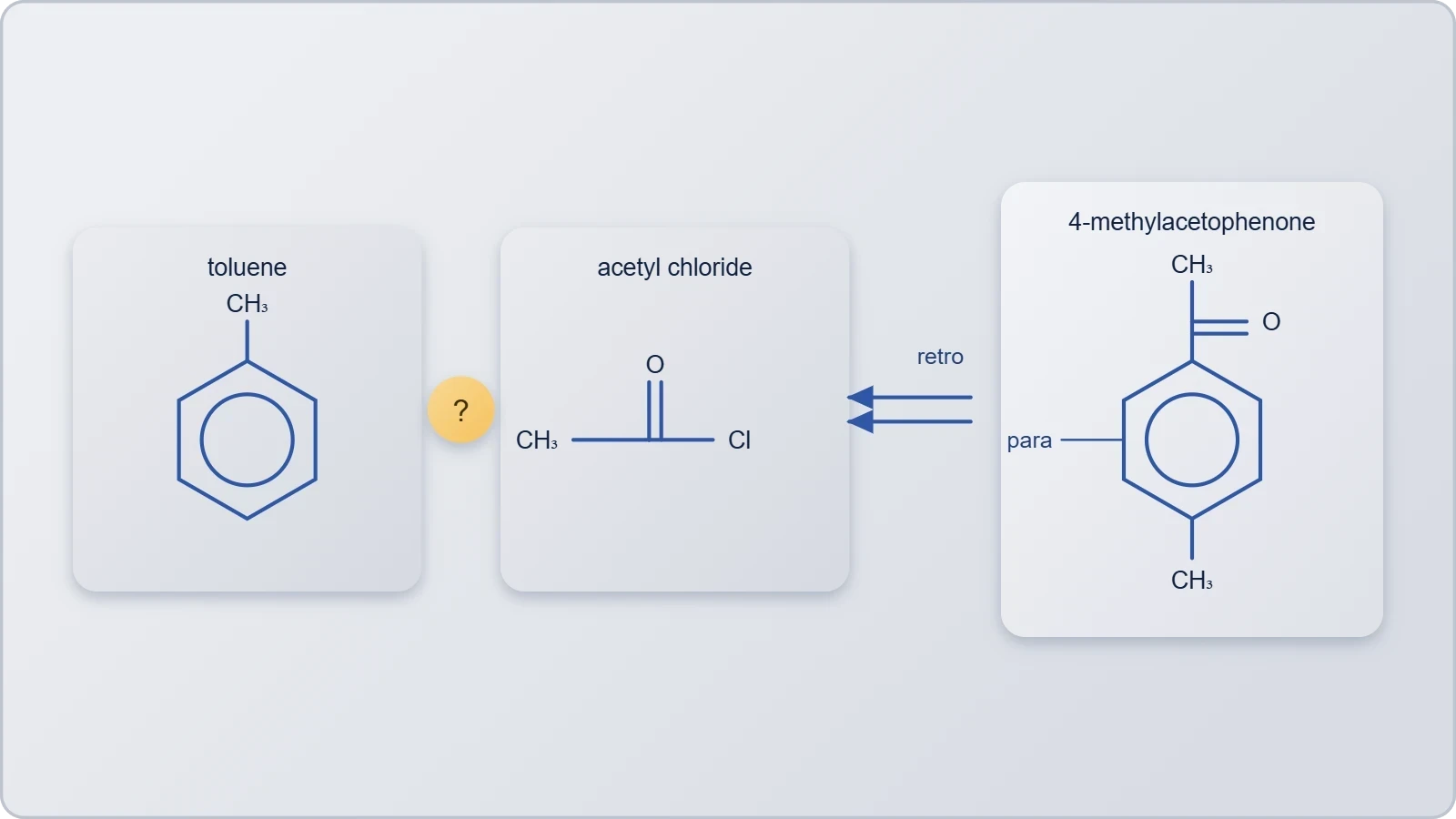
Students preparing for competitive examinations should practise this reversal on unfamiliar targets, because it exposes gaps in understanding that memorisation conceals. A target such as 4-methylacetophenone, for instance, is best approached by Friedel–Crafts acylation of toluene with acetyl chloride, since the methyl group directs the incoming acyl group to the para position. Deriving that answer from first principles is far more valuable than recalling it as a fact.
Connecting Forward to Physical Properties
The carbonyl compounds prepared by these methods share the polarised ##\ce{C=O}## bond whose consequences will occupy the next lesson. Boiling points rise with chain length and are higher than comparable ethers because of dipole–dipole interactions; lower members are water-soluble because the carbonyl oxygen accepts hydrogen bonds; and infrared spectroscopy shows a strong absorption near ##1700\ \mathrm{cm^{-1}}## whose exact position depends on conjugation and ring strain. None of this is arbitrary — it all traces back to the electronic structure established two lessons ago.
Understanding preparation therefore does more than supply reaction equations. It explains which compounds are readily available, why some are more stable than others, and how a synthetic chemist chooses among competing routes. The student who can move fluently between structure, preparation and property has genuinely internalised the chapter, and will find the remaining lessons on nucleophilic addition, aldol condensation and the Cannizzaro reaction far easier to absorb.
From our network :
- Trump Political Strategy How Geopolitical Stunts Serve As Media Diversions
- How to Print Cheaply: Cutting the Cost per PageA practical, measured guide to lowering what each printed page costs — duplex and draft modes, third-party ink, yield mathematics, and knowing when a new printer beats refills.
- EV 2.0: The Solid-State Battery Breakthrough and Global Factory ExpansionDiscover the impact of the Solid-State Battery Breakthrough on the EV market. Learn about CATL and BYD stock growth, global factory expansion in Europe, and the future of EV 2.0 technology.
- 10 Physics Numerical Problems with Solutions for IIT JEEPrepare for IIT JEE with 10 physics numerical problems, complete with detailed solutions and conceptual explanations. Ideal for mastering kinematics, thermodynamics, electromagnetism, and optics.
- Analyzing Trump Deportation Numbers Insights Into The 2026 Immigration Crackdown
- 98% of Global MBA Programs Now Prefer GRE Over GMAT Focus EditionExplore why 98% of global MBA programs now prefer the GRE over GMAT Focus. Learn about the shorter GRE format, verbal logic importance, and strategic versatility for students.
- Do You Need a New Router or Is Your Internet Plan the Problem?A practical comparison of the signs that point to router limits versus signs your broadband speed or provider is the bottleneck, so you can decide what to replace before spending money.
- Where to Put Your Wireless Router for Better CoverageA practical, physics-grounded guide to router placement: why the centre of the home beats the corner, how walls and metal sap signal, and how to run a simple survey that proves the improvement.
- AI-Powered 'Precision Diagnostic' Replaces Standard GRE Score ReportsDiscover the new GRE Precision Diagnostic. Learn how AI-powered behavioral analytics and time-to-solve tracking are replacing standard GRE score reports to empower students.