The carbonyl group is one of the most versatile electrophilic centres in organic chemistry, and nowhere is that versatility more visible than in its reactions with oxygen- and nitrogen-centred nucleophiles. Where the previous lesson examined carbon nucleophiles such as cyanide, bisulphite and Grignard reagents, this lesson turns to alcohols, ammonia and its substituted derivatives. These reagents do not simply add and stop; they add, then often eliminate water, converting a reactive ##\ce{C=O}## into a stable, isolable ##\ce{C=N-Z}## or a masked dialkoxy compound. Understanding that two-step logic is the key to predicting products.

The chemistry matters far beyond the examination hall. Acetals serve as protecting groups in multi-step synthesis, allowing chemists to shield a sensitive carbonyl while reactions proceed elsewhere in the molecule. Imines and related derivatives underpin enzyme catalysis, the chemistry of vision, and analytical methods for identifying unknown compounds. Oximes are the gateway to the Beckmann rearrangement, an industrial route to caprolactam and nylon-6. Semicarbazones and 2,4-dinitrophenylhydrazones remain standard tools for characterising carbonyl compounds in the laboratory, producing crystalline solids with sharp melting points.
This lesson builds directly on the mechanistic foundations already established: protonation of the carbonyl oxygen, nucleophilic attack on the electrophilic carbon, and the fate of the tetrahedral intermediate. It prepares the ground for the reduction and oxidation reactions that follow, where the same carbonyl group is transformed into alcohols, hydrocarbons or carboxylic acids. Work carefully through the mechanisms, the equilibrium considerations and the stereochemical subtleties, because each idea reappears in later lessons and in competitive examinations such as JEE and NEET.
On This Page
Acetal and Ketal Formation: Mechanism and Control
When an aldehyde reacts with one equivalent of a monohydric alcohol in the presence of dry hydrogen chloride, the first product is a hemiacetal, an alkoxyalcohol intermediate in which the same carbon bears both a hydroxyl and an alkoxy group. This species is generally unstable and difficult to isolate, because the equilibrium lies only modestly in its favour. A second molecule of alcohol then attacks, and water is eliminated to give a gem-dialkoxy compound known as an acetal. Ketones follow the same pathway under similar conditions, and with ethylene glycol they form cyclic products called ethylene glycol ketals.
The role of dry hydrogen chloride is purely catalytic and strictly mechanistic. The acid protonates the oxygen of the carbonyl compound, which increases the electrophilicity of the carbonyl carbon and thereby facilitates nucleophilic attack by the alcohol oxygen. Without this activation, the weak nucleophile would react sluggishly. The complete transformation is an equilibrium, so Le Chatelier's principle governs the outcome: removing water as it forms, usually by azeotropic distillation or with a drying agent, drives the reaction towards the acetal, while excess water reverses it.
The stepwise mechanism of acid-catalysed acetal formation
The mechanism proceeds through a sequence of proton transfers and nucleophilic attacks that students must be able to draw fluently. Protonation of the carbonyl oxygen generates a resonance-stabilised oxocarbenium ion, which is the true electrophile. The alcohol then attacks this species, and deprotonation yields the hemiacetal. A second protonation, this time on the hemiacetal hydroxyl, converts it into a good leaving group, water. Loss of water produces a second oxocarbenium ion, which is captured by a second alcohol molecule, and final deprotonation delivers the neutral acetal.
Two practical points deserve emphasis. First, the reaction is reversible, and acetals are deliberately cleaved by aqueous mineral acids to regenerate the corresponding aldehydes and ketones; this is precisely why acetals are so useful as protecting groups. Second, the equilibrium for ketones is less favourable than for aldehydes because of steric crowding around the quaternary carbon, so ketals often require more forcing conditions or a diol such as ethylene glycol, whose cyclic product is entropically favoured.
Acetals as protecting groups in synthesis
A protecting group must be easy to install, inert to the conditions of subsequent reactions, and easy to remove without damaging the rest of the molecule. Acetals satisfy all three criteria admirably. A carbonyl that would otherwise be attacked by a hydride reagent, an organometallic, or an oxidant can be converted into a cyclic acetal, carried through the sequence untouched, and then liberated by mild acid hydrolysis. Ethylene glycol is the reagent of choice because the resulting 1,3-dioxolane ring is stable to base and to nucleophiles.
Consider a molecule containing both a ketone and an ester. Reducing the ester with lithium aluminium hydride would normally also reduce the ketone, so the ketone is first protected as its ethylene glycol ketal. After reduction, dilute aqueous acid removes the ketal and restores the carbonyl. This strategy is standard in the synthesis of complex natural products and pharmaceuticals, and it illustrates a broader principle: chemists control selectivity not by finding perfectly selective reagents, but by temporarily masking the functional groups they wish to preserve.
Addition of Ammonia and Its Derivatives
Nucleophiles of the general form ##\ce{H2N-Z}## add to the carbonyl group of aldehydes and ketones in a reaction that is reversible and catalysed by acid. The initial addition gives a carbinolamine intermediate, which dehydrates rapidly to form a carbon-nitrogen double bond, ##\ce{>C=N-Z}##. Because the dehydration step is fast and essentially irreversible under the reaction conditions, the equilibrium is pulled towards the product even though the initial addition may be unfavourable. This is a classic example of nucleophilic addition followed by elimination.
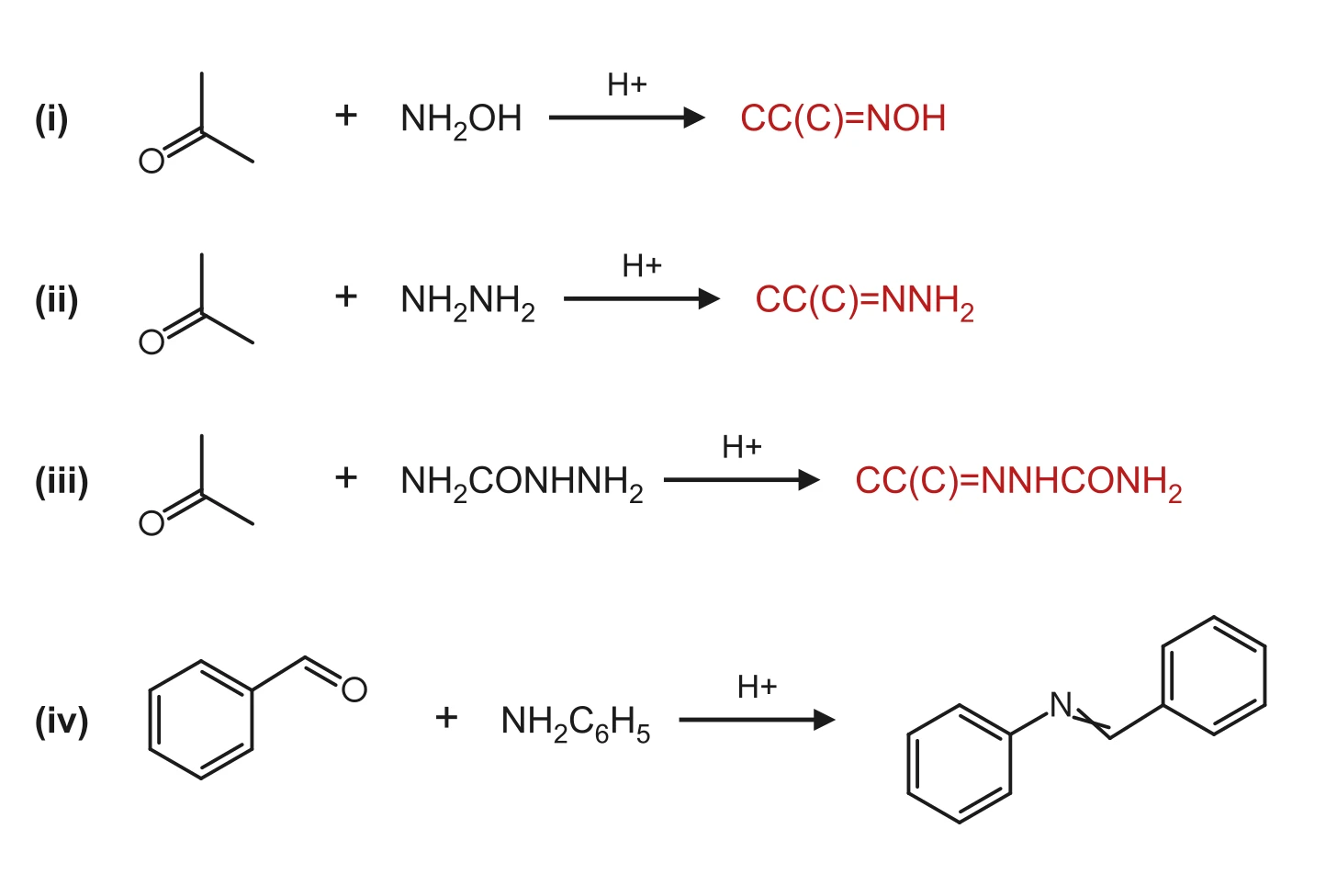
The identity of the ##\ce{Z}## group determines the name of the product and the properties of the reagent. When ##\ce{Z}## is hydrogen, the reagent is ammonia and the product is an imine. When ##\ce{Z}## is an alkyl or aryl group, the product is a substituted imine, commonly called a Schiff's base. Hydroxylamine gives an oxime, hydrazine gives a hydrazone, phenylhydrazine gives a phenylhydrazone, semicarbazide gives a semicarbazone, and 2,4-dinitrophenylhydrazine gives a 2,4-dinitrophenylhydrazone. Each product is a crystalline solid with a characteristic melting point.

Imines, oximes, hydrazones and semicarbazones
Imine formation is pH-dependent in a subtle way. Too little acid leaves the carbonyl unprotonated and the amine unreactive; too much acid protonates the amine and destroys its nucleophilicity. The optimum lies at mildly acidic pH, typically around 4.5 to 5, where a small equilibrium concentration of protonated carbonyl is available while most of the amine remains free. This pH optimum is a recurring theme in biochemistry, where enzymes such as transaminases exploit imine intermediates under precisely buffered conditions.
Oximes are formed from hydroxylamine, ##\ce{NH2OH}##, and are particularly valuable because they can exist as geometric isomers about the ##\ce{C=N}## bond. Hydrazones arise from hydrazine, ##\ce{NH2NH2}##, while phenylhydrazine, ##\ce{C6H5NHNH2}##, gives phenylhydrazones that were historically central to carbohydrate chemistry. Semicarbazide, ##\ce{NH2NHCONH2}##, yields semicarbazones, which are excellent derivatives for characterisation because they crystallise readily and have sharp, well-documented melting points.
2,4-DNP derivatives and the identification of unknown carbonyls
2,4-Dinitrophenylhydrazine, often abbreviated as Brady's reagent, reacts with aldehydes and ketones to give 2,4-dinitrophenylhydrazones that are yellow, orange or red solids. The striking colour arises from the extended conjugation between the phenyl ring, the two nitro groups and the ##\ce{C=N}## bond. Because these derivatives precipitate immediately from solution, the test is a rapid qualitative screen for the presence of a carbonyl group, and the melting point of the purified solid can be compared with literature values to identify the parent compound.
The procedure is straightforward: the carbonyl compound is treated with a solution of 2,4-dinitrophenylhydrazine in methanol and concentrated sulphuric acid, and the coloured precipitate is filtered, recrystallised and its melting point determined. This approach remains one of the most reliable classical methods for characterising an unknown aldehyde or ketone, and it complements modern spectroscopic techniques. In an examination context, the appearance of an orange precipitate with Brady's reagent is a definitive positive test for a carbonyl compound.
Biological and Synthetic Significance of C=N Derivatives
The carbon-nitrogen double bond is not merely an examination curiosity; it is a recurring motif in living systems and in industrial chemistry. Schiff's bases appear in enzyme active sites, where they act as electron sinks that stabilise carbanion intermediates. Oximes serve as intermediates in the Beckmann rearrangement, a reaction of enormous industrial importance. Understanding these connections transforms a set of named reactions into a coherent picture of how carbonyl chemistry underpins both biology and manufacturing.
Equally important is the stereochemistry of the ##\ce{C=N}## bond. Unlike the ##\ce{C=O}## bond, which is planar and rapidly interconverts between identical resonance forms, the imine bond can give rise to distinct ##E## and ##Z## isomers because the nitrogen bears a lone pair and a substituent. These isomers have different physical properties and can often be separated, which has consequences for the analysis of reaction mixtures and for the design of drugs that target imine-containing intermediates.
Schiff's bases in vision and enzyme catalysis
The most celebrated biological Schiff's base is found in rhodopsin, the light-sensitive pigment of the retina. The aldehyde group of retinal is linked to the amino group of a lysine residue in the protein opsin through an imine bond. Absorption of a photon isomerises the ##\ce{C11=C12}## double bond of the retinal chain from the all-##trans## to the ##cis## configuration, and this change propagates through the protein to trigger the signalling cascade that we experience as vision. The imine bond is essential because it tunes the absorption maximum of retinal into the visible region.
Schiff's bases also appear in the mechanism of class I aldolases and in transaminases, where pyridoxal phosphate forms an imine with an amino acid substrate. This imine acts as an electron sink, stabilising the carbanion that forms during transamination. In medicinal chemistry, Schiff's bases derived from salicylaldehyde and various amines are studied for their antimicrobial and anticancer activity, and the imine linkage is exploited as a dynamic covalent bond in the construction of supramolecular assemblies.
Oximes and the Beckmann rearrangement
Oximes undergo the Beckmann rearrangement when treated with a strong acid such as concentrated sulphuric acid or with a reagent such as phosphorus pentachloride. The hydroxyl group is protonated and departs, and the group anti to the leaving group migrates from carbon to nitrogen in a concerted step, generating a nitrilium ion that is subsequently hydrolysed to an amide. The stereospecificity is striking: the group that migrates is the one anti to the departing hydroxyl, so the configuration of the oxime determines the structure of the product.

The industrial significance is considerable. The Beckmann rearrangement of cyclohexanone oxime gives caprolactam, the monomer from which nylon-6 is manufactured by ring-opening polymerisation. Millions of tonnes of caprolactam are produced annually, making this one of the largest-scale applications of imine chemistry. In the laboratory, the rearrangement is used to convert ketones into amides with complete control of regiochemistry, a transformation that would otherwise require several steps.
Mechanistic Comparisons and Stereochemical Considerations
Placing the addition of alcohols and the addition of ammonia derivatives side by side reveals a shared logic. Both begin with protonation of the carbonyl oxygen, both proceed through a tetrahedral intermediate, and both can eliminate a small molecule to give a stable double bond. The difference lies in what is eliminated: water in the case of acetals and imines, and the driving force provided by the formation of a strong ##\ce{C=N}## or ##\ce{C-O}## bond. Recognising this pattern allows students to predict the outcome of unfamiliar reactions with confidence.
Stereochemistry adds a further layer of sophistication. The addition of a nucleophile to a prochiral carbonyl carbon can create a new stereocentre, and the face selectivity depends on the steric environment of the carbonyl. In imine formation, the tetrahedral carbinolamine intermediate can eliminate water to give either the ##E## or the ##Z## imine, and the ratio depends on the relative stability of the two isomers and on the reaction conditions. For oximes, the configuration is often thermodynamically controlled, with the more stable isomer predominating.
Equilibrium, catalysis and the role of pH
Every reaction in this lesson is an equilibrium, and every one is acid-catalysed. The apparent contradiction, that acid both accelerates the reaction and can suppress it by protonating the nucleophile, is resolved by the concept of an optimum pH. For imine formation the optimum is mildly acidic, for acetal formation it is dry acidic conditions with water removed, and for oxime formation it is a buffered mildly acidic medium. Mastering this idea is essential for answering mechanistic questions in competitive examinations.

Water plays a dual role. It is a product of the condensation, so removing it drives the reaction forward, but it is also required for the hydrolysis that reverses the reaction. This is why acetals are stable to base but labile to acid, and why imines are hydrolysed by aqueous acid to regenerate the carbonyl compound and the amine. The reversibility is not a nuisance but a design feature: it allows these functional groups to be installed and removed under mild conditions, which is precisely what protecting-group chemistry requires.
Common mistakes and how to avoid them
Students frequently confuse the names of the products, writing "hydrazine" when they mean "hydrazone" or "oxime" when they mean "hydroxylamine". A simple mnemonic helps: the reagent name ends in -amine or -azide, while the product name ends in -one or -ime. Another common error is to forget that the reaction is acid-catalysed and to write a mechanism without protonation. A third is to assume that ketones form acetals as readily as aldehydes; in fact, steric hindrance makes ketal formation slower and often requires a diol or a dehydrating agent.
A further pitfall concerns the distinction between hemiacetals and acetals. A hemiacetal has one ##\ce{-OH}## and one ##\ce{-OR}## group on the same carbon, while an acetal has two ##\ce{-OR}## groups. Students sometimes draw a hemiacetal and label it an acetal, losing marks unnecessarily. Finally, remember that aromatic aldehydes such as benzaldehyde react readily with ammonia derivatives but are sluggish in acetal formation because the carbonyl is conjugated with the ring, which reduces its electrophilicity.
We Also Published
Worked Examples and Examination Technique
Applying these ideas to unfamiliar molecules is the real test of understanding. Consider the reaction of cyclohexanone with ethylene glycol in the presence of dry hydrogen chloride. The product is a cyclic ketal, a 1,4-dioxaspiro compound, and the reaction is driven forward by removing water. If the same ketone is treated with hydroxylamine, the product is cyclohexanone oxime, which on treatment with concentrated sulphuric acid undergoes Beckmann rearrangement to give caprolactam. Both sequences illustrate how the same starting material can be channelled towards different products by choosing the right nucleophile.
Another instructive example is the reaction of benzaldehyde with aniline. The product is ##\ce{C6H5CH=NC6H5}##, a Schiff's base, formed by acid-catalysed condensation with the loss of water. If the same aldehyde is treated with 2,4-dinitrophenylhydrazine, an orange precipitate of the corresponding hydrazone forms immediately, providing a simple test for the aldehyde. These transformations are frequently examined in CBSE and JEE papers, and the ability to write balanced equations with correct reagents and conditions is essential.
Practice problems with guided solutions
Problem one: predict the product when propanone reacts with semicarbazide. The ##\ce{C=O}## is replaced by ##\ce{C=N-NHCONH2}##, giving propanone semicarbazone, a crystalline solid used for identification. Problem two: explain why acetals are stable to base but hydrolysed by acid. The answer lies in the mechanism: base cannot protonate the leaving group, so the acetal is inert, whereas acid converts the alkoxy group into a good leaving group and allows hydrolysis to proceed. Problem three: why does benzaldehyde fail to form an acetal readily? Conjugation with the ring reduces the electrophilicity of the carbonyl carbon.

Problem four: a compound of formula ##\ce{C4H8O}## gives an orange precipitate with 2,4-DNP but does not reduce Tollens' reagent. Identify it. The positive DNP test confirms a carbonyl, and the negative Tollens' test indicates a ketone rather than an aldehyde, so the compound is butanone. Problem five: write the structure of the oxime formed from butanal and explain why it can exist as two isomers. The oxime is ##\ce{CH3CH2CH2CH=NOH}##, and the two isomers arise from the different relative positions of the hydroxyl group and the alkyl chain about the ##\ce{C=N}## bond.

Connecting to the next lesson
The products formed in this lesson are themselves reactive intermediates. Acetals can be hydrolysed back to carbonyls, imines can be reduced to amines, and oximes can be rearranged to amides. The next lesson examines the reduction and oxidation of aldehydes and ketones, where the carbonyl group is converted into alcohols, hydrocarbons or carboxylic acids. The protecting-group strategy introduced here becomes indispensable when a molecule contains more than one reducible or oxidisable group, and the distinction between aldehydes and ketones in oxidation reactions is a recurring theme in both laboratory work and examinations.
As you move forward, keep the mechanistic logic in mind: protonation, nucleophilic attack, and elimination of a small molecule. This triad explains acetal formation, imine formation, and the hydrolysis that reverses both. It also explains why the reactions are reversible and why conditions must be chosen carefully to drive them in the desired direction. Mastery of these principles will make the reduction and oxidation chemistry that follows far easier to understand and to apply.
Advanced Insights and Laboratory Applications
Beyond the syllabus, the chemistry of acetals and imines connects to some of the most active areas of modern research. Dynamic covalent chemistry exploits the reversibility of imine formation to build self-assembling structures, molecular cages and responsive materials. Because the imine bond can exchange under mild conditions, it allows libraries of compounds to equilibrate and select the most stable member, a principle that underpins the design of sensors and drug-delivery systems. Acetals, meanwhile, are used as acid-labile linkers in prodrug design, releasing the active compound in the acidic environment of a tumour or a lysosome.
In the laboratory, the practical details matter as much as the theory. Acetal formation is typically carried out in a solvent such as benzene or toluene with a Dean-Stark apparatus to remove water azeotropically, and a catalytic amount of ##p##-toluenesulfonic acid often replaces hydrogen chloride for convenience. Oxime and hydrazone formations are usually performed in aqueous ethanol with a few drops of acetic acid, and the products crystallise directly from the reaction mixture. These practical touches are worth remembering because they reveal how the equilibrium principle is translated into experimental technique.
Green chemistry and industrial perspectives
Industrial processes increasingly favour catalytic, solvent-free and water-based conditions. The Beckmann rearrangement, traditionally performed with oleum, has been adapted to vapour-phase conditions over zeolite catalysts, which avoids the large volumes of sulphuric acid and the associated waste. Similarly, acetalisation can be catalysed by solid acids such as ion-exchange resins, allowing easy separation and reuse of the catalyst. These developments reflect a broader shift towards sustainable manufacturing without compromising the underlying chemistry.
The pharmaceutical industry relies heavily on protecting-group strategies that use acetals and related derivatives. In the synthesis of complex molecules, a single unprotected hydroxyl or carbonyl group can derail a multi-step sequence, so chemists plan the order of reactions carefully and use orthogonal protecting groups that can be removed independently. The principles covered in this lesson, namely reversibility, acid lability and the choice of nucleophile, are the foundation on which those strategies are built.
Summary and key takeaways
The addition of alcohols to aldehydes and ketones gives hemiacetals and then acetals or ketals, with dry hydrogen chloride acting as a catalyst that protonates the carbonyl oxygen and increases its electrophilicity. The reaction is reversible, and acetals are hydrolysed by aqueous mineral acids, which makes them valuable protecting groups. The addition of ammonia and its derivatives gives imines, Schiff's bases, oximes, hydrazones, phenylhydrazones, semicarbazones and 2,4-dinitrophenylhydrazones, all formed by acid-catalysed addition followed by dehydration.
Each product class has its own significance: imines in vision and enzyme catalysis, oximes in the Beckmann rearrangement and the manufacture of nylon-6, and 2,4-DNP derivatives in the identification of unknown carbonyl compounds. The stereochemistry of the ##\ce{C=N}## bond gives rise to ##E## and ##Z## isomers, and the pH optimum of each reaction reflects the balance between activating the carbonyl and preserving the nucleophile. These ideas prepare the ground for the reduction and oxidation chemistry of the next lesson, where the same carbonyl group is transformed once again.
From our network :
- Trump Political Strategy How Geopolitical Stunts Serve As Media Diversions
- Where to Put Your Wireless Router for Better CoverageA practical, physics-grounded guide to router placement: why the centre of the home beats the corner, how walls and metal sap signal, and how to run a simple survey that proves the improvement.
- Do You Need a New Router or Is Your Internet Plan the Problem?A practical comparison of the signs that point to router limits versus signs your broadband speed or provider is the bottleneck, so you can decide what to replace before spending money.
- How to Print Cheaply: Cutting the Cost per PageA practical, measured guide to lowering what each printed page costs — duplex and draft modes, third-party ink, yield mathematics, and knowing when a new printer beats refills.
- 10 Physics Numerical Problems with Solutions for IIT JEEPrepare for IIT JEE with 10 physics numerical problems, complete with detailed solutions and conceptual explanations. Ideal for mastering kinematics, thermodynamics, electromagnetism, and optics.
- Analyzing Trump Deportation Numbers Insights Into The 2026 Immigration Crackdown
- 98% of Global MBA Programs Now Prefer GRE Over GMAT Focus EditionExplore why 98% of global MBA programs now prefer the GRE over GMAT Focus. Learn about the shorter GRE format, verbal logic importance, and strategic versatility for students.
- AI-Powered 'Precision Diagnostic' Replaces Standard GRE Score ReportsDiscover the new GRE Precision Diagnostic. Learn how AI-powered behavioral analytics and time-to-solve tracking are replacing standard GRE score reports to empower students.
- EV 2.0: The Solid-State Battery Breakthrough and Global Factory ExpansionDiscover the impact of the Solid-State Battery Breakthrough on the EV market. Learn about CATL and BYD stock growth, global factory expansion in Europe, and the future of EV 2.0 technology.