Carboxylic acids occupy a distinctive position among the organic compounds studied at the senior secondary level: they are weak acids by the standards of mineral acids, yet remarkably strong when measured against alcohols and most simple phenols. This apparent contradiction dissolves once we examine the conjugate base. When a carboxylic acid donates its proton, the resulting carboxylate ion carries a negative charge that is shared equally between two electronegative oxygen atoms through two equivalent resonance structures. That symmetry, and the electronegativity of the atoms bearing the charge, is the structural heart of the entire lesson. Everything else — pKa values, substituent effects, solvent dependence, and even the behaviour of biological molecules — flows from this single idea.
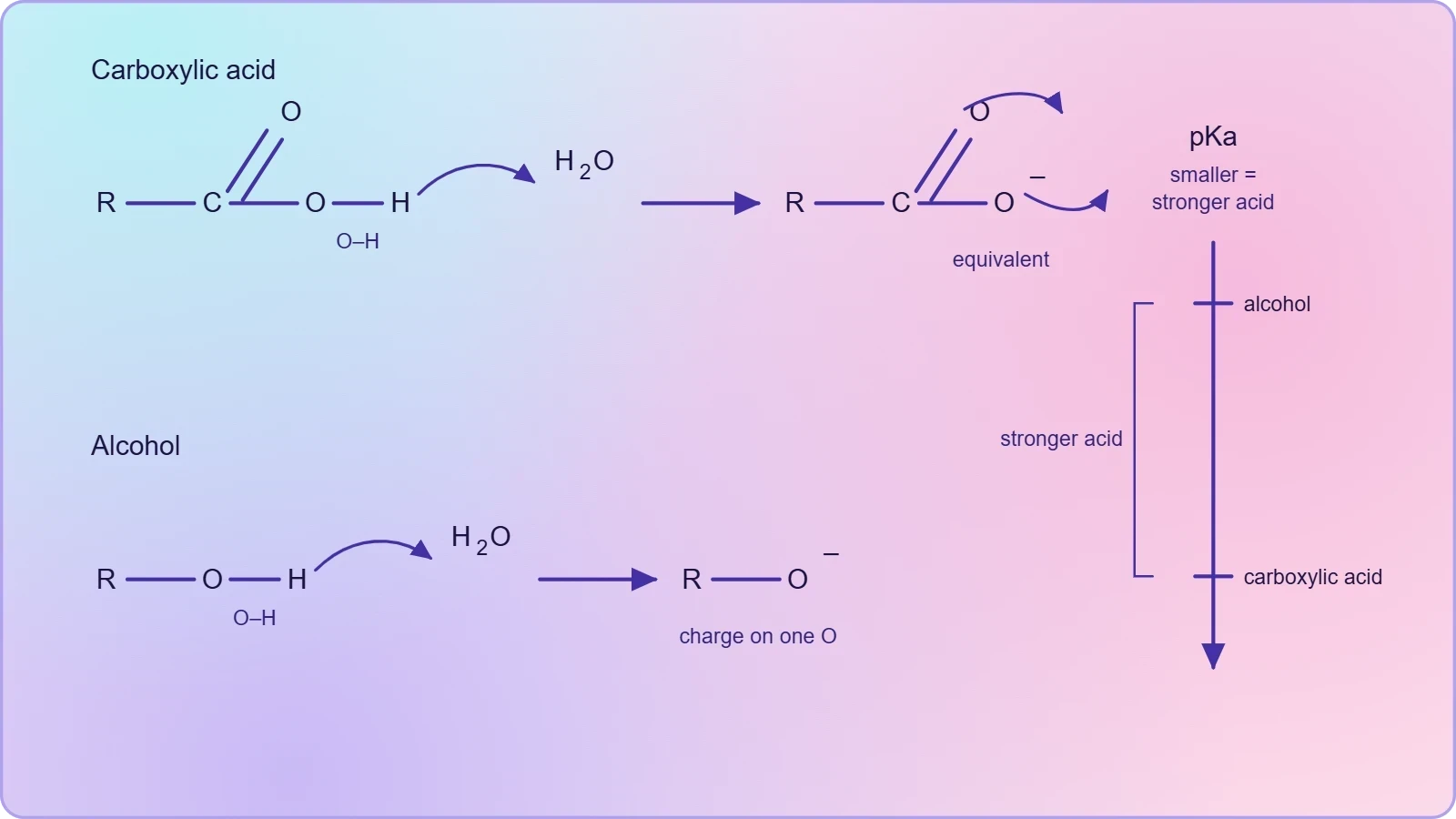
Understanding acidity is not merely an exercise in memorising a table of pKa values. It is a way of reasoning about molecular stability. A chemist who can look at a structure and predict whether it will be more or less acidic than acetic acid possesses a genuinely transferable skill, one that reappears in reaction mechanisms, in drug design, and in the interpretation of metabolic pathways. In this lesson we move from the mechanism of dissociation through the quantitative language of ##K_a## and ##pK_a##, then into the inductive and resonance effects of substituents, the Hammett treatment that formalises those effects, and finally to the practical consequences in dicarboxylic acids and living systems.
Because this lesson follows directly from the physical properties of carboxylic acids, we build on the dimeric hydrogen-bonded structures already described and prepare the ground for the reactions involving O–H and C–OH cleavage that follow. The emphasis throughout is on mechanism and on the logic of structure–property relationships, supported by worked examples, common pitfalls, and the numerical reasoning that examination questions reward.
On This Page
- The Mechanism of Acid Dissociation in Water
- Quantifying Acidity: Ka, pKa and the Strength Scale
- Substituent Effects on Carboxylic Acid Acidity
- The Hammett Equation and Substituent Constants
- Strong Organic Acids, Solvent Effects and Dicarboxylic Acids
- Worked Problems and Common Mistakes
- Connecting Acidity to Structure and to the Next Lesson
The Mechanism of Acid Dissociation in Water
When a carboxylic acid dissolves in water, an equilibrium is established in which the acid transfers a proton to a solvent molecule, generating a carboxylate anion and a hydronium ion. The process is not a simple ejection of a proton into empty space; water actively participates as a base, accepting the proton and stabilising it as ##\ce{H3O+}##. The general equation for acetic acid illustrates the transformation, and the equilibrium lies far to the left, which is precisely why carboxylic acids are classified as weak.
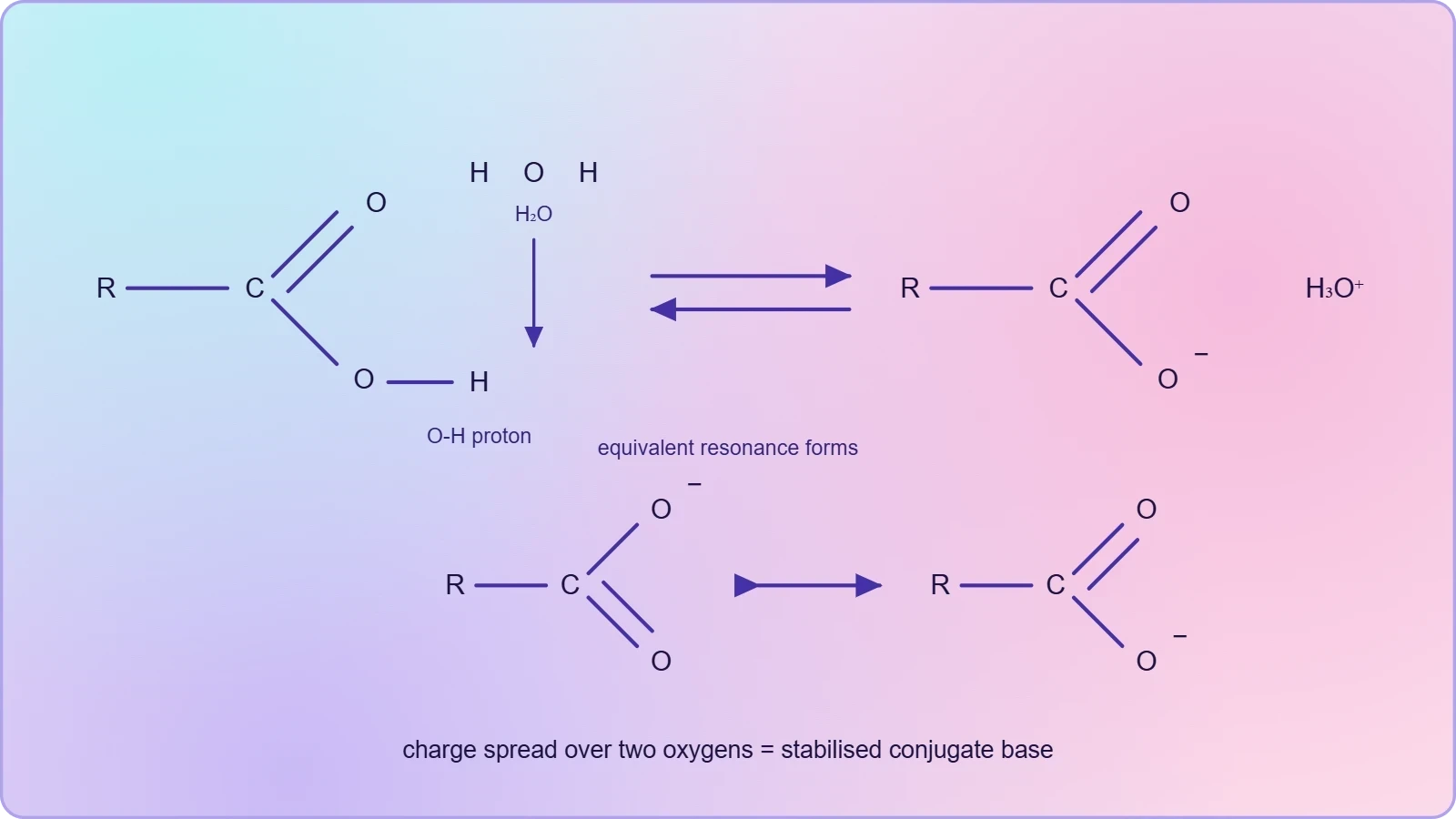
The thermodynamic driving force for dissociation is the difference in stability between the undissociated acid and its conjugate base, modified by the solvation of every species involved. Water surrounds the carboxylate ion and disperses its charge through hydrogen bonding, and it solvates the hydronium ion equally well. The measured acidity therefore reflects not only the intrinsic stability of the anion but also how comfortably the solvent accommodates the separated charges. This is why the same acid can appear stronger or weaker depending on the medium in which it is measured.
Resonance Stabilisation of the Carboxylate Ion
The carboxylate ion is described by two equivalent resonance structures in which the negative charge resides on one oxygen atom or the other. Because the two structures are identical in energy, the true ion is a hybrid in which each carbon–oxygen bond has partial double-bond character and each oxygen bears half of the negative charge. This symmetrical delocalisation over two electronegative atoms is exceptionally effective, and it is the principal reason the carboxylate ion is so much more stable than the corresponding alkoxide ion, where the charge sits on a single oxygen.

Contrast this with the phenoxide ion. The conjugate base of phenol delocalises its negative charge into the aromatic ring, but the resonance structures are not equivalent: some place the charge on carbon, which is far less electronegative than oxygen. The result is a less effective delocalisation, and phenol is correspondingly a weaker acid than a carboxylic acid. The pKa of phenol is approximately 10, while acetic acid sits at 4.76 — a difference of more than five orders of magnitude in acidity.
Why the O–H Bond Breaks and Not the C–OH Bond
A carboxylic acid contains two potentially acidic sites, but only the O–H hydrogen is released under ordinary conditions. Cleaving the C–OH bond would require departure of a hydroxide ion, an extremely poor leaving group, and would generate an acylium-type species of very high energy. The O–H bond, by contrast, releases a proton whose charge is immediately stabilised by the carboxylate resonance. This selectivity is fundamental: it explains why carboxylic acids behave as acids toward bases while their C–OH bond reacts only under the specific conditions of esterification, anhydride formation, and conversion to acid chlorides.
The strength of the O–H bond in the acid is itself modulated by the carbonyl group. The carbonyl oxygen withdraws electron density inductively and, more importantly, provides the empty orbital system into which the oxygen lone pair can delocalise once the proton departs. This is a subtle but essential point: the acid is pre-organised for dissociation because the carbonyl group is already conjugated with the hydroxyl oxygen, so the electronic reorganisation required to form the anion is modest.
Quantifying Acidity: Ka, pKa and the Strength Scale
The equilibrium constant for dissociation, ##K_{eq}##, includes the concentration of water, which is essentially constant in dilute aqueous solution. Chemists therefore define the acid dissociation constant ##K_a## by removing the water term, giving a quantity that depends only on the acid and its conjugate base. For acetic acid, ##K_a## is approximately ##1.8 \times 10^{-5}##, a small number that immediately signals weak acidity. Because such values span many orders of magnitude, they are conventionally expressed on a logarithmic scale.
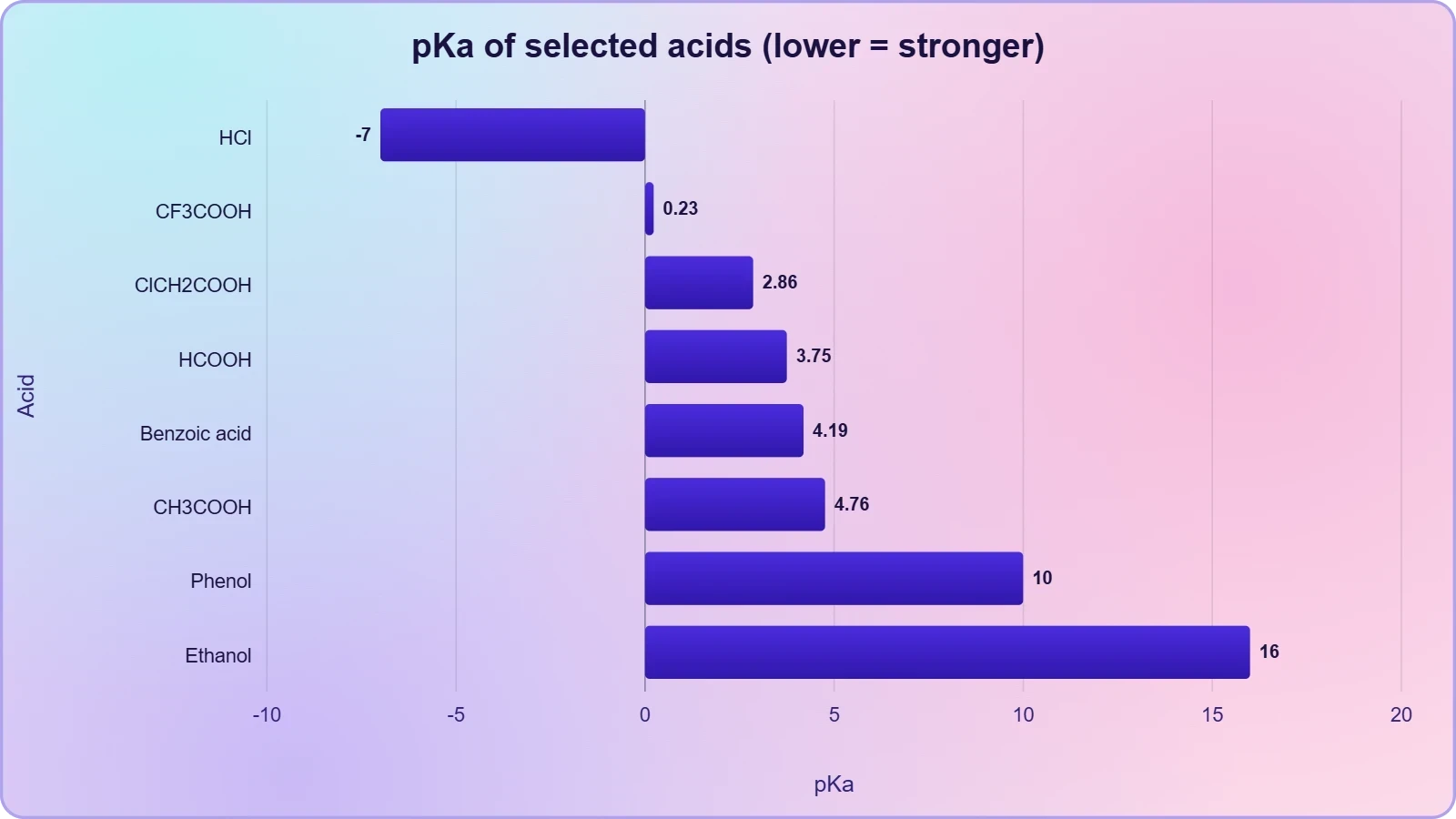
The pKa scale inverts the intuitive direction of acidity: the smaller the pKa, the stronger the acid, because a smaller pKa corresponds to a larger ##K_a## and therefore a greater tendency to donate a proton. Hydrochloric acid has a pKa of about ##-7.0##, trifluoroacetic acid 0.23, benzoic acid 4.19, and acetic acid 4.76. These figures allow a rapid ranking and, more importantly, allow prediction of the direction of proton-transfer reactions: an acid will protonate the conjugate base of any acid with a larger pKa.
Reading the Acidity Bands
The reference material provides a useful classification that students should internalise. Strong acids have pKa values below 1; moderately strong acids fall between 1 and 5; weak acids lie between 5 and 15; and extremely weak acids exceed 15. Carboxylic acids cluster in the moderately strong band, which is why they are described as weak relative to mineral acids yet strong relative to alcohols (ethanol, pKa ≈ 16) and many phenols. This banding is a practical tool for estimating whether a given proton transfer will proceed to a useful extent.
It is worth noting that the pKa of a carboxylic acid is a property of the whole system, not of the carboxyl group in isolation. When we say acetic acid has a pKa of 4.76, we mean in dilute aqueous solution at standard temperature. Change the solvent, change the temperature, or add a strong electrolyte, and the number shifts. Examiners frequently test this nuance by asking students to compare acidities in different media, and the answer always returns to the relative solvation of the neutral acid and its anion.
Worked Example: Comparing Two Acids
Suppose we are asked which is stronger, chloroacetic acid (pKa 2.86) or acetic acid (pKa 4.76). The difference in pKa is 1.90, so the ratio of acid dissociation constants is ##10^{1.90} \approx 79##. Chloroacetic acid is therefore roughly eighty times stronger. The reasoning is that the electronegative chlorine withdraws electron density through the sigma framework, dispersing the negative charge of the carboxylate ion and stabilising it. This inductive effect falls off rapidly with distance, which is why 3-chloropropanoic acid (pKa 4.0) is far weaker than 2-chloroethanoic acid.

Substituent Effects on Carboxylic Acid Acidity
A substituent attached to the carbon chain of a carboxylic acid can influence acidity in two distinct ways. It may withdraw electron density through the sigma bonds, an inductive effect transmitted by electronegativity differences, or it may donate or withdraw electron density through a conjugated pi system, a resonance or mesomeric effect. Both operate by altering the stability of the carboxylate anion: anything that disperses the negative charge stabilises the conjugate base and strengthens the acid, while anything that concentrates the charge destabilises it and weakens the acid.
The inductive effect is distance-dependent and decays sharply with each intervening bond. A chlorine atom on the alpha carbon exerts a strong influence; the same chlorine on the beta carbon exerts a much weaker one; by the gamma position the effect is barely measurable. This is why 2-chloroethanoic acid (pKa 2.86) is far stronger than 3-chloropropanoic acid (pKa 4.0), and why 4-chlorobutanoic acid is weaker still. Students should treat the number of bonds between substituent and carboxyl group as a primary variable in any comparison.

The Inductive Series and Its Ordering
The reference material gives the order of electron-withdrawing power as ##\ce{Ph < I < Br < Cl < F < CN < NO2 < CF3}##. This ordering reflects a combination of electronegativity and the ability of the group to relay the withdrawal through its own bonding. The trifluoromethyl group is exceptional because three fluorine atoms withdraw cooperatively, making ##\ce{CF3COOH}## the strongest simple carboxylic acid with a pKa of 0.23. The nitro group is similarly powerful, and the cyano group follows closely. Halogens sit in the middle, with fluorine strongest among them despite its lower polarisability, because electronegativity dominates in the inductive series.
Applying this ordering produces the acidity sequence ##\ce{CF3COOH > CCl3COOH > CHCl2COOH > NO2CH2COOH > NC-CH2COOH > FCH2COOH > ClCH2COOH > BrCH2COOH > HCOOH > ClCH2CH2COOH}##. Notice that formic acid, with no substituent at all, sits above the beta-chloro acid, confirming how quickly the inductive effect fades. The sequence continues with ##\ce{C6H5COOH > C6H5CH2COOH > CH3COOH > CH3CH2COOH}##, where the aromatic ring and the methyl group act as weak electron donors relative to hydrogen.
The Aromatic Ring: A Case of Competing Effects
Direct attachment of a phenyl or vinyl group to the carboxyl carbon increases acidity, contrary to what a simple resonance argument would predict. The reason is that the carboxyl carbon is bonded to an sp2-hybridised carbon, which is more electronegative than an sp3 carbon and therefore withdraws electron density inductively. This inductive withdrawal outweighs the resonance donation of the ring, so benzoic acid (pKa 4.19) is stronger than acetic acid (pKa 4.76). The lesson is that resonance and inductive effects can oppose one another, and the observed acidity reflects their net balance.
When substituents are placed on the aromatic ring, their effects become more pronounced and more predictable. An electron-withdrawing group such as nitro at the para position stabilises the carboxylate through both inductive and resonance withdrawal, lowering the pKa to 3.41 for 4-nitrobenzoic acid. An electron-donating group such as methoxy raises the pKa to 4.46 for 4-methoxybenzoic acid. The magnitude of these shifts is modest compared with aliphatic substituents because the effects must travel through the ring, but the direction is unfailingly consistent with the electronic character of the substituent.
We Also Published
The Hammett Equation and Substituent Constants
The qualitative reasoning above can be made quantitative through the Hammett equation, one of the most influential relationships in physical organic chemistry. Hammett proposed that the effect of a meta or para substituent on the acidity of benzoic acid could be expressed as a linear free-energy relationship, because the logarithm of the equilibrium constant is proportional to the free-energy change of the dissociation. The equation introduces a substituent constant ##\sigma## that captures the electronic character of the group and a reaction constant ##\rho## that captures the sensitivity of the particular reaction to electronic effects.
Here ##K## is the dissociation constant of the substituted benzoic acid, ##K_0## that of benzoic acid itself, and ##\sigma## is defined so that the ionisation of benzoic acids in water at 25 °C serves as the reference reaction with ##\rho = 1##. Electron-withdrawing groups such as nitro have positive ##\sigma## values, while electron-donating groups such as methoxy have negative values. The beauty of the treatment is that once ##\sigma## values are tabulated, the acidity of an enormous range of substituted benzoic acids can be predicted without further experiment.
Interpreting Sigma Values
For the para-nitro group, ##\sigma## is approximately ##+0.78##, and for the para-methoxy group it is about ##-0.27##. Applying the equation to 4-nitrobenzoic acid gives ##\log(K/K_0) = 0.78##, so the acid is roughly six times stronger than benzoic acid, consistent with the pKa drop from 4.19 to 3.41. For the methoxy compound, ##\log(K/K_0) = -0.27##, predicting a weaker acid, again matching the observed pKa of 4.46. The agreement between prediction and experiment is a powerful demonstration that substituent effects are systematic and additive.
Meta substituents have their own ##\sigma_m## values, which differ from the para values because resonance interaction with the carboxyl group is attenuated at the meta position. A group that is strongly resonance-withdrawing at the para position may act mainly through induction at the meta position, and the tabulated constants reflect this. Students who encounter the Hammett equation for the first time should appreciate that it is not an arbitrary curve fit but a consequence of the linear relationship between the logarithm of an equilibrium constant and the free energy of the species involved.
Beyond Benzoic Acids
The Hammett equation extends far beyond acid dissociation. Any reaction whose rate or equilibrium is sensitive to the electronic character of a substituent can be analysed with an appropriate ##\rho## value. When ##\rho## is positive, the reaction is accelerated by electron withdrawal, indicating that negative charge builds up in the transition state. When ##\rho## is negative, the reverse holds. This makes the Hammett treatment a diagnostic tool for mechanism, allowing chemists to infer the charge distribution in a transition state from the pattern of substituent effects on rate.
For the student preparing for competitive examinations, the practical takeaway is that substituent constants provide a rigorous language for the qualitative rules already learned. The inductive series, the resonance effects, and the special case of the aromatic ring all find a unified expression in the Hammett framework. Mastery of the concept, even without memorising every ##\sigma## value, allows confident prediction of trends and a deeper appreciation of why the pKa values in the reference table are what they are.
Strong Organic Acids, Solvent Effects and Dicarboxylic Acids
Although carboxylic acids are weak by mineral-acid standards, the family contains members of remarkable strength. Trifluoroacetic acid, with a pKa of 0.23, is strong enough to protonate many weak bases and is used as a reagent and mobile-phase modifier in chromatography. The three fluorine atoms withdraw electron density so effectively that the carboxylate ion is stabilised far beyond what acetic acid achieves. Other strong organic acids include trichloroacetic acid (pKa 0.66) and, at the extreme, the sulfonic acids such as ##\ce{CF3SO3H}##, which are superacids by comparison.
The solvent in which acidity is measured exerts a profound influence on the observed pKa. Water stabilises both the neutral acid and the carboxylate ion through hydrogen bonding, but it stabilises the charged anion more strongly, which tends to compress the differences between acids. In a less polar aprotic solvent such as dimethyl sulfoxide or acetonitrile, the anion is poorly solvated and the intrinsic stability of the conjugate base dominates, so the spread of acidities widens dramatically. Some acids that appear weak in water become strong in DMSO, and the reverse can occur for others.
Dicarboxylic Acids and Stepwise Dissociation
Dicarboxylic acids such as oxalic acid, malonic acid, and succinic acid possess two carboxyl groups and therefore two dissociation constants. The first dissociation is always easier than the second because the second proton departs from an already negatively charged species, and the electrostatic repulsion between the departing proton and the carboxylate anion raises the energy of the second ionisation. For oxalic acid, ##pK_{a1}## is about 1.25 and ##pK_{a2}## about 4.14, a difference of nearly three units. For malonic acid the values are approximately 2.83 and 5.69.

The separation between the two carboxyl groups matters. When the groups are close, as in oxalic and malonic acids, the inductive withdrawal of the second carboxyl group stabilises the first carboxylate and makes the first dissociation unusually strong. As the chain lengthens, the groups become electronically isolated and the first pKa approaches that of a simple monocarboxylic acid. Succinic acid, with two methylene groups between the carboxyls, has ##pK_{a1}## of 4.21 and ##pK_{a2}## of 5.64, much closer together than in oxalic acid.
Acidity in Biological Systems
The acidity of carboxylic acids is central to biochemistry. Amino acids contain both a carboxyl group and an amino group, and their ionisation behaviour determines the charge state of proteins at physiological pH. The carboxyl group of a typical amino acid has a pKa near 2, so it is fully deprotonated at pH 7.4, while the amino group is protonated. This charge distribution underlies the zwitterionic structure of amino acids and the electrostatic interactions that fold proteins into their functional shapes.
Carboxylic acids also participate in metabolic regulation. The citric acid cycle depends on the stepwise ionisation of its intermediates, and the buffering capacity of blood is maintained in part by the bicarbonate system, which is in equilibrium with dissolved carbon dioxide and, indirectly, with carboxylic acid metabolism. Lactic acid accumulation during vigorous exercise lowers blood pH and is buffered by the same principles of weak-acid equilibrium. Understanding pKa is therefore not an abstract exercise but a prerequisite for understanding physiology, pharmacology, and the design of drugs whose absorption depends on their ionisation state.
Worked Problems and Common Mistakes
Applying the principles of acidity to unfamiliar structures is the surest test of understanding. The following worked problems illustrate the reasoning expected in examinations, moving from straightforward ranking to more demanding multi-step comparisons. Each solution should be read as a template: identify the conjugate base, assess the electronic effects operating on it, and only then commit to a ranking. Rushing to memorised orders without this analysis is the most frequent source of error.
Common mistakes cluster around a few recurring confusions. Students often assume that the most electronegative atom always produces the strongest acid, ignoring the distance dependence of the inductive effect. They may also forget that resonance donation and inductive withdrawal can oppose each other, as in the phenylacetic acid series. A third frequent error is to compare pKa values measured in different solvents as though they were directly comparable. Each of these pitfalls is addressed below with a concrete example.
Worked Example: Ranking a Mixed Series
Consider the task of arranging ##\ce{CH3COOH}##, ##\ce{ClCH2COOH}##, ##\ce{ClCH2CH2COOH}##, and ##\ce{CF3COOH}## in order of increasing acidity. The conjugate bases differ only in the substituent attached to the carboxylate. The trifluoromethyl group is the strongest electron withdrawer, so ##\ce{CF3COOH}## is the strongest acid. Chlorine on the alpha carbon is next, followed by the unsubstituted acetic acid, and finally the beta-chloro acid, where the inductive effect has decayed. The order is therefore ##\ce{ClCH2CH2COOH < CH3COOH < ClCH2COOH < CF3COOH}##.
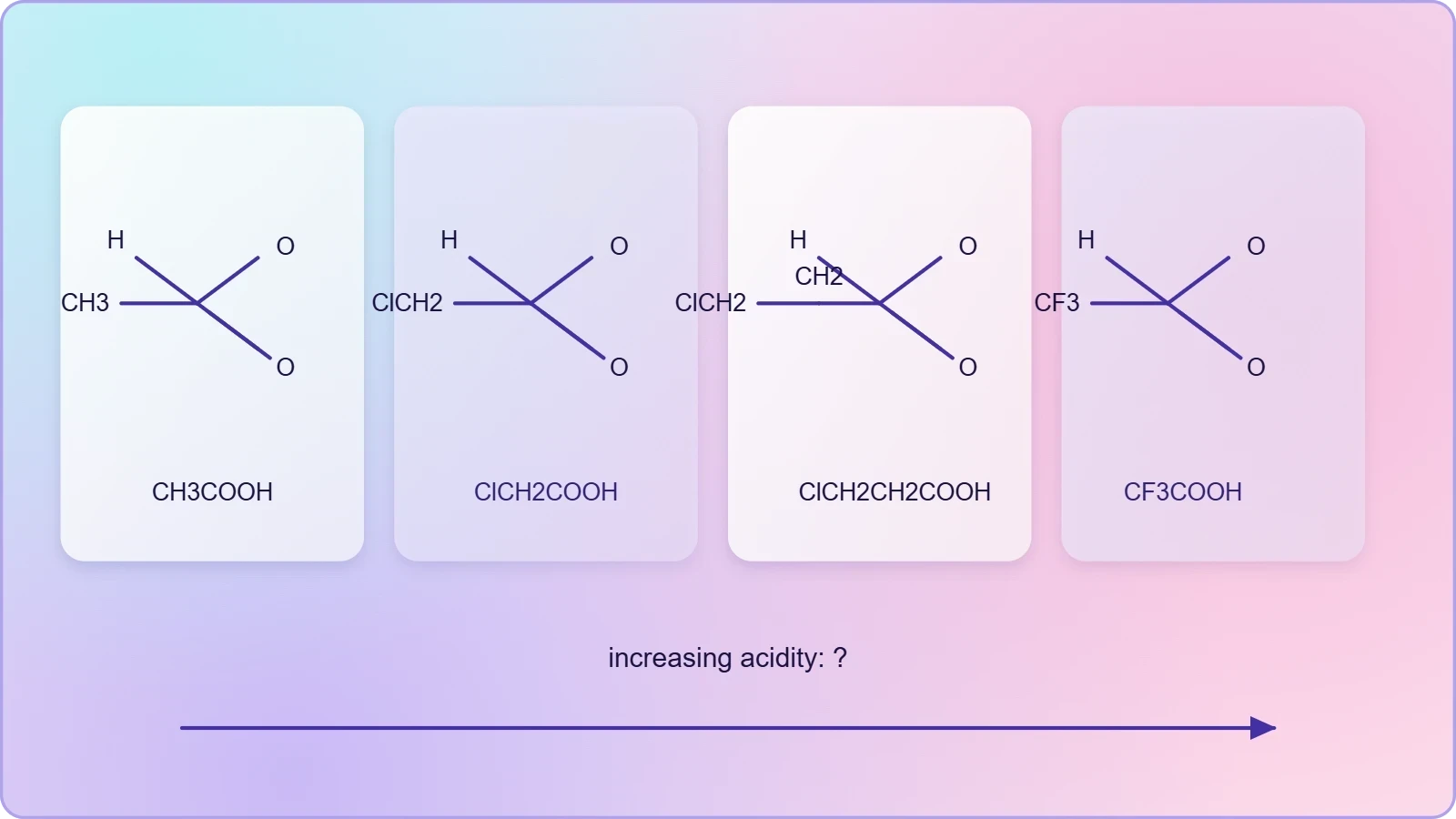
A subtler problem asks why ##\ce{FCH2COOH}## is stronger than ##\ce{ClCH2COOH}## despite chlorine being larger and more polarisable. The answer lies in electronegativity: fluorine is the most electronegative element, and in the inductive series electronegativity dominates over polarisability. The same logic explains why ##\ce{CF3COOH}## outranks ##\ce{CCl3COOH}##. Students who reason from size alone will predict the wrong order, so the electronegativity principle must be applied consistently.
Worked Example: Aromatic versus Aliphatic
Comparing benzoic acid (pKa 4.19) with cyclohexanecarboxylic acid (pKa approximately 4.9) tests understanding of hybridisation effects. The carboxyl carbon in benzoic acid is attached to an sp2 carbon of the ring, which is more electronegative than the sp3 carbon of cyclohexane and therefore withdraws electron density more strongly. The result is a more stable conjugate base and a stronger acid. This example reinforces the point that the hybridisation of the adjacent carbon is a first-order consideration, sometimes outweighing the resonance donation of the ring itself.
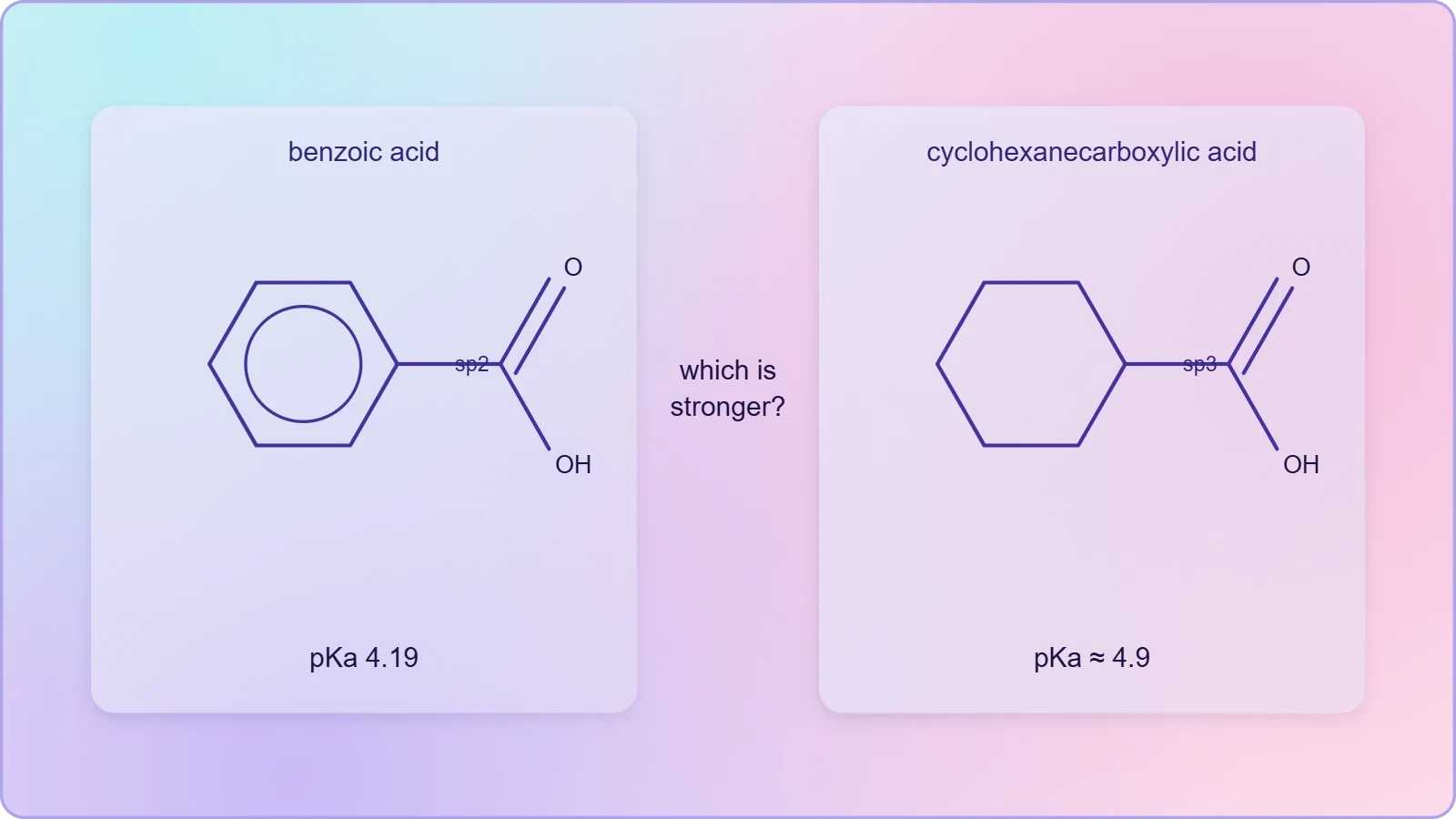
A related comparison places phenylacetic acid (##\ce{C6H5CH2COOH}##, pKa 4.31) between benzoic acid and acetic acid. Here the phenyl group is separated from the carboxyl by a methylene unit, so its inductive withdrawal is attenuated and its weak resonance donation becomes relatively more important. The observed pKa reflects this balance. Such examples demonstrate that the acidity of a carboxylic acid is never determined by a single factor but by the interplay of inductive, resonance, and hybridisation effects.
Connecting Acidity to Structure and to the Next Lesson
The acidity of a carboxylic acid is a direct readout of the stability of its conjugate base, and that stability is governed by resonance, induction, hybridisation, and solvation. Every comparison in this lesson reduces to the same question: where does the negative charge sit, and how comfortably is it accommodated? Once that question is asked systematically, the apparent complexity of substituent effects resolves into a small number of principles. The pKa values in the reference tables are not arbitrary facts to be memorised but consequences of structure that can be derived from first principles.
This understanding prepares the ground for the reactions that follow. The same O–H bond that breaks in acid dissociation is the one that participates in salt formation with metals and alkalies, and the carboxylate ion formed here is the species that reacts with alkyl halides in esterification. The C–OH bond, which we have seen is not cleaved during simple acid dissociation, becomes the reactive site in anhydride formation, esterification, and conversion to acid chlorides. Recognising which bond breaks under which conditions is the organising principle of the next lesson.
Summary of Core Relationships
The essential relationships can be stated compactly. Acidity increases with the electron-withdrawing power of substituents and decreases with their electron-donating power. The inductive effect decays with distance, while resonance effects require conjugation and are therefore strongest at the para position of an aromatic ring. The carboxylate ion is stabilised by two equivalent resonance structures over electronegative oxygen atoms, which is why carboxylic acids outrank phenols and alcohols. The Hammett equation quantifies these effects through substituent constants, and dicarboxylic acids show stepwise dissociation with the second step always weaker than the first.
Solvent effects remind us that pKa is a property of a system, not of an isolated molecule. In water, strong solvation of the carboxylate compresses the differences between acids; in aprotic media, the intrinsic stability of the anion dominates and the spread widens. Biological systems exploit these principles constantly, from the zwitterionic character of amino acids to the buffering of blood. A student who can move fluently between the molecular structure, the pKa value, and the biological consequence has genuinely understood the lesson.
Looking Ahead
The next lesson examines the reactions of carboxylic acids involving O–H and C–OH cleavage in detail. The acidity developed here explains why carboxylic acids react with carbonates and hydrogencarbonates to evolve carbon dioxide, a reaction used to detect the carboxyl group. It also explains why the carboxylate ion, rather than the neutral acid, is the nucleophile in certain esterification mechanisms. Carrying the conjugate-base reasoning forward will make those mechanisms far easier to follow, because each step can be interpreted as a stabilisation of charge.
Students preparing for board and competitive examinations should practise drawing conjugate bases for unfamiliar acids and predicting their relative stability before consulting tables. This habit builds the structural intuition that examinations reward and that advanced study of organic chemistry demands. The numerical skills developed here — manipulating ##K_a## and ##pK_a##, estimating ratios from pKa differences, and applying the Hammett equation — recur throughout physical organic chemistry and are worth consolidating now.
From our network :
- How to Print Cheaply: Cutting the Cost per PageA practical, measured guide to lowering what each printed page costs — duplex and draft modes, third-party ink, yield mathematics, and knowing when a new printer beats refills.
- Trump Political Strategy How Geopolitical Stunts Serve As Media Diversions
- EV 2.0: The Solid-State Battery Breakthrough and Global Factory ExpansionDiscover the impact of the Solid-State Battery Breakthrough on the EV market. Learn about CATL and BYD stock growth, global factory expansion in Europe, and the future of EV 2.0 technology.
- AI-Powered 'Precision Diagnostic' Replaces Standard GRE Score ReportsDiscover the new GRE Precision Diagnostic. Learn how AI-powered behavioral analytics and time-to-solve tracking are replacing standard GRE score reports to empower students.
- 98% of Global MBA Programs Now Prefer GRE Over GMAT Focus EditionExplore why 98% of global MBA programs now prefer the GRE over GMAT Focus. Learn about the shorter GRE format, verbal logic importance, and strategic versatility for students.
- Do You Need a New Router or Is Your Internet Plan the Problem?A practical comparison of the signs that point to router limits versus signs your broadband speed or provider is the bottleneck, so you can decide what to replace before spending money.
- Analyzing Trump Deportation Numbers Insights Into The 2026 Immigration Crackdown
- 10 Physics Numerical Problems with Solutions for IIT JEEPrepare for IIT JEE with 10 physics numerical problems, complete with detailed solutions and conceptual explanations. Ideal for mastering kinematics, thermodynamics, electromagnetism, and optics.
- Where to Put Your Wireless Router for Better CoverageA practical, physics-grounded guide to router placement: why the centre of the home beats the corner, how walls and metal sap signal, and how to run a simple survey that proves the improvement.