Physical properties are the first laboratory evidence a chemist has about a compound's identity, and for aldehydes and ketones they are unusually informative. A boiling point, a solubility test and a careful sniff together narrow the possibilities enormously before any spectroscopic instrument is switched on. This lesson examines why methanal escapes as a gas while decanal sits as a viscous liquid, why propanone dissolves freely in water while hexanal barely wets it, and why the air around a crushed almond smells of benzaldehyde rather than of anything else. Each observation traces back to the same structural feature: the polar ##\ce{C=O}## group and the hydrocarbon tail attached to it.

The reasoning is built on intermolecular forces, and the comparison is always like-for-like. Molecules of similar molecular mass are placed side by side, and the strength of their attractions is inferred from how much thermal energy is needed to separate them. Aldehydes and ketones sit in a revealing middle position: their permanent dipoles make them stick together more firmly than alkanes or ethers of comparable mass, yet they lack the ##\ce{O-H}## donor that lets alcohols form continuous hydrogen-bonded chains. That single absence explains a boiling point gap of roughly 40 to 50 K relative to alcohols, and it is the thread running through every section below.
Beyond the examination syllabus, these properties govern real practice. Distillation ranges decide which fraction of a reaction mixture is collected, odour thresholds underpin the flavour and fragrance industry, and partition behaviour determines how a compound moves through the body or through soil. The lesson therefore moves from the fundamental data table through solubility and odour, then into branching effects, aromatic behaviour and purification, closing with the electronic reasoning that prepares the ground for nucleophilic addition in the next lesson.
On This Page
The Intermolecular Forces That Set Boiling Points
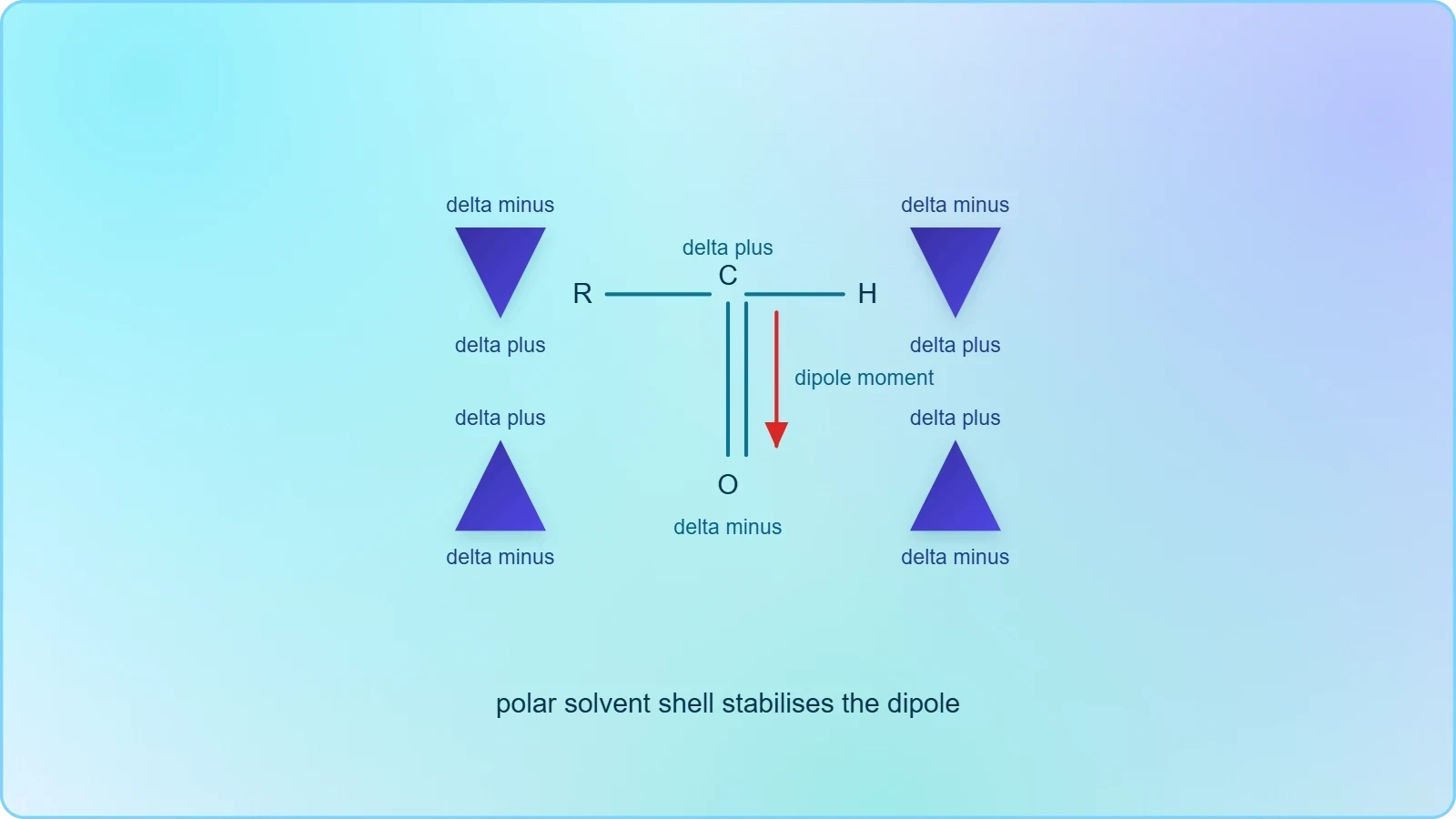
Boiling occurs when the thermal energy of molecules overcomes the attractive forces holding them in the liquid phase. In an aldehyde or ketone, the dominant attractions are dipole–dipole interactions between aligned carbonyl groups, supplemented by London dispersion forces that grow with the size of the electron cloud. Because oxygen is substantially more electronegative than carbon, the ##\ce{C=O}## bond carries a partial negative charge on oxygen and a partial positive charge on carbon, giving each molecule a permanent dipole of roughly 2.3 to ##2.8\ \mathrm{D}##. Neighbouring molecules therefore associate weakly, with the positive carbon of one drawn toward the negative oxygen of another.
This association is real but modest. Unlike the hydrogen bond in an alcohol, where a hydrogen atom bridges two electronegative atoms, the carbonyl dipole interaction has no such bridging atom and is easily disrupted by thermal motion. The consequence is a boiling point that sits above hydrocarbons and ethers but comfortably below alcohols. The reference data make the ranking vivid: compounds of molecular mass 58 and 60 span a boiling range of nearly 100 K, from n-butane at 273 K to propan-1-ol at 370 K, with propanal and acetone falling in between.
Reading the Benchmark Data
Consider the five compounds of molecular mass 58 or 60. n-Butane, a nonpolar alkane, boils at 273 K on dispersion forces alone. Methoxyethane, an ether with a small dipole, boils slightly higher at 281 K. Propanal reaches 322 K and acetone 329 K, both lifted by carbonyl dipole association. Propan-1-ol, the only member capable of intermolecular hydrogen bonding, tops the set at 370 K. The ordering is a clean demonstration that hydrogen bonding outweighs dipole–dipole attraction, which in turn outweighs dispersion forces at equal mass.
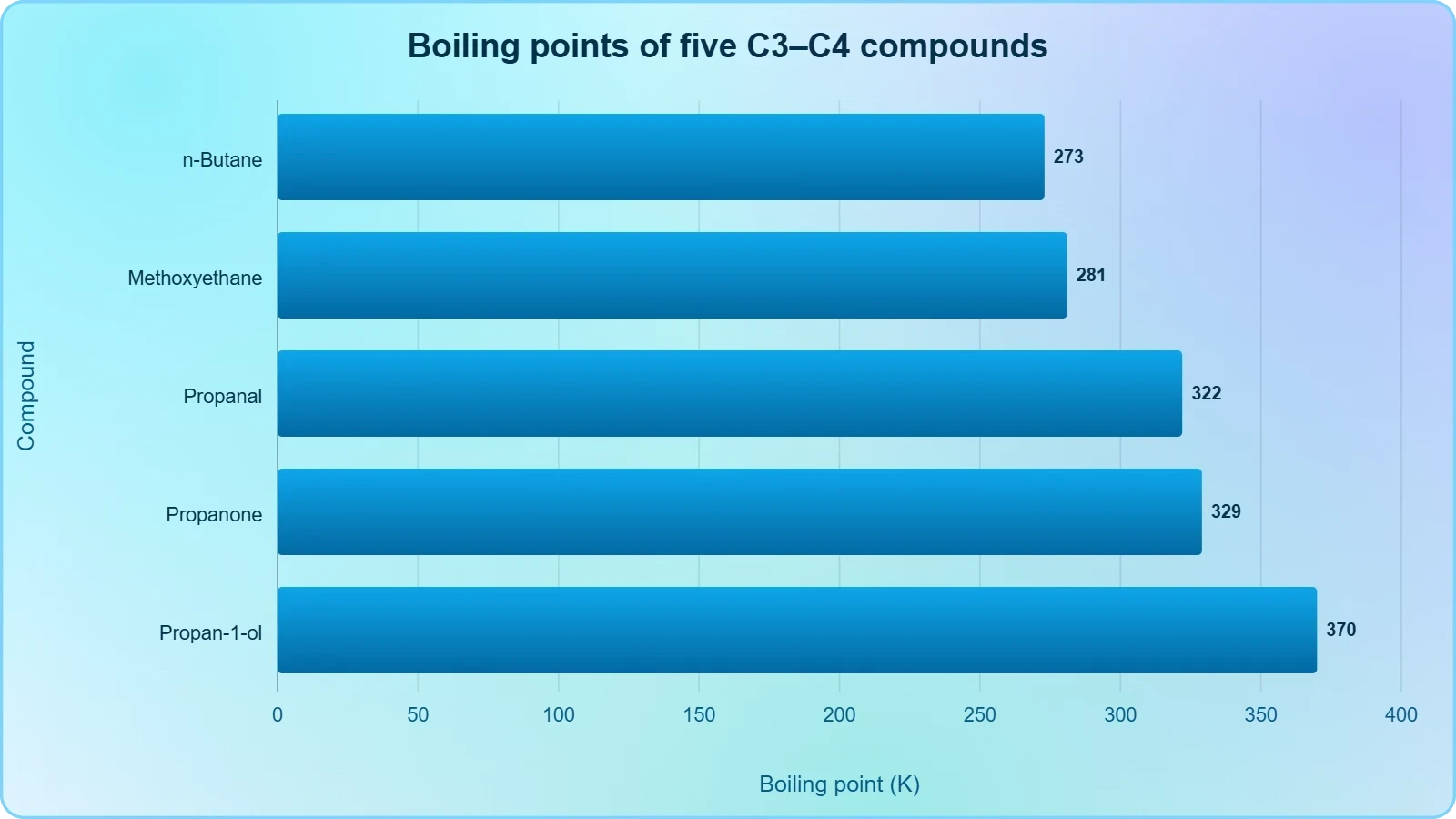
Note that acetone boils about 7 K above propanal despite identical molecular formula ##\ce{C3H6O}##. The difference is subtle and arises from how the dipole is presented to neighbours: in acetone the carbonyl sits between two methyl groups, allowing closer and more effective dipole alignment in the liquid, whereas propanal's terminal carbonyl is flanked by a hydrogen and a chain. Such small gaps remind students that boiling point comparisons are only meaningful when molecular mass is held nearly constant.
Why Methanal Is a Gas and Higher Members Are Not
Methanal, ##\ce{HCHO}##, has a molecular mass of only 30 and the smallest possible hydrocarbon framework: two hydrogen atoms bonded to the carbonyl carbon. With so few electrons, dispersion forces are negligible, and the single carbonyl dipole cannot generate enough attraction to hold molecules together at room temperature. Methanal therefore boils at 252 K, well below ambient, and exists as a gas. Ethanal, with one methyl group added, boils at 294 K and is a volatile liquid whose vapour is easily detected. The jump from gas to liquid is a direct consequence of adding one ##\ce{CH2}## unit.
As the alkyl chain lengthens, dispersion forces accumulate rapidly because they depend on the surface area of the electron cloud. Propanone boils at 329 K, butanal at 348 K, pentanal at 376 K and hexanal at 404 K. Each additional ##\ce{CH2}## group adds roughly 20 to 30 K to the boiling point, a regularity that mirrors the homologous series behaviour of alkanes. By the time the chain reaches ten carbons, as in decanal, the compound is a viscous liquid with a boiling point above 480 K, and longer homologues approach waxy solidity.

Solubility in Water and Organic Solvents
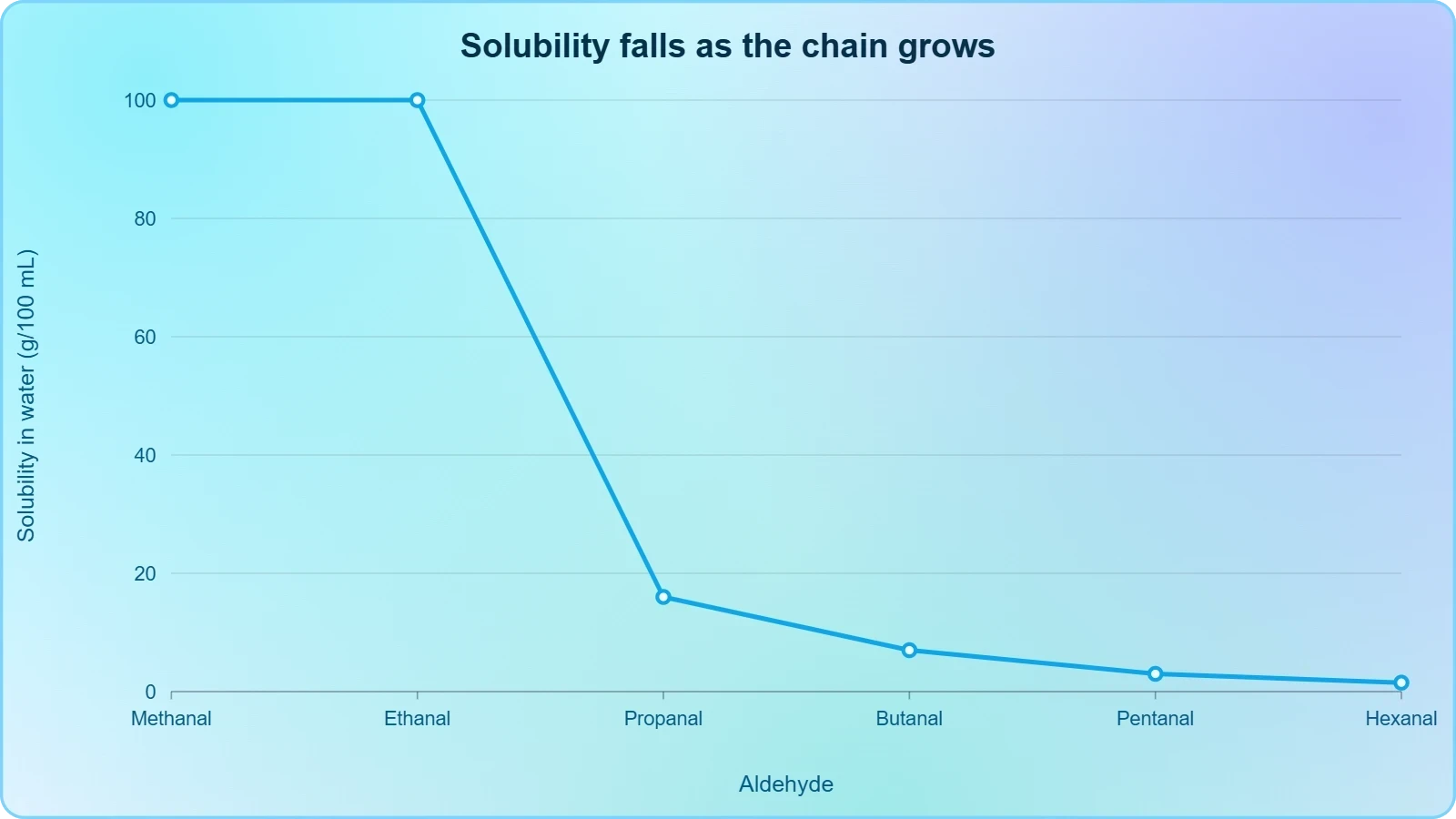
Dissolution in water requires that the energy released by new solute–solvent attractions compensates for the energy needed to break existing ones. For the lower aldehydes and ketones, this balance is favourable because the carbonyl oxygen can accept a hydrogen bond from water. Methanal, ethanal and propanone are miscible with water in all proportions, forming hydrogen bonds of the type ##\ce{C=O\cdots H-O-H}## in which the carbonyl oxygen acts as the acceptor and water as the donor. The small hydrocarbon portion does not seriously obstruct the approach of water molecules.
As the alkyl chain grows, the hydrophobic portion begins to dominate. Water molecules must reorganise around an increasingly large nonpolar surface, an entropically costly process, while the single hydrogen-bonding site remains unchanged. Solubility therefore falls sharply: butanal dissolves to the extent of about 7 g per 100 g of water, hexanal to roughly 0.5 g, and higher aldehydes are effectively insoluble. Ketones behave similarly, with cyclohexanone only sparingly soluble despite its compact ring. All aldehydes and ketones, however, remain freely soluble in benzene, ether, methanol and chloroform, since these solvents offer dispersion and dipole interactions without demanding hydrogen bonding.
Aromatic Aldehydes and Ketones
Benzaldehyde illustrates how an aromatic ring changes the solubility picture. Its molecular mass is 106, and the phenyl group is large and hydrophobic, so benzaldehyde is only slightly soluble in water, dissolving to about 0.3 g per 100 mL at room temperature. It mixes readily with ethanol, ether and chloroform. Acetophenone, with a methyl group added to the ring, is practically insoluble in water. The general rule holds: aromatic aldehydes and ketones are far less water-soluble than their aliphatic counterparts of similar carbon count, because the ring contributes hydrophobic surface without adding hydrogen-bonding capacity.
There is a further subtlety worth noting for later lessons. In benzaldehyde the carbonyl group is conjugated with the aromatic ring, and resonance delocalisation reduces the polarity of the ##\ce{C=O}## bond. This not only lowers the dipole moment relative to an aliphatic aldehyde but also reduces the electrophilicity of the carbonyl carbon, a point that becomes central when reactivity toward nucleophiles is discussed. The physical consequence is weaker dipole–dipole association and a somewhat lower boiling point than a fully saturated analogue of comparable mass might suggest.
Worked Comparison of Boiling Points
Arrange ##\ce{CH3CH2CH2CHO}##, ##\ce{CH3CH2CH2CH2OH}##, ##\ce{H5C2-O-C2H5}## and ##\ce{CH3CH2CH2CH3}## in increasing order of boiling point. All four have molecular masses between 72 and 74, so the comparison is fair. Butan-1-ol is the only molecule with an ##\ce{O-H}## group and therefore the only one capable of extensive intermolecular hydrogen bonding; it must have the highest boiling point. Butanal is more polar than ethoxyethane, so its dipole–dipole attraction is stronger. n-Pentane has only weak van der Waals forces and comes lowest.

The resulting order is ##\ce{CH3CH2CH2CH3} < \ce{H5C2-O-C2H5} < \ce{CH3CH2CH2CHO} < \ce{CH3CH2CH2CH2OH}##. Numerically, n-pentane boils near 309 K, ethoxyethane near 308 K, butanal near 348 K and butan-1-ol near 391 K. The near-equality of pentane and ethoxyethane is instructive: the ether's small dipole is almost exactly offset by its slightly greater mass and shape, so the two are practically indistinguishable on boiling point alone. Butanal's clear advantage over both confirms the strength of carbonyl dipole association.
Common Mistakes to Avoid
Students frequently compare compounds of different molecular mass and attribute the difference to functional group alone. Always check mass first. A second error is to claim that aldehydes and ketones hydrogen-bond with each other; they do not, because they possess no ##\ce{O-H}## or ##\ce{N-H}## donor. They hydrogen-bond only with solvents that can donate, such as water or an alcohol. A third mistake is to assume that higher boiling point always means higher solubility in water, when in fact the two trends run in opposite directions as the alkyl chain lengthens.
Odour, Volatility and the Chemistry of Smell
The lower aldehydes possess sharp, pungent odours that are instantly recognisable. Methanal's irritating smell is familiar from formalin solutions, ethanal has a characteristic stale-apple pungency, and propanone gives the sweetish solvent odour of nail polish remover. These molecules are small and volatile, so they reach the olfactory receptors in high concentration and interact strongly with them. As the molecule grows, volatility falls and the odour character changes: the sharpness fades and a pleasant, fruity or floral fragrance emerges. This transition is one of the most useful diagnostic clues available in the organic laboratory.
Nature exploits this progression extensively. Benzaldehyde carries the bitter-almond note of cherry and almond. Cinnamaldehyde, ##\ce{C6H5CH=CHCHO}##, provides the warm spice of cinnamon bark. Vanillin, a substituted aromatic aldehyde, gives vanilla its characteristic sweetness. Citral, an unsaturated aldehyde with two double bonds, supplies the lemon aroma of lemongrass, while citronellal contributes to rose and citrus notes. Among ketones, carvone is remarkable for its chirality: the (R) enantiomer smells of spearmint and the (S) enantiomer of caraway, a striking demonstration that olfactory receptors are themselves chiral.
Odour as an Identification Tool
Before spectroscopy, chemists relied on smell to identify natural products, and the practice remains valuable as a rapid preliminary check. The characteristic odour of oil of wintergreen, cloves or bitter almonds often confirmed a suspected constituent during extraction. Modern laboratories treat odour cautiously because many aldehydes are irritants and some, such as methanal, are toxic, so the technique is applied by wafting rather than direct inhalation. Nevertheless, the correlation between structure and scent is a genuine chemical relationship, and the fragrance industry builds entire product lines on it.
The blending of perfumes and flavouring agents depends on precise knowledge of volatility. Top notes are small, highly volatile aldehydes that evaporate within minutes; middle notes are moderately sized compounds such as citral; base notes are heavier, less volatile molecules that persist for hours. A perfumer selects components so that the fragrance evolves gracefully over time, and the underlying science is simply the vapour pressure of each carbonyl compound, which in turn reflects molecular mass and intermolecular forces.
Branching and the Shape of the Molecule
Branching lowers the boiling point of an aldehyde or ketone by reducing the surface area available for dispersion forces. A straight-chain isomer presents a long, extended electron cloud that allows neighbouring molecules to lie close together over a large contact region. A branched isomer is more compact and roughly spherical, so the contact area shrinks and the total attraction weakens. This is the same principle that makes 2-methylpropane boil below n-butane, and it applies with equal force to carbonyl compounds.
Compare butanal, ##\ce{CH3CH2CH2CHO}##, with 2-methylpropanal, ##\ce{(CH3)2CHCHO}##. Both have the formula ##\ce{C4H8O}## and molecular mass 72, yet the branched isomer boils several kelvin lower because its molecules cannot pack as efficiently. Among ketones, pentan-2-one and pentan-3-one differ only in the position of the carbonyl group, and their boiling points are close but not identical, reflecting subtle differences in dipole alignment and packing. Branching near the carbonyl is especially significant because it also shields the reactive carbon, a point that anticipates the steric argument for reactivity in the next lesson.

We Also Published
Physical Properties as Tools for Purification
Boiling point and solubility are not merely examination facts; they are the operational basis of purification. Simple distillation separates a volatile aldehyde from a less volatile impurity, provided the boiling points differ by at least 25 K. Fractional distillation, using a column that provides repeated vapour–liquid equilibria, resolves mixtures of closer-boiling components such as propanal and acetone. The choice of technique follows directly from the data table, and a chemist who knows the boiling points can plan a separation before entering the laboratory.
Solubility differences support extraction and crystallisation. Because lower aldehydes are water-miscible while higher ones are not, a reaction mixture can often be worked up by washing with water to remove small polar by-products while the product remains in the organic layer. Steam distillation exploits the volatility of immiscible organic compounds with water, and it is the classical method for isolating benzaldehyde from bitter almonds. Recrystallisation of solid derivatives, such as the 2,4-dinitrophenylhydrazones used to characterise carbonyls, depends on the sharp change in solubility with temperature.
Connecting Properties to Structure
Every property discussed so far traces back to two structural variables: the strength of the carbonyl dipole and the size and shape of the attached hydrocarbon framework. A larger dipole strengthens dipole–dipole attraction and raises the boiling point; a larger hydrocarbon framework increases dispersion forces but simultaneously dilutes the polar group's influence on solubility. The interplay explains why propanone, with a substantial dipole and a small frame, is both high-boiling relative to its mass and completely water-miscible, while decanal, with the same functional group but a long tail, is high-boiling yet water-insoluble.
This structural reasoning is the bridge to chemical behaviour. The same polarity that creates dipole–dipole attraction also makes the carbonyl carbon electrophilic, and the same steric bulk that lowers the boiling point of a branched isomer also hinders the approach of a nucleophile. Physical properties are therefore not a separate topic to be memorised but the visible expression of the electronic structure that governs reactivity. The next lesson takes up nucleophilic addition, where the electrophilic character of the carbonyl carbon becomes the central actor.
Advanced Insight: Dipole Moments and Solvent Effects
The dipole moment of a carbonyl compound is not a fixed quantity; it depends on conformation and environment. In the gas phase, propanal has a dipole moment near ##2.5\ \mathrm{D}##, but in a polar solvent the surrounding molecules stabilise the charge-separated form and can increase the effective polarity. This solvent dependence explains why boiling points measured in solution differ from those measured in the pure liquid, and why a compound's apparent solubility can shift with the composition of the solvent mixture. For examination purposes the pure-liquid values are standard, but the underlying physics is worth appreciating.
A further advanced point concerns the difference between aldehydes and ketones of identical mass. Because the carbonyl group in a ketone is flanked by two alkyl groups, the dipole is more symmetrically embedded and the molecule is more polarisable in the region around the oxygen. This often gives ketones slightly higher boiling points than isomeric aldehydes, as the propanal–acetone pair demonstrates. The effect is small but consistent, and it reinforces the general principle that molecular shape, not just functional group, determines physical behaviour.
Consolidating the Evidence
The physical properties of aldehydes and ketones form a coherent set of observations that all point to the same structural cause. Boiling points rise with molecular mass and fall with branching, sitting between those of comparable alkanes and alcohols. Solubility in water is high for the first three members and collapses as the hydrocarbon chain lengthens, while solubility in organic solvents remains universal. Odour shifts from sharp and pungent to fragrant as volatility falls, and this shift is exploited in the flavour and fragrance industries. Each fact is a measurable consequence of the polar carbonyl group and its hydrocarbon surroundings.
Mastery of this lesson means being able to predict, not merely recall. Given two structures, a student should be able to rank their boiling points by comparing mass, then branching, then the presence or absence of hydrogen bonding. Given a solubility question, the same student should assess the size of the hydrophobic portion against the single hydrogen-bonding site. These predictive habits carry directly into the next lesson, where the electrophilic character of the carbonyl carbon and the steric environment around it determine how readily a nucleophile attacks.
Worked Problems and Examination Practice
Applying the principles to unfamiliar structures is the surest test of understanding. The problems below progress from straightforward ranking to multi-step reasoning, and each is designed to expose a common conceptual gap. Attempt them before reading the solutions, and pay attention to the order in which you consider mass, branching and hydrogen bonding. The discipline of checking mass first, then functional group, then shape will serve well in both board examinations and competitive entrance tests where such questions appear frequently.
Ranking and Reasoning Exercises
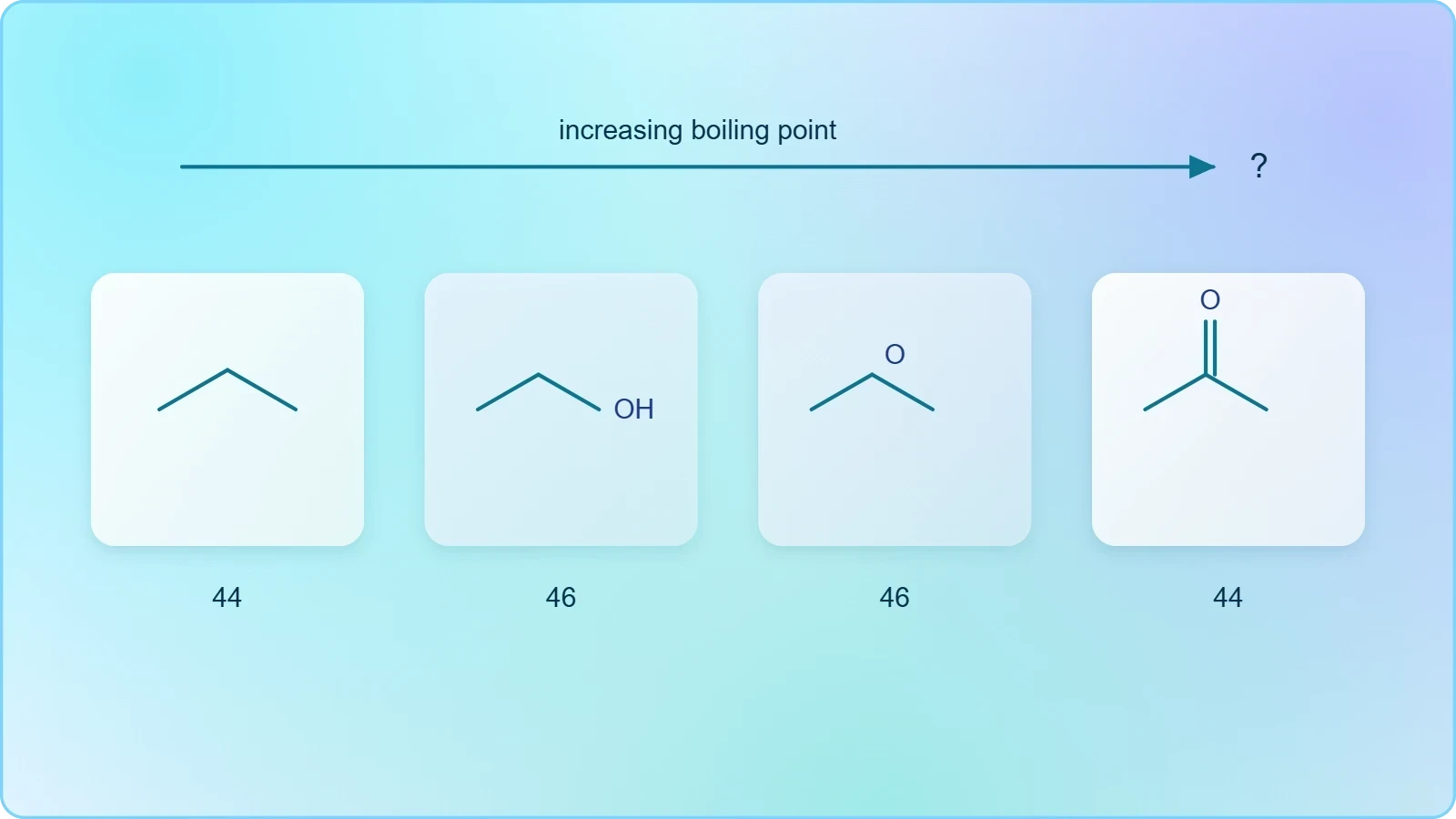
Arrange ##\ce{CH3CHO}##, ##\ce{CH3CH2OH}##, ##\ce{CH3OCH3}## and ##\ce{CH3CH2CH3}## in increasing order of boiling point. The masses are close, ranging from 44 to 46. Ethanol is the only compound with an ##\ce{O-H}## group and therefore the highest. Ethanal has a carbonyl dipole stronger than the ether's, and propane has only dispersion forces. The order is ##\ce{CH3CH2CH3} < \ce{CH3OCH3} < \ce{CH3CHO} < \ce{CH3CH2OH}##, with approximate values of 231, 248, 294 and 351 K respectively.
A second exercise asks why benzaldehyde is less reactive than propanal toward nucleophiles, even though both are aldehydes. The answer lies in resonance: the aromatic ring delocalises the carbonyl ##\pi## electrons, reducing the partial positive charge on the carbonyl carbon and hence its electrophilicity. This electronic effect, combined with the steric bulk of the phenyl ring, makes benzaldehyde less reactive. The question connects physical properties to reactivity and previews the electronic arguments developed fully in the next lesson on nucleophilic addition.
Laboratory Application: Choosing a Separation Method
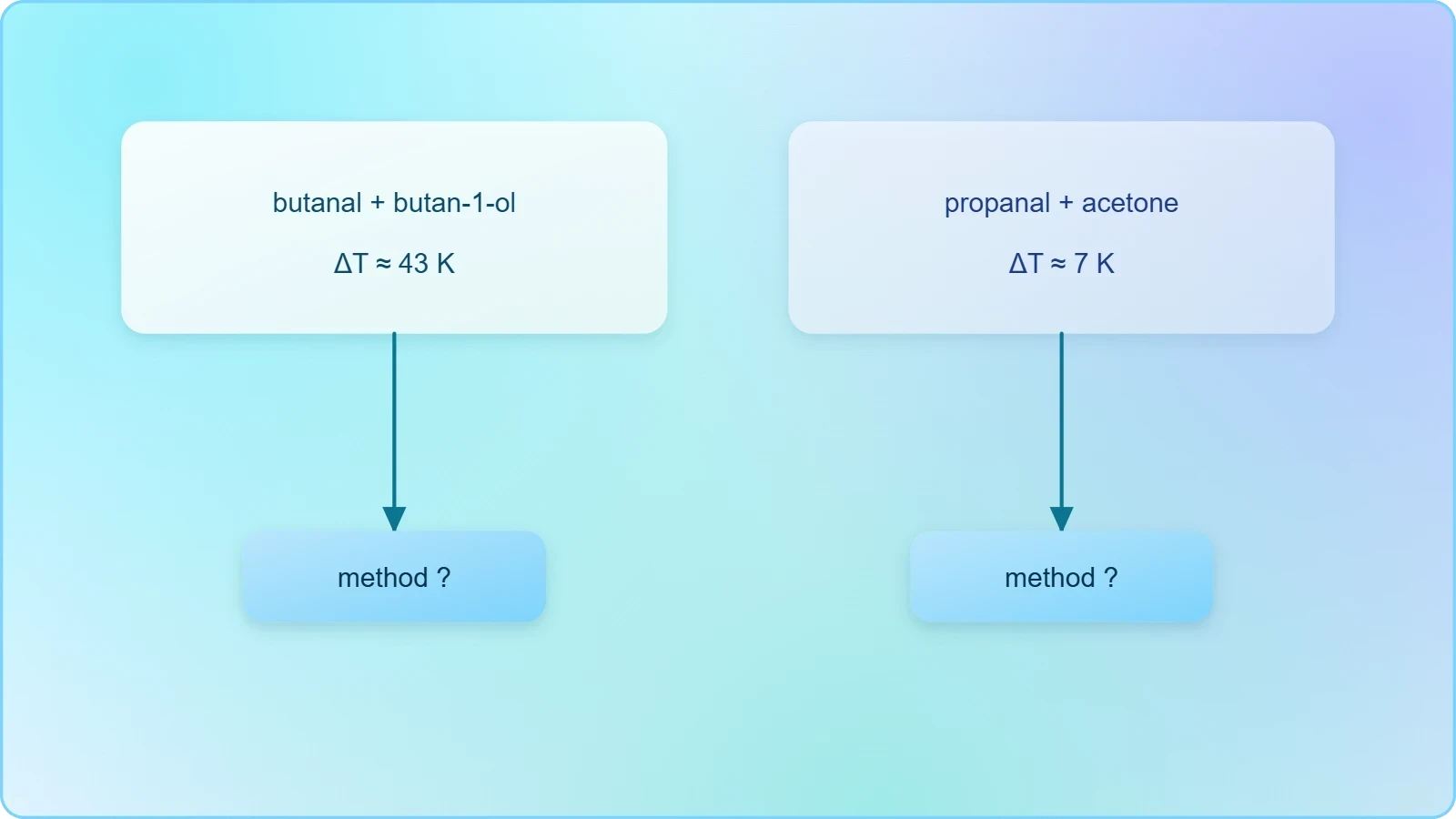
Suppose a reaction produces a mixture of butanal and butan-1-ol. Their boiling points differ by roughly 43 K, so simple distillation can separate them adequately. If instead the mixture contains propanal and acetone, whose boiling points differ by only 7 K, fractional distillation with an efficient column is required. If one component is water-miscible and the other is not, extraction may be simpler than distillation. The physical property data thus translate directly into a practical decision tree, and this is precisely the kind of reasoning that distinguishes a competent laboratory chemist.
Purification by recrystallisation relies on the temperature dependence of solubility. A solid aldehyde derivative that is sparingly soluble in cold ethanol but freely soluble in hot ethanol can be purified by dissolving it in the minimum hot solvent, filtering while hot to remove insoluble impurities, and cooling slowly to obtain crystals. The choice of solvent follows from the solubility rules discussed earlier: polar solvents dissolve polar carbonyl derivatives, and the sharp temperature dependence allows controlled crystallisation. Understanding why a solvent works is more valuable than memorising a recipe.
Summary of Key Relationships
The relationships developed in this lesson can be stated compactly. Boiling point increases with molecular mass, increases with the strength of the carbonyl dipole, and decreases with branching. It is higher than that of comparable alkanes and ethers but lower than that of comparable alcohols. Water solubility is high when the hydrocarbon portion is small and falls rapidly as the chain lengthens, while solubility in organic solvents is essentially universal. Odour shifts from pungent to fragrant as volatility decreases, and these properties underpin distillation, extraction, recrystallisation and the formulation of fragrances.
These conclusions rest on a single structural feature, the polar ##\ce{C=O}## group, and a single counterweight, the hydrocarbon framework. Holding that pair of ideas in mind allows a student to reason from structure to property without memorising tables. The same pair governs chemical reactivity, because the electrophilic carbonyl carbon that attracts water molecules also attracts nucleophiles, and the steric bulk that lowers a boiling point also shields that carbon from attack. The next lesson develops this connection in full.
From our network :
- AI-Powered 'Precision Diagnostic' Replaces Standard GRE Score ReportsDiscover the new GRE Precision Diagnostic. Learn how AI-powered behavioral analytics and time-to-solve tracking are replacing standard GRE score reports to empower students.
- Do You Need a New Router or Is Your Internet Plan the Problem?A practical comparison of the signs that point to router limits versus signs your broadband speed or provider is the bottleneck, so you can decide what to replace before spending money.
- 10 Physics Numerical Problems with Solutions for IIT JEEPrepare for IIT JEE with 10 physics numerical problems, complete with detailed solutions and conceptual explanations. Ideal for mastering kinematics, thermodynamics, electromagnetism, and optics.
- Analyzing Trump Deportation Numbers Insights Into The 2026 Immigration Crackdown
- Where to Put Your Wireless Router for Better CoverageA practical, physics-grounded guide to router placement: why the centre of the home beats the corner, how walls and metal sap signal, and how to run a simple survey that proves the improvement.
- 98% of Global MBA Programs Now Prefer GRE Over GMAT Focus EditionExplore why 98% of global MBA programs now prefer the GRE over GMAT Focus. Learn about the shorter GRE format, verbal logic importance, and strategic versatility for students.
- Trump Political Strategy How Geopolitical Stunts Serve As Media Diversions
- How to Print Cheaply: Cutting the Cost per PageA practical, measured guide to lowering what each printed page costs — duplex and draft modes, third-party ink, yield mathematics, and knowing when a new printer beats refills.
- EV 2.0: The Solid-State Battery Breakthrough and Global Factory ExpansionDiscover the impact of the Solid-State Battery Breakthrough on the EV market. Learn about CATL and BYD stock growth, global factory expansion in Europe, and the future of EV 2.0 technology.