Integrated problems in the chemistry of aldehydes, ketones and carboxylic acids are where a student's separate skills finally meet: nomenclature, structure, preparation, physical properties, reaction mechanisms and synthetic planning all converge on a single question. A typical examination item rarely asks for one isolated fact. It hands you a molecular formula, a set of diagnostic observations, and a demand for a structure, a sequence of equations, or a reasoned ranking of acid strengths. The challenge is not memorising more reactions but learning to read evidence, order it logically, and defend each deduction with a mechanism.
This closing lesson of the course builds directly on the uses of carboxylic acids and pushes toward the kind of multi-step reasoning that separates a competent answer from an elegant one. We will work through identification problems of the type that give a formula such as ##\ce{C9H10O}## alongside Tollens' and 2,4-DNP results, then move to synthesis under strict carbon limits, conversion puzzles solvable in two steps, and the mechanistic explanations examiners reward. Along the way we treat the recurring errors that cost marks: sloppy resonance drawings, forgotten stereochemistry, and mechanisms that skip the proton transfer that actually drives a reaction forward.
Because this is the final lesson, the emphasis falls on transferable strategy rather than new content. Every worked example is chosen to illustrate a pattern you can reuse: the logic of the iodoform test, the way substituent effects on ##\ce{-COOH}## acidity follow from induction and resonance, and the discipline of writing curly-arrow mechanisms that conserve charge and mass. Treat the problems below as a rehearsal for the examination hall, where clarity of reasoning matters as much as the final structure you draw.
On This Page
- Reading Evidence: The Logic of Structure Identification
- Planning Synthesis Under Carbon Constraints
- Mechanistic Reasoning and the Acidity of Carboxylic Acids
- Distinguishing Compounds and Predicting Condensation Products
- Common Mistakes and Advanced Perspectives
- Bringing It Together: A Problem-Solving Framework
Reading Evidence: The Logic of Structure Identification
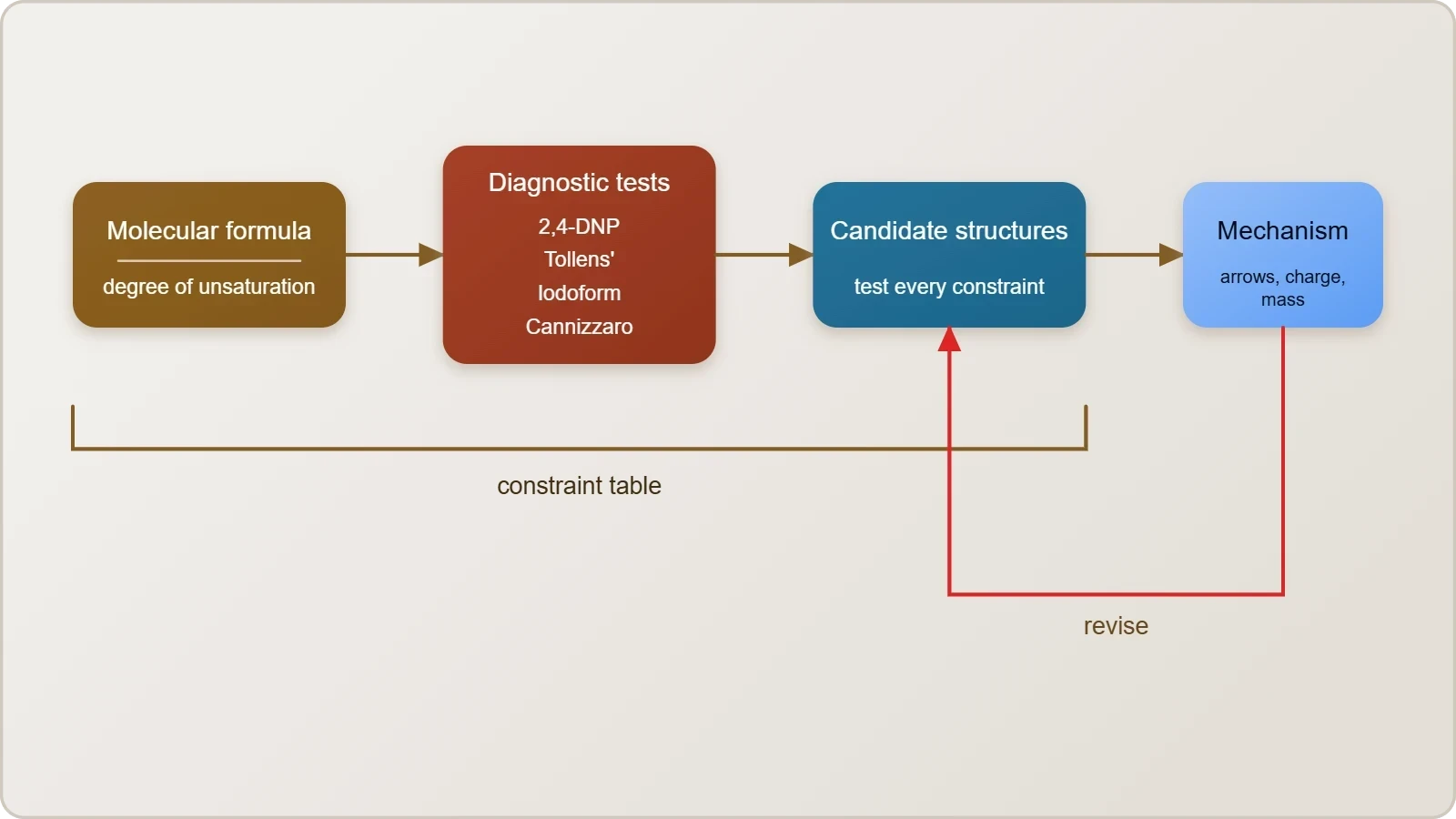
Identification problems are essentially detective work, and the most reliable method is to convert each observation into a structural constraint before attempting any structure. A molecular formula gives the degree of unsaturation, which immediately tells you how many rings and ##\pi## bonds the molecule must contain. Functional-group tests then narrow the possibilities: a positive 2,4-DNP result confirms a carbonyl, Tollens' reagent distinguishes an aldehyde from a ketone, and the iodoform test flags a methyl ketone or a ##\ce{CH3CH(OH)-}## unit. Building a constraint table before drawing anything prevents the common error of forcing a structure to fit only one clue.
Worked Example: The ##\ce{C9H10O}## Problem
Consider a compound of formula ##\ce{C9H10O}## that forms a 2,4-DNP derivative, reduces Tollens' reagent, and undergoes the Cannizzaro reaction. Vigorous oxidation yields 1,2-benzenedicarboxylic acid. The degree of unsaturation is ###\Omega = \dfrac{2(9)+2-10}{2} = 5###, which a benzene ring alone accounts for. Tollens' positivity and the Cannizzaro reaction together demand an aromatic aldehyde lacking ##\alpha##-hydrogens, so the carbonyl carbon must be attached directly to the ring. Oxidation to a phthalic acid fixes the substituent positions as adjacent, giving 2-methylbenzaldehyde as the answer.
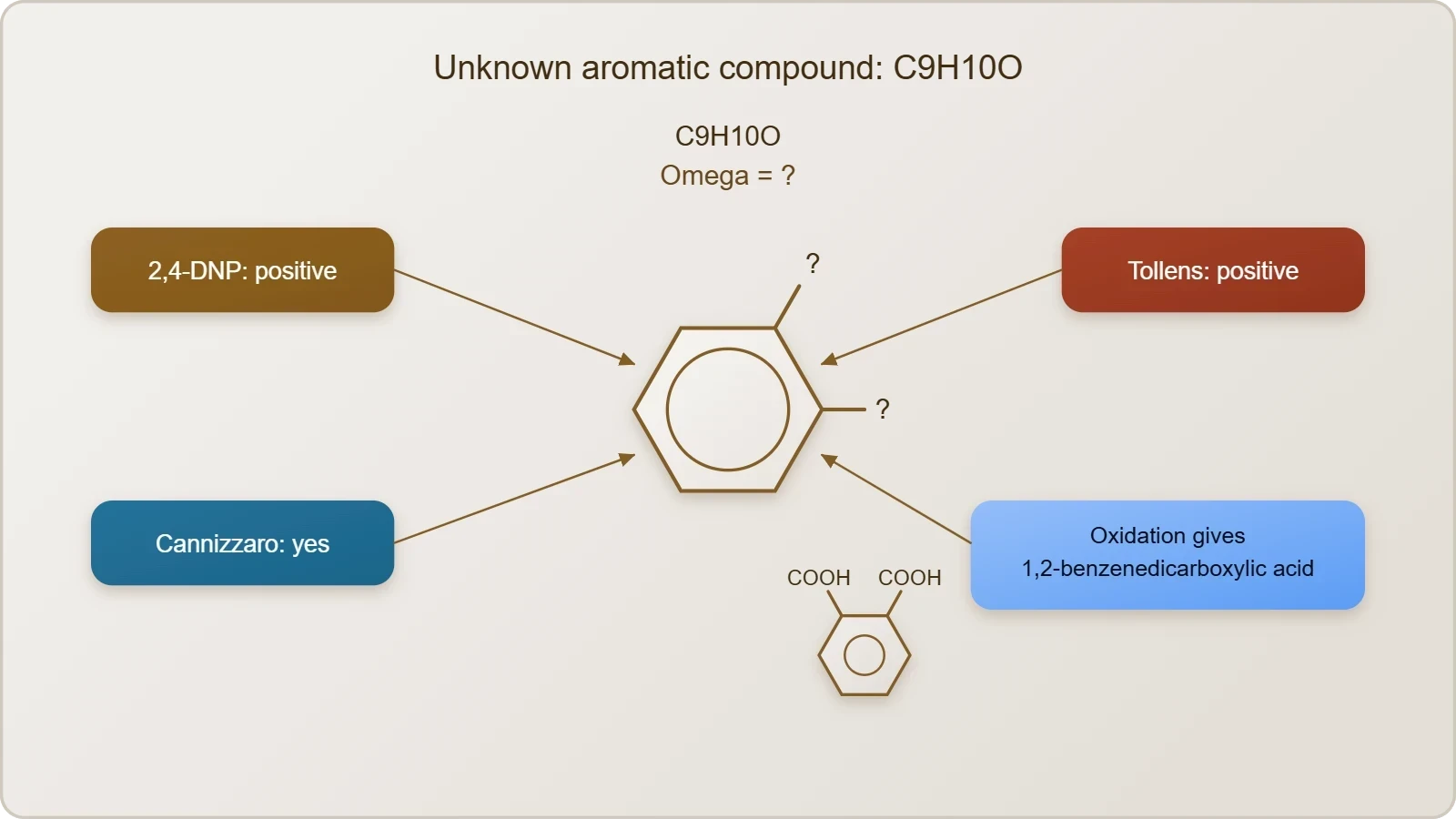
The elegance of this problem lies in how each clue eliminates alternatives. A ketone would fail Tollens'; an aldehyde with ##\alpha##-hydrogens would prefer aldol condensation over Cannizzaro; a meta or para substituent would oxidise to a different dicarboxylic acid. Notice also that the Cannizzaro reaction is diagnostic of the absence of ##\alpha##-hydrogens, a point students frequently overlook when they assume every aldehyde disproportionates. Writing the constraint table first, then testing candidate structures against every observation, is the habit that makes such questions routine rather than intimidating.
Worked Example: The ##\ce{C5H10O}## Ketone
A second classic asks for a compound of molecular mass 86 containing 69.77% carbon, 11.63% hydrogen and the remainder oxygen. Dividing each percentage by the atomic mass gives an empirical ratio of roughly ##5:10:1##, consistent with ##\ce{C5H10O}##. The compound fails to reduce Tollens' reagent but forms a bisulphite addition compound and gives a positive iodoform test, so it is a methyl ketone. Vigorous oxidation to ethanoic and propanoic acids fixes the skeleton as pentan-2-one, since cleavage must occur on either side of the carbonyl carbon.
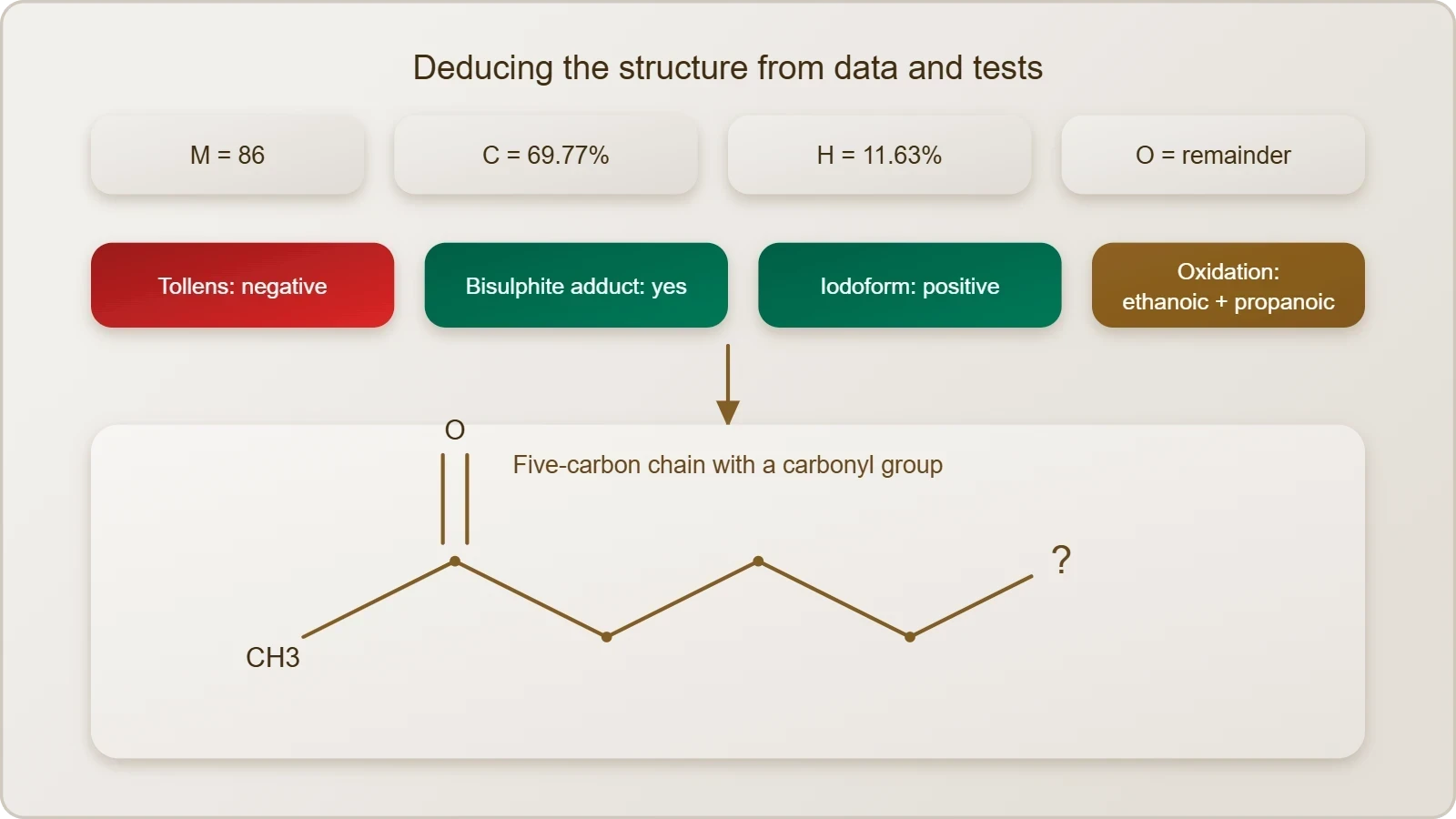
This example rewards careful arithmetic as much as chemical insight. The empirical formula calculation is straightforward, but the deduction that oxidation products reveal the position of the carbonyl group is a powerful general tool. Whenever a ketone is oxidised under vigorous conditions, the carbon chain breaks at the carbonyl, and the fragments identify the neighbouring carbons. Combining that logic with the iodoform test, which localises a methyl group adjacent to the carbonyl, pins the structure precisely and demonstrates how independent clues reinforce one another.
Planning Synthesis Under Carbon Constraints
Synthesis questions that restrict the carbon sources are testing retrosynthetic thinking, not memory. When a problem permits only inorganic reagents and organic reagents of one carbon or fewer, you must build the carbon skeleton from benzene or from single-carbon units such as methanol, methanal, or cyanide. The discipline is to work backwards from the target, identifying which bond must be formed last and which one-carbon reagent can supply the needed fragment. This forces you to recognise that the Friedel–Crafts acylation, the Grignard addition, and the nitrile route are your principal tools for extending a chain.
Retrosynthesis from Benzene
Preparing methyl benzoate from benzene under a one-carbon limit begins with a Friedel–Crafts acylation using ##\ce{CH3COCl}## and ##\ce{AlCl3}## to give acetophenone, which is then oxidised with alkaline ##\ce{KMnO4}## to benzoic acid before esterification with methanol. For m-nitrobenzoic acid, the order matters: nitration of benzoic acid directs meta, whereas nitration of toluene would give the ortho and para products. Recognising that the carboxylic acid is itself a meta-directing group is the key insight, and it illustrates why the sequence of electrophilic substitutions must be planned before any drawing begins.
Phenylacetic acid demands a different strategy because the target has a ##\ce{CH2}## inserted between ring and carboxyl. The classical route converts benzene to bromobenzene, forms the Grignard reagent, and treats it with carbon dioxide to give benzoic acid, but that yields the wrong product. Instead, chloromethylation or a cyanide displacement on benzyl chloride supplies the extra carbon. The lesson is that the position of the carboxyl relative to the ring dictates the disconnection, and no single route serves every target.
Two-Step Conversions
Conversion problems such as transforming propanone into propene reward a clear mental map of functional-group interconversions. Reduction of propanone with ##\ce{NaBH4}## gives propan-2-ol, which on dehydration with concentrated ##\ce{H2SO4}## yields propene in two steps. Similarly, benzoic acid to benzaldehyde proceeds by reduction to benzyl alcohol followed by controlled oxidation, or more directly through the acid chloride and a Rosenmund reduction. The skill being tested is selecting the shortest legitimate route while respecting the two-step ceiling.
Other conversions in this family include ethanol to 3-hydroxybutanal, achieved by oxidation to ethanal and then an aldol addition, and benzaldehyde to 3-phenylpropan-1-ol, which requires a crossed aldol with ethanal followed by hydrogenation of the unsaturated aldehyde. Each conversion is a small retrosynthesis, and the discipline of counting steps keeps you honest. Examiners award marks for the correct reagent at each stage, so write every reagent and condition explicitly rather than sketching a vague arrow.
We Also Published
Mechanistic Reasoning and the Acidity of Carboxylic Acids
Mechanism questions reward a disciplined narrative: identify the electrophile and nucleophile, show the flow of electron pairs, and account for every proton transfer. The nucleophilic addition to a carbonyl begins with attack of the nucleophile on the electrophilic carbon, generating a tetrahedral alkoxide that is protonated. For Grignard reagents the intermediate is a magnesium alkoxide, and only after aqueous acidic workup does the alcohol appear. Students who omit the workup step lose marks because the reaction is not complete until the metal–oxygen bond is cleaved.
Why Carboxylic Acids Outrank Phenols
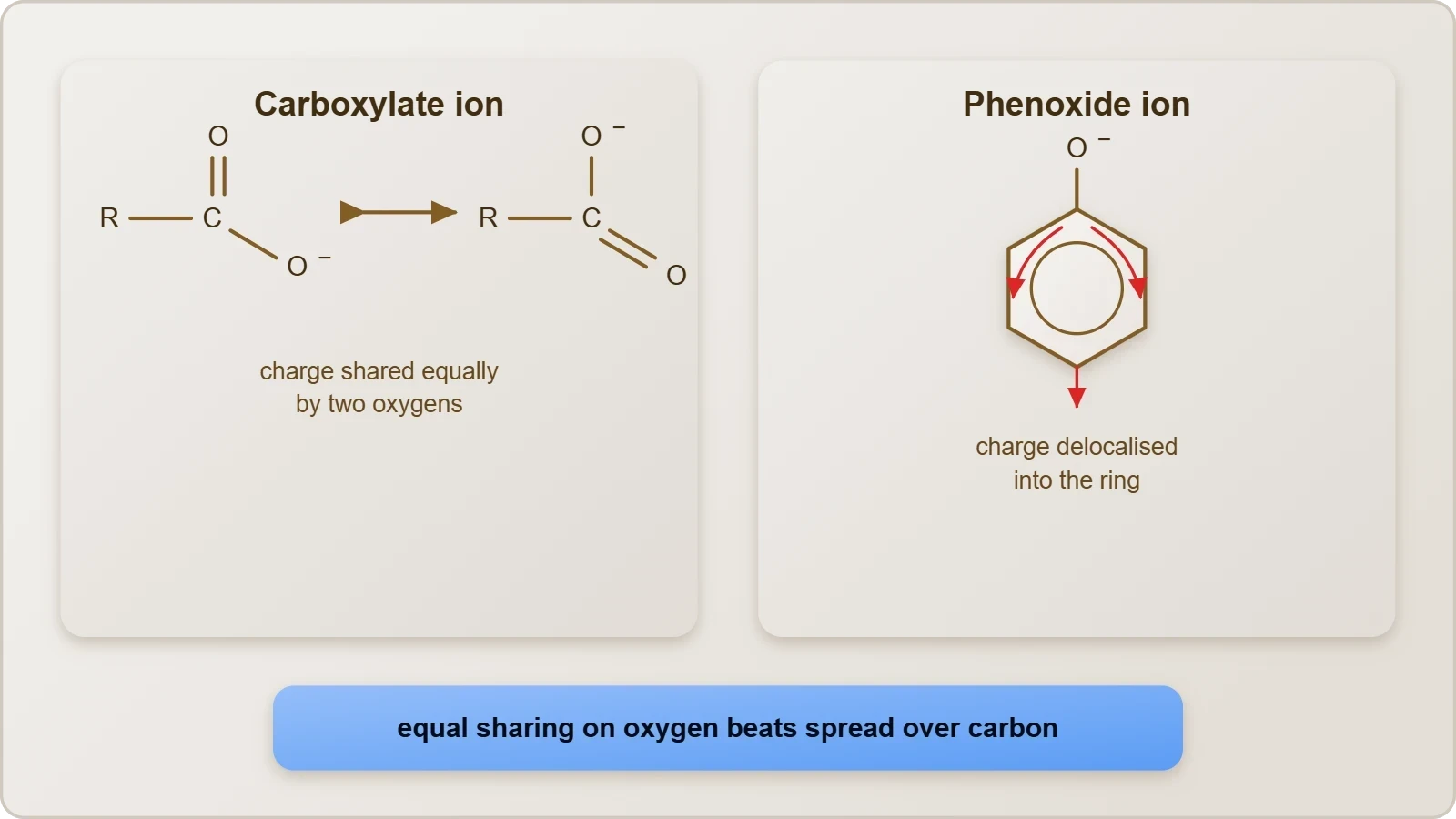
A perennial question asks why carboxylic acids are stronger acids than phenols even though the phenoxide ion has more resonance structures. The answer lies in the quality rather than the quantity of stabilisation. In the carboxylate ion, the negative charge is delocalised equally over two electronegative oxygen atoms, each bearing half a charge, and the two structures are equivalent. In the phenoxide ion, the charge is delocalised onto carbon atoms that are less electronegative, and the contributing structures are not equivalent, so the stabilisation is weaker despite the larger count.
Substituent effects then modulate this baseline. Electron-withdrawing groups such as ##\ce{-NO2}## stabilise the carboxylate anion through induction and, where possible, resonance, raising acidity; electron-donating groups such as ##\ce{-OCH3}## destabilise it and lower acidity. This explains the ordering benzoic acid ##<## 4-nitrobenzoic acid ##<## 3,4-dinitrobenzoic acid, with 4-methoxybenzoic acid weakest of the substituted series. The same inductive logic orders the bromo-substituted butanoic acids, where the halogen nearest the carboxyl exerts the strongest effect.
Explaining the Semicarbazide and Cyanohydrin Puzzles
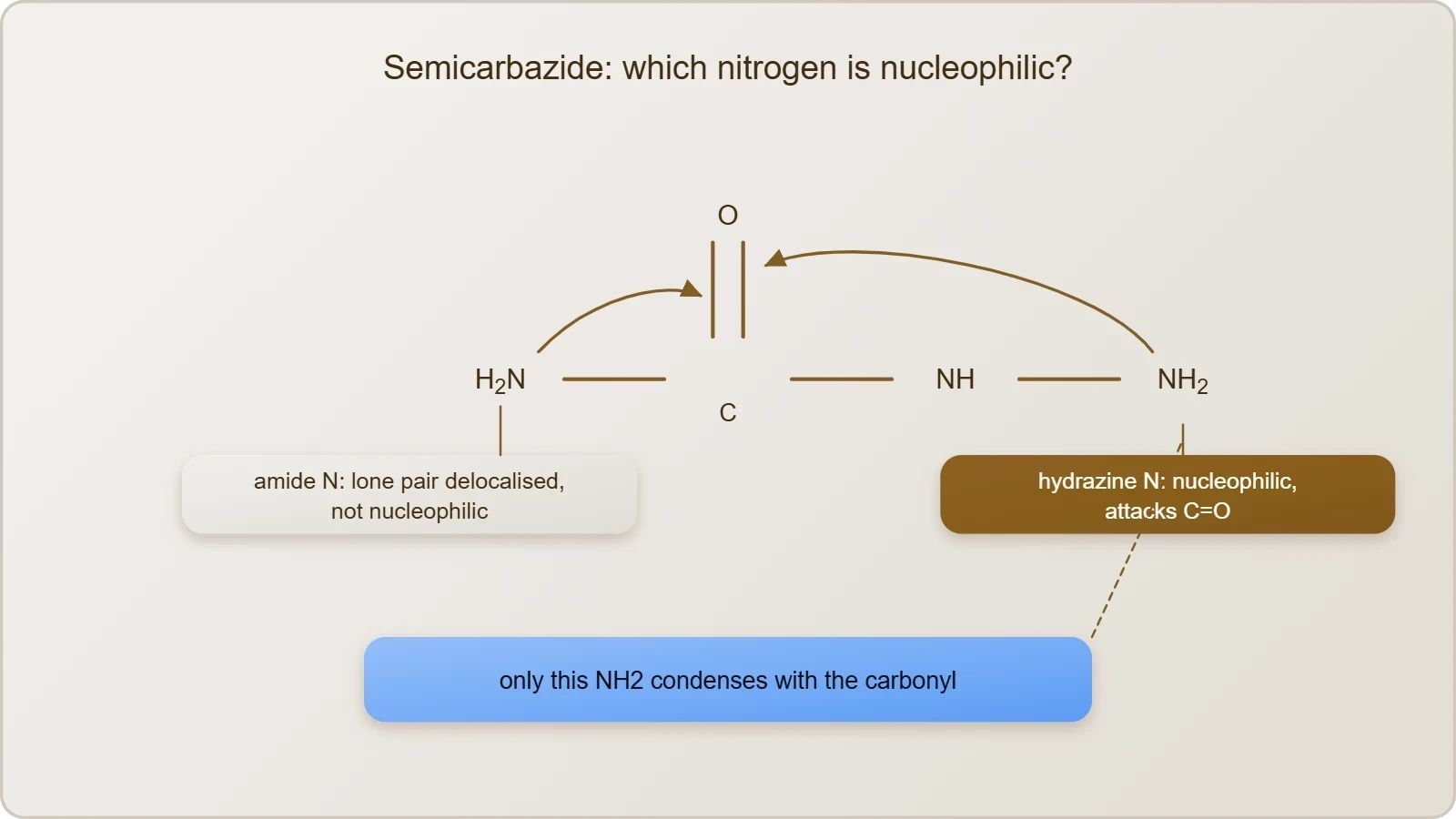
Semicarbazide contains two ##\ce{-NH2}## groups, yet only one condenses with a carbonyl. The reason is resonance: the ##\ce{-NH2}## adjacent to the carbonyl of the semicarbazide is delocalised into that carbonyl, reducing its nucleophilicity, so the hydrazine-like nitrogen attacks instead. Similarly, cyclohexanone forms a cyanohydrin in good yield while 2,2,6-trimethylcyclohexanone does not, because the three methyl groups create severe steric crowding at the carbonyl carbon, blocking the approach of the cyanide nucleophile. These explanations require you to connect structure to reactivity rather than recite a fact.
The esterification puzzle follows the same principle of equilibrium control. When a carboxylic acid and an alcohol are heated with an acid catalyst, the reaction is reversible, so removing water or distilling the ester as it forms drives the equilibrium toward products by Le Chatelier's principle. Writing the equilibrium explicitly and naming the removal strategy demonstrates understanding. In examinations, a mechanism answer that names the rate-determining step and justifies each arrow earns full credit, while a bare equation rarely does.
Distinguishing Compounds and Predicting Condensation Products
Chemical tests are chosen so that each pair differs in exactly one functional feature, and the art lies in selecting the test that isolates that difference. Propanal and propanone are separated by Tollens' reagent or Fehling's solution, since only the aldehyde reduces them. Acetophenone and benzophenone differ in the presence of a methyl ketone, so the iodoform test distinguishes them. Phenol and benzoic acid are told apart by sodium bicarbonate, which liberates carbon dioxide only from the acid, while benzoic acid and ethyl benzoate differ in the acid's solubility in bicarbonate.
Choosing the Right Test
Pentan-2-one and pentan-3-one are positional isomers that both give positive iodoform results only if a methyl group adjoins the carbonyl; pentan-2-one does, pentan-3-one does not, so the iodoform test separates them. Benzaldehyde and acetophenone are distinguished by Tollens' reagent, which the aldehyde reduces. Ethanal and propanal both reduce Tollens', but the iodoform test is positive only for ethanal because it possesses the ##\ce{CH3CO-}## unit. Building a small decision tree from these tests makes the choice automatic under exam pressure.
When predicting aldol and Cannizzaro products, the decisive question is whether the carbonyl compound possesses ##\alpha##-hydrogens. Methanal, benzaldehyde, and 2,2-dimethylbutanal lack them and therefore undergo the Cannizzaro reaction, while 2-methylpentanal, cyclohexanone, 1-phenylpropanone, and phenylacetaldehyde possess them and undergo aldol condensation. Benzophenone has no ##\alpha##-hydrogens but is a ketone, so it undergoes neither. Butan-1-ol has no carbonyl at all and is inert to both, a distinction students often miss when they scan a list too quickly.
Crossed Aldol and the Nucleophile–Electrophile Assignment
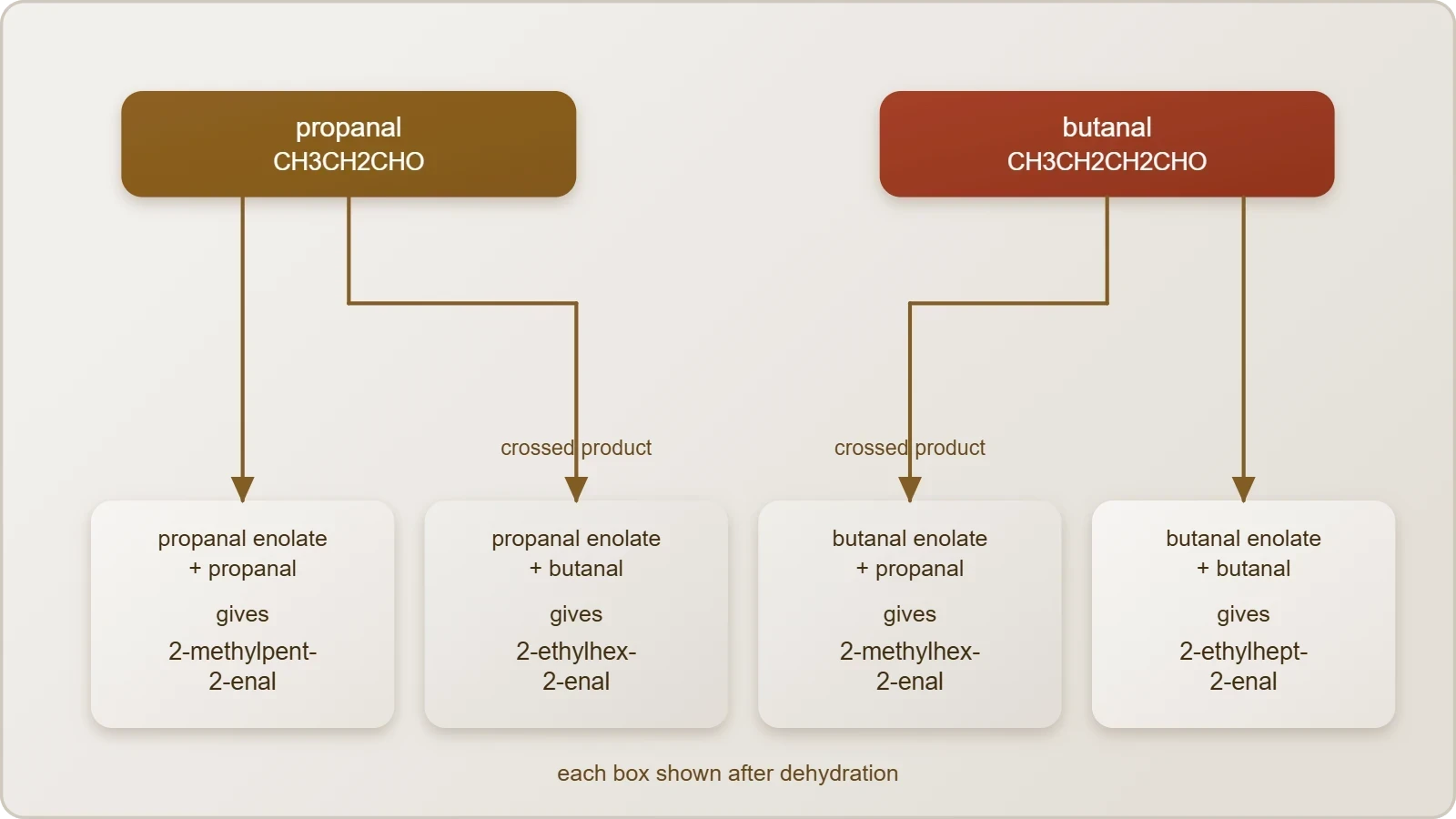
In a crossed aldol between propanal and butanal, four products are possible because either aldehyde can act as the nucleophile after enolate formation. The enolate of propanal attacking butanal gives 2-ethylhex-2-enal after dehydration, while the enolate of butanal attacking propanal gives a different branched product. Writing each combination explicitly, and labelling which partner supplies the nucleophilic ##\alpha##-carbon and which supplies the electrophilic carbonyl, is the clearest way to answer such questions and demonstrates genuine mechanistic understanding.
The Cannizzaro reaction of benzaldehyde under concentrated alkali produces benzyl alcohol and benzoate in equal amounts through a hydride transfer from one aldehyde molecule to another. Crossed Cannizzaro reactions between formaldehyde and an aromatic aldehyde are synthetically useful because formaldehyde is oxidised preferentially, leaving the aromatic alcohol. Recognising that the hydride donor is the aldehyde that retains its hydrogen, and that the more electrophilic carbonyl accepts the hydride, allows you to predict the major products of mixed systems with confidence.
Common Mistakes and Advanced Perspectives
Resonance structures are the single largest source of lost marks in this topic. The most frequent error is moving ##\pi## electrons without conserving the position of atoms, which produces a structure that is not a true resonance contributor. A second error is drawing curved arrows that imply a nucleus moves, when only electron pairs migrate. A third is forgetting that the carboxylate ion's two structures are equivalent, so neither oxygen is preferentially double-bonded. Practising with a strict rule—atoms fixed, electrons mobile, charge conserved—eliminates most of these slips.
Exam Technique for Mechanism Questions
When a mechanism question appears, structure your answer in three movements: identify the electrophilic and nucleophilic centres, show the electron flow with clear arrows, and account for proton transfers and leaving groups. Label the rate-determining step if the question asks for kinetics, and state the role of the catalyst explicitly. For acid-catalysed reactions, show the protonation that activates the carbonyl; for base-catalysed reactions, show the deprotonation that generates the enolate. Examiners look for these markers, and their presence signals that you understand why the reaction proceeds rather than merely what it produces.
Another common pitfall is neglecting stereochemistry where it matters. Nucleophilic addition to a carbonyl in a chiral environment can give diastereomeric products, and the aldol reaction can create a new stereocentre. At school level you are rarely asked to assign configuration, but acknowledging that a new stereocentre forms shows sophistication. Similarly, when a question asks for the product of a Grignard addition to an ester, remember that the reaction does not stop at the ketone; a second equivalent adds to give a tertiary alcohol, and controlling the stoichiometry is essential.
Asymmetric Aldol and Modern Context
Beyond the syllabus, the asymmetric aldol reaction illustrates how the principles you have learned scale into modern synthesis. Chiral auxiliaries such as the Evans oxazolidinone, or chiral catalysts, bias the approach of an aldehyde to one face of an enolate, producing one enantiomer in excess. The underlying logic is the same nucleophilic addition you have studied, but the steric environment of the chiral controller dictates the outcome. Appreciating this connection shows that the mechanistic reasoning practised here is the foundation of contemporary organic chemistry.
Green chemistry offers another advanced perspective. Catalytic hydrogenation, solvent-free conditions, and the use of benign oxidants such as hydrogen peroxide are increasingly preferred for transforming aldehydes and carboxylic acids. Recognising that a reaction's value depends not only on yield but on atom economy and waste connects classroom chemistry to industrial practice. These broader considerations rarely appear in examinations, but they enrich your understanding and prepare you for university-level study, where selectivity and sustainability are as important as the transformation itself.
Bringing It Together: A Problem-Solving Framework
The final skill this course develops is a repeatable framework for unfamiliar problems. Begin by extracting every constraint from the question and writing them as a list. Compute the degree of unsaturation, identify functional groups from tests, and note any stereochemical or regiochemical requirements. Then propose candidate structures and test each against the full list, discarding those that fail any single constraint. This systematic approach is slower than guessing but far more reliable, and it mirrors how practising chemists actually solve structural problems in the laboratory.
Worked Synthesis: The Ester Hydrolysis Problem
A compound of formula ##\ce{C8H16O2}## hydrolyses in dilute sulphuric acid to a carboxylic acid and an alcohol; oxidation of the alcohol with chromic acid gives the same acid, and dehydration of the alcohol gives but-1-ene. The dehydration product fixes the alcohol as butan-1-ol, and oxidation to the acid identifies the acid as butanoic acid. The original ester is therefore butyl butanoate, and the equations are straightforward once the fragments are identified. This problem rewards working from the most diagnostic clue—the alkene—backwards to the ester.
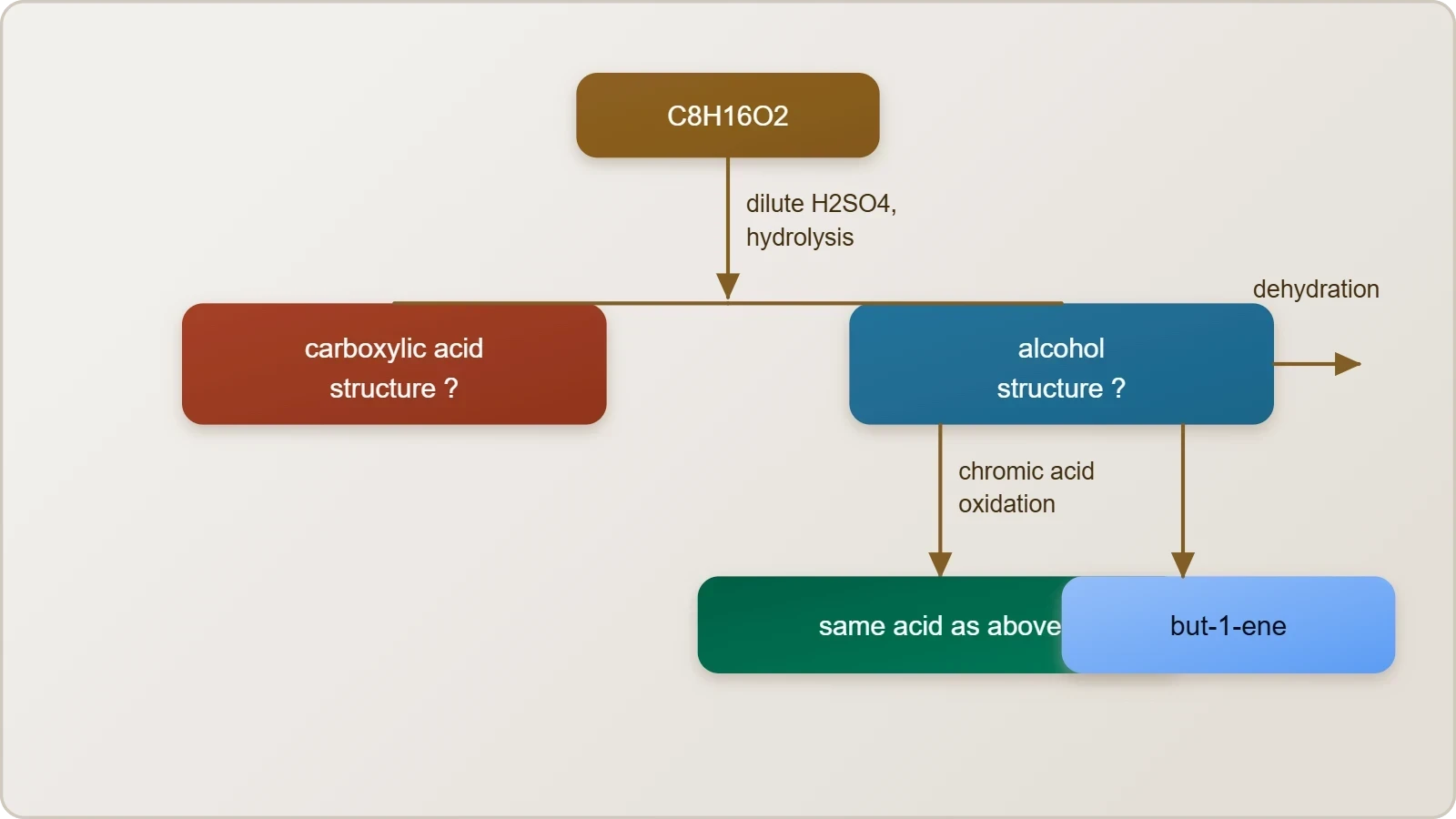
Notice how the framework applies: the formula gives the degree of unsaturation, the hydrolysis reveals an ester, the oxidation links alcohol and acid, and the dehydration pins the carbon skeleton. Each step narrows the field, and the final structure satisfies every constraint simultaneously. Practising this sequence on the exercises in this lesson builds the fluency that turns a daunting multi-step problem into a series of manageable deductions, which is precisely the outcome this course has aimed for.
Final Revision Checklist
Before the examination, consolidate the reactions that recur across problems: nucleophilic addition of Grignard reagents, cyanohydrin formation, aldol and crossed aldol condensation, Cannizzaro and crossed Cannizzaro reactions, oxidation and reduction interconversions, and the acidity trends of substituted carboxylic acids. For each, be able to state the reagent, the product, and the mechanistic reason. Pair this with the diagnostic tests and the degree-of-unsaturation calculation, and you have a compact toolkit that covers the majority of integrated questions.
Finally, remember that clarity of presentation earns marks. Draw structures with correct bond angles, label nucleophiles and electrophiles, and write equations that balance. When a question asks for an explanation, answer with a mechanism or a structural argument rather than a restatement of the observation. These habits, cultivated across the course, transform knowledge into performance, and they are the true measure of mastery in organic chemistry.
From our network :
- How to Print Cheaply: Cutting the Cost per PageA practical, measured guide to lowering what each printed page costs — duplex and draft modes, third-party ink, yield mathematics, and knowing when a new printer beats refills.
- 10 Physics Numerical Problems with Solutions for IIT JEEPrepare for IIT JEE with 10 physics numerical problems, complete with detailed solutions and conceptual explanations. Ideal for mastering kinematics, thermodynamics, electromagnetism, and optics.
- Where to Put Your Wireless Router for Better CoverageA practical, physics-grounded guide to router placement: why the centre of the home beats the corner, how walls and metal sap signal, and how to run a simple survey that proves the improvement.
- 98% of Global MBA Programs Now Prefer GRE Over GMAT Focus EditionExplore why 98% of global MBA programs now prefer the GRE over GMAT Focus. Learn about the shorter GRE format, verbal logic importance, and strategic versatility for students.
- Trump Political Strategy How Geopolitical Stunts Serve As Media Diversions
- Analyzing Trump Deportation Numbers Insights Into The 2026 Immigration Crackdown
- Do You Need a New Router or Is Your Internet Plan the Problem?A practical comparison of the signs that point to router limits versus signs your broadband speed or provider is the bottleneck, so you can decide what to replace before spending money.
- EV 2.0: The Solid-State Battery Breakthrough and Global Factory ExpansionDiscover the impact of the Solid-State Battery Breakthrough on the EV market. Learn about CATL and BYD stock growth, global factory expansion in Europe, and the future of EV 2.0 technology.
- AI-Powered 'Precision Diagnostic' Replaces Standard GRE Score ReportsDiscover the new GRE Precision Diagnostic. Learn how AI-powered behavioral analytics and time-to-solve tracking are replacing standard GRE score reports to empower students.