Molarity stands as the most frequently invoked concentration unit in the working chemist's vocabulary, and for good reason: it translates the abstract counting of particles into a practical volume-based measure that fits the glassware on every laboratory bench. Where mass percent and mole fraction describe composition in terms of mass or particle ratios, molarity answers a more immediate question — how many moles of solute are dissolved in each litre of the finished solution? That single ratio governs how reagents are prepared, how reaction stoichiometry is executed in solution, and how clinical and industrial measurements are reported across the world.
This lesson builds directly on the composition concepts of mass percent and mole fraction, extending them into the volumetric language that dominates laboratory practice. You will learn to compute molarity from mass and volume, to prepare a solution of specified concentration from a solid solute, and to perform dilution calculations using the relation ##M_1V_1 = M_2V_2##. Beyond the mechanics, the lesson examines why molarity changes with temperature, how it differs from molality, and where each unit is the correct choice in analytical, clinical, and industrial settings.
Because concentration errors propagate silently through every downstream calculation, the lesson also treats molarity as a discipline of precision. Worked examples drawn from sodium hydroxide, sodium chloride, and glucose solutions illustrate the arithmetic, while serial dilution, the ideal gas connection ##M = n/V##, and the temperature dependence of volume reveal the conceptual depth beneath a deceptively simple formula. By the end, you should be able to move confidently between solid mass, solution volume, and molar concentration, and to recognise the situations in which molarity is the right tool — and those in which it is not.
On This Page
- Defining Molarity and Its Place Among Concentration Units
- Preparing a Solution of Known Molarity from a Solid Solute
- Dilution and the Relation M₁V₁ = M₂V₂
- Molarity, the Ideal Gas Law, and Temperature Dependence
- Molarity in Clinical Chemistry and Applied Measurement
- Computational Practice and Precision in Molarity Work
- Consolidating Molarity: Summary and Forward Look
Defining Molarity and Its Place Among Concentration Units
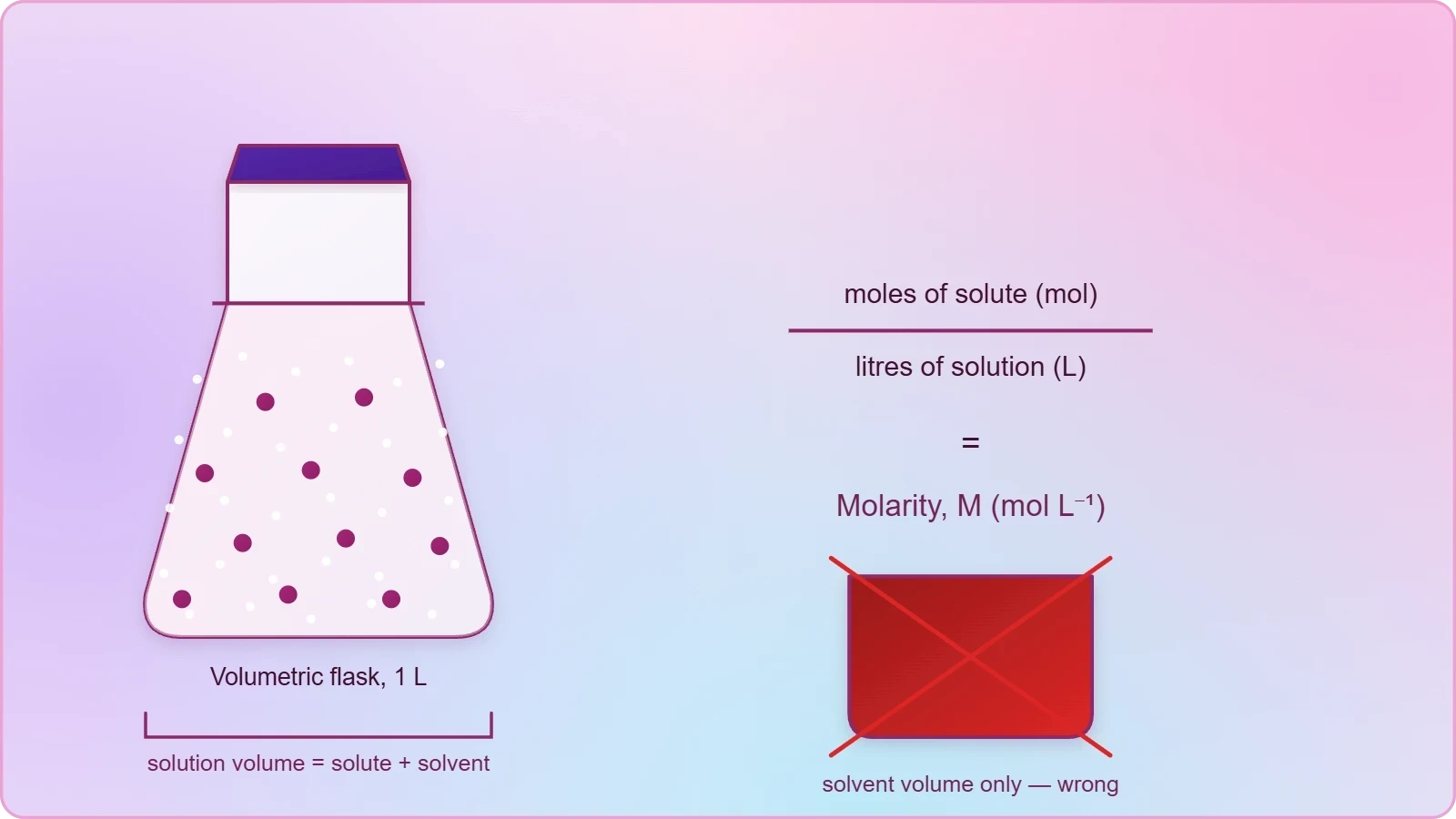
Molarity, denoted by the symbol M, is defined as the number of moles of solute present in one litre of solution. The definition is deliberately framed around the solution's total volume rather than the solvent's volume, a distinction that matters enormously in practice. When you dissolve four grams of sodium hydroxide in enough water to make 250 millilitres of solution, the volume that enters the denominator is the final calibrated volume of the homogeneous mixture, not the volume of water added. This convention ensures that every chemist reading "0.400 M NaOH" understands precisely the same physical reality.
The unit is expressed in moles per litre, often abbreviated as mol L⁻¹, and the capital M is reserved exclusively for molarity in chemical notation. A 1 M solution of sodium hydroxide contains one mole of NaOH, approximately 40 grams, dissolved and made up to one litre. Because molarity links a countable quantity of particles to a measurable volume, it serves as the natural bridge between the microscopic world of molecules and the macroscopic world of beakers, burettes, and volumetric flasks. This bridge is what makes molarity indispensable in stoichiometric reasoning.
The Molarity Formula and Its Components
The defining relation can be written compactly as the ratio of solute amount to solution volume. In symbols, molarity equals the number of moles of solute divided by the volume of solution in litres. When working in millilitres, the volume must be converted by dividing by one thousand before substitution, a step that accounts for a large share of student errors. The formula rewards careful unit tracking: moles in the numerator, litres in the denominator, and the result expressed in mol L⁻¹.
Consider the reference problem: four grams of NaOH dissolved in enough water to form 250 mL of solution. The molar mass of NaOH is 40 g mol⁻¹, so the amount of solute is ##4 / 40 = 0.1## mol. The volume in litres is ##250/1000 = 0.25## L. Dividing gives ##0.1/0.25 = 0.4## mol L⁻¹, so the solution is 0.400 M. Every molarity calculation follows this same three-step rhythm: convert mass to moles, convert volume to litres, then divide.
Molarity Versus the Composition Units of the Previous Lesson
Mass percent and mole fraction, developed earlier, describe composition without reference to volume. Mass percent expresses the solute's mass as a fraction of total solution mass, while mole fraction compares the moles of one component to the total moles present. Both are dimensionless and temperature-independent, which makes them attractive for certain physical measurements. Molarity, by contrast, is dimensioned and volume-based, and its convenience lies in the directness with which it connects to reaction stoichiometry through the mole ratio in a balanced equation.
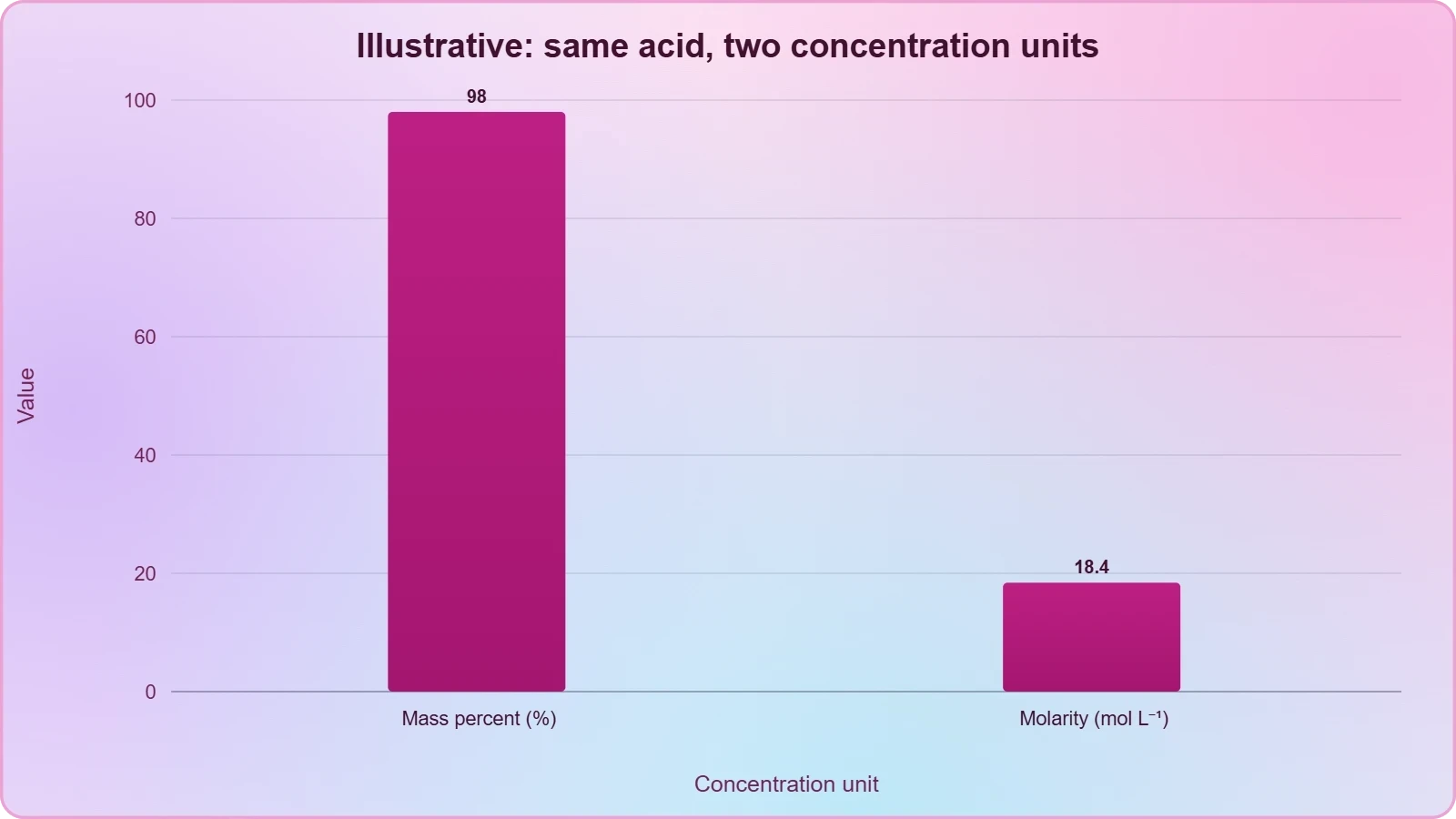
The practical consequence is that a solution described by mass percent requires an extra density step before its molarity can be used in volumetric calculations. A concentrated acid labelled 98 percent by mass, for instance, must be converted using its density to yield a molarity suitable for titration planning. Recognising which unit you have and which unit you need is therefore a core competency. The table below summarises how the principal concentration units compare on the dimensions that matter most in the laboratory.
Preparing a Solution of Known Molarity from a Solid Solute
Laboratory preparation of a molar solution follows a fixed sequence that converts a weighed mass of solid into a calibrated volume of homogeneous solution. The procedure begins with an accurate mass measurement on an analytical balance, followed by dissolution in a volume of solvent deliberately smaller than the final target. Only after the solid has fully dissolved is the solution transferred to a volumetric flask and made up to the calibration mark. This ordering is not arbitrary: dissolving a solid can change the solution's volume, so the final dilution must always be the last step.
The choice of volumetric flask is dictated by the required volume, and flasks are manufactured to tight tolerances at a specified temperature, typically 20 °C. Using a beaker with approximate graduations instead of a volumetric flask introduces a volume uncertainty that can easily exceed one percent, which is unacceptable for quantitative analysis. The worked example below demonstrates the complete calculation for a common laboratory reagent, showing how molar mass, target volume, and desired concentration combine to give the mass to be weighed.
A Worked Preparation: Sodium Chloride Solution
Suppose a laboratory requires 500 mL of 0.150 M sodium chloride solution. The molar mass of NaCl is 58.5 g mol⁻¹. The amount of solute needed is the product of molarity and volume in litres: ##0.150 \times 0.500 = 0.075## mol. Multiplying by the molar mass gives ##0.075 \times 58.5 = 4.3875## g, which is rounded to 4.39 g for weighing on a balance reading to two decimal places. The solid is dissolved in roughly 300 mL of distilled water, transferred quantitatively to a 500 mL volumetric flask, and made up to the mark.
Quantitative transfer deserves emphasis because it is a frequent source of systematic error. After dissolution, the beaker and stirring rod must be rinsed several times with small portions of distilled water, and each rinsing added to the flask. Any residue left behind represents solute that never reaches the final volume, lowering the true concentration below the nominal value. Once the flask is filled to within a centimetre of the mark, the final addition is made dropwise using a dropper until the meniscus rests exactly on the calibration line, viewed at eye level.
Common Errors in Molarity Calculations
The most persistent mistake is forgetting to convert millilitres to litres before dividing. A student who computes ##0.1/250## instead of ##0.1/0.25## obtains 0.0004 rather than 0.4, an error of three orders of magnitude that should be caught immediately by a sanity check. A second frequent error is using the solvent volume rather than the solution volume, which is especially misleading when the solute contributes appreciable volume, as with concentrated salts or when mixing liquids. The definition is unambiguous: the denominator is always the final solution volume.
Another subtle pitfall involves hydrates. Copper sulfate pentahydrate, for example, has a molar mass of 249.7 g mol⁻¹ rather than the 159.6 g mol⁻¹ of the anhydrous salt, and using the wrong value introduces a large systematic error. Finally, students sometimes confuse molarity with the number of moles themselves, treating "0.4 M" as though it meant "0.4 mol." Molarity is a ratio, not an amount, and the distinction becomes critical when volumes other than one litre are involved. Careful dimensional reasoning eliminates most of these errors before they reach the calculation.
Dilution and the Relation M₁V₁ = M₂V₂
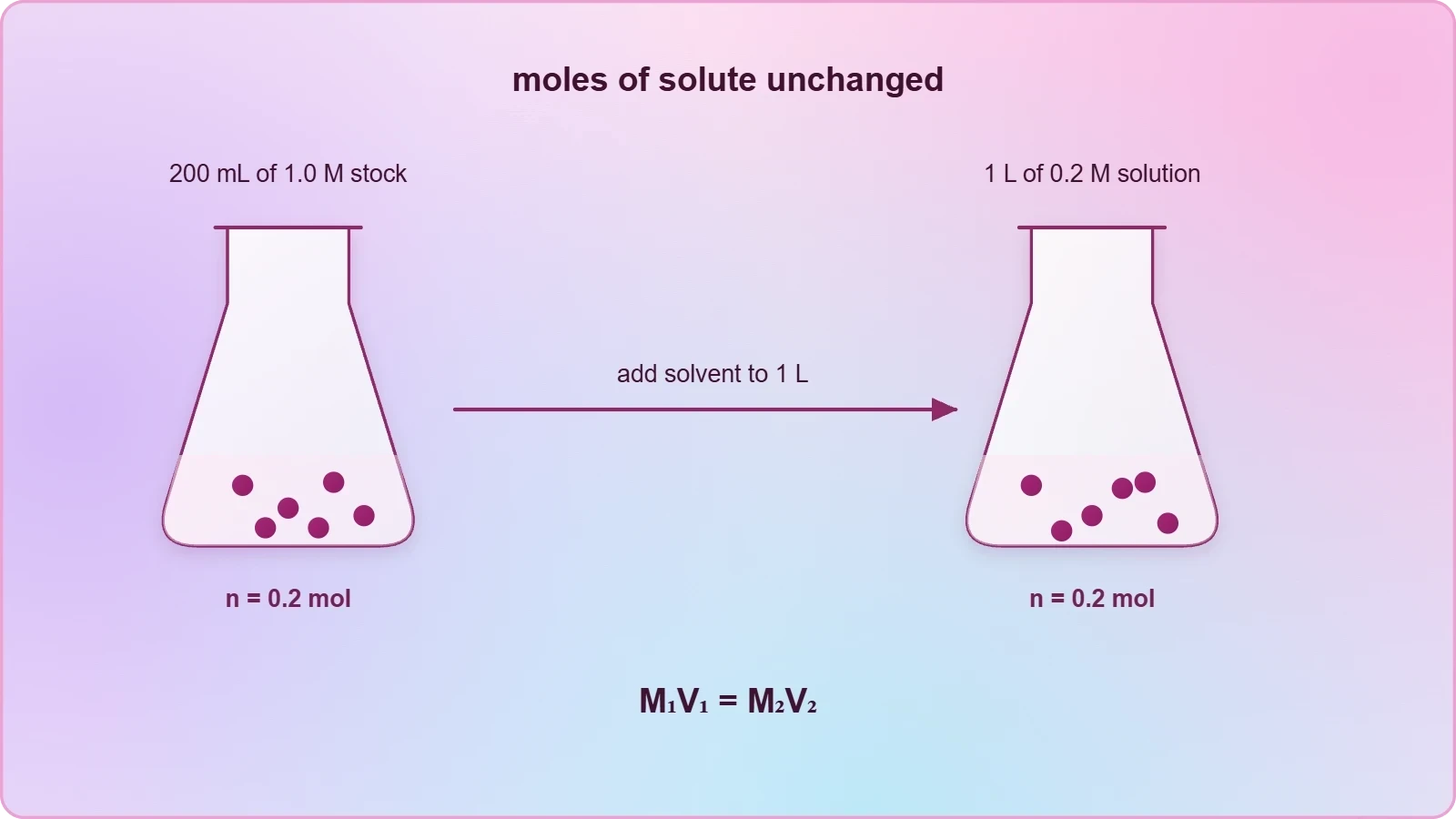
Dilution is the process of reducing a solution's concentration by adding solvent while keeping the amount of solute unchanged. Because no solute is added or removed, the number of moles present before and after dilution is identical. This conservation principle yields the working relation ##M_1V_1 = M_2V_2##, where the subscript 1 refers to the concentrated stock solution and subscript 2 to the diluted result. The equation is one of the most frequently applied relationships in the analytical laboratory, underpinning everything from reagent preparation to calibration curve construction.
The reference example illustrates the logic beautifully. A 1 M sodium hydroxide stock solution is to be diluted to 0.2 M. Since one litre of 1 M solution contains one mole of NaOH, a 0.2 M solution requires only 0.2 moles per litre. The volume of stock containing 0.2 moles is therefore 200 mL, which is measured out and diluted with water to a final volume of one litre. The moles of NaOH remain 0.2 throughout; only the volume, and hence the concentration, has changed.
Applying the Dilution Equation
Substituting the reference values into the relation gives ##0.2 \times 1000 = 1.0 \times V_2##, which solves to ##V_2 = 200## mL. The interpretation is that 200 mL of the 1 M stock must be taken and diluted to one litre to obtain the 0.2 M solution. Note the pleasing symmetry: the dilution factor of five, from 1 M to 0.2 M, corresponds exactly to a fivefold increase in volume, from 200 mL to 1000 mL. This inverse proportionality between concentration and volume is the conceptual heart of every dilution calculation.
In practice, the calculation is usually run in reverse: the analyst knows the desired final concentration and volume and must determine how much stock to pipette. Rearranging gives ##V_1 = M_2V_2/M_1##. For example, preparing 250 mL of 0.050 M hydrochloric acid from a 1.0 M stock requires ##V_1 = (0.050 \times 250)/1.0 = 12.5## mL of stock, made up to 250 mL in a volumetric flask. The stock is always added to a portion of water, never the reverse, to control any heat of mixing.
Serial Dilution and Its Laboratory Uses
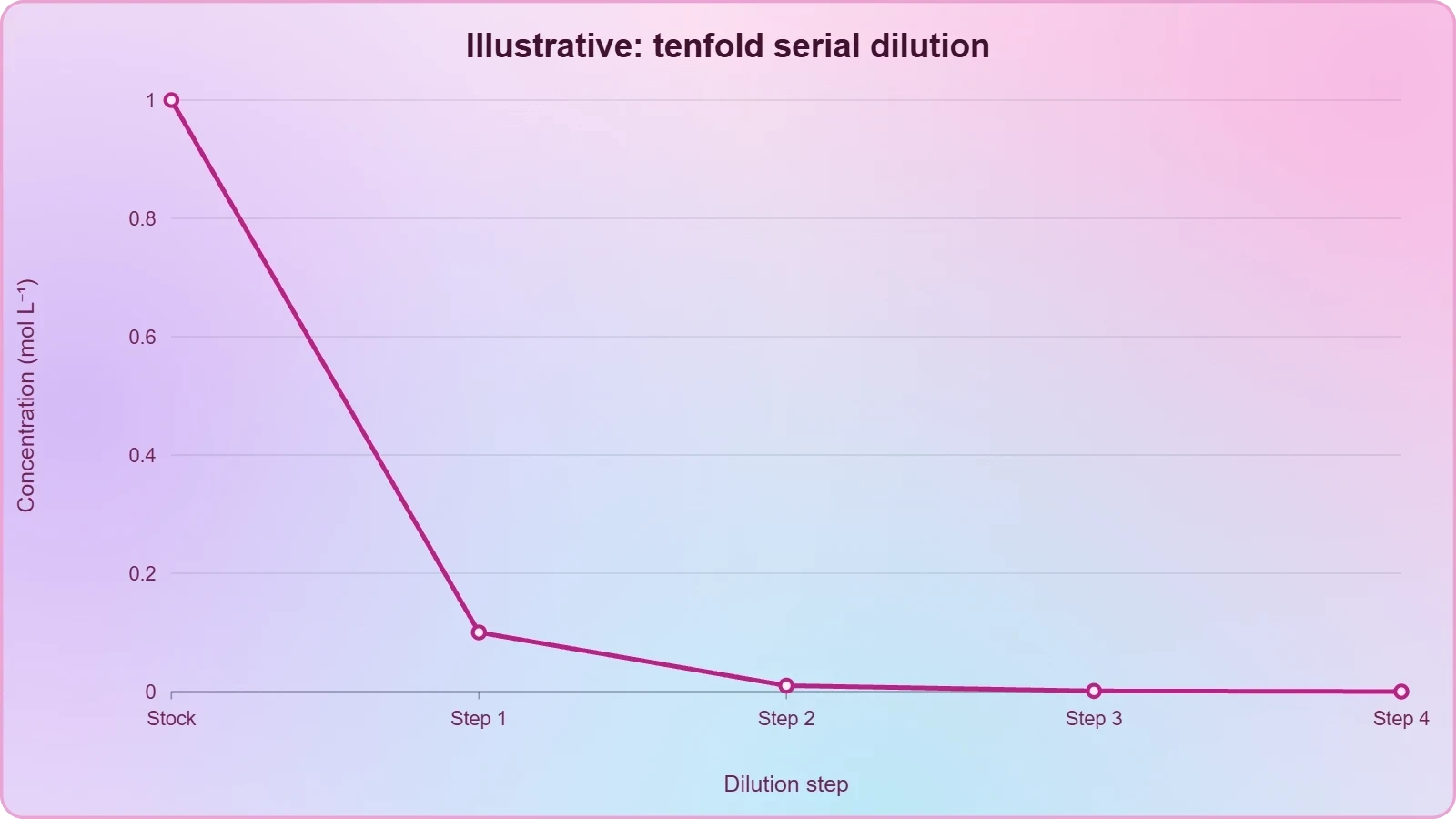
Serial dilution extends the principle across a sequence of steps, each reducing concentration by a fixed factor. A common scheme prepares a tenfold series by transferring 1 mL of stock into 9 mL of diluent, mixing, then transferring 1 mL of that solution into a fresh 9 mL, and so on. The resulting concentrations form a geometric progression, and the cumulative dilution factor after ##n## steps is ##10^{-n}##. Serial dilution conserves stock and produces a wide concentration range from a single starting material, which is why it dominates in microbiology, immunoassay, and pharmacokinetic studies.
The accuracy of a serial dilution depends on the precision of each transfer, and errors compound multiplicatively rather than additively. A one percent pipetting error repeated across five steps can produce a five percent deviation in the final concentration, which may be unacceptable for quantitative assays. For this reason, laboratories use calibrated micropipettes and fresh tips for each transfer, and they often verify the final concentration independently by spectrophotometry or titration. The table below shows a representative tenfold series and the cumulative dilution at each stage.
Molarity, the Ideal Gas Law, and Temperature Dependence
Molarity is fundamentally a statement about number density: moles per unit volume. This is precisely the quantity that appears in the ideal gas law, where pressure, volume, and temperature are linked to the amount of gas. Rearranging ##PV = nRT## gives ##P = (n/V)RT##, and since ##n/V## is molarity, the relation becomes ##P = MRT##. For gaseous solutions and reaction mixtures, molarity therefore connects directly to pressure and temperature, allowing a gas-phase concentration to be computed from a pressure gauge reading and a thermometer.
This connection also exposes molarity's principal weakness. Because the volume of a liquid solution expands measurably with temperature, the denominator of the molarity expression is not constant. A solution prepared to be exactly 1.000 M at 20 °C will be slightly less concentrated at 30 °C, since the same amount of solute now occupies a larger volume. The effect is small for dilute aqueous solutions, roughly 0.02 percent per degree, but it becomes significant in precise analytical work and in concentrated solutions where thermal expansion coefficients are larger.
Why Molality Is Preferred for Temperature-Sensitive Work
Molality, defined as moles of solute per kilogram of solvent, sidesteps the temperature problem entirely because mass does not expand with heat. This is why colligative property calculations, such as boiling point elevation and freezing point depression, are formulated in molality rather than molarity. The reference problem converting a 3 M NaCl solution of density 1.25 g mL⁻¹ to molality illustrates the bridge: one litre of solution weighs 1250 g, contains 175.5 g of NaCl, and therefore 1074.5 g of water, giving a molality of 2.79 m. The next lesson develops this unit in full.
The choice between the two units is therefore a matter of context. Molarity is preferred whenever volumes are measured directly, as in titrations, spectrophotometry, and reaction stoichiometry in solution. Molality is preferred whenever temperature varies or when the physical properties of the solvent are the focus, as in thermodynamic and colligative studies. A well-trained chemist keeps both tools available and selects the one whose denominator matches the quantity actually measured in the experiment at hand.
Molarity in Clinical Chemistry and Applied Measurement
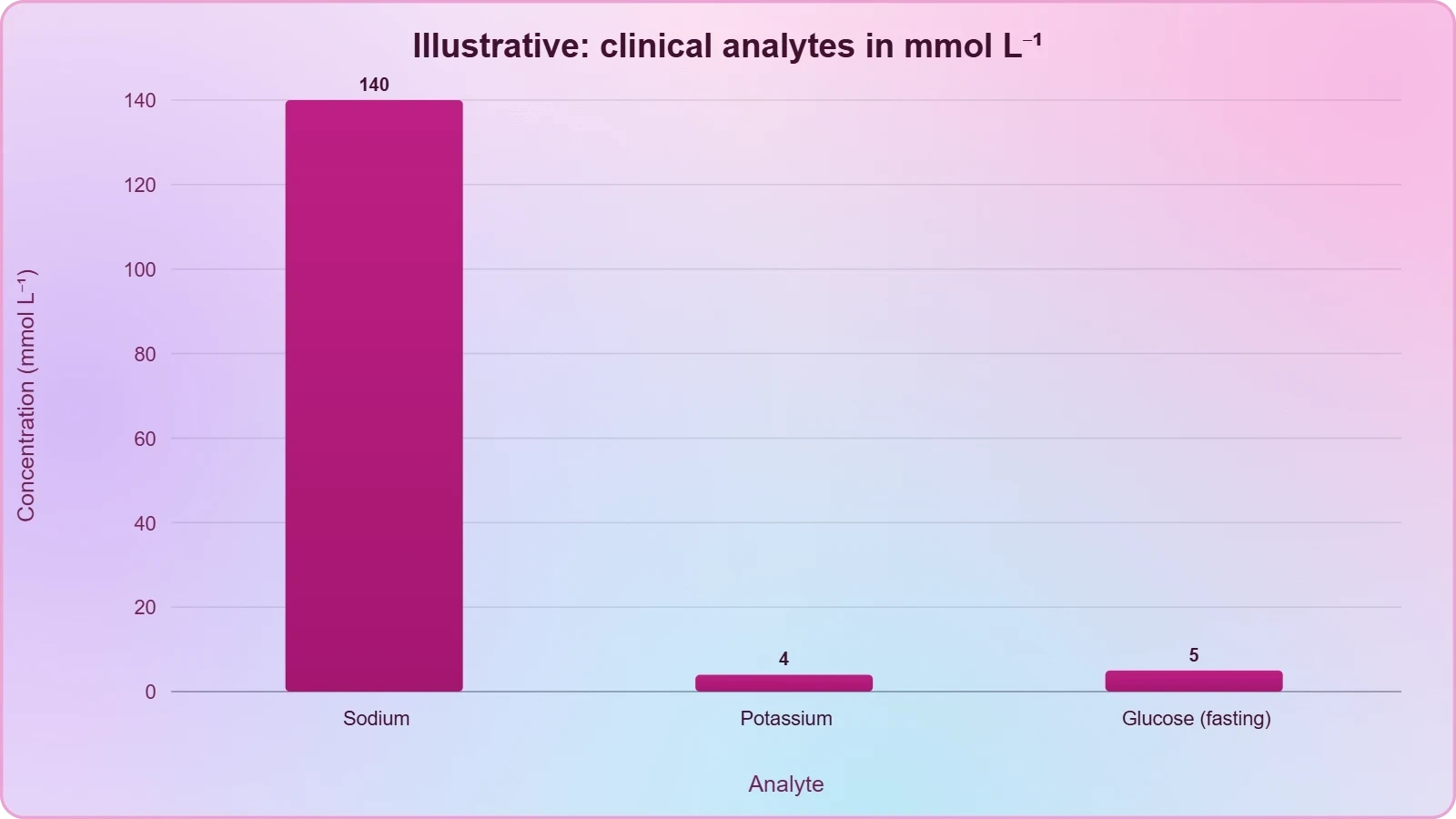
Clinical laboratories report the overwhelming majority of blood and urine analytes in molar units, and the reason is stoichiometric. When glucose is measured in blood, the result is conventionally expressed in millimoles per litre, with a normal fasting range of roughly 3.9 to 5.5 mmol L⁻¹. Because one mole of glucose reacts with a fixed number of moles of reagent in an enzymatic assay, molarity allows the instrument's signal to be converted directly into an amount of substance, which is what the clinician actually needs to interpret. Mass concentration in grams per litre would obscure the one-to-one chemistry underlying the measurement.
The same logic governs electrolyte reporting. Sodium and potassium are quoted in millimoles per litre because their physiological effects depend on the number of ions present, not their mass. A sodium concentration of 140 mmol L⁻¹ corresponds to about 3.2 g L⁻¹, but the molar figure is the one that maps onto osmotic balance and membrane potential. This is a striking illustration of a general principle: molarity is the language of chemical reaction and physiological function, while mass concentration is the language of shipping and formulation.
Worked Clinical and Analytical Examples
Consider a blood glucose reading of 5.0 mmol L⁻¹. Expressed in molarity, this is ##5.0 \times 10^{-3}## M. If a laboratory assay requires the glucose concentration in milligrams per decilitre, the conversion uses the molar mass of 180 g mol⁻¹: ##5.0 \times 10^{-3} \times 180 = 0.90## g L⁻¹, or 90 mg dL⁻¹. The two figures describe the same physiological state, and the ability to move between them fluently is essential for anyone interpreting clinical data or designing a diagnostic assay.
In analytical chemistry, the same molar reasoning underpins titration. If 25.00 mL of a hydrochloric acid sample requires 22.40 mL of 0.1000 M sodium hydroxide to reach the endpoint, the moles of base consumed are ##0.1000 \times 0.02240 = 2.240 \times 10^{-3}## mol. Since the reaction is one-to-one, the acid sample contains the same amount, giving an acid molarity of ##2.240 \times 10^{-3}/0.02500 = 0.0896## M. Every step rests on the definition of molarity as moles per litre.
Industrial and Environmental Applications
Industrial process control relies on molarity wherever reactions are run in solution. A pharmaceutical manufacturer preparing a batch of active ingredient must charge reactants in exact molar proportions, and the reactor's concentration setpoints are expressed in molar units so that the stoichiometry of the balanced equation translates directly into volumes to be pumped. Environmental monitoring similarly reports aqueous pollutants in molar or micromolar terms when toxicity is mediated by the number of molecules interacting with a biological target, as with heavy metal ions in drinking water.
Even the humble pH scale is a molarity statement in disguise. The pH is defined as the negative logarithm of the hydrogen ion concentration in moles per litre, so a solution of pH 3 contains ##10^{-3}## M hydrogen ions. This compact notation compresses an enormous range of molarities into a manageable scale, and it reminds us that molarity is not merely a laboratory convenience but a fundamental descriptor of solution chemistry that reaches into acid-base theory, electrochemistry, and biochemistry alike.
We Also Published
Computational Practice and Precision in Molarity Work
Modern molarity calculations are increasingly performed in code, particularly when large numbers of samples or calibration standards must be prepared. A short script can convert a target concentration and volume into the mass of solid to weigh, or compute the stock volume required for a dilution, eliminating arithmetic slips and producing a printable preparation sheet. The value of such automation lies not in replacing chemical understanding but in enforcing consistent unit handling and documenting every step for audit and reproducibility.
Writing the calculation as a function also forces the chemist to state assumptions explicitly: the molar mass used, the purity of the reagent, and the temperature at which the volumetric glassware was calibrated. These are precisely the details that are lost when calculations are done hastily on a scrap of paper. The example below implements the two core relations of this lesson, molarity from mass and volume, and the dilution equation, in a form that can be extended to handle hydrates and purity corrections.
Automating Molarity and Dilution Calculations
The function below accepts a mass in grams, a molar mass, and a volume in millilitres, and returns the molarity. A second function applies the dilution relation to compute the stock volume needed for a target concentration and final volume. Both functions perform explicit unit conversion and raise an error when a physically impossible input, such as a zero volume, is supplied. This defensive style is standard practice in laboratory informatics, where silent failures can corrupt an entire batch of analytical results.
def molarity_from_mass(mass_g, molar_mass_g_per_mol, volume_ml):
    """Return molarity (mol/L) from solute mass and solution volume."""
    if volume_ml <= 0:
        raise ValueError("Volume must be positive")
    moles = mass_g / molar_mass_g_per_mol
    volume_l = volume_ml / 1000.0
    return moles / volume_l

def stock_volume_for_dilution(m_stock, m_target, v_final_ml):
    """Return volume of stock (mL) needed using M1*V1 = M2*V2."""
    if m_stock <= 0:
        raise ValueError("Stock molarity must be positive")
    return (m_target * v_final_ml) / m_stock

# Prepare 250 mL of 0.400 M NaOH from solid (molar mass 40 g/mol)
mass_needed = 0.400 * (250 / 1000.0) * 40
print(round(molarity_from_mass(mass_needed, 40, 250), 3))  # 0.4

# Dilute 1.0 M stock to 0.2 M in 1000 mL
print(stock_volume_for_dilution(1.0, 0.2, 1000))  # 200.0
Running this code reproduces the reference values exactly: four grams of NaOH in 250 mL gives 0.400 M, and 200 mL of 1.0 M stock diluted to one litre gives 0.2 M. The agreement between hand calculation and script is a useful cross-check, and in a teaching laboratory it reinforces the idea that the formula is a statement about conservation of solute, not a magic incantation. Students who can write the function can usually explain the chemistry, and vice versa.
Significant Figures and Uncertainty in Concentration
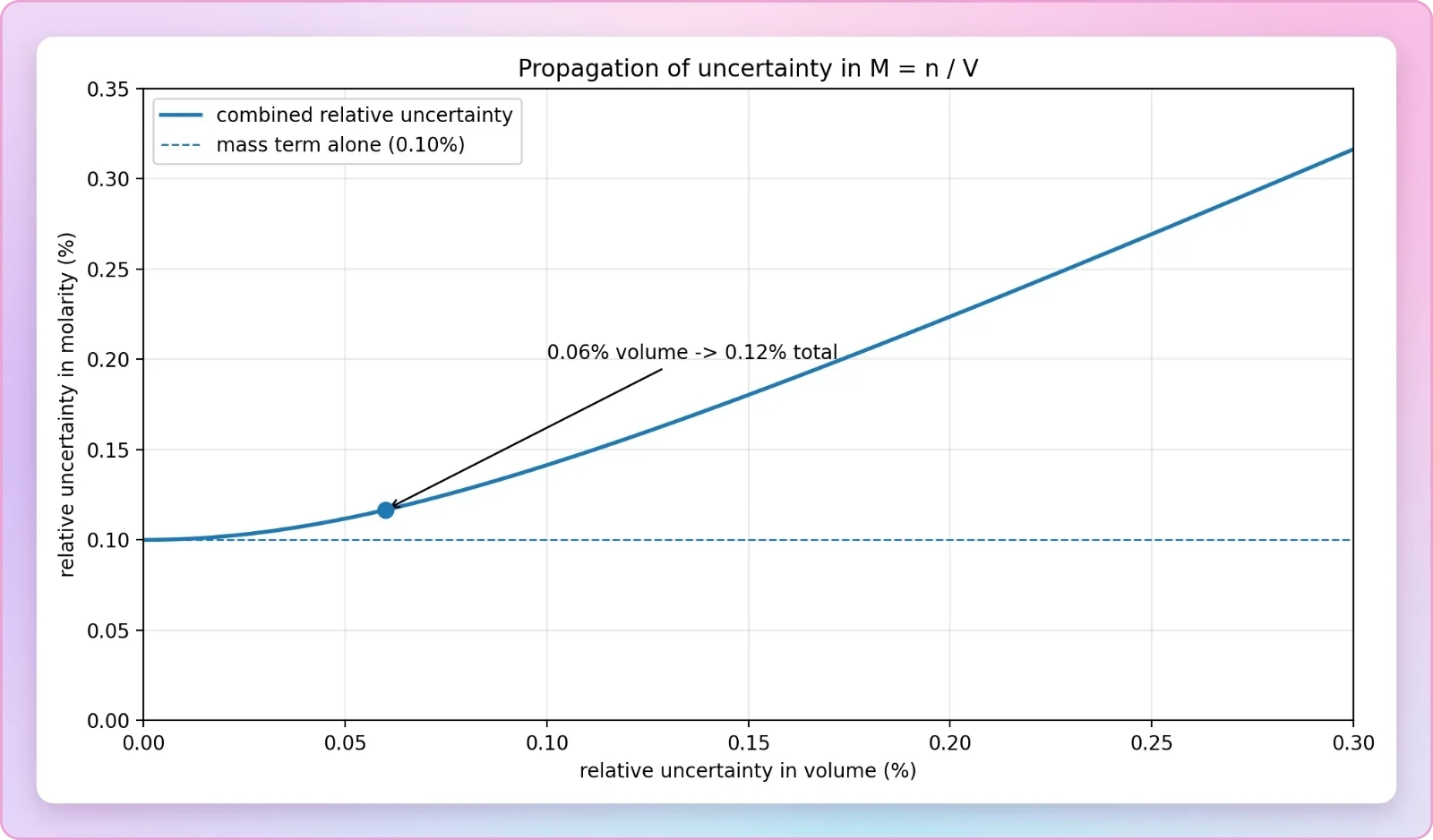
Molarity carries the combined uncertainty of two independent measurements, the mass of solute and the volume of solution, and the final result should reflect both. If a balance reads to 0.0001 g and a volumetric flask is certified to ±0.3 mL in 500 mL, the relative uncertainty in volume dominates for dilute solutions. Reporting a molarity to four significant figures when the flask is only certified to three is a common and misleading overstatement of precision, and examiners and reviewers alike treat it as a technical error.
The propagation follows the standard rule for quotients: the relative uncertainties of numerator and denominator add in quadrature. For a mass uncertainty of 0.1 percent and a volume uncertainty of 0.06 percent, the combined relative uncertainty is approximately 0.12 percent, so a nominal 0.400 M solution should be quoted as 0.400 ± 0.0005 M. This level of care distinguishes a competent analytical chemist from a careless one, and it prepares the ground for the molality discussion that follows, where mass-based measurements offer a more stable foundation.
Consolidating Molarity: Summary and Forward Look
Molarity converts a measured mass of solute and a calibrated volume of solution into a single number that speaks directly to reaction stoichiometry. Its definition, moles of solute per litre of solution, is simple, but its correct application demands discipline: converting millilitres to litres, using solution volume rather than solvent volume, accounting for hydrate molar masses, and reporting results to a defensible number of significant figures. The dilution relation ##M_1V_1 = M_2V_2## follows from conservation of solute and extends naturally to serial dilution schemes used across the analytical and biological sciences.
The unit's temperature dependence is its principal limitation, and it is precisely this limitation that motivates the shift to molality in the next lesson. Where molarity divides by a volume that expands with heat, molality divides by a mass that does not, making it the unit of choice for colligative and thermodynamic work. Understanding both, and knowing when to reach for each, is the mark of a chemist who can move fluently between the bench, the balance, and the theoretical model without losing track of what the numbers actually mean.
From our network :
- Analyzing Trump Deportation Numbers Insights Into The 2026 Immigration Crackdown
- How to Print Cheaply: Cutting the Cost per PageA practical, measured guide to lowering what each printed page costs — duplex and draft modes, third-party ink, yield mathematics, and knowing when a new printer beats refills.
- AI-Powered 'Precision Diagnostic' Replaces Standard GRE Score ReportsDiscover the new GRE Precision Diagnostic. Learn how AI-powered behavioral analytics and time-to-solve tracking are replacing standard GRE score reports to empower students.
- 98% of Global MBA Programs Now Prefer GRE Over GMAT Focus EditionExplore why 98% of global MBA programs now prefer the GRE over GMAT Focus. Learn about the shorter GRE format, verbal logic importance, and strategic versatility for students.
- Trump Political Strategy How Geopolitical Stunts Serve As Media Diversions
- Do You Need a New Router or Is Your Internet Plan the Problem?A practical comparison of the signs that point to router limits versus signs your broadband speed or provider is the bottleneck, so you can decide what to replace before spending money.
- Where to Put Your Wireless Router for Better CoverageA practical, physics-grounded guide to router placement: why the centre of the home beats the corner, how walls and metal sap signal, and how to run a simple survey that proves the improvement.
- EV 2.0: The Solid-State Battery Breakthrough and Global Factory ExpansionDiscover the impact of the Solid-State Battery Breakthrough on the EV market. Learn about CATL and BYD stock growth, global factory expansion in Europe, and the future of EV 2.0 technology.
- 10 Physics Numerical Problems with Solutions for IIT JEEPrepare for IIT JEE with 10 physics numerical problems, complete with detailed solutions and conceptual explanations. Ideal for mastering kinematics, thermodynamics, electromagnetism, and optics.
RESOURCES
- Dilution Problems, Chemistry, Molarity & Concentration ... - YouTubeyoutube.comAug 14, 2017 ... This chemistry video tutorial explains how to solve common dilution problems using a simple formula using concentration or molarity with ...
- Dilution Calculator - Molarity, Percent - PhysiologyWebphysiologyweb.comThis calculator can be utilized to perform dilution calculations when working with molar or percent (%) solutions using the formula C1V1 = C2V2, ...
- 4.5: Molarity and Dilutions - Chemistry LibreTextschem.libretexts.orgFeb 23, 2017 ... Concentrations may be measured using various units, with one very useful unit being molarity, defined as the number of moles…
- Solution Dilution Calculator - Sigma-Aldrichsigmaaldrich.comThe calculator uses the formula M1V1 = M2V2 where "1" represents the concentrated conditions (i.e., stock solution molarity and volume) and "2" represents the ...
- Molarity Calculator - GraphPadgraphpad.comMolarity Calculator. The calculators on this page are independent and ... Dilute a stock solution. Stock concentration: femtomolar, picomolar, nanomolar ...
- Dilution Problems #1-10 - ChemTeamchemteam.infoRemember to keep the volume units consistent. Problem #2: You need to make 10.0 L of 1.2 M KNO3. What molarity would the potassium…
- 4.4 Molarity and Dilutions - Chad's Prep®chadsprep.comThe General Form: C₁V₁ = C₂V₂. The dilution equation is not limited to molarity. It works with any unit of concentration — percent concentration,…
- Dilution Calculator (formerly Tocris Dilution Calculator) - R&D Systemsrndsystems.comUse our dilution calculator to calculate how to dilute a stock solution of known concentration ... Are the Tocris Molarity and Reconstitution Calculators ...
- Molarity Worksheet - WongChemistrywongchemistry.weebly.comconstant, causing the molarity (i.e. concentration) to decrease. Dilution Formula: moles of solute before dilution = moles of solute after dilution.
- Molarity Formula & Molar Solution Calculator Guide - CASRAIcasrai.orgJul 28, 2026 ... A molar solution has a set number of moles per liter: M = moles / liters. Get the formula, worked…
- Molarity and dilution | PPT - Slideshareslideshare.netThe document discusses molarity, which is a measurement of concentration that expresses the number of moles of solute per liter of solution.
- Volume • Moles • Molarity | PhET Simulationsphet.colorado.eduCalculate the concentration of solutions in units of molarity (mol/L). Use molarity to calculate the dilution of solutions. Compare solubility limits ...
- molarity by dilution answer key Workbookwww2.american-usa.comOne key concept that underpins these processes is molarity, which measures the concentration of a solute in a solution. When working with dilute solutions, ...
- Molarity & Dilutionresources.finalsite.netDilute: more solvent than solute in a solution. Molarity. Molarity (also called concentration) is a measure of the amount of solute that is dissolved…
- 6.1 Solution Concentration and Molarity | Introduction to Chemistrycuny.manifoldapp.orgDescribe the fundamental properties of solutions · Calculate solution concentrations using molarity · Perform dilution calculations using the dilution equation.