Every organism, however large or complex, begins its existence as a single cell. That modest beginning raises one of the most elegant questions in biology: how does one cell give rise to millions? The answer lies in the cell cycle, the ordered sequence of events through which a cell duplicates its genome, synthesises the other constituents it needs, and eventually divides into two daughter cells. Growth and reproduction are characteristics of cells, and indeed of all living organisms, and the cell cycle is the mechanism through which these two characteristics are reconciled in time.
This lesson examines the cell cycle as a coordinated programme rather than a loose collection of events. Cell division, DNA replication and cell growth must all take place in a coordinated way to ensure correct division and the formation of progeny cells containing intact genomes. That requirement for coordination is the central idea of the lesson, and it explains why the cycle is described as a sequence rather than a simple repetition. The emphasis throughout falls on timing, order and genetic control, because a cell that grew, copied or divided out of step would pass on an incomplete or damaged genome.
Building on the previous lesson, which considered how a single cell grows and reproduces to form a population, this lesson defines the cell cycle itself and establishes the vocabulary used in the lessons that follow. It distinguishes the continuous nature of cytoplasmic growth from the sharply restricted timing of DNA synthesis, and it introduces the idea that the events of division are themselves under genetic control. The next lesson will take up the phases of the cycle in detail; here the aim is to understand why the cycle exists and what it must accomplish.
On This Page
The Cell Cycle as a Defined Sequence of Events
The cell cycle is defined precisely: it is the sequence of events by which a cell duplicates its genome, synthesises the other constituents of the cell and eventually divides into two daughter cells. Each of the three verbs in that definition carries weight. Duplication concerns the genome, synthesis concerns the cytoplasm and its contents, and division concerns the partition of the whole into two. The definition therefore binds together three processes that are chemically and structurally distinct, and it presents them as one sequence with a beginning, a middle and an end.
What makes the definition more than a list is the word sequence. The events do not occur simultaneously or in arbitrary order; they follow one another in a manner that preserves the integrity of the genome. All cells reproduce by dividing into two, with each parental cell giving rise to two daughter cells each time they divide. These newly formed daughter cells can themselves grow and divide, giving rise to a new cell population formed by the growth and division of a single parental cell and its progeny. Such cycles of growth and division allow a single cell to form a structure consisting of millions of cells.
Why Coordination Is the Central Requirement
During the division of a cell, DNA replication and cell growth also take place. All these processes, that is cell division, DNA replication and cell growth, have to take place in a coordinated way to ensure correct division and formation of progeny cells containing intact genomes. The phrase intact genomes is the test of success. A daughter cell that receives an incomplete copy of the genome, or a genome copied more than once, is not a correct product of the cycle, however vigorously the cell may have grown.
Coordination therefore operates on two fronts at once. It aligns the growth of the cell with the copying of its DNA, so that division does not begin before the genome is ready, and it aligns division with both, so that the replicated chromosomes are distributed accurately. The cycle is best imagined as a schedule in which each task has its proper place, and the schedule is enforced by the cell's own regulatory machinery rather than by chance.
The Cycle as a Repeating Unit of Cell Life
Because each division produces two cells capable of repeating the process, the cycle is genuinely cyclic. A parental cell and its progeny pass through the same sequence again and again, and the population expands through repetition. This is why the cycle is treated as the fundamental unit of cellular reproduction: it is the smallest complete description of how one cell becomes two, and how two become four, without loss of genetic information at any step.
The repetition also explains the scale of living structures. A single cell, dividing repeatedly through successive cycles, can generate a structure consisting of millions of cells. The arithmetic is simple even though the biology is not: each cycle doubles the number of cells, so the population grows geometrically while the genome is preserved. The cycle is thus both a reproductive mechanism and a conservative one, multiplying cells while keeping the hereditary material intact.
Growth, Replication and Division in a Coordinated Programme
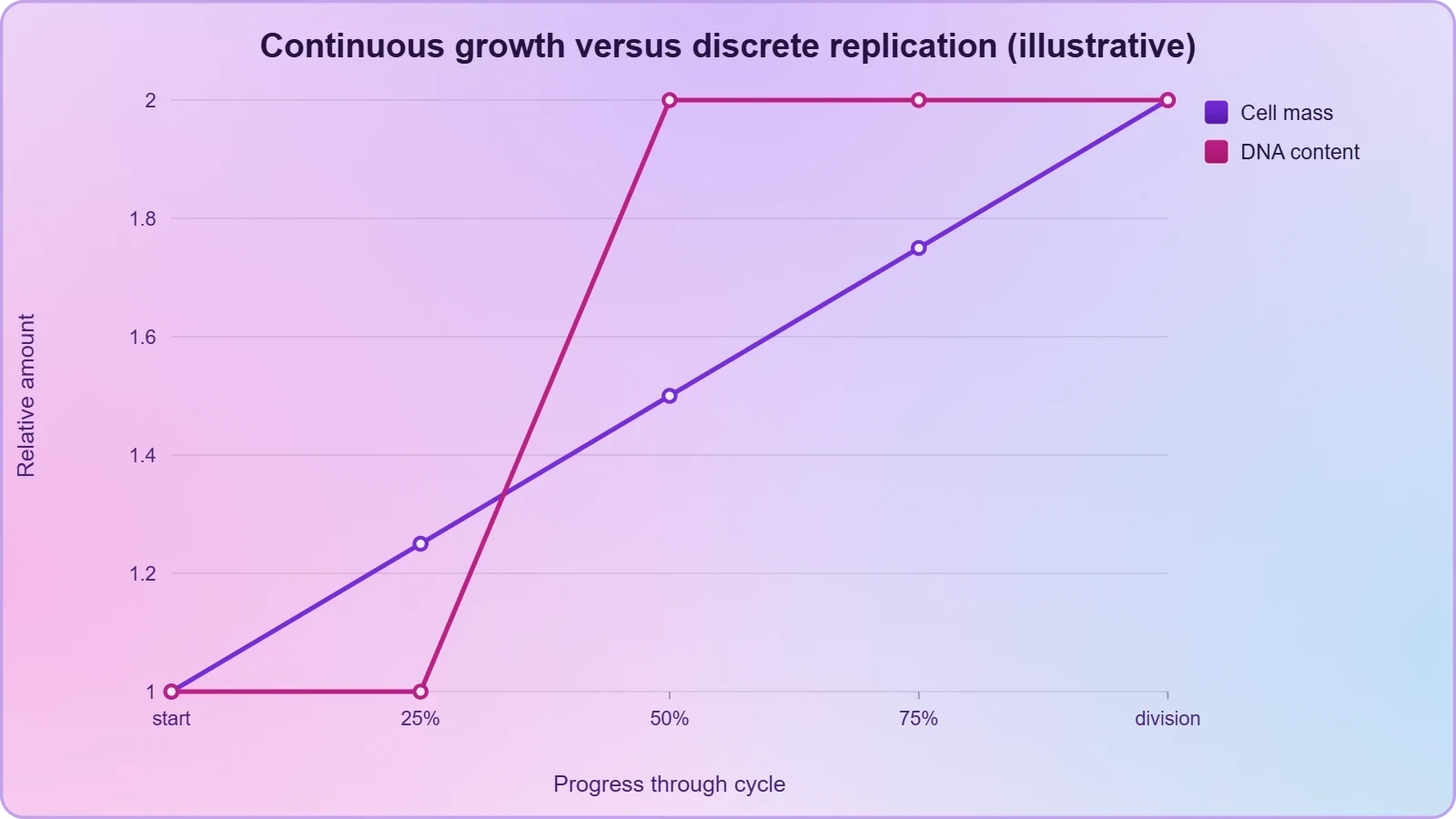
Although cell growth, in terms of cytoplasmic increase, is a continuous process, DNA synthesis occurs only during one specific stage in the cell cycle. This asymmetry is one of the most instructive facts in the whole subject. Growth proceeds steadily, adding material to the cell over an extended period, while the copying of the genome is compressed into a single defined interval. The cell therefore cannot rely on growth alone to prepare for division; it must schedule replication separately and protect that interval from interference.
The replicated chromosomes are then distributed to daughter nuclei by a complex series of events during cell division. Distribution is not a passive consequence of replication but a distinct phase of work, involving the movement of chromosomes and the construction of new nuclear boundaries. The cycle thus separates three kinds of labour: the continuous accumulation of cytoplasm, the discrete duplication of DNA, and the intricate partition of the duplicated material into two new cells.
Continuous Growth Versus Discrete Replication
The contrast between continuous growth and discrete replication has practical consequences for how the cycle is studied. Because growth is continuous, it cannot by itself mark the progress of a cell through the cycle; a cell that is growing may be at almost any point in the sequence. Because DNA synthesis is confined to one specific stage, it provides a reliable landmark, a fixed interval against which the other events can be ordered and described.
This is why the cycle is conventionally described in terms of stages defined by the state of the DNA rather than by the size of the cell. The cell's cytoplasmic increase is real and necessary, but it is the timing of genome duplication that gives the cycle its structure. A student who grasps this distinction will find the phases of the cycle far easier to arrange in order, because the sequence is anchored to a single, sharply bounded event.
Genetic Control of the Events of Division
The events of division are themselves under genetic control. This statement, brief as it is, carries a large implication: the order and timing of the cycle are not emergent properties of chemistry alone but are directed by the cell's own hereditary instructions. Genes specify the machinery that carries out replication and division, and they also specify the controls that decide when each step may proceed. The cycle is therefore an inherited programme as much as it is a physical process.
Genetic control also explains why the cycle can be adjusted to circumstance while remaining faithful in its essentials. Because the controls are encoded, they can be regulated, and regulation allows the cycle to respond to the needs of the organism. The same basic sequence of duplication, synthesis and division is conserved, yet its execution is governed by instructions that the cell carries and transmits, ensuring that each generation of cells inherits both the genome and the means of copying it.
From One Parental Cell to a Population of Cells
The reproductive logic of the cycle is cumulative. All cells reproduce by dividing into two, with each parental cell giving rise to two daughter cells each time they divide. Each daughter is a complete cell in its own right, capable of growth and of further division. The result is not a single act of reproduction but a continuing process, in which every division adds two new participants to the population and every participant can repeat the performance.
These newly formed daughter cells can themselves grow and divide, giving rise to a new cell population that is formed by the growth and division of a single parental cell and its progeny. The phrase and its progeny is important, because it shifts attention from the individual cell to the lineage. What begins as one cell becomes a family of cells, all descended from the same parent and all carrying copies of the same genome, produced through repeated rounds of the same coordinated sequence.
The Arithmetic of Repeated Division
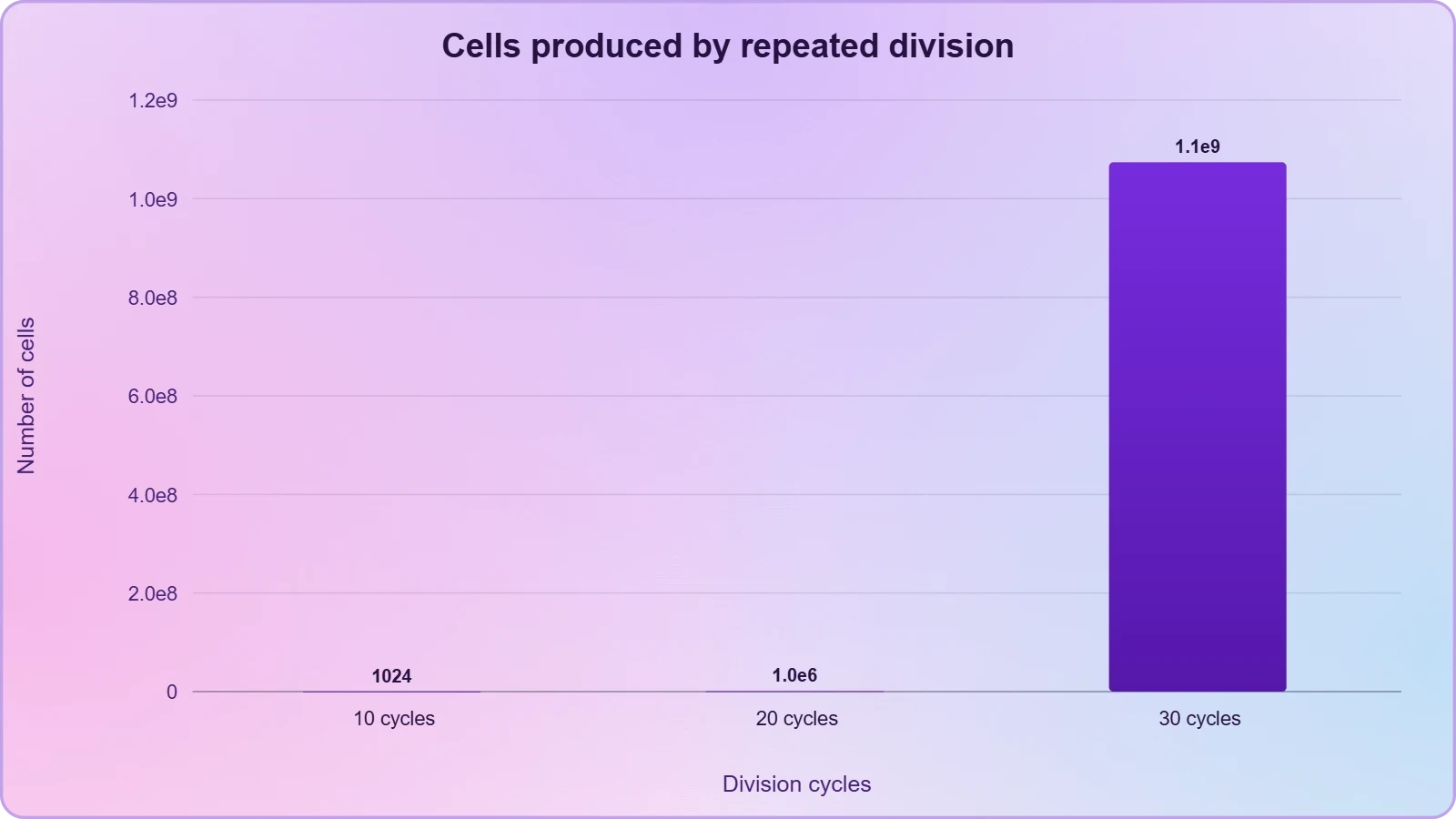
The growth of a population through repeated division follows a simple doubling pattern. If every cell divides once per cycle, the number of cells after ##n## cycles is given by a power of two, starting from a single parental cell:
This relation shows why such cycles of growth and division allow a single cell to form a structure consisting of millions of cells. Twenty cycles already yield more than a million cells, and thirty exceed a billion. The arithmetic is only an illustration of scale; the biological point is that the doubling is reliable because each cycle is coordinated, so that the genome is faithfully copied and distributed at every round rather than merely at the first.
Progeny Cells and the Preservation of Intact Genomes
The measure of a successful cycle is the condition of the progeny. Correct division must produce daughter cells containing intact genomes, and this requirement governs every step of the sequence. Replication must copy the genome completely, growth must supply the material the daughters will need, and division must distribute the replicated chromosomes so that neither daughter is left with a partial set. Coordination is the means by which these separate requirements are satisfied together rather than at each other's expense.
Seen in this light, the cycle is a conservative mechanism of remarkable precision. It multiplies cells without altering the hereditary information they carry, and it does so repeatedly across countless generations of cells. The continuity of a cell lineage, and ultimately the continuity of a multicellular organism, depends on this repeated preservation of intact genomes through cycles of growth and division.
Reading the Cycle as a Controlled Schedule
A useful way to hold the lesson together is to read the cycle as a schedule with three obligations. The genome must be duplicated, the cell must be supplied with its other constituents, and the whole must be divided into two daughters. Each obligation is met by a different kind of process, and the schedule succeeds only when the three are ordered so that none interferes with another. The definition of the cell cycle is, in effect, a statement of these obligations and of the requirement that they be met in a coordinated way.
The schedule metaphor also clarifies what goes wrong when coordination fails. If division began before replication was complete, a daughter would receive an incomplete genome. If replication occurred without subsequent distribution, the extra copies would be stranded. If growth outpaced the other processes without limit, the cell would enlarge without reproducing. The cycle avoids all three failures by treating its events as a sequence, each step preparing the conditions for the next.
Order of Ideas in the Study of the Cycle
The order in which the subject is presented follows the logic of the definition. First the cycle is defined and its three processes named; then the requirement for coordination is stated; then the contrast between continuous growth and restricted DNA synthesis is drawn; then the distribution of replicated chromosomes is introduced; and finally the genetic control of these events is asserted. This order moves from the whole to its parts and from description to control, and it prepares the ground for a detailed treatment of the phases themselves.
Keeping this order in mind is helpful because the terminology introduced here recurs throughout the study of division. The terms genome, DNA replication, daughter cells, progeny and intact genomes are not decorative; each names a component of the definition and each will be used again when the stages of division are described. A learner who can state the definition and identify its three processes has the framework on which the rest of the subject is built.
What the Cycle Must Guarantee
Reduced to its essentials, the cycle must guarantee three outcomes. It must produce two daughter cells from one parental cell, it must ensure that each daughter contains an intact genome, and it must allow the daughters in turn to grow and divide. These guarantees are what make the cycle a mechanism of reproduction rather than a mere episode of cellular activity. They also explain why the cycle is described as a sequence of events rather than as a single event, since no one step can deliver all three outcomes at once.
The guarantees are interdependent. A daughter cell with an intact genome but no capacity to grow cannot continue the lineage; a daughter that grows vigorously but lacks a complete genome cannot contribute faithfully to it. The cycle satisfies all three conditions together, and it is this combination that allows a single cell to generate a population and, ultimately, a structure of millions of cells.
Going Further
The cell cycle is often described as the life of a cell from one division to the next. This phrasing is a convenience rather than a new definition, but it is a useful one, because it places the cycle in the life of the cell as a whole. The interval between divisions is not a pause; it is the period during which the genome is duplicated and the cell's constituents are synthesised, so that the next division can occur correctly. Reading the cycle this way helps connect the definition given here with the detailed phases that follow.
Coordination of growth and DNA replication helps ensure each daughter cell receives a complete genome. This is the practical meaning of the requirement stated in the definition. When growth and replication proceed in step, the cell arrives at division with both the material and the genetic instructions needed to furnish two viable daughters. The emphasis on coordination is therefore not a stylistic preference but a statement about what makes faithful reproduction possible, and it is the idea that should be carried forward into the study of the phases themselves.
Consolidating the Definition Before the Phases
Before the phases of the cycle are examined in detail, it is worth consolidating what the definition has established. The cell cycle is the sequence of events by which a cell duplicates its genome, synthesises the other constituents of the cell and eventually divides into two daughter cells. Cell division, DNA replication and cell growth must take place in a coordinated way to ensure correct division and the formation of progeny cells containing intact genomes. Growth is continuous, DNA synthesis occurs only during one specific stage, and the events of division are under genetic control.
These statements form a compact summary of the lesson and a reliable foundation for what follows. The next lesson turns to the phases of the cell cycle, distinguishing interphase from M phase and locating within them the events described here in outline. The lesson after that will examine the stages of M phase and cytokinesis. Each of those topics presupposes the definition and the requirement for coordination established in this lesson, so a firm grasp of the present material will make the later detail easier to place.
A Short Self-Check
A learner can test understanding by attempting to state the definition without notes and then identifying its three processes. A further check is to explain why growth cannot serve as a marker of progress through the cycle, and why DNA synthesis can. A third is to explain what is meant by saying that the events of division are under genetic control. Each of these questions can be answered directly from the material of this lesson, and each answer reinforces the central idea of coordination.
Finally, the learner should be able to connect the cycle to the growth of a cell population. All cells reproduce by dividing into two, and the newly formed daughter cells can themselves grow and divide, so that a single parental cell and its progeny can form a structure consisting of millions of cells. The cycle is thus the mechanism by which growth and reproduction, the two characteristics of living organisms, are achieved at the level of the cell.
Also Read
- No links available.
From our network :
- Trump Political Strategy How Geopolitical Stunts Serve As Media Diversions
- Mastering DB2 12.1 Instance Design: A Technical Deep Dive into Modern Database ArchitectureComprehensive guide to DB2 12.1 Instance Design. Explore architectural components, HADR setup, buffer pool tuning, and security policies for IBM DB2 12.1. Includes 10 functional SQL and Shell samples.
- 98% of Global MBA Programs Now Prefer GRE Over GMAT Focus EditionExplore why 98% of global MBA programs now prefer the GRE over GMAT Focus. Learn about the shorter GRE format, verbal logic importance, and strategic versatility for students.
- Vite 6/7 'Cold Start' Regression in Massive Module GraphsIn-depth analysis of Vite 6/7 cold start regressions in massive module graphs. Learn about barrel file issues, pre-bundling optimizations, and how to improve Vite dev server performance.
- Analyzing Trump Deportation Numbers Insights Into The 2026 Immigration Crackdown
- 10 Physics Numerical Problems with Solutions for IIT JEEPrepare for IIT JEE with 10 physics numerical problems, complete with detailed solutions and conceptual explanations. Ideal for mastering kinematics, thermodynamics, electromagnetism, and optics.
- AI-Powered 'Precision Diagnostic' Replaces Standard GRE Score ReportsDiscover the new GRE Precision Diagnostic. Learn how AI-powered behavioral analytics and time-to-solve tracking are replacing standard GRE score reports to empower students.
- EV 2.0: The Solid-State Battery Breakthrough and Global Factory ExpansionDiscover the impact of the Solid-State Battery Breakthrough on the EV market. Learn about CATL and BYD stock growth, global factory expansion in Europe, and the future of EV 2.0 technology.
- Mastering DB2 LUW v12 Tables: A Comprehensive Technical GuideComprehensive guide on DB2 LUW v12 tables. Explore CREATE TABLE syntax, BLU Acceleration, range partitioning, data types, and security features for IBM DB2 LUW v12.
RESOURCES
- Multiple regulatory systems coordinate DNA replication with cell ...pubmed.ncbi.nlm.nih.govOct 23, 2014 ... In many bacteria the rate of DNA replication is linked with cellular physiology to ensure that genome duplication is coordinated…
- The Great Divide: Coordinating cell cycle events during bacterial ...pmc.ncbi.nlm.nih.govInstead, an intricate set of intersecting, and at times opposing, forces coordinate DNA replication, cell division, and cell growth with one another, thereby ...
- DNA replication, the bacterial cell cycle, and cell growth - PubMedpubmed.ncbi.nlm.nih.govApr 3, 1992 ... The coupling of replication to the cell cycle and cell growth involves events that occur at oriC. Immediately after initiation,…
- Coordination of Polyploid Chromosome Replication with Cell Size ...journals.asm.orgApr 23, 2019 ... Relationship between cell growth and DNA replication in S. ... Relationship between DNA cycle and growth rate in Synechococcus sp.
- coordinating cell cycle events during bacterial growth and divisionsciencedirect.comHere we discuss the bacterial cell cycle with emphasis on the mechanisms responsible for coordinating DNA replication, cell division, and cell growth. For ...
- DNA/Cell Mass Homeostasis: Coordinating DNA Replication and ...mdpi.comConsequently, during fast growth, the initiation of DNA replication occurs in the mother cell before cell division. This results in chromosomes with multiple ...
- Connecting chromosome replication with cell growth in bacteriasciencedirect.comDNA replication must be carefully coordinated with cell growth and division to ensure production of viable progeny. In the archetypical bacterial genome ...
- The Eukaryotic Cell Cycle - The Cell - NCBI Bookshelf - NIHncbi.nlm.nih.govThe division cycle of most cells consists of four coordinated processes: cell growth, DNA replication, distribution of the duplicated chromosomes to ...
- Extrusion-modulated DnaA activity oscillations coordinate DNA ...elifesciences.orgNov 18, 2025 ... focused on DnaA-cell size-division relationships, we addressed the decoupling of replication initiation from dnaA expression with our novel ...
- Regulation with cell size ensures mitochondrial DNA homeostasis ...nature.comSep 7, 2023 ... ... mechanism for cells to maintain mtDNA homeostasis during cell growth, without requiring a coordination of mtDNA replication with the…
- Extrusion-modulated DnaA activity oscillations coordinate DNA ...elifesciences.orgAug 6, 2025 ... Tight correlation between DnaA activity oscillations and DNA replication initiation. (A) Cell cycle-dependent DnaA activity oscillations in wild ...
- Tetrapyrrole signal as a cell-cycle coordinator from organelle to ...pnas.orgJan 20, 2009 ... In plant cells, plastid and mitochondrial DNA replication [organelle DNA replication (ODR)] occurs in advance of the subsequent cell cycles ...
- Coordinated cell and chloroplast growth and its perturbation by ...biorxiv.orgMay 10, 2026 ... The chromosome cycle includes DNA replication and nuclear division, resulting in the duplication and separation of genetic information ...
- Cell Size and the Initiation of DNA Replication in Bacteriajournals.plos.orgDNA replication must be coordinated with growth and division to ensure the viability of cells and organisms. In bacteria, it is believed that cell…
- Coordination of the Cell Cycle in Trypanosomes | Annual Reviewsannualreviews.orgSep 8, 2019 ... Timing of nuclear and kinetoplast DNA replication and early morphological events in the cell cycle of Trypanosoma brucei. J. Cell…