Taxonomy is, at its heart, an exercise in disciplined comparison. Once a biologist has separated species and gathered them into genera, the next task is to ask a larger question: which genera share enough structure to sit together, and which of those groupings in turn belong beside one another? Lesson 9 of this course on the living world takes up that question directly, working through the three middle rungs of the taxonomic ladder — family, order and class — that carry the student from the intimate scale of genus toward the broad architecture of kingdom.
The material for this lesson is deliberately concrete. Three plant genera, Solanum, Petunia and Datura, are drawn together into the family Solanaceae; the great cats of genus Panthera are placed alongside the smaller cats of genus Felis within Felidae; and the cat and the dog are separated into two distinct families, Felidae and Canidae. From there the lesson climbs to the order Polymoniales among plants and the order Carnivora among animals, and finally to class Mammalia, which gathers related orders under one heading.
What makes these categories instructive is the way similarity thins as the hierarchy rises. A family holds fewer shared features than a genus, an order fewer still, and a class fewer again. Grasping that gradient — and the fact that plant families are judged on both vegetative and reproductive characters, while higher categories rest on aggregates of characters — is the conceptual core of the lesson. It also prepares the ground for the next and final step, where phylum, division and kingdom complete the ascent.
On This Page
Why the Family Category Sits Above Genus
Family occupies the first position above genus, and its definition turns on a comparative judgement rather than a fixed checklist. A family is a group of related genera that share a smaller number of similarities than the genera and species beneath it. The category therefore does not abolish the distinctions among genera; it absorbs them into a broader resemblance that becomes visible only when several genera are examined side by side.
For plants, the criteria are explicitly dual. Families are characterised on the basis of both vegetative features — roots, stems, leaves and their arrangement — and reproductive features, meaning flowers, fruits and seeds. This double standard matters because vegetative similarity alone can mislead, while floral structure has long been treated as the more reliable signal of genuine relationship among flowering plants.
The Solanaceae Example Among Plants
Three different genera, Solanum, Petunia and Datura, are placed together in the family Solanaceae. Each genus retains its own identity and its own species — potato and brinjal remain two species within Solanum — yet the shared reproductive architecture of the three genera justifies their union at the family level. The example shows how family aggregates genera without erasing them.
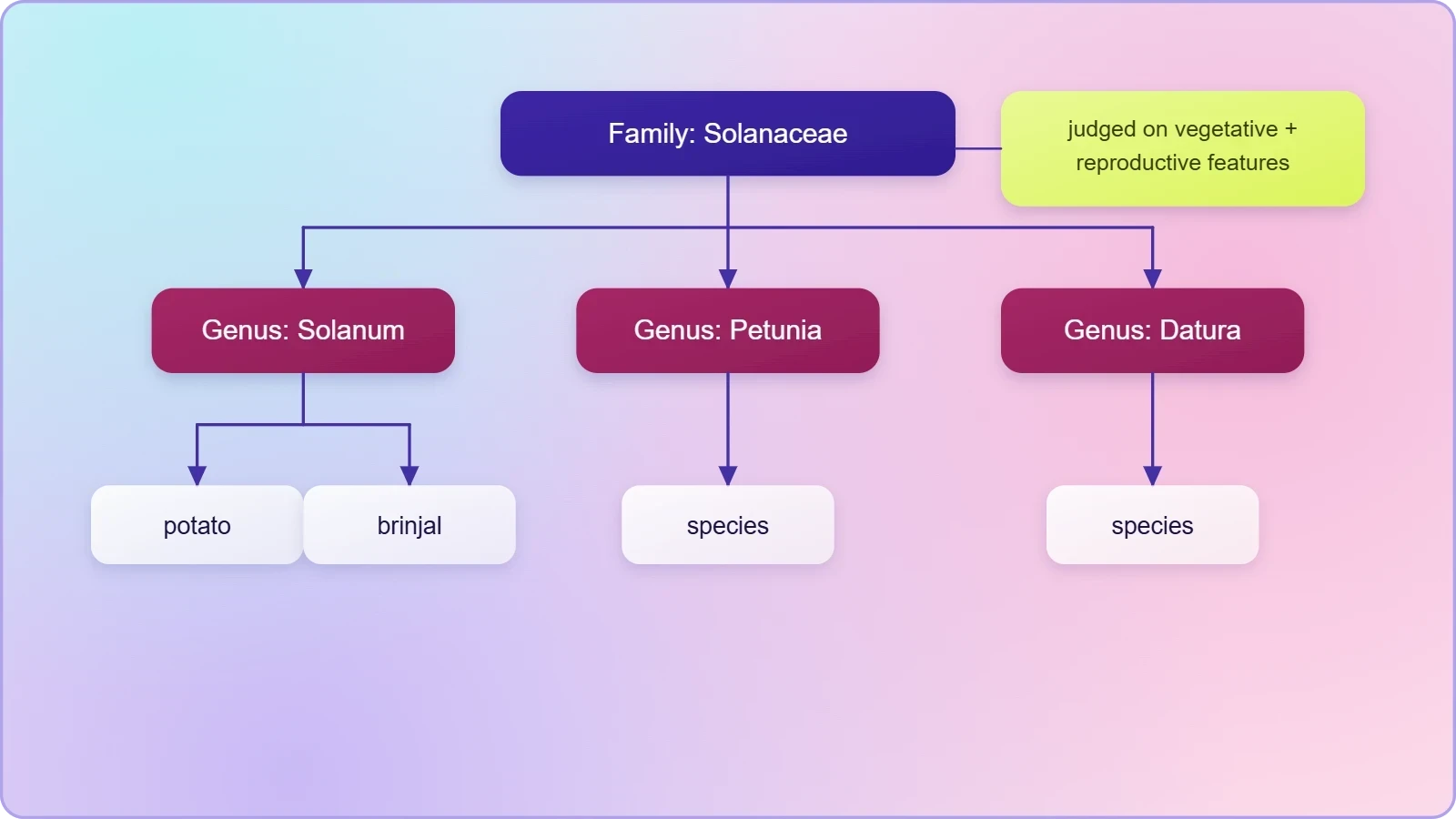
Students should notice the direction of reasoning here. The botanist does not begin with the family and deduce its members; rather, the family is recognised after comparing genera and finding a common pattern of floral and vegetative organisation. Solanaceae is thus a conclusion drawn from observation, not a category imposed in advance upon the plants.
Felidae and Canidae Among Animals
Among animals, the genus Panthera — comprising the lion, tiger and leopard — is placed along with the genus Felis, which includes the cats, in the family Felidae. The two genera differ in size, build and habit, yet their shared carnivorous anatomy and related structure hold them within one family. Felidae is therefore an aggregate of closely allied genera, exactly parallel to Solanaceae among plants.
The cat and the dog illustrate the boundary of a family. Observing their features reveals some similarities and some differences; the differences are sufficient to separate them into two different families, Felidae and Canidae respectively. The lesson is that family membership is a matter of degree, and the line between two families is drawn where resemblance becomes too thin to sustain a single grouping.
The Order as an Assemblage of Families
Order is a higher category than family, and its definition reflects that elevation. It is the assemblage of families that exhibit a few similar characters. The qualifying phrase is important: the similar characters are fewer in number than those that bind together the different genera within a single family. Order therefore rests on a thinner but broader foundation of resemblance.
The material adds a general principle that governs everything above family. Categories like species, genus and family are based on a number of similar characters, but order and the other higher taxonomic categories are identified on the basis of aggregates of characters. The shift is from counting individual resemblances to weighing the overall pattern that several families present when considered together.
Polymoniales and the Floral Criterion
Among plants, the families Convolvulaceae and Solanaceae are included in the order Polymoniales, and the basis for this grouping is stated plainly: it rests mainly on floral characters. The reproductive architecture that already helped define Solanaceae now serves a second purpose, linking that family with another on the strength of shared flower structure.
This continuity is worth emphasising to students. The same class of evidence — floral organisation — operates at the family level and again at the order level, but at the higher level it is applied more sparingly. Polymoniales is not a family writ large; it is a looser association in which only a few characters are held in common.
Carnivora and the Animal Families
The animal order Carnivora includes families like Felidae and Canidae. Here the two families that were separated in the previous section are reunited at a higher level, which is precisely the logic of hierarchy: distinctions drawn at one rank do not forbid association at the next. The cat and the dog remain members of different families while sharing membership of one order.
Students often find this double relationship confusing, so it deserves a moment. Separation and inclusion are not contradictory but sequential. Felidae and Canidae are kept apart because their differences are too many for a single family, yet they are brought together in Carnivora because the characters they do share are sufficient for an order.
Class: Gathering Related Orders
Class is the category that includes related orders, and the material supplies a single, economical illustration. The order Primata, comprising the monkey, gorilla and gibbon, is placed in class Mammalia along with the order Carnivora, which includes animals like the tiger, the cat and the dog. Two orders, one largely herbivorous and arboreal, the other predatory, meet within one class.
The example is chosen to show that class membership does not depend on similarity of habit or diet. What unites Primata and Carnivora at this level is a broader set of shared organisational characters, not a common way of life. The category is wide enough to hold orders that differ conspicuously in behaviour and form while agreeing in deeper structural respects.
Primata and Carnivora Within Mammalia
Placing Primata and Carnivora side by side makes the hierarchy visible in a single stroke. The monkey, gorilla and gibbon form an order; the tiger, cat and dog form another; and both orders are gathered into class Mammalia. Each animal keeps its species, genus, family and order identity while acquiring a further, more inclusive affiliation.
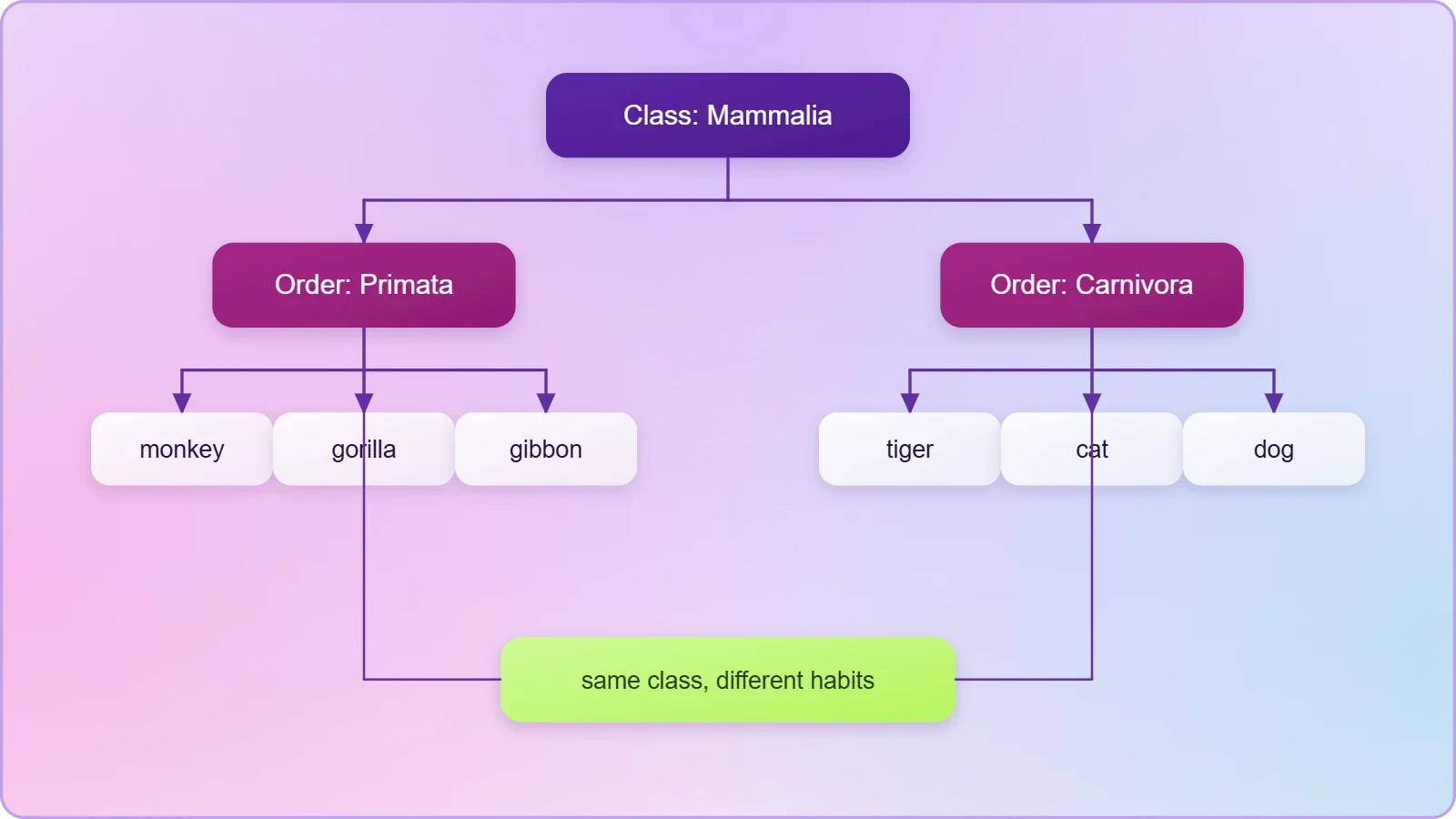
It is worth noting how the same animal appears at several ranks at once. The tiger is a species of Panthera, a member of Felidae, a member of Carnivora, and a member of Mammalia. No rank cancels another; each successive category simply states a wider circle of relationship to which the organism belongs.
Reading the Hierarchy as a Nested Series
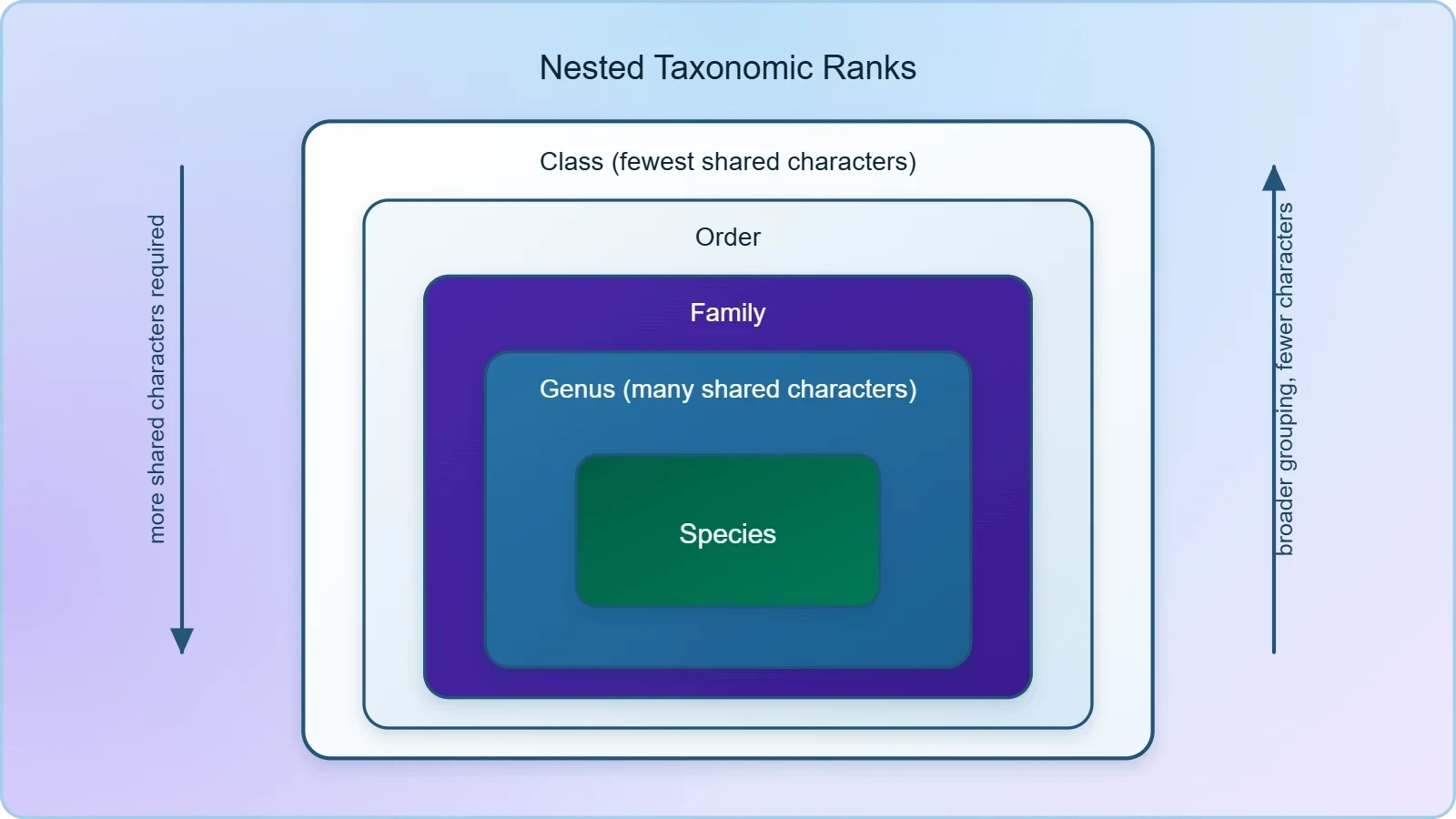
The sequence from species upward can be read as a series of nested sets, each containing the one below. Species sit within genus, genera within family, families within order, and orders within class. The material's examples trace this nesting exactly, from Panthera through Felidae and Carnivora to Mammalia, and from Solanum through Solanaceae and Polymoniales.
Formally, if we let ##S## denote the set of species, ##G## the set of genera, ##F## the set of families, ##O## the set of orders and ##C## the set of classes, the containment can be written as a chain of inclusions:
This notation is a convenience for the mind, not a claim that the boundaries are mathematically exact. The biological content lies in the comparative judgement that decides where one set ends and the next begins, and that judgement becomes progressively broader as the chain ascends.
The Gradient of Similarity Across the Ranks
The unifying thread of this lesson is a single, steadily declining quantity: the number of shared characters required to justify a grouping. Genus demands many; family fewer; order fewer still; class the fewest of the three examined here. The categories are not arbitrary labels but markers along a continuum of resemblance that narrows as one climbs.
This gradient explains why the criteria themselves change character. At the family level, botanists can still point to specific vegetative and reproductive features. By the order level, the material speaks of a few similar characters and, for Polymoniales, singles out floral characters as the principal basis. At the class level, the appeal is to aggregates of characters rather than any short list.
Counting Characters Versus Weighing Aggregates
The material draws a clear methodological distinction. Species, genus and family rest on a number of similar characters, whereas order and the higher categories are identified from aggregates of characters. The wording signals a change in method, not merely a change in scale, and students should register the difference between counting resemblances and assessing their combined weight.
In practice the two approaches shade into one another, and the material does not pretend otherwise. What matters for examination purposes is the stated principle: as categories rise, individual characters carry less decisive weight and the overall pattern of agreement carries more. This is the conceptual hinge on which the whole hierarchy turns.
A Worked Comparison in Code
A small computational model can make the nesting concrete without adding biological claims. The following snippet simply stores the relationships named in the material and checks that each lower rank is contained within the next, mirroring the inclusion chain given above.
# Taxonomic nesting as named in the lesson material
hierarchy = {
    "species": {"Panthera leo", "Panthera pardus", "Panthera tigris", "Felis catus"},
    "genus":   {"Panthera", "Felis"},
    "family":  {"Felidae", "Canidae"},
    "order":   {"Carnivora", "Primata"},
    "class":   {"Mammalia"},
}

# Each rank is a broader grouping than the one below it
for lower, higher in zip(
    ["species", "genus", "family", "order"],
    ["genus", "family", "order", "class"],
):
    print(f"{lower} -> {higher}: {len(hierarchy[lower])} entries fold into {len(hierarchy[higher])}")

# Plant side of the same lesson
plants = {
    "genus":  {"Solanum", "Petunia", "Datura"},
    "family": {"Solanaceae", "Convolvulaceae"},
    "order":  {"Polymoniales"},
}
print("Plant genera in Solanaceae:", plants["genus"])
The output is trivial, but the exercise has pedagogical value. Writing the names into nested structures forces the student to decide, for each taxon, which rank it occupies and which broader group contains it. The code does not discover relationships; it records judgements already made by comparison, which is exactly what classification is.
Going Further
Two observations from the material deserve to be carried forward explicitly, because they anticipate the final lesson. The first concerns the placement of the primates: the monkey, gorilla and gibbon are placed in the order Primata, and Primata is placed in class Mammalia. This is the same two-step movement seen with Carnivora, and it confirms that class gathers orders rather than families directly.
The second observation is a caution against treating the named examples as a complete inventory. The material notes that class Mammalia has other orders also, beyond Primata and Carnivora. The examples are illustrative samples chosen to display the logic of the hierarchy, not an exhaustive catalogue of mammalian orders, and students should read them in that spirit.
Preparing for Phylum, Division and Kingdom
The next and final lesson completes the ascent. Classes comprising animals like fishes, amphibians, reptiles, birds along with mammals constitute the next higher category called phylum. The pattern established here — related orders gathered into a class, related classes gathered into a phylum — will simply continue one rung higher, with division serving plants where phylum serves animals.
Students who have understood why Felidae and Canidae separate yet share Carnivora, and why Primata and Carnivora share Mammalia, will find the final step straightforward. The hierarchy is one continuous argument about resemblance, and this lesson has supplied its middle chapters. The summit remains to be described.
Also Read
- No links available.
From our network :
- Mastering DB2 12.1 Instance Design: A Technical Deep Dive into Modern Database ArchitectureComprehensive guide to DB2 12.1 Instance Design. Explore architectural components, HADR setup, buffer pool tuning, and security policies for IBM DB2 12.1. Includes 10 functional SQL and Shell samples.
- AI-Powered 'Precision Diagnostic' Replaces Standard GRE Score ReportsDiscover the new GRE Precision Diagnostic. Learn how AI-powered behavioral analytics and time-to-solve tracking are replacing standard GRE score reports to empower students.
- Analyzing Trump Deportation Numbers Insights Into The 2026 Immigration Crackdown
- Trump Political Strategy How Geopolitical Stunts Serve As Media Diversions
- Vite 6/7 'Cold Start' Regression in Massive Module GraphsIn-depth analysis of Vite 6/7 cold start regressions in massive module graphs. Learn about barrel file issues, pre-bundling optimizations, and how to improve Vite dev server performance.
- EV 2.0: The Solid-State Battery Breakthrough and Global Factory ExpansionDiscover the impact of the Solid-State Battery Breakthrough on the EV market. Learn about CATL and BYD stock growth, global factory expansion in Europe, and the future of EV 2.0 technology.
- 10 Physics Numerical Problems with Solutions for IIT JEEPrepare for IIT JEE with 10 physics numerical problems, complete with detailed solutions and conceptual explanations. Ideal for mastering kinematics, thermodynamics, electromagnetism, and optics.
- Mastering DB2 LUW v12 Tables: A Comprehensive Technical GuideComprehensive guide on DB2 LUW v12 tables. Explore CREATE TABLE syntax, BLU Acceleration, range partitioning, data types, and security features for IBM DB2 LUW v12.
- 98% of Global MBA Programs Now Prefer GRE Over GMAT Focus EditionExplore why 98% of global MBA programs now prefer the GRE over GMAT Focus. Learn about the shorter GRE format, verbal logic importance, and strategic versatility for students.
RESOURCES
- Taxonomic rank - Wikipediaen.wikipedia.orgThe major ranks: domain, kingdom, phylum, class, order, family, genus, and species, applied to the red fox, Vulpes vulpes. Many classifications based on genetic ...
- Taxonomy: the science of classificationnaturalsciences.be... taxonomic hierarchy that includes domain, kingdom, phylum, class, order, family, genus, and species. Still unsure about what taxonomy is? Watch the ...
- biological classification - Students | Britannica Kids | Homework Helpkids.britannica.comOrder. The order ranks below the class and above the family in the taxonomic hierarchy. The groups in an order have more in common…
- Family (taxonomy) - Wikipediaen.wikipedia.orgThe hierarchy of biological classification's eight major taxonomic ranks. ... In zoology, the family as a rank intermediate between order and genus was ...
- Taxonomic Hierarchy in Biological Classification - BYJU'Sbyjus.comIn this system of classification, kingdom is always ranked the highest followed by division, class, order, family, genus, and species. Also Read: Binomial ...
- I teach high school biology, recently heard the best acronym ... - Redditreddit.comDec 17, 2011 ... Kingdom, phylum, class, order, family, species, is what I thought it is. ... Was our taxonomic classification system (kingdom, phylum…
- Significant loss of sensitivity and specificity in the taxonomic ...pubmed.ncbi.nlm.nih.govSep 23, 2016 ... Similar pattern was detected for sequences classified up to more superficial taxonomic categories (i.e. family, order, class…). Results also ...
- how plants and animals are classified. Years ago I taught ...facebook.comMay 10, 2022 ... Species (smallest), Genus, Family, Order, Class, Phylum. There are various taxonomy categories that have been added or changed over the…
- Genomic-based taxonomic classification of the order ... - PubMedpubmed.ncbi.nlm.nih.govAt present, it consists of 4 families and 49 genera making it the third largest order within the class Alphaproteobacteria. However, their taxonomy remains ...
- Taxonomic classification for microbiome analysis, which correlates ...pmc.ncbi.nlm.nih.govNov 16, 2018 ... The identification percentages (the number of identified reads/the total number of reads) of each taxonomic level—phylum, class, order, family, ...
- What is the correct order of taxonomic categories, from most specific ...homework.study.comThe correct order of taxonomic categories, from most specific to broadest, is: species, genus, family, order, class, phylum and kingdom. The species name of ...
- Taxonomy - Definition, Classification & Example | Biology Dictionarybiologydictionary.netMar 19, 2017 ... ... class, order, family, genus, and species. The Taxonomic Hierarchy. A taxon (plural: taxa) is a group of organisms that…
- 2.1 Plant Taxonomy – The Science of Plantsopen.lib.umn.eduClass; Order; Family; Genus; Species. Memorize this hierarchy, so it rolls off your tongue like a multiplication table. Now apply this taxonomic ...
- Biology: Taxonomic Categories Flashcards - Quizletquizlet.comExamples of taxonomic ranks are species, genus, family, order, class, phylum, kingdom, domain, etc. Image: Taxonomic Categories. Domain. The taxonomic category ...
- Hierarchical Deep Learning for Diatom Image Classification - arXivarxiv.orgDec 11, 2025 ... Each pyramid shows the number of taxonomic categories at each level (class, order, family, genus, and species). The pipeline progresses…