Chemistry became a quantitative science the moment its practitioners stopped asking only what substances are and began asking how much of each substance takes part in a change. That shift, accomplished largely in the late eighteenth century, produced two principles that still govern every balanced equation written today: matter is neither created nor destroyed in an ordinary reaction, and a pure compound always holds its constituent elements in the same proportion by mass. These are the laws of conservation of mass and of definite proportions, and they form the bedrock on which atomic theory, the mole concept, and all of stoichiometry rest.
This lesson examines both laws in depth, tracing them from Antoine Lavoisier's careful weighings through Joseph Proust's contentious debates with Claude Berthollet, and connecting them to the atomic picture that John Dalton later supplied. It builds directly on the dimensional analysis and unit conversion skills developed in the previous lesson, since every meaningful statement about mass conservation depends on measuring mass correctly and expressing it in consistent units. The treatment here deliberately goes beyond the textbook statements, exploring why burning wood seems to lose mass, how isotopes complicate the notion of fixed composition, and where the law of conservation of mass itself breaks down at the nuclear scale.
By the end, you should be able to justify both laws from atomic reasoning, apply them to unfamiliar reactions, recognise the experimental conditions under which each holds, and anticipate the refinements that the next lesson will introduce through multiple proportions, gaseous volumes, and Avogadro's hypothesis. The emphasis throughout is on quantitative reasoning and on the critical evaluation of measurement, because a law of nature is only as trustworthy as the experiments that support it.
On This Page
- The Demise of Phlogiston and the Birth of Mass Conservation
- Apparent Violations and the Discipline of Closed Systems
- Proust, Berthollet, and the Law of Definite Proportions
- Non-Stoichiometric Compounds and the Boundaries of the Law
- Quantitative Applications: From Composition to Formula
- Consolidating the Two Laws: A Comparative View
- Experimental Verification and Laboratory Practice
- Refining the Concepts: Advanced Perspectives
- Worked Problems and Self-Assessment
- Historical Experiments and Their Modern Significance
- Extended Reference Tables
- Historical Milestones in Chemical Combination Laws
- Composition Data for Common Compounds
- Mass Composition of Common Compounds
- Summary of Key Formulas
- Key Formulas for Chemical Combination Laws
- Comparison of Stoichiometric and Non-Stoichiometric Compounds
- Stoichiometric versus Non-Stoichiometric Compounds
- Mass Changes in Open versus Closed Systems
The Demise of Phlogiston and the Birth of Mass Conservation
Before mass conservation could be stated, chemistry had to abandon a theory that made it seem false. The phlogiston theory, dominant through the early eighteenth century, held that combustible materials contained a fiery principle called phlogiston which escaped during burning. Metals were thought to be compounds of a calx (the powdery residue left after heating) and phlogiston, so burning or calcining a metal released phlogiston and left the calx behind. The theory explained combustion, rusting, and respiration in one framework, and it was not obviously wrong; its fatal flaw was quantitative, because metals were observed to gain weight on calcination rather than lose it.
Antoine Lavoisier, working in Paris in the 1770s and 1780s, resolved the difficulty by insisting on closed vessels and precise balances. He showed that the gain in mass of a metal during calcination exactly matched the mass of a gas absorbed from the air, a gas he eventually named oxygen. Combustion was not the escape of a principle but the combination of the burning substance with oxygen. By weighing all reactants and products in sealed apparatus, Lavoisier established that the total mass before and after a chemical change remains constant, a principle he articulated with unusual clarity for his era.
Lavoisier's Experimental Method
Lavoisier's contribution was as much methodological as theoretical. He recognised that gases are material substances with measurable mass, a point his predecessors had missed because they treated air as an elemental fluid. His experiments on the decomposition of mercuric oxide, in which a red calx heated in a retort released a gas that supported combustion while leaving behind liquid mercury, demonstrated that the calx was a compound of mercury and oxygen. The mass of oxygen released plus the mass of mercury recovered equalled the mass of the calx, a result that could only be explained if matter were conserved.
This insistence on the balance transformed chemistry into a quantitative discipline. Lavoisier collaborated with his wife Marie-Anne Paulze, who translated foreign papers and illustrated the apparatus, and together they produced the Traité Élémentaire de Chimie in 1789, which presented a systematic nomenclature and a table of simple substances. The law of conservation of mass, sometimes called Lavoisier's law, is the direct legacy of this work, and it remains the first check any chemist applies to a proposed reaction.
Why the Law Holds: The Atomic Explanation
At the atomic level, the law is almost self-evident once Dalton's model is accepted. A chemical reaction is a reorganisation of atoms, not a creation or destruction of them. Bonds break and form, atoms exchange partners, but the number of atoms of each element present before and after the change is unchanged. Since the mass of an atom of a given isotope is fixed, the total mass must also be unchanged, provided no atoms leave the system and no energy is exchanged with the surroundings in a way that alters mass.

This reasoning explains why the law is stated for closed systems. In an open vessel, atoms of a gaseous product can escape, and the mass of what remains appears to decrease. The law is not violated; the accounting is simply incomplete. Dalton's fourth postulate, that chemical reactions involve only the reorganisation of atoms which are neither created nor destroyed, is precisely the atomic statement of mass conservation, and it is why balanced chemical equations are possible at all.
Apparent Violations and the Discipline of Closed Systems
Every student encounters reactions that seem to defy conservation. A log of wood burns and leaves a small heap of ash; a candle shortens as it burns; a piece of iron rusts and gains weight. In each case the appearance of change is an artefact of an open system. The wood combines with oxygen from the air to form carbon dioxide and water vapour, both of which escape, while the ash is only the mineral residue. The candle loses mass because its carbon and hydrogen leave as gases. The rusting iron gains mass because it incorporates oxygen from the air.
The remedy is to perform the reaction in a sealed container and weigh the whole container before and after. If the vessel is truly closed and no gas leaks, the total mass is unchanged to within experimental error. This is the principle behind the classic demonstration in which a flask containing vinegar and baking soda is sealed, weighed, shaken, and reweighed; the fizzing produces carbon dioxide, but the gas cannot escape, and the balance reads the same. The demonstration is simple, yet it captures the essential experimental content of Lavoisier's law.
Worked Example: The Burning of Magnesium
Consider a strip of magnesium of mass 2.40 g burned in air to form magnesium oxide. If the reaction goes to completion and the product is collected, its mass is greater than 2.40 g because oxygen has been incorporated. The balanced equation is ##2\text{Mg} + \text{O}_2 \rightarrow 2\text{MgO}##. The molar mass of magnesium is 24.31 g mol⁻¹, so 2.40 g corresponds to 0.0987 mol of Mg. This requires 0.0494 mol of O₂, or 1.58 g of oxygen, giving a product mass of 3.98 g. The apparent gain of 1.58 g is exactly the mass of oxygen consumed.
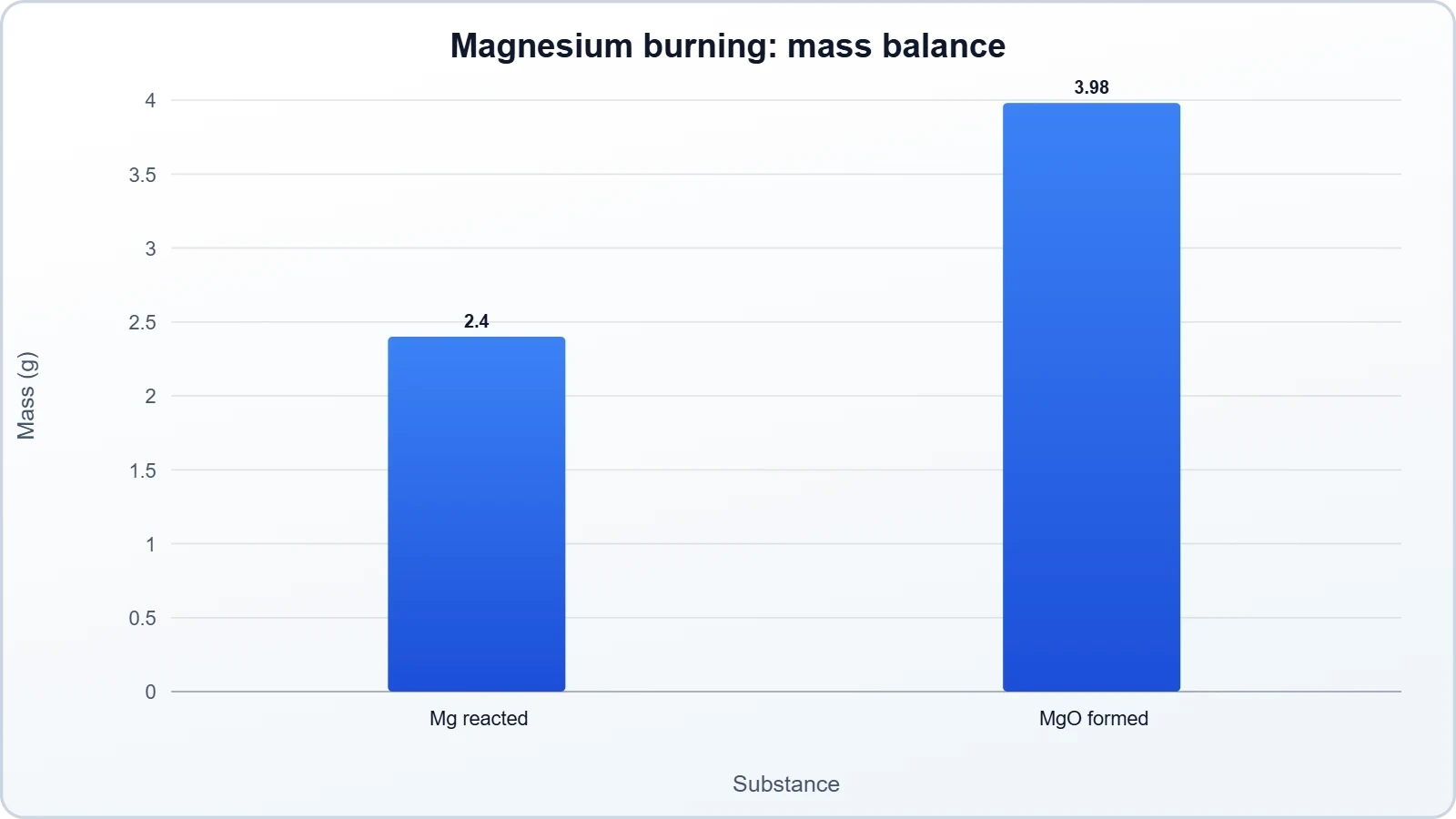
If the experiment is performed in an open crucible, some magnesium oxide may be lost as smoke, and the measured mass will be lower than predicted. The discrepancy is not a failure of the law but a failure of containment. Careful laboratory practice, including covering the crucible with a lid and allowing air to enter only gradually, minimises this loss. The exercise teaches an important habit: before declaring a law violated, check whether the system was genuinely closed and whether all products were retained.
Mass Defect and the Limits of the Law
The law of conservation of mass is exact for chemical reactions, but it is not a fundamental law of nature. In nuclear reactions, the total mass of the products is measurably less than the mass of the reactants, and the difference appears as energy according to Einstein's relation ##E = mc^2##. The mass defect in a nuclear reaction is typically a fraction of a percent, far too small to detect in ordinary chemical work, but it is real and has been measured with great precision. Chemical reactions involve energies of a few hundred kilojoules per mole, corresponding to mass changes of order ##10^{-9}## g, utterly negligible on a laboratory balance.
This distinction matters for understanding the scope of the law. Conservation of mass is an excellent approximation for chemistry because the binding energies of electrons are tiny compared with the rest masses of the nuclei. At the nuclear scale, the correct conserved quantity is mass-energy, and the separate conservation of mass no longer holds. For the purposes of this course, however, the law is exact within experimental uncertainty, and it is the foundation of every stoichiometric calculation.
Proust, Berthollet, and the Law of Definite Proportions
Joseph Proust, a French chemist working in the 1790s, advanced the claim that a given compound always contains the same elements in the same proportion by mass, regardless of how the compound was prepared. He supported this with analyses of cupric carbonate from natural and synthetic sources, finding identical percentages of copper, carbon, and oxygen in both: 51.35% copper, 9.74% carbon, and 38.91% oxygen. The constancy was striking, and Proust argued that it reflected a fundamental property of chemical combination rather than an accident of preparation.
His claim was contested by Claude Berthollet, who held that the composition of a compound could vary continuously with the proportions of the reactants present. Berthollet's view was not unreasonable; many solid solutions and alloys do vary in composition, and the distinction between a compound and a mixture was not yet sharp. The debate was settled in Proust's favour for the compounds he studied, and the law of definite proportions, also called the law of constant composition, became a cornerstone of chemistry. It is worth noting that Berthollet was not entirely wrong: non-stoichiometric compounds exist, and they are discussed below.
Experimental Basis and Modern Confirmation
Proust's analyses were laborious and his methods were limited, but the conclusion has been confirmed repeatedly with modern instrumentation. Water from any source, whether distilled in a laboratory or collected from a glacier, contains hydrogen and oxygen in a mass ratio of approximately 1:8, corresponding to the formula H₂O. Pure sodium chloride, whether mined or crystallised from solution, contains 39.34% sodium and 60.66% chlorine by mass. These figures are reproducible to many significant figures, and they are the basis for determining empirical formulas from combustion analysis and other compositional techniques.
The law is best understood as a consequence of the atomic structure of compounds. A pure compound has a fixed chemical formula, and each formula unit contains a definite number of atoms of each element. Since the atoms of a given element have a characteristic mass, the mass ratio of the elements in the compound is fixed. The law therefore provides strong support for Dalton's atomic theory, which was published in 1808 and which explained why compounds should have constant composition.
Isotopes and the Meaning of Constant Composition
A subtlety arises when isotopes are considered. Natural chlorine consists of about 75% chlorine-35 and 25% chlorine-37, and the isotopic composition varies slightly with source. A sample of sodium chloride from a particular mineral deposit may therefore have a marginally different mass ratio of sodium to chlorine than a sample from another source, because the average atomic mass of chlorine depends on its isotopic mix. The variation is small, typically in the third or fourth significant figure, but it is real and is exploited in isotope geochemistry to trace the origins of materials.
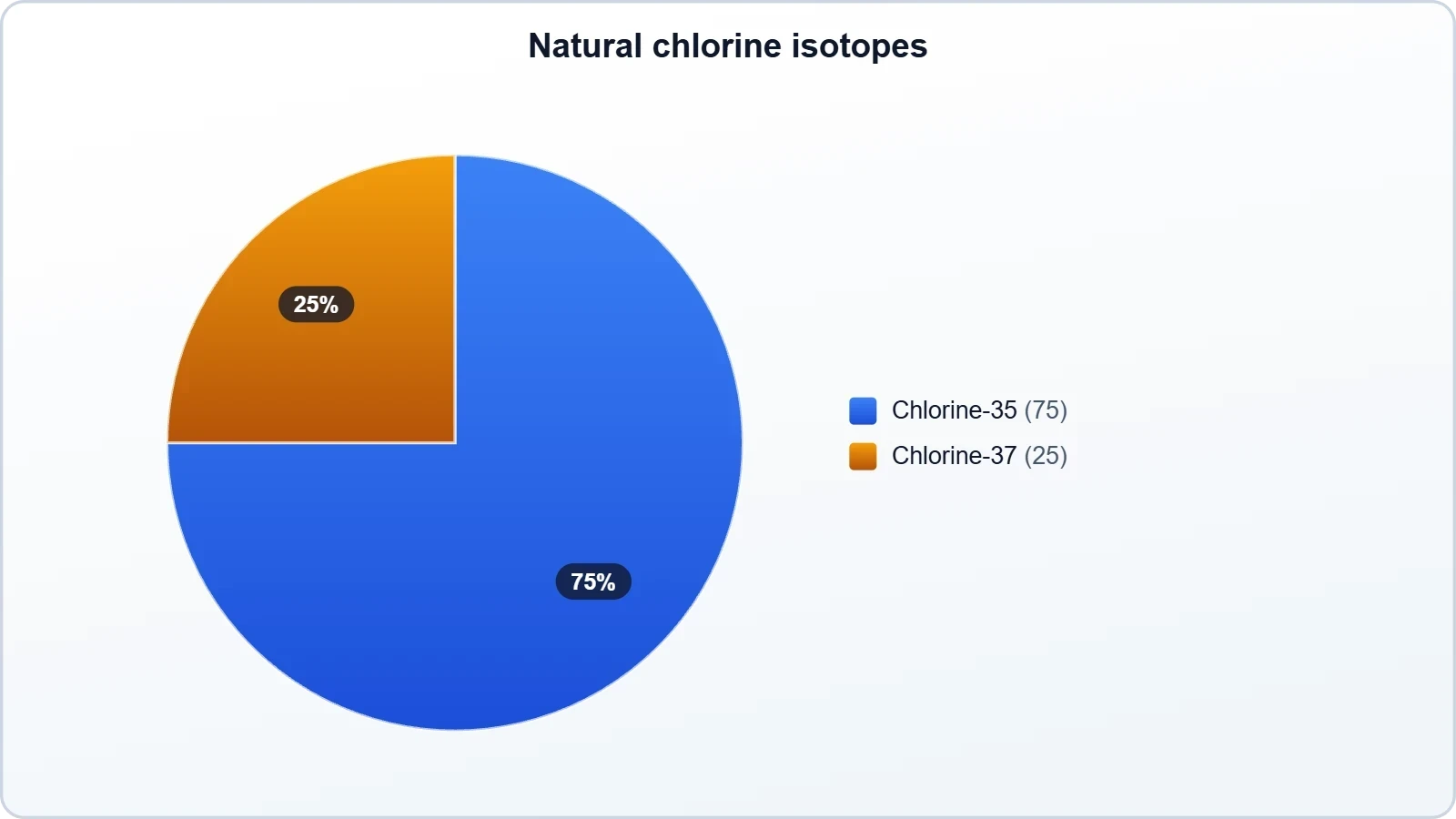
The law of definite proportions is therefore best stated in terms of the ratio of numbers of atoms, not masses. A compound has a fixed atomic composition; its mass composition is fixed only to the extent that the isotopic composition of each element is fixed. For most chemical purposes the distinction is negligible, but it is important in precise analytical work and in understanding why atomic masses are quoted as averages over natural isotopic abundances.
Non-Stoichiometric Compounds and the Boundaries of the Law
Berthollet's intuition was vindicated in the twentieth century by the discovery of non-stoichiometric compounds, also called berthollides. Iron(II) oxide, for example, is typically deficient in iron, with a composition ranging from about Fe₀.₈₄O to Fe₀.₉₅O depending on preparation. The deficiency arises because some iron sites in the crystal lattice are vacant, and charge balance is maintained by the presence of some iron(III) ions. The compound has a definite crystal structure but not a definite atomic ratio, and its composition can vary continuously within a range.
Such compounds are common among transition metal oxides, sulfides, and hydrides, and they are important in materials science, catalysis, and battery chemistry. Their existence does not invalidate the law of definite proportions for molecular compounds; rather, it shows that the law applies to compounds with a well-defined molecular or ionic formula unit. The distinction between stoichiometric and non-stoichiometric compounds is a reminder that chemical laws are statements about classes of substances, not universal dogmas, and that the boundaries of a law are as instructive as its content.
How the Law Supports Atomic Theory
Dalton's atomic theory gained credibility precisely because it explained the law of definite proportions. If a compound is formed by the combination of atoms in a fixed ratio, then its composition by mass must be fixed, because each atom has a characteristic mass. Conversely, the observation of fixed composition is strong evidence that matter is particulate and that combination occurs in discrete units. The law of multiple proportions, which the next lesson treats in detail, extends this reasoning to compounds formed from the same pair of elements in different ratios.
The logical structure is worth appreciating. The law of definite proportions is an empirical generalisation; Dalton's theory is a model that explains it. The model also predicts phenomena not yet observed, such as the existence of compounds with simple whole-number ratios of atoms, and these predictions were subsequently confirmed. This interplay between empirical law and explanatory model is characteristic of good science, and it is a theme that runs through the whole of chemistry.
Quantitative Applications: From Composition to Formula
The law of definite proportions is not merely a historical curiosity; it is a working tool. Given the mass percentages of the elements in a compound, one can determine its empirical formula, and given the empirical formula and the molar mass, one can determine the molecular formula. The procedure relies on converting masses to moles, dividing by the smallest number of moles, and adjusting to whole numbers. It is a direct application of the dimensional analysis skills developed earlier in the course, and it is the standard method of elemental analysis.
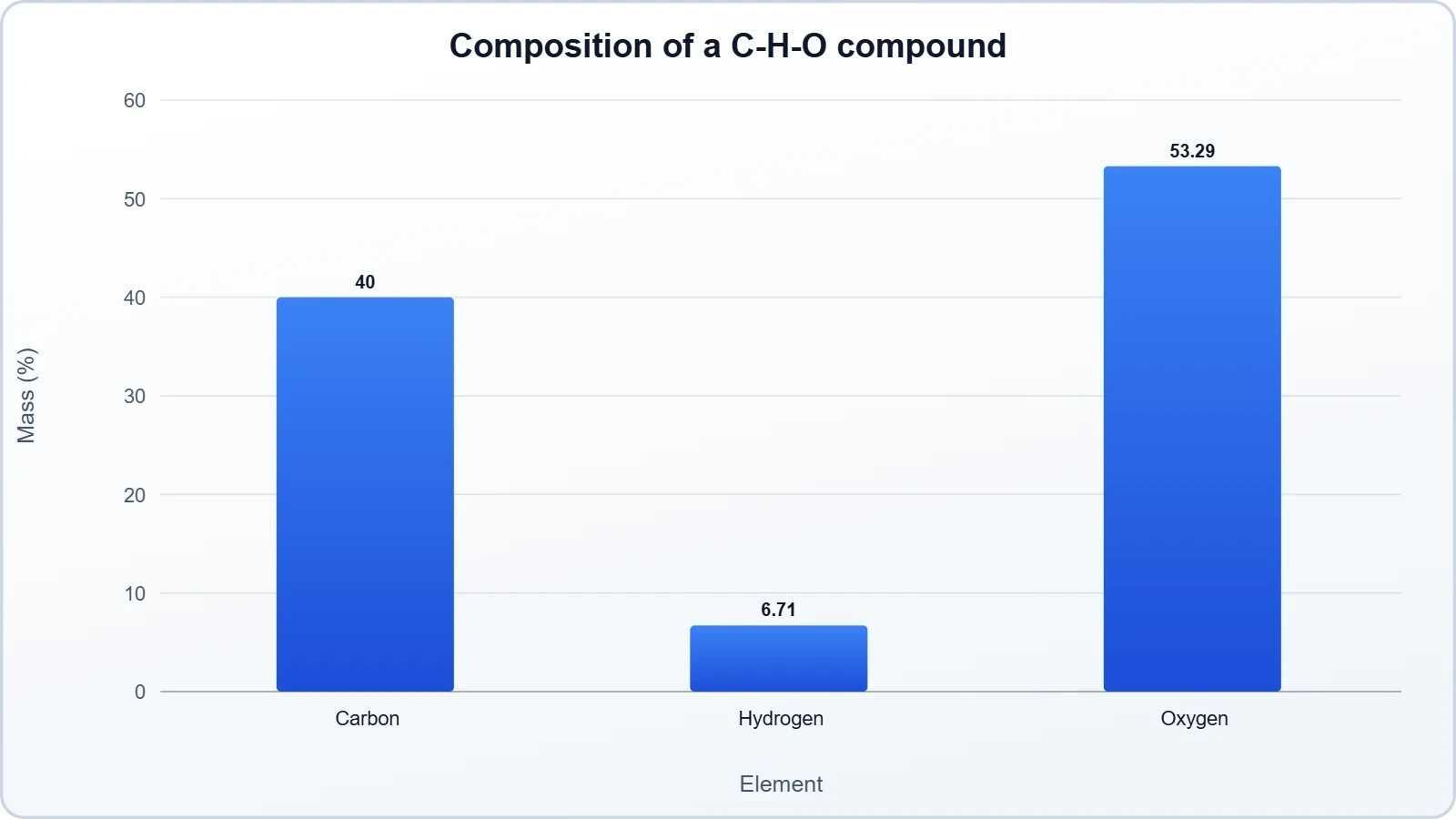
Consider a compound containing 40.00% carbon, 6.71% hydrogen, and 53.29% oxygen by mass. Taking 100 g of the compound, we have 40.00 g of carbon, 6.71 g of hydrogen, and 53.29 g of oxygen. Dividing by the respective atomic masses gives 3.33 mol of carbon, 6.66 mol of hydrogen, and 3.33 mol of oxygen. Dividing by the smallest value, 3.33, gives a ratio of 1:2:1, so the empirical formula is CH₂O. If the molar mass is found to be 180 g mol⁻¹, the molecular formula is C₆H₁₂O₆, glucose.
Worked Example: Verifying a Composition
Suppose a sample of pure copper carbonate is analysed and found to contain 51.35% copper, 9.74% carbon, and 38.91% oxygen. These are precisely the figures Proust reported, and they correspond to the formula CuCO₃. To verify, calculate the molar mass of CuCO₃: 63.55 + 12.01 + 3(16.00) = 123.56 g mol⁻¹. The mass percentage of copper is 63.55/123.56 × 100 = 51.43%, of carbon is 12.01/123.56 × 100 = 9.72%, and of oxygen is 48.00/123.56 × 100 = 38.85%. The small differences from Proust's values reflect the atomic masses available in his time and the precision of his methods.
Such calculations are routine in analytical chemistry, and they illustrate the predictive power of the law. If a sample of copper carbonate were found to contain 45% copper, one would suspect contamination or incomplete reaction rather than a violation of the law. The constancy of composition is a diagnostic tool, and departures from it are signals to investigate the purity of the sample or the conditions of the experiment.
Common Mistakes and How to Avoid Them
Students frequently confuse the law of definite proportions with the law of multiple proportions. The former concerns a single compound and states that its composition is fixed; the latter concerns two or more compounds formed from the same elements and states that the masses of one element combining with a fixed mass of the other are in a simple whole-number ratio. The two laws are related but distinct, and the next lesson develops the second in detail. Keeping them separate prevents a great deal of confusion.
Another common error is to apply the law of conservation of mass without checking that the system is closed. A reaction carried out in an open beaker may lose a gaseous product, and the mass of the contents will appear to decrease. The correct procedure is to account for all products, including gases, or to perform the reaction in a sealed vessel. A third error is to treat the law as exact at the nuclear level, where mass defect becomes significant. Recognising the domain of validity of each law is part of chemical maturity.
We Also Published
Consolidating the Two Laws: A Comparative View
The two laws are complementary. Conservation of mass governs the total mass of a reacting system and is a statement about the indestructibility of matter in chemical change. Definite proportions govern the composition of a single compound and is a statement about the fixed ratio in which elements combine. Together they underpin the balancing of equations, the calculation of yields, and the determination of formulas. Without them, stoichiometry would be impossible, because there would be no guarantee that the mass of the products could be predicted from the mass of the reactants.
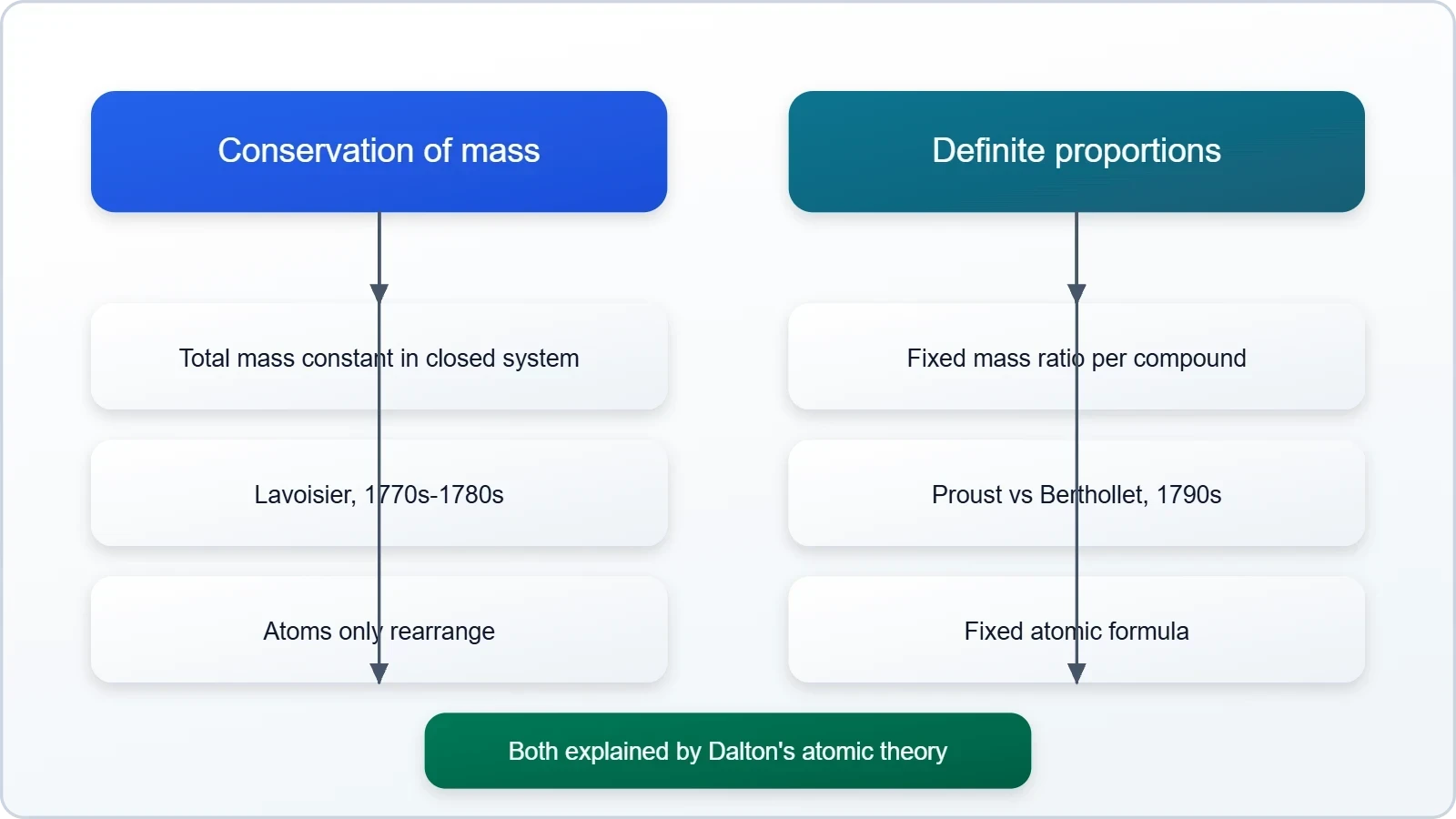
The historical sequence is also instructive. Lavoisier established conservation of mass in the 1770s and 1780s, Proust established definite proportions in the 1790s, and Dalton's atomic theory in 1808 explained both. The order reflects the growing precision of chemical measurement and the increasing willingness of chemists to reason quantitatively. Each law was established by careful experiment and each was subsequently explained by a model of matter that has survived, with refinements, to the present day.
Summary of Key Relationships
The table below consolidates the essential features of the two laws, their experimental basis, their atomic interpretation, and their limitations. It is intended as a revision aid and as a reference for the problems that follow. The entries are deliberately concise so that the contrasts between the laws are clear at a glance.
Preparing for Multiple Proportions
The next lesson extends the reasoning developed here to the law of multiple proportions, which concerns two elements that form more than one compound. Water and hydrogen peroxide provide the classic example: 2 g of hydrogen combines with 16 g of oxygen in water and with 32 g of oxygen in hydrogen peroxide, a ratio of 1:2. The law of definite proportions applies to each compound individually; the law of multiple proportions relates the compositions of the two compounds. Together they provide powerful evidence for the atomic model.
The lesson will also introduce Gay-Lussac's law of gaseous volumes and Avogadro's hypothesis, which together explain why gases combine in simple volume ratios. These ideas build on the mass-based laws considered here and prepare the ground for the mole concept and stoichiometric calculations. The conceptual thread is continuous: from the conservation of mass, through fixed composition, to multiple proportions and the atomic theory that unifies them all.
Experimental Verification and Laboratory Practice
The laws of chemical combination are not abstract; they are verified daily in teaching laboratories. A simple experiment to demonstrate conservation of mass uses a conical flask containing a solution of lead(II) nitrate and a small test tube of potassium iodide solution suspended inside. The flask is stoppered and weighed, then tilted so the solutions mix, producing a yellow precipitate of lead(II) iodide. On reweighing, the mass is unchanged, provided no material has escaped. The experiment is safe, visually striking, and directly illustrates the law.
To demonstrate definite proportions, students can prepare copper(II) carbonate by mixing solutions of copper(II) sulfate and sodium carbonate, filter the precipitate, dry it, and determine its copper content by a suitable method. The result should agree with the theoretical 51.4% copper within experimental error. Such exercises teach the importance of drying to constant mass, of avoiding contamination, and of reporting results with appropriate significant figures, all of which are applications of the measurement skills developed earlier in the course.
Sources of Error in Composition Experiments
Composition experiments are sensitive to several sources of error. Incomplete drying leaves residual water, which lowers the apparent percentage of the metal. Incomplete precipitation leaves some metal in solution, again lowering the result. Contamination from impure reagents or from the atmosphere can raise or lower the result depending on the contaminant. The balance itself has a finite precision, and the uncertainty in each weighing propagates through the calculation, as discussed in the lesson on error analysis.
A careful worker repeats the determination several times and reports the mean with an uncertainty. If the mean differs from the theoretical value by more than the combined uncertainty, the discrepancy must be explained. The law of definite proportions predicts a specific composition, and a significant departure is evidence of a problem with the experiment or the sample. This interplay between theory and measurement is the essence of quantitative chemistry.
Beyond the Laboratory: Industrial and Environmental Relevance
The laws of chemical combination have direct industrial relevance. In the manufacture of ammonia by the Haber process, the stoichiometry of the reaction determines the ratio of nitrogen to hydrogen that must be fed to the reactor, and the law of conservation of mass determines the mass balance of the plant. In environmental chemistry, the composition of pollutants is fixed by their formulas, and the mass of a pollutant released can be calculated from the mass of fuel burned and the composition of the fuel. These applications show that the laws are not confined to the classroom.
In materials science, the distinction between stoichiometric and non-stoichiometric compounds is crucial. The properties of a semiconductor or a battery electrode depend sensitively on the exact composition, and controlling that composition is a central challenge of synthesis. The law of definite proportions provides the reference point against which deviations are measured, and the concept of non-stoichiometry extends the law to materials where composition can vary. The result is a richer and more nuanced picture of chemical combination than the simple statement of the law suggests.
Refining the Concepts: Advanced Perspectives
At a more advanced level, the law of conservation of mass can be derived from the principle of relativity and the conservation of energy. The total energy of a closed system is conserved, and mass is related to energy by ##E = mc^2##. In a chemical reaction, the energy released or absorbed corresponds to a tiny change in mass, which is negligible for practical purposes but conceptually important. The law of conservation of mass is therefore an approximation valid when the energy changes are small compared with the rest energies of the particles involved.
The law of definite proportions can be refined by considering the statistical nature of atomic masses. The atomic mass of an element is an average over its isotopes, weighted by their natural abundances. A compound's mass composition therefore depends on the isotopic composition of its constituent elements, which can vary slightly with source. For most elements the variation is negligible, but for elements such as hydrogen, oxygen, and carbon it can be measured and is used in isotope ratio mass spectrometry to trace the origins of materials.
Connecting to Thermodynamics and Kinetics
The laws of chemical combination are statements about the stoichiometry of reactions, not about their rates or their equilibrium positions. A reaction may be thermodynamically favourable but kinetically slow, and the laws say nothing about how fast it will proceed. This distinction between stoichiometry and kinetics is important, and it is developed in later courses. For now, it is enough to recognise that the laws constrain what can happen, not how quickly it happens.
Thermodynamics enters through the energy changes associated with bond breaking and formation, which are related to the mass defect discussed earlier. The energy released in a chemical reaction is the difference between the bond energies of the reactants and the products, and it corresponds to a mass change that is far too small to measure in ordinary chemical work. The laws of chemical combination are therefore consistent with thermodynamics, and the apparent conflict between mass conservation and mass-energy equivalence is resolved by recognising the different scales involved.
Pedagogical Note: Why These Laws Matter
For the advanced learner, the laws of chemical combination are more than historical curiosities. They are the logical foundation of stoichiometry, and they illustrate the relationship between empirical observation and theoretical explanation. Understanding why the laws hold, and where they fail, develops the critical thinking that distinguishes a chemist from a calculator. The exercises that follow are designed to test both the ability to apply the laws and the ability to recognise their limits.
The lesson has covered the historical development of the two laws, their atomic interpretation, their experimental verification, and their limitations. It has also prepared the ground for the next lesson on multiple proportions, gaseous volumes, and Avogadro's law. The thread that connects all of these ideas is the atomic hypothesis: matter is made of atoms, atoms combine in fixed ratios, and reactions rearrange atoms without creating or destroying them. From this simple idea, the whole of stoichiometry follows.
Worked Problems and Self-Assessment
The following problems are designed to consolidate the material. They range from straightforward applications of the laws to more demanding questions that require careful reasoning about experimental conditions and the limits of the laws. Attempt each problem before reading the solution, and pay attention to the units and significant figures. The problems are representative of the kind of question that appears in advanced high school and early undergraduate examinations.
Problem 1: A 5.00 g sample of a compound containing only carbon and hydrogen is burned completely in oxygen, producing 15.0 g of carbon dioxide and 9.00 g of water. Determine the empirical formula of the compound. Solution: The mass of carbon in the CO₂ is 15.0 × (12.01/44.01) = 4.09 g, and the mass of hydrogen in the water is 9.00 × (2.016/18.02) = 1.01 g. The total is 5.10 g, slightly more than 5.00 g due to rounding; using more precise values gives 5.00 g. The mole ratio is 4.09/12.01 : 1.01/1.008 = 0.341 : 1.00, which is approximately 1:3, giving CH₃ as the empirical formula.
Problem 2: Conservation in a Sealed System
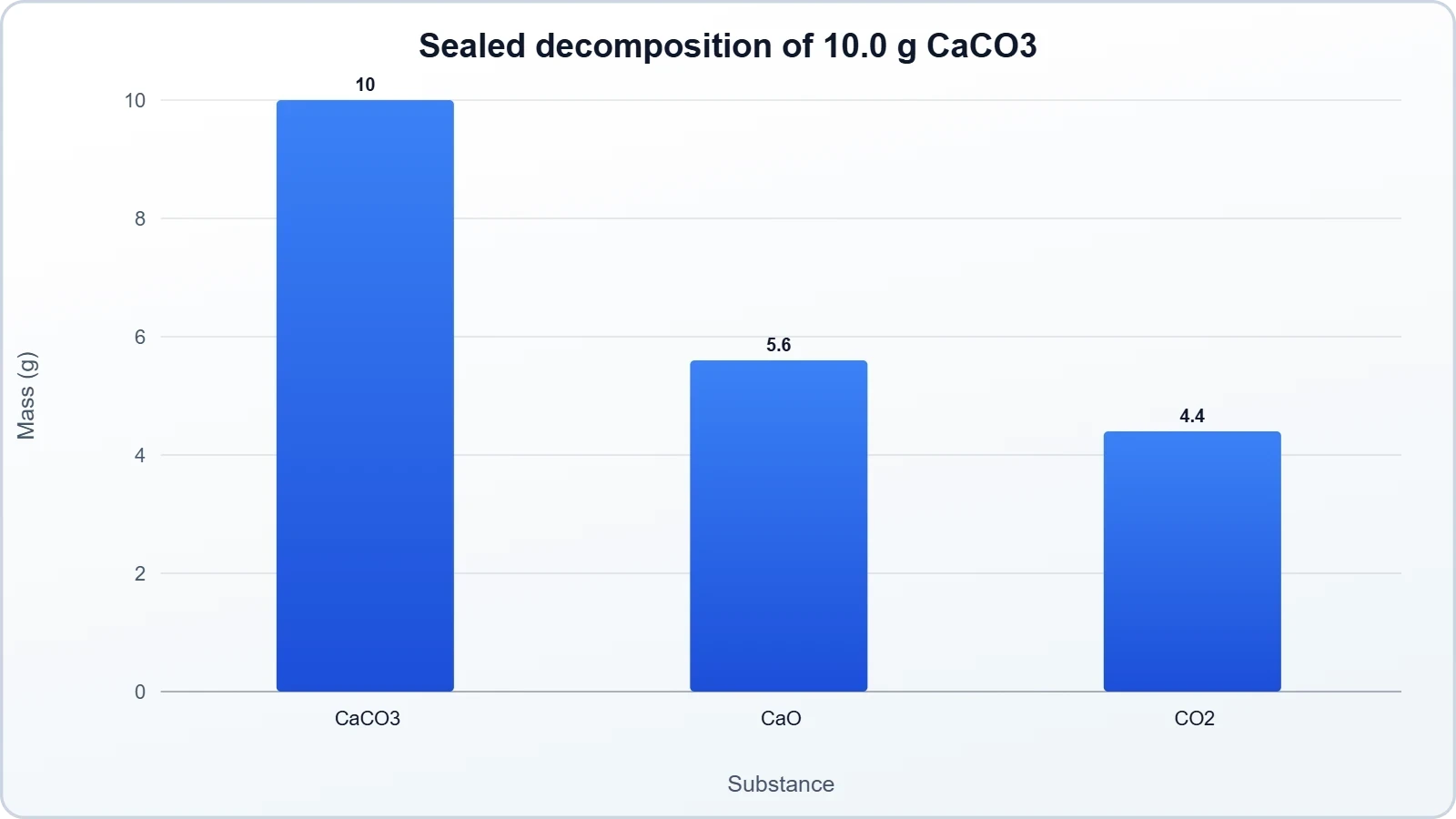
A sealed flask contains 10.0 g of calcium carbonate. On strong heating, the carbonate decomposes to calcium oxide and carbon dioxide. After cooling, the total mass of the flask and contents is found to be unchanged. Explain why, and calculate the mass of calcium oxide formed. Solution: The flask is sealed, so the carbon dioxide cannot escape, and the law of conservation of mass guarantees that the total mass is unchanged. The reaction is CaCO₃ → CaO + CO₂. The molar mass of CaCO₃ is 100.09 g mol⁻¹, so 10.0 g is 0.0999 mol. This produces 0.0999 mol of CaO, with molar mass 56.08 g mol⁻¹, giving 5.60 g of CaO. The remaining 4.40 g is CO₂.
Problem 3: A sample of a compound of nitrogen and oxygen contains 2.80 g of nitrogen and 4.80 g of oxygen. Determine its empirical formula and comment on whether the law of definite proportions is satisfied. Solution: The moles of nitrogen are 2.80/14.01 = 0.200 mol, and the moles of oxygen are 4.80/16.00 = 0.300 mol. The ratio is 2:3, giving N₂O₃. The law of definite proportions is satisfied because the composition is fixed for this compound; any pure sample of N₂O₃ will have the same mass ratio of nitrogen to oxygen.
Problem 4: Apparent Violation of Mass Conservation
A student heats a piece of copper in an open crucible and finds that the mass increases from 2.00 g to 2.50 g. Does this violate the law of conservation of mass? Explain. Solution: No. The copper has combined with oxygen from the air to form copper(II) oxide. The mass of oxygen incorporated is 0.50 g, and the total mass of copper plus oxygen is conserved. The apparent increase is due to the open system, which allows oxygen to enter but does not allow the products to escape. If the crucible were sealed, the total mass would be unchanged.
Problem 5: Non-Stoichiometric Compound
A sample of iron oxide is found to contain 72.4% iron and 27.6% oxygen by mass. Determine its empirical formula and comment on whether it is stoichiometric. Solution: The moles of iron are 72.4/55.85 = 1.30 mol, and the moles of oxygen are 27.6/16.00 = 1.73 mol. The ratio is 1:1.33, or 3:4, giving Fe₃O₄. This is a stoichiometric compound, magnetite, which has a well-defined composition. A non-stoichiometric iron oxide would show a composition between FeO and Fe₂O₃, and its formula would not be expressible in small whole numbers.
Problem 6: Mass Defect
Calculate the mass defect for the formation of a helium-4 nucleus from two protons and two neutrons, given that the mass of a proton is 1.00728 u, the mass of a neutron is 1.00867 u, and the mass of a helium-4 nucleus is 4.00151 u. Solution: The total mass of the constituents is 2(1.00728) + 2(1.00867) = 4.03190 u. The mass defect is 4.03190 − 4.00151 = 0.03039 u. This corresponds to an energy of 0.03039 × 931.5 MeV = 28.3 MeV, which is the binding energy of the helium-4 nucleus. The mass defect is far larger than any chemical mass change, illustrating why the law of conservation of mass is a chemical approximation.
These problems illustrate the range of reasoning required to apply the laws of chemical combination. They also show how the laws connect to other areas of chemistry, from elemental analysis to nuclear physics. The next lesson will build on these foundations by introducing the law of multiple proportions and the laws of gaseous volumes, which together complete the classical picture of chemical combination.
Historical Experiments and Their Modern Significance
The experiments that established the laws of chemical combination are worth studying in their own right, because they illustrate the methods of careful science. Lavoisier's use of sealed vessels and precise balances set a new standard for chemical investigation. Proust's analyses of copper carbonate from different sources demonstrated the importance of comparing samples prepared in different ways. These experiments were not merely technical achievements; they were conceptual breakthroughs that changed the way chemists thought about matter.
Modern instrumentation has refined these experiments but not replaced them. Mass spectrometry can determine atomic and molecular masses with extraordinary precision, and elemental analysers can determine the composition of a compound in minutes. Yet the underlying principles are the same: measure the masses of reactants and products, compare them, and draw conclusions about the composition of matter. The laws of chemical combination are as relevant today as they were in the eighteenth century, and they remain the foundation of quantitative chemistry.
From Lavoisier to Modern Stoichiometry
The development of stoichiometry from the laws of chemical combination is one of the great success stories of science. Lavoisier's conservation of mass, Proust's definite proportions, Dalton's atomic theory, and Avogadro's hypothesis together provided a framework for understanding chemical reactions that has stood the test of time. The mole concept, which is the subject of a later lesson, is the practical embodiment of this framework, allowing chemists to count atoms by weighing them.
The journey from the phlogiston theory to modern stoichiometry is a reminder that scientific progress is often driven by the resolution of anomalies. The apparent gain in mass during calcination was an anomaly for the phlogiston theory, and its resolution by Lavoisier led to a new understanding of combustion and of the nature of gases. Similarly, the existence of non-stoichiometric compounds was an anomaly for the law of definite proportions, and its resolution led to a richer understanding of the solid state. Anomalies are not failures of science; they are opportunities for deeper understanding.
Final Reflections
The laws of conservation of mass and definite proportions are simple to state but profound in their implications. They tell us that matter is indestructible in chemical change and that compounds have fixed compositions. From these two principles, the whole of stoichiometry follows. The next lesson will extend the reasoning to multiple proportions and gaseous volumes, completing the classical picture of chemical combination and preparing the way for the mole concept and quantitative analysis.
As you review this lesson, focus on the connections between the laws, the atomic theory that explains them, and the experimental methods that verify them. The ability to move between these levels of description, from the macroscopic observation to the atomic model to the experimental test, is the hallmark of a mature understanding of chemistry. The exercises and problems in this lesson are designed to develop that ability, and they will serve you well in the lessons that follow.
Extended Reference Tables
The following tables provide additional reference material for the laws of chemical combination. They are intended to support revision and to provide quick access to the key data and relationships discussed in the lesson. Each table is self-contained and can be used independently of the surrounding text.
Composition Data for Common Compounds
The table below lists the mass composition of several common compounds, calculated from their formulas and standard atomic masses. It can be used to check the results of elemental analysis and to illustrate the law of definite proportions. The values are given to four significant figures, which is appropriate for most laboratory work.
Summary of Key Formulas
The formulas below are used throughout the lesson and in the problems. They are collected here for easy reference. The first is the definition of mass percentage, the second is the relationship between mass, moles, and molar mass, and the third is the mass-energy equivalence relation that explains the limits of mass conservation.
Comparison of Stoichiometric and Non-Stoichiometric Compounds
The distinction between stoichiometric and non-stoichiometric compounds is important for understanding the scope of the law of definite proportions. The table below summarises the key differences. Stoichiometric compounds have a fixed composition and a definite formula, while non-stoichiometric compounds have a variable composition within a range and are often described by a formula with a variable subscript.
Mass Changes in Open versus Closed Systems
The table below illustrates the apparent mass changes observed in open systems and the corresponding mass balance in closed systems. It is intended to help students recognise when the law of conservation of mass is being tested correctly and when an apparent violation is simply an artefact of the experimental setup.
From our network :
- AI-Powered 'Precision Diagnostic' Replaces Standard GRE Score ReportsDiscover the new GRE Precision Diagnostic. Learn how AI-powered behavioral analytics and time-to-solve tracking are replacing standard GRE score reports to empower students.
- 98% of Global MBA Programs Now Prefer GRE Over GMAT Focus EditionExplore why 98% of global MBA programs now prefer the GRE over GMAT Focus. Learn about the shorter GRE format, verbal logic importance, and strategic versatility for students.
- How to Print Cheaply: Cutting the Cost per PageA practical, measured guide to lowering what each printed page costs — duplex and draft modes, third-party ink, yield mathematics, and knowing when a new printer beats refills.
- Analyzing Trump Deportation Numbers Insights Into The 2026 Immigration Crackdown
- Trump Political Strategy How Geopolitical Stunts Serve As Media Diversions
- EV 2.0: The Solid-State Battery Breakthrough and Global Factory ExpansionDiscover the impact of the Solid-State Battery Breakthrough on the EV market. Learn about CATL and BYD stock growth, global factory expansion in Europe, and the future of EV 2.0 technology.
- 10 Physics Numerical Problems with Solutions for IIT JEEPrepare for IIT JEE with 10 physics numerical problems, complete with detailed solutions and conceptual explanations. Ideal for mastering kinematics, thermodynamics, electromagnetism, and optics.
- Do You Need a New Router or Is Your Internet Plan the Problem?A practical comparison of the signs that point to router limits versus signs your broadband speed or provider is the bottleneck, so you can decide what to replace before spending money.
- Where to Put Your Wireless Router for Better CoverageA practical, physics-grounded guide to router placement: why the centre of the home beats the corner, how walls and metal sap signal, and how to run a simple survey that proves the improvement.
RESOURCES
- 2.2: Scientific Laws - Conservation of Mass and Definite Proportionschem.libretexts.orgAug 10, 2022 ... This law states that if a compound is broken down into its constituent elements, the masses of the constituents will…
- 3 Fundamental Laws of Chemistry - Mediummedium.comJul 23, 2022 ... The Law of Definite Proportions states that a specific compound will always contain the exact same ratio (proportion) of elements…
- Laws of Conservation of Mass and Definite Proportionsserc.carleton.eduJun 6, 2009 ... By using this simulation interactively, students see first hand how measurement and observation are used as evidence to build laws…
- Conservation of mass - Wikipediaen.wikipedia.orgAntoine Lavoisier's discovery of the law of conservation of mass led to many new findings in the 19th century. Joseph Proust's law of definite…
- Laws of Definite and Multiple Proportions - Pathways to Chemistrypathwaystochemistry.comThe Law of Multiple Proportions states that if two elements combine to form more than one compound, the mass of one element that combines…
- Law of Conservation of Mass | CK-12 Foundationflexbooks.ck12.orgIt includes laws of conservation of mass, multiple proportion, definite proportion, and reciprocal proportion. In 1789, Antoine Lavoisier formulated law of ...
- Law of definite proportions - Wikipediaen.wikipedia.orgIn chemistry, the law of definite proportions, sometimes called Proust's law or the law of constant composition, states that a given chemical compound ...
- Laws of Chemical combinations (practice) - Khan Academykhanacademy.orgLaw of conservation of mass · Video 2 minutes 19 seconds. 2:19. Law of definite proportions · Video 8 minutes 22 seconds. 8:22. Law…
- Dalton's Atomic Theory | CK-12 Foundationflexbooks.ck12.orgDalton's Atomic Theory Based on Laws of Chemical Combination · Law of Conservation of Mass (Lavoisier's Law) · Law of Definite Proportions (Proust's Law)…
- Law of Conservation of Mass, Definite Proportions, Multiple ... - Quizletquizlet.comStudy with Quizlet and memorize flashcards containing terms like Law of Conservation of Mass, law of definite proportions, Law of Multiple Proportions and ...
- Introduction to Chemistry Study Guide: Atoms and Elements | Notespearson.comLaw of Definite Composition: A chemical compound always contains the same elements in the same proportion by mass. Law of Conservation of Mass: Mass…
- Concepts (chapter 3) Flashcards - Quizletquizlet.coma.) Law of Conservation of Mass - no detectable gain or loss in mass occurs in chemical reactions b.) Law of Definite Proportion -…
- Lecture2_Ch1_091205.pdfcolumbia.eduLaw of conservation of mass. Proust (1790). Law of definite proportions of mass. Dalton (1800). Atomic theory to explain laws of conservation and definite ...
- Explain the law of conservation of mass, the law of definite ...homework.study.comWe were asked to explain the law of conservation of mass, the law of definite proportion, and the law of multiple proportions. Law of…