Balancing a chemical equation is the single act that transforms a symbolic sketch of a reaction into a quantitative instrument. The law of conservation of mass demands that every atom present among the reactants reappears among the products, and a balanced equation is simply the written proof that this accounting holds. Without that proof, no mole ratio can be trusted, no limiting reagent identified, and no yield predicted. This lesson builds directly on the concentration work of the previous session, where molality taught you to express how much substance sits in a given mass of solvent, and it prepares the ground for stoichiometric calculations in solutions, where those concentrations will be multiplied by balanced coefficients to answer real analytical questions.
The reference material for this lesson keeps its demands modest: many equations, it notes, can be balanced by trial and error, and it walks through the reactions of iron, magnesium and phosphorus with oxygen before tackling the combustion of propane in five careful steps. That foundation is sound but deliberately narrow. Real chemistry presents equations that resist inspection, redox systems where electrons must be tracked explicitly, organic combustions with long carbon chains, and ionic reactions in solution where spectator ions obscure the essential change. Each of these requires a technique beyond simple counting, and each rewards the student who understands why the coefficients exist rather than merely where to place them.
What follows is a systematic treatment. You will learn the inspection method as a disciplined procedure rather than guesswork, meet the stoichiometric coefficient as a statement about molecular ratios, and then extend into oxidation numbers, the half-reaction method for redox systems, and net ionic equations for reactions in solution. Worked examples appear throughout, including the combustion of propane and more demanding organic cases, together with the errors that most often derail careful students. By the end, balancing should feel less like puzzle-solving and more like bookkeeping performed with complete confidence.
On This Page
- The Conservation Law Beneath Every Balanced Equation
- The Inspection Method as a Disciplined Procedure
- Oxidation Numbers and the Logic of Electron Transfer
- Net Ionic Equations and Reactions in Solution
- Verification, Pitfalls and the Discipline of Checking
- Why Balanced Equations Govern All Quantitative Chemistry
- Consolidating the Techniques
The Conservation Law Beneath Every Balanced Equation
Every coefficient you will ever write rests on a single experimental principle: in an ordinary chemical change, matter is neither created nor destroyed. Antoine Lavoisier established this law of conservation of mass in the late eighteenth century through meticulous weighing of closed reaction vessels, and it remains the bedrock of quantitative chemistry. When the reference material states that a balanced equation has the same number of atoms of each element on both sides, it is expressing that law in symbolic form. The equation is not a recipe to be adjusted until it looks tidy; it is an assertion that the atoms you started with are precisely the atoms you finished with, merely rearranged into new partnerships.
This has an immediate practical consequence that students often overlook. Because atoms are conserved, the total mass of reactants must equal the total mass of products, and this equality holds regardless of how the substances are combined or separated. A balanced equation therefore functions as a mass ledger. If you know the mass of one participant, the coefficients let you compute the mass of any other, and the ledger will always close. The previous lesson on molality gave you a way to express composition in solution; the present lesson gives you the ratios that connect one solution's contents to another's, which is exactly what the next lesson on stoichiometry in solutions will exploit.
Why Coefficients and Not Subscripts
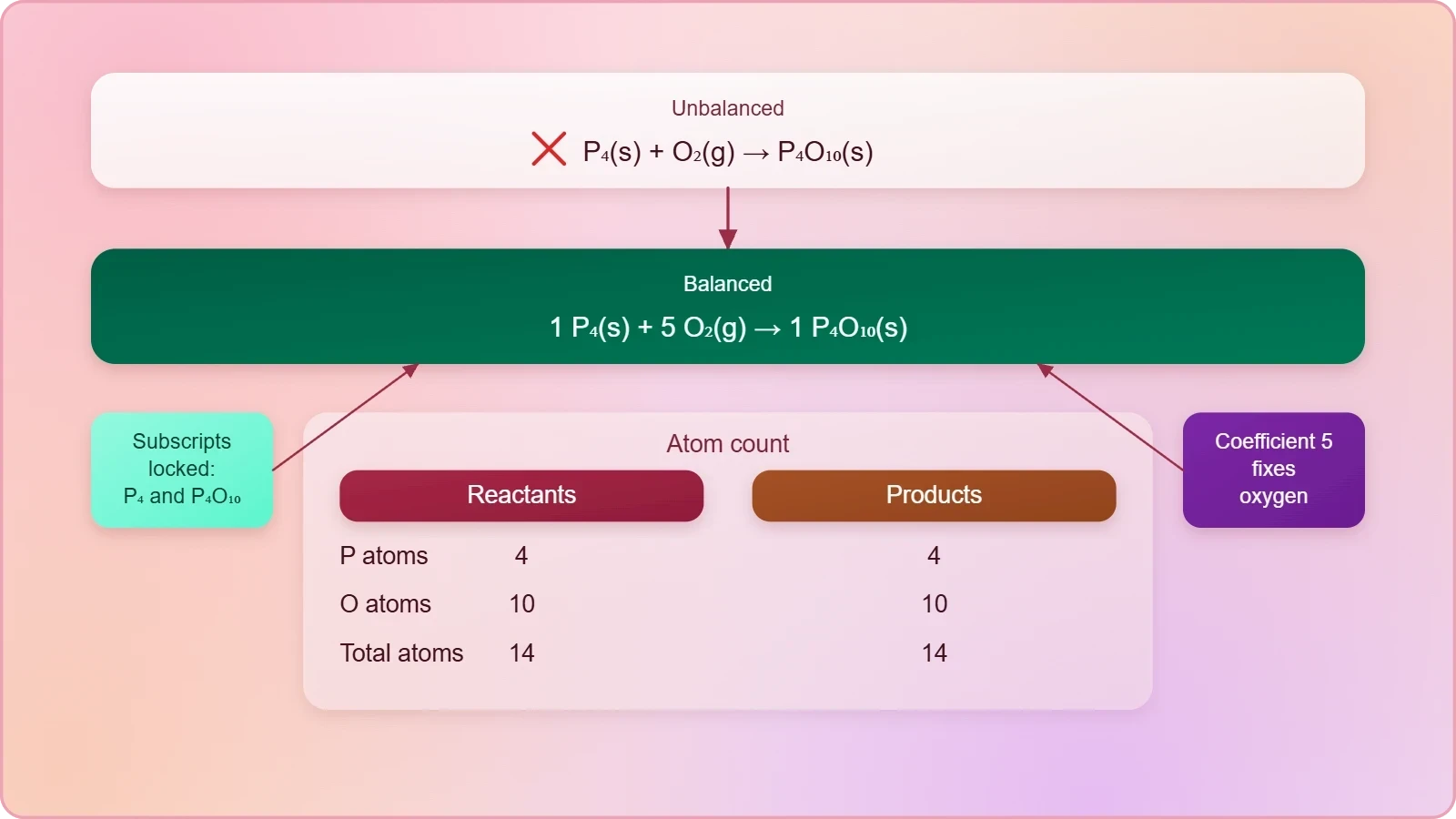
The reference material issues a warning that deserves emphasis: subscripts in the formulas of reactants and products cannot be changed to balance an equation. A subscript is part of a substance's identity. Water is ##H_2O##; writing ##H_2O_2## to satisfy an oxygen count produces hydrogen peroxide, an entirely different compound with different properties. Coefficients, by contrast, sit in front of formulas and multiply the entire species. Placing a 5 before ##O_2## says five molecules of dioxygen participate; it does not alter what dioxygen is. This distinction between changing identity and changing quantity is the conceptual heart of balancing, and confusing the two is the most common error in the entire topic.
Consider the phosphorus example from the reference material. The unbalanced equation ##P_4(s) + O_2(g) \rightarrow P_4O_{10}(s)## already has phosphorus balanced, since four atoms appear on each side. Only oxygen is deficient. Placing the coefficient 5 before ##O_2## supplies ten oxygen atoms to match the ten in ##P_4O_{10}##, yielding ##P_4(s) + 5O_2(g) \rightarrow P_4O_{10}(s)##. At no point did we touch a subscript. The formula ##P_4O_{10}## remained untouched because it correctly describes the product; only the quantity of oxygen molecules was adjusted. This is the discipline the method demands.
The Stoichiometric Coefficient as a Ratio Statement
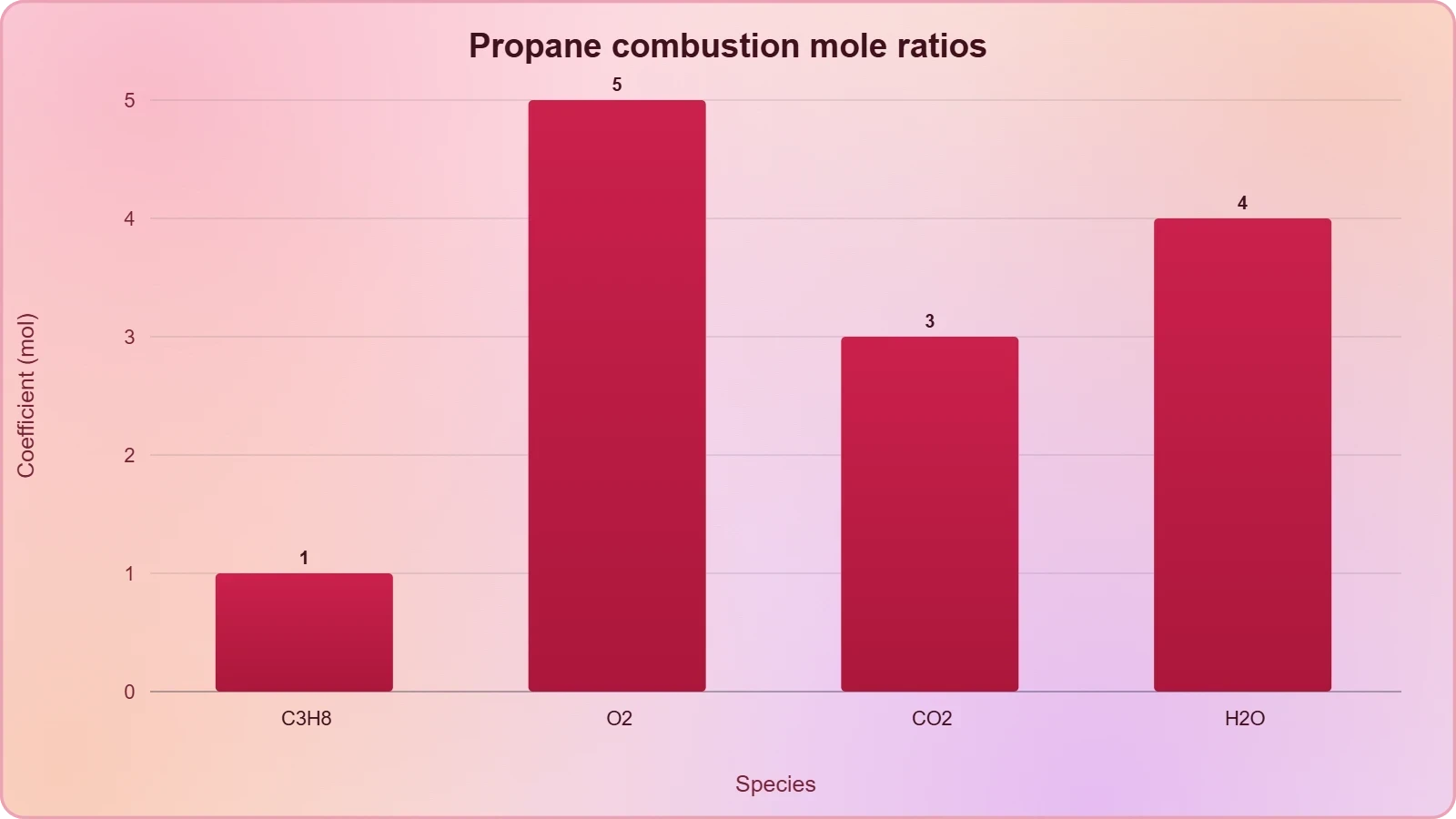
A coefficient is far more than a counting device. In the balanced equation for the combustion of propane, ##C_3H_8(g) + 5O_2(g) \rightarrow 3CO_2(g) + 4H_2O(l)##, the numbers 1, 5, 3 and 4 encode a fixed ratio in which these substances react and form. One molecule of propane requires five molecules of oxygen and produces three molecules of carbon dioxide and four of water. Because the mole is simply a counting unit for particles, the same ratio applies at the macroscopic scale: one mole of propane consumes five moles of oxygen. This is the bridge between the symbolic equation and the laboratory balance, and it is why balancing must precede any stoichiometric calculation.
The ratio can be read in either direction and between any pair of species. From the propane equation, the mole ratio of ##O_2## to ##CO_2## is 5:3, meaning every five moles of oxygen consumed generate three moles of carbon dioxide. Such ratios are the working currency of the next lesson, where solution concentrations supply the moles and balanced coefficients convert them into answers. A student who balances carelessly inherits every subsequent error, because a wrong coefficient silently corrupts every ratio derived from it. Accuracy at this stage is not pedantry; it is the foundation on which all quantitative reasoning about reactions is built.
The Inspection Method as a Disciplined Procedure
Trial and error, as the reference material calls it, is a misleading name for what skilled chemists actually do. The process is systematic: identify the elements present, balance those appearing in the fewest compounds first, leave hydrogen and oxygen until the end, and verify at the close. The propane example follows precisely this logic. Carbon appears in only one reactant and one product, so it is balanced first by placing a 3 before ##CO_2##. Hydrogen appears in one reactant and one product, so it is balanced next with a 4 before ##H_2O##. Oxygen, which now appears in two products, is balanced last by placing a 5 before ##O_2##. The order is not arbitrary; it minimizes the number of coefficients that must later be revised.
This ordering principle generalizes. When an element appears in a single compound on each side, its coefficient can be fixed immediately and will not need revisiting. Elements appearing in several compounds, such as oxygen in combustion reactions, should be deferred because their count depends on coefficients already chosen elsewhere. Students who begin with oxygen often find themselves adjusting carbon and hydrogen afterward, undoing earlier work. The disciplined sequence—metals first, then non-metals, then hydrogen, then oxygen—converts a guessing game into a reliable algorithm that succeeds on the great majority of equations encountered in school and early undergraduate work.
Worked Example: Iron and Magnesium Oxides
The reference material offers two reactions that are already balanced and worth examining for what they teach. Iron reacts with oxygen to give ##4Fe(s) + 3O_2(g) \rightarrow 2Fe_2O_3(s)##, and magnesium gives ##2Mg(s) + O_2(g) \rightarrow 2MgO(s)##. In the iron case, the product formula ##Fe_2O_3## fixes the ratio of iron to oxygen at 2:3, so the smallest whole-number coefficients that satisfy both elements are 4, 3 and 2. In the magnesium case, the product ##MgO## fixes a 1:1 ratio, and the simplest balance is 2, 1 and 2. Both equations illustrate that the product's formula constrains the coefficients rather than the reverse.
Notice also that fractional coefficients are sometimes convenient intermediate steps. One could write ##Fe + \dfrac{3}{2}O_2 \rightarrow Fe_2O_3##, which is arithmetically correct, but conventional balanced equations use the smallest whole-number coefficients. Multiplying through by 2 recovers 4, 3 and 2. This habit of clearing fractions is worth adopting deliberately: fractions are useful while working, but the final equation should present integers, because a coefficient of one and a half molecules is physically meaningless even when the arithmetic is sound.
Worked Example: A Harder Combustion
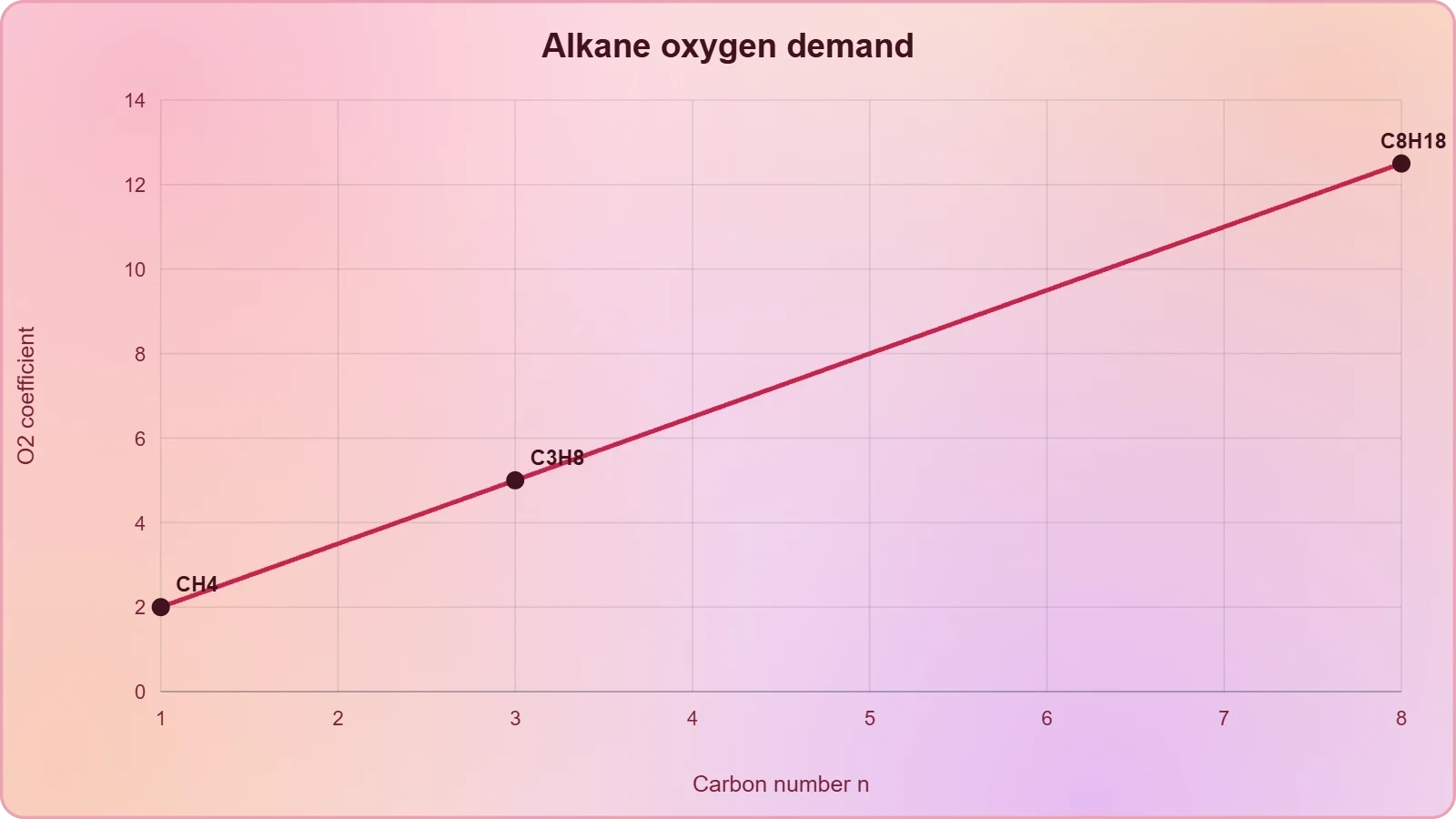
Consider the combustion of octane, the principal component of petrol: ##C_8H_{18}(l) + O_2(g) \rightarrow CO_2(g) + H_2O(l)##. Following the disciplined order, place an 8 before ##CO_2## to balance carbon and a 9 before ##H_2O## to balance the eighteen hydrogens. The right side now holds ##8 \times 2 = 16## oxygen atoms from carbon dioxide and 9 from water, a total of 25. Since each ##O_2## supplies two oxygen atoms, the coefficient required is ##\dfrac{25}{2}##. Multiplying the entire equation by 2 clears the fraction and yields ##2C_8H_{18}(l) + 25O_2(g) \rightarrow 16CO_2(g) + 18H_2O(l)##. Verification confirms 16 carbon, 36 hydrogen and 50 oxygen atoms on each side.
This example repays close attention because it shows how a fractional intermediate is not a mistake but a stage in the calculation. The general pattern for complete combustion of any alkane ##C_nH_{2n+2}## is worth memorizing as a check: the oxygen coefficient is ##\dfrac{3n+1}{2}## before clearing fractions. For octane, ##n = 8## gives ##\dfrac{25}{2}##, exactly as derived. Such general formulas are not substitutes for understanding, but they provide a rapid verification that catches arithmetic slips before they propagate into later stoichiometric work.
We Also Published
Oxidation Numbers and the Logic of Electron Transfer
Inspection works beautifully when atoms simply rearrange, but it falters when electrons move between species. Redox reactions involve a change in oxidation state, and balancing them requires that electrons lost by one species equal electrons gained by another. The oxidation number is the bookkeeping device that tracks this transfer. For a monatomic ion it equals the charge; for an atom in a compound it is assigned by convention: fluorine is always −1, oxygen is usually −2, hydrogen is usually +1, and the sum of oxidation numbers in a neutral compound is zero. These conventions let you determine whether an element has been oxidised or reduced before you attempt to balance anything.
Consider the oxidation of iron by oxygen. In ##Fe_2O_3##, each oxygen is −2, so the three oxygens contribute −6, forcing each iron to be +3. Elemental iron has oxidation number 0, so each iron atom loses three electrons and is oxidised. Elemental oxygen has oxidation number 0 and each atom gains two electrons, becoming −2. The total electrons lost must equal those gained, which is precisely the constraint the coefficients must satisfy. Oxidation numbers thus convert a vague instruction to balance into a quantitative statement about electron flow, and they reveal which species is the oxidising agent and which the reducing agent.
The Half-Reaction Method Step by Step
The half-reaction method separates a redox equation into an oxidation half and a reduction half, balances each for atoms and charge, then combines them so that electrons cancel. Take the reaction of permanganate with iron(II) in acidic solution, a classic analytical system. The reduction half is ##MnO_4^- + 8H^+ + 5e^- \rightarrow Mn^{2+} + 4H_2O##, where manganese falls from +7 to +2, a gain of five electrons. The oxidation half is ##Fe^{2+} \rightarrow Fe^{3+} + e^-##, a loss of one electron. To cancel electrons, multiply the iron half by five and add the two halves together.
The combined equation is ##MnO_4^- + 5Fe^{2+} + 8H^+ \rightarrow Mn^{2+} + 5Fe^{3+} + 4H_2O##. Every element balances, and the total charge is +17 on each side, confirming correctness. This method is more laborious than inspection but far more reliable for complex redox systems, and it makes the electron transfer explicit rather than implicit. In basic solution, the procedure is modified by adding hydroxide ions to neutralise hydrogen ions, but the underlying logic of electron conservation remains identical. Mastering the half-reaction method equips you for the redox chemistry that dominates electrochemistry and analytical titrations.
Common Errors in Redox Balancing
The most frequent mistake is forgetting to multiply the half-reactions by the correct factors before adding them, which leaves electrons unbalanced and the final equation wrong. A second error is balancing oxygen and hydrogen before establishing electron equality, which produces coefficients that must later be discarded. A third is neglecting charge balance entirely; a redox equation in ionic form must have equal total charge on both sides, and checking this catches most slips. Finally, students sometimes apply the acidic-solution procedure to a basic medium without converting hydrogen ions to water and hydroxide, producing an equation that is arithmetically balanced but chemically inappropriate for the conditions described.
Careful verification resolves all of these. After combining half-reactions, count every element and compute the total charge on each side. If either check fails, the error lies in the electron multipliers or in the atom balancing of one half. This habit of dual verification—atoms and charge—is the redox analogue of the element-by-element audit used in inspection. It costs a few seconds and prevents the silent propagation of errors into subsequent stoichiometric calculations, where a wrong coefficient can distort an entire analysis of solution concentrations.
Net Ionic Equations and Reactions in Solution
Most laboratory chemistry happens in solution, as the reference material notes when introducing concentration expressions, and in solution many ions are merely spectators. When silver nitrate solution is added to sodium chloride solution, the precipitate that forms is silver chloride; the sodium and nitrate ions remain dissolved and unchanged. The full molecular equation ##AgNO_3(aq) + NaCl(aq) \rightarrow AgCl(s) + NaNO_3(aq)## obscures this. Writing the strong electrolytes as dissociated ions gives ##Ag^+(aq) + NO_3^-(aq) + Na^+(aq) + Cl^-(aq) \rightarrow AgCl(s) + Na^+(aq) + NO_3^-(aq)##, and cancelling the spectator ions yields the net ionic equation ##Ag^+(aq) + Cl^-(aq) \rightarrow AgCl(s)##.
The net ionic equation is the chemically meaningful statement: it shows only the species that actually change. This matters enormously for stoichiometry in solution, the subject of the next lesson, because the coefficients in a net ionic equation give the true reacting ratio. If you titrate chloride with silver nitrate, the 1:1 ratio in ##Ag^+(aq) + Cl^-(aq) \rightarrow AgCl(s)## is what governs the calculation, not the more elaborate molecular equation. Learning to strip away spectators is therefore a practical skill, not a stylistic preference, and it connects the balancing work of this lesson directly to the analytical calculations that follow.
Rules for Constructing Net Ionic Equations
Three rules govern the construction. First, write the balanced molecular equation. Second, dissociate all strong electrolytes—soluble salts, strong acids and strong bases—into their ions, leaving weak electrolytes, gases, precipitates and pure liquids intact as molecules. Third, cancel ions appearing unchanged on both sides. Applying these rules to the neutralisation of hydrochloric acid by sodium hydroxide gives ##H^+(aq) + OH^-(aq) \rightarrow H_2O(l)##, the essential reaction of every strong acid with a strong base. The same three rules handle precipitation, gas evolution and acid–carbonate reactions with equal reliability.
Careful students note that weak acids such as acetic acid are written undissociated, because they exist predominantly as molecules in solution. Writing them as ions would misrepresent the chemistry and produce a net ionic equation that overstates the availability of hydrogen ions. Similarly, insoluble solids are never split. These distinctions require knowing solubility rules and acid strength, which is why net ionic equations are usually introduced after those topics. Once mastered, however, they provide the cleanest possible view of what happens in solution, and they make the connection between balanced equations and measured concentrations transparent.
From Balanced Equation to Solution Stoichiometry
The bridge to the next lesson is direct. Suppose you wish to find the volume of 0.100 M silver nitrate needed to precipitate all chloride from 25.0 mL of 0.0500 M sodium chloride. The net ionic equation gives a 1:1 mole ratio. Moles of chloride are ##0.0250 \times 0.0500 = 1.25 \times 10^{-3}## mol, so the same number of moles of silver ion is required. Dividing by the silver nitrate concentration gives a volume of 12.5 mL. Every step depends on the balanced equation being correct; a coefficient error here would produce a wrong volume and a failed analysis.
This is why the present lesson precedes the next. Balancing is not an isolated exercise but the prerequisite for every quantitative question about solutions. The concentration expressions introduced earlier—mass per cent, mole fraction, molarity and molality—supply the amounts, and the balanced equation supplies the ratios that connect them. When both are secure, stoichiometric calculations in solution become straightforward arithmetic. When either is shaky, the arithmetic merely conceals the underlying confusion, and errors surface later in the laboratory as failed titrations and inexplicable yields.
Verification, Pitfalls and the Discipline of Checking
Every balanced equation deserves a final audit, and the audit is simple: count each element on both sides and confirm equality. The reference material closes its propane example with precisely this step, noting three carbon, eight hydrogen and ten oxygen atoms on each side. This verification is not a formality. It catches the arithmetic slips that creep into even careful work, and it builds the habit of treating a balanced equation as a claim that must be justified rather than a result to be assumed. In examinations and in the laboratory alike, the few seconds spent counting repay themselves many times over.
Beyond the count, check that the formulas themselves are correct. A perfectly balanced equation built on a wrong product formula is worse than an unbalanced one, because it looks authoritative while being false. Confirm that the products are chemically plausible for the conditions described, that state symbols are consistent, and that the coefficients are the smallest whole numbers. These checks form a complete quality standard, and applying it consistently distinguishes the student who understands balancing from the one who has merely memorized a procedure.
The Most Frequent Mistakes
Changing a subscript to force a balance remains the cardinal error, and it usually arises from impatience. A second common mistake is placing coefficients inside a polyatomic ion, as though ##SO_4## could be multiplied internally; the coefficient applies to the whole ion, so ##2H_2SO_4## means two sulfate groups, not a modified sulfate. A third is forgetting to clear fractional coefficients before presenting the final answer. A fourth is failing to balance charge in ionic equations, which inspection alone will not catch. Each of these errors has a specific remedy, and recognizing the pattern behind the mistake is the fastest route to avoiding it in future.
There is also a subtler error: assuming that every equation can be balanced by inspection. Some redox systems, particularly those involving permanganate, dichromate or nitrate, resist the method entirely because the electron transfer is not visible in the atom counts. Recognizing when to switch to the half-reaction method is itself a skill. As a rule of thumb, if two attempts at inspection produce conflicting coefficients, or if the reaction clearly involves a change in oxidation state, abandon inspection and set up half-reactions. The time invested is recovered immediately through reliability.
Practice Set with Guided Solutions
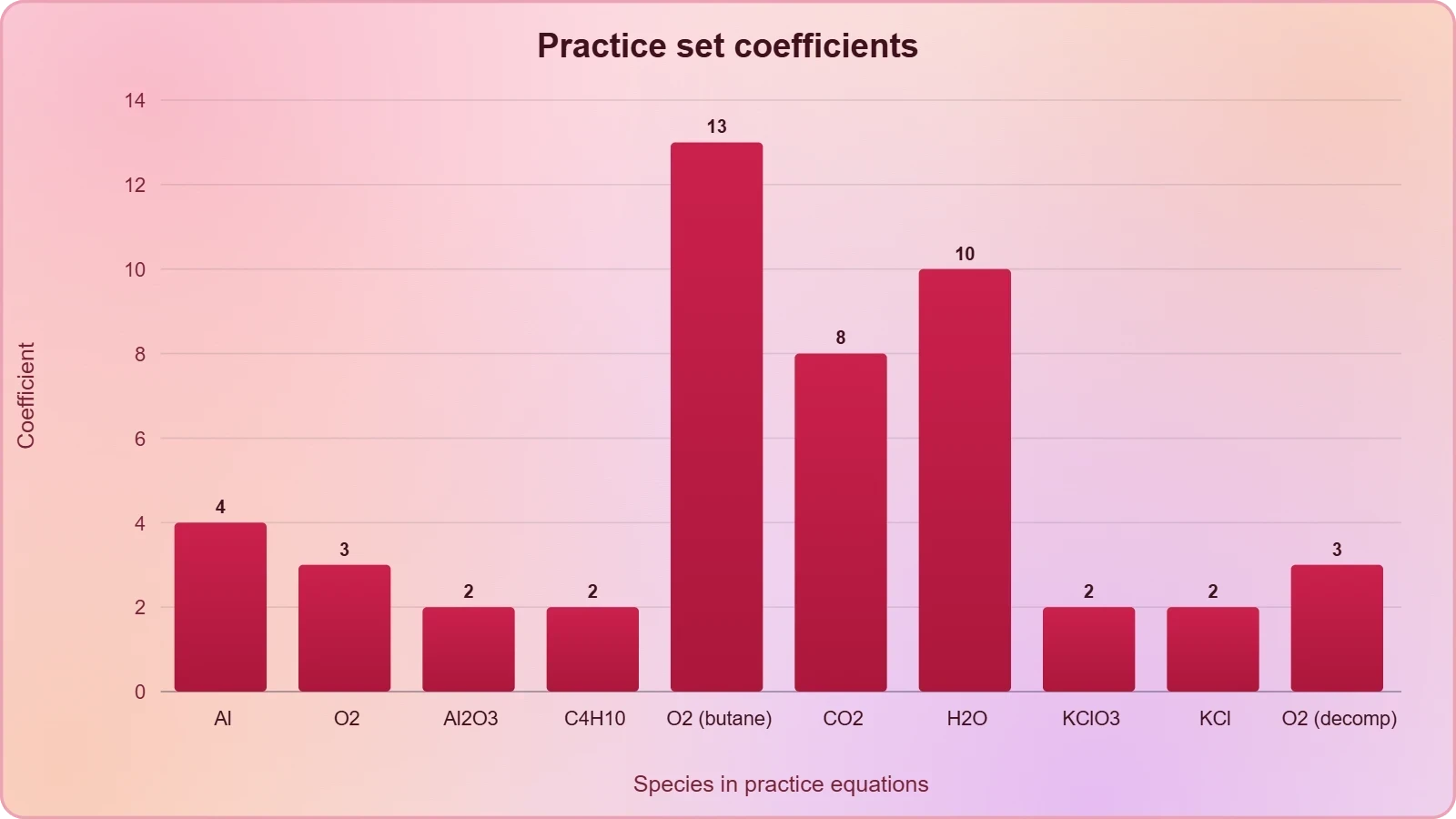
Attempt these before reading the solutions. Balance ##Al + O_2 \rightarrow Al_2O_3##; balance ##C_4H_{10} + O_2 \rightarrow CO_2 + H_2O##; balance ##KClO_3 \rightarrow KCl + O_2##; and write the net ionic equation for ##BaCl_2(aq) + Na_2SO_4(aq) \rightarrow BaSO_4(s) + 2NaCl(aq)##. The first gives ##4Al + 3O_2 \rightarrow 2Al_2O_3##, the second ##2C_4H_{10} + 13O_2 \rightarrow 8CO_2 + 10H_2O##, and the third ##2KClO_3 \rightarrow 2KCl + 3O_2##. The fourth reduces to ##Ba^{2+}(aq) + SO_4^{2-}(aq) \rightarrow BaSO_4(s)##, with sodium and chloride as spectators.
Work through each solution and verify the atom counts yourself rather than accepting them. For the butane equation, note that the fractional intermediate ##C_4H_{10} + \dfrac{13}{2}O_2 \rightarrow 4CO_2 + 5H_2O## is cleared by doubling, exactly as with octane. For the chlorate decomposition, the oxygen count on the right depends on both products, so it is balanced last. These small habits—clearing fractions, deferring oxygen, verifying at the close—are what separate a reliable method from a lucky guess, and they will serve you throughout the stoichiometric work that follows.
Why Balanced Equations Govern All Quantitative Chemistry
The importance of a balanced equation extends far beyond the classroom exercise. Every industrial process, from the Haber synthesis of ammonia to the refining of metals, is designed around the ratios encoded in balanced equations. The Haber process, ##N_2(g) + 3H_2(g) \rightarrow 2NH_3(g)##, tells engineers that one volume of nitrogen requires three of hydrogen, a ratio that determines reactor design and feedstock costs. The reference material's discussion of the limiting reagent, the reactant consumed first that limits the amount of product formed, depends entirely on these ratios. Without a balanced equation, the limiting reagent cannot even be identified, let alone quantified.
This is the conceptual thread running through the whole course. The laws of chemical combination establish that elements combine in fixed proportions; atomic and molecular masses allow those proportions to be expressed in grams; the mole concept converts grams into countable particles; and the balanced equation supplies the ratios that connect one substance to another. Each idea supports the next, and the present lesson is the hinge on which the sequence turns. The concentration expressions studied earlier and the solution stoichiometry to come both presuppose that the equations connecting their species are correctly balanced.
Connecting to Limiting Reagents and Yield
Once an equation is balanced, the limiting reagent follows from a simple comparison. Suppose 4.0 mol of nitrogen reacts with 9.0 mol of hydrogen in the Haber process. The equation requires three moles of hydrogen per mole of nitrogen, so 4.0 mol of nitrogen would need 12.0 mol of hydrogen. Only 9.0 mol is available, so hydrogen is limiting and nitrogen is in excess. The product formed is governed by hydrogen: ##9.0 \times \dfrac{2}{3} = 6.0## mol of ammonia. Every step of this reasoning rests on the coefficients 1, 3 and 2, and a single error in them would corrupt the entire conclusion.
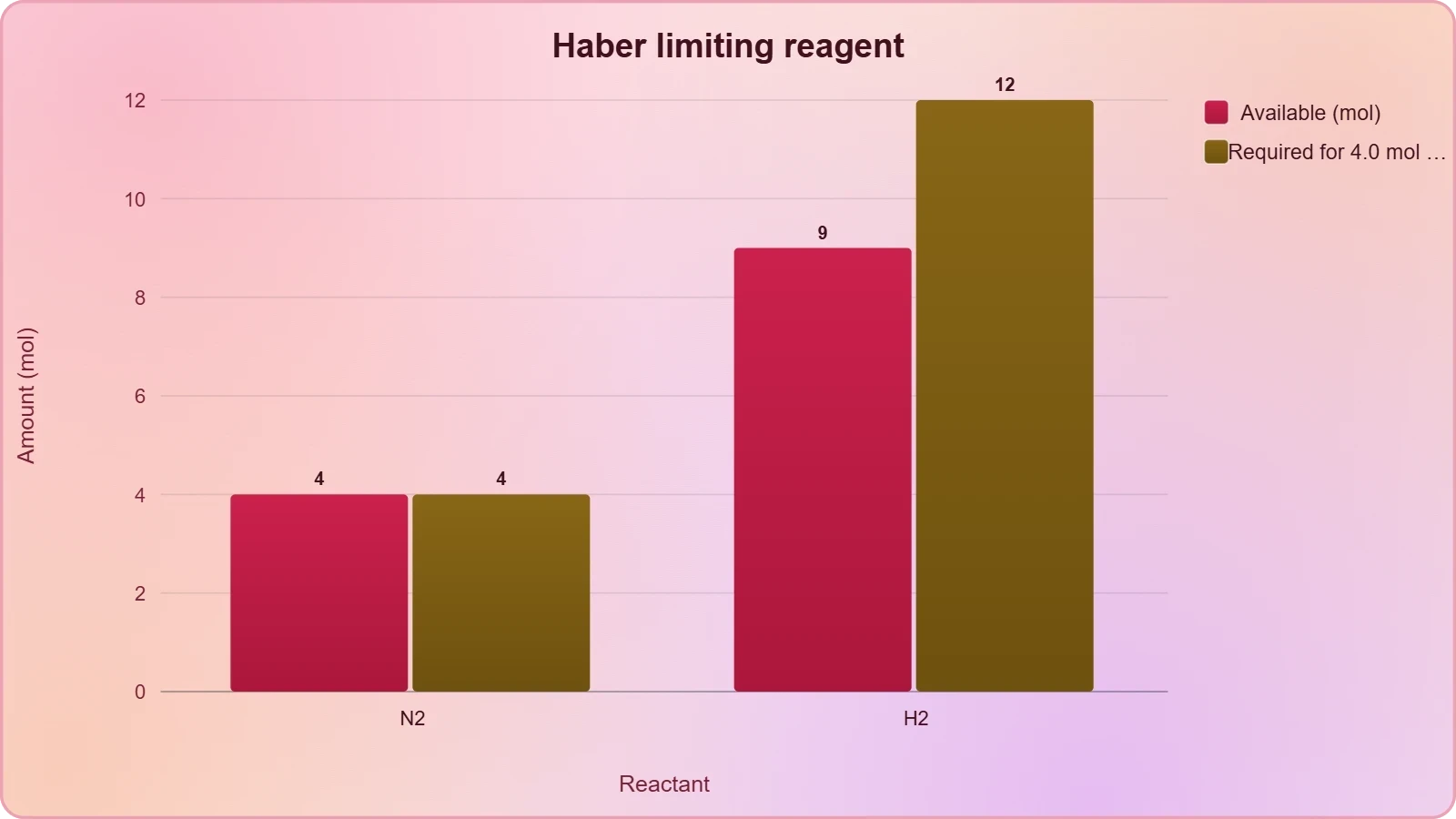
Percentage yield calculations build on the same foundation. The theoretical yield is computed from the limiting reagent using the balanced equation, and the actual yield is measured experimentally. The ratio of the two, expressed as a percentage, measures the efficiency of the process. Because both quantities depend on the coefficients, accurate balancing is the precondition for any meaningful statement about yield. This is why the discipline of verification, emphasized throughout this lesson, matters so much: it protects every downstream calculation from the silent corruption of a misplaced coefficient.
Looking Ahead to Solution Stoichiometry
The next lesson takes these ratios into solution, where concentrations replace masses as the starting data. The molarity and molality expressions introduced earlier supply the moles, and the balanced equation supplies the conversion. A titration, for instance, uses a known concentration and volume of one reactant to determine the unknown concentration of another, with the balanced equation providing the mole ratio at the equivalence point. The net ionic equation often gives the cleanest ratio, which is why the two topics belong together. Everything in this lesson prepares for that transition, and nothing in it will be wasted.
Students who master balancing now will find solution stoichiometry straightforward, because the conceptual difficulty lies almost entirely in the equation. The arithmetic of concentrations is simple once the ratios are secure. Conversely, those who treat balancing as a chore to be rushed will struggle later, often without understanding why. The remedy is the habit cultivated here: balance systematically, verify every element, clear fractions, and check charge where ions are involved. These four habits, applied consistently, make the entire quantitative edifice of chemistry accessible and reliable.
Consolidating the Techniques
The lesson has moved from the simple inspection of metal–oxygen reactions to the half-reaction method for redox systems and the net ionic representation of solution chemistry. These are not separate topics but a graded toolkit. Inspection handles straightforward equations quickly; oxidation numbers reveal whether electron transfer is involved; half-reactions provide a reliable procedure when it is; and net ionic equations strip away spectators to expose the essential change. A competent chemist selects the appropriate tool for each equation rather than applying one method indiscriminately, and that judgment is the mark of genuine understanding.
The unifying principle throughout is conservation: of mass in every equation, of charge in ionic equations, and of electrons in redox equations. Each conservation law supplies a check, and each check catches a different class of error. Students who internalize this structure find that balancing becomes predictable rather than mysterious. They know what to balance first, what to defer, when to switch methods, and how to verify the result. That confidence is the intended outcome of this lesson, and it is the foundation on which the next lesson's solution calculations will be built.
Summary of Methods and Their Uses
Inspection suits equations with few elements and no change in oxidation state, and it should be attempted first because it is fastest. Oxidation numbers diagnose redox character and identify which species is oxidised and which reduced. The half-reaction method balances complex redox systems reliably, especially in acidic or basic media where hydrogen and oxygen must be accounted for explicitly. Net ionic equations apply to reactions in solution and give the true reacting ratio by removing spectators. Each method has a clear domain, and recognizing the domain is as important as executing the procedure.
Practice consolidates these skills. Work through equations of each type until the sequence becomes automatic, and verify every result by counting atoms and, where relevant, charge. The reference material's insistence that subscripts cannot be changed bears repeating, because it is the error most likely to survive into later work unnoticed. With these habits established, the transition to stoichiometric calculations in solutions will feel natural, and the concentration concepts from the previous lesson will find their proper place in a coherent quantitative framework.
Preparing for the Next Lesson
The next lesson, on stoichiometric calculations in solutions, will assume that you can balance any equation presented and derive mole ratios from it without hesitation. It will also assume fluency with molarity and molality, which the previous lesson established. Before proceeding, review the worked examples in this lesson, particularly the octane and butane combustions and the permanganate–iron redox system, and confirm that you can reproduce each from first principles. If any step remains uncertain, revisit it now, because the solution calculations ahead compound every earlier skill and leave little room for foundational gaps.
Chemistry rewards precision, and balancing is where precision begins. The coefficients you write are not decorative; they are quantitative claims about how matter behaves, and they will be tested against measurement in every laboratory exercise that follows. Treat them accordingly, verify them habitually, and the rest of the course will unfold with a clarity that careless work never permits. The techniques gathered here are durable, and they will serve you well beyond this course, in analytical work, in industrial contexts, and in any setting where the question is how much of one substance reacts with another.
From our network :
- 98% of Global MBA Programs Now Prefer GRE Over GMAT Focus EditionExplore why 98% of global MBA programs now prefer the GRE over GMAT Focus. Learn about the shorter GRE format, verbal logic importance, and strategic versatility for students.
- EV 2.0: The Solid-State Battery Breakthrough and Global Factory ExpansionDiscover the impact of the Solid-State Battery Breakthrough on the EV market. Learn about CATL and BYD stock growth, global factory expansion in Europe, and the future of EV 2.0 technology.
- 10 Physics Numerical Problems with Solutions for IIT JEEPrepare for IIT JEE with 10 physics numerical problems, complete with detailed solutions and conceptual explanations. Ideal for mastering kinematics, thermodynamics, electromagnetism, and optics.
- Analyzing Trump Deportation Numbers Insights Into The 2026 Immigration Crackdown
- AI-Powered 'Precision Diagnostic' Replaces Standard GRE Score ReportsDiscover the new GRE Precision Diagnostic. Learn how AI-powered behavioral analytics and time-to-solve tracking are replacing standard GRE score reports to empower students.
- Where to Put Your Wireless Router for Better CoverageA practical, physics-grounded guide to router placement: why the centre of the home beats the corner, how walls and metal sap signal, and how to run a simple survey that proves the improvement.
- How to Print Cheaply: Cutting the Cost per PageA practical, measured guide to lowering what each printed page costs — duplex and draft modes, third-party ink, yield mathematics, and knowing when a new printer beats refills.
- Trump Political Strategy How Geopolitical Stunts Serve As Media Diversions
- Do You Need a New Router or Is Your Internet Plan the Problem?A practical comparison of the signs that point to router limits versus signs your broadband speed or provider is the bottleneck, so you can decide what to replace before spending money.
RESOURCES
- Balancing Chemical Equations | PhET Simulations - PhETphet.colorado.eduHow do you know if a chemical equation is balanced? What can you change to balance an equation? Play a game to test your…
- 7.4: Balancing Chemical Equations - Chemistry LibreTextschem.libretexts.orgMar 6, 2026 ... To be useful, chemical equations must always be balanced. Balanced chemical equations have the same number and type of each…
- Balance Chemical Equation Calculator | Step-by-Step & Easy to Usepearson.comFree Balance Chemical Equation Calculator with step-by-step solutions, redox reaction balancing, ionic equation support, and conservation-of-mass checks for ...
- Balancing Chemical Equations Kit | Carolina Biological Supplycarolina.comStudents use manipulatives to model how to balance chemical equations and understand the law of conservation of mass. These tools help students visualize ...
- Using Balancing Chemical Equations as a Key Starting Point To ...pubs.acs.orgMay 4, 2016 ... The skill of balancing chemical equations, particularly redox reactions, is emphasized along with identifying byproducts that may be ...
- Chemical reactions and stoichiometry | Chemistry archivekhanacademy.orgFor our most up-to-date, mastery-enabled courses, check out High School Chemistry and AP Chemistry. Balancing chemical equations.
- Balancing chemical equations using matrices : r/math - Redditreddit.comMar 19, 2022 ... Take the chemical equation, put a coefficient on each compound, and move everything to the left side. e.g. CH4 +…
- Balancing Equations Worksheet - De Anza Collegedeanza.edu___ H3PO4 + ___ KOH → ___ K3PO4 + ___ H2O. 2). ___ K + ___ B2O3 → ___ K2O + ___ B. 3).…
- 14.2 Balancing chemical equations (ESAEB) - Siyavulasiyavula.comSteps to balance a chemical equation through inspection (ESAED) · Identify the reactants and the products in the reaction and write their chemical formulae.
- Equation Balancing Tips - Essential Chemistry | PASCOpasco.comOne way to balance chemical equations is by trial and error. This is where you try using different coefficients until the numbers work out.…
- 1.6: Balancing Chemical Reactions - Mathematics LibreTextsmath.libretexts.orgThe tools of linear algebra can also be used in the subject area of Chemistry, specifically for balancing chemical reactions.
- Balance chemical equations without trial and error?math.stackexchange.comJul 24, 2010 ... Yes; it's possible to write a system of equations that can be solved to find the correct coefficients. Here's an…
- Research backed method for teaching Balancing Chemical ...mindmatterspedagogy.comMar 14, 2026 ... The Best Way to Teach Balancing Chemical Equations in high school chemistry (Backed by Research) · Step 1: Start with…
- Balance Chemical Equation - Online Balancerwebqc.orgBalance any chemical equation online: step-by-step solutions by inspection and by the algebraic method, reaction type, stoichiometry and limiting reagent.
- Balancing Chemical Equations - Maple Help - Maplesoftmaplesoft.comBalancing Chemical Equations Main Concept A chemical equation describes the changes that occur during a chemical reaction. The equation shows the reactants ...