Atomic mass is one of those deceptively simple ideas that quietly underpins almost everything else in chemistry. On the surface, it asks a modest question: how heavy is an atom? Yet answering that question properly forces us to confront the carbon-12 standard, the reality that most elements exist as mixtures of isotopes, and the subtle distinction between the mass of a single atom and the mass of a mole of those atoms. This lesson builds directly on Dalton's atomic theory and prepares the ground for molecular mass and formula mass, so the reasoning developed here will carry forward into every stoichiometric calculation that follows.
What makes atomic mass genuinely interesting is that it is not a fixed, tidy number for most elements. Chlorine, for instance, is not simply "35.5" — that familiar figure is a weighted average of two isotopes with very different masses and abundances. Understanding how such averages arise, and how to compute them from isotopic data, is a skill that separates a student who memorises the periodic table from one who can reason with it. We will work through the carbon, chlorine and argon examples carefully, then extend the discussion to mass spectrometry, isotopic enrichment, and the deeper nuclear physics of mass defect and binding energy.
Beyond the mechanics, this lesson situates atomic mass in its modern context. The 2019 redefinition of the mole decoupled the unit of amount from the carbon-12 standard, and that change has real consequences for how we think about molar mass and the Avogadro constant. By the end, you should be able to move fluently between atomic mass units, grams, and moles, explain why the periodic table reports average atomic masses, and appreciate why the mass of a nucleus is always slightly less than the sum of its parts. These are the quantitative foundations on which all of chemistry rests.
On This Page
- The Atomic Mass Unit and the Carbon-12 Standard
- Average Atomic Mass and Isotopic Abundance
- Atomic Mass, Molar Mass and the 2019 Redefinition of the Mole
- Measuring Atomic Masses by Mass Spectrometry
- Mass Defect, Binding Energy and the Limits of Additivity
- Consolidating the Concepts and Preparing for Molecular Mass
The Atomic Mass Unit and the Carbon-12 Standard
Every measurement needs a reference point, and for atomic masses that reference is the carbon-12 isotope. By international agreement, one atom of carbon-12 is assigned a mass of exactly 12 atomic mass units, which fixes the size of the unit itself. This choice is not arbitrary: carbon forms an enormous variety of compounds, is readily available in pure isotopic form, and gives a convenient numerical scale on which hydrogen sits near 1 and the heaviest natural elements sit above 200. The standard allows chemists everywhere to report atomic masses on a common, comparable footing.

The unit has an interesting history of nomenclature. Older textbooks speak of the "atomic mass unit" or amu; the modern preferred term is the unified atomic mass unit, symbol u, sometimes written as the dalton (Da). The numerical value is the same, but the shift in language reflects a desire for consistency across physics and chemistry. When you see a mass quoted as 15.995 u for oxygen-16, you are seeing the mass of a single atom expressed relative to one-twelfth of the mass of a carbon-12 atom, a ratio that is dimensionless at heart but conventionally attached to the unit u.
Converting Between Atomic Mass Units and Grams
The bridge between the atomic scale and the laboratory scale is a single conversion factor. One atomic mass unit equals ##1.66056 \times 10^{-24}## grams, a value derived directly from the measured mass of a carbon-12 atom. Because a carbon-12 atom weighs ##1.992648 \times 10^{-23}## g and is defined as 12 u, dividing gives the mass of one unit. This tiny number is the reason chemists prefer to work in u for single atoms and in grams per mole for bulk samples, switching between the two only when a calculation demands it.

Applying the factor to hydrogen illustrates the arithmetic. A hydrogen atom has a measured mass of ##1.6736 \times 10^{-24}## g, and dividing by ##1.66056 \times 10^{-24}## g per u yields approximately 1.0078 u, conventionally rounded to 1.008 u. The same procedure applied to oxygen-16 gives 15.995 u rather than a clean 16, a small discrepancy that reflects the binding energy holding the nucleus together. These conversions are routine but worth practising until they become second nature, because they recur constantly in later stoichiometric work.
Why the Standard Matters for Consistency
Before carbon-12 was adopted in 1961, two competing standards existed: physicists used oxygen-16 while chemists used a natural-oxygen mixture, and the two scales differed by about 0.03 percent. That small discrepancy caused genuine confusion in published data. Unifying on carbon-12 eliminated the ambiguity and gave a single scale valid across disciplines. The lesson is broader than the history: a shared reference standard is what makes quantitative science possible, and choosing it well requires balancing convenience, availability and precision.
The carbon-12 standard also anchors the definition of the mole, at least historically. Because 12 g of carbon-12 contains one mole of atoms, the atomic mass in u and the molar mass in grams per mole were numerically identical by construction. That elegant coincidence is now a consequence rather than a definition, following the 2019 revision, but it remains numerically true to within the precision most calculations require. Understanding this link helps you see why the periodic table's numbers can be read either as atomic masses or as molar masses.
We Also Published
Average Atomic Mass and Isotopic Abundance
Most elements in nature are not isotopically pure. They exist as mixtures of isotopes, atoms of the same element with different numbers of neutrons and therefore different masses. The atomic mass reported on the periodic table is not the mass of any single isotope but a weighted average that reflects how common each isotope is. This is why chlorine's atomic mass is 35.45 u rather than a whole number, and why the value sits closer to 35 than to 37: chlorine-35 is roughly three times more abundant than chlorine-37.
Computing the average is straightforward once the data are known. Multiply each isotope's mass by its fractional abundance, then sum the products. The fractional abundance is simply the percentage divided by 100, so an isotope present at 75.78 percent contributes 0.7578 of its mass to the total. The result is the average atomic mass, the quantity that appears in the periodic table and that you use in all ordinary chemical calculations. The method is a direct application of the weighted-mean concept familiar from statistics.

Worked Examples: Carbon, Chlorine and Argon
Carbon provides a clean first example because its dominant isotope overwhelms the others. Carbon-12 has a relative abundance of 98.892 percent and a mass of 12 u; carbon-13 is 1.108 percent at 13.00335 u; carbon-14 is present at only ##2 \times 10^{-10}## percent at 14.00317 u. Multiplying and summing gives ##(0.98892)(12) + (0.01108)(13.00335) + (2 \times 10^{-12})(14.00317) = 12.011## u. The carbon-14 term is so small it barely affects the fourth decimal place, which is why it can often be neglected.
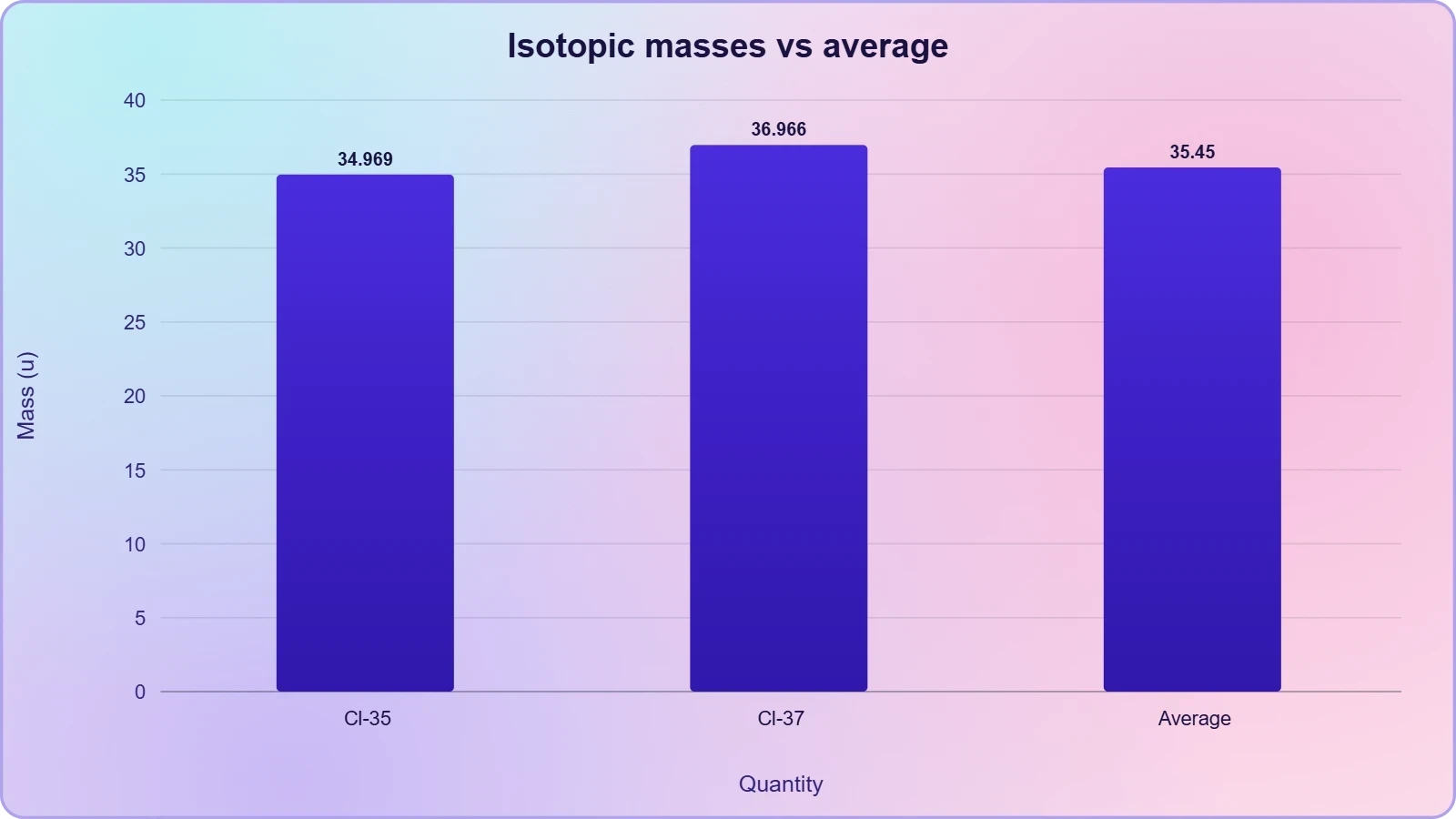
Chlorine is more instructive because its two isotopes are comparable in abundance. Chlorine-35 (mass 34.96885 u) is 75.78 percent abundant, while chlorine-37 (mass 36.96590 u) is 24.22 percent abundant. The weighted average is ##(0.7578)(34.96885) + (0.2422)(36.96590) = 35.45## u. Notice how the result lands near 35 but is pulled upward by the heavier isotope, illustrating that the average is a genuine blend rather than a simple midpoint. Argon behaves similarly, with argon-40 dominating at 99.6 percent and giving an average of 39.95 u.
Common Errors in Weighted-Average Calculations
The most frequent mistake is forgetting to convert percentages to fractions, which inflates the answer by a factor of a hundred. A second common slip is using mass numbers (35 and 37) instead of precise isotopic masses (34.96885 and 36.96590), which introduces small but avoidable errors. A third is assuming the average must lie exactly midway between the isotopes; it does not, because the weighting is rarely equal. Finally, students sometimes confuse average atomic mass with the mass of the most abundant isotope, which is only a rough approximation.
There is also a conceptual trap worth naming. The average atomic mass is a statistical property of a bulk sample, not a property of any individual atom. No single chlorine atom weighs 35.45 u; each weighs either about 35 or about 37. The average emerges only when you consider enormous numbers of atoms, in the same way that the average height of a population describes no particular person. Keeping this distinction clear prevents a great deal of confusion when you later work with molar masses and stoichiometric ratios.
Atomic Mass, Molar Mass and the 2019 Redefinition of the Mole
Atomic mass and molar mass are numerically linked but conceptually distinct. Atomic mass describes a single atom or, more precisely, an average atom, expressed in unified atomic mass units. Molar mass describes one mole of entities and is expressed in grams per mole. For carbon, the average atomic mass is 12.011 u and the molar mass is 12.011 g/mol. The numbers coincide because of how the mole was historically defined, but the quantities answer different questions: one concerns the microscopic scale, the other the laboratory scale.
This numerical coincidence was once a definitional identity. Before 2019, the mole was defined as the number of atoms in exactly 12 g of carbon-12, which forced the molar mass of carbon-12 to be exactly 12 g/mol. The 2019 revision changed this. The mole is now defined by fixing the Avogadro constant at exactly ##6.02214076 \times 10^{23}## per mole, decoupling it from any particular substance. The consequence is subtle but real: the molar mass of carbon-12 is now an experimentally determined quantity, equal to 11.9999999958 g/mol rather than exactly 12.
What Changed and What Did Not
The redefinition did not alter any practical calculation. For all ordinary work, the molar mass of carbon-12 is 12 g/mol to as many figures as you will ever need. What changed is the logical structure: the mole is now defined by a counted number of entities rather than by a mass of a specific isotope. This makes the definition more fundamental and more stable, since counting a fixed number is conceptually cleaner than tying a unit to the mass of a particular artefact or isotope. It also aligns the mole with the other redefined SI base units.
The practical benefit is improved consistency across the measurement system. Because the Avogadro constant is now exact, the molar mass of any substance can be determined with uncertainty limited only by the atomic mass measurements themselves. The tiny discrepancy for carbon-12, about four parts in a billion, is far below the precision of any school or undergraduate experiment. Students should understand the change conceptually while continuing to use the familiar numerical equivalence, which remains valid to every significant figure they will encounter.
Working With Molar Mass in Calculations
Once the molar mass is known, converting between mass and moles is a single division. For water, whose molar mass is 18.02 g/mol, a 36.04 g sample contains exactly two moles of water molecules. The same logic applies to any substance: divide the mass in grams by the molar mass in grams per mole to obtain the amount in moles. This operation is the gateway to every stoichiometric problem, because balanced equations speak in moles while balances read in grams.
A useful habit is to track units explicitly. Writing ##n = m / M## with grams divided by grams per mole makes it obvious that the result is in moles, and it catches errors before they propagate. Students who skip this step often invert the ratio or lose a factor of a thousand. The molar mass itself is obtained by summing atomic masses, so the average atomic masses discussed earlier feed directly into these calculations. The chain from isotopic abundance to laboratory mass is continuous and worth seeing as a whole.
Measuring Atomic Masses by Mass Spectrometry
How do we know that chlorine-35 has a mass of 34.96885 u? The answer is mass spectrometry, one of the most powerful analytical techniques in chemistry. A sample is vaporised and ionised, typically by electron impact, and the resulting ions are accelerated through an electric field and then deflected by a magnetic field. The extent of deflection depends on the mass-to-charge ratio, so lighter ions bend more than heavier ones. A detector records the arriving ions, producing a mass spectrum whose peaks reveal both the masses and the relative abundances of the isotopes present.
The spectrum is a direct picture of isotopic composition. Each peak corresponds to a particular isotope, and the height of the peak is proportional to its abundance. By measuring peak positions precisely, chemists obtain isotopic masses to many decimal places; by measuring peak areas, they obtain the fractional abundances needed for the weighted average. Modern instruments achieve resolutions high enough to distinguish ions differing by a fraction of a unit, which is how the small mass defect from nuclear binding energy becomes measurable rather than merely theoretical.

From Spectrum to Average Atomic Mass
Reading a mass spectrum is a two-step exercise. First, identify each peak and its mass-to-charge ratio, correcting for the charge if the ion is multiply charged. Second, measure the relative area under each peak to obtain the fractional abundance. With both sets of numbers in hand, the weighted-average formula applies exactly as before. The technique is so precise that it can detect isotopic variations in samples from different sources, which is the basis for applications ranging from geochemistry to forensic tracing of materials.
Mass spectrometry also underpins the determination of relative atomic masses for the periodic table. The International Union of Pure and Applied Chemistry evaluates measurements from multiple laboratories and publishes recommended values, which is why the atomic mass of an element occasionally changes in the last decimal place. For elements with no stable isotopes, such as technetium, no standard atomic mass is given at all, and the mass number of the most stable isotope is quoted instead. This nuance is worth knowing when you read a periodic table carefully.
Isotopic Enrichment and Its Applications
Because isotopes of an element behave almost identically in chemical reactions, separating them is difficult but industrially important. Enrichment processes exploit the tiny mass differences to concentrate a desired isotope. Uranium enrichment, which raises the proportion of fissionable uranium-235 from its natural 0.72 percent, is the most consequential example, but the technique also produces enriched boron for nuclear reactors and deuterium-enriched water for research. The enriched material's average atomic mass differs measurably from the natural value, which is why isotopic provenance can be traced.
Isotopic enrichment has applications far beyond nuclear technology. Stable-isotope labelling uses enriched carbon-13 or nitrogen-15 to trace metabolic pathways, and deuterated compounds are used in pharmaceuticals to slow metabolism and extend drug lifetimes. In each case, the chemistry is essentially unchanged while the mass is deliberately altered, allowing researchers to follow specific atoms through complex systems. The concept ties directly back to average atomic mass: an enriched sample simply has a different set of fractional abundances, and the weighted-average formula still applies.
Mass Defect, Binding Energy and the Limits of Additivity
If you add up the masses of the protons, neutrons and electrons in an atom, the total is always slightly greater than the measured atomic mass. The difference is called the mass defect, and it is not an error. It reflects the energy released when the nucleus formed, according to Einstein's relation ##E = mc^2##. The binding energy that holds the nucleus together accounts for the missing mass, so a stable nucleus is measurably lighter than its separated constituents. This is why oxygen-16 has a mass of 15.995 u rather than exactly 16.
The mass defect is small in absolute terms but enormous in energy terms because the conversion factor ##c^2## is so large. For helium-4, the binding energy is about 28.3 MeV, which corresponds to a mass defect of roughly 0.0304 u, or about 0.75 percent of the atom's mass. This is the energy released in nuclear fusion and the reason stars shine. For chemical purposes the effect is negligible, but it explains why atomic masses are not exact integers and why the periodic table's values carry small deviations from whole numbers.

Why Chemical Calculations Can Ignore Mass Defect
Chemical reactions involve energies of a few electron-volts per atom, whereas nuclear binding energies are measured in millions of electron-volts. The corresponding mass changes in chemistry are therefore smaller than the precision of ordinary atomic mass measurements by many orders of magnitude. This is why chemists can treat atomic masses as fixed constants and why the law of conservation of mass holds to extraordinary accuracy in chemical reactions. The mass defect is real, but it lies far below the threshold that matters for stoichiometry.
Understanding this hierarchy is valuable because it clarifies the boundary between chemistry and nuclear physics. Chemistry rearranges electrons and leaves nuclei intact; nuclear physics rearranges nucleons and converts measurable mass into energy. The atomic mass you use in a stoichiometric calculation is the mass of an intact atom, binding energy included. Recognising that the number already accounts for the nucleus's internal energy prevents the misconception that mass defect contradicts conservation of mass in chemical change.
Connecting Back to the Carbon-12 Standard
The carbon-12 standard is itself defined in terms of an intact atom, binding energy included. When we say carbon-12 has a mass of exactly 12 u, we are assigning the unit by reference to a real, bound nucleus rather than to its separated parts. This choice keeps the scale practical: every atomic mass you look up already incorporates the relevant binding energy, so no correction is needed. The standard and the mass defect are therefore consistent, not contradictory, and the periodic table's numbers are directly usable.
This consistency is worth emphasising because it resolves a common student puzzle. If a helium nucleus weighs less than its parts, why does the periodic table not show a deficit? The answer is that the table reports the mass of the whole atom, and the whole atom is what the standard references. The deficit is relative to a hypothetical unbound state, not to the tabulated value. Once this is clear, the relationship between atomic mass, binding energy and the carbon-12 standard becomes a coherent whole rather than a set of disconnected facts.
Consolidating the Concepts and Preparing for Molecular Mass
The ideas in this lesson form a connected chain. Isotopic abundances feed into average atomic masses; average atomic masses appear on the periodic table; those values, expressed in grams per mole, give molar masses; and molar masses convert laboratory measurements into moles. Each link depends on the one before it, and each is anchored by the carbon-12 standard and the unified atomic mass unit. Mastery here means being able to move along the chain in either direction without losing track of units or definitions.
A useful self-check is to explain, in your own words, why chlorine's atomic mass is not a whole number, why the molar mass of carbon is numerically equal to its atomic mass, and why a nucleus weighs less than its parts. If you can answer all three clearly, you have grasped the essential content. The next lesson extends these ideas to molecules and ionic compounds, where atomic masses are summed to give molecular and formula masses, and the same weighted-average logic continues to apply.
Summary of Key Relationships
The core relationships can be stated compactly. Average atomic mass is the abundance-weighted sum of isotopic masses. Molar mass in grams per mole is numerically equal to average atomic mass in u. The number of moles equals mass divided by molar mass. The Avogadro constant, now exactly defined, links the number of entities to the amount in moles. Each relationship is simple on its own; together they form the quantitative backbone of chemistry and the foundation for everything that follows in stoichiometry.
It is worth noting that these relationships hold regardless of whether the substance is atomic, molecular or ionic. The distinction between molecular mass and formula mass, which the next lesson develops, concerns what entity is being counted, not how the arithmetic works. The weighted-average method, the unit conversions and the mole concept all carry over unchanged. Building confidence with these tools now will make the transition to molecular and formula masses straightforward and will pay dividends throughout the rest of the course.
Looking Ahead to Molecular and Formula Mass
The next lesson takes the atomic masses developed here and combines them. Molecular mass is the sum of atomic masses in a molecule, obtained by multiplying each element's atomic mass by its atom count and adding. Formula mass does the same for ionic compounds, where no discrete molecule exists. Both rely on the average atomic masses from the periodic table, so the accuracy of your molecular mass calculation depends directly on the concepts covered in this lesson.
As you move forward, keep the distinction between the microscopic and macroscopic scales in view. Atomic mass describes atoms; molar mass describes moles; molecular mass describes molecules; formula mass describes formula units. Each is a different lens on the same underlying composition. The arithmetic is consistent, and the weighted-average logic you have practised here will reappear whenever a sample contains a mixture of entities, whether isotopes, molecules or isotopes within molecules.
Practice Problems for Consolidation
Try these to test your understanding. First, calculate the average atomic mass of an element with two isotopes: one of mass 10.0129 u at 19.9 percent abundance and one of mass 11.0093 u at 80.1 percent abundance. Second, convert a mass of ##3.32 \times 10^{-24}## g to atomic mass units. Third, explain why the molar mass of an element is numerically equal to its average atomic mass. Fourth, describe how a mass spectrum would distinguish two isotopes of the same element. Work through each without looking back, then check your reasoning against the sections above.
For a more demanding exercise, consider a sample of chlorine that has been artificially enriched to 50 percent chlorine-37. Calculate its new average atomic mass and explain how the value would appear on a mass spectrum. Then reflect on why such enrichment is industrially difficult despite the simplicity of the arithmetic. The gap between calculating an average and physically separating isotopes is a useful reminder that chemistry involves both elegant theory and formidable engineering, and that the numbers on the periodic table represent a great deal of careful measurement.
# Average atomic mass from isotopic data
isotopes = [(12.00000, 0.98892), (13.00335, 0.01108), (14.00317, 2e-12)]
average = sum(mass * abundance for mass, abundance in isotopes)
print(f"Average atomic mass of carbon: {average:.3f} u")

# Convert grams to atomic mass units
def grams_to_u(mass_g):
    return mass_g / 1.66056e-24

print(f"Hydrogen atom: {grams_to_u(1.6736e-24):.4f} u")
Running this short script reproduces the carbon value of 12.011 u and the hydrogen value of 1.0078 u, confirming the arithmetic developed throughout the lesson. Programming is a useful companion to chemistry here because it makes the weighted-average structure explicit and lets you explore how the result changes when abundances are altered. The same logic scales to molecules with many atoms, which is exactly where the next lesson takes you.
From our network :
- Where to Put Your Wireless Router for Better CoverageA practical, physics-grounded guide to router placement: why the centre of the home beats the corner, how walls and metal sap signal, and how to run a simple survey that proves the improvement.
- EV 2.0: The Solid-State Battery Breakthrough and Global Factory ExpansionDiscover the impact of the Solid-State Battery Breakthrough on the EV market. Learn about CATL and BYD stock growth, global factory expansion in Europe, and the future of EV 2.0 technology.
- Analyzing Trump Deportation Numbers Insights Into The 2026 Immigration Crackdown
- AI-Powered 'Precision Diagnostic' Replaces Standard GRE Score ReportsDiscover the new GRE Precision Diagnostic. Learn how AI-powered behavioral analytics and time-to-solve tracking are replacing standard GRE score reports to empower students.
- Trump Political Strategy How Geopolitical Stunts Serve As Media Diversions
- How to Print Cheaply: Cutting the Cost per PageA practical, measured guide to lowering what each printed page costs — duplex and draft modes, third-party ink, yield mathematics, and knowing when a new printer beats refills.
- 98% of Global MBA Programs Now Prefer GRE Over GMAT Focus EditionExplore why 98% of global MBA programs now prefer the GRE over GMAT Focus. Learn about the shorter GRE format, verbal logic importance, and strategic versatility for students.
- Do You Need a New Router or Is Your Internet Plan the Problem?A practical comparison of the signs that point to router limits versus signs your broadband speed or provider is the bottleneck, so you can decide what to replace before spending money.
- 10 Physics Numerical Problems with Solutions for IIT JEEPrepare for IIT JEE with 10 physics numerical problems, complete with detailed solutions and conceptual explanations. Ideal for mastering kinematics, thermodynamics, electromagnetism, and optics.
RESOURCES
- Find the Average Atomic Mass - Example: Magnesium - YouTubeyoutube.comJan 30, 2012 ... How to find the average atomic mass of an element. You need to know the mass of each isotope and…
- Classroom Resources | Isotopes & Calculating Average Atomic Massteachchemistry.orgOct 5, 2022 ... In this simulation, students first learn how the average atomic mass is determined through a tutorial based on the isotope…
- Isotopes and Atomic Mass - PhETphet.colorado.eduGive evidence to support or dispute: “In nature, the chance of finding one isotope of an element is the same for all isotopes.” Find…
- Calculate the average atomic weight from isotopic ... - ChemTeamchemteam.infoTo calculate the average atomic weight, each isotopic atomic weight is multiplied by its percent abundance (expressed as a decimal). Then, add the results ...
- Can I use the term "atomic mass" to mean "average atomic mass"?reddit.comJan 16, 2023 ... At least in the textbook we use, the mass of a single isotope is called the "isotopic mass", and the…
- Average Atomic Mass Calculator | Isotopes, Abundance & Element IDpearson.comAverage atomic mass is a weighted average: multiply each isotope's mass by its fractional abundance (percent ÷ 100), then add up every isotope's contribution.…
- Average Atomic Masses Quiz - ChemQuiz.netchemquiz.netThis online quiz is intended to give you extra practice in calculating the average atomic mass of fictional elements from their isotope masses and ...
- Average Atomic Mass | Definition, Formula & Calculation - Lessonstudy.comAverage atomic mass is a measurement that describes the average mass of individual atoms in a given element. Elements can be made of isotopes…
- What is the difference between "molecular mass", "average atomic ...chemistry.stackexchange.comSep 29, 2015 ... Molecular mass refers to the average mass of a molecule. Again, this has dimensions of mass. It's just the sum…
- 2.5: Atomic Masses - Chemistry LibreTextschem.libretexts.orgThe weighted average is determined by multiplying the percent of natural abundance by the actual mass of the isotope. This is repeated until there…
- Difference Between Relative Atomic Mass & Average ... - Sciencingsciencing.comMar 24, 2022 ... Average atomic mass is a very similar concept to relative atomic masses. Again, it is a weighted average of all…
- Lab: The Atomic Mass of Candium - Pedersen Sciencepedersenscience.comCalculate the relative mass for each isotope. Relative Mass = Relative Abundance x Average mass. 5. Finally, calculate the average atomic mass of this…
- Mass number, (relative) atomic mass, average masschemistry.stackexchange.comOct 12, 2015 ... It's pretty simple: The mass number is the integer you get if you count (and add up) the neutrons and…
- Atomic Mass | Periodic Table of Elements - PubChempubchem.ncbi.nlm.nih.govRelative atomic mass is the ratio of the average mass of the atom to the unified atomic mass unit (symbol: u) or dalton (symbol:…
- Calculating Average Atomic Mass Practice - Study.comstudy.comPractice Calculating Average Atomic Mass with practice problems and explanations. Get instant feedback, extra help and step-by-step explanations.