Counting atoms one by one is an exercise in futility. A single drop of water holds more molecules than there are stars in the observable universe, and even the most patient laboratory would exhaust centuries tallying the particles in a grain of salt. Chemistry therefore does what commerce has always done when faced with overwhelming quantities: it invents a counting unit of convenient magnitude. Just as a dozen bundles twelve eggs and a gross bundles one hundred and forty-four items, the mole bundles an astronomically large but precisely fixed number of elementary entities into a single, manageable package.
This lesson sits at the quantitative heart of the discipline. Having established in the previous lesson how atomic and molecular masses are expressed in unified mass units, we now cross the bridge from the microscopic world of individual particles to the macroscopic world of weighable samples. The mole is that bridge, and Avogadro's number is its toll. Mastery here means you can move fluently in either direction — from a mass on a balance to a count of molecules, or from a stated number of formula units back to the grams you must actually weigh out on the bench.
The treatment below follows the classical development of the concept, then extends it into territory that introductory texts often leave implicit: the 2019 redefinition of the mole as a fixed-constant definition, the sharp distinction between a mole and a molecule, molar volume calculations for gases, the analytical vocabulary of millimoles and micromoles, and the role of the mole in deriving empirical formulas from percentage composition. Worked examples, common pitfalls, and a set of structured reference tables accompany each stage so that the arithmetic never obscures the reasoning.
On This Page
The Mole as the SI Unit of Amount of Substance
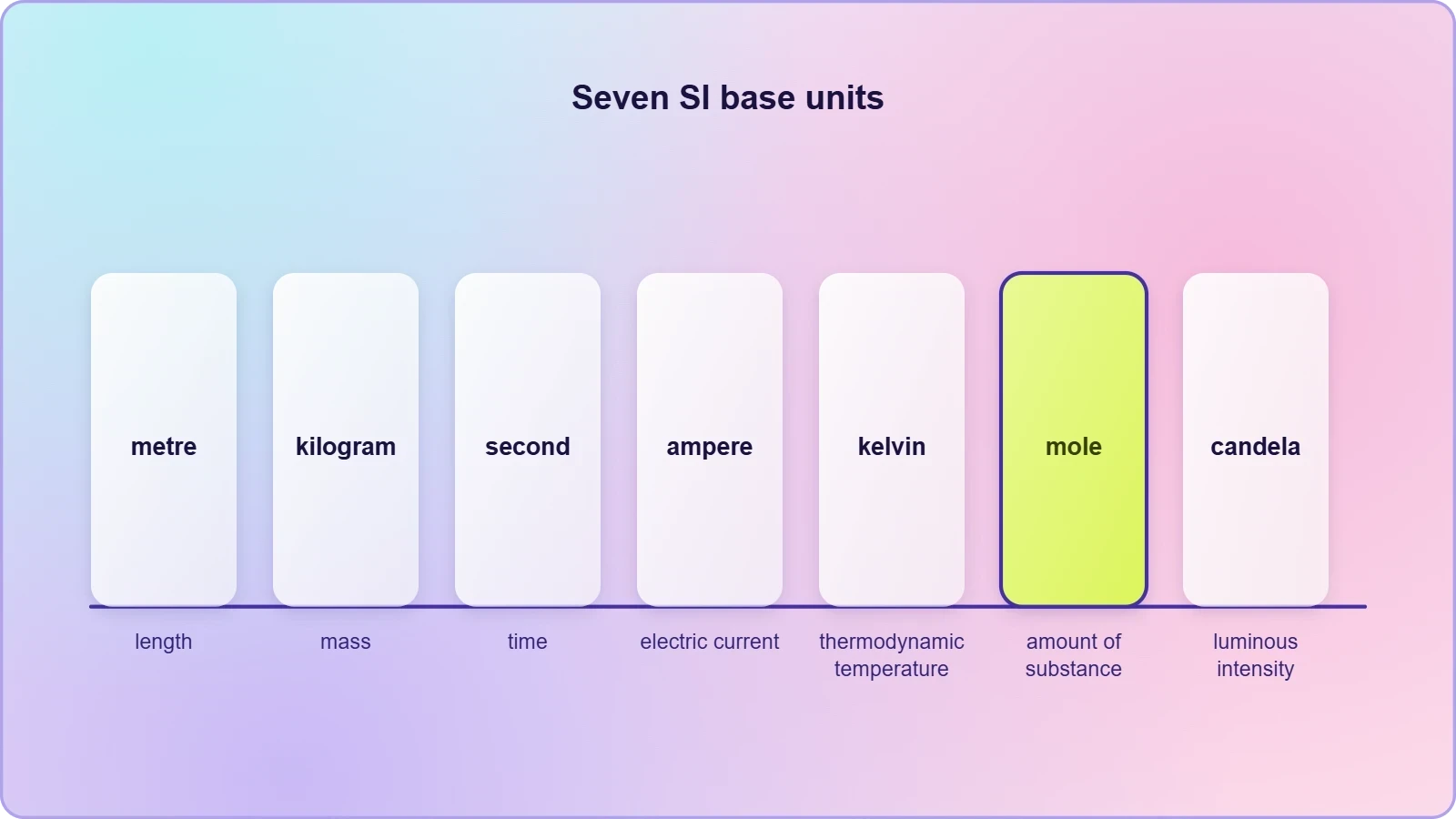
In the International System of Units, the mole — symbol mol — occupies a place of genuine distinction. It was introduced as the seventh base quantity, joining the metre, kilogram, second, ampere, kelvin and candela as one of the fundamental pillars on which all measurement rests. This status matters because it signals that "amount of substance" is not a derived convenience but an independent physical dimension. A sample's amount, denoted by the symbol ##n##, measures how many specified elementary entities it contains, and that count is a property entirely separate from the sample's mass, volume or temperature.
The definition is deliberately broad about what counts as an entity. An elementary entity may be an atom, a molecule, an ion, an electron, a photon, or any other particle or specified group of particles. What the definition demands is specificity: when you state an amount in moles, you must be clear about which entity you are counting. One mole of hydrogen atoms and one mole of hydrogen molecules both contain Avogadro's number of entities, but they are radically different quantities of matter, weighing roughly one gram and two grams respectively.
The Classical Definition and Its Numerical Anchor
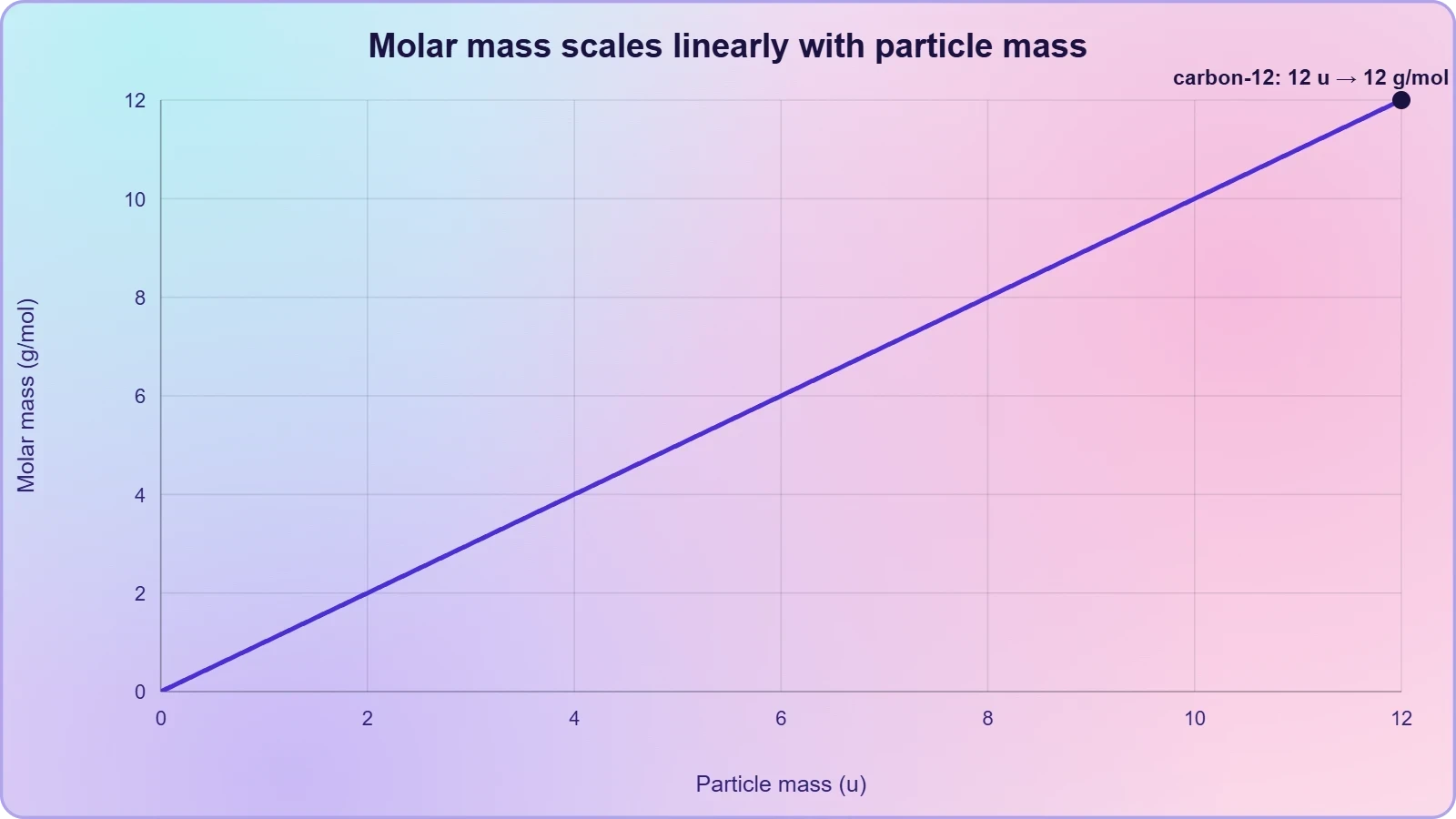
For most of the twentieth century, the mole was defined by reference to carbon-12. One mole was the amount of substance containing as many elementary entities as there are atoms in exactly twelve grams of carbon-12. This definition was operationally elegant: it tied the counting unit directly to the mass scale chemists already used, so that the molar mass of any substance in grams per mole was numerically identical to its atomic or molecular mass in unified mass units. The number itself was then a measured quantity, refined over decades as mass spectrometry improved.
The historical determination deserves attention because it reveals the logic of the unit. The mass of a single carbon-12 atom was measured by mass spectrometer and found to be ##1.992648 \times 10^{-23}\ \text{g}##. Since one mole of carbon-12 weighs twelve grams, the number of atoms in that mole follows by simple division, and the result is Avogadro's number. This is the reasoning that transforms a weighing experiment into a particle count, and it remains the clearest illustration of why the constant exists at all.
The 2019 Redefinition: A Fixed Constant, Not a Measured Mass
The 2019 revision of the SI inverted the logic entirely. Rather than defining the mole through a mass of carbon-12 and measuring the constant, the General Conference on Weights and Measures fixed the Avogadro constant at exactly ##6.02214076 \times 10^{23}\ \text{mol}^{-1}## and defined the mole as the amount of substance containing exactly that many elementary entities. The constant is now exact by decree, no longer carrying experimental uncertainty, and the mass of a carbon-12 atom became the measured quantity instead. The numerical value changed only in the eighth significant figure, so no practical calculation is affected.
This redefinition has a conceptual consequence worth absorbing. The mole is no longer anchored to any particular substance; it is a pure counting definition, valid for atoms, molecules, ions, electrons or apples alike. It also aligns the mole with the other redefined base units, all of which now rest on fixed values of fundamental constants. For students, the practical takeaway is simple: use ##6.022 \times 10^{23}## for routine work, and recognise that the trailing digits in ##6.02214076 \times 10^{23}## represent exactness rather than precision.
Avogadro's Number and the Scale of the Microscopic World
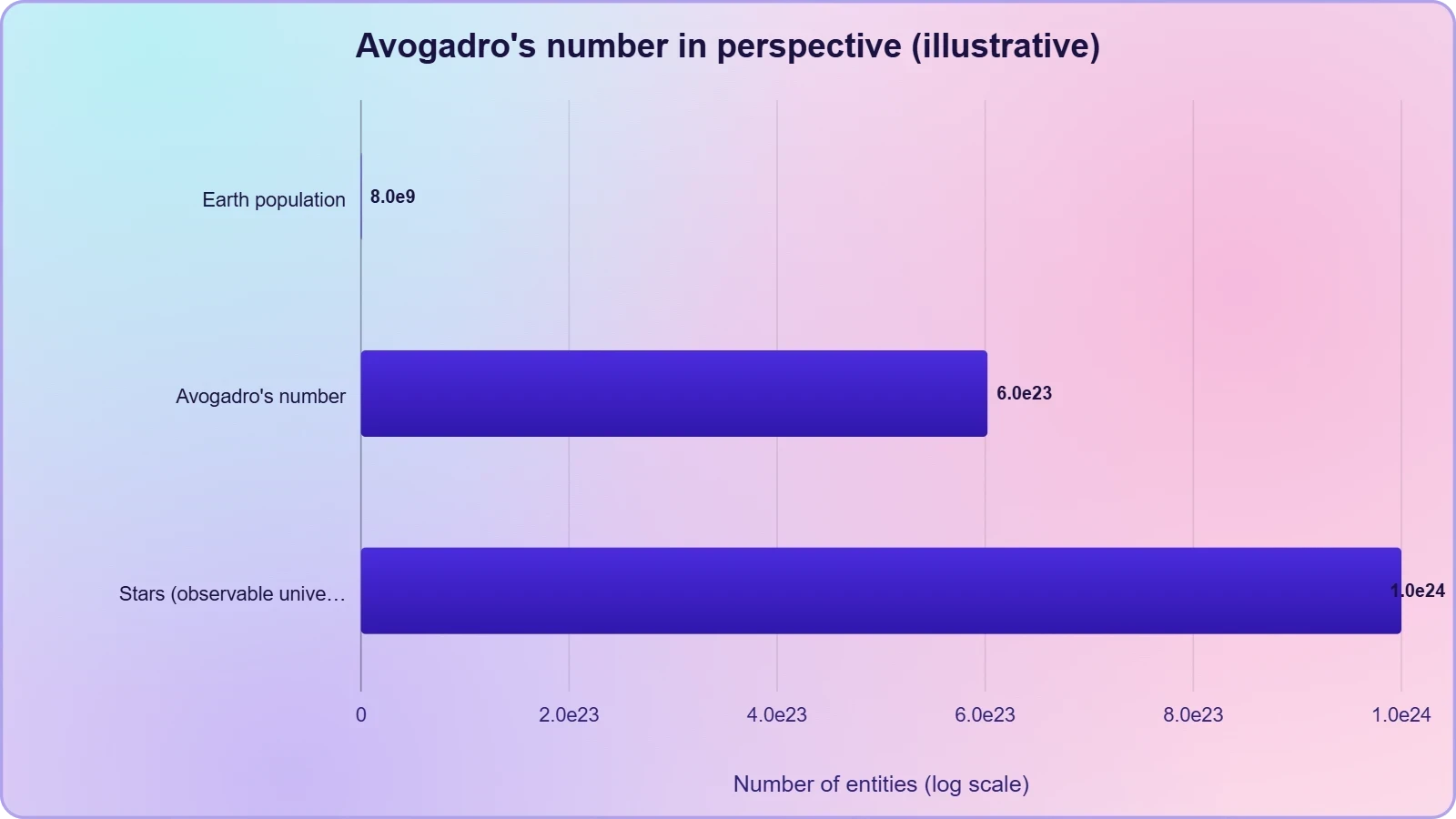
The magnitude of Avogadro's number resists intuition, and that is precisely why it deserves a moment of contemplation. Written out in full without powers of ten, it reads 602,213,670,000,000,000,000,000 — a figure so vast that no everyday analogy fully captures it. If you could count one particle per second without pause, completing a single mole would take roughly nineteen trillion years, far longer than the age of the universe. The number is not arbitrary; it is the exchange rate between the atomic mass unit and the gram, fixed by the size of the carbon-12 atom.
This constant is named in honour of Amedeo Avogadro, the Italian physicist whose 1811 hypothesis — that equal volumes of gases at the same temperature and pressure contain equal numbers of molecules — laid the conceptual groundwork. Avogadro never knew the number's value; it was determined long after his death, and the name was attached as a tribute to his insight rather than his measurement. The constant carries the symbol ##N_A## and, since 2019, an exact numerical value that defines the mole itself.
Mole Versus Molecule: A Distinction That Changes the Answer
Students routinely conflate the mole with the molecule, and the confusion produces wrong answers with depressing regularity. A molecule is a physical entity — a specific bonded assembly of atoms, such as H₂O or CO₂. A mole is a counting unit, a quantity of such entities, exactly as a dozen is a quantity of eggs. One mole of water contains ##6.022 \times 10^{23}## water molecules; one molecule of water contains three atoms. These are statements about entirely different levels of description, and mixing them up is the single most common error in mole arithmetic.
The distinction becomes critical when a substance's formula unit differs from its molecule. Sodium chloride does not exist as discrete NaCl molecules in the solid state; it forms a lattice, so chemists speak of formula units rather than molecules. One mole of sodium chloride therefore contains ##6.022 \times 10^{23}## formula units of NaCl, each comprising one sodium ion and one chloride ion. Similarly, one mole of hydrogen atoms contains ##6.022 \times 10^{23}## atoms, while one mole of hydrogen molecules contains the same number of molecules but twice as many atoms.
Interconverting Mass, Moles and Particle Count
Every quantitative problem in this territory reduces to a small set of conversion pathways, and fluency comes from recognising which pathway a question demands. Mass converts to moles by dividing by molar mass; moles convert to particle count by multiplying by Avogadro's number; and the reverse operations undo each other. The molar mass in grams per mole is numerically equal to the atomic, molecular or formula mass in unified mass units, a correspondence that makes the arithmetic almost frictionless once the concept is secure.
Consider glucose, whose molecular mass was established in the previous lesson as 180.162 u. Its molar mass is therefore 180.162 g mol⁻¹, and a 90.0 g sample contains half a mole, or ##3.011 \times 10^{23}## glucose molecules. Each molecule holds six carbon atoms, so the sample contains ##1.807 \times 10^{24}## carbon atoms. Notice how each step uses exactly one conversion factor and how the units cancel to confirm the reasoning — this unit-tracking habit catches most errors before they propagate.
Molar Mass and the Bridge to Weighable Quantities
The mass of one mole of a substance, expressed in grams, is its molar mass. This quantity is numerically identical to the atomic, molecular or formula mass in unified mass units, a correspondence that follows directly from the definition of the mole and the mass of the carbon-12 atom. Water has a molar mass of 18.02 g mol⁻¹, sodium chloride 58.5 g mol⁻¹, and glucose 180.162 g mol⁻¹. The unit g mol⁻¹ is the chemist's working currency, and the numerical equality with u is what makes the mole concept practically usable at the bench.
This equality is not a coincidence but a designed consequence. Because the mole was historically defined so that twelve grams of carbon-12 contained one mole of atoms, and because the atomic mass unit was defined as one-twelfth the mass of a carbon-12 atom, the two scales align perfectly. The 2019 redefinition preserved this alignment to within the precision of measurement, so the practical identity between molar mass in grams and formula mass in u remains valid for all ordinary work.
Molar Volume of Gases at Standard Conditions
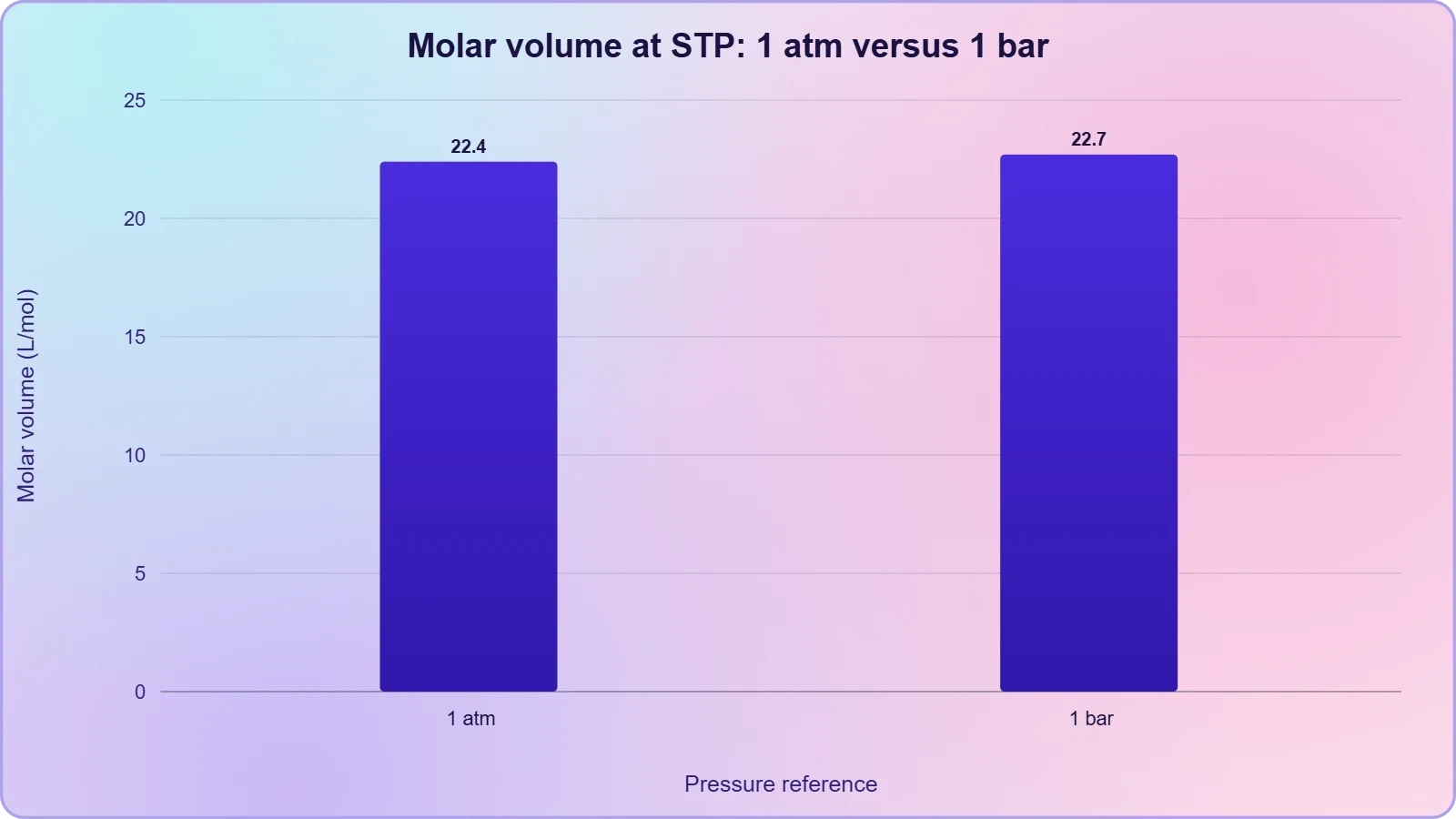
Gases offer a particularly elegant application of the mole concept because, under identical conditions, equal numbers of molecules occupy equal volumes. At standard temperature and pressure — conventionally 273.15 K and 1 bar, or 273.15 K and 1 atm in older usage — one mole of any ideal gas occupies approximately 22.4 litres at 1 atm, or 22.7 litres at 1 bar. This molar volume lets you convert directly between the volume of a gas and the amount of substance it contains, without ever weighing anything.
Suppose a reaction consumes 11.2 litres of oxygen at STP. Dividing by the molar volume gives 0.500 mol of O₂, which corresponds to ##3.011 \times 10^{23}## oxygen molecules and 16.0 g of the gas. The same logic works in reverse: 4.00 g of helium, whose molar mass is 4.00 g mol⁻¹, is one mole and therefore occupies 22.4 litres at STP. These conversions are the backbone of gas stoichiometry and will reappear whenever reactions involving gaseous reactants or products are analysed.
Millimoles and Micromoles in Analytical Practice
Laboratory work rarely deals in whole moles. A titration might consume 25.00 mL of a 0.100 M solution, which is 2.50 millimoles of solute; a spectrophotometric assay might measure a few micromoles of a coloured product. The millimole (mmol, ##10^{-3}## mol) and the micromole (µmol, ##10^{-6}## mol) are therefore the everyday units of analytical chemistry, and the mole concept extends to them without modification. The conversion factors simply carry the appropriate power of ten.
This scaling is not mere convenience; it reflects the actual quantities chemists handle. A clinical laboratory reporting serum glucose in millimoles per litre, or a biochemist measuring enzyme activity in micromoles per minute, is using the same Avogadro-based counting logic applied to samples small enough to fit in a cuvette. Recognising that the mole concept scales seamlessly across twelve orders of magnitude is part of understanding it properly rather than merely memorising a formula.
Percentage Composition and the Route to Empirical Formulas
Knowing how many entities a sample contains is only one kind of information chemists need. Equally important is knowing what fraction of a compound's mass each element contributes, because that data allows an unknown substance to be identified and a known one to be checked for purity. The mass percentage of an element in a compound is calculated by dividing the mass that element contributes per mole by the compound's molar mass and multiplying by one hundred. For water, hydrogen contributes 2.016 g out of 18.02 g, giving 11.18 per cent, while oxygen accounts for the remaining 88.79 per cent.
Ethanol offers a richer illustration because it contains three elements. Its molecular formula C₂H₅OH corresponds to a molar mass of 46.068 g mol⁻¹, with carbon contributing 24.02 g, hydrogen 6.048 g and oxygen 16.00 g. The respective mass percentages are 52.14, 13.13 and 34.73 per cent, summing to one hundred as they must. Such data serve as a fingerprint: a sample purporting to be pure ethanol but showing a different composition is contaminated, and the discrepancy can be quantified rather than merely suspected.
From Mass Percent to Empirical Formula
The reverse journey — from percentage composition to formula — is one of the most instructive applications of the mole concept. The procedure is a fixed sequence: assume a 100 g sample so that percentages become grams, convert each mass to moles by dividing by the atomic mass, divide all mole values by the smallest to obtain the simplest ratio, and if necessary multiply to clear fractions. The result is the empirical formula, the simplest whole-number ratio of atoms in the compound.
A worked case makes the sequence concrete. A compound contains 4.07 per cent hydrogen, 24.27 per cent carbon and 71.65 per cent chlorine, with a molar mass of 98.96 g mol⁻¹. In a 100 g sample there are 4.07 g H, 24.27 g C and 71.65 g Cl, which convert to 4.04 mol H, 2.021 mol C and 2.021 mol Cl. Dividing by the smallest gives a ratio of 2:1:1, so the empirical formula is CH₂Cl. The empirical formula mass is 49.48 u, and dividing the molar mass by this value yields exactly 2, so the molecular formula is C₂H₄Cl₂.
Empirical Versus Molecular Formula
The empirical formula states the simplest whole-number ratio of atoms; the molecular formula states the exact number of each type in one molecule. Glucose has the empirical formula CH₂O and the molecular formula C₆H₁₂O₆, the two related by a factor of six. The factor is obtained by dividing the experimentally determined molar mass by the empirical formula mass, and it must be a whole number — a non-integer result signals an arithmetic error or impure data rather than a new kind of compound.
This relationship explains why percentage composition alone cannot distinguish between compounds sharing an empirical formula. Formaldehyde, acetic acid and glucose all have the empirical formula CH₂O, yet they are entirely different substances with molar masses of 30, 60 and 180 g mol⁻¹ respectively. The mole concept supplies the missing link: only when the molar mass is known can the empirical formula be scaled to the true molecular formula, and only then can the compound be identified.
We Also Published
Mole Fraction and the Composition of Mixtures
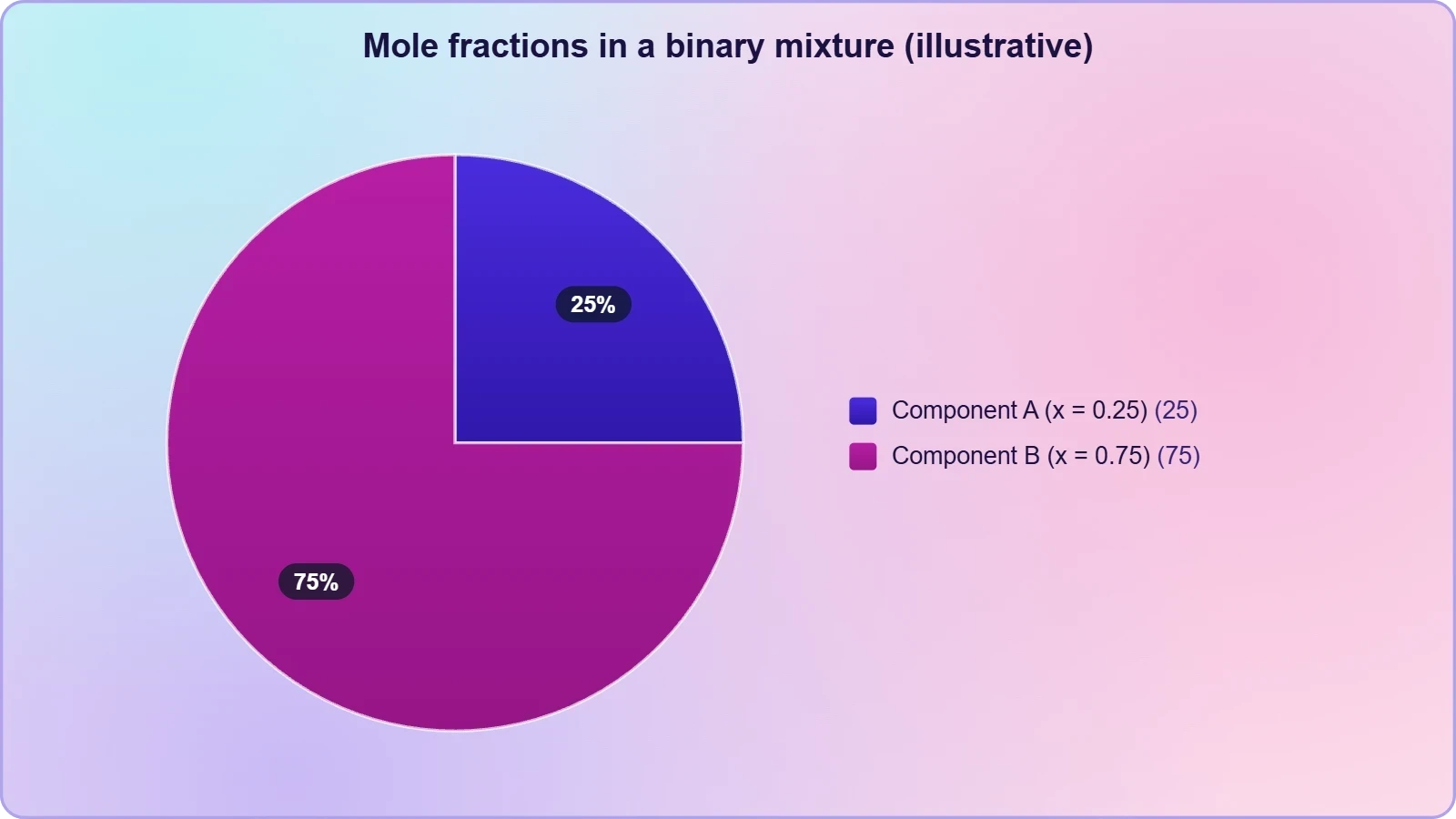
Percentage composition describes a pure compound, but many chemical systems are mixtures, and mixtures require a different measure of composition. The mole fraction expresses the amount of one component as a fraction of the total amount of all components present. For a mixture containing ##n_A## moles of A and ##n_B## moles of B, the mole fraction of A is ##n_A/(n_A + n_B)##. Unlike mass percentage, mole fraction is dimensionless, ranges from zero to one, and the sum of all mole fractions in a mixture is exactly one.
Mole fraction is indispensable in the physical chemistry of solutions and gases. Raoult's law for vapour pressure, Dalton's law for partial pressures, and the chemical potential expressions of thermodynamics all use mole fractions as their natural composition variable. It will be developed fully in a later lesson on solutions, but its definition belongs here because it is built directly on the mole concept: it counts particles rather than weighing them, and it therefore reflects the microscopic reality that chemical behaviour depends on how many molecules of each kind are present.
Common Mistakes and How to Avoid Them
The most frequent error is treating molar mass as though it were molecular mass, dropping the per-mole qualifier and thereby losing the connection to Avogadro's number. A second common slip is forgetting to specify the entity: "one mole of oxygen" is ambiguous, since it could mean one mole of O atoms or one mole of O₂ molecules, a difference of a factor of two in both mass and particle count. Always name the entity explicitly in your working.
A third pitfall is unit confusion in gas calculations, where 22.4 L mol⁻¹ applies at 1 atm and 273.15 K but 22.7 L mol⁻¹ applies at 1 bar. Mixing the two introduces a one per cent error that may or may not matter depending on the precision required. Finally, students often round Avogadro's number prematurely; carry at least four significant figures through intermediate steps and round only at the end, or accumulated rounding will distort the final answer.
Computational Practice and the Road Ahead
The mole concept becomes second nature only through repeated calculation, and a short programmatic exercise can reinforce the conversion pathways while demonstrating how the arithmetic scales. The snippet below computes moles, particle counts and gas volumes for a given mass, illustrating the three conversion factors in sequence. Running it with different inputs builds the intuition that molar mass, Avogadro's number and molar volume are simply three different exchange rates between the same underlying quantity.
NA = 6.022e23          # Avogadro constant, mol^-1
VM = 22.4              # molar volume at STP, L mol^-1

def analyse(mass_g, molar_mass):
    moles = mass_g / molar_mass
    particles = moles * NA
    volume = moles * VM
    return moles, particles, volume

n, N, V = analyse(90.0, 180.162)   # 90 g of glucose
print(f"moles = {n:.4f} mol")
print(f"molecules = {N:.3e}")
print(f"volume if gaseous at STP = {V:.2f} L")
Such a script is not a substitute for understanding, but it is a useful check on hand calculations and a reminder that the mole concept is fundamentally a set of proportional relationships. The same logic underlies every stoichiometric calculation that follows, from determining the limiting reagent in a reaction to computing the yield of a synthesis. The next lesson takes up molar mass and its applications in greater depth, extending these conversions to solutions, concentrations and reaction stoichiometry.
Consolidating the Core Relationships
Three equations capture the entire lesson. The amount in moles equals mass divided by molar mass; the number of entities equals amount multiplied by Avogadro's number; and the volume of a gas at STP equals amount multiplied by molar volume. Every problem in this territory is a composition of these three relationships, and recognising which one applies is the skill that separates fluent students from those who merely memorise formulas. The table below summarises the relationships and their units for quick reference.
Preparing for Molar Mass Applications
The next lesson extends these ideas to molar mass in solution contexts, where concentration, dilution and reaction stoichiometry all rest on the conversions practised here. Before moving on, ensure you can move confidently in both directions between mass and moles, between moles and particle count, and between moles and gas volume at STP. Each of these pathways will be used repeatedly, and hesitation at this stage compounds into difficulty later. The mole is not a difficult idea; it is a simple idea applied with great frequency, and frequency is what builds fluency.
From our network :
- AI-Powered 'Precision Diagnostic' Replaces Standard GRE Score ReportsDiscover the new GRE Precision Diagnostic. Learn how AI-powered behavioral analytics and time-to-solve tracking are replacing standard GRE score reports to empower students.
- How to Print Cheaply: Cutting the Cost per PageA practical, measured guide to lowering what each printed page costs — duplex and draft modes, third-party ink, yield mathematics, and knowing when a new printer beats refills.
- Trump Political Strategy How Geopolitical Stunts Serve As Media Diversions
- Where to Put Your Wireless Router for Better CoverageA practical, physics-grounded guide to router placement: why the centre of the home beats the corner, how walls and metal sap signal, and how to run a simple survey that proves the improvement.
- Analyzing Trump Deportation Numbers Insights Into The 2026 Immigration Crackdown
- 10 Physics Numerical Problems with Solutions for IIT JEEPrepare for IIT JEE with 10 physics numerical problems, complete with detailed solutions and conceptual explanations. Ideal for mastering kinematics, thermodynamics, electromagnetism, and optics.
- EV 2.0: The Solid-State Battery Breakthrough and Global Factory ExpansionDiscover the impact of the Solid-State Battery Breakthrough on the EV market. Learn about CATL and BYD stock growth, global factory expansion in Europe, and the future of EV 2.0 technology.
- 98% of Global MBA Programs Now Prefer GRE Over GMAT Focus EditionExplore why 98% of global MBA programs now prefer the GRE over GMAT Focus. Learn about the shorter GRE format, verbal logic importance, and strategic versatility for students.
- Do You Need a New Router or Is Your Internet Plan the Problem?A practical comparison of the signs that point to router limits versus signs your broadband speed or provider is the bottleneck, so you can decide what to replace before spending money.
RESOURCES
- 7.1 The Mole Concept and Avogadro's Numberecampusontario.pressbooks.pubThe number of entities composing a mole has been experimentally determined to be 6.02214179 × 10²³, a fundamental constant named Avogadro's number (NA) or…
- The Mole and Avogadro's Constant - Chemistry LibreTextschem.libretexts.orgJan 30, 2023 ... The number of atoms can also be calculated using Avogadro's Constant (6.02214179×10²³) / one mole of substance. Example ...
- Mole Concept Avogadros Number Na - Stoichiometry - MCAT Contentjackwestin.comThe mol (plural: moles), also referred to as Avogadro's number (NA), is 6.022×10²³ elementary entities (which can be defined as atoms, molecules, ions, or ...
- 2.2.4: Avogadro's Number and the Mole - Biology LibreTextsbio.libretexts.orgIt is equal to 6.022 × 10²³ mol-1and is expressed as the symbol NA. Avogadro's number is a similar concept to that of a…
- Introducing High School Students to the Avogadro Number and the ...pubs.acs.orgJan 29, 2021 ... Students discover the Avogadro number through an inquiry activity and realize that a mole of any chemical element contains the…
- Avogadro constant - Wikipediaen.wikipedia.orgThe Avogadro constant was historically derived from the old definition of the mole as the amount of substance in 12 grams of carbon-12 (…
- Chemistry Mole Concept Study Guide: Avogadro, Molar Mass | Notespearson.comThe mole is a fundamental unit in chemistry used to express amounts of a chemical substance. Avogadro's number defines the number of particles (atoms,…
- Understanding Moles and Avogadro's Number | PDF - Scribdscribd.comOne mole is equal to 6.02214179 × 10^23 atoms or other elementary units. The mass of one mole of a substance is called its…
- 3.1 Formula Mass and the Mole Concept - Chemistry 2e | OpenStaxopenstax.orgFeb 14, 2019 ... Define the amount unit mole and the related quantity Avogadro's number; Explain the relation between mass, moles, and numbers of…
- Avogadro's number - BYJU'Sbyjus.comIt is equal to 6.022140857×10²³. The units may be electrons, ions, atoms, or molecules, depending on the character of the reaction and the nature…
- ELI5 Avogadro's number : r/explainlikeimfive - Redditreddit.comAug 28, 2023 ... Avogadro's number is just the definition of a mole. Avogadro's number is 6.022 x 10²³ things in one mole. You…
- A new definition of the mole has arrived - IUPACiupac.orgJan 8, 2018 ... This number is the fixed numerical value of the Avogadro constant, NA, when expressed in mol−1, and is called the…
- Avogadro's number and the mole - Chem1chem1.comAug 23, 2018 ... Introduction to the mole concept in chemistry · 1 - Counting atoms: Avogadro's number · 2 - Moles and their…
- Avogadro's number | Definition & Units - Britannicabritannica.comOct 15, 2026 ... Avogadro's number, number of units in one mole of any substance (defined as its molecular weight in grams), equal to…
- An Exact Value for Avogadro's Number | American Scientistamericanscientist.orgWith today's definition of Avogadro's number being the number of atoms in one mole of a particular element, this new fixed value for it…