Every chemical formula is a compressed argument about composition, and the distinction between an empirical formula and a molecular formula is one of the most consequential ideas a young chemist can absorb. The empirical formula reports the simplest whole-number ratio of atoms in a substance; the molecular formula reports the actual number of atoms in one molecule. A compound that is 92.26% carbon and 7.74% hydrogen by mass could be written as CH, yet that same ratio describes benzene, acetylene, and a host of other hydrocarbons whose behaviours differ profoundly. Learning to move between these representations is therefore not clerical arithmetic but a genuine act of chemical reasoning.
This lesson builds directly on percentage composition, which supplies the raw material for every empirical formula determination. From there, the work proceeds through the classic five-step algorithm: convert mass percentages to moles, divide by the smallest mole value, clear any fractional ratios, write the empirical formula, and finally scale it using the molar mass. Each stage carries its own traps, from rounding too early to misreading a ratio of 1.5 as a whole number. The worked examples below move deliberately through those hazards, because precision in these early calculations pays dividends when stoichiometry arrives in the next lesson.
Beyond the algorithm, the lesson widens the frame considerably. Combustion analysis, the experimental engine behind organic formula determination, deserves careful attention, as does the mass spectrometer, the instrument that supplies the molar mass needed for the final scaling step. Ionic compounds complicate the picture because they possess no discrete molecules, only formula units in a lattice. Mineralogists, meanwhile, have used empirical formulas for two centuries to classify silicates and oxides. By the end, the formula on the page should read as a claim about the physical world, testable, refinable, and rich with meaning.
On This Page
- The Logic of Simplest Ratios and Why They Matter
- Scaling Up: From Empirical to Molecular Formula
- Combustion Analysis and the Experimental Route
- Same Ratio, Different Molecules: A Gallery of Isomers
- Measuring Molar Mass: The Mass Spectrometer and Its Allies
- Empirical Formulas in Mineralogy and Materials Science
- Computational Practice and the Road to Stoichiometry
- Consolidating the Lesson: Pitfalls, Practice, and Perspective
The Logic of Simplest Ratios and Why They Matter
An empirical formula is the most reduced statement a compound can make about itself. If a substance contains hydrogen, carbon, and chlorine in the ratio 2:1:1, the empirical formula is written CH₂Cl regardless of whether the real molecule contains four atoms or four hundred. This reduction is not an approximation but a definition: the empirical formula captures composition at its most economical. Chemists value it because percentage composition data, which is what experiments most readily deliver, can only ever yield ratios. The molecular formula requires an additional, independent measurement of molar mass before it can be fixed.
The historical weight of this idea is considerable. Nineteenth-century chemists such as Berzelius and Cannizzaro fought long disputes over whether formulas should express combining ratios or actual molecular contents, and the resolution of those disputes helped establish atomic theory on firm quantitative ground. Cannizzaro's 1858 pamphlet, which insisted on distinguishing atomic weight from equivalent weight, is often credited with clarifying the confusion that had surrounded organic formulas for decades. The lesson's five-step procedure is, in effect, the practical residue of that hard-won clarity, distilled into a routine any careful student can execute.
From Percentage Composition to Moles
The first move in any empirical formula determination is to translate mass percentages into amounts of substance. Because percentage composition sums to 100, a convenient convention is to assume a 100 g sample, which converts each percentage directly into grams. Dividing each mass by the element's atomic mass yields the number of moles of that element. For a compound containing 2.016% hydrogen, 24.27% carbon, and 71.65% chlorine, the mole values are approximately 2.021 mol H, 2.021 mol C, and 2.021 mol Cl, an unusually tidy result that immediately signals a 1:1:1 ratio.

Real data rarely behaves so obligingly. Experimental percentages carry uncertainty, and atomic masses are themselves averages over isotopic distributions, so the mole values will differ in the third or fourth significant figure. The discipline here is to carry enough digits through the intermediate steps and round only at the end. Premature rounding can shift a ratio of 2.98:1 into 3:1 or, worse, into 2.5:1, producing a formula that is simply wrong. The reference procedure's insistence on dividing by the smallest mole value before any rounding is precisely the safeguard against this failure mode.
Clearing Fractions and Writing the Formula
Once each mole value is divided by the smallest among them, the resulting ratios should be whole numbers or very close to them. When they are not, a small integer multiplier rescues the situation. A ratio of 1:1.5 becomes 2:3 after multiplication by two; a ratio of 1:1.33 becomes 3:4 after multiplication by three; a ratio of 1:1.25 becomes 4:5 after multiplication by four. The multiplier is chosen to clear the fractional part, and the resulting whole numbers become the subscripts. Only after this step is the empirical formula written, with element symbols in the conventional order and subscripts omitted when they equal one.
Consider a compound whose analysis gives 40.0% carbon, 6.7% hydrogen, and 53.3% oxygen. Assuming 100 g, the moles are 3.33 mol C, 6.64 mol H, and 3.33 mol O. Dividing by 3.33 yields 1:1.99:1, which rounds cleanly to 1:2:1, giving the empirical formula CH₂O. That formula, as later sections show, is shared by formaldehyde, acetic acid, and glucose, three substances with radically different chemistry. The empirical formula is thus a starting point for identification, never a conclusion, and the next measurement, molar mass, is what converts it into a genuine molecular identity.

We Also Published
Scaling Up: From Empirical to Molecular Formula
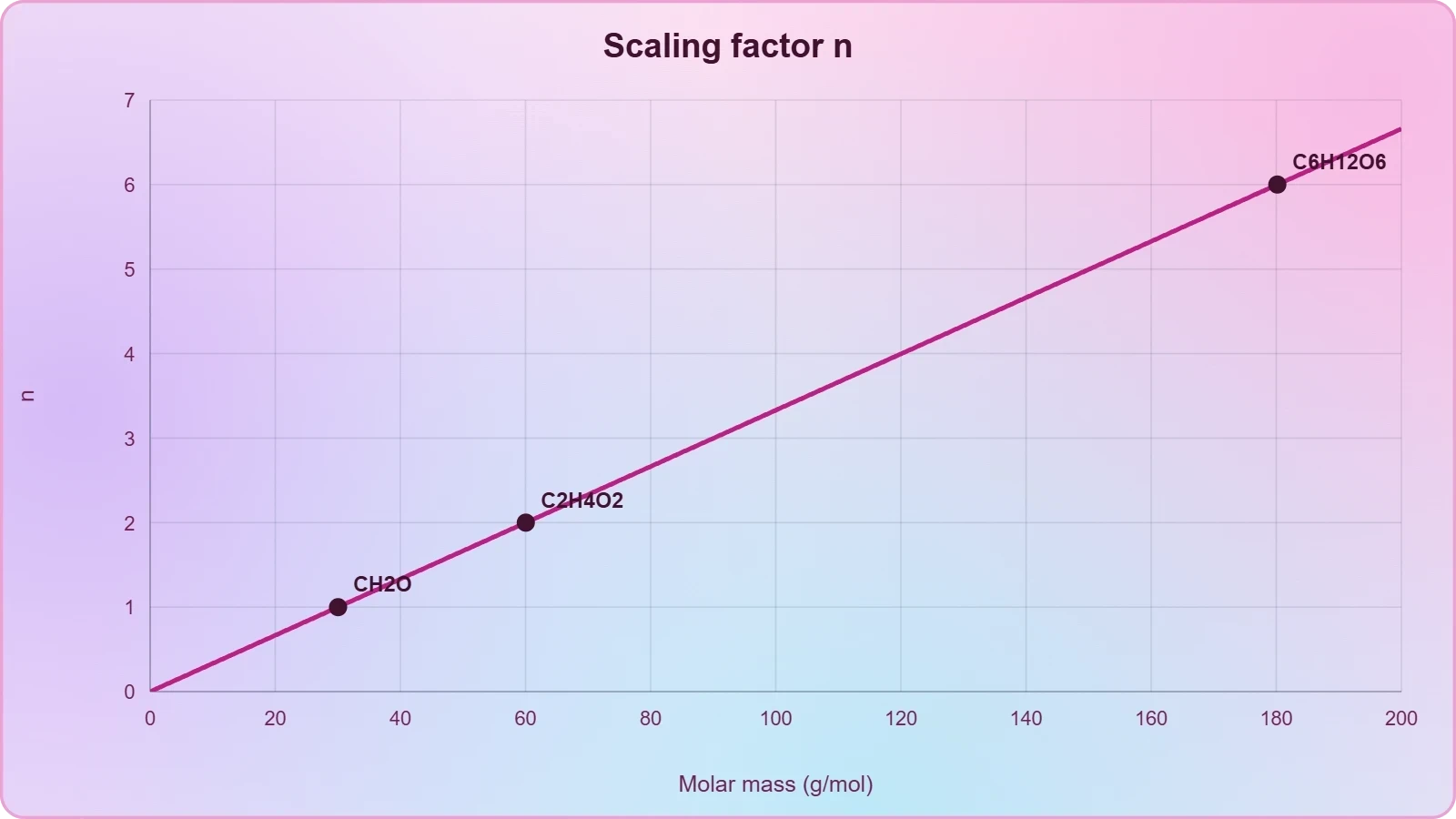
The empirical formula becomes a molecular formula only when an independent measurement of molar mass is available. The scaling factor n is defined as the molar mass divided by the empirical formula mass, and it must be a positive integer. For the compound CH₂Cl, the empirical formula mass is 12.01 + (2 × 1.008) + 35.453 = 49.48 g mol⁻¹. If the measured molar mass is approximately 98.96 g mol⁻¹, then n equals 2, and the molecular formula is C₂H₄Cl₂, which is 1,1-dichloroethane. The arithmetic is trivial; the conceptual point is that two independent experiments, composition and molar mass, must agree before a molecular formula can be asserted.
Mathematically, the relationship is compact enough to state directly. The molecular formula is the empirical formula multiplied by n, where
and n must be an integer. When the computed n lands near 1.98 or 3.04, the sensible reading is 2 or 3, because experimental uncertainty in molar mass is typically a few tenths of a percent. When n lands near 2.5, something has gone wrong: either the empirical formula is incorrect or the molar mass measurement is unreliable. A useful diagnostic is to check whether the empirical formula mass divides the molar mass within experimental error; if it does not, the composition data should be re-examined before any formula is published.
Worked Example: A Chlorinated Hydrocarbon
Suppose combustion analysis of an unknown liquid gives 24.27% carbon, 4.07% hydrogen, and 71.65% chlorine by mass, and a mass spectrum shows a molecular ion at m/z 98.96. Assuming 100 g, the moles are 2.021 mol C, 4.04 mol H, and 2.021 mol Cl. Dividing by 2.021 gives 1:2:1, so the empirical formula is CH₂Cl with a formula mass of 49.48 g mol⁻¹. The ratio 98.96/49.48 equals exactly 2, so the molecular formula is C₂H₄Cl₂. The result is consistent with the compound being 1,1-dichloroethane, a common industrial solvent.
Notice how the hydrogen figure, 4.07%, is the least precise of the three percentages and yet the ratio still resolves cleanly. This is typical: hydrogen's low atomic mass amplifies small absolute errors in its percentage, but the division by the smallest mole value tends to absorb the noise. A student who rounds 4.04 to 4.0 before dividing will still obtain 1:1.98:1, which rounds to the same formula. The lesson is not that precision is optional but that the algorithm is forgiving when the underlying data are sound, and unforgiving when they are not.
Worked Example: An Oxygen-Containing Compound
A second example sharpens the fractional-ratio skill. An organic acid contains 40.0% carbon, 6.7% hydrogen, and 53.3% oxygen, and its molar mass is 60.05 g mol⁻¹. The mole values are 3.33 mol C, 6.64 mol H, and 3.33 mol O, giving a ratio of 1:1.99:1, which rounds to CH₂O with a formula mass of 30.03 g mol⁻¹. Dividing 60.05 by 30.03 gives n = 2, so the molecular formula is C₂H₄O₂, which corresponds to acetic acid. The empirical formula CH₂O is shared with formaldehyde and glucose, a point developed in the next section.
Had the molar mass been 180.16 g mol⁻¹ instead, n would equal 6 and the molecular formula would be C₆H₁₂O₆, glucose. The composition data are identical in both cases; only the molar mass distinguishes the acid from the sugar. This is the cleanest possible demonstration that percentage composition alone cannot identify a compound. It can only narrow the field, and the narrowing is often substantial, but the final identification always requires a second, orthogonal measurement. Chemists call this convergent evidence, and it is the backbone of structural determination.
Combustion Analysis and the Experimental Route
Where do the percentage compositions come from? For organic compounds, the workhorse method is combustion analysis, developed to high precision by Justus von Liebig in the 1830s and still taught because it illustrates the logic of quantitative chemistry so clearly. A weighed sample is burned in a stream of oxygen, and the products, carbon dioxide and water, are swept through pre-weighed absorption tubes containing potassium hydroxide and a dehydrating agent such as magnesium perchlorate. The mass gain of each tube gives the mass of CO₂ and H₂O produced, from which the masses of carbon and hydrogen in the original sample are calculated.
The arithmetic rests on simple stoichiometric ratios. Every mole of CO₂ contains one mole of carbon, so the mass of carbon is the mass of CO₂ multiplied by 12.01/44.01. Every mole of water contains two moles of hydrogen, so the mass of hydrogen is the mass of H₂O multiplied by 2.016/18.016. If the compound contains oxygen, its mass is found by difference: the original sample mass minus the carbon and hydrogen masses. Nitrogen is usually determined separately by the Kjeldahl method, and halogens by other specialized procedures. The resulting masses convert to percentages, and the five-step algorithm takes over from there.

A Complete Combustion Calculation
Consider 0.2500 g of an organic compound that yields 0.3664 g of CO₂ and 0.1500 g of H₂O on combustion. The carbon mass is 0.3664 × (12.01/44.01) = 0.1000 g, and the hydrogen mass is 0.1500 × (2.016/18.016) = 0.0168 g. The oxygen mass is 0.2500 − 0.1000 − 0.0168 = 0.1332 g. Converting to moles gives 0.00833 mol C, 0.0167 mol H, and 0.00833 mol O, a ratio of 1:2:1. The empirical formula is CH₂O, and if the molar mass is known to be 60.05 g mol⁻¹, the molecular formula is C₂H₄O₂.
The precision of the method depends on the balance and on complete combustion. Incomplete burning produces carbon monoxide or soot, which escapes absorption and makes the carbon result too low. Moisture in the sample or in the oxygen stream inflates the apparent hydrogen. Modern instruments use a flash combustion chamber at around 1000 °C with a catalyst, followed by gas chromatography, achieving accuracy better than 0.3% absolute. The classical Liebig train is rarely used today, but its logic survives intact in every elemental analyser, and the calculation above is exactly what the instrument's software performs.
Common Errors in Combustion Data
The most frequent student error is forgetting the factor of two in the hydrogen calculation, which halves the apparent hydrogen content and produces formulas that are systematically hydrogen-poor. A second common mistake is assuming the sample contains oxygen without checking the mass balance; if the carbon and hydrogen masses already sum to the sample mass, the compound is a hydrocarbon and no oxygen term should appear. A third error is treating the mass of CO₂ as the mass of carbon, which inflates carbon by a factor of roughly 3.67 and produces impossible formulas with fractional subscripts far from any integer.
Rounding errors compound these problems. A student who rounds 0.00833 to 0.008 and 0.0167 to 0.017 obtains a ratio of 1:2.13:1, which may be misread as 3:6:3 or worse. The remedy is procedural: keep four significant figures until the final division, then round the ratio to the nearest simple fraction. A useful check is to verify that the empirical formula mass is consistent with the molar mass within a few percent. If the ratio of molar mass to formula mass is not close to an integer, the composition data deserve a second look before any formula is committed to paper.
Same Ratio, Different Molecules: A Gallery of Isomers
The empirical formula CH₂O is one of chemistry's most instructive coincidences. Formaldehyde, HCHO, is a pungent gas used to preserve biological specimens and to manufacture resins; its molecular formula is CH₂O, identical to its empirical formula. Acetic acid, CH₃COOH, is the sour component of vinegar and a fundamental industrial feedstock; its molecular formula is C₂H₄O₂, twice the empirical formula. Glucose, C₆H₁₂O₆, is the energy currency of cellular life; its molecular formula is six times the empirical formula. Three substances, one ratio, three entirely different chemical personalities.

This gallery is not a curiosity but a lesson in the limits of compositional data. Percentage composition tells you what a compound is made of; it says nothing about how the atoms are connected. Formaldehyde's carbon is bonded to two hydrogens and double-bonded to oxygen, making it a reactive electrophile. Acetic acid's carboxyl group donates a proton readily. Glucose's six carbons form a chain studded with hydroxyl groups, allowing it to cyclize into a ring. The molecular formula distinguishes these compounds from one another, but only the structural formula explains their behaviour.
Structural Formulas and the Limits of Composition
A structural formula shows how atoms are connected, which bonds are single, double, or triple, and often the three-dimensional arrangement in space. It is the natural successor to the molecular formula, and the two are related but not interchangeable. Ethanol and dimethyl ether both have the molecular formula C₂H₆O, yet ethanol is a liquid that boils at 78 °C and dissolves freely in water, while dimethyl ether is a gas that boils at −24 °C and is only moderately soluble. The difference lies entirely in connectivity: ethanol's hydroxyl group hydrogen-bonds, dimethyl ether's oxygen is ether-linked and cannot donate a proton.
Structural formulas come in several grades of detail. A condensed formula such as CH₃CH₂OH shows connectivity without spatial information. A full Lewis structure shows every bond and lone pair. A skeletal formula omits carbon and hydrogen labels for compactness. A three-dimensional ball-and-stick or wedge-dash representation shows stereochemistry, which matters enormously in biology: the two enantiomers of a drug can have wildly different potencies. The progression from empirical to molecular to structural formula is a progression from composition to connectivity to shape, and each step requires new experimental evidence.
Formula Units and the Ionic World
Ionic compounds do not contain molecules at all, so the concept of a molecular formula does not apply. Sodium chloride exists as a three-dimensional lattice in which each sodium ion is surrounded by six chloride ions and vice versa; there is no discrete NaCl unit to point to. Chemists therefore speak of the formula unit, the smallest whole-number ratio of ions that reproduces the compound's composition. For sodium chloride the formula unit is NaCl; for calcium chloride it is CaCl₂; for aluminium sulfate it is Al₂(SO₄)₃. The formula unit is the ionic analogue of the empirical formula, and it is always the simplest ratio.
This distinction has practical consequences. The molar mass of an ionic compound is the mass of one mole of formula units, not of molecules, and the term "formula mass" is preferred over "molecular mass" for this reason. When students calculate the concentration of a salt solution, they are counting formula units per litre, not molecules. The lattice energy that holds the ions together depends on the charges and radii of the ions, not on any molecular unit, which is why ionic solids have high melting points and cleave along specific planes. The formula unit is a bookkeeping device, but a rigorously correct one.
Measuring Molar Mass: The Mass Spectrometer and Its Allies
The scaling step from empirical to molecular formula demands a molar mass, and the modern instrument of choice is the mass spectrometer. A sample is vaporized and ionized, typically by electron impact or electrospray ionization, and the resulting ions are accelerated through electric and magnetic fields. Because the radius of an ion's path depends on its mass-to-charge ratio, the detector records a spectrum of peaks whose positions reveal the masses of the fragments. The molecular ion peak, corresponding to the intact molecule minus one electron, gives the molar mass directly, often to four or five significant figures.
High-resolution mass spectrometry can do considerably more. By measuring the exact mass of the molecular ion to within a few parts per million, the technique can distinguish between formulas that share a nominal mass but differ in elemental composition. For example, the nominal mass 44 could correspond to CO₂, C₂H₄O, or C₃H₈, but their exact masses differ by fractions of a dalton, and a high-resolution instrument resolves them cleanly. This capability has made mass spectrometry indispensable in metabolomics, proteomics, and forensic chemistry, where identifying an unknown compound from a few micrograms of material is routine.
Complementary Methods for Molar Mass
Mass spectrometry is not the only route. Freezing-point depression, boiling-point elevation, and osmotic pressure all yield molar mass through colligative properties, and they remain valuable when the sample is thermally fragile or when a mass spectrometer is unavailable. The relation for freezing-point depression is
where ΔT_f is the depression, K_f is the cryoscopic constant of the solvent, and m is the molality of the solute. Measuring the depression allows the molality to be calculated, and from the known mass of solute the molar mass follows. The method is less precise than mass spectrometry, typically good to about 1%, but it is inexpensive and conceptually transparent. End-group titration offers a third route for polymers and acids, and light scattering serves for macromolecules too large for the other techniques.
Reading a Mass Spectrum
A typical electron-impact spectrum contains a molecular ion peak, isotope peaks one or two mass units higher, and fragment peaks from bond cleavage. The molecular ion is usually the highest-mass peak in the cluster, though it may be weak if the molecule fragments readily. The M+1 peak arises mainly from carbon-13, whose natural abundance is 1.07%, so the ratio of M+1 to M gives a rough count of carbon atoms: a compound with ten carbons shows an M+1 peak about 11% the height of M. The M+2 peak is dominated by oxygen-18, chlorine-37, or bromine-81, and its size relative to M reveals the number of these atoms present.
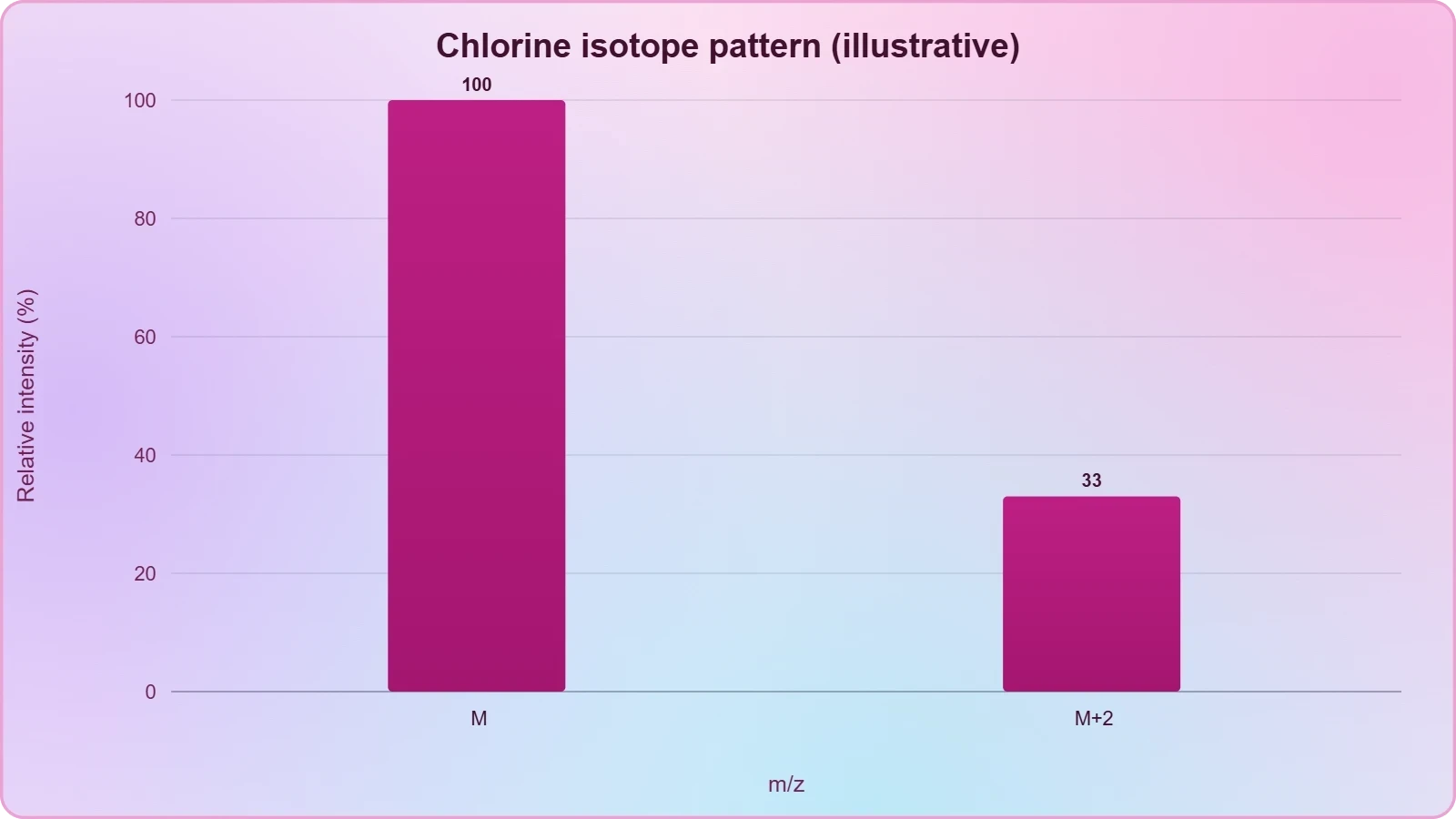
Chlorine is especially diagnostic. Because chlorine-35 and chlorine-37 occur in roughly a 3:1 ratio, a molecule containing one chlorine atom shows an M+2 peak about one-third the height of M. Two chlorines produce a distinctive triplet with intensities near 9:6:1. Bromine, whose isotopes are nearly equal in abundance, gives an M+2 peak almost as tall as M. These patterns allow an experienced spectroscopist to read the halogen content directly from the spectrum, and they provide an independent check on the empirical formula derived from combustion data.
Empirical Formulas in Mineralogy and Materials Science
Mineralogists have relied on empirical formulas since the early nineteenth century, when chemical analysis of rocks and crystals became routine. A mineral's formula is conventionally written as the simplest ratio of its constituent elements, often with the cations listed first. Quartz is SiO₂, corundum is Al₂O₃, and hematite is Fe₂O₃. These formulas describe the stoichiometry of the crystal lattice, not discrete molecules, and they are properly understood as formula units. The empirical formula is thus the natural language of solid-state chemistry, where extended networks rather than isolated molecules dominate.
The mineral world complicates the picture through solid solution, in which one ion substitutes for another of similar size and charge. Olivine, for example, spans a continuous range from forsterite, Mg₂SiO₄, to fayalite, Fe₂SiO₄, and a natural sample might be written (Mg,Fe)₂SiO₄ to reflect its intermediate composition. The empirical formula becomes a variable rather than a fixed ratio, and mineralogists use it to infer the conditions under which the mineral formed. This is a powerful extension of the lesson's core idea: composition is not merely a label but a record of geological history.
From Formula to Crystal Structure
The empirical formula of a mineral constrains but does not determine its crystal structure. SiO₂ occurs as quartz, cristobalite, tridymite, and coesite, all with the same composition but different arrangements of silicon-oxygen tetrahedra. The polymorphs have different densities and stabilities, and their presence in a rock tells geologists about the pressure and temperature conditions the rock experienced. The formula is the starting point; the structure is the destination, and the path between them runs through X-ray crystallography and spectroscopic analysis.
Materials scientists use the same logic when designing alloys and ceramics. A formula such as YBa₂Cu₃O₇₋ₓ describes the high-temperature superconductor YBCO, where the oxygen deficiency x controls the superconducting transition temperature. The empirical formula is a design parameter, not a fixed identity, and small changes in stoichiometry produce large changes in properties. This is the modern face of an old idea: the simplest ratio of atoms is a lever that engineers can pull to tune a material's behaviour, whether the material is a mineral, a ceramic, or a battery cathode.
Hydrates and Non-Stoichiometric Compounds
Hydrated salts add another layer. Copper(II) sulfate pentahydrate is written CuSO₄·5H₂O, and its empirical formula includes the water of crystallization as a distinct component. Heating drives off the water in stages, and the intermediate hydrates have their own formulas and colours. The dot notation is a convention that preserves the identity of the water molecules rather than merging them into the empirical ratio, and it reminds the reader that the water occupies specific sites in the crystal lattice. Determining the degree of hydration is a classic gravimetric experiment and a fine application of the empirical formula method.
Non-stoichiometric compounds push the concept further. Iron(II) oxide is typically iron-deficient, with a composition near Fe₀.₉₅O rather than FeO, because some iron sites are vacant and charge balance is maintained by oxidation of some Fe²⁺ to Fe³⁺. The empirical formula becomes a range rather than a point, and the concept of a fixed molecular formula breaks down entirely. This is not a failure of the theory but an extension of it: the empirical formula remains the correct tool, provided one understands that its subscripts may be non-integer and that the "formula unit" is an average over the crystal.
Computational Practice and the Road to Stoichiometry
The five-step procedure is simple enough to encode, and doing so forces a student to confront every decision point explicitly. The function below accepts a dictionary of mass percentages and a dictionary of atomic masses, converts to moles, divides by the smallest value, and searches for the smallest integer multiplier that brings every ratio within a tolerance of a whole number. It returns the empirical formula as a dictionary of subscripts. Writing such a function is an excellent way to internalize the algorithm, and it exposes the tolerance parameter that the hand calculation handles by judgement.
from fractions import Fraction

def empirical_formula(percent, atomic_mass, tol=0.05):
    moles = {el: percent[el] / atomic_mass[el] for el in percent}
    smallest = min(moles.values())
    ratios = {el: moles[el] / smallest for el in moles}
    for multiplier in range(1, 13):
        scaled = {el: ratios[el] * multiplier for el in ratios}
        if all(abs(v - round(v)) < tol for v in scaled.values()):
            return {el: int(round(scaled[el])) for el in scaled}
    raise ValueError("No simple integer ratio found")

percent = {"C": 24.27, "H": 4.07, "Cl": 71.65}
atomic_mass = {"C": 12.011, "H": 1.008, "Cl": 35.453}
print(empirical_formula(percent, atomic_mass))
Running this code on the chlorinated hydrocarbon data returns {'C': 1, 'H': 2, 'Cl': 1}, confirming the empirical formula CH₂Cl. The tolerance of 0.05 is a judgement call: too tight and genuine rounding noise triggers a spurious multiplier; too loose and a real ratio of 1:1.5 is mistaken for 1:1. A tolerance of about 0.05 to 0.1 works well for data reported to two decimal places. The function also illustrates a broader principle: computational tools do not replace chemical judgement, they formalize it, and the choice of tolerance is itself a chemical decision.
Checking Your Work
Every empirical formula should be checked against the original data. Multiply the subscripts by the atomic masses, sum to obtain the formula mass, and divide each element's contribution by the formula mass to recover the percentage composition. If the recovered percentages match the input within experimental error, the formula is consistent. This backward check catches most arithmetic slips and is far faster than redoing the entire calculation. It also reinforces the central relationship: percentage composition and empirical formula are two views of the same information, and a correct formula must reproduce the data that generated it.
A second check uses the molar mass. If the ratio of molar mass to empirical formula mass is not close to an integer, either the empirical formula or the molar mass is wrong. A ratio of 1.5, for instance, suggests that the empirical formula should be doubled, which often happens when a fractional ratio was rounded incorrectly. A ratio of 0.5 suggests the opposite: the empirical formula may already be the molecular formula and the molar mass measurement is suspect. These sanity checks are the difference between a student who computes and a student who understands.
Preparing for Stoichiometry
The empirical and molecular formula are the bridge between composition and reaction. Once a formula is known, the balanced equation can be written, and the stoichiometric coefficients can be interpreted as mole ratios. The combustion of methane, CH₄ + 2O₂ → CO₂ + 2H₂O, tells us that one mole of methane reacts with two moles of oxygen to give one mole of carbon dioxide and two moles of water. Those coefficients are the foundation of every quantitative calculation in the next lesson, from limiting reagents to theoretical yields, and they rest on the formulas established here.
The connection runs deeper than arithmetic. The formula determines the molar mass, the molar mass converts mass to moles, and the balanced equation converts moles of one substance to moles of another. Each link in that chain depends on the previous one, and an error in the formula propagates through every subsequent calculation. This is why formula determination deserves the care it receives: it is not an isolated exercise but the first step in a quantitative argument that extends from the laboratory bench to the industrial reactor. Mastery of this step makes the next one tractable.
Consolidating the Lesson: Pitfalls, Practice, and Perspective
The most persistent error in empirical formula work is premature rounding. A student who rounds 2.021 to 2.0 and 4.04 to 4.0 obtains a ratio of 1:2, which happens to be correct here but fails elsewhere. A second persistent error is misreading a ratio of 1:1.5 as 1:1, which halves the subscripts and produces a formula that is wrong by a factor of two. A third is forgetting that the empirical formula mass must divide the molar mass to an integer; when it does not, the data or the arithmetic are at fault. These three errors account for the majority of lost marks in examinations.
Practice should therefore emphasize the diagnostic checks rather than the arithmetic itself. Given a set of percentages and a molar mass, a student should be able to predict the empirical formula, compute the scaling factor, and verify the result by recovering the percentages. Given a mass spectrum, a student should be able to read the molecular ion and the isotope pattern and use them to confirm or correct a proposed formula. These skills transfer directly to the next lesson, where the formula becomes the input to stoichiometric calculations involving limiting reagents and yields.
Beyond the Classroom
The empirical formula is not a schoolroom artefact. Pharmaceutical chemists use it to characterize new drug candidates, and the elemental analysis report is a standard part of any compound's characterization file. Environmental scientists use it to identify pollutants, forensic analysts use it to match unknown substances to databases, and astrochemists use it to interpret the spectra of interstellar clouds. The same five steps, executed with modern instruments and software, underlie the identification of molecules in space and the quality control of industrial chemicals. The method is old, but its reach is enormous.
What unites these applications is the logic of convergent evidence. Composition alone is ambiguous; molar mass alone is ambiguous; together they pin down a molecular formula, and structural methods pin down the arrangement. The lesson's contribution is the first link in that chain, and it is a link that must be forged carefully. A student who understands why the empirical formula is a ratio, why the molar mass is needed to scale it, and why the structural formula is needed to explain behaviour has grasped something more valuable than a procedure: they have grasped how chemistry reasons from data to structure.
Looking Ahead
The next lesson takes the formula as given and asks how much of each substance reacts. Stoichiometry, from the Greek stoicheion and metron, is the measurement of elements in reaction, and it depends entirely on the formulas established here. The balanced equation for methane combustion, with its coefficients of 1, 2, 1, and 2, is a statement about mole ratios, and those ratios are only meaningful if the formulas are correct. A student who has mastered empirical and molecular formulas arrives at stoichiometry with the tools already in hand, ready to calculate masses, volumes, and yields with confidence.
The broader arc of the course runs from the historical development of chemistry in India and beyond, through the classification and measurement of matter, to the quantitative laws that govern reactions. Empirical and molecular formulas sit near the centre of that arc, translating composition into structure and structure into reaction. They are the point at which the qualitative chemistry of the ancients becomes the quantitative chemistry of the modern laboratory, and they repay the attention this lesson has given them. The formula on the page is a claim about reality, and learning to make that claim correctly is the work of a chemist.
From our network :
- Trump Political Strategy How Geopolitical Stunts Serve As Media Diversions
- EV 2.0: The Solid-State Battery Breakthrough and Global Factory ExpansionDiscover the impact of the Solid-State Battery Breakthrough on the EV market. Learn about CATL and BYD stock growth, global factory expansion in Europe, and the future of EV 2.0 technology.
- Where to Put Your Wireless Router for Better CoverageA practical, physics-grounded guide to router placement: why the centre of the home beats the corner, how walls and metal sap signal, and how to run a simple survey that proves the improvement.
- 98% of Global MBA Programs Now Prefer GRE Over GMAT Focus EditionExplore why 98% of global MBA programs now prefer the GRE over GMAT Focus. Learn about the shorter GRE format, verbal logic importance, and strategic versatility for students.
- Analyzing Trump Deportation Numbers Insights Into The 2026 Immigration Crackdown
- How to Print Cheaply: Cutting the Cost per PageA practical, measured guide to lowering what each printed page costs — duplex and draft modes, third-party ink, yield mathematics, and knowing when a new printer beats refills.
- Do You Need a New Router or Is Your Internet Plan the Problem?A practical comparison of the signs that point to router limits versus signs your broadband speed or provider is the bottleneck, so you can decide what to replace before spending money.
- AI-Powered 'Precision Diagnostic' Replaces Standard GRE Score ReportsDiscover the new GRE Precision Diagnostic. Learn how AI-powered behavioral analytics and time-to-solve tracking are replacing standard GRE score reports to empower students.
- 10 Physics Numerical Problems with Solutions for IIT JEEPrepare for IIT JEE with 10 physics numerical problems, complete with detailed solutions and conceptual explanations. Ideal for mastering kinematics, thermodynamics, electromagnetism, and optics.
RESOURCES
- Empirical Formula and Molecular Formula Introduction - YouTubeyoutube.comJul 14, 2014 ... We will talk about what empirical formula and molecular formula are, how they are different, and we'll learn how to…
- 1.15: Molecular Formulas and Empirical Formulas (Review)chem.libretexts.orgMay 30, 2020 ... Molecular formulas tell you how many atoms of each element are in a compound, and empirical formulas tell you the…
- 3.2 Determining Empirical and Molecular Formulas - Chemistry 2eopenstax.orgFeb 14, 2019 ... Determine the molecular formula of a compound. The previous section discussed the relationship between the bulk mass of a substance…
- when to use empirical formula vs molecular formula? - Redditreddit.comFeb 27, 2020 ... The empirical formula is the simplest ratio of atoms. There are certain analytical methods that only tell you the ratio.…
- Empirical Versus Molecular Formula - Stoichiometry - MCAT Contentjackwestin.comThe molecular formula indicates the actual number of atoms in a compound; The empirical formula indicates…
- Highschool Chem help! Empirical vs Molecular formulas - Redditreddit.comOct 4, 2014 ... As an example: The empirical formula HO has a mass of 17 g/mol. If your compound has a mass of…
- Empirical & Molecular Formulas | Notes - Pearsonpearson.comEmpirical vs. Molecular Formula. The empirical formula represents the simplest whole-number ratio of elements in a compound, while the molecular formula shows ...
- Molecular Formula vs Empirical Formula - LabXchangelabxchange.orgThe empirical formula represents the relative amount of the elements in a molecule. This is sometimes different than the molecular formula, which gives the ...
- 3.3 Mass Percents and Empirical and Molecular Formulaschadsprep.com7 Key Takeaways · The molecular formula gives the exact atom count per molecule; the empirical formula gives the lowest whole-number ratio. · Mass…
- Section 6.5: Emperical versus Molecular Formulaschem.uiuc.eduThe molecular formula of a compound is a multiple of its empirical formula. the molecular formula weight is some multiple of the empirical formula…
- How to Find the Empirical Formula of Any Chemical Compoundelementalanalysis.comSep 30, 2026 ... Empirical Formula vs. Molecular Formula: Core Definitions · Empirical Formula: The simplest positive integer ratio of atoms present in a…
- Molecular Formula versus Empirical Formula - MedSchoolCoachmedschoolcoach.comThe empirical formula is the smallest integer ratio of atoms in a molecule. That is, instead of describing the number of atoms in each…
- Empirical and Molecular Formulas, The Mole, and Mass Percent in ...pearson.comDefinitions and Key Differences · Empirical Formula: Represents the simplest whole-number ratio of the elements in a compound. · Molecular Formula: Shows the ...
- Chemistry Basics: Chemical Equations and Empirical Formula - LITFLlitfl.comApr 10, 2018 ... Tyler DeWitt reviews Chemical Equations including - Empirical Formula; Molecular Formula; Balancing Chemical Equations and Practice ...