
Molar mass is the quiet hinge on which nearly every quantitative calculation in chemistry turns. Avogadro's number tells us how many particles inhabit a mole, but it says nothing about how much that mole weighs; molar mass supplies precisely that missing bridge, converting the invisible world of atoms and molecules into grams a laboratory balance can actually measure. Once a student grasps that one mole of any substance carries a mass in grams numerically equal to its formula mass in atomic mass units, the entire architecture of stoichiometry becomes navigable rather than mysterious.
This lesson builds directly on the mole concept and Avogadro's constant, extending them into a working toolkit for mass–mole–particle conversions. We will compute molar masses for elements and compounds, including water, ethanol and glucose, then apply them to the ideal gas law, solution molarity, equivalent mass and normality, polymer molecular weight distributions, and the molecular masses of proteins. Each application reinforces a single unifying idea: molar mass is the exchange rate between the macroscopic and the particulate, and fluency with it separates students who merely memorise formulas from those who can reason through unfamiliar problems.
Because the next lesson turns to percentage composition and empirical formula determination, the treatment here deliberately stops short of compositional analysis while laying the numerical groundwork it requires. Expect worked examples, common pitfalls such as confusing molecular mass with molar mass, and a few advanced extensions that reward careful reading. The goal is not formula recall but genuine command of the conversion logic that governs mass, moles and particle counts across every branch of chemistry.
On This Page
- Defining Molar Mass and Its Relationship to Atomic Mass
- Converting Between Mass, Moles and Number of Particles
- Molar Mass in the Gas Phase and the Ideal Gas Law
- Molar Mass in Solution: Molarity and Concentration
- Molar Mass in Polymer Science and Biochemistry
- Consolidating the Applications and Preparing for Compositional Analysis
- Worked Problems and Self-Assessment
Defining Molar Mass and Its Relationship to Atomic Mass
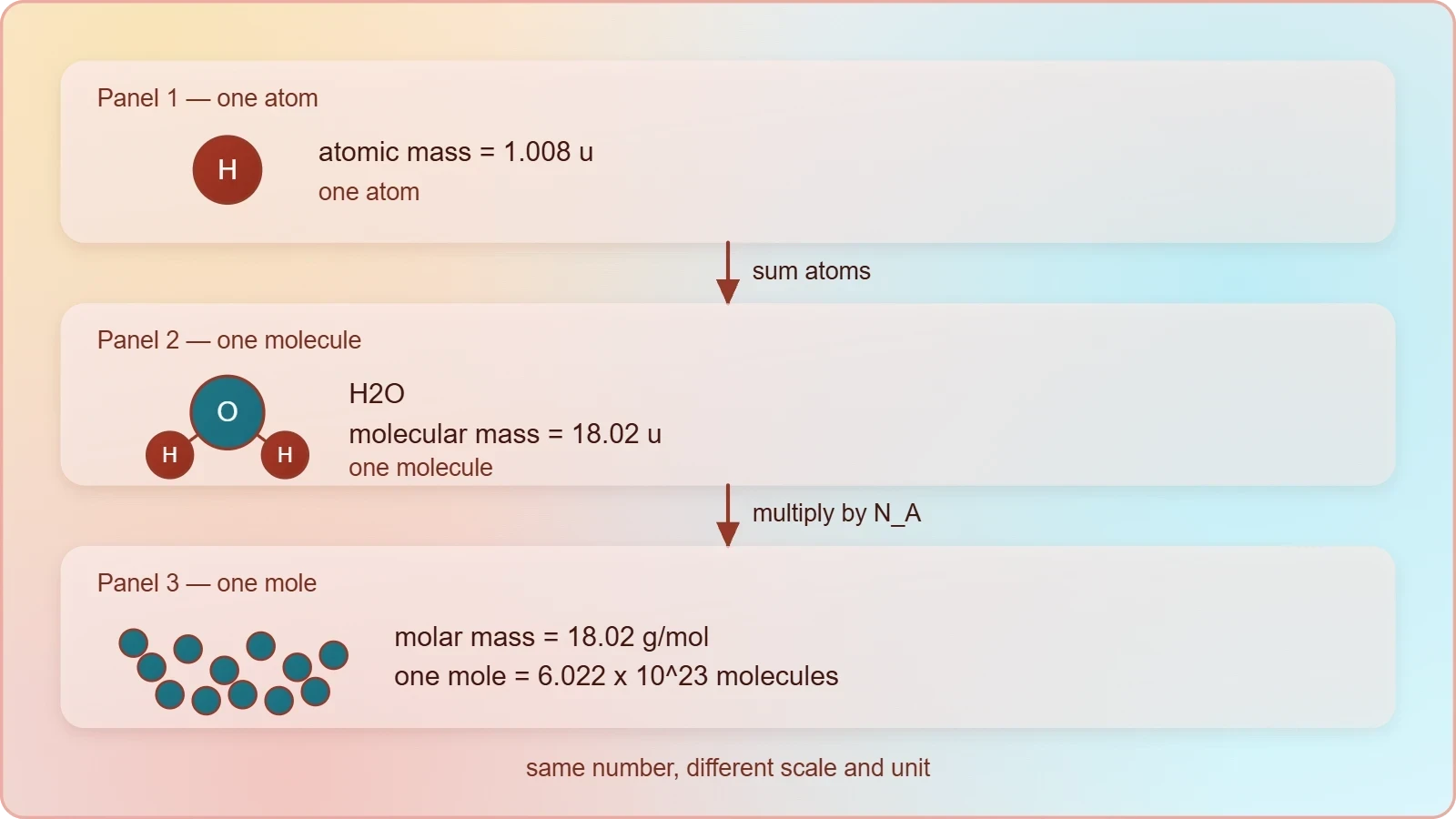
Molar mass is defined as the mass of one mole of a substance, expressed in grams per mole. Its numerical value coincides with the substance's relative molecular mass or formula mass because the mole is defined through the carbon-12 standard: one mole contains exactly ##6.022 \times 10^{23}## entities, and the molar mass of carbon-12 is exactly 12 g/mol. This deliberate alignment means that atomic masses read from the periodic table can be used directly as molar masses in grams per mole, eliminating the need for separate conversion factors and making the mole a genuinely practical counting unit for the laboratory.
The distinction between atomic mass, molecular mass and molar mass deserves careful attention because examiners exploit it relentlessly. Atomic mass is measured in unified atomic mass units and refers to a single atom; molecular mass is the sum of atomic masses in one molecule, also in atomic mass units; molar mass is the mass of an entire mole, in grams per mole. Numerically the three coincide, but their units and referents differ. A student who writes "the molar mass of water is 18.02 u" has confused a single molecule with a mole of molecules, a conceptual slip that signals shaky understanding even when the arithmetic is correct.
Computing Molar Mass from Chemical Formulas
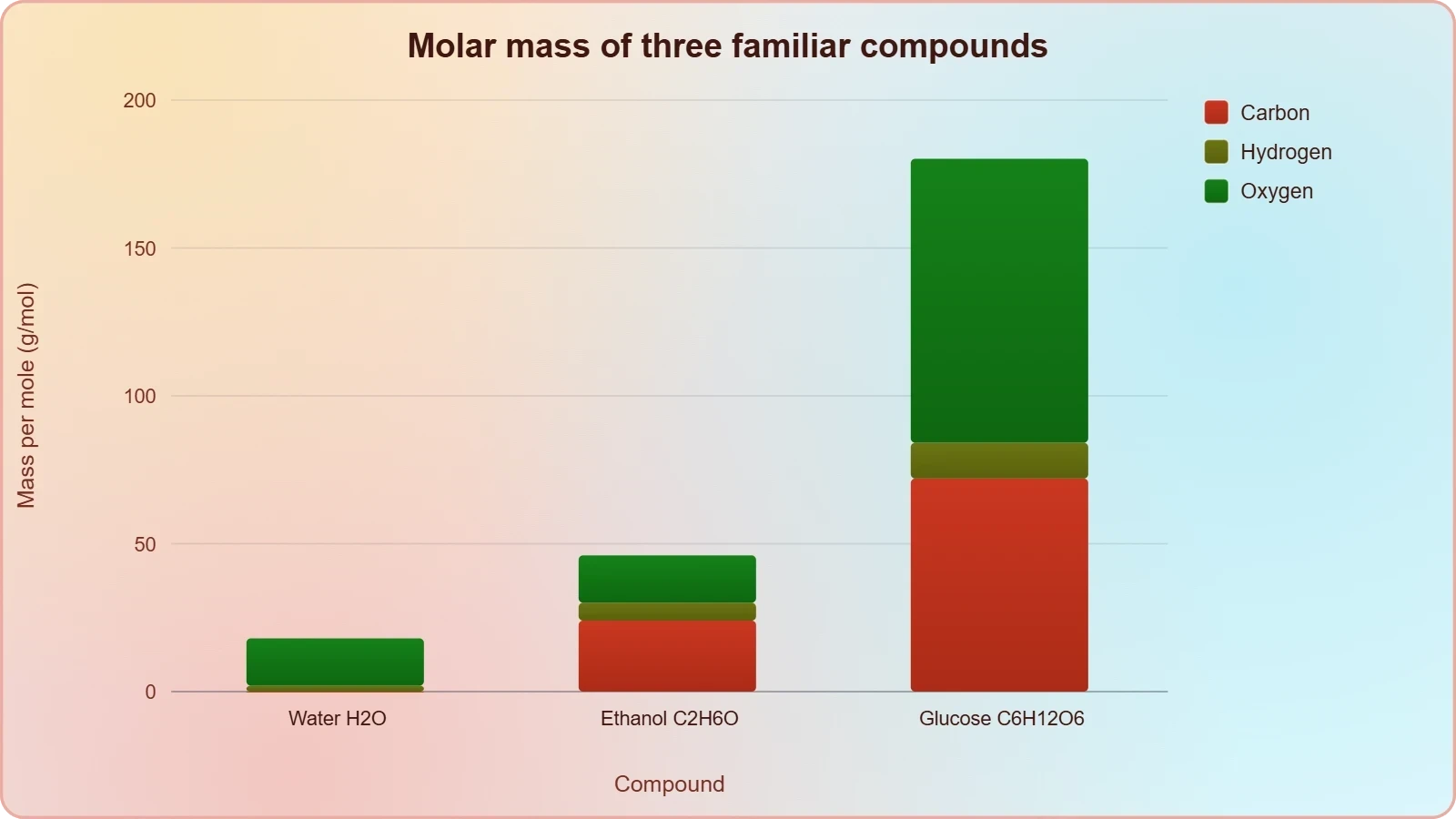
Calculating molar mass requires only the formula and a periodic table, yet the operation rewards systematic habits. For water, ##\text{H}_2\text{O}##, we sum two hydrogen atoms at 1.008 g/mol each and one oxygen at 16.00 g/mol, giving 18.02 g/mol. For ethanol, ##\text{C}_2\text{H}_5\text{OH}##, the count is two carbons (24.02), six hydrogens (6.048) and one oxygen (16.00), totalling 46.068 g/mol. Writing the arithmetic explicitly, element by element, prevents the silent omission of atoms hidden inside condensed groups such as the hydroxyl unit.
Glucose, ##\text{C}_6\text{H}_{12}\text{O}_6##, offers a richer exercise: six carbons contribute 72.06 g/mol, twelve hydrogens contribute 12.096 g/mol, and six oxygens contribute 96.00 g/mol, yielding 180.156 g/mol. Notice how the subscript applies to every atom of that element, and how polyatomic ions in ionic compounds must be multiplied as whole units. For calcium phosphate, ##\text{Ca}_3(\text{PO}_4)_2##, the phosphate group appears twice, so phosphorus contributes ##2 \times 30.97## and oxygen ##8 \times 16.00##. Careful bracketing is the single most effective defence against arithmetic error in such formulas.
Precision, Significant Figures and Common Errors
Reported molar masses should reflect the precision of the atomic masses used. Standard practice employs atomic masses to two decimal places, so water's molar mass is quoted as 18.02 g/mol rather than 18.01528 g/mol, and answers in calculations inherit the significant figures of the least precise input. Rounding intermediate molar masses too aggressively, however, propagates error through multi-step stoichiometry; carrying one extra digit until the final answer is the safer discipline. Examiners frequently deduct marks for premature rounding even when the method is flawless.
Three errors recur with striking frequency. First, students forget that a subscript outside parentheses multiplies every atom inside, so ##\text{Al}_2(\text{SO}_4)_3## contains twelve oxygens, not four. Second, hydrated salts are treated as anhydrous, ignoring the water of crystallisation; copper(II) sulfate pentahydrate, ##\text{CuSO}_4\cdot 5\text{H}_2\text{O}##, has a molar mass of 249.68 g/mol rather than 159.61 g/mol. Third, the molar mass of a diatomic element such as chlorine is taken as 35.45 g/mol instead of 70.90 g/mol, because the molecule contains two atoms. Each error is conceptual, not computational, and each is preventable by reading the formula slowly.
Converting Between Mass, Moles and Number of Particles
The central operational skill of this lesson is the three-way conversion linking mass, amount in moles, and particle count. The governing relations are simple but must be wielded with dimensional confidence. Mass divided by molar mass gives moles; moles multiplied by molar mass returns mass; moles multiplied by Avogadro's constant gives the number of entities. Chaining these relations allows any starting quantity to reach any target quantity, and the unit labels themselves act as a check, since unwanted units must cancel algebraically at every step.
Here ##n## is the amount in moles, ##m## the mass in grams, ##M## the molar mass in grams per mole, ##N## the number of particles, and ##N_A## Avogadro's constant, ##6.022 \times 10^{23}\ \text{mol}^{-1}##. These three equations, applied in sequence, solve the overwhelming majority of introductory quantitative problems. The discipline lies in identifying the known quantity, selecting the conversion that eliminates it, and repeating until the desired quantity remains. Students who sketch this pathway before touching a calculator make far fewer errors than those who improvise.
Worked Examples Across the Conversion Chain
Consider 9.00 g of water. Dividing by 18.02 g/mol gives 0.4994 mol, and multiplying by Avogadro's constant yields ##3.01 \times 10^{23}## molecules, each containing three atoms, so ##9.02 \times 10^{23}## atoms in total. Reversing the logic, how many grams of glucose contain ##1.20 \times 10^{24}## molecules? Dividing by Avogadro's constant gives 1.993 mol, and multiplying by 180.16 g/mol gives 359 g. The pathway is identical in both directions; only the entry point differs.
A subtler example asks for the mass of a single molecule of ethanol. Dividing the molar mass, 46.068 g/mol, by Avogadro's constant gives ##7.65 \times 10^{-23}## g per molecule, a figure so small that it explains why chemists count in moles rather than individual particles. Conversely, one can ask how many moles of oxygen atoms reside in 25.0 g of glucose: 25.0 g divided by 180.16 g/mol gives 0.1388 mol of glucose, and six oxygen atoms per molecule give 0.833 mol of oxygen atoms, or ##5.01 \times 10^{23}## atoms. Such multi-level reasoning is exactly what advanced examinations reward.
Building a Reliable Problem-Solving Routine
A dependable routine begins with writing the formula and computing the molar mass explicitly, even when it seems obvious. Next, convert every given quantity to moles, because the mole is the universal currency of chemical calculation. Only then apply the stoichiometric or structural relationship required, and finally convert back to the requested unit. This moles-in-the-middle strategy keeps the logic transparent and makes errors easy to localise, since a mistake in the first conversion cannot masquerade as a stoichiometric error later.
Dimensional analysis deserves explicit practice. Writing the conversion as a chain of fractions, with grams in the denominator of one factor and moles in the numerator of the next, guarantees that units cancel correctly and that the final unit matches the question. Students who skip this step often invert the molar mass, dividing where they should multiply. A useful habit is to ask, before calculating, whether the answer should be larger or smaller than the starting value: converting grams to moles of a heavy compound must yield a small number, and an answer of 500 mol from 10 g signals an inverted factor immediately.

Molar Mass in the Gas Phase and the Ideal Gas Law
Gases offer an elegant route to molar mass because their volume, pressure and temperature are all measurable, and the ideal gas law connects these observables to the amount of substance. The relation ##PV = nRT##, with ##R = 0.08206\ \text{L atm mol}^{-1}\text{K}^{-1}##, allows moles to be extracted from pressure, volume and temperature, after which division of the sample mass by those moles yields the molar mass. This is the classical method by which the molar masses of volatile compounds were determined long before modern spectrometry existed.
Substituting ##n = m/M## into the ideal gas law and rearranging gives the working equation above, which computes molar mass directly from measurable quantities. A sample of an unknown volatile liquid weighing 0.856 g occupies 0.325 L at 373 K and 1.00 atm. Applying the equation gives ##M = (0.856 \times 0.08206 \times 373)/(1.00 \times 0.325)##, which evaluates to 80.6 g/mol, a value that can then be matched against candidate formulas. The method is approximate because real gases deviate from ideality, but for moderate pressures and temperatures the error is small.

Gas Density and Vapour Density as Molar Mass Probes
Because density is mass per unit volume, the ideal gas law can be recast to relate density directly to molar mass. Rearranging gives ##\rho = PM/RT##, so measuring the density of a gas at known pressure and temperature yields its molar mass without weighing a known volume separately. This relationship explains why denser gases are heavier on a molar basis, and why the relative density of a gas with respect to hydrogen or air provides a rapid estimate of molar mass in the field or the teaching laboratory.
Vapour density, defined as the mass of a volume of gas relative to the mass of the same volume of hydrogen under identical conditions, is numerically half the molar mass when hydrogen is taken as 2 g/mol. A compound with vapour density 44 therefore has a molar mass near 88 g/mol. This older convention still appears in some curricula and examination questions, and recognising it prevents confusion when a problem supplies vapour density rather than molar mass directly. The underlying physics is simply the ideal gas law applied comparatively.
Limits of the Ideal Treatment
Real gases deviate from ideal behaviour at high pressure and low temperature, where intermolecular forces and molecular volume become significant. The van der Waals equation corrects for these effects with parameters specific to each gas, and molar masses derived from gas measurements under such conditions carry systematic error. For most educational problems the ideal treatment suffices, but advanced students should recognise that the precision of a gas-derived molar mass depends on how closely the experimental conditions approach ideality.
There is also a practical caution about volatile liquids: the sample must be fully vaporised, the apparatus must be dry, and the pressure must be measured after equilibration. Classic Dumas and Victor Meyer methods embody these precautions. When a problem states that a volatile liquid of known mass vaporises to fill a vessel at a given temperature and pressure, the calculation is straightforward, but the experimental reasoning behind the numbers is what distinguishes genuine understanding from formula substitution.
Molar Mass in Solution: Molarity and Concentration
Solution chemistry depends on molar mass at its very foundation, because concentration is defined in moles per unit volume and moles are reached through molar mass. Molarity, the most common concentration unit, expresses moles of solute per litre of solution, so preparing a solution of specified molarity requires weighing an appropriate mass of solute calculated from its molar mass. This single application underpins titrimetric analysis, buffer preparation, pharmacological dosing and virtually every quantitative procedure in the analytical laboratory.
To prepare 250.0 mL of 0.100 M glucose solution, one computes the required moles as ##0.100 \times 0.2500 = 0.0250## mol, then multiplies by 180.16 g/mol to obtain 4.50 g. The solute is weighed, dissolved, and the solution made up to volume in a volumetric flask, because molarity refers to the final solution volume rather than the volume of solvent added. This distinction matters: adding 250 mL of water to 4.50 g of glucose does not produce exactly 0.100 M solution, since the dissolved solute contributes to the final volume.

Dilution, Molality and Their Molar Mass Dependence
Dilution problems rely on the conservation of solute moles, expressed as ##c_1V_1 = c_2V_2##, and molar mass enters whenever a mass-based quantity must be converted to moles. Molality, defined as moles of solute per kilogram of solvent, is preferred where temperature changes would alter volume and hence molarity; converting a given mass of solute to moles again requires molar mass. Mass percentage and mole fraction, though defined differently, all trace back to the same conversion, making molar mass the common denominator of concentration calculations.
A typical examination problem asks for the molarity of a solution containing 5.85 g of sodium chloride in 500 mL. Dividing 5.85 g by 58.44 g/mol gives 0.1001 mol, and dividing by 0.500 L gives 0.200 M. Reversing the question, how many grams of potassium nitrate are needed for 2.00 L of 0.150 M solution? The moles are 0.300, and multiplying by 101.10 g/mol gives 30.3 g. Fluency with both directions is essential, and the arithmetic is trivial once the molar mass is correctly established.
Equivalent Mass and Normality
Equivalent mass extends the mole concept to reactive capacity rather than particle count. It is defined as the molar mass divided by the number of equivalents per mole, where the equivalence factor depends on the reaction: the number of replaceable hydrogen ions for an acid, the number of hydroxide ions for a base, or the number of electrons transferred for a redox species. Normality, the number of equivalents per litre, therefore equals molarity multiplied by the equivalence factor, and it changes with the reaction context in a way molarity does not.
For sulfuric acid, ##\text{H}_2\text{SO}_4##, the molar mass is 98.08 g/mol, but in complete neutralisation the equivalent mass is 49.04 g per equivalent because two protons are released. A 0.050 M solution is therefore 0.100 N. For potassium permanganate in acidic medium, five electrons are transferred per formula unit, so the equivalent mass is one-fifth of the molar mass. Normality remains useful in volumetric analysis because equivalents react in simple one-to-one ratios, but it is reaction-dependent and must be specified carefully to avoid ambiguity.
We Also Published
Molar Mass in Polymer Science and Biochemistry
Macromolecules present a complication absent from small molecules: a polymer or protein sample is not a single compound but a distribution of chain lengths, so no single molar mass describes it. Polymer chemists therefore report averages, principally the number-average molar mass ##M_n## and the weight-average molar mass ##M_w##. The number-average weights each chain equally, while the weight-average weights larger chains more heavily because they contribute more mass, and the ratio ##M_w/M_n##, called the polydispersity index, measures the breadth of the distribution.
In these expressions ##N_i## is the number of molecules of molar mass ##M_i##. Because ##M_w## weights by mass, it is always greater than or equal to ##M_n##, with equality only for a perfectly uniform sample. A polymer with ##M_n = 20{,}000## g/mol and ##M_w = 40{,}000## g/mol has a polydispersity index of 2.0, indicating a broad distribution. Different experimental methods probe different averages: osmometry yields ##M_n##, light scattering yields ##M_w##, and viscometry yields a related viscosity-average mass, so reporting the method alongside the value is essential for meaningful comparison.

Proteins and the Biochemistry of Molecular Mass
Proteins are heteropolymers whose molar masses range from a few thousand to several million grams per mole, and their mass is a fundamental descriptor of identity and function. The average molar mass of an amino acid residue in a protein is approximately 110 g/mol, so a polypeptide of 300 residues has a molar mass near 33,000 g/mol, or 33 kDa. This rough estimate is invaluable for interpreting gel electrophoresis, where migration distance correlates with molecular mass, and for judging whether a purified sample matches its expected size.
Modern mass spectrometry, particularly electrospray ionisation, determines protein molar masses with extraordinary precision, resolving isotopic envelopes and detecting post-translational modifications that shift mass by a few daltons. Haemoglobin, with four subunits, has a molar mass near 64,500 g/mol, while immunoglobulin G approaches 150,000 g/mol. In biochemistry, molar mass informs dosing of therapeutic proteins, calculation of molar extinction coefficients for spectrophotometry, and the design of experiments in structural biology, making it as practical as it is fundamental.
Colligative Evidence for Macromolecular Mass
Colligative properties provide independent routes to molar mass and are especially valuable for macromolecules. Osmotic pressure follows ##\Pi = cRT/M## in its simplest form, so measuring the osmotic pressure of a dilute solution yields the number-average molar mass directly. Because the effect depends on the number of particles rather than their identity, it is well suited to large molecules where freezing-point depression would be immeasurably small. Membrane osmometry remains a standard technique for characterising synthetic polymers and biological macromolecules alike.
Sedimentation equilibrium in the ultracentrifuge offers another route, balancing sedimentation against diffusion to yield molar mass distributions of high accuracy. These methods reinforce a conceptual point: molar mass is not merely a number derived from a formula but an experimentally accessible property, and different techniques probe it in different ways. Understanding which average a method reports, and why, is the mark of a student ready to engage with research literature rather than textbook exercises alone.
Consolidating the Applications and Preparing for Compositional Analysis
The applications surveyed here share a single logical structure: convert a measurable macroscopic quantity into moles using molar mass, apply the relevant physical or chemical relationship, and convert back to the desired unit. Whether the context is a gas in a vessel, a solute in a flask, a polymer in solution or a protein in a cell, the molar mass remains the exchange rate between the balance and the particle count. Recognising this unity transforms a list of apparently separate formulas into one coherent method.
Looking ahead, the next lesson on percentage composition and empirical formula determination depends entirely on the skills developed here. Determining an empirical formula requires converting mass percentages to moles, and converting an empirical formula to a molecular formula requires the molar mass. The worked example involving a compound of hydrogen, carbon and chlorine, with a molar mass of 98.96 g/mol, illustrates the sequence: mass percentages become grams in a 100 g sample, grams become moles, and the molar mass then scales the empirical formula to the molecular one. Mastery of molar mass is therefore the prerequisite for that analysis.
Summary of Core Relationships
The essential relations can be gathered compactly. Moles equal mass divided by molar mass; particles equal moles times Avogadro's constant; gas molar mass equals ##mRT/PV##; molarity equals mass divided by molar mass times volume; normality equals molarity times the equivalence factor; and polymer averages follow the summation formulas given earlier. Each relation is a special case of the mass–mole bridge, and each can be derived from the others with modest algebra, which is precisely why understanding the bridge matters more than memorising the list.

Students preparing for advanced examinations should practise switching between these relations rapidly and should verify every answer by a sanity check on magnitude and units. A molar mass of 18 g/mol for water, 46 g/mol for ethanol and 180 g/mol for glucose should be known by heart, as should the value of Avogadro's constant and the molar volume of an ideal gas at standard conditions. These anchors make estimation possible and catch gross errors before they reach the answer sheet.
Common Pitfalls Revisited
The most damaging errors are conceptual rather than arithmetical. Confusing molecular mass with molar mass, forgetting waters of crystallisation, treating diatomic elements as monatomic, and inverting the molar mass in conversion factors account for a large share of lost marks. Equally common is the failure to distinguish solution volume from solvent volume in molarity calculations, and the assumption that normality equals molarity for all substances. Each pitfall has a simple antidote: read the formula carefully, write units at every step, and state the reaction context when using equivalents.
A final caution concerns significant figures and precision. Molar masses computed from two-decimal atomic masses carry limited precision, and chaining several such values compounds uncertainty. Reporting an answer to more figures than the inputs justify is a formal error, and examiners penalise it. The professional habit is to carry extra digits through intermediate steps, round only at the end, and state the final answer with the appropriate number of significant figures, ideally with units attached so that the quantity is unambiguous.
Worked Problems and Self-Assessment
Consolidation through practice is indispensable, so this section gathers representative problems that span the lesson's scope. Attempt each before reading the solution, and pay attention to the reasoning pathway rather than the arithmetic alone. The problems deliberately mix contexts, from a simple mass-to-mole conversion to a gas-density determination and a polymer average, because examination questions rarely announce which relationship applies. Recognising the applicable relation from the wording is itself a skill worth cultivating deliberately.
Problem one: calculate the molar mass of aluminium sulfate, ##\text{Al}_2(\text{SO}_4)_3##. Two aluminium atoms contribute 53.96 g/mol, three sulfur atoms contribute 96.21 g/mol, and twelve oxygen atoms contribute 192.00 g/mol, giving 342.17 g/mol. Problem two: how many molecules are present in 4.40 g of carbon dioxide? Dividing by 44.01 g/mol gives 0.100 mol, and multiplying by Avogadro's constant gives ##6.02 \times 10^{22}## molecules. Both problems reward the disciplined moles-in-the-middle approach.
Gas and Solution Problems
Problem three: a gaseous compound weighing 1.52 g occupies 0.500 L at 300 K and 0.950 atm. Applying ##M = mRT/PV## gives ##(1.52 \times 0.08206 \times 300)/(0.950 \times 0.500)##, which evaluates to 78.8 g/mol, consistent with benzene. Problem four: what mass of sodium hydroxide is required to prepare 750 mL of 0.200 M solution? The moles are 0.150, and multiplying by 40.00 g/mol gives 6.00 g. Problem five: a 0.100 M sulfuric acid solution is used in a complete neutralisation; state its normality. Since two protons are released, the normality is 0.200 N.
Problem six: a polymer sample contains equal numbers of chains of molar mass 10,000 and 30,000 g/mol. The number-average is 20,000 g/mol, but the weight-average is ##(10{,}000^2 + 30{,}000^2)/(10{,}000 + 30{,}000) = 25{,}000## g/mol, giving a polydispersity index of 1.25. This example demonstrates concretely why the two averages differ and why the weight-average is always the larger. Students who can reproduce this calculation from first principles have understood the distinction rather than merely memorised the formulas.
Programming the Conversions
Computational practice reinforces the logic and prepares students for data-heavy laboratory work. The short script below performs the core conversions for a compound given its molar mass, and can be extended to batch-process a table of samples. Writing such code forces explicit attention to units and to the order of operations, and it makes the moles-in-the-middle strategy visible as a sequence of function calls rather than an implicit mental habit.
AVOGADRO = 6.022e23

def moles_from_mass(mass_g, molar_mass):
    return mass_g / molar_mass

def particles_from_moles(moles):
    return moles * AVOGADRO

def molarity(mass_g, molar_mass, volume_l):
    return moles_from_mass(mass_g, molar_mass) / volume_l

glucose_M = 180.16
m = 9.00
n = moles_from_mass(m, glucose_M)
print(f"Moles of glucose: {n:.4f}")
print(f"Molecules: {particles_from_moles(n):.3e}")
print(f"Molarity in 0.500 L: {molarity(m, glucose_M, 0.500):.4f} M")
Running this script for 9.00 g of glucose in 0.500 L returns 0.0500 mol, ##3.01 \times 10^{22}## molecules, and a molarity of 0.100 M, matching the hand calculations exactly. Extending the script to accept a dictionary of formulas and molar masses allows rapid exploration of how concentration and particle count vary with solute identity. Such exercises build the numerical confidence that laboratory work demands, and they demonstrate that the chemistry resides in the relationships, not in the keystrokes.
From our network :
- AI-Powered 'Precision Diagnostic' Replaces Standard GRE Score ReportsDiscover the new GRE Precision Diagnostic. Learn how AI-powered behavioral analytics and time-to-solve tracking are replacing standard GRE score reports to empower students.
- 98% of Global MBA Programs Now Prefer GRE Over GMAT Focus EditionExplore why 98% of global MBA programs now prefer the GRE over GMAT Focus. Learn about the shorter GRE format, verbal logic importance, and strategic versatility for students.
- Where to Put Your Wireless Router for Better CoverageA practical, physics-grounded guide to router placement: why the centre of the home beats the corner, how walls and metal sap signal, and how to run a simple survey that proves the improvement.
- 10 Physics Numerical Problems with Solutions for IIT JEEPrepare for IIT JEE with 10 physics numerical problems, complete with detailed solutions and conceptual explanations. Ideal for mastering kinematics, thermodynamics, electromagnetism, and optics.
- Analyzing Trump Deportation Numbers Insights Into The 2026 Immigration Crackdown
- How to Print Cheaply: Cutting the Cost per PageA practical, measured guide to lowering what each printed page costs — duplex and draft modes, third-party ink, yield mathematics, and knowing when a new printer beats refills.
- EV 2.0: The Solid-State Battery Breakthrough and Global Factory ExpansionDiscover the impact of the Solid-State Battery Breakthrough on the EV market. Learn about CATL and BYD stock growth, global factory expansion in Europe, and the future of EV 2.0 technology.
- Trump Political Strategy How Geopolitical Stunts Serve As Media Diversions
- Do You Need a New Router or Is Your Internet Plan the Problem?A practical comparison of the signs that point to router limits versus signs your broadband speed or provider is the bottleneck, so you can decide what to replace before spending money.
RESOURCES
- Molar Mass and its Applications - AP Chem Unit 1, Topic 1b - YouTubeyoutube.comAug 12, 2023 ... Learn AP Chemistry with Mr. Krug! Get the AP Chemistry Ultimate Review Packet: http://www.ultimatereviewpacket.com/courses/chem *Guided ...
- Effect of the molar mass of chitosan and film casting solvents on the ...tandfonline.comThe current study aimed at appraising the effects of the molar mass ... Chitosan: Properties and Its Application in Agriculture in Context of Molecular…
- Review of bemiparin sodium--a new second-generation ... - PubMedpubmed.ncbi.nlm.nih.govReview of bemiparin sodium--a new second-generation low molecular weight heparin and its applications in venous thromboembolism · Author · Affiliation.
- Molar mass effect in food and health - PMCpmc.ncbi.nlm.nih.govIn the industrial application of these thickening and gelling polysaccharides, the solubility and the hydration rate and extent are important, which are related ...
- Dependency of tensile properties and biodegradation on molecular ...nature.comSep 17, 2024 ... ... its application by adjusting the molecular mass through hydrolysis. The mechanical properties depending on molecular mass changes or other ...
- Reductive Partial Depolymerization of Acetone Organosolv Lignin to ...pubs.acs.orgApr 3, 2023 ... ... molar mass and reduce its heterogen. ... molar mass heterogeneity and potentially the reactivity of lignin hydroxyl groups in…
- Absolute Molar Mass Analysis of Chitosans | LCGC Internationalchromatographyonline.comChitosan is deacetylated chitin. It can be obtained from shrimp or crab shells. Its applications vary from the therapeutic, such as wound healing, to…
- Molar Mass - Formulas, Calculations, Definition and Applicationsflexbooks.ck12.orgThe units for molar mass are grams per mole or g/mol. Molar Masses of Compounds. A molecular formula of the compound carbon dioxide is…
- Absolute Molar Mass in UHPLC via the µDAWN and UT-rEX - AWSwyattfiles.s3-us-west-2.amazonaws.comcally for UHPLC applications, combine to measure the absolute molecular weight (or molar mass) and size of eluting species in UHPLC. For a given…
- Plasticization Effects of PEG of Low Molar Fraction and Molar Mass ...pubs.acs.orgApr 3, 2025 ... ... Molar Fraction and Molar Mass on the Molecular ... the performance of these systems, considering the envisaged biomedical applications.
- AN1308: SEC-MALS to determine chitosan molar mass - AWSwyattfiles.s3-us-west-2.amazonaws.comChitosan is deacetylated chitin. It can be obtained from shrimp or crab shells. Its applications vary from the therapeutic, such as wound healing, to…
- SEC-MALS for Absolute Molar Mass and Size Measurementswyatt.comThe molar mass, and (if the molecule is large enough its rms radius as ... The theory and applications of light scattering and differential…
- Tissue Profiling by Mass Spectrometry: A Review of Methodology ...sciencedirect.comApplications of MALDI MS Imaging—. Imaging of a tissue section involves the generation of an ordered array of spots or pixels so that multiple…
- How to Determine Molar Mass by SEC-MALS - Wyatt Technologywyatt.commolar mass in order to provide accurate molar mass distributions across the chromatogram or fractogram. Important Applications of SEC-MALS and FFF-MALS.
- Mass Spectrometer - StatPearls - NCBI Bookshelfncbi.nlm.nih.govNov 22, 2024 ... ... the same as the mass of the molecular ion. ... 20. Hemling ME. Fast atom bombardment mass spectrometry and…