Quantitative chemistry rewards precision, yet even capable students lose marks not because they misunderstand the mole concept but because a single unit, a rounding decision, or a misread coefficient quietly corrupts an otherwise sound calculation. The discipline of stoichiometry is unforgiving in this respect: a mass expressed in grams where kilograms were required, or a molar mass quoted to two figures when four are justified, propagates through every subsequent step until the final answer is confidently wrong. Recognising these failure patterns is therefore as important as mastering the underlying theory, and it is the specific skill this lesson develops.
This closing-stage lesson in the course builds directly on combustion analysis and empirical formula determination, where multi-step arithmetic already demands careful bookkeeping. Here the focus shifts from new chemical content to the craft of calculation itself: dimensional analysis as a structural safeguard, estimation as an independent check, significant figures as an honest statement of measurement confidence, and error propagation as the formal language describing how uncertainty compounds. Each pitfall examined below is drawn from patterns that recur in real student work, which makes the material immediately practical rather than abstract.
By the end, you should be able to audit your own solutions systematically, catching unit slips before they spread, judging when a reported value claims more certainty than the data permit, and preparing for the capstone problems where these habits become indispensable. The treatment is deliberately diagnostic: every error category is paired with a detection strategy and a corrective routine, so that the lesson functions as a reference you can return to during examination preparation and laboratory work alike.
On This Page
- Why Basic Chemistry Calculations Fail: A Diagnostic Framework
- Dimensional Analysis as a Structural Safeguard
- Significant Figures and the Honest Reporting of Results
- Mole Calculations: Where Conceptual Confusion Becomes Numerical Error
- A Checklist for Stoichiometry and the Power of Estimation
- Error Propagation in Multi-Step Calculations
- Learning from Student Work: Documented Pitfalls and Their Remedies
- Preparing for the Capstone: Consolidating the Habits
Why Basic Chemistry Calculations Fail: A Diagnostic Framework
Errors in chemical arithmetic are rarely random. They cluster into recognisable families, and once you can name the family, you can design a defence against it. The most productive way to think about mistakes is to separate them into conceptual failures, where the chemistry itself is misunderstood, and procedural failures, where the chemistry is sound but the execution breaks down. A student who multiplies moles by molar mass instead of dividing has a conceptual gap; a student who performs the correct operation but forgets to convert milligrams to grams has a procedural one. The remedies differ sharply, and conflating the two wastes study time.
Procedural errors are the more common and the more easily eliminated, because they respond to checklists and structural habits rather than to re-teaching. Conceptual errors demand a return to first principles, particularly the meaning of the mole as a counting unit and the distinction between formula units, molecules, and ions. A useful diagnostic question to ask of any wrong answer is whether the number is off by a small factor, suggesting a unit or rounding slip, or by orders of magnitude, suggesting an inverted ratio or a confused conversion.
Classifying the Four Dominant Error Families
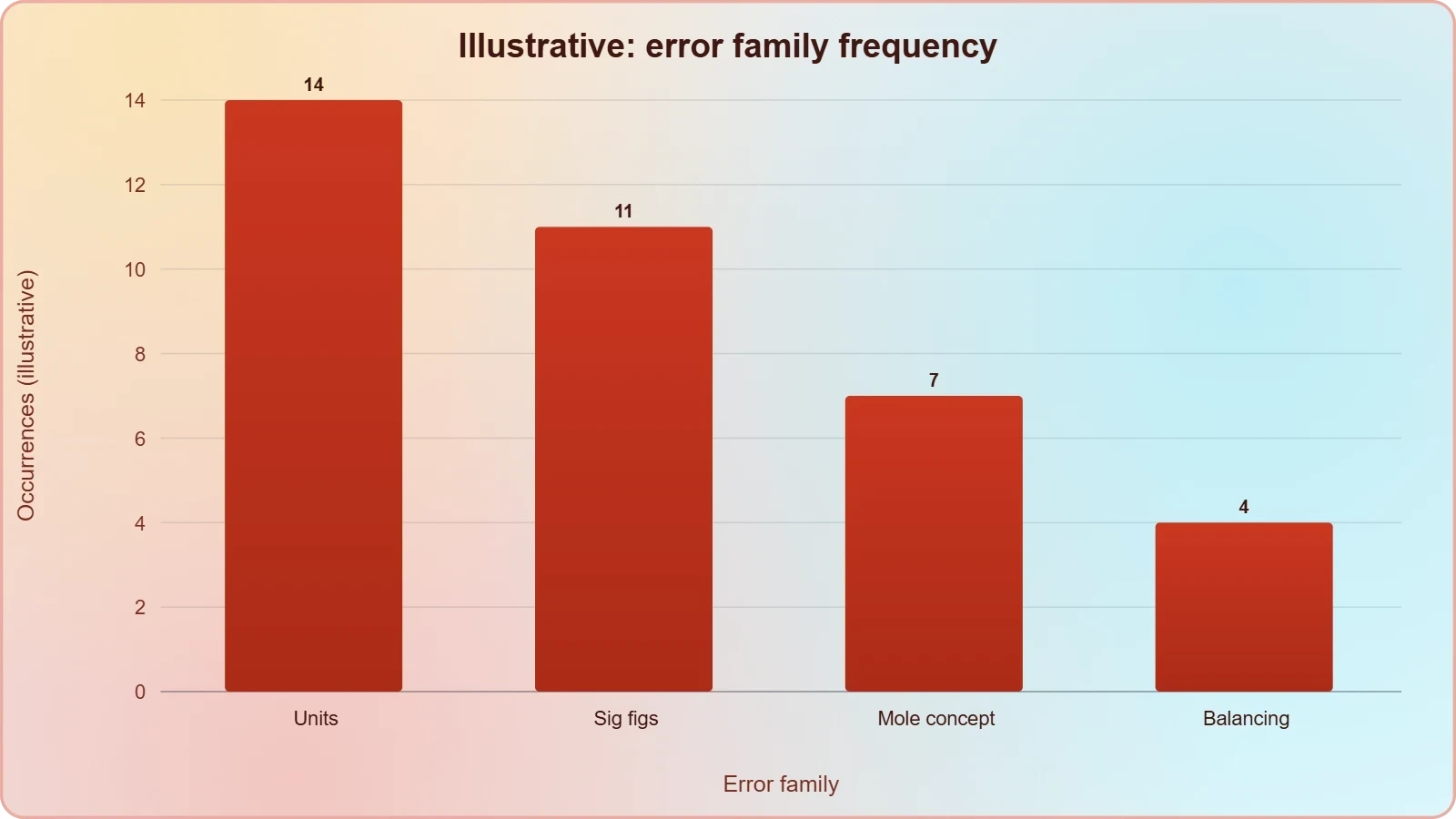
The first family covers unit and dimensional errors, in which quantities are combined without regard to whether their units are compatible. The second covers significant-figure and rounding errors, where the numerical value is arithmetically correct but the reported precision misrepresents the measurement. The third covers mole-concept errors, including confusion between molar mass and molecular mass, or between the number of particles and the number of moles. The fourth covers stoichiometric ratio errors, where coefficients from a balanced equation are applied to the wrong species or omitted entirely.
Each family has a characteristic signature in student work. Unit errors often produce answers that are dimensionally absurd, such as a mass expressed in moles per litre. Significant-figure errors produce over-precise answers like 4.23718 grams from data with three significant figures. Mole-concept errors frequently involve a factor of Avogadro's number appearing where it should not. Ratio errors typically produce answers that are stoichiometrically plausible but wrong by a simple integer factor, which is why comparing against an estimate catches them so reliably.
Building a Personal Error Audit
An error audit is a short written record, kept across several problem sets, noting the type of each mistake rather than merely the correct answer. After ten or fifteen entries, patterns emerge with striking clarity: most students discover they repeatedly commit two or three specific errors rather than a broad spectrum. Targeting those specific habits is far more efficient than general revision, because the marginal return on eliminating a recurring error is enormous compared with re-reading material already understood.
The audit should record the step at which the error occurred, not just the final answer. A mistake introduced during the conversion of grams to moles has a different remedy from one introduced during the final rounding. Recording the step forces you to locate the failure precisely, and the act of writing it down reinforces the corrective habit. Over a term, this practice converts vague anxiety about calculation into a concrete, shrinking list of specific weaknesses.
Dimensional Analysis as a Structural Safeguard
Dimensional analysis is the single most powerful defence against unit errors, because it converts an arithmetic operation into a statement that can be checked independently of the numbers. The principle is simple: treat units as algebraic quantities that multiply, divide, and cancel exactly as numbers do. If the units of the final expression do not match the units required by the question, the calculation is wrong regardless of how carefully the arithmetic was performed. This check costs seconds and catches an entire family of errors that numerical verification alone would miss.
The technique is best applied by writing the full chain of conversion factors as a single expression, with units arranged so that unwanted ones cancel diagonally. Rather than computing intermediate values, you construct a continuous product in which grams cancel grams, moles cancel moles, and only the target unit survives. This approach, sometimes called the factor-label method, makes the logic of the calculation visible and auditable, and it removes the temptation to guess whether a particular quantity should be multiplied or divided.
Constructing Conversion Chains That Cancel Cleanly
Consider converting a mass of a compound to the number of molecules it contains. The chain runs from grams to moles using the molar mass, then from moles to molecules using Avogadro's constant. Written as a single product, the units read grams × (moles/grams) × (molecules/moles), and both grams and moles cancel, leaving molecules. The structure of the expression guarantees the correct operation at each stage, because an inverted factor would leave the wrong unit standing and immediately expose itself.

The same discipline applies to concentration problems, where molarity carries units of moles per litre, and to gas calculations, where the molar volume links moles to litres at stated conditions. In every case, the rule is to write the units explicitly alongside every number, even when the arithmetic seems trivial. The habit feels laborious at first and becomes automatic within a few weeks, at which point it operates as a silent error filter on every problem you attempt.
Worked Illustration: A Unit Slip Caught Before It Spreads
Suppose a student is asked for the mass of sodium chloride produced when 0.500 moles of sodium react completely. The correct calculation multiplies 0.500 moles by the molar mass of NaCl, approximately 58.44 grams per mole, giving 29.2 grams. A common slip is to use the molar mass of sodium alone, 22.99, yielding 11.5 grams. Dimensional analysis does not catch this particular error, since the units are correct, which is precisely why estimation and chemical reasoning must supplement it.
Now suppose instead the student is given 500 milligrams of sodium and forgets the conversion to grams. The calculation proceeds with 500 rather than 0.500, and the answer is inflated a thousandfold. Here dimensional analysis catches the error instantly if the units are tracked, because the milligram unit never cancels. The two examples together show the division of labour: dimensional analysis polices units, while estimation and chemical sense police the choice of quantities.

# Dimensional analysis as an executable check
# Convert 500 mg of Na to mass of NaCl produced (Na + Cl2 -> 2 NaCl, so 2 Na : 2 NaCl)

molar_mass_Na = 22.99   # g/mol
molar_mass_NaCl = 58.44 # g/mol

mass_Na_mg = 500.0
mass_Na_g = mass_Na_mg / 1000.0        # explicit mg -> g conversion

moles_Na = mass_Na_g / molar_mass_Na
moles_NaCl = moles_Na * (2 / 2)        # stoichiometric ratio from balanced equation
mass_NaCl = moles_NaCl * molar_mass_NaCl

print(f"{mass_NaCl:.3f} g NaCl")       # ~1.27 g, consistent with estimation
Significant Figures and the Honest Reporting of Results
Significant figures are not a cosmetic convention but a statement about the reliability of a measurement. When a balance reads 2.50 grams, it asserts confidence to the nearest hundredth of a gram, and no subsequent calculation can legitimately manufacture more certainty than that. Reporting an answer to six decimal places from three-figure data is therefore a misrepresentation, however arithmetically exact the computation. Examiners penalise this consistently because it signals a misunderstanding of what measurement means.
The rules themselves are straightforward: multiplication and division limit the answer to the smallest number of significant figures among the inputs, while addition and subtraction limit it to the least precise decimal place. The difficulty lies not in the rules but in applying them at the correct moment. A widespread error is to round at every intermediate step, which accumulates rounding error and can shift the final digit. The correct practice is to carry extra figures through the calculation and round only the final reported value.
Counting Figures Correctly in Ambiguous Cases
Ambiguity arises with trailing zeros, with numbers written without a decimal point, and with exact conversion factors. The value 1000 grams could carry one, two, three, or four significant figures depending on context, and scientific notation resolves the ambiguity by writing 1.000 × 10³ for four figures. Exact numbers, such as the coefficients in a balanced equation or the definition of the mole, carry infinite precision and never limit the answer. Confusing exact and measured quantities is a frequent source of wrongly truncated results.
Another subtle case involves logarithmic quantities such as pH, where the number of significant figures is determined by the mantissa rather than the whole number. A pH of 4.72 corresponds to a hydrogen ion concentration with two significant figures, not three, because the integer part merely locates the decimal point. Recognising these special cases prevents the mechanical application of rules where they do not apply, and it demonstrates the kind of judgement that distinguishes careful quantitative work.
Rounding Discipline in Multi-Step Problems
In a multi-step stoichiometric calculation, the final answer should be rounded once, at the end, to the number of significant figures justified by the least precise input. Intermediate values should be carried with at least one or two extra figures, often retained in the calculator's memory rather than transcribed. This practice avoids the cumulative drift that occurs when each step is rounded independently, a drift that can amount to several units in the last reported digit across a long chain of operations.

It is worth noting that rounding conventions themselves vary slightly: the common rule of rounding half up differs from the banker's rounding used in some computational contexts. For examination purposes, the standard convention of rounding the final digit according to the following digit is expected, and consistency matters more than the choice of convention. What is never acceptable is presenting a result whose precision cannot be defended from the data, since that undermines the credibility of the entire calculation.
Mole Calculations: Where Conceptual Confusion Becomes Numerical Error
The mole is a counting unit, defined as the amount of substance containing exactly 6.02214076 × 10²³ elementary entities. Most mole-calculation errors trace back to losing sight of this definition and treating the mole as a mass rather than a count. When a student multiplies a mass by molar mass instead of dividing, the underlying confusion is between the conversion factor and the quantity being converted. Restating the relationship in words before substituting numbers is a reliable way to prevent the inversion.
A second cluster of errors involves the distinction between molar mass and molecular mass. Molar mass is expressed in grams per mole and is numerically equal to the relative molecular mass, but the two carry different units and different meanings. Writing the units explicitly, as dimensional analysis demands, keeps the distinction visible. A third cluster involves Avogadro's constant, which converts between moles and particles but has no place in a calculation that moves only between mass and moles.
Molar Mass, Molecular Mass, and the Inversion Trap
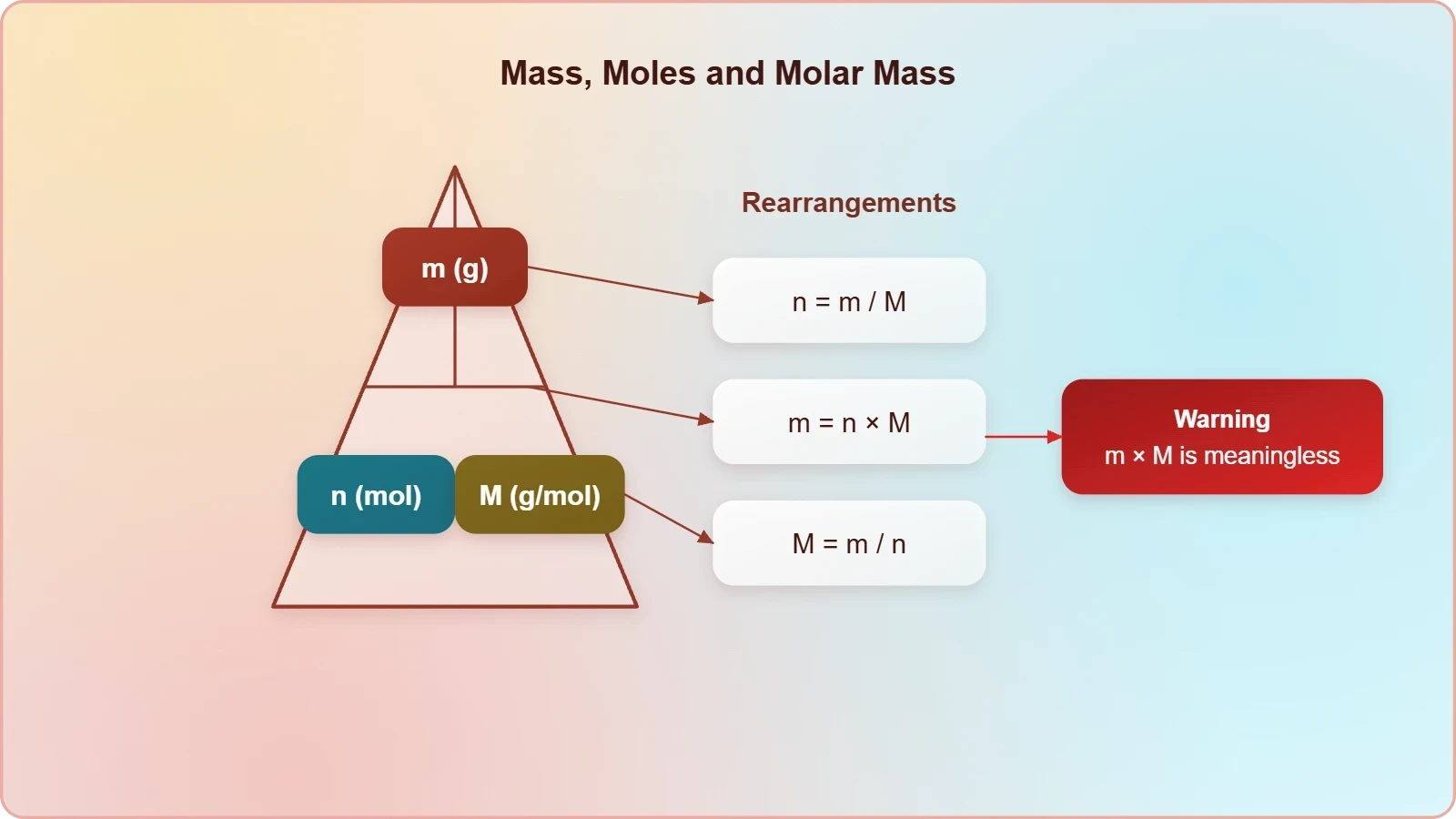
The relationship linking mass, moles, and molar mass is compact and worth committing to memory in its rearranged forms. The number of moles equals the mass divided by the molar mass, and the mass equals the number of moles multiplied by the molar mass. Writing the triangle or the equation before substituting values forces a conscious choice of operation, and it is far more reliable than trying to remember which way the ratio goes under examination pressure.
Here ##n## is the amount in moles, ##m## the mass in grams, and ##M## the molar mass in grams per mole. The inversion trap occurs when a student computes ##m \times M##, which yields grams squared per mole, a dimensionally meaningless quantity. If units are tracked, this error cannot survive, because the result carries a unit that answers no chemical question. The trap is common precisely because the multiplication feels natural, which is why the unit check must be habitual rather than optional.
Avogadro's Constant Applied in the Wrong Place
Avogadro's constant converts moles to elementary entities, and it should appear only when the question asks for a number of atoms, molecules, ions, or formula units. A frequent error is to multiply a mass by Avogadro's constant directly, bypassing the mole entirely, which produces an astronomically large and obviously wrong answer. Estimation catches this immediately: a few grams of any ordinary substance contains on the order of 10²² particles, never 10⁴⁶.
Care is also needed in deciding what counts as an entity. One mole of sodium chloride contains one mole of formula units but two moles of ions, and one mole of oxygen gas contains one mole of molecules but two moles of oxygen atoms. Reading the question for the specific entity requested, and writing that entity as the target unit in the dimensional chain, resolves the ambiguity before any arithmetic begins. This single habit eliminates a large proportion of mole-concept errors in examination scripts.
A Checklist for Stoichiometry and the Power of Estimation
Stoichiometric problems combine every skill discussed so far, which is why a fixed procedural checklist pays for itself many times over. The checklist should be short enough to memorise and specific enough to catch the dominant errors. A workable sequence runs as follows: write and balance the equation; identify the given quantity and its unit; convert the given to moles; apply the mole ratio from the balanced equation; convert to the requested unit; check the answer by estimation and by dimensional analysis; then round to the appropriate number of significant figures.
The order matters. Balancing before converting prevents the ratio error, since the coefficients are established while attention is fresh. Converting to moles early places the calculation on the common currency of chemical arithmetic, from which any target unit can be reached. Saving the rounding until the end preserves precision throughout. And placing the estimation check before the final rounding means that a gross error is caught while the numbers are still easy to adjust, rather than after the answer has been committed to paper.
The Seven-Step Stoichiometry Protocol
Step one is to read the question twice, identifying precisely which substance is given and which is requested. Step two is to write the balanced equation, including state symbols where relevant. Step three is to convert the given mass, volume, or concentration into moles. Step four is to apply the stoichiometric ratio, taking care that the coefficients correspond to the correct species on each side. Step five is to convert the moles of the target into the requested unit. Step six is the estimation check. Step seven is the final rounding and the statement of units.
Each step has a characteristic failure mode, and naming them makes the checklist diagnostic rather than merely procedural. Step one fails when the wrong substance is identified. Step two fails when the equation is unbalanced or a coefficient is omitted. Step three fails on unit conversion. Step four fails on ratio inversion. Step five fails on the reverse conversion. Step six is skipped altogether by most students, which is why it deserves explicit inclusion. Step seven fails on premature rounding or on omitted units.
Estimation as an Independent Verification
Estimation works by replacing awkward numbers with round ones and checking whether the answer lands in the right region. If a calculation suggests that burning 1 gram of methane produces 2.75 grams of carbon dioxide, an estimate confirms the plausibility: one mole of methane, about 16 grams, yields one mole of carbon dioxide, about 44 grams, so the mass ratio is roughly 2.75 to 1. The estimate and the calculation agree, and confidence is justified. If the calculation had produced 27.5 grams, the estimate would have flagged the decimal slip immediately.
The technique is especially valuable for catching order-of-magnitude errors, which are the most damaging because they survive casual inspection. A result that is ten times too large or a thousand times too small often looks superficially reasonable, particularly when the digits themselves are correct. Estimation provides an independent line of evidence, computed by a different route, and agreement between two independent routes is far stronger evidence than a single careful calculation. Cultivating the habit of a quick mental estimate before reaching for the calculator is one of the highest-value investments a chemistry student can make.
We Also Published
Error Propagation in Multi-Step Calculations
Every measurement carries uncertainty, and when measurements are combined arithmetically, their uncertainties combine as well. Error propagation is the formal treatment of this compounding, and although the full calculus-based derivation lies beyond this course, the working rules are accessible and highly practical. For addition and subtraction, absolute uncertainties add. For multiplication and division, relative or percentage uncertainties add. These rules explain why a long chain of operations can produce a final uncertainty far larger than any single input, and why reporting an answer without acknowledging that uncertainty is incomplete.
The practical consequence is that the weakest link dominates. If one measurement in a chain carries a relative uncertainty of five per cent while all others carry one per cent, the final answer inherits approximately five per cent, and improving the other measurements yields almost nothing. This insight guides experimental design: effort should be concentrated on the least precise measurement, because that is where the overall uncertainty is determined. Recognising this prevents the common mistake of agonising over precision in quantities that do not limit the result.
Combining Uncertainties: Addition and Multiplication Rules
For a sum or difference, the absolute uncertainties combine in quadrature for independent random errors, though the simple sum provides a conservative upper bound suitable for routine work. For a product or quotient, the relative uncertainties combine, again in quadrature for independent errors. The quadrature rule reflects the statistical fact that independent errors are as likely to cancel as to reinforce, so the combined uncertainty grows more slowly than a simple sum would suggest.
In this expression, ##z = xy## or ##z = x/y##, and ##\delta x##, ##\delta y## denote the absolute uncertainties in ##x## and ##y##. The equation states that the relative uncertainty in the result is the quadrature sum of the relative uncertainties in the inputs. For a single multiplication by an exact constant, the relative uncertainty is unchanged, which is why exact stoichiometric coefficients never degrade precision. Applying these rules to a worked example makes their practical meaning concrete.
Worked Example: Uncertainty Through a Three-Step Chain
Suppose a mass of 2.500 ± 0.005 grams of a compound of molar mass 100.0 ± 0.1 grams per mole is dissolved and diluted to 250.0 ± 0.2 millilitres. The relative uncertainty in mass is 0.2 per cent, in molar mass 0.1 per cent, and in volume 0.08 per cent. The concentration is computed as moles divided by volume, so the relative uncertainties combine in quadrature to give approximately 0.24 per cent. The final concentration therefore carries an uncertainty of about 0.24 per cent, dominated by the mass measurement.

This example illustrates the diagnostic value of propagation analysis. The mass measurement contributes the largest share of the final uncertainty, so upgrading the balance would improve the result more than refining the volumetric glassware. Conversely, if the volume uncertainty had been one per cent, it would have dominated, and the balance would have been adequate. Propagation analysis thus converts a vague sense that measurements matter into a precise allocation of experimental effort, and it provides the justification for the significant figures reported in the final answer.
Learning from Student Work: Documented Pitfalls and Their Remedies
The most instructive errors are those that recur across cohorts, because they reveal systematic gaps rather than individual lapses. A representative example: a student asked for the volume of carbon dioxide produced at standard conditions from the complete combustion of 4.00 grams of methane writes the balanced equation correctly, converts the mass to moles correctly, applies the one-to-one ratio correctly, and then reports the answer in grams rather than litres. The chemistry is flawless; the final unit is simply the wrong one, and the mark is lost.
Another recurring pattern involves hydrated salts. Asked for the mass of anhydrous copper sulphate obtainable from 10.0 grams of the pentahydrate, a student uses the molar mass of anhydrous CuSO₄, 159.6 grams per mole, instead of the hydrated molar mass, 249.7 grams per mole. The error is conceptual rather than careless, since it reflects a failure to recognise that the water of crystallisation contributes to the mass of the starting material. The remedy is to write the full formula, including the dot and the water, before computing any molar mass.
Three Annotated Cases from Examination Scripts
In the first case, a student calculates the number of moles in 5.00 grams of calcium carbonate as 5.00 multiplied by 100.1, obtaining 500.5. The error is the inversion trap, and the absurd magnitude should have triggered an estimate: five grams of a substance with molar mass about one hundred grams per mole is plainly about 0.05 moles, not five hundred. The remedy is to write the equation ##n = m/M## before substituting, and to estimate the expected order of magnitude first.
In the second case, a student reports the concentration of a solution as 0.1234567 moles per litre from a mass measured to three significant figures. The arithmetic is correct, but the reported precision is indefensible. The remedy is to carry extra figures through the calculation and round only at the end, reporting 0.123 moles per litre. In the third case, a student balances an equation with fractional coefficients and then applies those fractions as if they were whole numbers, producing an answer half the correct value. The remedy is to clear fractions by multiplying through before extracting the ratio.
Turning Mistakes into a Revision Strategy
Each documented pitfall maps onto a specific revision action. The unit error maps onto a habit of writing units at every step. The hydration error maps onto a habit of writing full formulae. The inversion error maps onto a habit of stating the governing equation before substituting. The precision error maps onto a habit of deferring rounding. The fractional-coefficient error maps onto a habit of clearing fractions. None of these remedies requires new chemical knowledge; all of them require the formation of a small, durable habit.
The most efficient revision strategy is therefore to select the two or three habits that address your own recurring errors, as revealed by your audit, and to practise them deliberately until they become automatic. Deliberate practice means working problems slowly enough to execute the habit consciously, rather than racing to the answer. Speed follows accuracy, never the reverse, and students who slow down to install these habits typically finish examinations faster because they spend less time reworking flawed solutions.
Preparing for the Capstone: Consolidating the Habits
The capstone lesson that follows will present integrated problems drawing on every concept in the course, from the historical foundations through stoichiometry to combustion analysis. Such problems are precisely where accumulated small errors become costly, because a single unit slip in the first step contaminates every subsequent result. The habits developed here, applied consistently, are what allow a long multi-part problem to be completed with confidence rather than anxiety. The goal is not to eliminate all mistakes but to make them visible before they propagate.
Consolidation means integrating the checks into a single routine that runs automatically on every problem. The routine begins with reading and identifying, proceeds through balancing and converting, applies the ratio, converts to the target unit, estimates, and finally rounds. Alongside this, the dimensional check runs continuously, and the significant-figure judgement is applied at the end. When this routine is habitual, the cognitive load shifts from remembering the steps to solving the chemistry, which is where attention properly belongs.
An Integrated Routine for Complex Problems
For a multi-part problem, the routine should be applied to each part separately, with the results of earlier parts carried forward only after they have been checked. This prevents an error in part one from silently corrupting parts two and three. Writing each intermediate result with its units and its significant figures, even when the final answer is not yet known, creates a visible audit trail that makes backtracking straightforward. The trail is also invaluable when reviewing work after an examination, since it shows exactly where reasoning diverged.
Time management matters as well. The estimation check takes perhaps fifteen seconds and routinely saves several minutes of reworking. The dimensional check is nearly instantaneous once habitual. The significant-figure judgement takes a moment at the end. Together these checks consume a small fraction of the total time and repay it many times over. Students who believe they cannot afford the checks are usually the ones who spend the most time correcting avoidable errors, and the arithmetic of the trade-off is decisively in favour of checking.
Final Reflections on Quantitative Craft
Chemistry is a quantitative science, and the ability to perform calculations reliably is part of what it means to understand the subject. A student who can explain the mole concept but cannot compute a mass correctly has an incomplete grasp, because the concept exists to enable exactly such computations. The habits developed in this lesson are therefore not peripheral skills but expressions of chemical understanding, and they will serve equally in the laboratory, where measurement and calculation are inseparable.
The broader lesson is that precision is a discipline of attention rather than a talent. Every error examined here is preventable by a simple, learnable habit, and every habit is reinforced by repetition. Approaching the capstone with these routines in place transforms integrated problems from a source of anxiety into an opportunity to demonstrate genuine command of the material. The final lesson will test that command, and the preparation done here is what makes the test a confirmation rather than a gamble.
From our network :
- Do You Need a New Router or Is Your Internet Plan the Problem?A practical comparison of the signs that point to router limits versus signs your broadband speed or provider is the bottleneck, so you can decide what to replace before spending money.
- 10 Physics Numerical Problems with Solutions for IIT JEEPrepare for IIT JEE with 10 physics numerical problems, complete with detailed solutions and conceptual explanations. Ideal for mastering kinematics, thermodynamics, electromagnetism, and optics.
- AI-Powered 'Precision Diagnostic' Replaces Standard GRE Score ReportsDiscover the new GRE Precision Diagnostic. Learn how AI-powered behavioral analytics and time-to-solve tracking are replacing standard GRE score reports to empower students.
- 98% of Global MBA Programs Now Prefer GRE Over GMAT Focus EditionExplore why 98% of global MBA programs now prefer the GRE over GMAT Focus. Learn about the shorter GRE format, verbal logic importance, and strategic versatility for students.
- Trump Political Strategy How Geopolitical Stunts Serve As Media Diversions
- EV 2.0: The Solid-State Battery Breakthrough and Global Factory ExpansionDiscover the impact of the Solid-State Battery Breakthrough on the EV market. Learn about CATL and BYD stock growth, global factory expansion in Europe, and the future of EV 2.0 technology.
- How to Print Cheaply: Cutting the Cost per PageA practical, measured guide to lowering what each printed page costs — duplex and draft modes, third-party ink, yield mathematics, and knowing when a new printer beats refills.
- Analyzing Trump Deportation Numbers Insights Into The 2026 Immigration Crackdown
- Where to Put Your Wireless Router for Better CoverageA practical, physics-grounded guide to router placement: why the centre of the home beats the corner, how walls and metal sap signal, and how to run a simple survey that proves the improvement.
RESOURCES
- Epistemological Lessons from Inconsistencies in Teachers' Errors ...pubs.acs.orgJun 15, 2023 ... Using the coefficients of a balanced equation to apply the mole ratio in proportional calculations is central to stoichiometry but…
- Book 4: Errors & Stoichiometry - Chemistry Teaching Resourceschemistry-teaching-resources.comFrom these data, calculate the absolute uncertainty in the mass of sodium chloride transferred from the bottle. A balance reading to two decimal places…
- Stoichiometry Tables - RSpace Helpdocumentation.researchspace.comThis feature streamlines reaction planning and documentation, reducing calculation errors and ensuring accurate record-keeping. Creating a Stoichiometry Table ...
- Stoichiometry Interactive Calculator - Firgelli Automationsfirgelliauto.comMar 8, 2026 ... Getting these calculations wrong isn't an academic mistake; it can mean wasted batches, scrapped material, or failed compliance checks—costly in ...
- STOICHIOMETRY AND PROCESS CALCULATIONS BY K V ...www2.american-usa.comHowever, understanding the underlying math is crucial to identify and correct potential errors. Conclusion. Mastering pharmacy calculations is a cornerstone of ...
- Master Moles, Mass & Gas Calculations in Stoichiometry - StudyPugstudypug.comBalancing chemical equations incorrectly can lead to significant errors in stoichiometric calculations. Always double-check equation balancing before ...
- Chapter 9 Stoichiometry Section 2 Worksheet Manualwww2.american-usa.comAchieving precise unit 8 stoichiometry answers involves avoiding common mistakes and applying best practices: - Always balance the chemical equation first. An ...
- How to Calculate Epoxy Stoichiometry Correctlydahuanm.com6 days ago ... For industrial epoxy systems, stoichiometry is not merely a laboratory calculation. A ratio error can create soft coatings, brittle castings, ...
- IB Chemistry Stoichiometry Common Mistakes and Fixesrevisiondojo.comAug 5, 2026 ... Stoichiometry errors in IB Chemistry usually come from a small set of recurring problems: using an unbalanced equation, mishandling units, ...
- Calculation of stoichiometry from EMP data for apatite and other ...pubs.geoscienceworld.orgAug 21, 2014 ... It removes errors of up to 4% in stoichiometric calculations that occur for apatite when an incorrect normalization is used.…
- A reliable algorithm for calculating stoichiometry parameters in the ...par.nsf.govA remaining question relates to the error sensitivity of the stoichiometry calculation. It is well known that absorbance error from the detector ...
- stoichiometry balance · Issue #2688 · firemodels/fds - GitHubgithub.comSep 4, 2015 ... ... FORMULA, an error in a lumped species definition, or both. We may ... Unbalanced stoichiometry. The following elements are…
- On-line stoichiometry and identification of metabolic state ... - PubMedpubmed.ncbi.nlm.nih.govA method for the on-line calculation of conversion rates and yield coefficients under dynamic process conditions was developed ... errors and in …
- A Non-Stoichiometric Thioaluminate Phosphor with Severe Stacking ...advanced.onlinelibrary.wiley.comApr 4, 2026 ... Through comprehensive characterization using HR-XRD, EXAFS/XANES, FAULTS analysis, time-resolved photoluminescence, and DFT calculations, we ...
- Improved Method for Determining Absolute Phosphorylation ...pubmed.ncbi.nlm.nih.govNov 3, 2017 ... The stoichiometry calculation relies on identifying and measuring ... stoichiometry values if measurement error is larger than the percent ...