Gymnosperms occupy a distinctive position in the plant kingdom because their ovules are never enclosed within an ovary wall. The name itself records this fact: gymnos means naked and sperma means seed, so the seeds remain exposed both before and after fertilisation. This single architectural decision shapes almost everything else about the group, from the structure of the cones to the way pollen reaches the egg.
The group includes medium-sized trees, tall trees and shrubs, and among its members stands the giant redwood Sequoia, one of the tallest tree species known. Familiar genera such as Pinus, Cycas and Ginkgo illustrate the range of form within the division. Their roots, stems and leaves each carry adaptations that let these plants persist where temperature, humidity and wind are unforgiving.
This lesson builds directly on the heterospory you met among pteridophytes, where Selaginella and Salvinia already produced two kinds of spores and retained their female gametophytes on the parent sporophyte. Gymnosperms carry that tendency to its logical conclusion: neither gametophyte lives freely, and the ovule itself becomes the seed. The pages that follow trace roots, shoots, cones, pollination and seed formation in the order the material presents them.
On This Page
Naked Seeds: The Defining Character of Gymnosperms
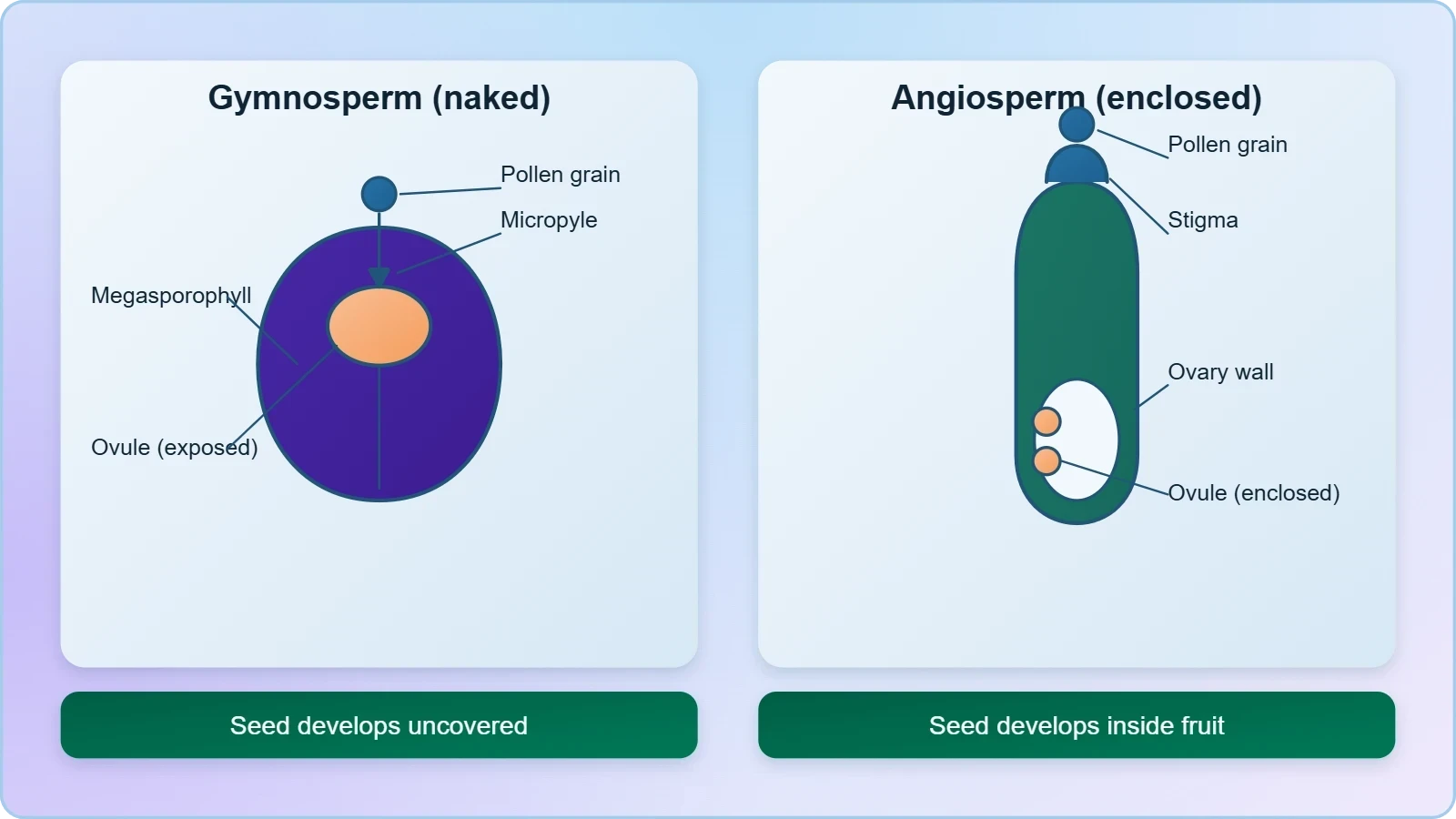
The gymnosperms are plants in which the ovules are not enclosed by any ovary wall and remain exposed, both before and after fertilisation. The seeds that develop after fertilisation are therefore not covered, that is, they are naked. This definition is the anchor for every other feature discussed in this lesson.
What "Naked" Means in Practice
An ovule in a gymnosperm sits openly on a megasporophyll rather than inside a closed chamber. Because nothing encloses it, the pollen grain can land directly at the opening of the ovule. The seed that follows inherits the same openness, resting on the scale instead of being sealed inside a fruit.
This contrasts sharply with the flowering plants you will meet in the next lesson, where ovules are enclosed within an ovary that matures into fruit. The exposed condition of gymnosperm seeds is thus a structural fact, not a matter of the seed simply lacking a coat. The integument is present; the enclosing ovary is not.
Habit and Stature Across the Group
Gymnosperms include medium-sized trees or tall trees and shrubs. The giant redwood Sequoia is one of the tallest tree species, a reminder that the group is not botanically marginal. Cycas, Pinus and Ginkgo are the representative genera used to illustrate the division.
Woody habit dominates throughout. These are not delicate herbs of damp shade but long-lived structural plants of forests and dry slopes. Their persistence across geological time is bound up with the reproductive and vegetative adaptations described in the sections that follow.
Roots, Stems and Leaves: Vegetative Organisation
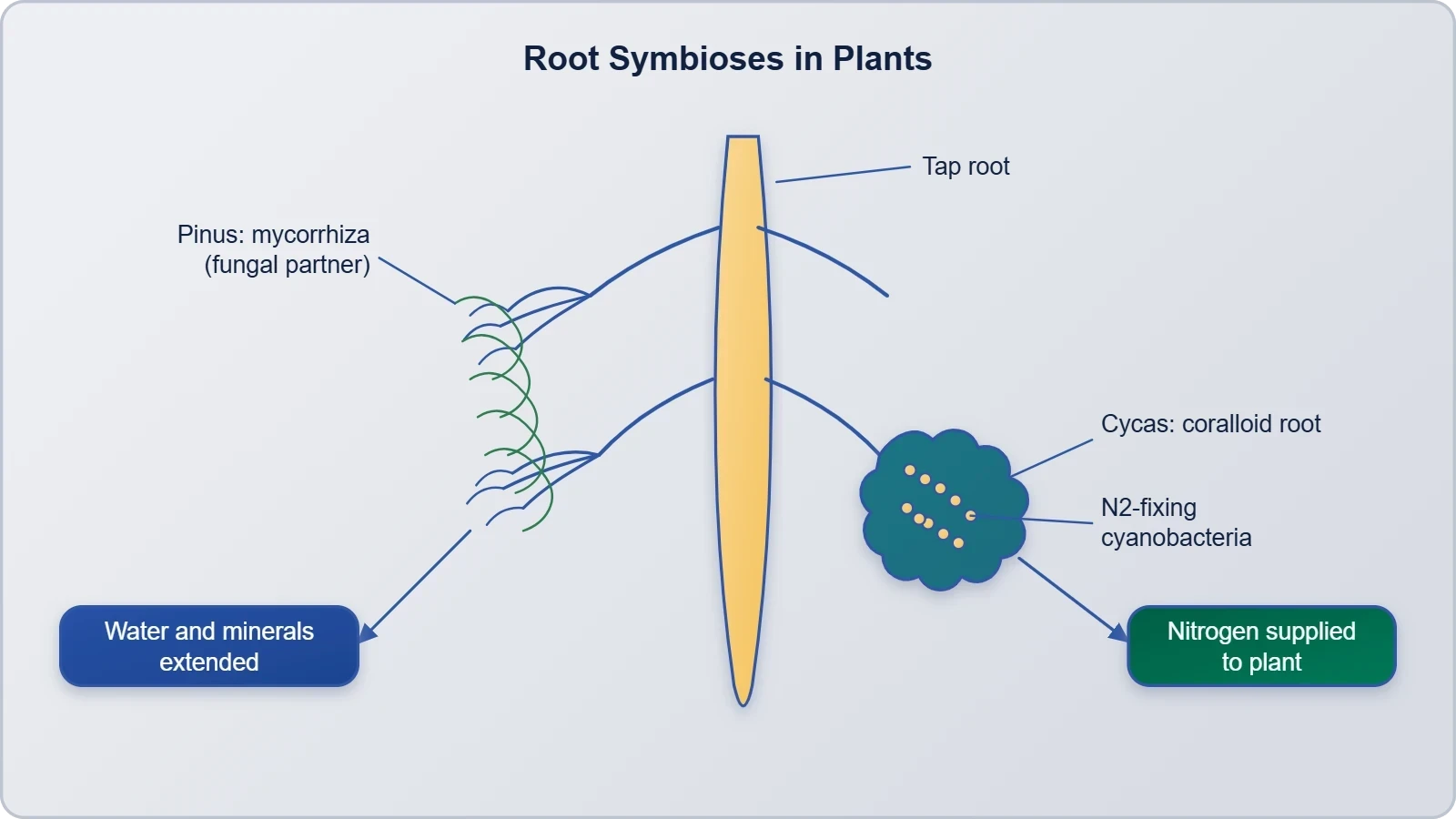
The roots are generally tap roots, anchoring a woody plant that must draw water from depth. Two genera depart from the ordinary pattern in instructive ways: Pinus forms mycorrhiza, while Cycas produces small specialised coralloid roots associated with nitrogen-fixing cyanobacteria. These associations extend what the root can do beyond simple anchorage and absorption.
Root Specialisations in Pinus and Cycas
In Pinus, roots have a fungal association in the form of mycorrhiza. In Cycas, the coralloid roots house cyanobacteria capable of fixing atmospheric nitrogen. Both arrangements are partnerships, and both broaden the nutritional reach of a plant that often grows on poor or demanding ground.
The coralloid roots are small and specialised rather than the main anchoring system. Their association with N2-fixing cyanobacteria links the root directly to nitrogen supply. The mycorrhizal roots of Pinus link the root to a fungal partner, a theme taken up in the Going Further block below.
Stem Form and Leaf Adaptation
The stems are unbranched in Cycas or branched in Pinus and Cedrus. The leaves may be simple or compound, and in Cycas the pinnate leaves persist for a few years. Leaf form therefore varies considerably across the division, from the crown of a cycad to the branching canopy of a pine.
What unites the leaves is adaptation to extremes of temperature, humidity and wind. In conifers, the needle-like leaves reduce surface area, while a thick cuticle and sunken stomata help to reduce water loss. These three features together form a compact water-retention strategy suited to exposed and seasonally harsh habitats.
Heterospory and the Structure of Cones
The gymnosperms are heterosporous, producing haploid microspores and megaspores. The two kinds of spores are produced within sporangia borne on sporophylls, and these sporophylls are arranged spirally along an axis to form lax or compact strobili, commonly called cones. The cone is thus a reproductive axis carrying spore-bearing leaves in a regular spiral.
Male Strobili and the Pollen Grain
Strobili bearing microsporophylls and microsporangia are called microsporangiate or male strobili. The microspores develop into a male gametophytic generation that is highly reduced and confined to only a limited number of cells. This reduced gametophyte is called a pollen grain, and its development takes place within the microsporangia.
The reduction is the point worth holding onto. Where a pteridophyte gametophyte was a free-living thallus, the male gymnosperm gametophyte is a few cells enclosed in a wall. The pollen grain is not a spore in the old sense but a whole miniature generation, packaged for airborne transport.
Female Strobili, Nucellus and Ovule
Cones bearing megasporophylls with ovules or megasporangia are called macrosporangiate or female strobili. The megaspore mother cell is differentiated from one of the cells of the nucellus. The nucellus is protected by envelopes, and this composite structure is called an ovule, borne on megasporophylls that may cluster into female cones.
The megaspore mother cell divides meiotically to form four megaspores. One of these, enclosed within the megasporangium, develops into a multicellular female gametophyte bearing two or more archegonia, the female sex organs. This multicellular female gametophyte is retained within the megasporangium rather than released.
Pollination and the Path to Fertilisation
Unlike bryophytes and pteridophytes, the male and female gametophytes of gymnosperms do not have an independent free-living existence. They remain within the sporangia, retained on the sporophytes. This retention removes the dependence on free water that constrained the spread of pteridophytes and opens the way to wind-borne reproduction.
From Microsporangium to Ovule
The pollen grain is released from the microsporangium and carried in air currents. It comes in contact with the opening of the ovules borne on megasporophylls. No swimming antherozoids cross a film of water here; the air itself is the transport medium, and the ovule's exposed opening is the landing site.
Once contact is made, the pollen tube carrying the male gametes grows towards the archegonia in the ovules. It then discharges its contents near the mouth of the archegonia. The tube is thus both a delivery channel and a directional guide, reaching the egg through maternal tissue rather than through open water.
Fertilisation and Seed Formation
Following fertilisation, the zygote develops into an embryo and the ovules into seeds. These seeds are not covered. The entire sequence, from pollen landing to mature seed, occurs while the ovule remains attached to the parent sporophyte, which supplies protection and nourishment throughout.
The seed habit that pteridophytes only foreshadowed is here complete. In Selaginella and Salvinia, the zygote developed into a young embryo within the female gametophyte retained on the parent. In gymnosperms, that retention extends all the way to a dormant, dispersible seed.
Gametophytes Retained: The Evolutionary Shift
The decisive difference from bryophytes and pteridophytes lies in where the gametophytes live. In gymnosperms the male and female gametophytes do not have an independent free-living existence; they remain within the sporangia retained on the sporophytes. Reproduction is thus sheltered inside parental tissue from start to finish.
Reduction of the Male Gametophyte
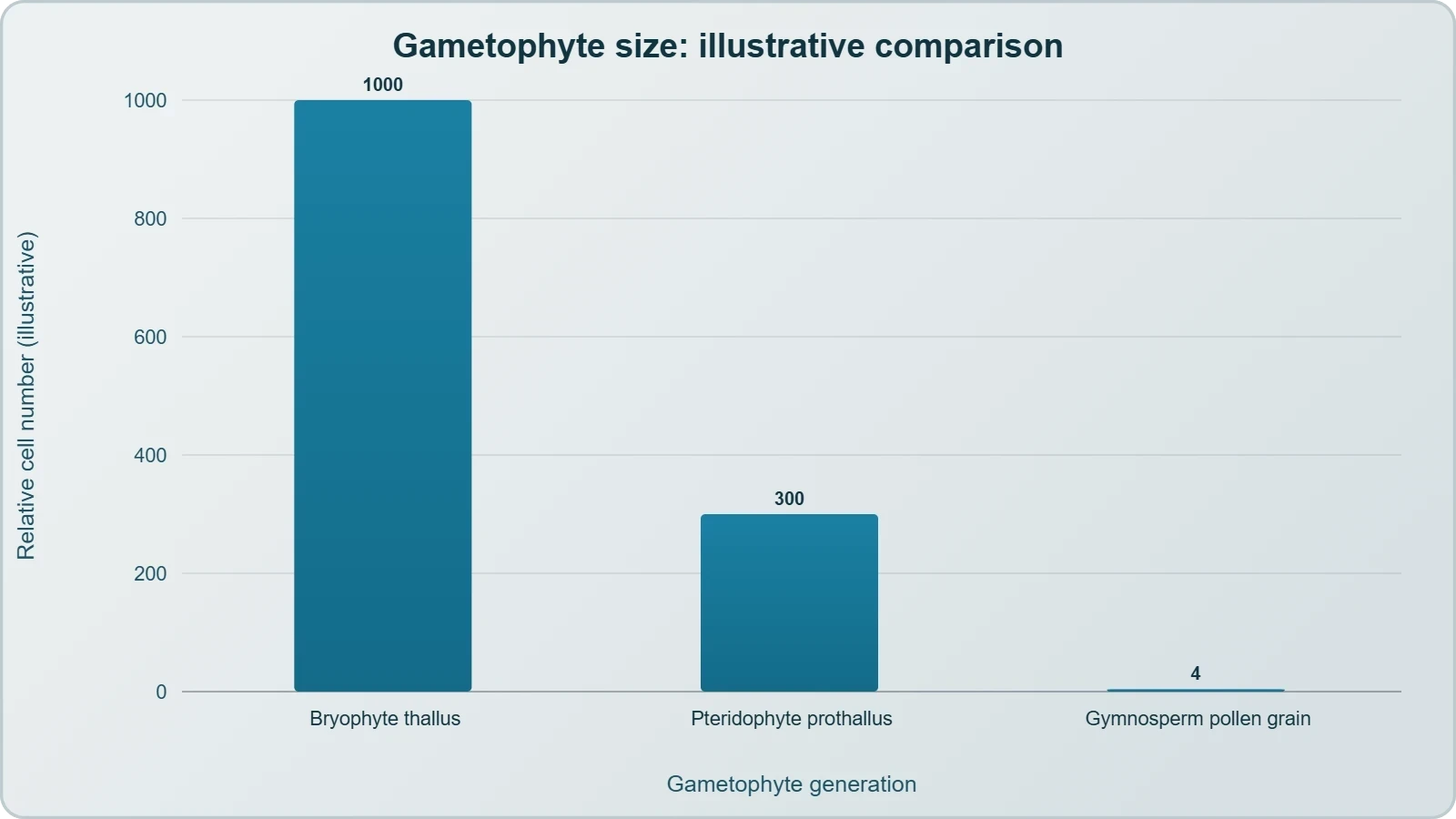
The male gametophyte is highly reduced and confined to only a limited number of cells, and it is this reduced generation that we call the pollen grain. Its development occurs within the microsporangia before release. Reduction and enclosure together make airborne dispersal practical.
Compare this with the pteridophyte prothallus, a free-living, mostly photosynthetic thalloid gametophyte requiring cool, damp, shady places. The gymnosperm has eliminated that vulnerable stage entirely. Nothing green and independent must survive on the forest floor for fertilisation to succeed.
Retention of the Female Gametophyte
The female gametophyte is multicellular and bears two or more archegonia, yet it never leaves the megasporangium. It develops from one of the four megaspores produced by meiosis of the megaspore mother cell. The other three megaspores do not give rise to the mature gametophyte.
Because the female gametophyte stays inside the ovule, the embryo develops in place, nourished and protected. This is the structural basis of the seed habit, and it is the thread that connects the heterospory of Selaginella to the naked seeds of Pinus and Cycas.
Reading the Cones: A Practical Summary
A gymnosperm cone rewards careful reading because its parts map directly onto the vocabulary of the lesson. Sporophylls are arranged spirally along an axis, and the resulting strobilus may be lax or compact. Whether the sporophylls bear microsporangia or megasporangia determines whether you are looking at a male or a female cone.
Distinguishing Male from Female Structures
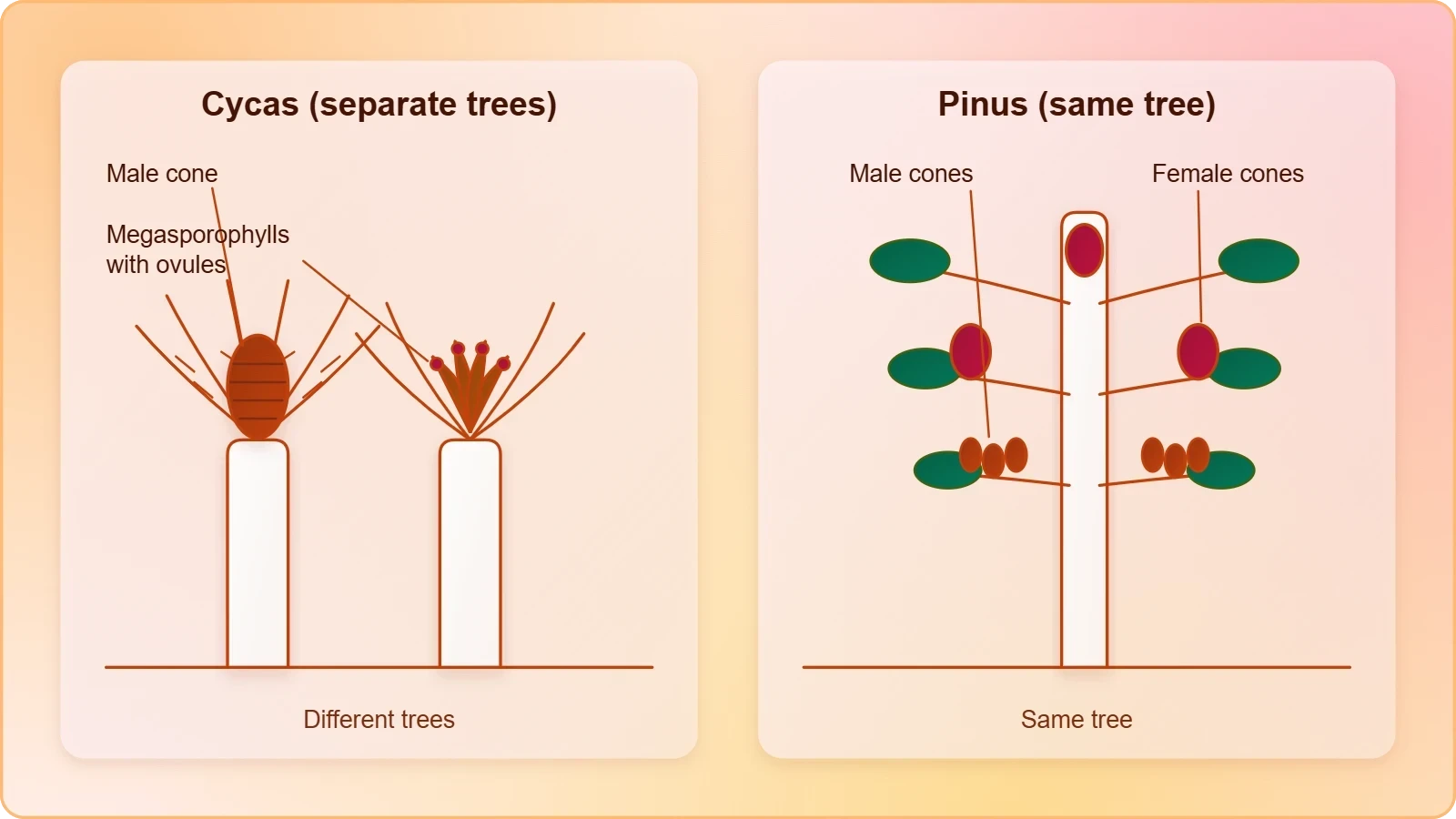
Male strobili carry microsporophylls and microsporangia, and their product is the pollen grain. Female strobili carry megasporophylls with ovules, and their product is the multicellular female gametophyte with archegonia. The two may sit on the same tree, as in Pinus, or on different trees, as in Cycas.
In Cycas, male cones and megasporophylls are borne on different trees, so a single individual is not simultaneously presenting both. In Pinus, male and female cones are borne on the same tree. This difference is worth noting when identifying material in the field.
Consolidating the Terminology
The vocabulary of this lesson is dense but internally consistent: microspore and megaspore, microsporophyll and megasporophyll, microsporangium and megasporangium, male and female strobilus. Each pair marks the same division of labour at a different level of structure. Mastering the pairs makes the whole reproductive story easy to reconstruct.
The defining fact remains the naked ovule. Everything else, the cones, the reduced pollen grain, the retained female gametophyte, the pollen tube and the uncovered seed, follows from that single arrangement. The next lesson turns to angiosperms, where the ovule is enclosed and the seed is not naked.
Going Further
Two background points help the root specialisations make sense without altering anything stated above. Mycorrhiza is a partnership between a fungus and plant roots, which explains why the roots of Pinus carry a fungal association. The fungus extends the reach of the root system and assists in the uptake of nutrients and water from the soil.
Coralloid roots of Cycas are associated with nitrogen-fixing cyanobacteria, so these roots help the plant obtain nitrogen. Atmospheric nitrogen is converted into a usable form within the root, supplementing what the plant draws from the soil. Both partnerships let a woody gymnosperm thrive where a solitary root system might struggle.
Also Read
- No links available.
From our network :
- 10 Physics Numerical Problems with Solutions for IIT JEEPrepare for IIT JEE with 10 physics numerical problems, complete with detailed solutions and conceptual explanations. Ideal for mastering kinematics, thermodynamics, electromagnetism, and optics.
- Vite 6/7 'Cold Start' Regression in Massive Module GraphsIn-depth analysis of Vite 6/7 cold start regressions in massive module graphs. Learn about barrel file issues, pre-bundling optimizations, and how to improve Vite dev server performance.
- AI-Powered 'Precision Diagnostic' Replaces Standard GRE Score ReportsDiscover the new GRE Precision Diagnostic. Learn how AI-powered behavioral analytics and time-to-solve tracking are replacing standard GRE score reports to empower students.
- Analyzing Trump Deportation Numbers Insights Into The 2026 Immigration Crackdown
- Mastering DB2 LUW v12 Tables: A Comprehensive Technical GuideComprehensive guide on DB2 LUW v12 tables. Explore CREATE TABLE syntax, BLU Acceleration, range partitioning, data types, and security features for IBM DB2 LUW v12.
- EV 2.0: The Solid-State Battery Breakthrough and Global Factory ExpansionDiscover the impact of the Solid-State Battery Breakthrough on the EV market. Learn about CATL and BYD stock growth, global factory expansion in Europe, and the future of EV 2.0 technology.
- 98% of Global MBA Programs Now Prefer GRE Over GMAT Focus EditionExplore why 98% of global MBA programs now prefer the GRE over GMAT Focus. Learn about the shorter GRE format, verbal logic importance, and strategic versatility for students.
- Mastering DB2 12.1 Instance Design: A Technical Deep Dive into Modern Database ArchitectureComprehensive guide to DB2 12.1 Instance Design. Explore architectural components, HADR setup, buffer pool tuning, and security policies for IBM DB2 12.1. Includes 10 functional SQL and Shell samples.
- Trump Political Strategy How Geopolitical Stunts Serve As Media Diversions
RESOURCES
- Beyond pine Cones: An Introduction to Gymnospermsarboretum.harvard.eduThe word gymnosperm comes from ancient Greek and means “naked seed.” This naked state of the ovule is a unifying feature of the gymno-…
- Gymnosperm - Wikipediaen.wikipedia.orgThe gymnosperms (/ˈdʒɪmnəˌspɜːrmz, -noʊ-/ nə-spurmz, -noh-; from Ancient Greek γυμνός , gymnós 'naked' and σπέρμα , spérma 'seed', thus 'naked seed') are a ...
- The New York Botanical Garden: Gymnospermsnybg.orgGymnosperms are a relatively small group of plants that do not flower and bear "naked seeds. ... Once the cone opens, the wing-shaped seeds…
- Gymnosperms and Angiosperms, the seed plantsscience.umd.eduII. Gymnosperms = naked seeds. A. seeds are formed on open surface of cone scale. No flowers or fruits! B. Four divisions: Cycad ...
- Gymnosperm | Definition, Description, Plants, Examples ... - Britannicabritannica.comSep 5, 2026 ... The seeds of many gymnosperms (literally 'naked seeds') are borne in cones and are not visible until maturity.
- In this primer, Andrew B. Leslie reviews the diversity of ... - Instagraminstagram.comJun 12, 2026 ... ✨ They produce naked seeds. ✨ Most living gymnosperms are woody, evergreen plants. ✨ Many conifers bear cones. ✨ Wind…
- gymnosperms : Naked seeds:: angiosperms - Brainly.inbrainly.inJun 30, 2021 ... ... naked” seeds on the surface of scales or leaves. Gymnosperm seeds are often configured as cones. Explore all similar…
- Pine Cone Botany For Beginners - Dyck Arboretumdyckarboretum.orgDec 2, 2015 ... True cones are produced by a group of plants called gymnosperms. Their cones ... naked seed”. The seed doesn't get…
- Fun facts about pine cones - MSU Extensioncanr.msu.eduDec 29, 2017 ... Gymnosperms are a group of plants who have naked seeds, not enclosed in an ovary. The main function of a…
- What is the difference between a Gymnosperm and Angiosperm?reddit.comMar 14, 2025 ... Gymnosperms are plants that make seeds, but not true fruits and don't have flowers. Gymnosperm means naked seed. Most of…
- Gymnosperms (Naked seeds) Flashcards - Quizletquizlet.comA gymnosperm, or naked seed plant, that produces cones. Image: Conifers. cone seeds. Image: cone seeds. Pinophyta. Needle/ scalelike leaves retain leaves all ...
- naked seeds - awkward botanyawkwardbotany.comFeb 6, 2019 ... ... seeds, angiosperms produce flowers and fruits while gymnosperms produce pollen cones and seed cones. There are always exceptions (Ginkgo ...
- GYMNOSPERMS - PlantFactsplantfacts.osu.edu... cone. "Gymnosperm" means naked seed. Alternation of generations is still involved in the reproduction of these plants. They are all heterosporous: the ...
- Gymnosperms = Naked Seeds + Dominant Sporophyte + Reduced ...facebook.comAug 7, 2026 ... OCR: BASIC GYMNOSPERMS BASIC TO HIGH LEVEL LEVEL STRUCTURE Gymnosperms= Naked- seeded plants Male cone enclosed ovary/fruit Mostly woody, ...
- The Tiny, Mighty Seed- UF/IFAS Extension Alachua County Blogblogs.ifas.ufl.eduJun 2, 2021 ... Gymnosperms use cones for seed production while angiosperms use flowers. ... Naked-Seeds form within gymnosperm cones. Unlike angiosperms' seeds ...