Motion in a plane is where intuition quietly begins to fail. Students who solve one-dimensional problems with confidence often carry habits into two dimensions that feel correct but produce systematically wrong answers, and those habits harden into misconceptions that survive all the way to advanced coursework. This lesson isolates the most persistent of those errors, names them plainly, and dismantles each one with the physics that actually governs two-dimensional motion.
The material here builds directly on the mathematical foundations established in the previous lesson, where vector components, resolution, and relative velocity were formalised. Rather than re-deriving those tools, this lesson applies them diagnostically: each misconception is treated as a testable claim, examined against the equations, and corrected with a cleaner mental model. The goal is conceptual precision, the kind that makes the advanced problem set that follows feel like a natural extension rather than a fresh assault.
Because misconceptions are rarely random, they tend to cluster around a handful of themes: the independence of horizontal and vertical motion, the meaning of velocity versus acceleration at a point, the role of the launch angle, and the behaviour of centripetal force in circular paths. Each theme receives careful treatment below, supported by worked reasoning, comparative data, and short computational checks that let learners verify the correction for themselves.
On This Page
Why Two-Dimensional Motion Confuses Careful Students
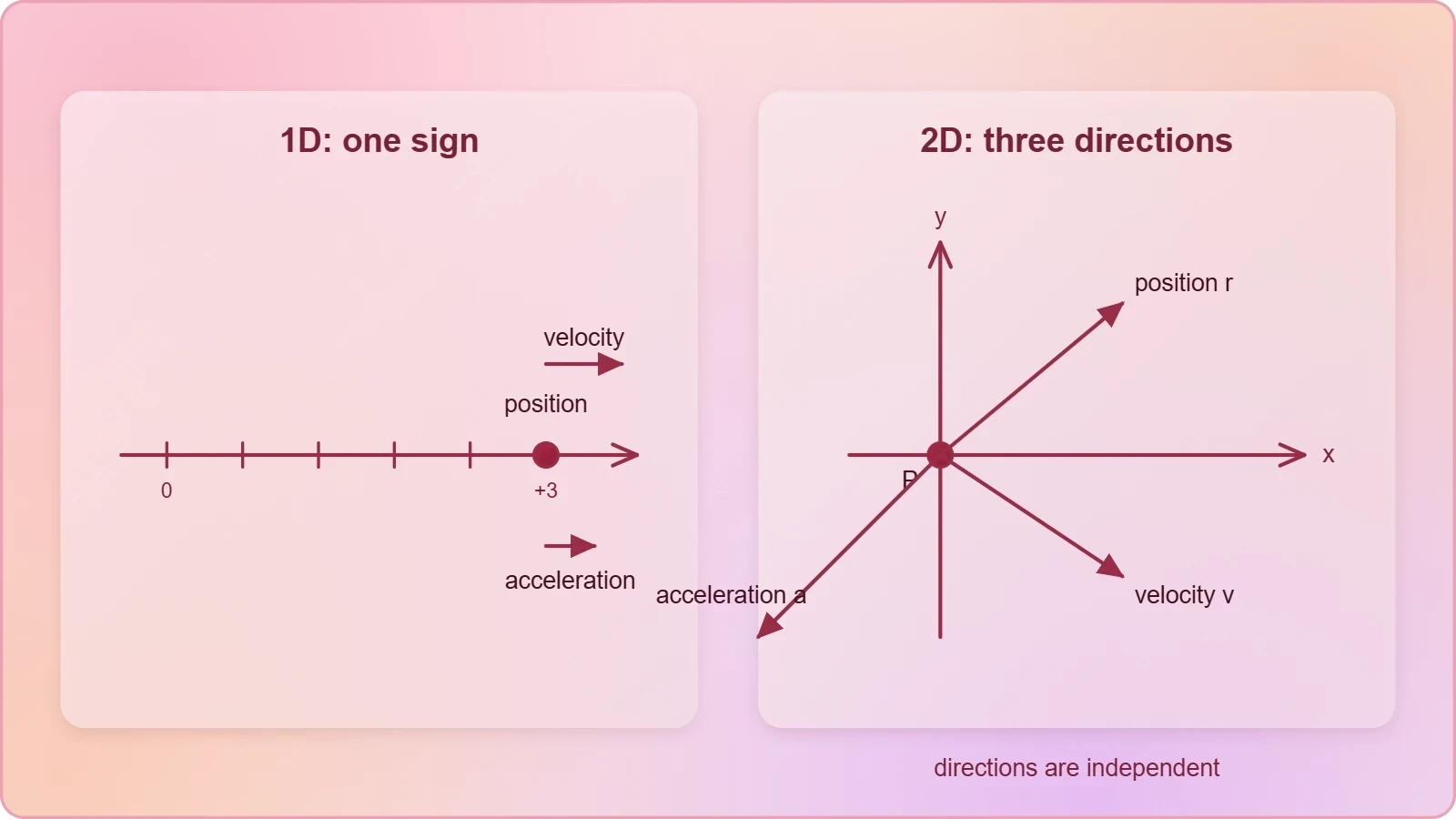
One-dimensional kinematics rewards a single scalar habit: track position, differentiate to velocity, differentiate again to acceleration, and the sign tells you everything. Two-dimensional motion breaks that habit because position, velocity, and acceleration become vectors that can point in entirely different directions at the same instant. A projectile at the top of its arc has zero vertical velocity but a full horizontal velocity and a constant downward acceleration, a combination that feels contradictory until vectors are treated as independent components.
The confusion is compounded by everyday language. We say a ball "slows down" as it rises, which is true of its speed but misleading about its acceleration, which never changes. We say a car "turns left," which hides the fact that its velocity is continuously changing direction while its speed may be perfectly constant. Misconceptions in this topic are largely linguistic artefacts dressed up as physics, and correcting them requires replacing loose speech with precise vector statements.
The Independence Principle and Its Violations
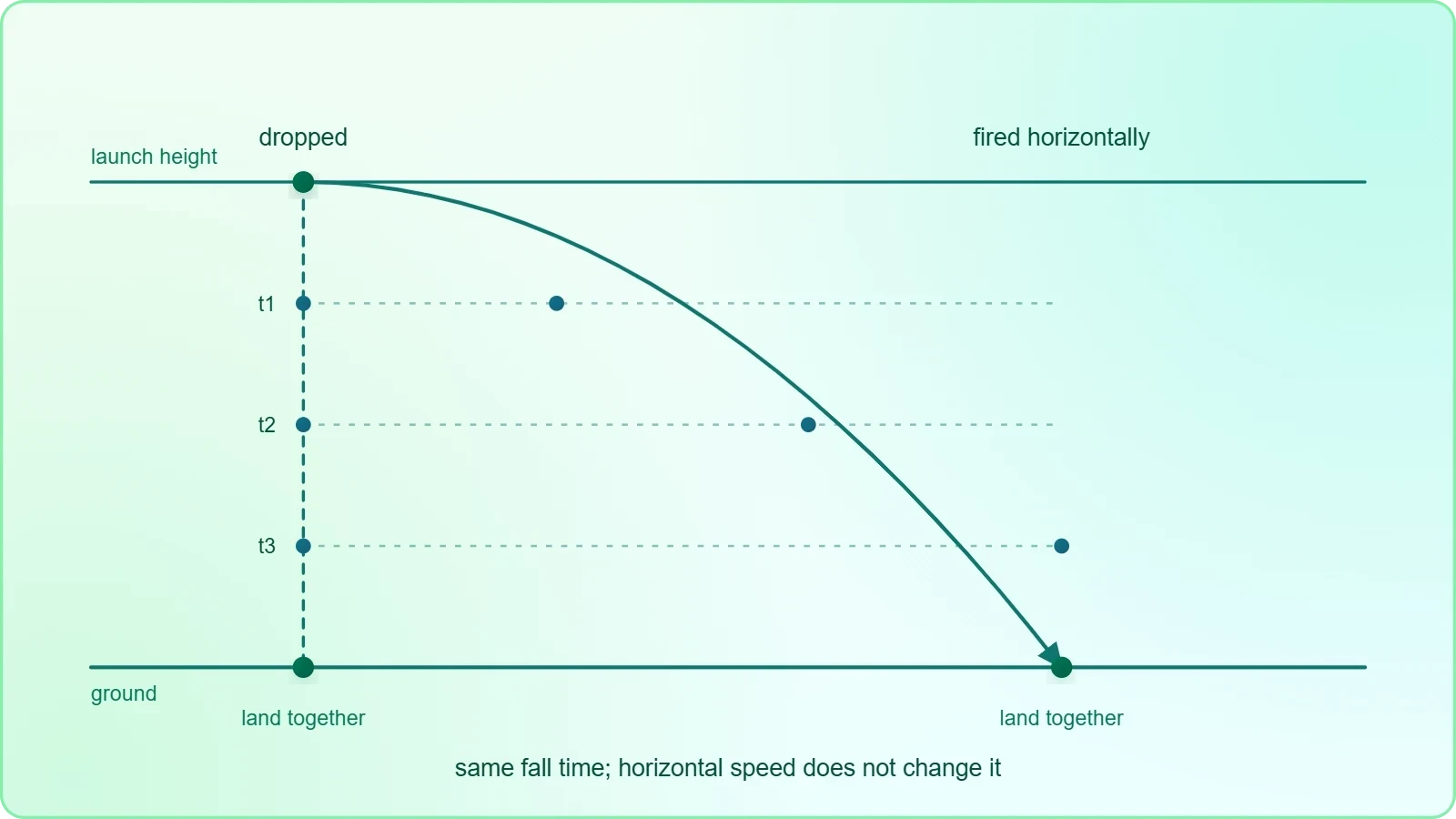
The single most useful idea in projectile motion is that horizontal and vertical motions are independent, coupled only by the shared time variable. A bullet fired horizontally and a bullet dropped from the same height strike the ground simultaneously, a result that surprises almost everyone on first encounter. The vertical fall is governed solely by gravity; the horizontal travel is governed solely by the initial horizontal velocity, and neither interferes with the other.
Violations of this principle appear whenever students assume that a faster horizontal launch delays the fall, or that a steeper launch angle makes a projectile "hang" longer for reasons beyond the vertical component. In reality, the time of flight depends only on the vertical component of initial velocity and the launch height. Horizontal speed changes range, never airtime, and recognising that separation resolves a large family of errors at once.
Velocity, Acceleration, and the Illusion of "Slowing Down"
Acceleration in two dimensions is the rate of change of the velocity vector, not the rate of change of speed. A body moving in a circle at constant speed is accelerating continuously because its velocity direction rotates, and that acceleration points toward the centre of the circle. Students who equate acceleration with "speeding up" cannot explain uniform circular motion at all, and they misread the projectile's apex as a point of zero acceleration.
The correction is to treat acceleration as a vector quantity with its own direction, computed from the vector difference of velocities over a small interval. At the apex of a projectile's path, the vertical velocity passes through zero, but the acceleration remains the constant gravitational vector pointing downward. Nothing about the acceleration vanishes; only one component of the velocity does, and only momentarily.

Projectile Motion: Where Intuition Goes Wrong
Projectile problems are deceptively simple in structure and surprisingly rich in traps. The standard model assumes negligible air resistance, constant gravitational acceleration, and a flat Earth, and within those assumptions the mathematics is clean. Misconceptions arise when students import real-world intuitions about air resistance into a model that deliberately excludes it, or when they treat the launch angle as a single controlling variable for every outcome.
The most productive correction is to insist on component thinking. Every projectile question reduces to two independent one-dimensional problems sharing a clock: constant-velocity motion horizontally and constant-acceleration motion vertically. Once that decomposition becomes automatic, questions about range, maximum height, and time of flight stop being memorised formulas and become direct consequences of the components.
Range, Angle, and the 45-Degree Myth
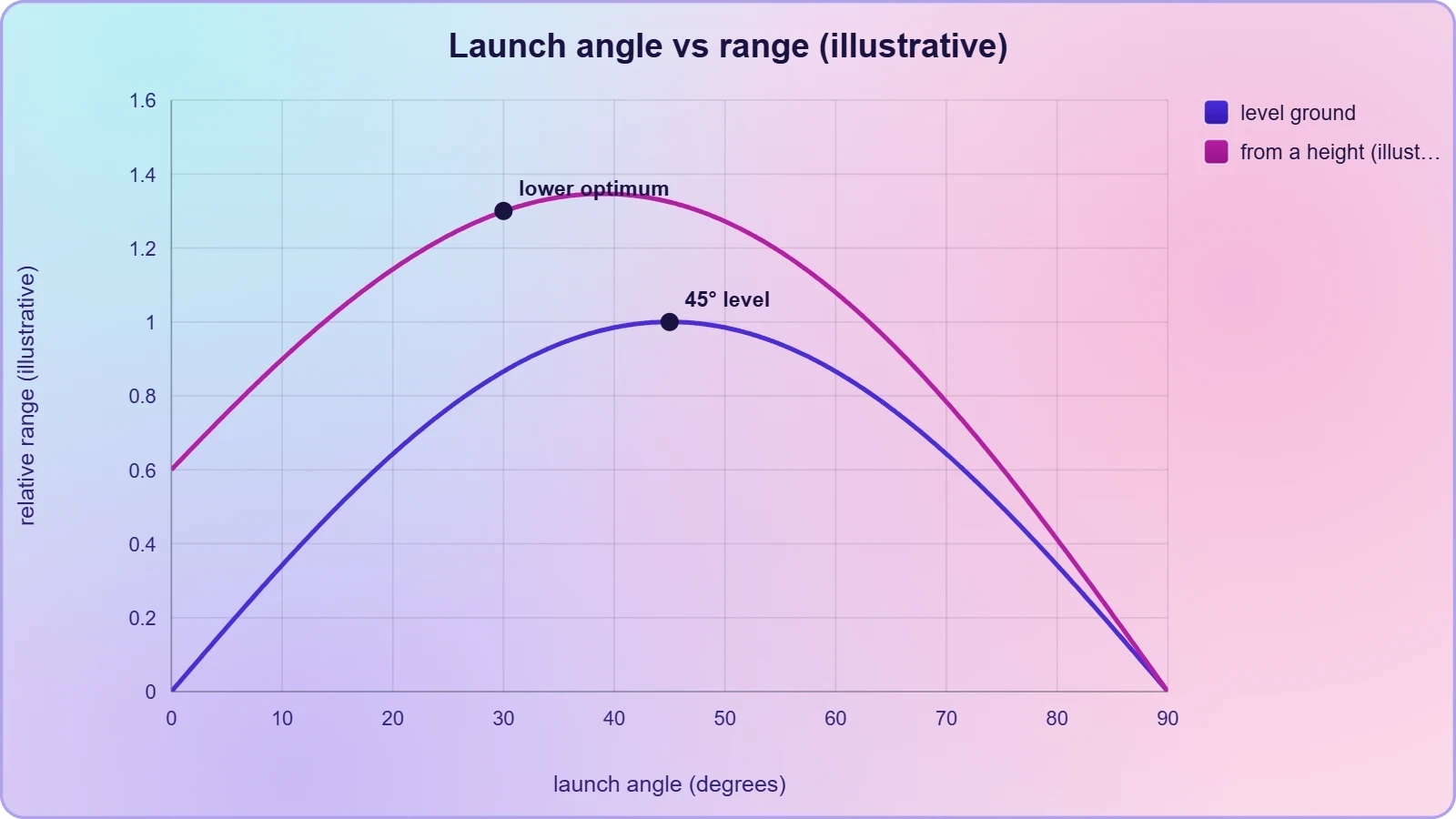
The claim that a 45-degree launch always maximises range is true only on level ground with no air resistance. Launch from a cliff, and the optimal angle drops below 45 degrees because the extra fall time rewards a flatter, faster trajectory. Launch into a headwind, and the optimum shifts again. The 45-degree rule is a special case masquerading as a universal law, and treating it as universal produces wrong answers on any elevated launch.
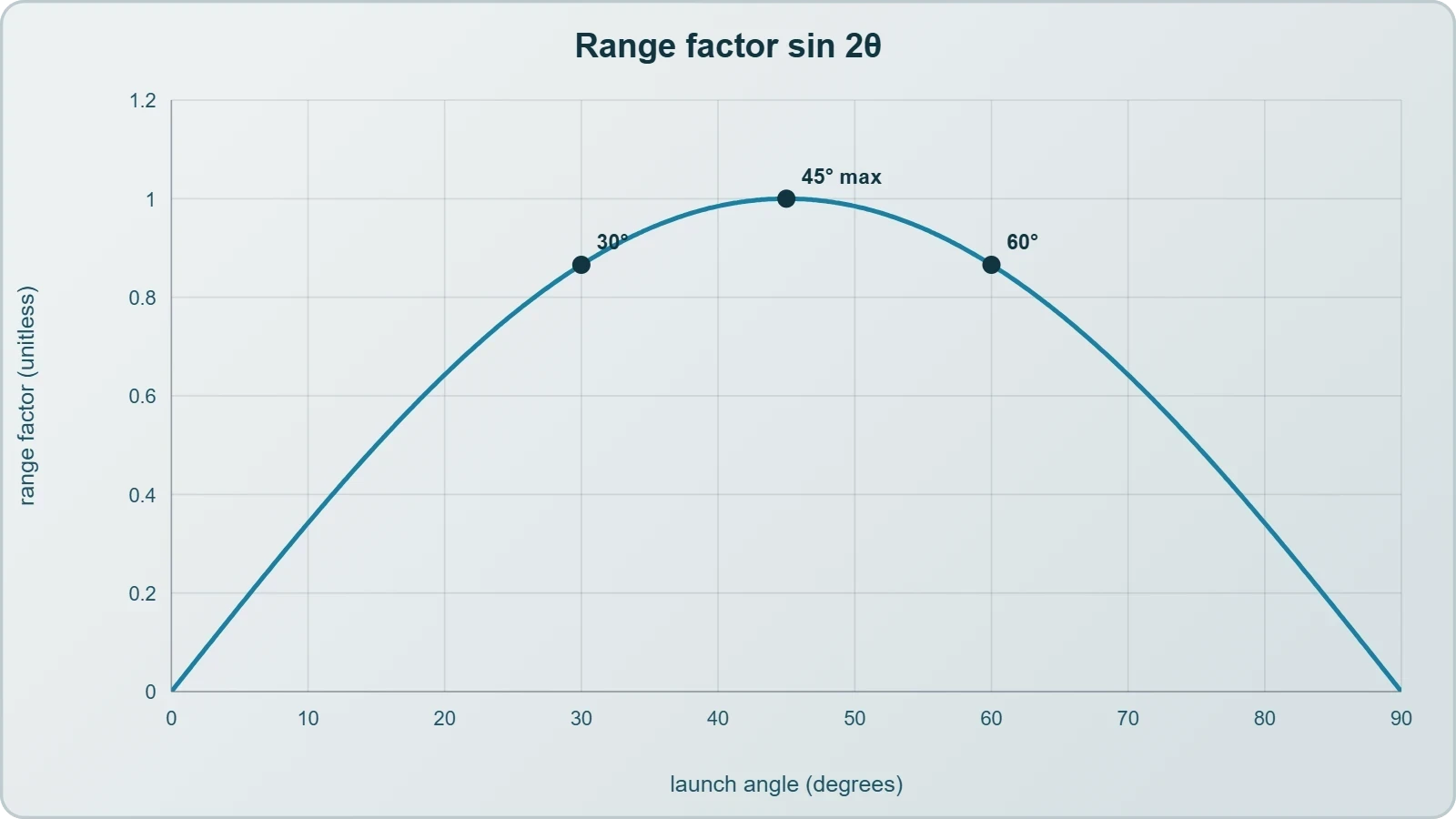
The general range expression on level ground is given by the familiar relation below, which makes the angle dependence explicit and shows why complementary angles share a range.
###R = \dfrac{v_0^2 \sin 2\theta}{g}###
Because ##\sin 2\theta## is symmetric about ##\theta = 45^\circ##, angles of 30 and 60 degrees yield identical ranges on level ground, a result students often doubt until they compute it. The symmetry is a property of the sine function, not a coincidence of the physics, and recognising it builds genuine fluency with the formula.
Air Resistance and the Limits of the Model
Real projectiles do not follow perfect parabolas. Air resistance produces a drag force opposing velocity, which shortens range, reduces maximum height, and makes the descent steeper than the ascent. The trajectory becomes asymmetric, and the optimal launch angle falls below 45 degrees even on level ground. None of this invalidates the ideal model; it simply marks its boundaries.
Students who conflate the ideal and real cases make errors in both directions, either dismissing air resistance entirely or overcorrecting and abandoning the clean equations. The disciplined position is to state the model's assumptions explicitly, solve within them, and then discuss qualitatively how reality departs. That habit of naming assumptions is itself a core scientific skill.

Circular Motion: Force, Speed, and Direction
Uniform circular motion is conceptually clean and intuitively slippery. The speed is constant, yet the velocity changes every instant because its direction rotates. That changing velocity is an acceleration, and the acceleration requires a net force pointing toward the centre. Students who accept the mathematics often still feel that something must be "pushing outward," a sensation rooted in the experience of riding in a turning vehicle rather than in the physics of the object itself.
The correction is to distinguish carefully between the forces acting on the object and the fictitious forces experienced in an accelerating frame. In the inertial frame of the ground, the only horizontal force on a car rounding a bend is friction pointing inward. The outward sensation belongs to the passenger's non-inertial frame, where an inertial pseudo-force appears. Naming that distinction dissolves the confusion.
Centripetal Force Is Not a New Force
A persistent error is to treat centripetal force as an additional force that appears whenever something moves in a circle. In truth, centripetal force is a role, not a source: tension, gravity, friction, or the normal force can each supply it depending on the situation. A satellite is held by gravity, a whirling stone by tension, and a turning car by friction, yet all three satisfy the same centripetal requirement.
The centripetal condition is expressed by the relation below, which states that the net inward force must equal the mass times the square of the speed divided by the radius. If the available inward force falls short, the object cannot maintain the circular path and departs along a tangent.
###F_c = \dfrac{mv^2}{r}###
This equation also explains why a car skids outward on a wet road: friction, the inward force, drops below the required value, and the car follows a wider path. The outward drift is not a force pushing the car out; it is the car failing to turn sharply enough because the inward force is insufficient.

Speed, Period, and the Tangential Trap
Another common error is to believe that a faster object in a circle needs a smaller centripetal force, or that the force is independent of speed. The ##v^2## dependence means doubling the speed quadruples the required inward force, which is why high-speed cornering demands so much more grip. The period of revolution, meanwhile, is related to speed and radius by ##T = 2\pi r / v##, so faster motion at fixed radius means a shorter period.
The tangential trap appears when students confuse the direction of velocity with the direction of acceleration. Velocity is always tangent to the circle; acceleration is always radial, pointing inward. These two vectors are perpendicular at every instant, which is precisely why the speed stays constant while the direction changes. Mixing them up produces errors in both force and kinematics calculations.
Relative Motion and the Frame-Dependence Fallacy
Relative velocity is where otherwise careful students start making sign errors with abandon. The velocity of one object as measured from another is the vector difference of their velocities in a common frame, and the order of subtraction matters. A passenger on a train sees the platform recede at the train's speed, while a ground observer sees the passenger moving forward. Both descriptions are correct, but only if the frame is stated.
The fallacy is to treat one frame as privileged. There is no absolute rest, and a velocity quoted without a frame is incomplete. Misconceptions here often take the form of adding speeds when the motions are perpendicular, or subtracting them when they are not collinear. The vector addition rule handles all cases, but only if the components are resolved before combining.
Adding Velocities That Are Not Parallel
When two velocities are perpendicular, the relative speed is the Pythagorean combination, not the arithmetic sum. A boat crossing a river with a current has a resultant velocity found by adding the boat's velocity relative to the water and the water's velocity relative to the bank. The crossing time depends only on the component of the boat's velocity perpendicular to the bank, a fact that surprises students who expect the current to slow the crossing.
The general rule is vector addition, and the magnitude of the resultant follows from the law of cosines when the angle between the vectors is not a right angle. Students who memorise only the perpendicular case stumble when the angle is oblique. Resolving into components first, then recombining, is the reliable method that never fails.
Why "Upstream" and "Downstream" Confuse
River problems are a classic source of confusion because the same boat speed produces different ground speeds depending on direction. Heading upstream, the boat's speed relative to the bank is reduced by the current; heading downstream, it is increased. The boat's speed relative to the water is unchanged in both cases, and keeping that distinction clear is the key to solving such problems correctly.
The deeper lesson is that speed is frame-dependent while the laws of physics are not. A ball thrown inside a smoothly moving train follows the same parabolic arc relative to the train as it would relative to the ground, a fact that underpins Galileo's relativity principle. Recognising frame-dependence as a feature, not a bug, removes a whole class of misconceptions.
Diagnostic Habits That Prevent Recurring Errors
Correcting a misconception once is not enough; the original intuition tends to reassert itself under exam pressure. The durable fix is to build diagnostic habits that catch errors before they propagate. Drawing a diagram with labelled axes, resolving every vector into components, and writing the horizontal and vertical equations separately are simple routines that make most misconceptions visible and correctable in the moment.
A second habit is dimensional and unit checking. If a computed acceleration has units of metres per second rather than metres per second squared, something has gone wrong in the algebra. If a range formula produces a negative time, the sign convention has been violated. These checks are cheap and catch a surprising fraction of errors that stem from conceptual confusion rather than arithmetic slips.
Component Discipline as a Universal Safeguard
Almost every misconception in this lesson dissolves when vectors are resolved into components before any equation is written. The independence of horizontal and vertical motion becomes obvious, the direction of acceleration becomes explicit, and the frame-dependence of velocity becomes a matter of bookkeeping. Component discipline is not a crutch; it is the professional method, used by engineers and physicists alike.
The short computational routine below resolves a velocity vector into components and reconstructs its magnitude and direction, a pattern worth internalising because it recurs throughout projectile and circular motion problems.
import math

def resolve(v, angle_deg):
    theta = math.radians(angle_deg)
    vx = v * math.cos(theta)
    vy = v * math.sin(theta)
    return vx, vy

def recombine(vx, vy):
    speed = math.hypot(vx, vy)
    direction = math.degrees(math.atan2(vy, vx))
    return speed, direction

vx, vy = resolve(20, 30)
print(vx, vy)
print(recombine(vx, vy))
Running this routine with a speed of 20 metres per second at 30 degrees returns components of roughly 17.3 and 10.0, and recombination recovers the original speed and angle. The round trip is a useful sanity check, and it reinforces the idea that components and magnitude are two descriptions of the same vector.
Testing Intuition Against Limiting Cases
Limiting-case reasoning is a powerful diagnostic. Set the launch angle to zero and the projectile becomes a horizontal throw; set it to ninety degrees and it becomes vertical motion. Set the radius of a circular path to infinity and the centripetal acceleration vanishes, recovering straight-line motion. If a formula or intuition fails in these limits, it is wrong.
Students who habitually test limits catch errors that pure algebra conceals. The 45-degree myth fails immediately when the launch height is raised, and the "no acceleration at the apex" claim fails when the limit of a very flat trajectory is considered. Limiting cases turn abstract formulas into physical stories, and stories are harder to misremember.
Preparing for the Advanced Problem Set
With the misconceptions named and corrected, the advanced problem set that follows becomes a genuine test of understanding rather than a trap for memorised formulas. The problems there will combine projectile and circular motion, require careful frame selection, and reward the component discipline rehearsed here. Learners who can articulate why each misconception is wrong are ready for that challenge.
The final table consolidates the corrections into a compact revision reference, useful before attempting the problem set. Each row pairs a misconception with the precise statement that replaces it, so the revision is active rather than passive. Reading the correct statement aloud and explaining it to someone else is a reliable way to lock it in.
Also Read
- No links available.
From our network :
- Vite 6/7 'Cold Start' Regression in Massive Module GraphsIn-depth analysis of Vite 6/7 cold start regressions in massive module graphs. Learn about barrel file issues, pre-bundling optimizations, and how to improve Vite dev server performance.
- EV 2.0: The Solid-State Battery Breakthrough and Global Factory ExpansionDiscover the impact of the Solid-State Battery Breakthrough on the EV market. Learn about CATL and BYD stock growth, global factory expansion in Europe, and the future of EV 2.0 technology.
- AI-Powered 'Precision Diagnostic' Replaces Standard GRE Score ReportsDiscover the new GRE Precision Diagnostic. Learn how AI-powered behavioral analytics and time-to-solve tracking are replacing standard GRE score reports to empower students.
- Mastering DB2 LUW v12 Tables: A Comprehensive Technical GuideComprehensive guide on DB2 LUW v12 tables. Explore CREATE TABLE syntax, BLU Acceleration, range partitioning, data types, and security features for IBM DB2 LUW v12.
- 98% of Global MBA Programs Now Prefer GRE Over GMAT Focus EditionExplore why 98% of global MBA programs now prefer the GRE over GMAT Focus. Learn about the shorter GRE format, verbal logic importance, and strategic versatility for students.
- Trump Political Strategy How Geopolitical Stunts Serve As Media Diversions
- 10 Physics Numerical Problems with Solutions for IIT JEEPrepare for IIT JEE with 10 physics numerical problems, complete with detailed solutions and conceptual explanations. Ideal for mastering kinematics, thermodynamics, electromagnetism, and optics.
- Analyzing Trump Deportation Numbers Insights Into The 2026 Immigration Crackdown
- Mastering DB2 12.1 Instance Design: A Technical Deep Dive into Modern Database ArchitectureComprehensive guide to DB2 12.1 Instance Design. Explore architectural components, HADR setup, buffer pool tuning, and security policies for IBM DB2 12.1. Includes 10 functional SQL and Shell samples.
RESOURCES
- Student Misconceptions of General Plane Motion in Rigid-Body ...ascelibrary.orgMar 21, 2018 ... AbstractThis paper presents a review on student misconceptions of general plane motion (GPM), one of the most difficult yet important ...
- Identifying physics misconceptions at the circus: The case of circular ...link.aps.orgJun 2, 2020 ... A commonly used demonstration of circular motion laws by physics teachers is spinning a bucket full of water in the…
- RC Plane Model Costs and Misconceptions - Facebookfacebook.comFeb 2, 2025 ... Motion RC Customer Community ... Non-hobbyists often misunderstand RC plane costs and capabilities, with common misconceptions about prices and ...
- Thrust and Newton's Third Law in Aviation - CAUcalaero.eduSep 7, 2023 ... Airplanes. The motion of an airplane is a perfect example of action and reaction in aerodynamics. The airplane's engines thrust…
- Plane Conveyor belt Myth - A resolution to reconcile both campsreddit.comMay 15, 2022 ... This was the most common misconception ... Another argument for the plane's motion: The riddle stipulates that the belt matches…
- Misconceptions in Projectile Motion and Conceptual Changes via ...files.eric.ed.govSep 30, 2021 ... Seven open-ended questions with CQPM discuss the main ideas of the PM; velocity, acceleration and force (Q1, Q2, Q5), flight…
- The impact of an online inquiry-based learning environment ...link.springer.comMar 5, 2023 ... The uniform circular motion simulation (see Fig. 4) was used to address three misconceptions, namely: the first misconception assuming that ...
- Common Misconception: My Aircraft Is Fully Covered at the Shop.aviationspecialtyinsurance.comMay 20, 2017 ... Option 1) Ground/Not in Motion: (commonly referred to as ground only). If the plan is to tuck the aircraft in…
- What are some commonly misunderstood concepts by students and ...reddit.comDec 30, 2022 ... ... plane touches down before the PAPI indicates the glide slope for the next plane. ... The movement shown for…
- 6 Common Misconceptions About Flying - Mental Flossmentalfloss.comJun 29, 2021 ... Newton's third law of motion can also be applied, since it means an airplane ... Misconception: The Plane flies itself.…
- One of the most common questions and misunderstood movements ...instagram.comJul 9, 2022 ... Love this picture and would remind you all the each of us has a slightly different scapular plane based on…
- Interstate Highway System - The Myths | FHWAhighways.dot.govOne in five miles of the Interstate System is straight so airplanes can land in emergencies. Interstates are intended to serve only traffic going…
- Students' misconceptions on rotational and rolling motionsiopscience.iop.orgmotion), 65.70% in rolling motion (the role of friction and other parameters), and 55.70% in the sliding cube on an inclined plane. Therefore, teachers ...
- The Role of Newton's Third Law in Aviation - Pilot Institutepilotinstitute.comApr 12, 2025 ... Top-down diagram of an aircraft tail showing rudder movement and how deflected air turns ... Common Misconceptions. Lift Is Not…
- A study of student teachers' misconceptions on uniform circular motioniopscience.iop.orgOnly one student got the following question correctly: An object undergoes uniform circular motion in a horizontal plane as shown in the diagram. The ...