Centripetal force is the invisible hand that keeps a body travelling along a curved path, and yet it is one of the most frequently misunderstood ideas in introductory mechanics. Students often imagine it as a mysterious extra push that appears whenever something turns, rather than recognising it as the ordinary net force—tension, gravity, friction, or a normal reaction—directed toward the centre of curvature. This lesson builds directly on the centripetal acceleration derived in the previous session and reframes it through Newton's second law, so that the cause of circular motion becomes a force analysis rather than a geometric curiosity.
Because the course moves from vectors through projectiles toward circular motion, this fifteenth lesson occupies a pivotal position. It converts the kinematic quantity ##a_c = v^2/r## into a dynamical statement, ##F_c = mv^2/r##, and then asks a deceptively simple question: which real interaction supplies that force in any given situation? Answering it requires the same free-body discipline already developed for linear motion, now applied to a direction that changes continuously. Learners who master this translation will find the following lesson on relative velocity far more intuitive, since rotating frames and turning observers depend on exactly these ideas.
The treatment below deliberately avoids restating the acceleration derivation and instead concentrates on identification, magnitude, and the common traps that examiners love. Expect worked reasoning about cars on banked roads, satellites in orbit, and stones whirled on strings, alongside a careful dismantling of the centrifugal misconception. Each section is designed for a beginner-to-intermediate audience, so the mathematics stays transparent while the physical insight deepens. By the end, you should be able to look at any curved motion and name, with confidence, the force responsible for it.
On This Page
Defining Centripetal Force Through Newton's Second Law
Newton's second law states that acceleration and net force share both direction and proportionality, so a body accelerating toward a centre must experience a net force toward that same centre. This is the entire logical foundation of centripetal force, and it follows without any additional physical assumption. The term itself is descriptive rather than a new kind of interaction: it labels a role that some real force plays.
The Dynamical Equation and Its Meaning
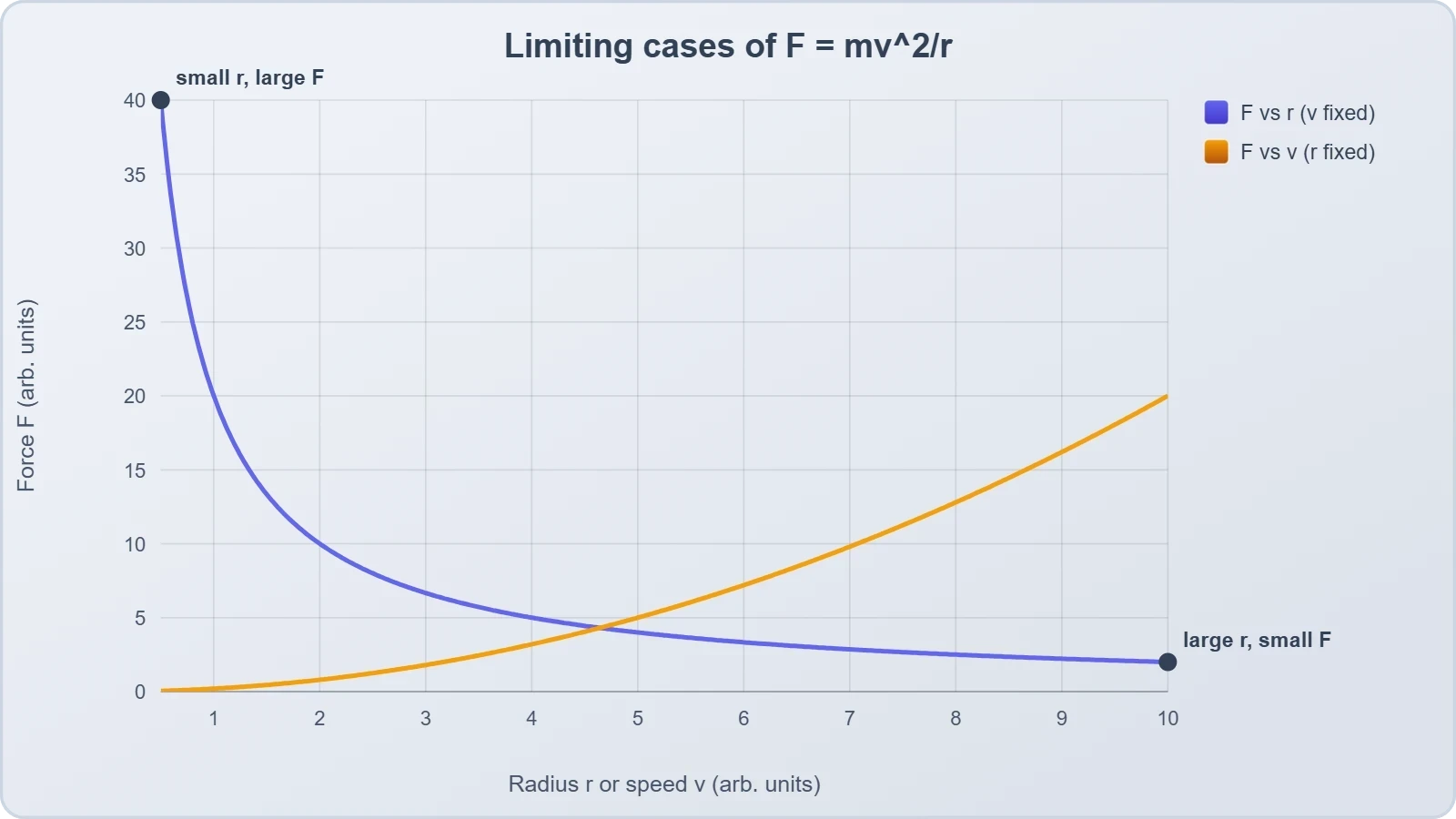
Combining the second law with the centripetal acceleration from the previous lesson yields the governing relation for uniform circular motion. The magnitude of the required net force grows with mass and with the square of speed, but falls as the radius increases. That squared dependence on speed explains why doubling a car's velocity through a bend quadruples the grip demanded from its tyres.

Each equivalent form suits a different style of problem. When speed is given, the first expression is direct; when angular velocity or period is known, the latter forms save a conversion step. Recognising which variable is actually controlled—speed, angular rate, or period—is often the difference between a clean solution and a tangle of algebra.
Why the Force Is Not a Separate Interaction
Textbooks sometimes list centripetal force alongside gravity and electromagnetism, which breeds confusion. In truth, no interaction in nature is labelled centripetal; the word merely identifies the radial component of whatever net force already exists. A tension, a gravitational pull, or a friction force becomes centripetal the moment it points toward the centre of a circular path.
This distinction matters because it forces students to draw free-body diagrams rather than reach for a memorised formula. Once the diagram is correct, the centripetal equation is simply the radial component of the second law. The skill being tested is identification, not substitution, and that is precisely where marks are won or lost.
Everyday Sources of Centripetal Force
In real situations the centripetal requirement is met by forces already familiar from earlier chapters, and identifying the correct one is the central analytical task. Tension, gravity, friction, normal reaction, and electrostatic attraction each take their turn depending on the geometry. The following subsections examine the two most instructive families of examples.
Tension and Gravity in Vertical and Orbital Motion
A stone whirled in a horizontal circle is held by string tension alone, so the tension equals the required centripetal force. Whirl it in a vertical circle and gravity joins the analysis, adding to tension at the bottom and opposing it at the top. At the topmost point, the minimum speed for the string to stay taut satisfies ##mg = mv^2/r##.
Orbital motion is the same idea on a cosmic scale, with gravitational attraction supplying the centripetal force. Setting ##GMm/r^2 = mv^2/r## yields the orbital speed ##v = \sqrt{GM/r}##, which is independent of the satellite's mass. This elegant cancellation explains why a heavy satellite and a light one share the same orbit at a given altitude.

Friction and Normal Reaction on Curved Roads
For a car on a flat bend, static friction between tyre and road provides the inward force, giving a maximum safe speed of ##v = \sqrt{\mu_s gr}##. Notice that the mass cancels, so a loaded lorry and a small hatchback can negotiate the same curve at the same limit, provided their tyres match.
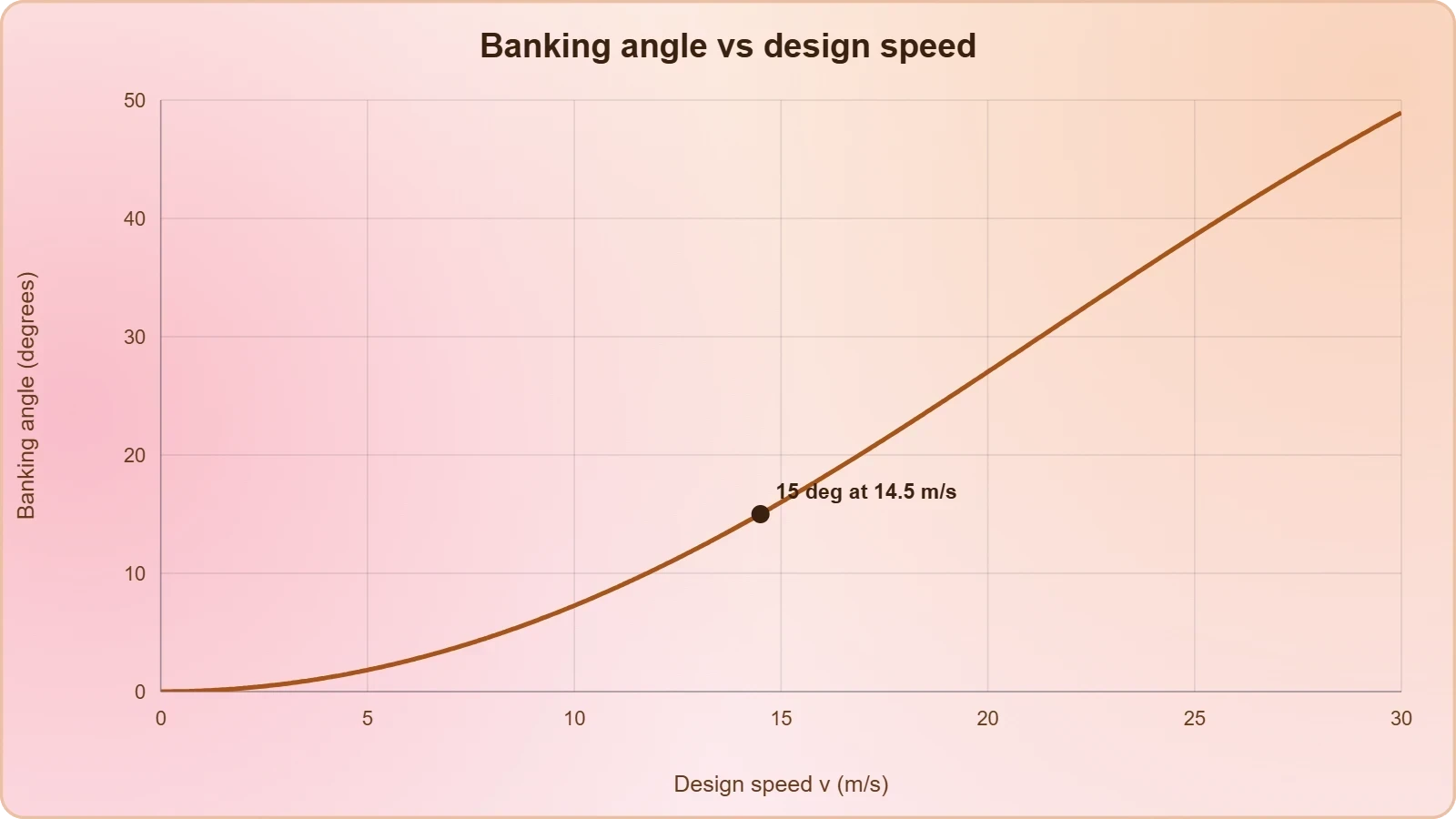
Banking the road tilts the normal reaction inward, allowing part of the centripetal requirement to be met without friction. The ideal banking angle satisfies ##\tan\theta = v^2/(rg)##, a design equation used on racing circuits and railway curves alike. Engineers choose the angle for a designated design speed, balancing comfort against safety margins.
Working Through Quantitative Problems
Numerical fluency comes from a disciplined routine: sketch the path, mark the centre, draw the free-body diagram, resolve along the radial direction, and only then substitute. Skipping the diagram is the single most common cause of sign errors and misidentified forces. The worked examples below model that routine explicitly.
A Car Negotiating a Banked Curve
Consider a curve of radius 80 m banked at 15° with no reliance on friction. The design speed follows from ##v = \sqrt{rg\tan\theta}##, giving roughly 14.5 m/s, or about 52 km/h. A driver exceeding this speed needs friction pointing down the slope to stay on the curve.
Below the design speed, friction must point up the slope instead, preventing the car from sliding inward. This reversal is a favourite examination subtlety, and it emerges naturally from a correctly drawn diagram. The same curve therefore has a range of safe speeds, not a single value.
Minimum Speed in a Vertical Loop
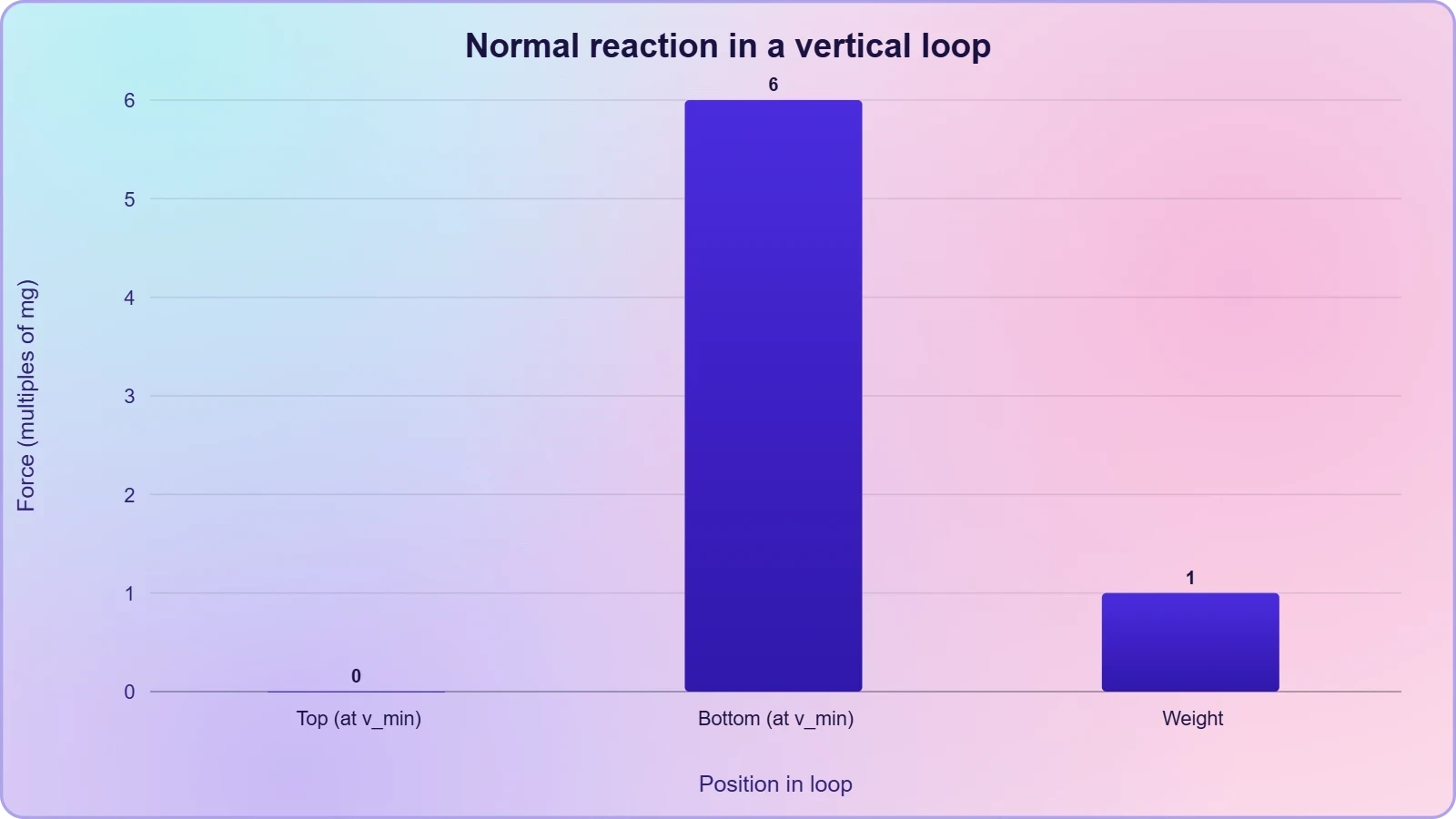
For a roller-coaster car at the top of a vertical loop, gravity and the normal reaction both point downward toward the centre. The minimum speed for the car to maintain contact occurs when the normal reaction just vanishes, so ##v_{min} = \sqrt{gr}##. For a 10 m loop, that is approximately 9.9 m/s.
At the bottom of the same loop, the normal reaction must both support the weight and supply the centripetal force, so it exceeds the weight considerably. Passengers feel this as the familiar pressed-into-the-seat sensation. The contrast between top and bottom is a direct consequence of vector addition along the radial line.
The Centrifugal Misconception and Rotating Frames
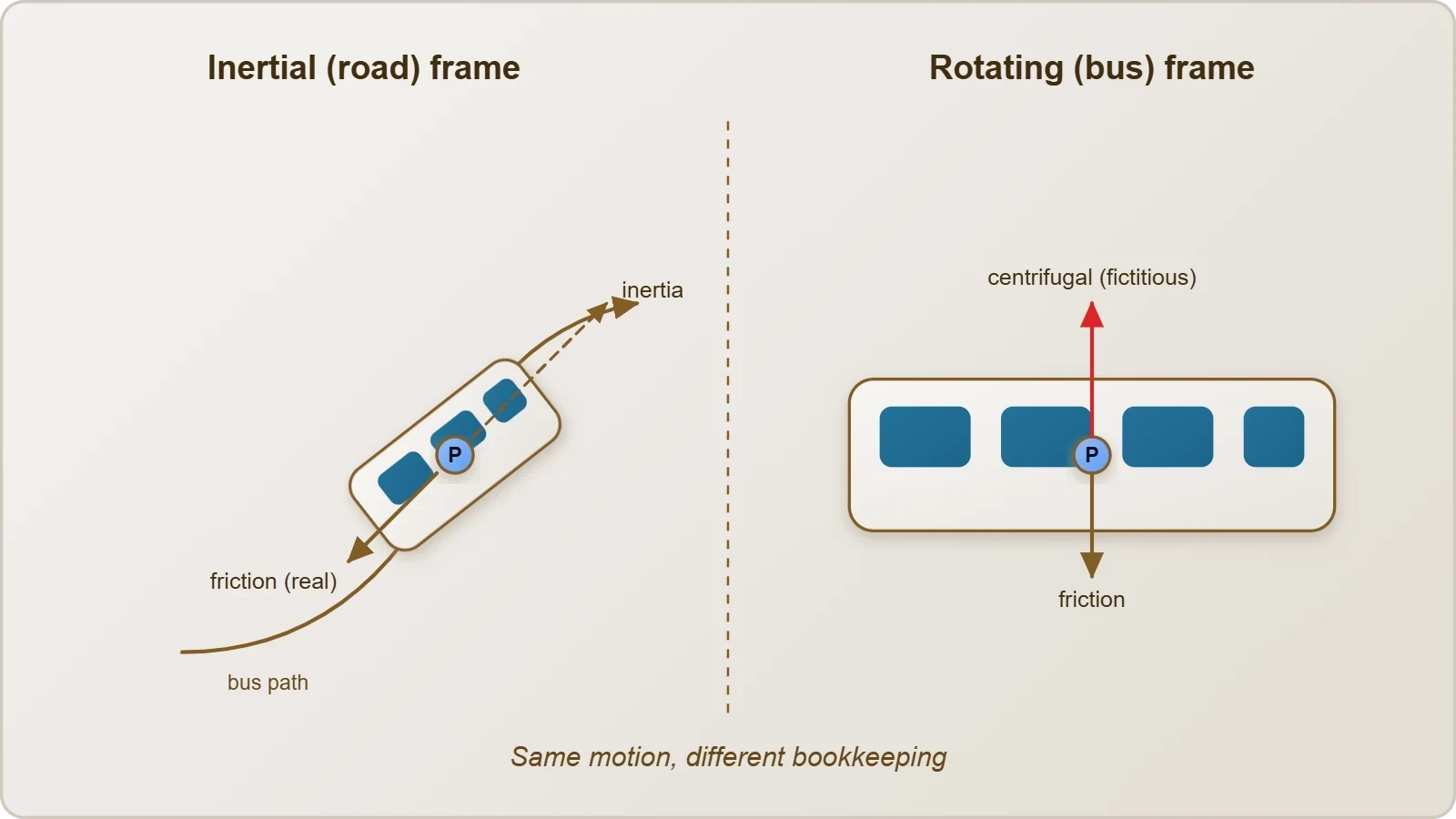
Ask a passenger in a turning bus why they lean outward and most will invoke a mysterious outward force. No such force exists in the inertial frame of the road; the passenger simply continues in a straight line while the bus curves beneath them. The sensation of being pushed outward is the felt consequence of inertia, not an applied push.
Why the Outward Force Is Fictitious
In an inertial frame, the only horizontal force on the passenger is friction from the seat, directed inward, and it is this friction that supplies the centripetal requirement. If the friction is insufficient, the passenger slides outward relative to the bus while still moving essentially straight in the ground frame. The apparent outward push is an artefact of observing from an accelerating frame.
Physicists do sometimes adopt a rotating frame and introduce a centrifugal term to make Newton's laws work there. This is a legitimate bookkeeping device, not evidence of a real interaction. The distinction between real and fictitious forces is a conceptual milestone worth marking clearly.
Choosing the Right Frame for Analysis
For most introductory problems, the inertial frame is simpler because no pseudo-forces need to be invented. Rotating frames become useful in advanced contexts such as meteorology, where the Coriolis and centrifugal terms simplify the description of large-scale flows. The choice is one of convenience, not of physical truth.
Examiners frequently test this distinction by asking students to explain the outward sensation without using the word centrifugal. A correct answer describes inertia and the inward friction force. A careless answer invents a force and loses marks, however confident the prose.
Common Errors and Diagnostic Checks
Most lost marks in this topic trace back to a handful of recurring slips, and each has a simple diagnostic. Learning to spot them before submission is more valuable than memorising further formulas. The checklist below distils the errors that examiners report most often.
Misapplied Directions and Missing Components
A frequent error is treating the centripetal force as an additional arrow on the diagram rather than the resultant of existing arrows. This double-counting inflates the net force and produces impossible answers. The cure is to resolve all real forces radially and set their sum equal to ##mv^2/r##.
Another slip is forgetting that on an incline the normal reaction is not vertical, so its radial component must be found with trigonometry. Students who assume ##N = mg## on a banked road will miscompute the design speed. Always resolve perpendicular and parallel to the surface before applying the radial condition.
Unit Consistency and Sanity Checks
Dimensional analysis offers a rapid sanity check: ##mv^2/r## must reduce to newtons, and any expression that does not is wrong. Substituting numbers only after the algebra is complete also reduces rounding errors. Finally, compare the answer with familiar magnitudes—a car cornering at 200 m/s should trigger immediate suspicion.
Checking limiting cases is equally powerful. Let the radius grow without bound and the required force should vanish, as it does for straight-line motion. Let the speed approach zero and the force should also vanish. Any formula failing these tests deserves re-derivation before it is trusted.
From Circular Motion Toward Relative Velocity
Centripetal force completes the dynamical picture of uniform circular motion, converting the acceleration of the previous lesson into a statement about physical interactions. With this foundation, the next lesson on relative velocity in two dimensions becomes far more tractable, because observers moving along curved paths are precisely where frame choice matters most.
Consolidating the Dynamical Picture
Three ideas deserve to travel forward with you: the centripetal force is a role played by real interactions, its magnitude is fixed by ##mv^2/r##, and its direction always points to the centre of curvature. Everything else in this lesson is elaboration on those three statements. Keep them close as the course turns toward relative motion.
A short programming exercise can reinforce the numerical side by computing required forces across a range of speeds and radii. The snippet below evaluates the centripetal force for a family of circular paths and prints a compact comparison table, mirroring the hand calculations practised earlier.
def centripetal_force(mass, speed, radius):
    if radius <= 0:
        raise ValueError("Radius must be positive")
    return mass * speed ** 2 / radius

for r in (20, 40, 80):
    for v in (10, 20):
        f = centripetal_force(1200, v, r)
        print(f"r={r:3d} m  v={v:2d} m/s  F={f:8.1f} N")
Preparing for Relative Velocity
Relative velocity asks how motion appears from a moving observer, and rotating observers are the most demanding case. The centripetal framework just built supplies the vocabulary for those discussions, including the reason rotating frames require fictitious terms. Arriving at the next lesson with this clarity will make the transition feel natural rather than abrupt.
Before moving on, attempt to classify five everyday curved motions by the force responsible, then verify each with a free-body sketch. This small habit of identification, practised deliberately, is what separates students who merely recall the formula from those who can analyse unfamiliar situations with confidence.
Also Read
- No links available.
From our network :
- Trump Political Strategy How Geopolitical Stunts Serve As Media Diversions
- 98% of Global MBA Programs Now Prefer GRE Over GMAT Focus EditionExplore why 98% of global MBA programs now prefer the GRE over GMAT Focus. Learn about the shorter GRE format, verbal logic importance, and strategic versatility for students.
- Vite 6/7 'Cold Start' Regression in Massive Module GraphsIn-depth analysis of Vite 6/7 cold start regressions in massive module graphs. Learn about barrel file issues, pre-bundling optimizations, and how to improve Vite dev server performance.
- 10 Physics Numerical Problems with Solutions for IIT JEEPrepare for IIT JEE with 10 physics numerical problems, complete with detailed solutions and conceptual explanations. Ideal for mastering kinematics, thermodynamics, electromagnetism, and optics.
- AI-Powered 'Precision Diagnostic' Replaces Standard GRE Score ReportsDiscover the new GRE Precision Diagnostic. Learn how AI-powered behavioral analytics and time-to-solve tracking are replacing standard GRE score reports to empower students.
- Mastering DB2 12.1 Instance Design: A Technical Deep Dive into Modern Database ArchitectureComprehensive guide to DB2 12.1 Instance Design. Explore architectural components, HADR setup, buffer pool tuning, and security policies for IBM DB2 12.1. Includes 10 functional SQL and Shell samples.
- Analyzing Trump Deportation Numbers Insights Into The 2026 Immigration Crackdown
- EV 2.0: The Solid-State Battery Breakthrough and Global Factory ExpansionDiscover the impact of the Solid-State Battery Breakthrough on the EV market. Learn about CATL and BYD stock growth, global factory expansion in Europe, and the future of EV 2.0 technology.
- Mastering DB2 LUW v12 Tables: A Comprehensive Technical GuideComprehensive guide on DB2 LUW v12 tables. Explore CREATE TABLE syntax, BLU Acceleration, range partitioning, data types, and security features for IBM DB2 LUW v12.
RESOURCES
- Uniform Circular Motion and Centripetal Force - YouTubeyoutube.comMar 17, 2017 ... Enough of this moving in straight lines business, let's go in circles! Circular motion may not be productive but it's…
- For circular motion in a vertical plane, why does Net Force ...physics.stackexchange.comMar 13, 2017 ... Centripetal force describes a force (often the net of several forces). It does not name a force. Gravity is a…
- 6.3 Centripetal Force - University Physics Volume 1 | OpenStaxopenstax.orgSep 19, 2016 ... Apply Newton's second law to develop the equation for centripetal force; Use circular motion concepts in solving problems involving Newton's ...
- Can anyone explain me centrifugal force : r/AskPhysics - Redditreddit.comOct 6, 2024 ... Centrifugal force is a 'fictitious force' - it only exists in a rotating reference frame. In an inertial frame, where…
- Physics Tutorial - Circular Motion - The Centripetal Force Requirementphysicsclassroom.comTo summarize, an object in uniform circular motion experiences an inward net force. This inward force is sometimes referred to as a centripetal force,…
- Why do you need a centripetal force for circular motion? - Redditreddit.comOct 12, 2019 ... Centripetal acceleration just means exactly that a particle is being accelerated in a way as to move on circular trajectory.…
- Centripetal Force - HyperPhysics Conceptshyperphysics.phy-astr.gsu.eduNote that the centripetal force is proportional to the square of the velocity, implying that a doubling of speed will require four times the…
- Centripetal force - Wikipediaen.wikipedia.orgCentripetal force is the force that makes a body follow a curved path. The direction of the centripetal force is always orthogonal to the…
- 6.3: Centripetal Force - Physics LibreTextsphys.libretexts.orgFeb 20, 2022 ... Any net force causing uniform circular motion is called a centripetal force. The direction of a centripetal force is toward…
- Learn and try: Circular motion (article) - Khan Academykhanacademy.orgThe term "centripetal force" is sometimes used to refer to the net force in the radial direction, Σ F → rad , acting…
- Circular Motion Flashcards - Quizletquizlet.comNOT Inertia causes objects to continue moving in circles. NOT Centripetal force is always present. Centripetal force pulls objects toward the center of a…
- Uniform Circular Motion - Imagine the Universe! - NASAimagine.gsfc.nasa.govSep 23, 2020 ... Centripetal means 'center seeking', so centripetal force is used to refer to the force experienced by an object traveling in…
- Centripetal Force Pendulum - ME-9821 - Products - PASCO scientificpasco.comBy attaching the Force Sensor/pendulum combination to the Rotary Motion Sensor, the relationship between force, mass, and velocity in a circular path can be ...
- Circular motionweb.chem.ox.ac.ukIn the frame of reference of the centre of the circle the real force acting is the centripetal force, however in the frame of…
- Textbook Presentation of Circular Motion Dynamics: Centrifugal ...ejrsme.icrsme.comThe vector sum of these forces is the centripetal force causing centripetal acceleration of the ball. Non-Inertial Frame Observer. In addition to the tension…