Vector algebra becomes genuinely useful the moment motion leaves a straight line. In one dimension, direction collapses into a sign, and arithmetic alone carries the analysis. In a plane, direction becomes a geometric fact that must be handled with its own rules. The dot and cross products are the two instruments that make this possible, converting questions about angles, projections, and perpendicularity into clean, computable quantities that physicists rely on constantly.
This lesson, the twenty-fourth in a thirty-part course on motion in a plane, introduces both products at an introductory level. It builds directly on the relative motion discussion of the previous lesson, where vector subtraction and reference frames first appeared, and it prepares the ground for the review and practice session that follows. The emphasis here is conceptual clarity: what each product measures, why its formula takes the shape it does, and where it surfaces in real physical problems.
By the end, you should be able to compute a dot product from components, interpret its sign geometrically, evaluate a two-dimensional cross product, and recognise which physical situations call for which operation. Work, power, torque, and magnetic force all rest on these two constructions, so the investment made here pays dividends across mechanics and electromagnetism alike.
On This Page
Why Two Products Exist for Vectors
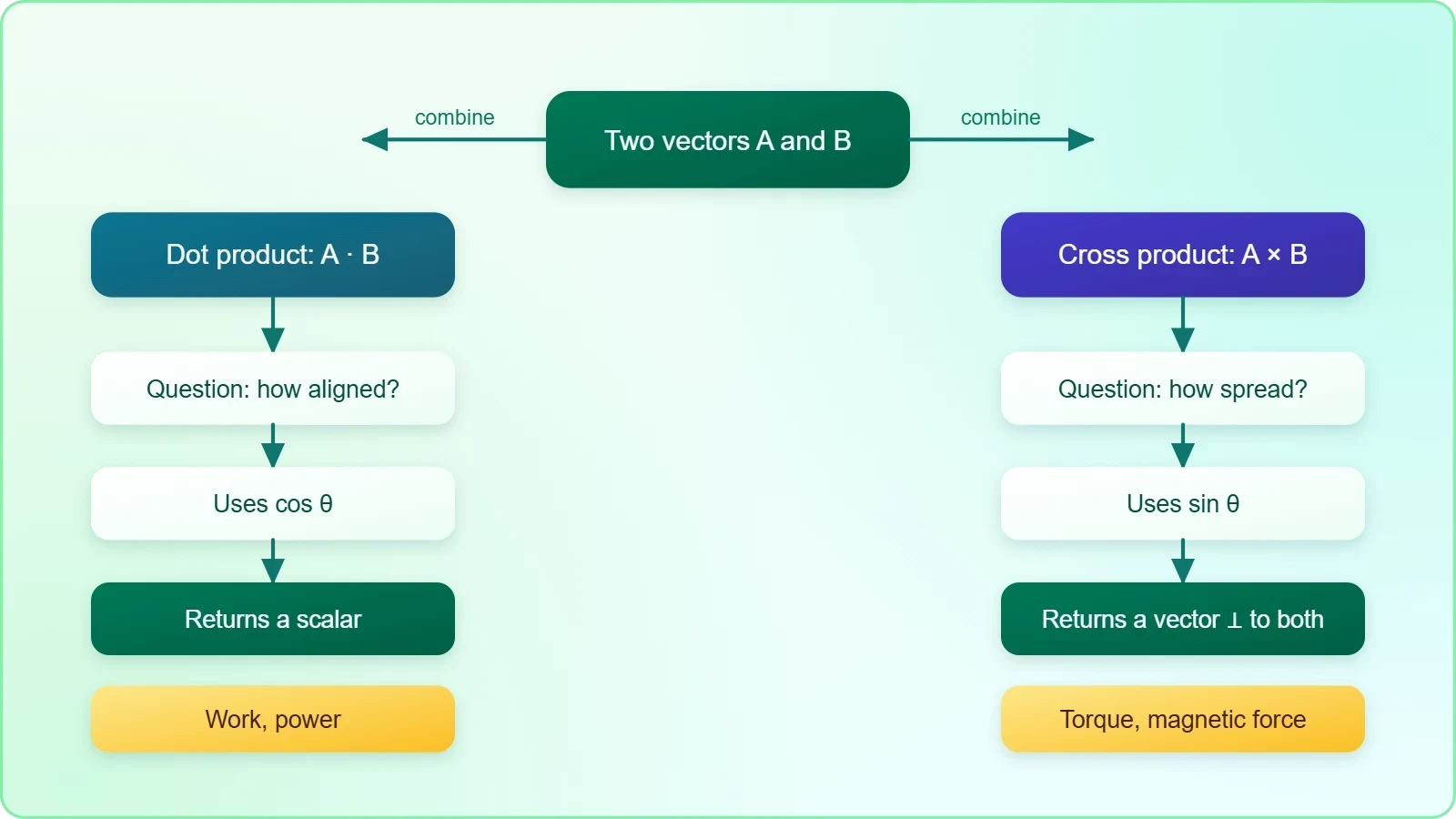
Ordinary numbers admit a single multiplication, but vectors carry magnitude and direction simultaneously, so a single product cannot capture every meaningful combination. Physics needs one operation that asks how much two vectors point along each other, and another that asks how much they span a perpendicular area. These are genuinely different questions, and they demand genuinely different answers.
The dot product answers the alignment question and returns a scalar, a pure number with no direction attached. The cross product answers the spanning question and returns a new vector, oriented perpendicular to both inputs. Recognising which question a physical situation poses is the first skill this lesson develops, and it prevents the most common beginner error of reaching for the wrong operation.
The Geometric Intuition Behind Each Operation
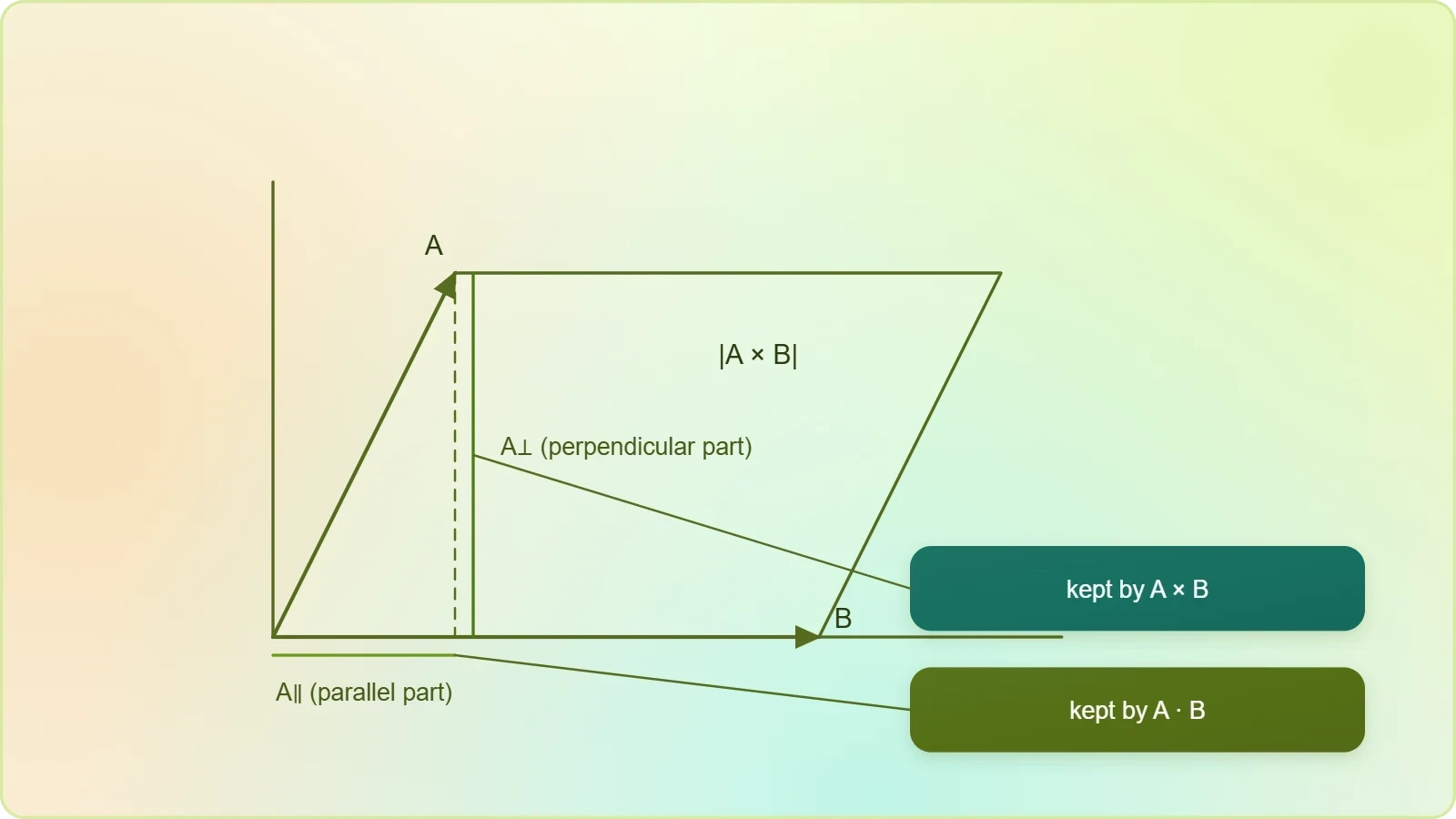
Imagine a force pulling a crate along a ramp. Only the component of force along the displacement does work, and the dot product extracts exactly that component. Now imagine a wrench turning a bolt. Only the component of force perpendicular to the handle produces rotation, and the cross product isolates precisely that perpendicular contribution.
Both products therefore act as filters, each selecting one geometric aspect of a vector pair while discarding the rest. The dot product keeps the parallel part and discards the perpendicular part. The cross product keeps the perpendicular part and discards the parallel part. Once this symmetry is visible, the formulas stop feeling arbitrary.
Scalars, Vectors, and What Each Product Returns
The return type matters enormously in physics. A scalar result can enter energy equations directly, while a vector result must be resolved into components before it can be added to other vectors. Mixing the two up produces dimensionally correct but physically meaningless answers, a failure mode that examiners see frequently.
Work, ##W = \vec{F} \cdot \vec{d}##, is scalar because energy has no direction. Torque, ##\vec{\tau} = \vec{r} \times \vec{F}##, is a vector because rotational tendency has an axis. The mathematical type of the product always mirrors the physical type of the quantity it defines, which is a useful consistency check during problem solving.
The Dot Product: Measuring Alignment
The dot product of two vectors is defined as the product of their magnitudes multiplied by the cosine of the angle between them. This single expression encodes the entire alignment story: when vectors point the same way, the cosine equals one and the product is maximal; when they are perpendicular, the cosine vanishes and so does the product.
Written compactly, the definition reads as follows, and every property of the dot product can be derived from it without further assumptions.
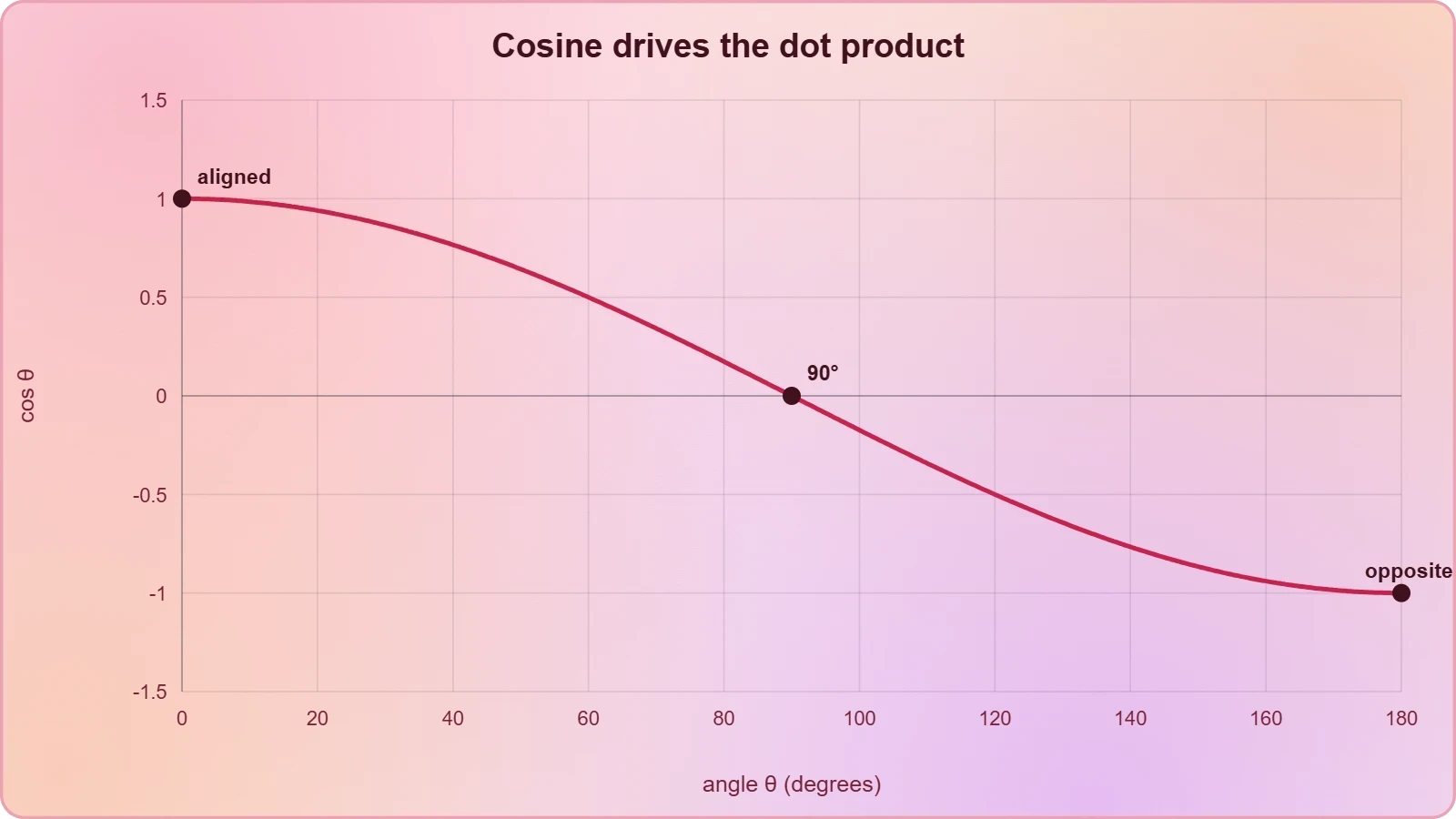
Because the cosine is an even function, the order of the vectors never matters, so ##\vec{A} \cdot \vec{B} = \vec{B} \cdot \vec{A}##. This commutativity is a small but reassuring property that distinguishes the dot product from its cross counterpart, which reverses sign when the order is swapped.
Component Form and the Cosine Rule Connection
In practice, vectors arrive as components rather than as magnitudes and angles, so the component formula does most of the computational work. Multiplying matching components and summing the results gives the dot product directly, with no trigonometry required at any stage of the calculation.
This formula is not an independent definition but a consequence of the geometric one, provable by expanding the cosine of a difference of angles. It also offers a practical route to finding the angle between two vectors, since rearranging the definition yields ##\cos\theta = \dfrac{\vec{A}\cdot\vec{B}}{|\vec{A}||\vec{B}|}##, a relation used constantly in geometry and physics alike.
Work as the Canonical Dot Product
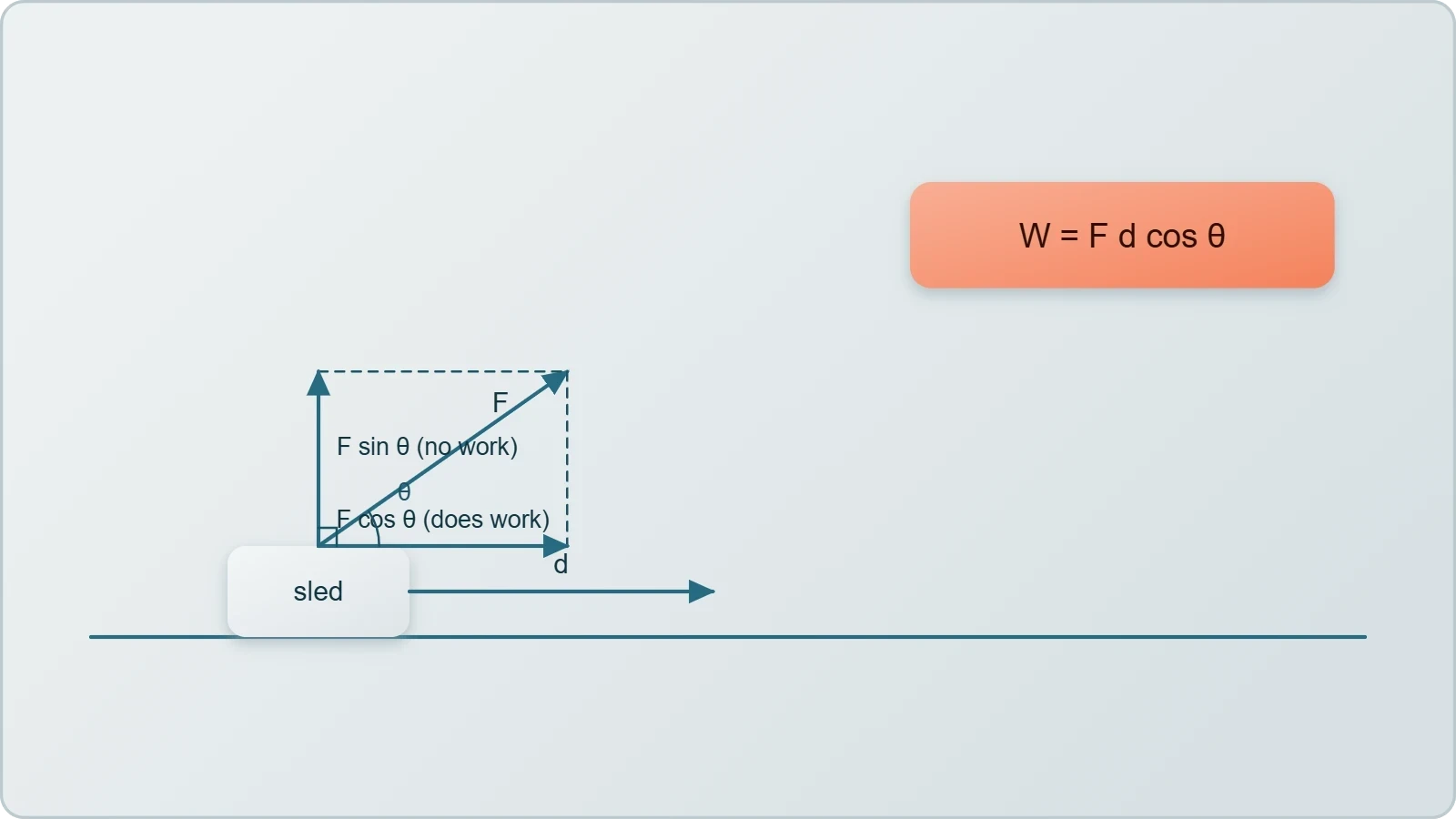
Work is the textbook example because it makes the alignment interpretation physically vivid. Pushing a sled horizontally along level ground transfers full effort into motion, while pushing downward at an angle wastes part of the effort against the ground. The dot product quantifies exactly how much of the force contributes.
When the force is perpendicular to the displacement, as with the normal force on a horizontally sliding block, the dot product vanishes and no work is done. This is not a mathematical curiosity but a physical fact that explains why carrying a bag horizontally over level ground requires no work against gravity, however tiring the task feels.
The Cross Product: Measuring Perpendicular Spread
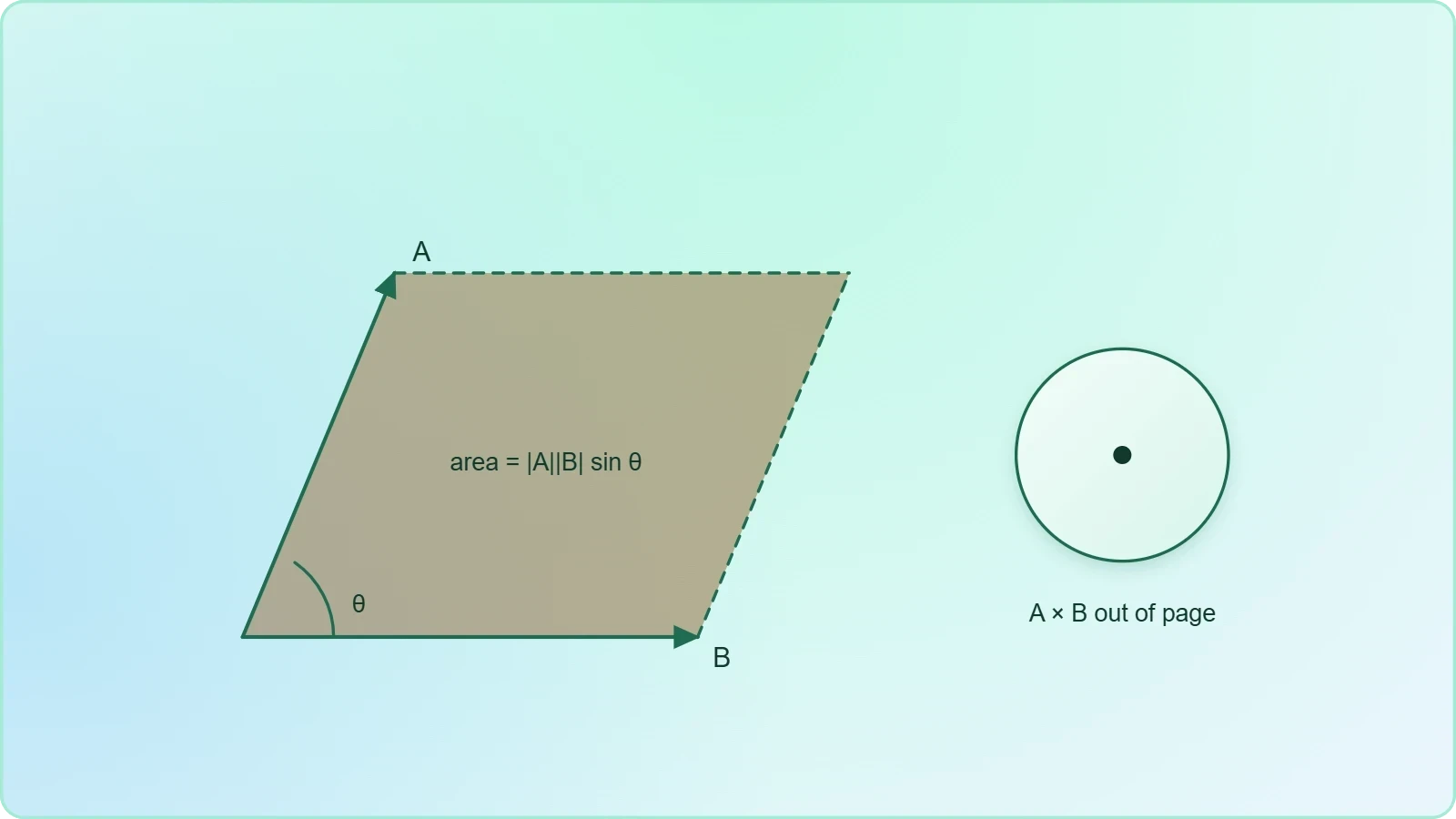
The cross product asks a different question entirely: how much do two vectors fail to align, and in which rotational sense do they spread apart? Its magnitude equals the area of the parallelogram the two vectors span, which grows as the vectors become more perpendicular and shrinks to nothing as they align.
The definition mirrors the dot product in structure but replaces cosine with sine, and the result is a vector rather than a scalar. The direction of that vector is perpendicular to the plane containing the original pair, fixed by the right-hand rule that students first meet when studying torque and magnetic fields.
Unlike the dot product, the cross product is anticommutative: swapping the order reverses the direction of the result, so ##\vec{A} \times \vec{B} = -\vec{B} \times \vec{A}##. This sign flip is not a technicality but the mathematical expression of the fact that reversing a rotation reverses its axis.
Right-Hand Rule and Direction in Two Dimensions
In a plane, the cross product of two vectors points either straight out of the page or straight into it, so its direction reduces to a single sign. Curling the fingers of the right hand from the first vector toward the second, with the thumb extended, gives the outward direction for a positive result.
For two-dimensional problems, this means the cross product behaves almost like a scalar with a sign, which simplifies calculations considerably. The full three-dimensional machinery becomes necessary only when the vectors themselves leave the plane, as they do in problems involving rotation about tilted axes.

Torque and Magnetic Force as Cross Products
Torque provides the most intuitive physical example. A force applied at a distance from a pivot produces rotation proportional to the perpendicular component of that force, and the cross product ##\vec{\tau} = \vec{r} \times \vec{F}## captures this exactly, including the axis about which the rotation occurs.
The magnetic force on a moving charge, ##\vec{F} = q\vec{v} \times \vec{B}##, is the other canonical case. The force is always perpendicular to both velocity and field, which is why charged particles in uniform magnetic fields trace circular paths rather than straight lines, a result that will reappear in later lessons on circular motion.
Computing Both Products from Components
Component arithmetic turns both products into routine bookkeeping, and fluency here is what separates students who understand vectors from those who merely recognise them. The dot product pairs matching components and sums, while the two-dimensional cross product pairs crosswise components and subtracts, a pattern worth memorising through practice rather than rote repetition.
For vectors in the plane, the cross product reduces to a single scalar component along the perpendicular axis, which is why two-dimensional rotational problems feel simpler than their three-dimensional counterparts. The following code demonstrates both computations in a form that can be adapted for checking homework answers.
import math

def dot(a, b):
    return sum(x * y for x, y in zip(a, b))

def cross_2d(a, b):
    # Returns the z-component of the cross product
    return a[0] * b[1] - a[1] * b[0]

def angle_between(a, b):
    cos_theta = dot(a, b) / (math.hypot(*a) * math.hypot(*b))
    return math.degrees(math.acos(max(-1.0, min(1.0, cos_theta))))

force = (6.0, 8.0)
displacement = (3.0, 4.0)
print("Work done:", dot(force, displacement))
print("Angle:", angle_between(force, displacement), "degrees")
print("Cross z-component:", cross_2d(force, displacement))
Running this snippet on parallel vectors returns a cross product of zero and an angle of zero degrees, confirming the geometric predictions. Changing the displacement to a perpendicular direction flips the outcome, producing a maximal cross product and a vanishing dot product, which is a useful sanity check when learning.
Worked Example: Force at an Angle
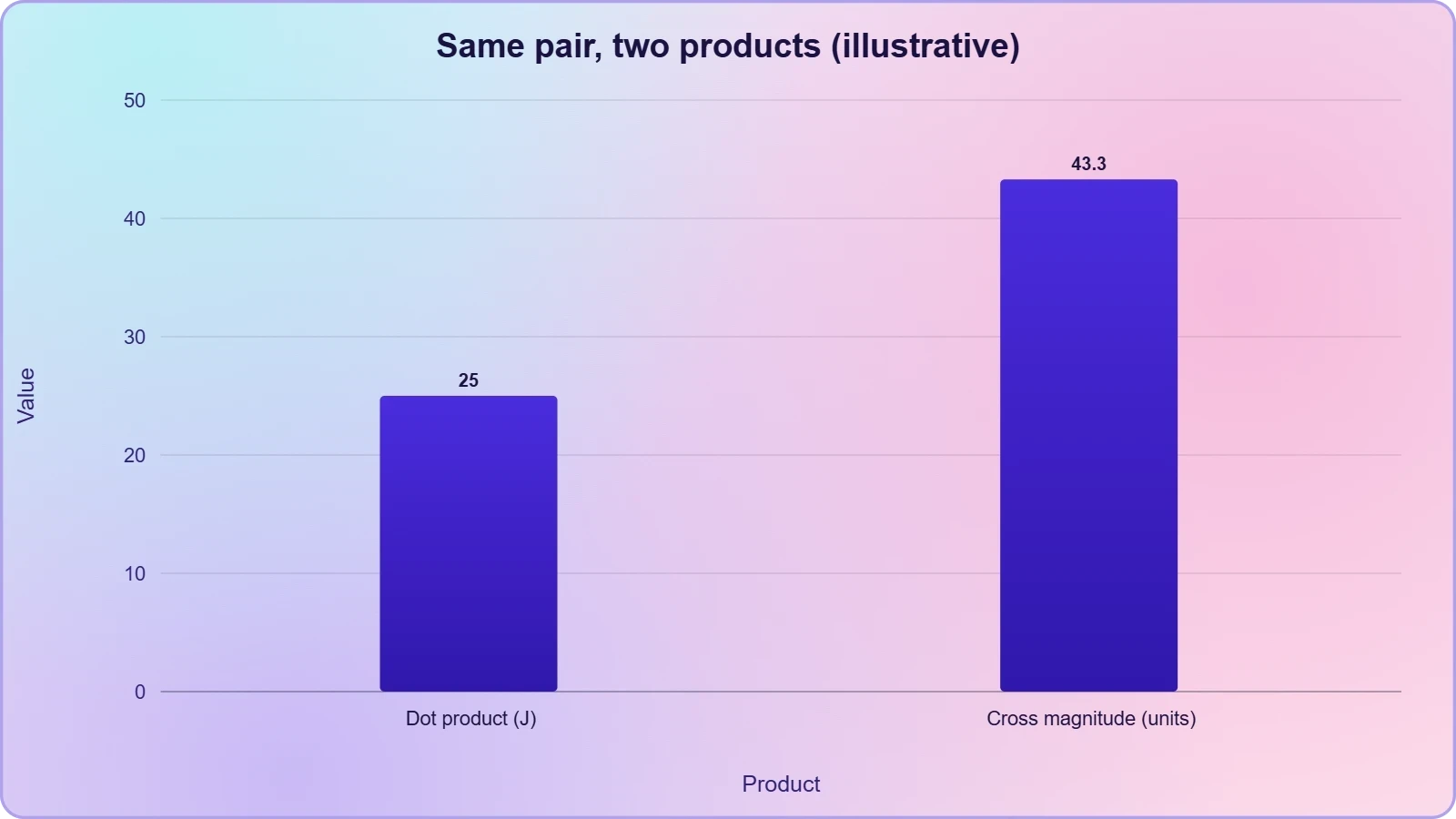
Consider a force of magnitude ten newtons applied at sixty degrees to a displacement of five metres. The dot product gives ##10 \times 5 \times \cos 60° = 25## joules, while the cross product magnitude gives ##10 \times 5 \times \sin 60° \approx 43.3## units, representing the perpendicular spread rather than any energy transfer.
This pairing illustrates why both products appear in the same problem without contradiction. The work depends only on the aligned component, while the torque about the starting point depends only on the perpendicular component. Each product extracts the information relevant to its own physical question.
Worked Example: Finding an Unknown Angle
Suppose two vectors of magnitudes four and seven have a dot product of fourteen. Rearranging the definition gives ##\cos\theta = 14/28 = 0.5##, so the angle is sixty degrees. The same data yield a cross product magnitude of ##28 \times \sin 60° \approx 24.2##, completing the geometric picture.
Such problems appear frequently in entrance examinations because they test both algebraic manipulation and geometric interpretation simultaneously. Practising the rearrangement until it becomes automatic frees attention for the physical reasoning that examiners actually reward.
Properties Worth Remembering
Both products obey algebraic rules that streamline manipulation, and knowing them saves considerable time in examinations. The dot product is commutative and distributive over addition, while the cross product is anticommutative but still distributive. These properties allow complex expressions to be expanded and simplified without returning to first principles each time.
Another useful fact concerns self-products. The dot product of a vector with itself equals the square of its magnitude, which provides a compact way to compute lengths. The cross product of a vector with itself is always zero, since a vector cannot span an area with itself, a result that follows immediately from the sine of zero degrees.
Distributive Laws and Their Uses
Distributivity means that ##\vec{A} \cdot (\vec{B} + \vec{C}) = \vec{A}\cdot\vec{B} + \vec{A}\cdot\vec{C}##, and the same expansion holds for the cross product. This allows composite vectors, such as a resultant force built from several contributions, to be handled one piece at a time rather than as an unwieldy whole.
In practice, this property underlies the component method itself. Splitting a vector into perpendicular components and applying the product to each pair is simply distributivity in action, which is why the component formulas feel so natural once the underlying algebra is understood.
Common Errors and How to Avoid Them
The most frequent mistake is treating the cross product as commutative, which reverses the sign of torque or magnetic force without warning. A second common error is applying the dot product when a perpendicular component is needed, producing a zero where a maximum was expected.
Careful attention to the physical question resolves both issues. Ask whether the situation concerns alignment or perpendicularity, and whether the answer should be a scalar or a vector. These two questions, asked before any calculation begins, eliminate most errors at the source.
Preparing for Planar Motion Problems
The next lesson consolidates the entire course through review and practice, and the dot and cross products will appear repeatedly in those exercises. Projectile problems use the dot product to find the component of velocity along a chosen axis, while circular motion problems use the cross product to relate angular velocity to tangential velocity.
Before moving on, ensure you can move fluidly between the geometric and component definitions of both products. That fluency is the real objective of this lesson, since the formulas themselves are simple once the underlying geometry is secure. Practice with varied angles until the sign patterns become instinctive.
Connecting to Circular Motion and Beyond
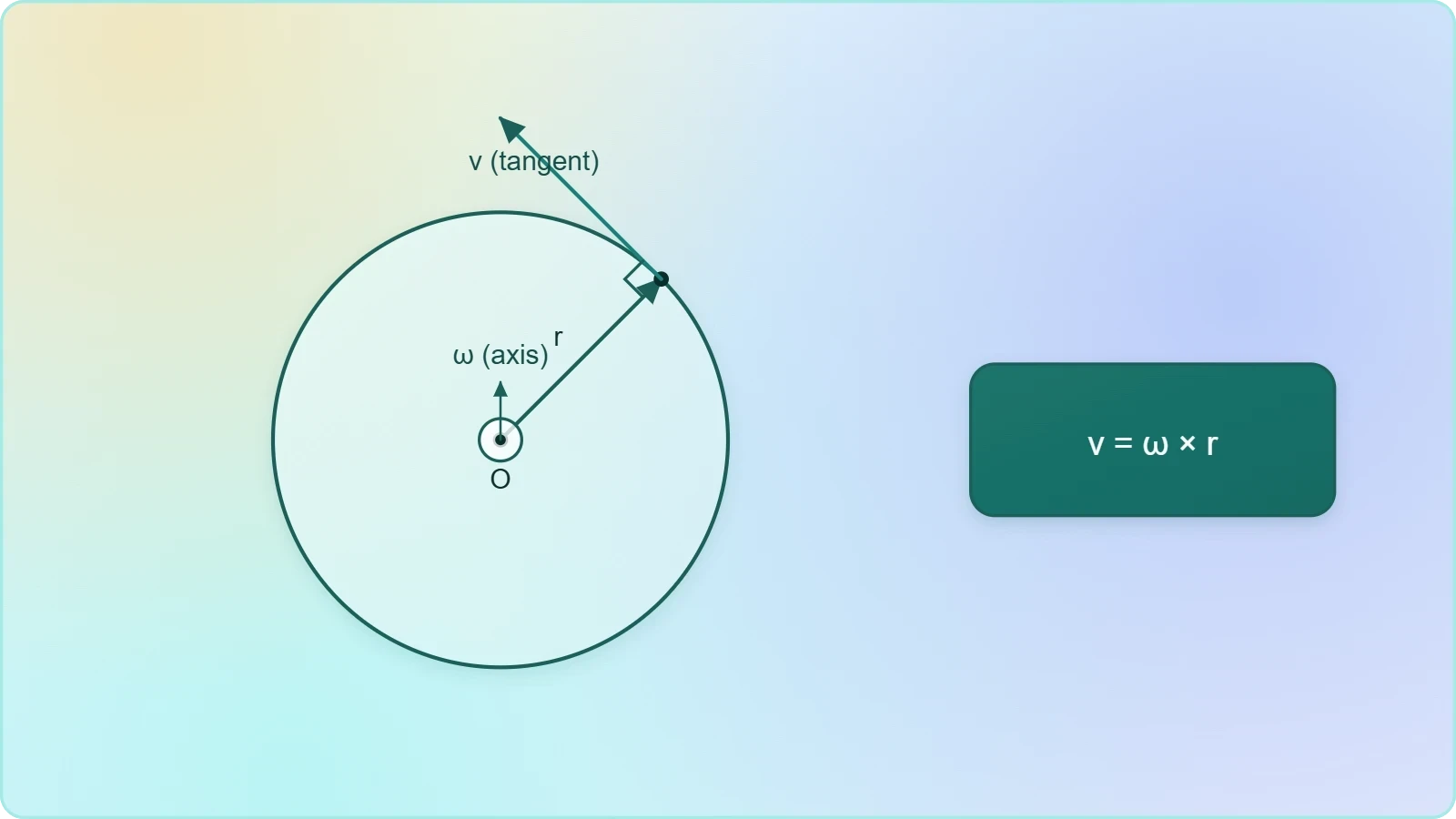
Uniform circular motion is naturally described by the relation ##\vec{v} = \vec{\omega} \times \vec{r}##, in which the cross product guarantees that velocity is perpendicular to both the rotation axis and the radius. This single equation explains why tangential speed equals angular speed times radius in the simplest case.
Later courses extend these tools to electromagnetism, where the Lorentz force and magnetic flux both rest on the same two products introduced here. The conceptual foundation laid in this lesson therefore reaches well beyond planar kinematics, even though its immediate application is confined to two dimensions.
A Brief Self-Check Before the Review Lesson
Try computing the dot and cross products for a pair of vectors given only as magnitudes and an included angle, then repeat the exercise from components alone. If both routes agree, your understanding is solid enough to proceed confidently into the review session that follows.
Also verify that you can state, without hesitation, which product vanishes for parallel vectors and which vanishes for perpendicular ones. This single distinction, more than any formula, captures the essential difference between the two operations and will serve you throughout the remainder of the course.
Also Read
- No links available.
From our network :
- Vite 6/7 'Cold Start' Regression in Massive Module GraphsIn-depth analysis of Vite 6/7 cold start regressions in massive module graphs. Learn about barrel file issues, pre-bundling optimizations, and how to improve Vite dev server performance.
- AI-Powered 'Precision Diagnostic' Replaces Standard GRE Score ReportsDiscover the new GRE Precision Diagnostic. Learn how AI-powered behavioral analytics and time-to-solve tracking are replacing standard GRE score reports to empower students.
- Trump Political Strategy How Geopolitical Stunts Serve As Media Diversions
- EV 2.0: The Solid-State Battery Breakthrough and Global Factory ExpansionDiscover the impact of the Solid-State Battery Breakthrough on the EV market. Learn about CATL and BYD stock growth, global factory expansion in Europe, and the future of EV 2.0 technology.
- Mastering DB2 LUW v12 Tables: A Comprehensive Technical GuideComprehensive guide on DB2 LUW v12 tables. Explore CREATE TABLE syntax, BLU Acceleration, range partitioning, data types, and security features for IBM DB2 LUW v12.
- 98% of Global MBA Programs Now Prefer GRE Over GMAT Focus EditionExplore why 98% of global MBA programs now prefer the GRE over GMAT Focus. Learn about the shorter GRE format, verbal logic importance, and strategic versatility for students.
- Analyzing Trump Deportation Numbers Insights Into The 2026 Immigration Crackdown
- 10 Physics Numerical Problems with Solutions for IIT JEEPrepare for IIT JEE with 10 physics numerical problems, complete with detailed solutions and conceptual explanations. Ideal for mastering kinematics, thermodynamics, electromagnetism, and optics.
- Mastering DB2 12.1 Instance Design: A Technical Deep Dive into Modern Database ArchitectureComprehensive guide to DB2 12.1 Instance Design. Explore architectural components, HADR setup, buffer pool tuning, and security policies for IBM DB2 12.1. Includes 10 functional SQL and Shell samples.
RESOURCES
- 1.5: The Dot and Cross Product - Mathematics LibreTextsmath.libretexts.orgGiven two linearly independent vectors a and b, the cross product, a × b, is a vector that is perpendicular to both a and…
- Dot vs. cross product | Physics | Khan Academy - YouTubeyoutube.comAug 8, 2008 ... cross-product Understanding the differences between the dot ... Calculating dot and cross products with unit vector notation | Physics |…
- Origin of the dot and cross product? - Mathematics Stack Exchangemath.stackexchange.comSep 6, 2011 ... [23] In 1843, William Rowan Hamilton introduced the quaternion product, and with it the terms "vector" and "scalar". Given two…
- Vectors and spaces | Linear algebra | Math - Khan Academykhanacademy.orgVector dot and cross products · Vector dot product and vector length. (Opens a ... Cross product introduction. (Opens a modal) · Proof: Relationship…
- Cross product - Wikipediaen.wikipedia.orgThe scalar and vector part of this Hamilton product corresponds to the negative of dot product and cross product of the two vectors. ...…
- Vectors: Using Dot and Cross Product :: Godot 4 Recipeskidscancode.orgYou'd like to understand what is meant by dot product and cross product. Solution. In this recipe we'll introduce the concept of vector dot…
- (Yet another) Introduction to quaternions - lisyarus bloglisyarus.github.io(Yet another) Introduction to quaternions. 2024 Oct 26. There are ... The usual 3D vector dot and cross products can be represented using conjugation:…
- The dot product - Math Insightmathinsight.orgSuggested background. An introduction to vectors. The dot product between two vectors is based on the projection of one vector ...
- Introduction to MATLAB: Part II - NJIT Researchresearch.njit.eduWhen two vectors are in unit-vector notation, their dot product is ... The cross product (also called vector product) of vectors a and b,…
- Dot and Cross Products on Vectors - GeeksforGeeksgeeksforgeeks.orgOct 26, 2026 ... The cross product or vector product gives another vector as an output that is always perpendicular to both a and…
- Vector math — Godot Engine (stable) documentation in Englishdocs.godotengine.orgIntroduction: This tutorial is a short and practical introduction to linear ... Like the dot product, the cross product is an operation on two…
- Can't believe I finally understand cross products. Mind completely ...reddit.comDec 20, 2020 ... In order to identify bivectors with vectors you need to have a dot product on your vector space, since there…
- Introduction to Multivariable Calculus - GATech Mathmath.gatech.eduVectors and geometry of space: dot and cross product, lines and planes, cylinders and quadric surfaces, 12.1-12.6, 3. Vector functions and curves: limits ...
- Dot & cross product of vectors | PPTX - Slideshareslideshare.netThe document explains the dot and cross products of vectors, defining the dot product as a scalar value and the cross product as a…
- 2.8 Cross Products - Engineering Staticsengineeringstatics.orgHow is a cross product different than a dot product?. What is a ... If you put the vectors in the wrong order you…