Vector subtraction and scalar multiplication form the quiet backbone of two-dimensional kinematics, the operations that let us reverse directions, rescale magnitudes, and reframe motion without ever redrawing a diagram from scratch. Where the previous lesson built vectors through analytical addition, this lesson turns that machinery around: subtracting one vector from another is simply adding its negative, and multiplying by a scalar stretches or shrinks a vector while preserving or flipping its line of action. These two ideas appear everywhere, from computing relative velocity between two moving bodies to resolving a projectile's displacement into manageable components.
Understanding these operations deeply matters because physics rarely hands us vectors already aligned. A boat crossing a river, a plane correcting for wind, or a particle reversing course all demand that we manipulate arrows algebraically and geometrically with equal confidence. Scalar multiplication governs how a unit vector becomes a full displacement, while subtraction reveals the gap between two positions, the very definition of displacement that the next lesson formalises. Mastering both prepares you to treat vectors as flexible algebraic objects rather than static pictures.
This lesson proceeds from the geometric picture to the component algebra, then to worked applications and common pitfalls. Each section connects backward to analytical addition and forward to position and velocity vectors, so the progression stays coherent. By the end, you will subtract vectors in two coordinate systems, scale them by positive and negative scalars, and recognise where these operations quietly power projectile and circular-motion analysis.
On This Page
The Geometry of Vector Subtraction
Subtraction of vectors is best understood as a geometric act of reversal followed by addition. To compute ##\vec{A} - \vec{B}##, we first draw ##-\vec{B}##, the vector with identical magnitude but opposite direction, then add it to ##\vec{A}## using the head-to-tail rule established in the previous lesson. The resulting arrow runs from the tail of ##\vec{A}## to the head of ##-\vec{B}##, capturing the net change between the two quantities.

Reversing Direction and the Negative Vector
The negative of a vector is defined purely by direction reversal, not by any change in length. Formally, ##-\vec{B}## satisfies ##\vec{B} + (-\vec{B}) = \vec{0}##, the zero vector, which has no magnitude and no defined direction. This additive inverse property mirrors ordinary arithmetic and guarantees that every vector has exactly one opposite, making subtraction always well defined.
Geometrically, flipping an arrow through 180 degrees produces its negative, and this flip is independent of coordinate axes. A displacement of 5 metres east becomes 5 metres west; a velocity of 20 m/s north becomes 20 m/s south. Recognising this symmetry lets you convert any subtraction problem into an addition problem instantly, which is often the fastest route to a correct diagram.

The Triangle and Parallelogram Views
When ##\vec{A}## and ##\vec{B}## share a common tail, the vector ##\vec{A} - \vec{B}## points from the head of ##\vec{B}## to the head of ##\vec{A}##. This is the diagonal of the parallelogram formed by the two vectors, drawn in the direction that closes the gap. It is the single most useful visual shortcut for relative-motion problems.
Equivalently, place ##\vec{A}## and ##-\vec{B}## head to tail and the resultant runs from the free tail to the free head. Both constructions yield identical results, so choose whichever suits the diagram at hand. The parallelogram view is especially helpful when the two vectors represent positions measured from one origin.

Subtraction in Component Form
Analytical subtraction follows the same logic as analytical addition, applied component by component. If ##\vec{A} = (A_x, A_y)## and ##\vec{B} = (B_x, B_y)##, then their difference is simply ##(A_x - B_x, A_y - B_y)##. No trigonometry is required at this stage; the geometry has already been encoded into the components during the previous lesson's resolution step.
Working Through the Components
Consider ##\vec{A} = (7, 3)## and ##\vec{B} = (2, 5)##. Their difference is ##(5, -2)##, a vector pointing rightward and downward. The magnitude follows from the Pythagorean relation, ##|\vec{A} - \vec{B}| = \sqrt{5^2 + (-2)^2} = \sqrt{29} \approx 5.39##, and the direction from the arctangent of the vertical over horizontal component.

This componentwise procedure scales effortlessly to three dimensions and to any number of vectors. The key discipline is consistency: subtract x from x, y from y, and never mix axes. A single transposed component silently corrupts the entire result, so double-checking the pairing is worth the few extra seconds it costs.
Magnitude and Direction of the Difference
The magnitude of a difference is not generally the difference of magnitudes. For the example above, ##|\vec{A}| = \sqrt{58} \approx 7.62## and ##|\vec{B}| = \sqrt{29} \approx 5.39##, yet ##|\vec{A} - \vec{B}| \approx 5.39##, which happens to equal ##|\vec{B}|## only by coincidence. Students frequently assume ##|\vec{A} - \vec{B}| = |\vec{A}| - |\vec{B}|##, an error that produces nonsense whenever the vectors are not collinear.
The correct relationship is governed by the law of cosines. If ##\theta## is the angle between ##\vec{A}## and ##\vec{B}##, then the squared magnitude of the difference is given by the expression below, which reduces to the naive subtraction only when the vectors are parallel.
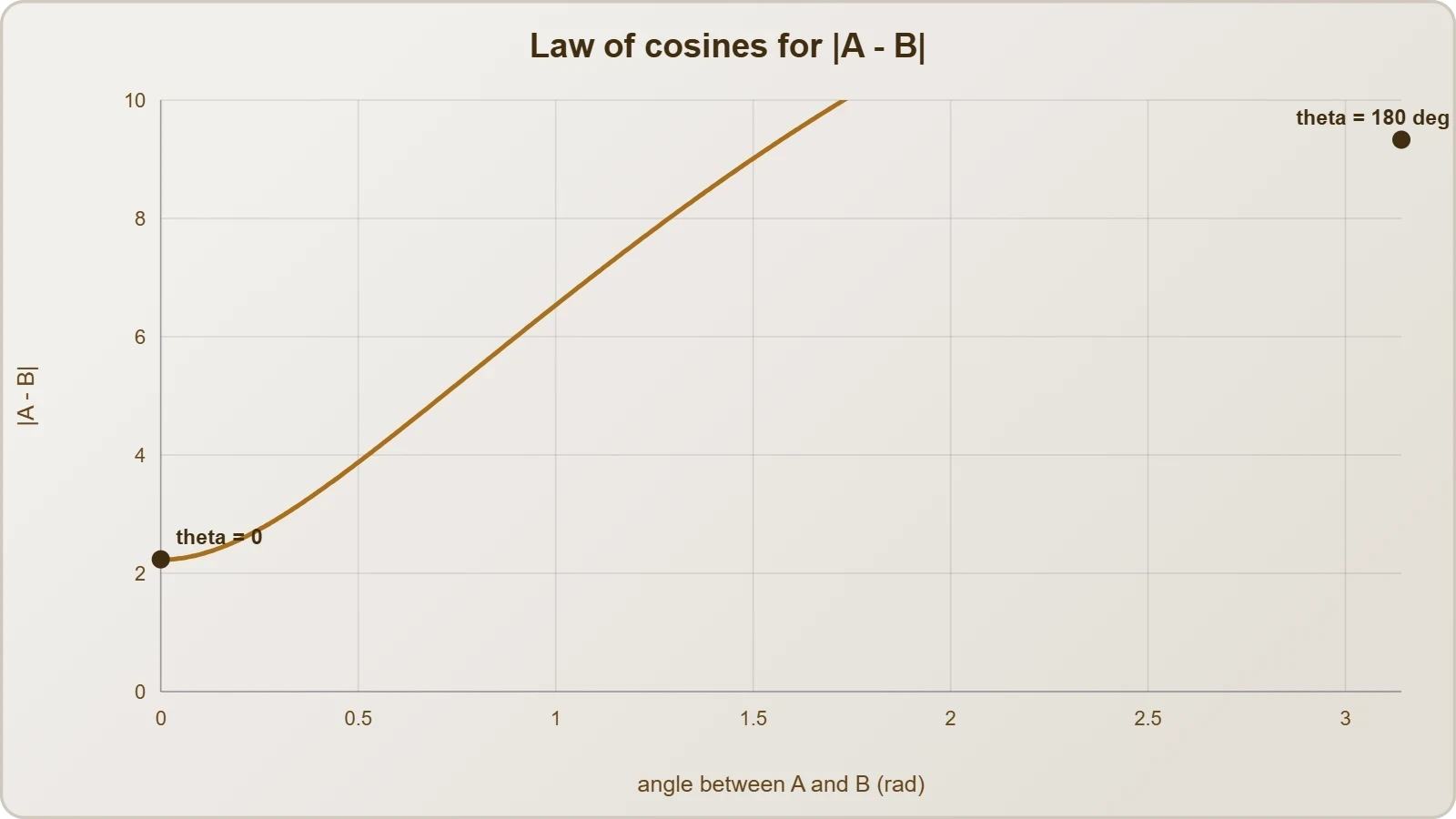
Multiplication by a Scalar: Stretching and Flipping
A scalar is an ordinary number that carries magnitude but no direction, and multiplying a vector by one rescales the arrow along its existing line. If ##k > 0##, the vector ##k\vec{A}## points the same way as ##\vec{A}## with length multiplied by ##k##. If ##k < 0##, the direction reverses as well, and if ##k = 0##, the result is the zero vector.
Positive, Negative, and Fractional Scalars
Doubling a velocity vector doubles its speed without altering its heading, while halving a displacement vector shortens the arrow to half its original length. A negative scalar such as ##-2## both doubles the magnitude and flips the direction, which is precisely why subtraction can be recast as addition of a scaled negative vector. Fractional scalars between zero and one compress the arrow, a routine operation when converting between unit vectors and full displacements.

Scalar multiplication distributes over addition, so ##k(\vec{A} + \vec{B}) = k\vec{A} + k\vec{B}##, and it associates with scalar products, ##(kl)\vec{A} = k(l\vec{A})##. These algebraic rules let you manipulate vector expressions exactly as you would ordinary algebra, which is the quiet reason vector methods feel so natural once the geometric intuition is in place.
Unit Vectors and Normalisation
Dividing a vector by its own magnitude produces a unit vector pointing in the same direction, written ##\hat{A} = \vec{A} / |\vec{A}|##. This is scalar multiplication by the reciprocal of the magnitude, and it underpins the standard decomposition ##\vec{A} = |\vec{A}|\hat{A}##. Unit vectors along the x and y axes, conventionally ##\hat{i}## and ##\hat{j}##, let us write any planar vector as ##A_x\hat{i} + A_y\hat{j}##.

Normalisation appears constantly in physics: defining a direction of motion independent of speed, constructing surface normals in mechanics, and expressing forces along specified lines. The operation is simple but its conceptual payoff is large, because it separates the two pieces of information a vector carries, namely how much and which way.
Combining Subtraction and Scaling in Practice
Real problems rarely ask for a single operation in isolation. A typical exercise might request ##2\vec{A} - 3\vec{B}##, which combines scaling and subtraction in one expression. The reliable strategy is to distribute the scalars across components first, then subtract matching components, and finally compute magnitude and direction from the resulting pair. This order avoids sign errors and keeps the arithmetic transparent.
Relative Velocity as a Difference
The velocity of object A relative to object B is defined as ##\vec{v}_{AB} = \vec{v}_A - \vec{v}_B##, a direct application of vector subtraction. If a cyclist moves at 8 m/s east and a walker at 3 m/s east, the cyclist's velocity relative to the walker is 5 m/s east. Reverse the walker's direction and the relative velocity becomes 11 m/s east, illustrating how subtraction captures closing speed.
This same construction resolves river-crossing and wind-correction problems. A boat's velocity relative to the shore equals its velocity relative to the water plus the water's velocity relative to the shore, and rearranging that sum into a difference isolates whichever quantity is unknown. The algebra is elementary, but the physical insight it delivers is substantial.
Worked Example with Components
Suppose ##\vec{A} = (4, -1)## and ##\vec{B} = (-2, 3)##, and we need ##\vec{C} = 2\vec{A} - 3\vec{B}##. Scaling gives ##2\vec{A} = (8, -2)## and ##3\vec{B} = (-6, 9)##, so the difference is ##(8 - (-6), -2 - 9) = (14, -11)##. The magnitude is ##\sqrt{196 + 121} = \sqrt{317} \approx 17.8## units.
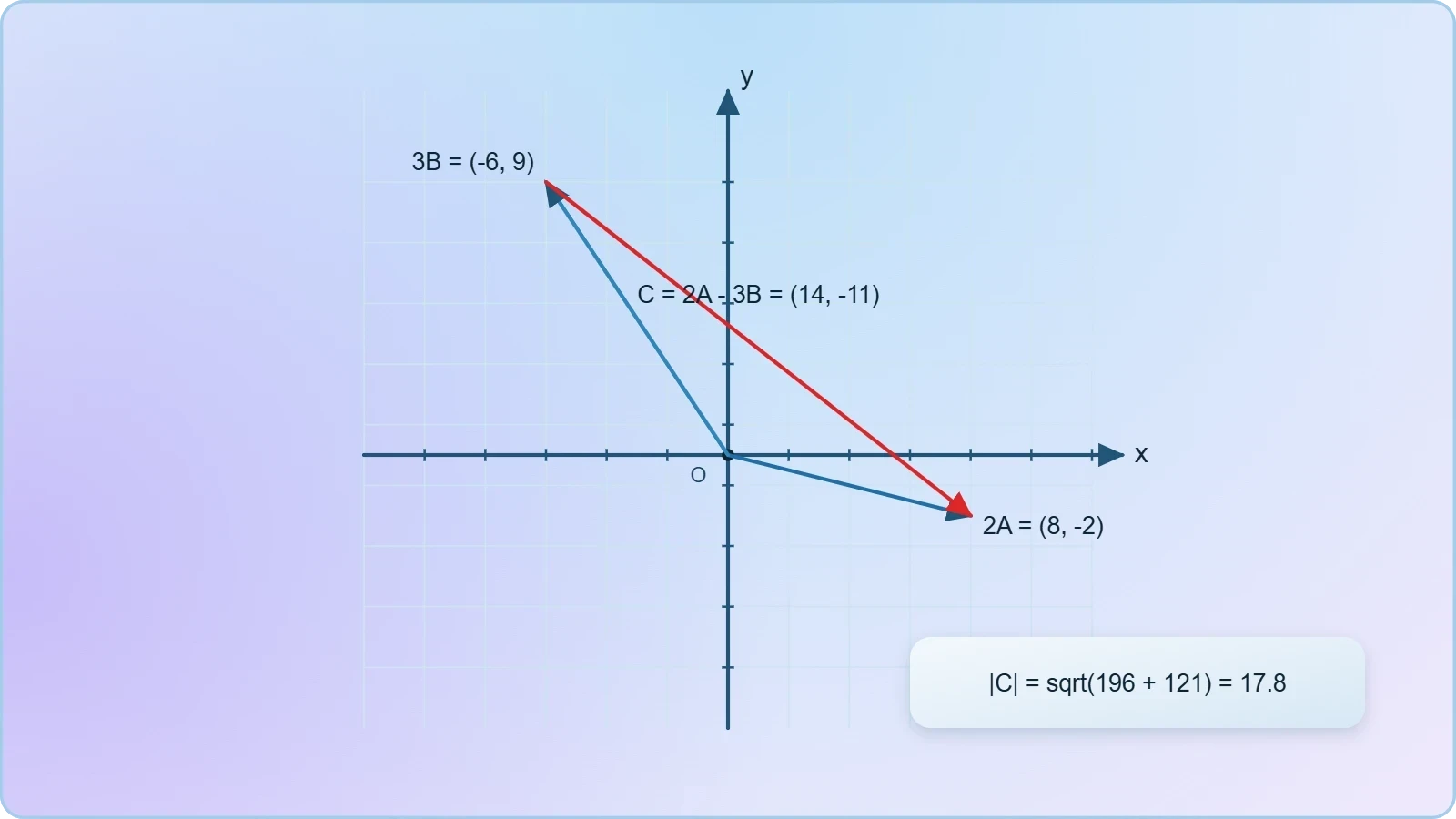
A short script confirms the arithmetic and generalises it to any pair of vectors, which is useful when checking homework or exploring how the result changes as inputs vary. The code below mirrors the hand calculation exactly, so discrepancies point straight to a sign slip rather than a conceptual misunderstanding.
import math

def scale(v, k):
    return (k * v[0], k * v[1])

def subtract(a, b):
    return (a[0] - b[0], a[1] - b[1])

def magnitude(v):
    return math.sqrt(v[0]**2 + v[1]**2)

A = (4, -1)
B = (-2, 3)
C = subtract(scale(A, 2), scale(B, 3))
print(C, round(magnitude(C), 2))  # (14, -11) 17.8
Algebraic Properties and Common Errors
Vector subtraction is anticommutative, meaning ##\vec{A} - \vec{B} = -(\vec{B} - \vec{A})##, so swapping the order reverses the result without changing its length. Scalar multiplication, by contrast, is commutative with respect to the scalar and associative with respect to repeated scaling. These properties are not trivia; they determine which rearrangements of an equation are legal and which silently introduce sign errors.
Anticommutativity and the Zero Vector
Because order matters, always write subtraction in the sequence the physics demands. Displacement from A to B is ##\vec{r}_B - \vec{r}_A##, not the reverse, and confusing the two flips the direction of travel. The zero vector arises only when the two operands are identical, and it is the unique vector satisfying ##\vec{A} + \vec{0} = \vec{A}## for every ##\vec{A}##.
Anticommutativity also explains why relative velocity reverses sign when you swap the observer and the observed. The cyclist sees the walker receding at 5 m/s west while the walker sees the cyclist receding at 5 m/s east. Same magnitude, opposite direction, exactly as the algebra predicts.
Pitfalls Worth Guarding Against
The most frequent mistake is subtracting magnitudes instead of vectors, which is valid only for collinear vectors pointing the same way. A close second is mishandling negative scalars, forgetting that the direction flips as well as the length. Both errors vanish if you sketch the arrows before computing, a habit worth cultivating from the start.
Another subtle trap is mixing coordinate systems mid-calculation, for instance subtracting a component resolved along one axis from a component resolved along another. Keep every vector in the same frame until the final step, then convert once. Consistency of frame is as important as consistency of sign.
Preparing for Position, Displacement, and Velocity Vectors
The operations developed here are the tools the next lesson wields. Position vectors locate points relative to an origin, displacement is the difference between two position vectors, and velocity is displacement divided by elapsed time. Every one of those definitions leans on subtraction and scalar scaling, so fluency now pays immediate dividends when the course turns to kinematics proper.
From Difference to Displacement
If a particle sits at ##\vec{r}_1## and later at ##\vec{r}_2##, its displacement is ##\Delta\vec{r} = \vec{r}_2 - \vec{r}_1##, a direct subtraction. Average velocity then follows by scaling that displacement by the reciprocal of the time interval, ##\vec{v}_{avg} = \Delta\vec{r} / \Delta t##. Both operations from this lesson appear in a single, compact definition.
Projectile motion later decomposes these vectors into horizontal and vertical components, each evolving independently under gravity. Circular motion, in turn, relies on differences between closely spaced position vectors to define centripetal acceleration. The algebra you have practised is not preliminary; it is the permanent grammar of two-dimensional kinematics.
A Short Self-Check
Before moving on, verify that you can subtract two vectors both graphically and by components, scale a vector by positive, negative, and fractional values, and explain why ##|\vec{A} - \vec{B}|## differs from ##|\vec{A}| - |\vec{B}|##. If any of these feels uncertain, revisit the worked example and the parallelogram construction until the reasoning is automatic.
Try constructing a unit vector from an arbitrary displacement and confirm that its magnitude is exactly one. Then compute a relative velocity between two objects moving at an angle to each other, and check that swapping the observer reverses the sign. These small exercises cement the operations far more effectively than rereading the definitions.
Also Read
- No links available.
From our network :
- AI-Powered 'Precision Diagnostic' Replaces Standard GRE Score ReportsDiscover the new GRE Precision Diagnostic. Learn how AI-powered behavioral analytics and time-to-solve tracking are replacing standard GRE score reports to empower students.
- Mastering DB2 12.1 Instance Design: A Technical Deep Dive into Modern Database ArchitectureComprehensive guide to DB2 12.1 Instance Design. Explore architectural components, HADR setup, buffer pool tuning, and security policies for IBM DB2 12.1. Includes 10 functional SQL and Shell samples.
- Trump Political Strategy How Geopolitical Stunts Serve As Media Diversions
- Analyzing Trump Deportation Numbers Insights Into The 2026 Immigration Crackdown
- 98% of Global MBA Programs Now Prefer GRE Over GMAT Focus EditionExplore why 98% of global MBA programs now prefer the GRE over GMAT Focus. Learn about the shorter GRE format, verbal logic importance, and strategic versatility for students.
- Vite 6/7 'Cold Start' Regression in Massive Module GraphsIn-depth analysis of Vite 6/7 cold start regressions in massive module graphs. Learn about barrel file issues, pre-bundling optimizations, and how to improve Vite dev server performance.
- 10 Physics Numerical Problems with Solutions for IIT JEEPrepare for IIT JEE with 10 physics numerical problems, complete with detailed solutions and conceptual explanations. Ideal for mastering kinematics, thermodynamics, electromagnetism, and optics.
- EV 2.0: The Solid-State Battery Breakthrough and Global Factory ExpansionDiscover the impact of the Solid-State Battery Breakthrough on the EV market. Learn about CATL and BYD stock growth, global factory expansion in Europe, and the future of EV 2.0 technology.
- Mastering DB2 LUW v12 Tables: A Comprehensive Technical GuideComprehensive guide on DB2 LUW v12 tables. Explore CREATE TABLE syntax, BLU Acceleration, range partitioning, data types, and security features for IBM DB2 LUW v12.
RESOURCES
- 2.2: Addition, Subtraction, and Scalar Multiplication of Vectorsmath.libretexts.orgMay 8, 2023 ... To multiply a vector by a scalar (a constant), multiply each of its components by the constant. This image shows…
- Vector operations review (article) - Khan Academykhanacademy.orgIn vector subtraction, we subtract the corresponding components. Want ... In scalar multiplication, we multiply the scalar by each component. Want to ...
- Vector Operations - Addition, Subtraction, and Scalar Multiplicationsuperprof.comJun 9, 2026 ... A brief and simple explanation of how to perform the most common operations with vectors: definitions and examples.
- Subset closed under vector addition and subtraction, but not scalar ...math.stackexchange.comAug 9, 2020 ... The integers form a ring, so this is obviously closed under addition. However, it's not closed under multiplication from scalars…
- Vector Addition, Subtraction, and Scalar Multiplication | noolnool.ontariotechu.caAlgebraically, to multiply a vector by a scalar (i.e. number) c , you simply multiply each component of the vector by c . Example:…
- Vector subtraction and scalar multiplication - Math Stack Exchangemath.stackexchange.comJan 20, 2016 ... Not quite correct, both 5v and −3w are too short. v is shown with a length 2 diagonals, but 5v…
- Performing Vector Addition and Scalar Multiplication - Lumen Learningcourses.lumenlearning.comThe sum u + v is the resultant vector because it results from addition or subtraction of two vectors. The resultant vector travels directly…
- Vector Subtraction and Scalar Multiplication - AK Lecturesaklectures.comVector subtraction is very similar to vector addition except instead of adding up vectors that both point in the positive direction, we add up…
- Vector Subtraction & Scalar Multiplication - Online Math Learningonlinemathlearning.comhow to subtract vectors and multiply a vector by a scalar, examples and step by step solutions, GCSE Maths.
- Vectors, addition, subtraction & scalar multiplication resourcesmathcentre.ac.ukA vector is a quantity that has both a magnitude (or size) and a direction. Both of these properties must be given in order…
- 13.02 Addition, subtraction and scalar multiplication - Mathspacemathspace.coTo add vectors we can use the triangle law. We put the tail of the second vector on the tip of the first vector.…
- Matrix operations - xaktly.comxaktly.comWe very often need to add or subtract matrices and vectors (mostly vectors), and even more often in linear algebra we multiply them. Adding…
- An introduction to vectors - Math Insightmathinsight.orgHere we define addition, subtraction, and multiplication by a scalar. On separate pages, we discuss two different ways to multiply two vectors together: the…
- Matrix and vector arithmetic - Eigenlibeigen.gitlab.ioAddition and subtraction. The left hand side and right hand side must ... Matrix-matrix and matrix-vector multiplication. Matrix-matrix multiplication ...
- Perturbative photonic matrix-vector multiplication with reduced ...link.aps.orgSep 3, 2026 ... ... subtraction, thereby reducing the required programable phase excursion. We develop this approach for photonic matrix-vector multiplication ...