Movement stands as one of the most significant and defining features of living beings, a quiet signature of life that separates the animate from the inert. Animals and plants alike exhibit a remarkably wide range of movements, from the invisible streaming of protoplasm inside a single cell to the coordinated flight of a bird across a continent. This opening lesson of the Locomotion and Movement course establishes the foundational distinction that governs everything that follows: the difference between movement in its broadest biological sense and locomotion as a specific, voluntary change of place. Grasping this distinction early gives learners a reliable framework for interpreting every example that appears later in the course.
The material draws on familiar organisms to make the point concrete. In unicellular forms such as Amoeba, the streaming of protoplasm is itself a simple form of movement. Many organisms move cilia, flagella and tentacles, while human beings move limbs, jaws, eyelids and tongue. Some of these movements result in a change of place or location, and such voluntary movements are called locomotion. Walking, running, climbing, flying and swimming are all forms of locomotory movement. The lesson's central insight is that locomotory structures need not be different from those affecting other types of movement, which is why movement and locomotion cannot be studied in isolation.
This lesson is the first of ten in the course, and it deliberately stays close to the terminology and order of ideas that structure the subject. It prepares the ground for the next lesson on the three types of movement in human cells, namely amoeboid, ciliary and muscular, without anticipating that material. By the end, learners should be able to state the relationship between movement and locomotion in a single, memorable sentence, recognise the shared anatomy behind both phenomena, and explain why animals perform locomotory movements at all. A short "Going further" block extends the discussion without contradicting the core material.
On This Page
- The Significance of Movement in Living Beings
- Defining Locomotion: Voluntary Movement That Changes Place
- Shared Structures: Why Movement and Locomotion Cannot Be Separated
- Why Animals Move: The Purposes of Locomotion
- The Three Types of Movement in Human Cells: A Preview
- Going Further: Context and Study Habits
- Consolidating the Lesson: Key Takeaways
- Applying the Distinction: Worked Examples and Practice
The Significance of Movement in Living Beings
Movement is presented as one of the significant features of living beings, a property so fundamental that it appears across the entire spectrum of life. Animals and plants exhibit a wide range of movements, and the variety is staggering when examined closely. At the microscopic end, the streaming of protoplasm in unicellular organisms like Amoeba represents a simple form of movement, an internal flow that reshapes the cell without any specialised appendage. At the macroscopic end, human beings move limbs, jaws, eyelids and tongue with precision and intent. Between these extremes lies an enormous diversity of biological motion.
The material deliberately widens the lens before narrowing it. Movement of cilia, flagella and tentacles is shown by many organisms, and each of these structures carries out functions that extend well beyond simple displacement. Recognising this breadth is essential, because a learner who equates movement only with walking or running will misread most of what follows in the course. The chapter's opening move is to establish that movement is a general property of living systems, expressed through many mechanisms, before introducing the narrower category of locomotion that will occupy the lessons ahead.
Movement as a General Property of Life
Every organism, from the simplest unicell to the most complex vertebrate, exhibits some form of movement. In Amoeba, the streaming of protoplasm is the movement, an internal rearrangement of the cell's contents that produces shape change and, ultimately, displacement. In organisms bearing cilia, flagella or tentacles, the movement is external and appendage-driven. In human beings, movement appears as the articulation of limbs, jaws, eyelids and tongue. The material treats all of these as instances of the same broad phenomenon, refusing to privilege one scale over another and insisting that the underlying biology be understood as a continuum.
This framing has an important pedagogical consequence. When movement is understood as a general property of life rather than a special talent of animals, the learner is prepared to see continuity between the protoplasmic streaming of a unicell and the muscular contraction of a human limb. Both are movements, both depend on the organised activity of living material, and both can be studied with the same analytical habits. The course builds on this continuity in later lessons, where the three types of movement in human cells are examined in detail.
Examples Across the Biological Spectrum
The material supplies a compact but vivid catalogue of examples. Amoeba demonstrates protoplasmic streaming. Paramoecium and other ciliated organisms demonstrate the movement of cilia. Flagellated organisms demonstrate the movement of flagella. Hydra demonstrates the movement of tentacles. Human beings demonstrate the movement of limbs, jaws, eyelids and tongue. Each example is chosen to illustrate a different structural basis for movement, and together they establish that the biological machinery of motion is remarkably varied across the living world.

What unites these examples is not the structure involved but the fact of organised biological displacement. The material does not ask the learner to memorise the catalogue as a list of curiosities; it asks the learner to see that movement is expressed through many different anatomical solutions to the same fundamental problem of rearranging living material in space and time. This perspective makes the later, more detailed treatment of muscle, skeleton and joints feel like a natural extension rather than an abrupt change of subject.
Defining Locomotion: Voluntary Movement That Changes Place
Some of the movements described above result in a change of place or location, and the material gives these a distinct name. Such voluntary movements are called locomotion. Walking, running, climbing, flying and swimming are all forms of locomotory movement. The definition is precise in two respects: locomotion is voluntary, and it produces a change of place. Both conditions matter. A heartbeat is a movement but not a voluntary one, and the streaming of protoplasm inside an Amoeba is a movement but does not by itself constitute locomotion in the sense the material intends.
The emphasis on change of place is what separates locomotion from the broader category of movement. An organism can move its parts extensively without relocating its body. A human being can move the tongue, eyelids and jaws without walking anywhere. Locomotion, by contrast, is movement that carries the organism from one location to another. The material's examples, walking, running, climbing, flying and swimming, all share this property, and each represents a different mechanical solution to the problem of transporting a body through its environment.
The Criterion of Voluntary Change of Place
Voluntariness is the second criterion, and it deserves attention. Locomotion is described as voluntary movement, which distinguishes it from involuntary motions such as the beating of the heart or the churning of the gut. The distinction is not merely semantic; it points to the involvement of the nervous system in initiating and controlling locomotory activity. When a human being decides to walk across a room, the decision precedes and shapes the movement. This voluntary character is what makes locomotion a behaviour in the fullest sense, something an organism does rather than something that merely happens to it.
The criterion of change of place is equally important. It gives the learner a simple test for classifying any movement encountered in the course. Does the movement relocate the organism? If yes, it is locomotion. If no, it is movement of some other kind. The test is not perfect at the margins, but it is robust enough to organise the examples the material presents and to prepare the learner for the more detailed typology of movements introduced in the next lesson.
Walking, Running, Climbing, Flying and Swimming
The material lists walking, running, climbing, flying and swimming as forms of locomotory movement, and the list is instructive because each form exploits a different medium and a different set of body structures. Walking and running use limbs against a solid substrate. Climbing uses limbs against a vertical or inclined surface. Flying uses wings against air. Swimming uses fins, flippers or body undulations against water. The diversity of mechanisms reflects the diversity of habitats, and the material explicitly notes that methods of locomotion performed by animals vary with their habitats and the demand of the situation.
This variation is not arbitrary. Each locomotory mode is adapted to the physical properties of the medium in which it occurs, and each imposes different demands on the organism's anatomy and physiology. The course will return to these demands in later lessons, when the skeletal and muscular systems are examined in detail. For now, the list serves to establish that locomotion is a category with many members, united by the criterion of voluntary change of place but realised through a wide range of biological solutions.
Shared Structures: Why Movement and Locomotion Cannot Be Separated
The material's most important conceptual move is the observation that locomotory structures need not be different from those affecting other types of movement. In Paramoecium, cilia help in the movement of food through the cytopharynx and in locomotion as well. Hydra can use its tentacles for capturing prey and also for locomotion. Human beings use limbs for changes in body posture and for locomotion. The same anatomical equipment serves multiple functions, and this overlap is the reason the material insists that movement and locomotion cannot be studied separately.
This observation has real consequences for how the subject is organised. If locomotory structures were always distinct from other movement structures, the two topics could be treated in separate chapters. Because they are not, the course must treat them together, examining the shared anatomy and then distinguishing the functions it performs. The material's formulation is elegant and worth committing to memory: all locomotions are movements, but all movements are not locomotions. The relationship is one of inclusion, not identity.
Paramoecium, Hydra and the Human Limb
Three examples carry the argument. In Paramoecium, the cilia that line the organism serve both to sweep food through the cytopharynx and to propel the organism through its medium. In Hydra, the tentacles that capture prey also participate in locomotion. In human beings, the limbs that adjust body posture also carry the body from place to place. Each example shows the same structure performing a locomotory and a non-locomotory function, and together they establish that the distinction between movement and locomotion is functional rather than anatomical.
The examples are chosen with care. Paramoecium represents the ciliary machinery, Hydra represents the tentacular machinery, and the human limb represents the skeletal and muscular machinery. Between them, they cover the three structural bases that the course will examine in detail. The learner who grasps these three examples has, in effect, a preview of the entire course, and can place each later lesson within the framework the first lesson establishes.
All Locomotions Are Movements, but Not All Movements Are Locomotions
The material's summary sentence deserves close reading. All locomotions are movements, because locomotion is a species of the broader genus. But not all movements are locomotions, because many movements do not produce a change of place. The sentence is a compact logical statement, and it captures the relationship between the two concepts with precision. It also provides a diagnostic tool: whenever a new example is encountered, the learner can ask whether it satisfies both criteria, voluntary and change of place, and classify it accordingly.
This formulation also explains why the course treats movement first and locomotion second. The broader category must be understood before the narrower one can be defined against it. The next lesson, on the three types of movement in human cells, will populate the broader category with amoeboid, ciliary and muscular examples, and the lessons after that will examine the muscular and skeletal systems that make human locomotion possible. The logical order of the course mirrors the logical order of the concepts.
Why Animals Move: The Purposes of Locomotion
Methods of locomotion performed by animals vary with their habitats and the demand of the situation, and the material is explicit about why animals move at all. Locomotion is generally for search of food, shelter, mate, suitable breeding grounds, favourable climatic conditions, or to escape from enemies and predators. The list is practical and ecological, and it frames locomotion as a solution to problems posed by the environment. An animal moves because movement improves its access to resources or reduces its exposure to danger, and the specific mode of locomotion is shaped by the specific problem it solves.
This ecological framing is important because it prevents locomotion from being studied as a purely mechanical phenomenon. The mechanics matter, and the course will examine them in detail, but they matter because they serve biological ends. A cheetah's sprint, a salmon's upstream swim and a monarch butterfly's migration are all locomotory movements, but they serve different purposes in different habitats. The material's list of purposes provides the interpretive key, and the learner who keeps it in mind will find the later anatomical lessons easier to absorb.
Food, Shelter, Mate and Breeding Grounds
The search for food is perhaps the most obvious driver of locomotion. An organism that cannot move must rely on resources arriving to it, while a mobile organism can seek them out. The search for shelter follows a similar logic, as does the search for a mate and for suitable breeding grounds. Each of these purposes involves moving from a less favourable location to a more favourable one, and each therefore requires the capacity for voluntary change of place. The material groups them together because they share this structure, even though the specific behaviours differ widely across species.
The search for favourable climatic conditions extends the logic to a larger scale. Seasonal migration, whether of birds, whales or insects, is locomotion undertaken to remain within a tolerable range of temperature, rainfall or daylight. The material includes this purpose alongside the others, and the inclusion is significant because it shows that locomotion can be driven by environmental conditions as well as by immediate biological needs. The learner should recognise that the list of purposes is not exhaustive but illustrative, and that the underlying principle is the improvement of the organism's circumstances through relocation.
Escape from Predators and Environmental Pressure
Escape from enemies and predators is the final purpose the material lists, and it is arguably the most urgent. The capacity to move quickly away from danger is under strong selective pressure, and many of the most spectacular locomotory adaptations, from the sprint of a gazelle to the burst flight of a startled bird, are best understood as escape mechanisms. The material places this purpose last in its list, but its biological importance is difficult to overstate, and the learner should treat it as a central rather than peripheral driver of locomotory evolution.
Environmental pressure more broadly, including the pressure of predators, competitors and changing conditions, shapes both the purposes and the methods of locomotion. The material's phrase, the demand of the situation, captures this nicely. An animal does not move in the abstract; it moves in response to a specific demand, and the mode of movement is fitted to that demand. This is why the study of locomotion is inseparable from the study of ecology, and why the course's early emphasis on purpose prepares the learner for the anatomical detail that follows.
The Three Types of Movement in Human Cells: A Preview
The material introduces the three main types of movement exhibited by cells of the human body, namely amoeboid, ciliary and muscular, and although the detailed treatment belongs to the next lesson, the preview is worth establishing here. The three types are distinguished by the cellular machinery involved and by the kind of displacement they produce. Amoeboid movement depends on the flow of protoplasm, ciliary movement on the beating of cilia, and muscular movement on the contraction of muscle fibres. Together they account for the movements that human cells perform, and together they connect the general discussion of movement to the specific anatomy of the human body.
The preview matters because it shows how the first lesson's abstract distinction becomes concrete. The amoeboid movement of a human white blood cell is recognisably related to the protoplasmic streaming of Amoeba. The ciliary movement of cells lining the respiratory tract is recognisably related to the ciliary locomotion of Paramoecium. The muscular movement of a limb is recognisably related to the tentacular movement of Hydra, in the sense that both depend on the coordinated activity of specialised tissue. The three types are thus not arbitrary categories but natural extensions of the examples already encountered.
Amoeboid, Ciliary and Muscular Movement
Amoeboid movement is the movement of cells by means of protoplasmic streaming, the same process that propels Amoeba. In the human body, certain white blood cells and other migratory cells use this form of movement to travel through tissues. Ciliary movement is the movement produced by the beating of cilia, which in the human body sweep fluids and particles across epithelial surfaces. Muscular movement is the movement produced by the contraction of muscle fibres, and it is the basis of the voluntary movements of limbs, jaws, eyelids and tongue that the material has already described.
The three types are not equally prominent in every context, and the course will examine each in its proper place. For the present lesson, the essential point is that the typology exists and that it follows naturally from the general discussion of movement. The learner who understands why movement and locomotion cannot be separated is already prepared to understand why the three cellular types are studied together, and why the muscular type in particular will occupy a central place in the lessons on muscle, skeleton and joints.
Connecting Cellular Movement to Whole-Body Locomotion
The connection between cellular movement and whole-body locomotion is one of the course's recurring themes. Muscular movement at the cellular level produces the contraction of muscle tissue, which in turn produces the movement of limbs and the displacement of the body. The chain from cellular mechanism to locomotory outcome is long but continuous, and the material's insistence that movement and locomotion be studied together reflects this continuity. The learner who sees the chain will find the later lessons on muscle structure and skeletal mechanics far more coherent than they would otherwise appear.
This continuity also explains why the course begins with the basic distinction rather than with anatomy. The distinction provides the conceptual frame within which the anatomy becomes meaningful. Without it, the details of muscle contraction and skeletal articulation would seem like disconnected facts. With it, they become parts of a single explanatory story that runs from the streaming of protoplasm in a unicell to the coordinated walking of a human being. The first lesson's job is to establish that frame, and the remaining lessons fill it in.
Going Further: Context and Study Habits
Locomotion is usually studied alongside movement because the same body structures can serve both purposes, and this habit of study is not merely convenient but conceptually necessary. When a learner examines a limb, a cilium or a tentacle, the question of whether it is a locomotory structure or a movement structure is often unanswerable in isolation, because the answer depends on the function being performed at that moment. The material's insistence on studying the two together is therefore a methodological recommendation as much as a definitional one, and it should shape how the learner approaches every subsequent lesson in the course.
The distinction between movement and locomotion also helps learners organise examples of animal behaviour. When a new behaviour is encountered, whether in a textbook, a documentary or a field observation, the learner can ask two questions: does it involve a change of place, and is it voluntary? The answers classify the behaviour and connect it to the framework established in this lesson. Over time, this habit of classification builds a mental map of the subject that makes the detailed anatomy of muscle, skeleton and joints easier to place and remember.
Building a Framework for Later Lessons
The framework established here will be used repeatedly. The next lesson examines the three types of movement in human cells, and the lessons after that examine muscle, the skeletal system, joints and the disorders that affect them. Each of these topics presupposes the distinction between movement and locomotion, and each extends it in a specific direction. The learner who has internalised the distinction will find that the later lessons slot into place, while the learner who has not will find them harder to organise and recall.
It is worth noting that the course follows the order of ideas in the source material closely, and that this order is pedagogically sound. Movement is introduced before locomotion, the general before the specific, the shared structures before the specialised ones. The learner who follows the sequence will build understanding cumulatively, and the early lessons will continue to pay dividends as the course progresses. The first lesson's apparent simplicity is therefore deceptive: it establishes the conceptual foundation on which everything else rests.
Common Misconceptions to Avoid
Several misconceptions are worth flagging. The first is that locomotion and movement are synonyms; the material's summary sentence corrects this directly. The second is that locomotory structures are always distinct from other movement structures; the examples of Paramoecium, Hydra and the human limb correct this. The third is that locomotion is simply any movement that happens to involve the whole body; the criterion of voluntariness rules out involuntary whole-body movements. The fourth is that the study of locomotion is purely mechanical; the ecological purposes listed by the material show that it is also behavioural and ecological.
Avoiding these misconceptions is easier when the learner keeps the material's own formulations in mind. The sentence that all locomotions are movements but not all movements are locomotions is a compact corrective to the first misconception. The examples of shared structures correct the second. The emphasis on voluntary movement corrects the third. The list of purposes corrects the fourth. Together, these formulations give the learner a set of reliable reference points that will remain useful throughout the course and beyond it.
Consolidating the Lesson: Key Takeaways
The lesson can be consolidated into a small number of durable takeaways. Movement is a significant feature of living beings and takes many forms, from protoplasmic streaming to the articulation of limbs. Locomotion is voluntary movement that results in a change of place, and walking, running, climbing, flying and swimming are its principal forms. Locomotory structures need not be different from those affecting other movements, as Paramoecium, Hydra and the human limb all demonstrate. And the relationship between the two concepts is captured by the sentence that all locomotions are movements but not all movements are locomotions.
These takeaways should be rehearsed until they are fluent, because the rest of the course depends on them. The next lesson will introduce the three types of movement in human cells, and the lessons after that will examine muscle, skeleton, joints and disorders. Each of these topics assumes that the learner can distinguish movement from locomotion and can recognise when a structure is serving a locomotory function. The first lesson's value lies in establishing these habits of thought, and the learner who invests in them now will find the remainder of the course considerably easier to navigate.
Summary of Core Definitions
Movement is the broad category of biological displacement, exhibited by animals and plants across a wide range of forms. Locomotion is the narrower category of voluntary movement that results in a change of place. The three types of movement in human cells are amoeboid, ciliary and muscular. The purposes of locomotion include the search for food, shelter, mate, suitable breeding grounds and favourable climatic conditions, as well as escape from enemies and predators. These definitions are the scaffolding on which the rest of the course is built, and they should be recalled whenever a new topic is introduced.
The definitions are deliberately simple, and their simplicity is a strength. They can be applied quickly to new examples, and they can be refined as the course proceeds. The learner who keeps them in mind will find that the later lessons on muscle contraction, skeletal articulation and joint structure are not a collection of isolated facts but a series of elaborations on a single coherent theme. That theme is the biology of movement, and the first lesson has introduced it in its most general and most useful form.
Preparing for the Next Lesson
The next lesson, on the three types of movement in human cells, will take the general framework established here and apply it to the specific cellular mechanisms of the human body. Amoeboid movement will be connected to protoplasmic streaming, ciliary movement to the beating of cilia, and muscular movement to the contraction of muscle fibres. The learner who has understood why movement and locomotion cannot be studied separately will be ready for this transition, and will see the three cellular types as natural extensions of the examples already encountered rather than as a new and unrelated topic.
Preparation for the next lesson therefore consists mainly of consolidating the present one. The learner should be able to define movement and locomotion, give examples of each, explain why the same structures can serve both functions, and state the relationship between the two concepts in a single sentence. With these foundations in place, the transition to cellular mechanisms will be smooth, and the subsequent lessons on muscle, skeleton and joints will build on a secure base. The first lesson's work is foundational, and its importance should not be underestimated.
Applying the Distinction: Worked Examples and Practice
Applying the distinction between movement and locomotion to unfamiliar examples is the best way to consolidate it. Consider the beating of cilia in the human respiratory tract: the cilia move, but the body does not change place, so this is movement without locomotion. Consider a fish swimming upstream: the body changes place voluntarily, so this is locomotion. Consider the streaming of protoplasm in an Amoeba: the cell's contents move, and the cell may or may not relocate as a result, so the streaming itself is movement while any resulting displacement is locomotion. Working through such examples sharpens the learner's grasp of the criteria.
The criteria can be expressed compactly. A movement is locomotory if and only if it is voluntary and it produces a change of place. In symbols, if ##M## denotes movement, ##L## denotes locomotion, ##V## denotes voluntariness and ##C## denotes change of place, then the material's relationship can be written as a set inclusion. The inclusion captures the logical structure of the distinction and provides a precise way to state the summary sentence that the lesson has emphasised throughout.
The expression states that locomotion is the subset of movements that are both voluntary and productive of a change of place. It is a formal restatement of the material's definition, and it can be used to check any candidate example. If a movement fails either condition, it falls outside the locomotory subset. If it satisfies both, it belongs. The formalism is not required for understanding, but it makes the logic explicit and helps learners who prefer symbolic reasoning to see the structure of the distinction clearly.
Classifying Examples with the Two Criteria
A short classification exercise makes the criteria concrete. Walking satisfies both conditions and is locomotory. Running, climbing, flying and swimming likewise satisfy both. The movement of eyelids satisfies neither the change-of-place condition nor, in the relevant sense, the locomotory purpose, so it is movement without locomotion. The movement of food through the cytopharynx of Paramoecium is movement without locomotion, even though the cilia responsible are the same structures that produce locomotion in that organism. Each classification follows directly from the two criteria and requires no additional information.
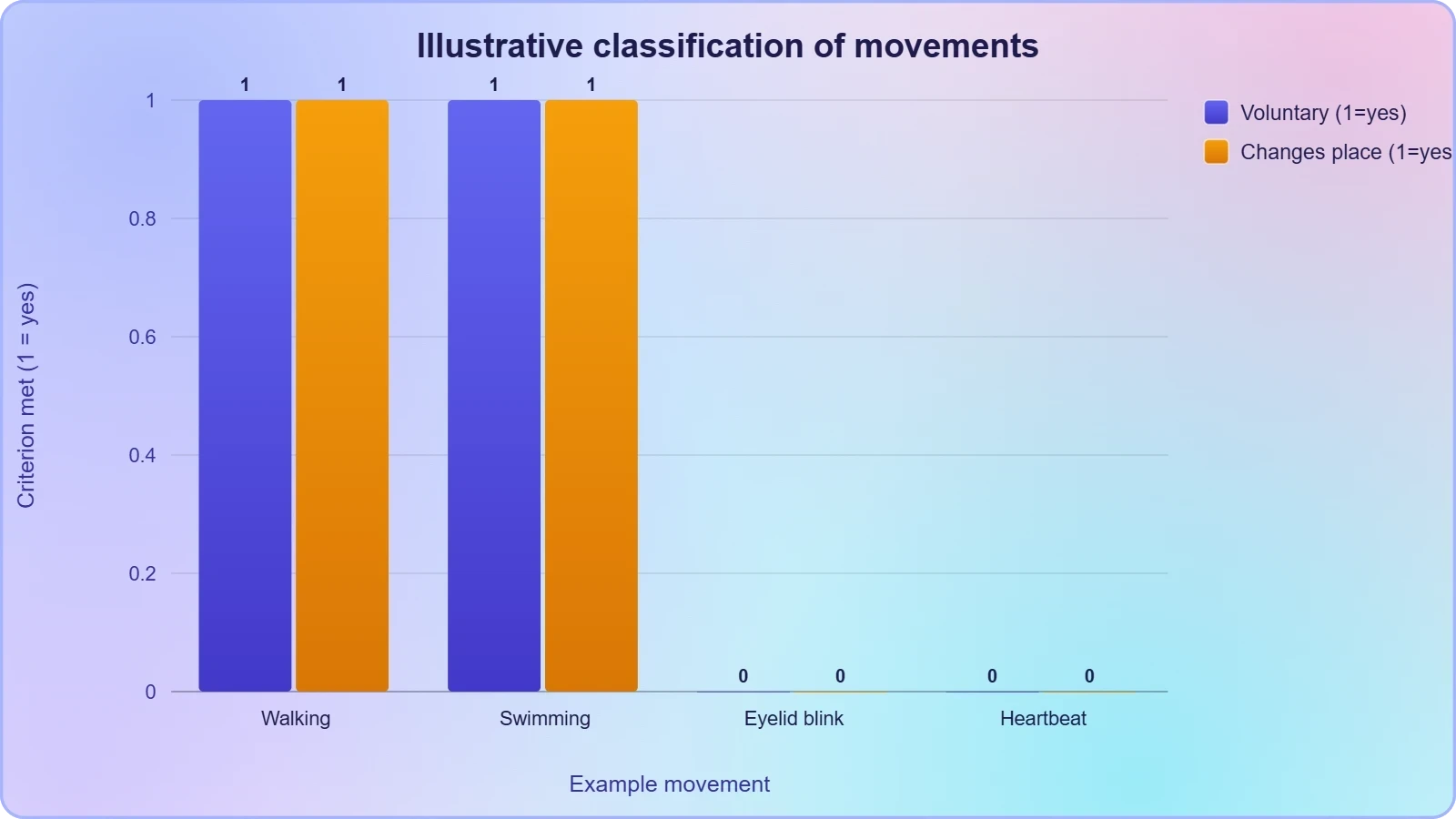
The exercise also reveals why the material insists that the two concepts be studied together. The same cilia appear in both a locomotory and a non-locomotory context, and the same limbs appear in both postural and locomotory contexts. The classification is therefore a classification of functions, not of structures, and the learner who grasps this will avoid the common error of assuming that a locomotory structure is always performing a locomotory function. The distinction is functional, and the structures are shared.
A Short Programming Analogue for Classification
Learners with an interest in computation may find a short analogue helpful. The classification of a movement as locomotory or not can be expressed as a simple predicate that checks the two criteria. The code below is illustrative only; it is not part of the biological material, but it shows how the logic of the distinction can be made explicit and testable. The predicate returns true only when both conditions hold, which mirrors the definition exactly and provides a mechanical way to apply the criteria to any number of examples.
def is_locomotion(voluntary: bool, changes_place: bool) -> bool:
    """Return True only if the movement is voluntary
    and results in a change of place."""
    return voluntary and changes_place


examples = [
    ("walking", True, True),
    ("eyelid movement", True, False),
    ("heartbeat", False, False),
    ("swimming", True, True),
]

for name, voluntary, changes_place in examples:
    label = "locomotion" if is_locomotion(voluntary, changes_place) else "movement only"
    print(f"{name}: {label}")
Running the code produces a classification that matches the lesson's reasoning: walking and swimming are labelled locomotion, eyelid movement and the heartbeat are labelled movement only. The analogue is deliberately simple, but it demonstrates that the distinction is precise enough to be applied mechanically. The learner who can write such a predicate has understood the criteria at a level that mere memorisation would not achieve, and the exercise reinforces the material's central conceptual point in a different register.
Also Read
- No links available.
From our network :
- Analyzing Trump Deportation Numbers Insights Into The 2026 Immigration Crackdown
- Mastering DB2 LUW v12 Tables: A Comprehensive Technical GuideComprehensive guide on DB2 LUW v12 tables. Explore CREATE TABLE syntax, BLU Acceleration, range partitioning, data types, and security features for IBM DB2 LUW v12.
- 98% of Global MBA Programs Now Prefer GRE Over GMAT Focus EditionExplore why 98% of global MBA programs now prefer the GRE over GMAT Focus. Learn about the shorter GRE format, verbal logic importance, and strategic versatility for students.
- AI-Powered 'Precision Diagnostic' Replaces Standard GRE Score ReportsDiscover the new GRE Precision Diagnostic. Learn how AI-powered behavioral analytics and time-to-solve tracking are replacing standard GRE score reports to empower students.
- EV 2.0: The Solid-State Battery Breakthrough and Global Factory ExpansionDiscover the impact of the Solid-State Battery Breakthrough on the EV market. Learn about CATL and BYD stock growth, global factory expansion in Europe, and the future of EV 2.0 technology.
- Vite 6/7 'Cold Start' Regression in Massive Module GraphsIn-depth analysis of Vite 6/7 cold start regressions in massive module graphs. Learn about barrel file issues, pre-bundling optimizations, and how to improve Vite dev server performance.
- Mastering DB2 12.1 Instance Design: A Technical Deep Dive into Modern Database ArchitectureComprehensive guide to DB2 12.1 Instance Design. Explore architectural components, HADR setup, buffer pool tuning, and security policies for IBM DB2 12.1. Includes 10 functional SQL and Shell samples.
- Trump Political Strategy How Geopolitical Stunts Serve As Media Diversions
- 10 Physics Numerical Problems with Solutions for IIT JEEPrepare for IIT JEE with 10 physics numerical problems, complete with detailed solutions and conceptual explanations. Ideal for mastering kinematics, thermodynamics, electromagnetism, and optics.
RESOURCES
- give 5 difference between movement and locomotion - Brainly.inbrainly.inApr 18, 2018 ... Locomotion takes place at organism level, while movement can take place between any biological level from cellular to organisms. Locomotion ...
- What is the basic difference between locomotion and movement?quora.comFeb 2, 2018 ... Locomotion is the movement of an organism. Locomotion in humans (bipeds) is accomplished by walking on legs. In animals, it…
- Optimal locomotion for limbless crawlers | Phys. Rev. E - APS Journalslink.aps.orgAug 26, 2022 ... Our model also explains the difference between crawlers with prograde and retrograde peristaltic waves, where prograde waves move from tail…
- Differentiate between movement and locomotion - Facebookfacebook.comAug 14, 2025 ... What is movement in biology? Movement in biology refers to the change in position of an organism or cell ...
- Kinematic and behavioral evidence for a distinction between trotting ...pmc.ncbi.nlm.nih.gov... locomotion. KEY WORDS: locomotion, cockroach, gait, behavior, walking. INTRODUCTION. During locomotion, legged animals tend to move their limbs in distinct ...
- Difference Between Locomotion and Movement - BYJU'Sbyjus.comLocomotion is the displacement of a body from one place to another. On the contrary, movement is the displacement of a body or a…
- Stochastic modeling of long-legged ant A. gracilipes locomotion in ...journals.plos.orgStochastic modeling of movement behavior provides a valuable way to understand how complex motion can be generated from relatively simple building blocks.
- Types of Movement | CK-12 Foundationflexbooks.ck12.orgNov 1, 2026 ... In biology, movement refers to any change in position of the ... Differentiate between movement and locomotion with one example…
- Moving in an Uncertain World: Robust and Adaptive Control of ...academic.oup.comNext, we attempt to map robust and adaptive control of locomotion across some animal groups and existing bio-inspired robots. Finally, we highlight exciting ...
- Difference Between Locomotion and Movement in Biology - Vedantuvedantu.comIn the case of Locomotion, the body moves away from one position to another, whereas in the case of Movement, change of place does…
- Establishing a High-Throughput Locomotion Tracking Method for ...pubmed.ncbi.nlm.nih.govJul 28, 2022 ... Establishing a High-Throughput Locomotion Tracking Method for Multiple Biological Assessments in Tetrahymena ... movement, were derived ...
- Retinal motion statistics during natural locomotion - eLifeelifesciences.orgMay 3, 2023 ... ... difference between retinal motion patterns and motion relative to the head. ... Current Biology 28:1224–1233. https://doi.org/10.1016/j.cub ...
- The movements of limb segments and joints during locomotion in ...pubmed.ncbi.nlm.nih.govSuch similarities have been obscured by the reliance on the term ;columnar' to differentiate elephant limb posture from that of other animals. Our database…
- Difference Between Locomotion And Movement - GeeksforGeeksgeeksforgeeks.orgJul 23, 2025 ... The difference between locomotion and movement lies in their function. Locomotion refers to the ability of an organism to move…
- Establishing a High-Throughput Locomotion Tracking Method for ...mdpi.comJul 28, 2022 ... ... locomotion endpoints based on movement trajectories. The ... locomotion difference among T. thermophila cells, and such difference ...