Motion in a plane stops being an abstraction the moment a ball leaves a hand, a marble rolls off a table edge, or a stone is swung in a horizontal circle. Lesson 26 of this thirty-part course turns attention away from the algebra of the previous review session and toward the bench, the playground, and the open field, where two-dimensional kinematics can be watched, measured, and argued about. The purpose here is not to introduce new equations but to demonstrate that the equations already assembled describe ordinary physical events with remarkable fidelity.
Laboratory work in this domain carries a distinctive discipline. A projectile experiment demands that the horizontal and vertical components of motion be treated as independent records of the same event, each with its own timing and its own governing relation. A circular-motion demonstration demands that students notice the continuous change of direction even when speed remains constant, and that they connect that change to a measurable inward acceleration. These are habits of observation as much as habits of calculation, and they repay careful cultivation.
This lesson surveys a compact set of experiments and field observations that beginners can perform with modest equipment: a rolled marble, a stopwatch, a protractor, a length of string, and a smartphone camera capable of frame-by-frame playback. Each activity is paired with the reasoning that makes it instructive, so that the measurement and the meaning arrive together. By the close, learners should be able to design a simple trial, record data honestly, and interpret the result against the vector framework developed throughout the course.
On This Page
- Why Bench Experiments Anchor Two-Dimensional Kinematics
- Circular Motion Demonstrated with Everyday Objects
- Field Observations That Reveal Vector Behaviour
- Recording Data Honestly and Estimating Uncertainty
- Connecting Laboratory Work to the Course Framework
- Safety, Ethics, and the Discipline of Measurement
Why Bench Experiments Anchor Two-Dimensional Kinematics
Textbook treatments of motion in a plane often proceed through diagrams that are already correct, which can leave learners without a sense of how such diagrams are earned. A laboratory exercise reverses that order: the messy data come first, and the clean parabolic curve emerges only after plotting and reflection. This inversion is pedagogically valuable because it forces students to confront uncertainty, timing error, and the difference between an ideal model and a real trial.
There is also a motivational dimension. When a student predicts where a marble will land and then watches it land within a few centimetres of the mark, the vector decomposition ceases to be a ritual and becomes a tool with predictive power. Experiments therefore serve both as evidence for the theory and as training in the craft of physical reasoning, which no amount of worked examples can fully substitute.
Setting Up a Projectile Trial with Minimal Equipment
A reliable projectile trial begins with a stable launch arrangement. A table edge, a smooth ramp, and a marble released from a fixed height on the ramp will produce a repeatable horizontal launch velocity, provided the release point is marked and the ramp is not disturbed between trials. Consistency of release matters more than sophistication of apparatus, and beginners should prioritise repeatability over precision instruments.
Once the launch is stable, the measurement plan can be built. Mark the table edge as the origin, measure the vertical drop to the floor with a tape, and record the horizontal distance from the edge to the landing point for each trial. Repeating the release five to ten times yields a spread of landing distances, and that spread is itself informative data about experimental variability.
Reading the Data Against the Parabolic Model
The vertical drop determines the flight time through the familiar relation for free fall, since the initial vertical velocity at a horizontal launch is zero. With flight time known, the horizontal range divided by that time gives the launch speed, assuming air resistance is negligible over the short flight. Students can then compare trials and discuss why the computed speed varies slightly from run to run.
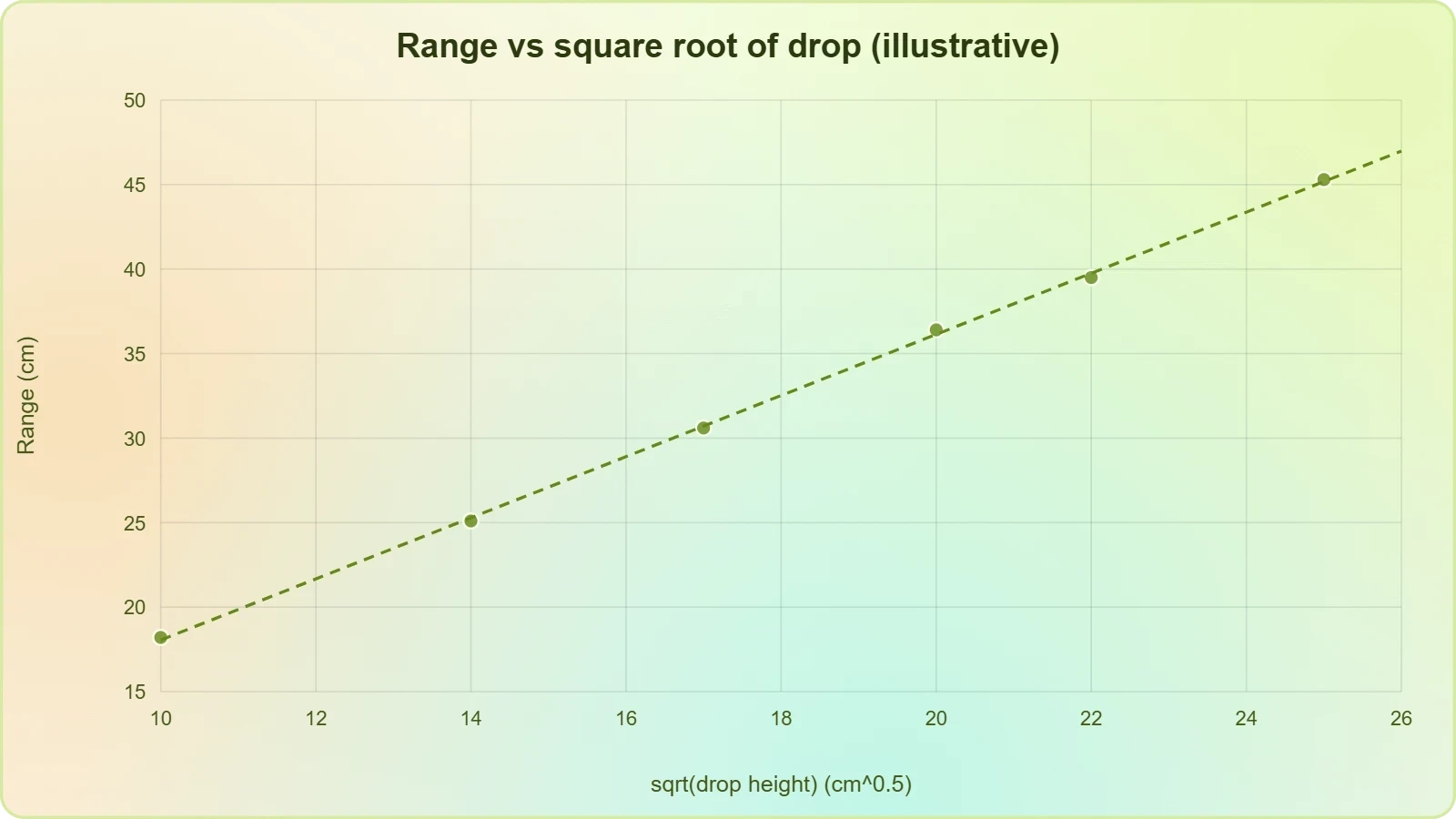
Plotting the trajectory is the next step. If the launch height is varied while the ramp release point is held fixed, the range should scale with the square root of the drop height, and a graph of range against that square root should be approximately linear. Deviations from linearity invite discussion of friction in the ramp, air drag, and timing uncertainty, all of which enrich the interpretation.
Circular Motion Demonstrated with Everyday Objects
Uniform circular motion is conceptually demanding because the speed is constant while the velocity is not, and a laboratory demonstration makes that distinction visible. A rubber stopper swung on a string, a coin on a rotating turntable, and a car rounding a bend all exhibit the same underlying structure: a velocity vector that continually rotates while its magnitude holds steady. The inward acceleration is the price of that rotation.
Classroom demonstrations should be chosen for safety and clarity. A stopper on a string swung in a horizontal circle above the head is a classic, and the tension in the string provides the centripetal force. Students can feel the pull increase as the rotation quickens, which links the abstract formula to a tangible sensation and prepares them for the quantitative treatment in later lessons.
Measuring Period, Radius, and Inward Acceleration
The measurable quantities in a circular-motion trial are the radius of the path, the period of one revolution, and the mass of the rotating object. Timing ten revolutions and dividing by ten reduces reaction-time error substantially. The inward acceleration then follows from the radius and period, and the required force follows from the mass and that acceleration.
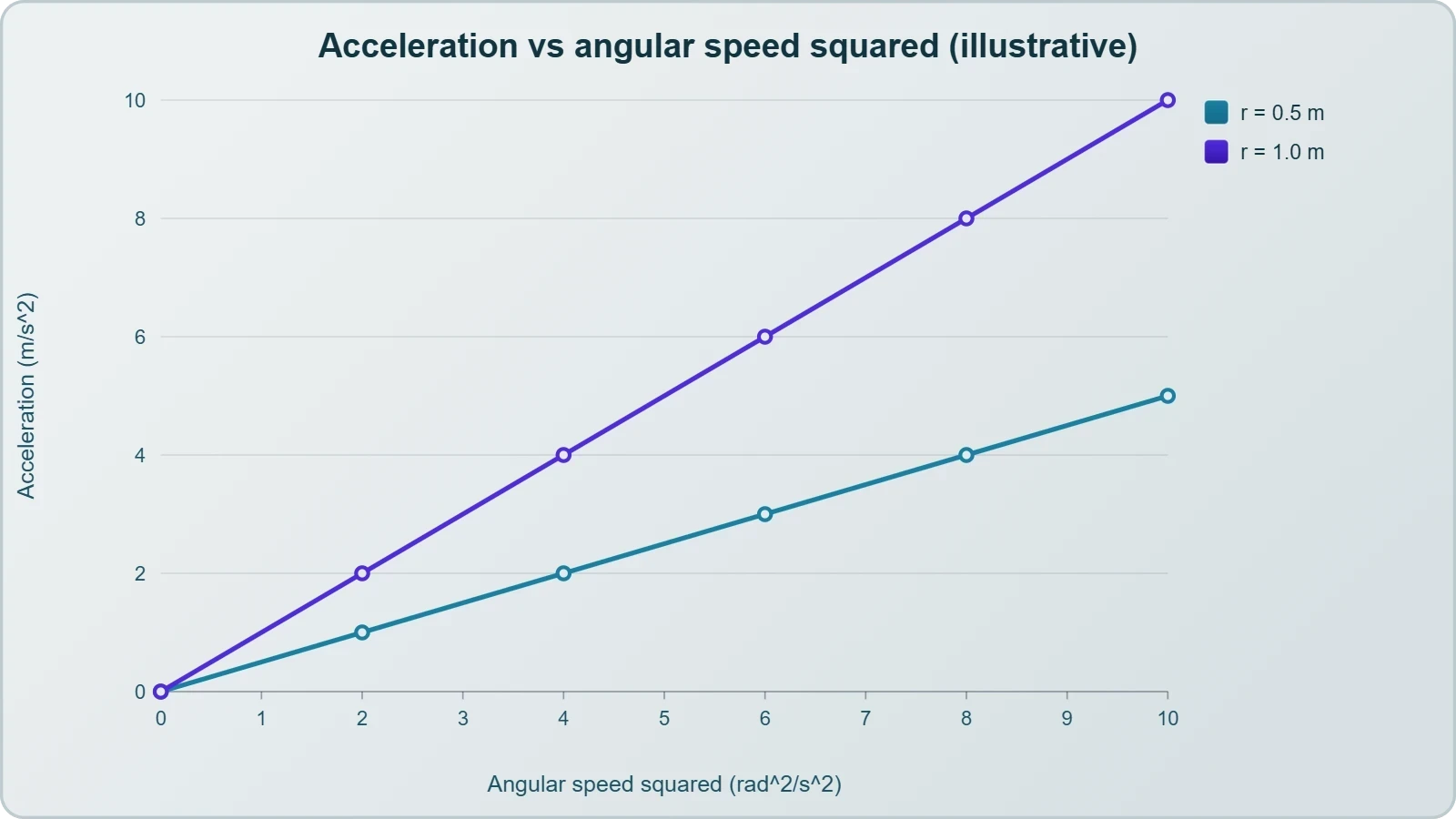
Students should record several trials at different radii and periods, then compare the computed accelerations. A graph of acceleration against the square of the angular speed should be linear, with the slope equal to the radius. This is a satisfying confirmation because it tests the relation rather than merely restating it, and it exposes systematic errors such as a string that stretches under load.
Interpreting the Inward Force in Real Contexts
The same reasoning explains why a car must slow down on a tight bend and why a cyclist leans into a turn. The available friction sets a ceiling on the inward force, and exceeding that ceiling produces a skid. Recognising this connection turns a formula into a safety principle that students can apply to their own experience on roads and bicycles.
Laboratory discussion should also acknowledge the limits of the simple model. Real turns involve changing speed, banking, and variable friction, and the uniform circular motion treatment is an idealisation. Naming those limits explicitly is part of scientific honesty and prepares learners for the more general treatment of acceleration that follows in later study.
Field Observations That Reveal Vector Behaviour
Not every instructive experiment requires apparatus. A river crossing, a moving walkway, a cyclist riding into a crosswind, and a swimmer heading across a current all display the addition of velocity vectors in plain view. These situations are valuable because the observer can see the resultant path directly, without the mediation of a graph or a spreadsheet, and can reason about it in real time.
Consider a boat aimed straight across a flowing river. The boat's velocity relative to the water and the water's velocity relative to the bank combine to produce a diagonal path relative to the bank. The crossing time depends only on the component of velocity perpendicular to the current, a result that surprises many beginners and rewards careful vector reasoning.
River Crossing and Relative Velocity Reasoning
The river-crossing problem is best treated as a vector triangle. The boat's heading, the current, and the resultant ground velocity form the three sides, and the geometry determines the drift downstream. If the boat aims upstream at an angle, the drift can be eliminated entirely, though the crossing then takes longer because the perpendicular component is reduced.
Students can model this with a shallow tray of water, a floating cork, and a gentle current, or with a moving walkway in a station. The key insight is that velocities add as vectors, and that the choice of reference frame changes the description without changing the physics. This prepares learners for the frame-of-reference discussions that follow in the mathematical foundations lesson.
Everyday Projectiles and Their Hidden Assumptions
A thrown ball, a water jet from a hose, and a basketball free throw are all projectiles, and each carries assumptions that the simple model ignores. Air resistance, spin, and the height of release all matter in practice, and a beginner who notices these effects is already thinking like a physicist. The model is a starting point, not a complete description.
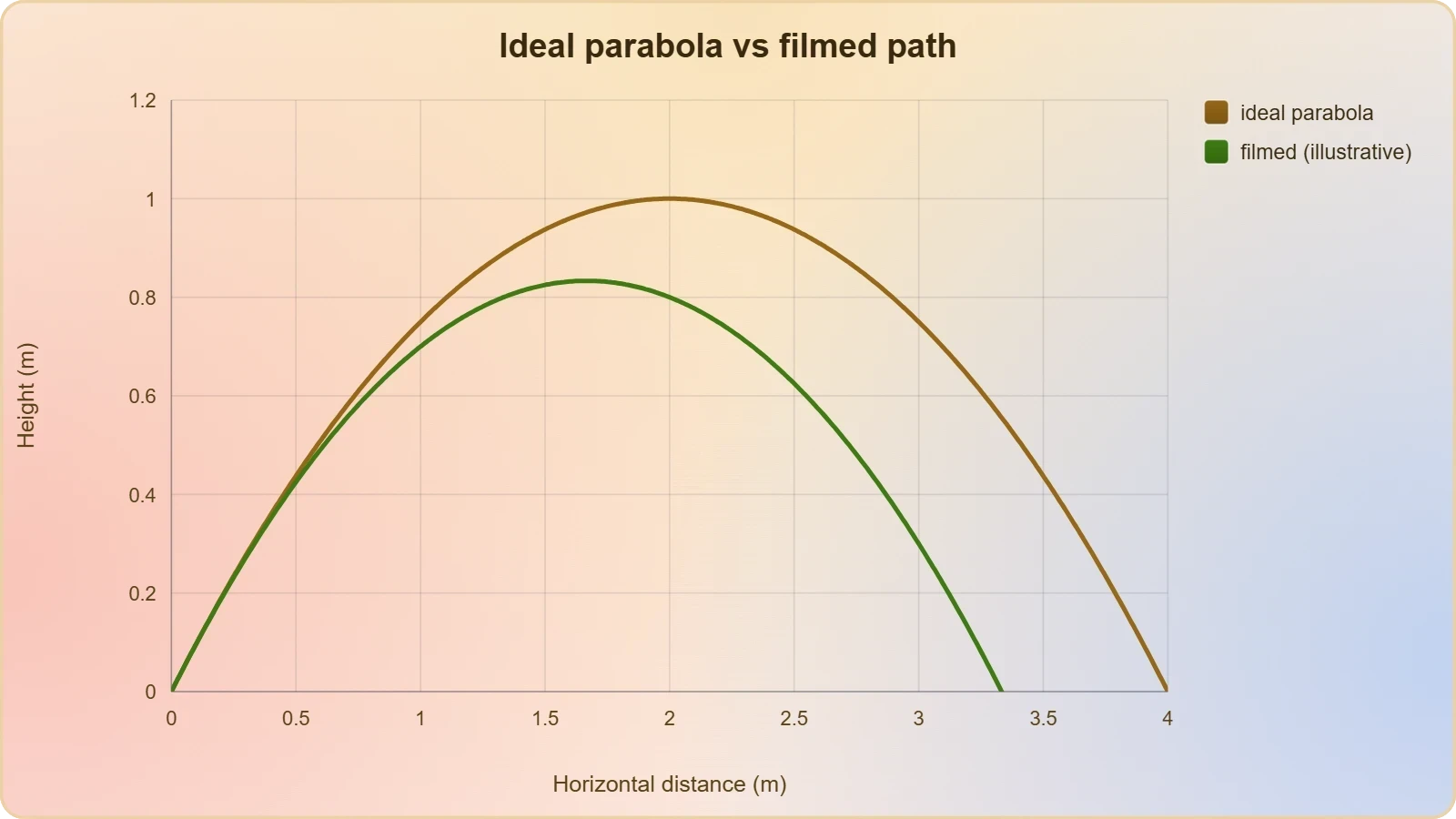
Filming a thrown ball with a smartphone and stepping through the frames allows students to plot the trajectory and compare it with the predicted parabola. The comparison is often surprisingly close for a dense object over a short flight, and the discrepancies become a productive topic for discussion about drag and measurement error.
Recording Data Honestly and Estimating Uncertainty
An experiment is only as good as its record. Beginners should be taught to write down the raw reading before any calculation, to note the conditions of the trial, and to record anomalous results rather than quietly discarding them. A data table with a column for remarks is a simple but powerful instrument of scientific integrity.
Uncertainty estimation need not be elaborate at this stage. The resolution of the measuring instrument, the reaction time of the observer, and the spread of repeated trials together give a reasonable sense of how much confidence a result deserves. Reporting a range rather than a single number is often the most honest presentation of a beginner's measurement.
Sources of Error in Plane-Motion Trials
Parallax in reading a scale, delay in starting and stopping a stopwatch, and friction in a launch ramp are the usual suspects. Each can be reduced by careful technique, but none can be eliminated entirely. Naming the sources explicitly helps students distinguish between a result that is wrong and a result that is merely imprecise.
Systematic errors shift all trials in the same direction, while random errors scatter them. A ramp that is slightly tilted introduces a systematic bias in launch speed, whereas a hesitant thumb on the stopwatch produces random scatter. Recognising the difference guides the student toward the right corrective action, whether recalibration or repetition.
Turning Measurements into a Defensible Conclusion
A conclusion should state what was measured, what was found, and how confident the experimenter is in the finding. It should also acknowledge what the experiment did not test. This structure is simple enough for beginners yet rigorous enough to serve as a template for more advanced work in later courses.
Comparing a measured value with a theoretical prediction is the final step. A percentage difference within the estimated uncertainty supports the model, while a larger discrepancy invites investigation. Either outcome is a legitimate result, and treating both as informative is central to the scientific attitude this lesson seeks to cultivate.
Connecting Laboratory Work to the Course Framework
Each experiment in this lesson maps onto a specific piece of the vector framework developed earlier in the course. The projectile trial exercises independence of components, the circular-motion trial exercises changing direction with constant speed, and the field observations exercise vector addition. The laboratory is therefore not a detour but a consolidation.
This consolidation matters because the next lesson turns toward mathematical foundations, where the same ideas are expressed in more formal language. Students who have watched a marble trace a parabola and felt a stopper pull against a string arrive at that formalism with concrete referents, which makes the abstraction easier to absorb and less likely to be memorised without understanding.
From Observation to Formal Description
The transition from observation to formalism is a recurring pattern in physics. A phenomenon is noticed, measured, and then described in symbols that permit prediction. The laboratory lesson sits at the measurement stage, and the mathematical foundations lesson sits at the symbolic stage, and the two are complementary rather than sequential in importance.
Students should be encouraged to keep their laboratory notebooks as a resource for the coming lessons. A recorded trajectory or a measured period can be revisited when the formal equations appear, and the memory of the physical event will anchor the algebra. This habit of cross-referencing observation and theory is one of the most durable skills the course can instil.
Designing a Simple Investigation of Your Own
A good investigation begins with a question that can be answered with available equipment. How does the range of a rolled marble depend on the height of the table? How does the period of a swinging stopper depend on the length of the string? These questions are modest, answerable, and rich in kinematic content.
The design should specify what will be varied, what will be held constant, and what will be measured. A single controlled variable, a repeated trial, and a clear record are enough to produce a defensible result. Beginners who master this simple discipline are well prepared for the more elaborate practical work that awaits them in advanced study.
Safety, Ethics, and the Discipline of Measurement
Laboratory work carries responsibilities that extend beyond getting the right answer. A swinging mass must be given adequate clearance, a projectile must be aimed away from people, and electrical equipment must be handled with care. These are not bureaucratic formalities but expressions of respect for the people sharing the space.
Ethical measurement is equally important. Recording a result that contradicts expectation, reporting an outlier rather than hiding it, and crediting the contributions of collaborators are all part of scientific integrity. Beginners who internalise these habits early carry them into every subsequent investigation, and the discipline of honest recording becomes second nature.
Practical Precautions for Classroom Trials
Clear the launch zone before releasing any projectile, and mark the landing area so that observers do not wander into it. Secure the string of a swinging mass firmly and inspect it for fraying before each trial. Keep the rotation slow enough that the demonstrator retains control, and never swing a heavy object near faces.
For water-based demonstrations, protect surfaces and electrical outlets, and keep the volume of water modest. For smartphone filming, ensure that the device is secured rather than held loosely, so that attention remains on the experiment. These precautions are simple, and observing them allows the lesson to proceed without incident.
Building a Culture of Careful Observation
The deepest lesson of the laboratory is patience. A result obtained hastily is worth little, while a result obtained carefully, recorded fully, and interpreted honestly is worth a great deal. Students who learn to slow down, to check their setup, and to repeat a trial when something looks wrong are learning a transferable professional habit.
This habit of care is what distinguishes a measurement from a guess. It is also what makes the study of motion in a plane more than an exercise in algebra. The equations describe the world, but only the disciplined observer can confirm that they do, and that confirmation is the quiet reward of the experimental method.
Also Read
- No links available.
From our network :
- Mastering DB2 12.1 Instance Design: A Technical Deep Dive into Modern Database ArchitectureComprehensive guide to DB2 12.1 Instance Design. Explore architectural components, HADR setup, buffer pool tuning, and security policies for IBM DB2 12.1. Includes 10 functional SQL and Shell samples.
- AI-Powered 'Precision Diagnostic' Replaces Standard GRE Score ReportsDiscover the new GRE Precision Diagnostic. Learn how AI-powered behavioral analytics and time-to-solve tracking are replacing standard GRE score reports to empower students.
- 10 Physics Numerical Problems with Solutions for IIT JEEPrepare for IIT JEE with 10 physics numerical problems, complete with detailed solutions and conceptual explanations. Ideal for mastering kinematics, thermodynamics, electromagnetism, and optics.
- Vite 6/7 'Cold Start' Regression in Massive Module GraphsIn-depth analysis of Vite 6/7 cold start regressions in massive module graphs. Learn about barrel file issues, pre-bundling optimizations, and how to improve Vite dev server performance.
- 98% of Global MBA Programs Now Prefer GRE Over GMAT Focus EditionExplore why 98% of global MBA programs now prefer the GRE over GMAT Focus. Learn about the shorter GRE format, verbal logic importance, and strategic versatility for students.
- Analyzing Trump Deportation Numbers Insights Into The 2026 Immigration Crackdown
- Mastering DB2 LUW v12 Tables: A Comprehensive Technical GuideComprehensive guide on DB2 LUW v12 tables. Explore CREATE TABLE syntax, BLU Acceleration, range partitioning, data types, and security features for IBM DB2 LUW v12.
- Trump Political Strategy How Geopolitical Stunts Serve As Media Diversions
- EV 2.0: The Solid-State Battery Breakthrough and Global Factory ExpansionDiscover the impact of the Solid-State Battery Breakthrough on the EV market. Learn about CATL and BYD stock growth, global factory expansion in Europe, and the future of EV 2.0 technology.
RESOURCES
- Motion blur suppression method for time-of-flight imaging systems ...pubmed.ncbi.nlm.nih.govSep 8, 2025 ... Experimental validation in both laboratory and real-world environments demonstrates the superiority of the proposed method. Compared with ...
- High-Speed Imaging for Motion Analysis: Systems and Techniquesprofessional.mit.eduSelecting the correct lighting technologies and design the lighting arrangements for an experiment. Analyzing the resulting images to get a real world ...
- Design and Development of an Ultra-Concurrent Remote Laboratory ...mdpi.com... real-world experiment. The study of projectile motion often presents various conceptual difficulties for both students and teachers. Among these is the ...
- Physics Lab Experiments - Lehigh Carbon Community Collegelccc.edu... Flight Pad, Independence of Motion Accessory ... Each of the investigations includes links to internet background information that ties the topics to real-world ...
- Peripheral vision in real-world tasks: A systematic review - PMCpmc.ncbi.nlm.nih.govWe included both simulated lab experiments and real-world experiments because laboratory experiments ... movement control during simulated flight.
- Understanding Minds in Real-World Environments: Toward a Mobile ...frontiersin.orgJan 11, 2017 ... In particular, the use of laboratory-based experiments in which ... experiments assessing the feasibility of brain imaging in motion.
- A new approach to virtual learning about the real world - APS Journalslink.aps.orgIn a second-semester physics course for life science majors, we conducted a comparative study of three instructional approaches in a laboratory focused on ...
- AE Labs, Centers, Collaborative Groupsae.gatech.edu... real-world problems. The lab currently operates several ground and aerial ... The Indoor Flight Laboratory (IFL) is a 2,000‑square‑foot, highly ...
- Centers and Laboratories | Texas A&M University Engineeringengineering.tamu.eduMembers of the AggieSat Laboratory work with real-world deliverables ... The Vehicle Systems & Control Laboratory houses experimental research, flight ...
- Physics | Drexel University Catalogcatalog.drexel.edu... plane and solid geometry, use of trigonometric ... PHYS 172 Experimental Lab for Electricity and Motion 1.0 Credit. Students will experiment with real…
- OpenMetabolics: Estimating energy expenditure using a ... - Naturenature.comFeb 6, 2026 ... ... laboratory-based experiments. The ... Emulating smartphone data with pocket motion artifacts during real-world walking experiments.
- Wireless EEG System g.Nautilus Research: Reliable 64 Channelsgtec.atACTIVE EEG FOR REAL-WORLD NEUROSCIENCE. Modern neuroscience increasingly requires experiments outside highly controlled laboratory environments. The g.Nautilus ...
- Students in University Physics I Lab are exploring real ... - Instagraminstagram.comMar 21, 2026 ... Through experiments on force, motion, work, and energy, students collect real data, analyze results, and connect physics theory to practical ...
- Breakthroughs in Testing Solid-Fuel Ramjets Advance Researchnrl.navy.milJan 28, 2026 ... ... experiments at conditions relevant to solid-fuel ramjet flight. ... laboratory experiments and real-world propulsion systems. “All of ...
- Time of Flight Pad - Verniervernier.comTime-of-flight measurements allow students to see just how kinematic calculations work in real-world applications. ... Get free experiments, innovative lab ...