Uniform circular motion describes one of the most elegant ideas in classical mechanics: an object tracing a perfect circle at a constant speed. Where projectile motion asked us to separate horizontal and vertical components, this lesson asks us to think in terms of rotation, repetition, and rhythm. The mathematics shifts from displacement vectors to angles, and from linear velocity to angular velocity. Understanding this transition is essential before centripetal acceleration arrives in the next lesson.
Every clock hand, satellite orbit, and spinning turbine blade obeys the same underlying relationships. A body moving uniformly on a circular path covers equal angles in equal intervals of time, which gives the motion a predictable, periodic character. This lesson defines the three quantities that describe that rhythm: the period, the frequency, and the angular velocity. Each one measures the same phenomenon from a different vantage point, and fluency in converting between them is the practical skill we build here.
Because this is Lesson 13 of a structured course, we deliberately avoid the dynamics of circular motion. No forces, no centripetal acceleration, and no tension calculations appear yet. Instead, we concentrate on kinematics: how position, angle, and time relate when a particle travels around a circle. By the end, you should be able to read a problem statement, identify which rotational quantity is given, and compute the remaining ones with confidence.
On This Page
Defining Uniform Circular Motion Precisely
Uniform circular motion occurs when a particle moves along a circular path with constant speed. The word uniform refers strictly to the magnitude of velocity, not its direction. Because the direction of motion changes continuously, the velocity vector is never constant, even though the speedometer reading never wavers. This distinction is the conceptual heart of the lesson.
The Geometry of a Circular Path
Picture a particle bound to a circle of radius ##r## centred at the origin. Its position at any instant can be described by the angle ##\theta## measured from a fixed reference line. As the particle moves, this angle grows steadily, and the arc length travelled equals ##r\theta## when the angle is expressed in radians. Radians are the natural unit here because they make arc length and angle numerically interchangeable through the radius.

A full revolution corresponds to an angle of ##2\pi## radians, or 360 degrees. Choosing radians over degrees simplifies every formula that follows, eliminating stray factors of 180 and pi. From this point onward, assume all angular quantities are measured in radians unless explicitly stated otherwise. This convention keeps the algebra clean and consistent across the entire course.
Constant Speed, Changing Velocity
Although the speed remains fixed, the velocity vector rotates continuously around the circle. At each point, velocity is tangent to the path, perpendicular to the radius. Two positions separated by a quarter revolution therefore have velocity vectors at right angles to each other. This perpetual change of direction is what distinguishes circular motion from straight-line motion at constant speed.

Students often ask why we call the motion uniform if the velocity keeps changing. The answer lies in separating magnitude from direction. Uniformity applies to the rate at which distance is covered, not to the vector itself. Recognising this subtlety prepares you for the acceleration analysis that follows in the next lesson, where the changing direction becomes the source of centripetal acceleration.
Period and Frequency: The Rhythm of Revolution
Two everyday quantities capture the repetitive nature of circular motion. The period tells us how long one complete cycle takes, while the frequency tells us how many cycles occur each second. Together they form a reciprocal pair that appears throughout physics, from pendulum clocks to alternating current. Mastering their relationship is the first computational milestone of this lesson.
Understanding the Period
The period, denoted ##T##, is the time required for one complete revolution around the circle. If a satellite completes an orbit in 90 minutes, then its period is 90 minutes. The period depends on the radius of the path and the speed of travel, though we postpone that relationship until we introduce angular velocity. For now, treat ##T## as a directly measurable interval.
Because the motion is uniform, every revolution takes exactly the same time. This predictability allows us to describe the particle's position at any future moment simply by counting revolutions. The period therefore acts as a natural clock embedded in the motion itself. Engineers exploit this property when designing rotating machinery, timing circuits, and orbital schedules.
Frequency as the Reciprocal of Period
Frequency, denoted ##f##, counts the number of complete revolutions per unit time. Its SI unit is the hertz, defined as one revolution per second. The relationship between the two quantities is beautifully simple and worth committing to memory:
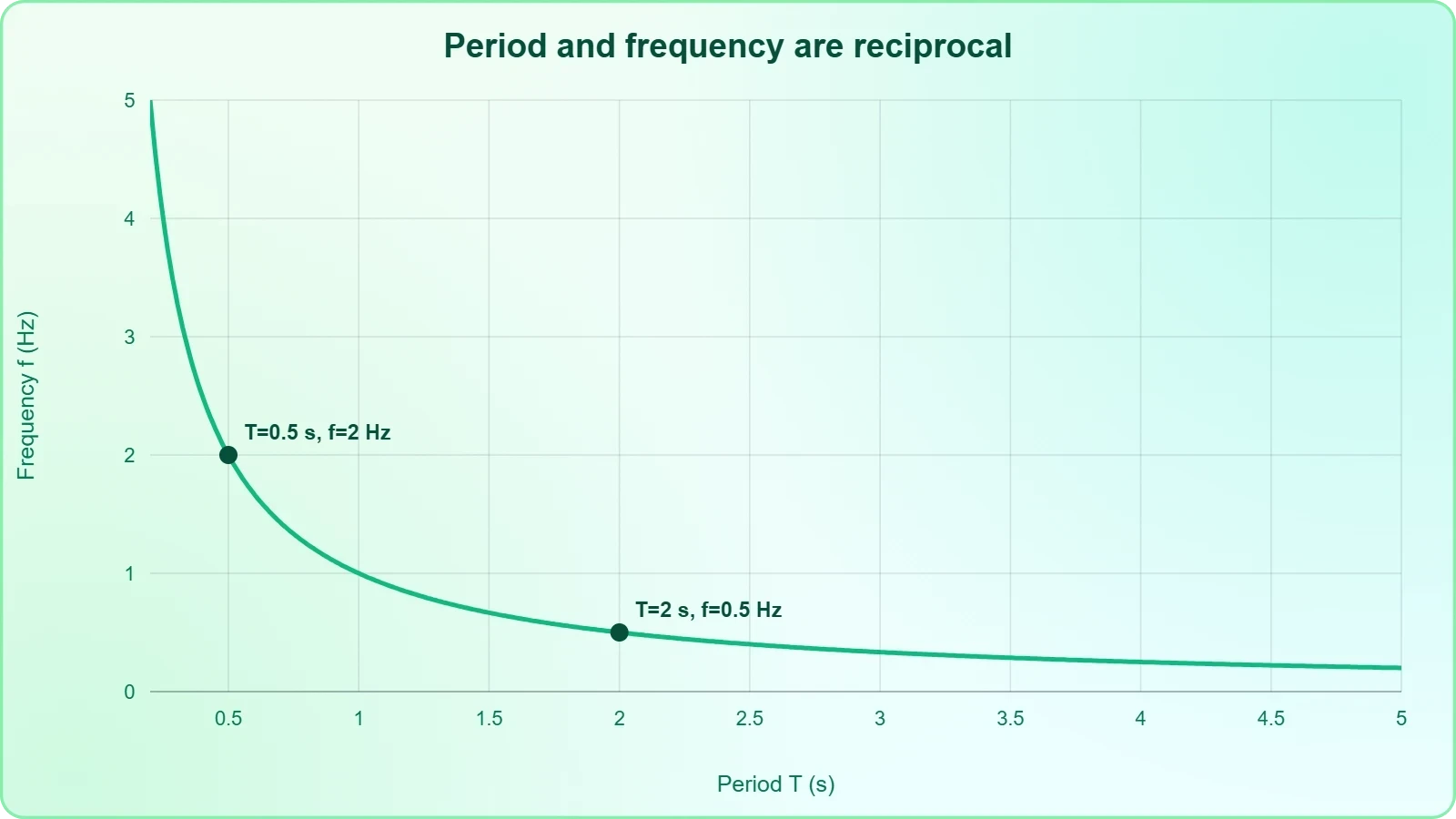
If a wheel completes 5 revolutions every second, its frequency is 5 Hz and its period is 0.2 seconds. The reciprocal nature means that a large frequency implies a short period, and vice versa. This inverse relationship appears so often in physics that recognising it instantly saves considerable calculation time during examinations.
Angular Velocity: Measuring Rotation Rate
Linear velocity measures how fast position changes along a path, but circular motion invites a more natural measure: how fast the angle changes. Angular velocity captures precisely this idea. It tells us the rate at which the particle sweeps out angle around the centre, and it connects the geometry of the circle to the timing of the motion in one compact quantity.
Defining Angular Velocity
Angular velocity, usually denoted ##\omega##, is the angle swept per unit time. For uniform circular motion, the angle changes at a constant rate, so we can write the definition directly as the total angle divided by the total time. One full revolution sweeps ##2\pi## radians in time ##T##, giving the central relationship:

The SI unit of angular velocity is radians per second. Because radians are dimensionless, some texts quote angular velocity in reciprocal seconds, but the radian form is clearer and more standard. Notice how the formula links all three quantities introduced in this lesson: given any one of ##\omega##, ##T##, or ##f##, the other two follow immediately.
Relating Angular and Linear Speed
Angular velocity describes the rotation of the whole system, but the particle itself travels along the arc at a linear speed ##v##. The arc length covered in one period is the circumference ##2\pi r##, so the linear speed equals circumference divided by period. Substituting the angular velocity definition yields the bridge equation:
This equation is the workhorse of circular kinematics. It shows that for a fixed angular velocity, points farther from the centre move faster in linear terms. A rider near the rim of a merry-go-round travels much faster than one near the axis, even though both complete each revolution in the same time. The same principle explains why the outer edge of a rotating disc experiences greater linear speeds.

Connecting the Three Quantities
Period, frequency, and angular velocity are three descriptions of the same underlying rhythm. Any one of them, combined with the radius, determines the entire kinematic state of a uniformly rotating particle. The skill worth developing is rapid conversion between these representations, because problems rarely hand you the quantity you need directly. Fluency here pays dividends in later lessons on acceleration and dynamics.
Conversion Workflow
A reliable workflow begins by identifying what the problem provides. If the period is given, compute frequency as its reciprocal and angular velocity as ##2\pi## divided by the period. If frequency is given, invert it for the period and multiply by ##2\pi## for angular velocity. If angular velocity is given, divide by ##2\pi## to obtain frequency, then invert for the period.
Once the angular velocity is known, the linear speed follows from ##v = \omega r##. This single chain of conversions handles the vast majority of introductory problems. Practising the chain until it becomes automatic is the most efficient preparation for the exercises that follow. Write the relationships on a single reference card and rehearse them until recall is instantaneous.
A Worked Example
Consider a bicycle wheel of radius 0.35 metres completing 120 revolutions per minute. Convert the frequency to hertz by dividing by 60, giving 2 Hz. The period is therefore 0.5 seconds, and the angular velocity equals ##2\pi \times 2 \approx 12.57## radians per second. The linear speed at the rim is then ##12.57 \times 0.35 \approx 4.4## metres per second.
Notice how each step used only the relationships defined in this lesson. No forces, no accelerations, and no vector components were required. The example illustrates the power of the conversion chain: a single given quantity, combined with the radius, unlocks every other kinematic descriptor. Try varying the numbers yourself to build intuition for how the quantities respond.
Real-World Applications of Rotational Kinematics
The concepts in this lesson extend far beyond textbook exercises. Any system that repeats its motion at regular intervals can be described using period, frequency, and angular velocity. From the microscopic rotation of molecules to the vast orbits of planets, the same kinematic framework applies. Recognising these patterns in everyday life reinforces the abstract mathematics and makes the formulas memorable.
Engineering and Technology
Hard drives, turbines, and electric motors all rely on precise control of angular velocity. A hard drive spinning at 7200 revolutions per minute has a frequency of 120 hertz and an angular velocity near 754 radians per second. Engineers must know these values to calculate data transfer rates and mechanical stresses. The same reasoning governs the design of wind turbines and jet engines.

In robotics, joint motors are specified by their angular velocity and torque characteristics. A robotic arm that rotates through a full circle in two seconds has an angular velocity of pi radians per second. Programmers use these values to plan smooth trajectories and avoid sudden jerks. The kinematic relationships from this lesson form the foundation of every motion planning algorithm.
Astronomy and Everyday Life
Celestial mechanics offers the grandest examples of uniform circular motion. The Moon orbits Earth with a period of roughly 27.3 days, giving a frequency near ##4.2 \times 10^{-7}## hertz. Artificial satellites in low Earth orbit complete a revolution in about 90 minutes. These figures allow mission planners to predict when a satellite will pass over a ground station.
Closer to home, the hands of a clock illustrate the same principles. The second hand has a period of 60 seconds and a frequency of one-sixtieth of a hertz. Its angular velocity is ##\pi/30## radians per second. Even a simple ceiling fan demonstrates the relationship between angular velocity and linear speed at the blade tips, where the air is pushed fastest.
Common Misconceptions and Conceptual Pitfalls
Several persistent misunderstandings surround uniform circular motion, and addressing them directly strengthens conceptual clarity. The most frequent error is conflating speed with velocity, treating the constant speed as if it implied constant velocity. A second common mistake involves mixing degrees and radians in the same calculation. A third concerns the belief that angular velocity depends on radius, which it does not.
Speed Versus Velocity
Speed is a scalar, describing only how fast the particle moves along the path. Velocity is a vector, encoding both speed and direction. In uniform circular motion, the speed is constant while the velocity changes continuously. This distinction matters enormously when acceleration enters the picture, because acceleration depends on velocity changes, not speed changes.
Students who blur this distinction often conclude that uniform circular motion has zero acceleration. That conclusion is incorrect and leads to confusion in the next lesson. The velocity vector rotates even though its length stays fixed, and any rotation of a vector constitutes a change. Keep the scalar-vector distinction sharp, and the upcoming acceleration analysis will feel natural rather than mysterious.
Radians, Degrees, and Radius Independence
Mixing degrees and radians is a silent source of factor-of-pi errors. Always convert to radians before applying any formula involving ##\omega## or ##2\pi##. A frequency of 3 hertz corresponds to an angular velocity of ##6\pi## radians per second, not 1080 degrees per second, even though both describe the same rotation. Consistency of units prevents most computational slips.
Another pitfall is assuming that angular velocity varies with radius. For a rigid rotating body, every point shares the same angular velocity, regardless of distance from the axis. Only the linear speed changes with radius, scaling as ##v = \omega r##. Recognising this invariance clarifies why the outer rim of a wheel moves faster than the hub while both complete each turn together.

Preparing for Centripetal Acceleration
This lesson has established the kinematic vocabulary of uniform circular motion: period, frequency, angular velocity, and their connection to linear speed. The next lesson builds directly on this foundation by asking what acceleration must accompany such motion. Because the velocity vector rotates continuously, an acceleration must exist, and its direction points toward the centre of the circle. Everything we have defined here feeds into that analysis.
What Comes Next
The centripetal acceleration will be expressed as ##a_c = v^2/r## or equivalently ##a_c = \omega^2 r##. Both forms rely on the quantities introduced today. Recognising that the second form emerges naturally from substituting ##v = \omega r## reinforces why angular velocity is such a useful variable. The derivation will feel inevitable rather than abrupt if the present lesson is secure.
Beyond acceleration, later lessons will introduce the forces responsible for maintaining circular paths, including tension, gravity, and friction. Each of those analyses begins with the kinematic relationships established here. Treat this lesson as the vocabulary chapter of a longer story about rotational dynamics. Mastery of the terms ensures the narrative that follows remains coherent and accessible.
Practice Checklist
Before moving on, verify that you can convert freely between period, frequency, and angular velocity without consulting notes. Confirm that you can compute linear speed from angular velocity and radius, and that you can explain why speed is constant while velocity is not. These three competencies form the exit criteria for this lesson and the entry requirements for the next.
Attempt at least five numerical problems covering different starting quantities. Include one problem involving unit conversion, such as revolutions per minute to hertz. Include another requiring you to compare linear speeds at two different radii on the same rotating body. Consistent practice at this stage prevents conceptual gaps from compounding in later lessons on dynamics and energy.
Also Read
- No links available.
From our network :
- Mastering DB2 12.1 Instance Design: A Technical Deep Dive into Modern Database ArchitectureComprehensive guide to DB2 12.1 Instance Design. Explore architectural components, HADR setup, buffer pool tuning, and security policies for IBM DB2 12.1. Includes 10 functional SQL and Shell samples.
- 98% of Global MBA Programs Now Prefer GRE Over GMAT Focus EditionExplore why 98% of global MBA programs now prefer the GRE over GMAT Focus. Learn about the shorter GRE format, verbal logic importance, and strategic versatility for students.
- 10 Physics Numerical Problems with Solutions for IIT JEEPrepare for IIT JEE with 10 physics numerical problems, complete with detailed solutions and conceptual explanations. Ideal for mastering kinematics, thermodynamics, electromagnetism, and optics.
- Trump Political Strategy How Geopolitical Stunts Serve As Media Diversions
- AI-Powered 'Precision Diagnostic' Replaces Standard GRE Score ReportsDiscover the new GRE Precision Diagnostic. Learn how AI-powered behavioral analytics and time-to-solve tracking are replacing standard GRE score reports to empower students.
- EV 2.0: The Solid-State Battery Breakthrough and Global Factory ExpansionDiscover the impact of the Solid-State Battery Breakthrough on the EV market. Learn about CATL and BYD stock growth, global factory expansion in Europe, and the future of EV 2.0 technology.
- Mastering DB2 LUW v12 Tables: A Comprehensive Technical GuideComprehensive guide on DB2 LUW v12 tables. Explore CREATE TABLE syntax, BLU Acceleration, range partitioning, data types, and security features for IBM DB2 LUW v12.
- Vite 6/7 'Cold Start' Regression in Massive Module GraphsIn-depth analysis of Vite 6/7 cold start regressions in massive module graphs. Learn about barrel file issues, pre-bundling optimizations, and how to improve Vite dev server performance.
- Analyzing Trump Deportation Numbers Insights Into The 2026 Immigration Crackdown
RESOURCES
- 6.4: Period and Frequency for Uniform Circular Motionphys.libretexts.orgA convenient measure might be the orbit's radius. We may also independently know the period, or the frequency, or the angular velocity, or the…
- What is uniform circular motion? Explain the terms time period ...brainly.inNov 24, 2020 ... Find an answer to your question What is uniform circular motion? Explain the terms time period, frequency, angular velocity and…
- Uniform circular motion - Richard Fitzpatrickfarside.ph.utexas.edu... time) is simply the tangential velocity $v$ , whereas $deltatheta /delta t$ (i.e., angle turned through per unit time) is simply the angular…
- Circular Motion Calculator - CalcToolcalctool.orgSep 7, 2022 ... Calculate uniform circular motion parameters like frequency, speed, angular velocity, and centripetal acceleration using our circular motion ...
- Circular motion basics: Angular velocity, period, and frequency ...khanacademy.orgA smaller catapult of pole length r throws another watermelon from one end of a pole which rotates about an axis at the…
- Difference between angular frequency and angular velocity?physics.stackexchange.comApr 12, 2014 ... This difference usually happens when a system has an oscillation of angular position. For uniform circular motion, we have Θ(t)=ωt ...
- Angular velocity vs angular frequency in nonuniform circular motionphysicsforums.comAug 8, 2018 ... Usually, answers were always given in the context of uniform circular motion (angular speed) and simple harmonic oscillation (angular frequency) ...
- Circular motion - Wikipediaen.wikipedia.org... velocity or Rotational frequency. Learn more. hide. This article has ... Figure 1: Velocity v and acceleration a in uniform circular motion at…
- Question about period and frequency - Physics Stack Exchangephysics.stackexchange.comNov 28, 2022 ... In the context of uniform circular motion, I have been so informed that period ... Angular velocity or frequency in…
- Angular Velocity Calculator | RPM, Period, Frequency & Tangential ...pearson.comUse our Angular Velocity Calculator to solve ω = θ/t for angle, time, or angular velocity, then convert freely between period, frequency, RPM, and…
- Equations of the Uniform Circular Motion (U.C.M.) - Fisicalabfisicalab.com... us to write the last of our expressions which relates angular velocity, lineal velocity, period, frequency and radius in uniform circular motion (u.c.m.):.…
- Circular Motion Interactive Calculator - Firgelli Automationsfirgelliauto.comMar 5, 2026 ... The calculator here will give you tangential velocity, centripetal acceleration, centripetal force, angular velocity, period, and frequency ...
- Simple harmonic motion - Physicsphysics.bu.eduNov 17, 1999 ... ... time can be found by applying the equations: The motion is uniform circular motion, meaning that the angular velocity…
- Understanding uniform circular motion and its key relationshipsfacebook.comJun 10, 2026 ... ... time for one revolution (s) QUICK MEMORY CHAIN 2π y= TW frequency angular velocity Fc linear speed mae centripetal…
- Uniform Circular Motion | CK-12 Foundation - FlexBooksflexbooks.ck12.orgAngular acceleration is the rate of change of angular velocity with time. ... Frequency. Angular speed. Linear speed. Centripetal acceleration. A cyclist ...