Molecular mass and formula mass sit at the precise hinge of quantitative chemistry, the point where the atomic-scale world of individual particles becomes the laboratory-scale world of weighable samples. Having established in the previous lesson how atomic masses are measured and averaged across isotopes, we now extend that reasoning to entire molecules and ionic assemblies. The task appears simple—add up the masses of the constituent atoms—yet beneath that simplicity lies a rich conceptual structure that distinguishes covalent from ionic substances, discrete molecules from extended lattices, and empirical formulas from true molecular formulas. Mastering this distinction is what allows a chemist to move confidently from a chemical formula to a numerical mass, and eventually to the mole concept that follows.
This lesson builds directly on atomic mass and average atomic mass, treating the unified atomic mass unit as the fundamental currency of the microscopic world. For covalent compounds, the molecular mass is the sum of the atomic masses of all atoms present in one molecule, expressed in unified atomic mass units. For ionic compounds, the term molecular mass is inappropriate because no discrete molecule exists; instead we speak of formula mass, the sum of atomic masses of all atoms in the empirical formula unit. The reference material illustrates this beautifully with sodium chloride, whose formula mass is simply the atomic mass of sodium plus the atomic mass of chlorine, yielding 58.5 u. That single example opens a door to a much larger discussion about lattice structures, macromolecular solids, and the meaning of a "formula unit."
Beyond the arithmetic, this lesson develops the conceptual vocabulary that later lessons will assume. We will examine why ionic compounds lack discrete molecules, how macromolecular substances such as diamond and silica are handled with formula masses, and how molecular mass can be used to determine a molecular formula once the empirical formula is known. We will also clarify the subtle difference between molecular mass and relative molecular mass, a distinction that trips up many advanced learners. Throughout, worked examples and common pitfalls will anchor the theory, preparing you for the mole concept and Avogadro's number in the next lesson.
On This Page
- The Conceptual Foundation: From Atoms to Assemblies
- Calculating Molecular Mass for Covalent Compounds
- Formula Mass for Ionic Compounds and Lattices
- Molecular Mass, Empirical Formula, and Molecular Formula
- Precision, Significant Figures, and Measurement Uncertainty
- From Molecular Mass to Molar Mass: A Bridge to the Next Lesson
- Advanced Considerations and Problem-Solving Strategies
- Consolidation: Worked Problems and Self-Assessment
The Conceptual Foundation: From Atoms to Assemblies
The journey from atomic mass to molecular mass is essentially a journey of summation, but the rules of summation depend critically on the type of bonding that holds the particles together. In a covalent compound, atoms share electrons and form discrete, identifiable molecules with a fixed number of atoms. Water, glucose, and carbon dioxide are all covalent, and each exists as a well-defined molecular entity whose mass can be calculated by adding the atomic masses of its constituent atoms. This discreteness is what makes the term molecular mass meaningful: there is a real particle whose mass we are describing, and that particle can be counted, weighed collectively, and manipulated in stoichiometric reasoning.
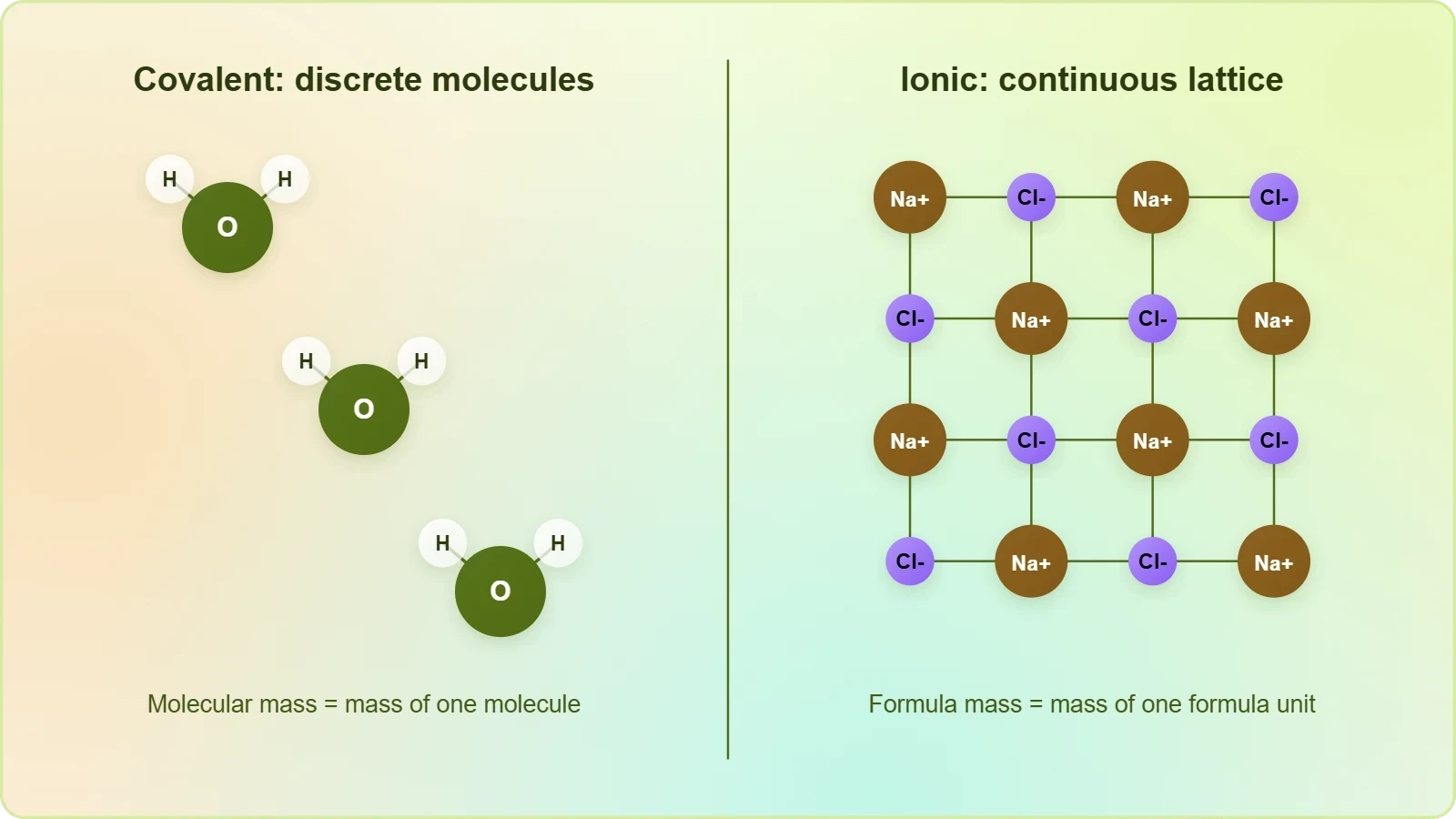
Ionic compounds behave differently. When sodium reacts with chlorine, electrons are transferred rather than shared, and the resulting ions arrange themselves into a continuous three-dimensional lattice in which each sodium ion is surrounded by six chloride ions and vice versa. There is no molecule of sodium chloride in the sense that there is a molecule of water. The smallest repeating unit that captures the composition is the formula unit, NaCl, and the mass calculated from it is the formula mass. Recognizing this distinction early prevents a great deal of confusion later, particularly when students encounter the mole concept and must decide whether to count molecules or formula units.
Why the Distinction Matters
The distinction between molecular and formula mass is not merely semantic; it shapes how chemists describe reactions and calculate quantities. When you write the equation for the combustion of methane, you are dealing with discrete molecules of CH₄ and O₂ producing discrete molecules of CO₂ and H₂O, so molecular masses apply throughout. When you write the precipitation of silver chloride from silver nitrate and sodium chloride, you are dealing with ions in solution forming an extended lattice, so formula masses are the appropriate quantities. Mixing the terminology can lead to conceptual errors, especially when students attempt to count "molecules" of an ionic solid and arrive at nonsensical particle counts.
There is also a practical dimension. Formula masses are used in every stoichiometric calculation involving ionic solids, from the preparation of a standard solution to the gravimetric determination of an unknown. A student who understands that NaCl has a formula mass of 58.5 u rather than a molecular mass is already thinking like a chemist, recognizing that the lattice is the true entity and that the formula unit is a bookkeeping device for composition. This habit of mind becomes essential when we later discuss molar mass, where the numerical value in grams per mole is identical to the formula mass in unified atomic mass units.
Building on Atomic Mass
Everything in this lesson rests on the atomic masses established previously. The atomic mass of an element is the weighted average of the masses of its naturally occurring isotopes, expressed in unified atomic mass units, where one u is defined as one-twelfth the mass of a carbon-12 atom. For hydrogen, the average atomic mass is approximately 1.008 u; for carbon, 12.011 u; for oxygen, 16.00 u; for sodium, 23.0 u; and for chlorine, 35.5 u. These values, which reflect isotopic abundances, are the building blocks from which all molecular and formula masses are constructed, and their precision determines the precision of our final answers.
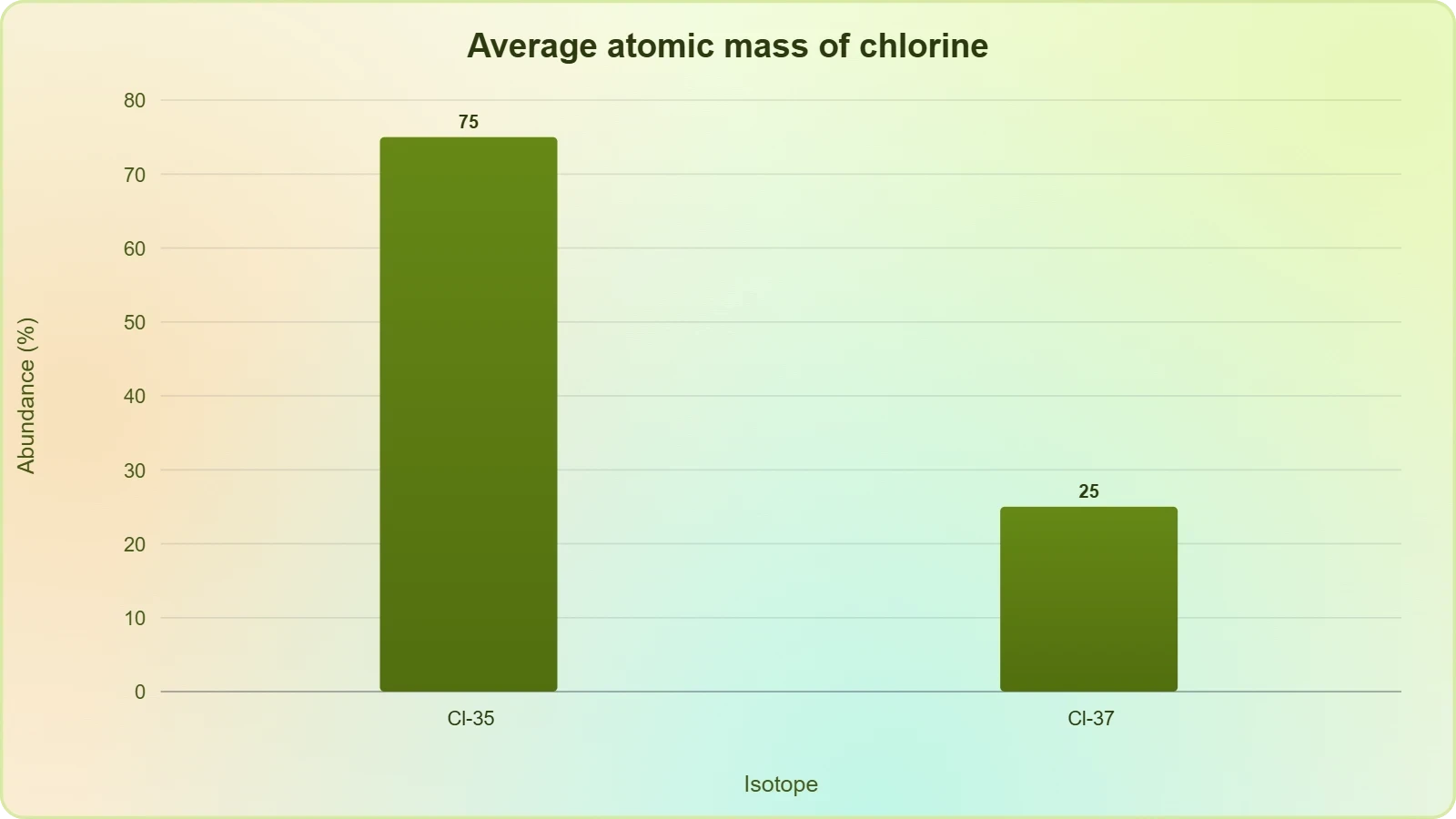
It is worth pausing to appreciate why average atomic masses are used rather than the mass of a single isotope. A macroscopic sample of chlorine contains roughly 75 percent chlorine-35 and 25 percent chlorine-37, so any realistic calculation must use the weighted average of 35.5 u. When we compute the formula mass of sodium chloride as 23.0 u plus 35.5 u equals 58.5 u, we are implicitly describing the average formula unit in a naturally occurring sample. This averaging is what makes the numbers transferable to laboratory work, where samples are always isotopic mixtures rather than pure single isotopes.
Calculating Molecular Mass for Covalent Compounds
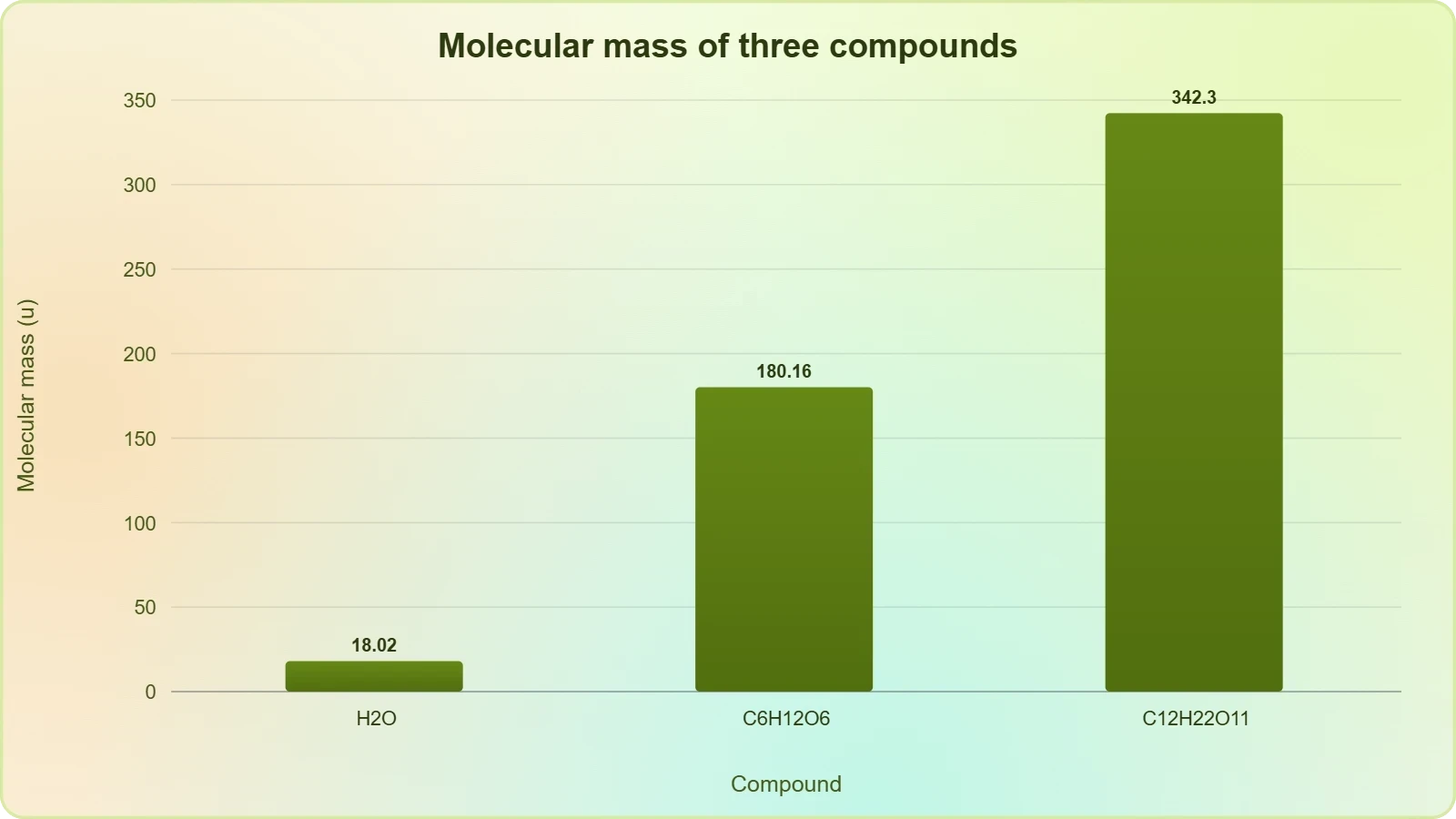
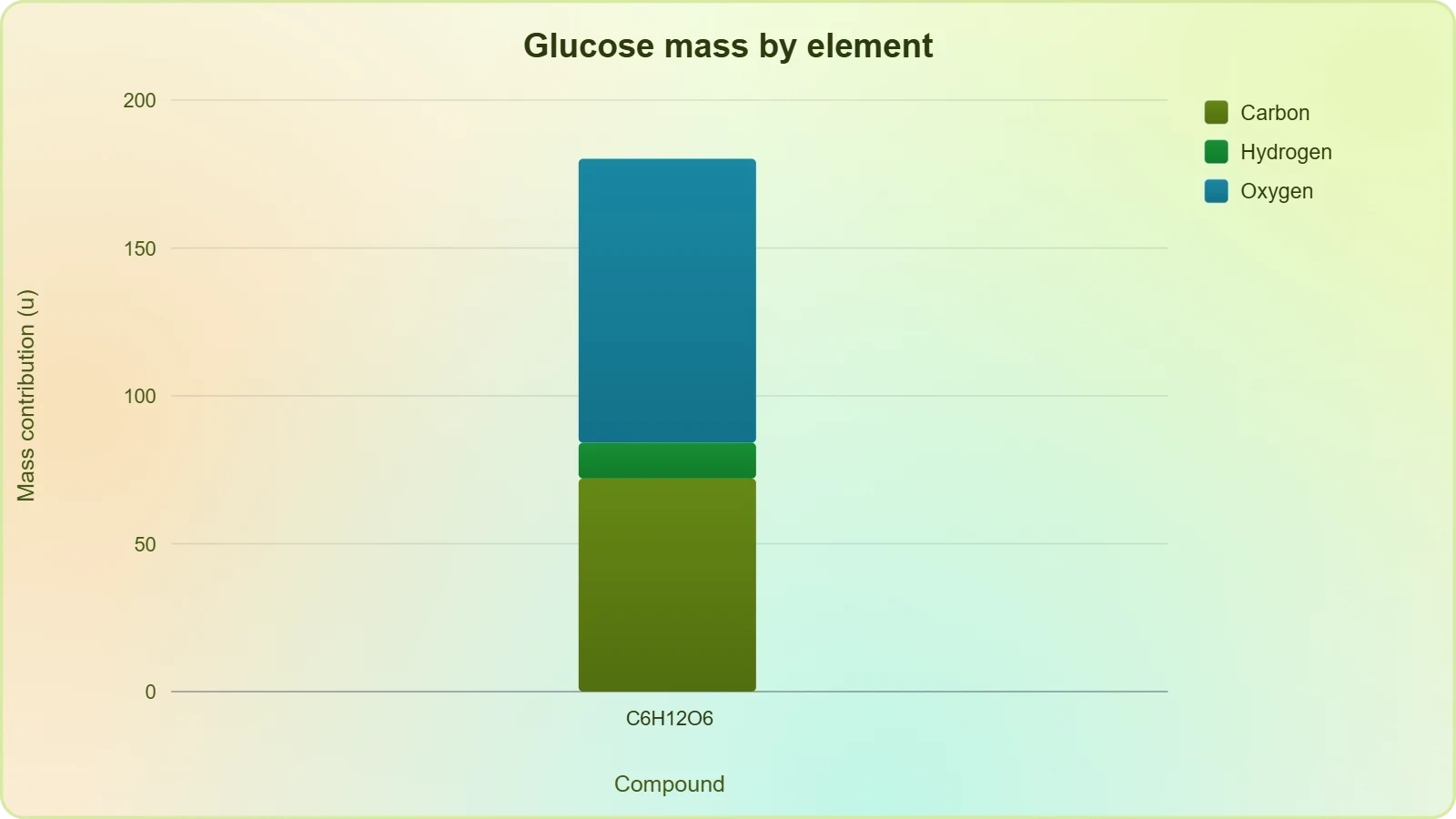
The procedure for calculating molecular mass is straightforward in principle: identify the molecular formula, multiply the atomic mass of each element by the number of its atoms in the molecule, and sum the results. The reference material demonstrates this with glucose, C₆H₁₂O₆, where six carbon atoms contribute 6 × 12.011 u, twelve hydrogen atoms contribute 12 × 1.008 u, and six oxygen atoms contribute 6 × 16.00 u. Summing these gives 72.066 u plus 12.096 u plus 96.00 u, for a total molecular mass of 180.162 u. The arithmetic is simple, but the discipline of tracking significant figures and units is what separates a careful calculation from a careless one.
Water offers an even simpler illustration. Its molecular formula is H₂O, so the molecular mass is 2 × 1.008 u plus 16.00 u, which equals 18.016 u, commonly rounded to 18.02 u. Carbon dioxide, CO₂, gives 12.011 u plus 2 × 16.00 u, or 44.011 u. Ammonia, NH₃, gives 14.007 u plus 3 × 1.008 u, or 17.031 u. Each of these values represents the mass of one molecule relative to the carbon-12 standard, and each will reappear in the next lesson when we convert between molecular mass and molar mass.
Worked Example: Glucose and Beyond
Let us work through glucose in full detail, because it illustrates several habits worth cultivating. The molecular formula C₆H₁₂O₆ tells us there are six carbon atoms, twelve hydrogen atoms, and six oxygen atoms. Using atomic masses to three decimal places, carbon contributes 72.066 u, hydrogen contributes 12.096 u, and oxygen contributes 96.000 u. The sum is 180.162 u. If we round atomic masses to one decimal place, as is common in examinations, we obtain 6 × 12.0 plus 12 × 1.0 plus 6 × 16.0, which equals 72.0 plus 12.0 plus 96.0, or 180.0 u. Both answers are correct within their stated precision, and the choice depends on the data provided.
Consider a second example, sucrose, C₁₂H₂₂O₁₁. Twelve carbon atoms give 144.132 u, twenty-two hydrogen atoms give 22.176 u, and eleven oxygen atoms give 176.000 u, for a total of 342.308 u. Notice how the molecular mass of sucrose is almost exactly twice that of glucose, reflecting the fact that sucrose is essentially two monosaccharide units joined together. This kind of pattern recognition is valuable: chemists often estimate molecular masses by comparing formulas, and the ability to spot such relationships speeds up reasoning in the laboratory and in examinations.
Common Mistakes and How to Avoid Them
The most frequent error is misreading the subscript, particularly when parentheses appear in the formula. In calcium hydroxide, Ca(OH)₂, the subscript two applies to the entire hydroxide group, so there are two oxygen atoms and two hydrogen atoms, not one of each. The molecular mass is therefore 40.08 u plus 2 × 16.00 u plus 2 × 1.008 u, which equals 74.096 u. Students who distribute the subscript incorrectly obtain 57.08 u, a mistake that propagates through every subsequent calculation. Always expand parentheses before multiplying.
A second common error is forgetting that some elements exist as diatomic molecules. When the formula is written as H₂, O₂, N₂, F₂, Cl₂, Br₂, or I₂, the molecular mass is twice the atomic mass. A student who computes the molecular mass of chlorine as 35.5 u rather than 71.0 u has confused the atom with the molecule. A third error involves significant figures: adding numbers with different decimal places should yield an answer with the fewest decimal places among the addends, not the most. Attending to these details transforms a routine calculation into a reliable one.
Formula Mass for Ionic Compounds and Lattices
Ionic compounds present a fundamentally different situation because their constituent particles are ions arranged in a continuous lattice rather than discrete molecules. When sodium chloride crystallizes, each sodium ion is coordinated by six chloride ions and each chloride ion by six sodium ions, extending in three dimensions until the crystal boundary is reached. There is no finite group of atoms that constitutes a "molecule" of NaCl. Instead, the composition is described by the empirical formula NaCl, and the mass calculated from this formula is called the formula mass. The reference material states this clearly: the formula mass of sodium chloride is the atomic mass of sodium plus the atomic mass of chlorine, or 23.0 u plus 35.5 u, giving 58.5 u.
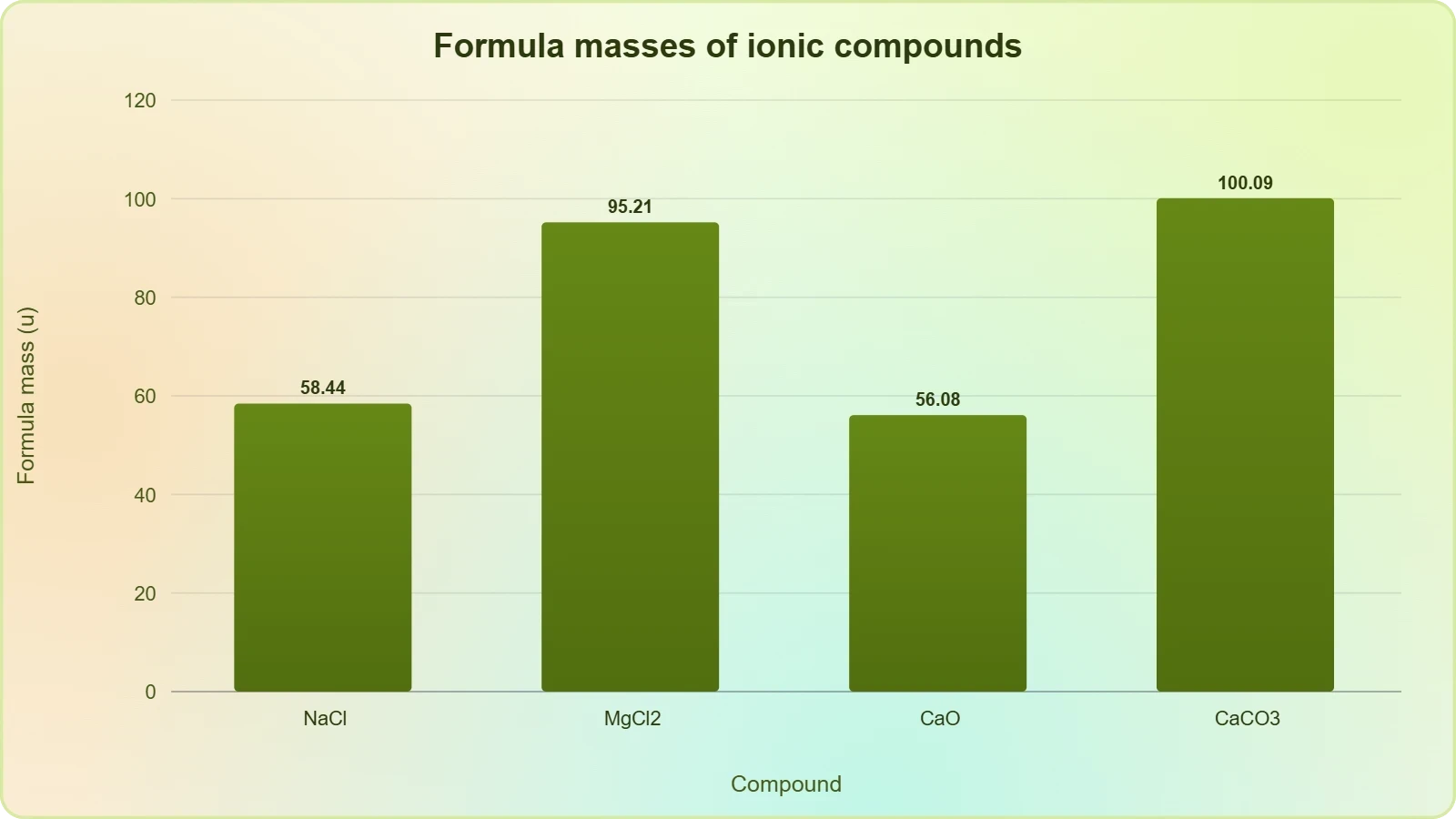
The same logic applies to every ionic compound. Magnesium chloride, MgCl₂, has a formula mass of 24.305 u plus 2 × 35.45 u, or 95.21 u. Calcium oxide, CaO, has a formula mass of 40.08 u plus 16.00 u, or 56.08 u. Aluminium oxide, Al₂O₃, has a formula mass of 2 × 26.982 u plus 3 × 16.00 u, or 101.96 u. In each case, the formula unit represents the simplest ratio of ions in the lattice, and the formula mass represents the mass of that ratio expressed in unified atomic mass units. The calculation is identical in form to molecular mass; only the interpretation differs.
Why Ionic Compounds Lack Discrete Molecules
The absence of discrete molecules in ionic solids follows directly from the nature of ionic bonding. Electrostatic attraction between oppositely charged ions is non-directional and operates equally in all directions, so ions pack together in the arrangement that minimizes energy and maximizes coordination. In sodium chloride, the rock-salt structure achieves six-fold coordination for both ions, and the lattice energy released by this arrangement is enormous. Breaking the lattice requires supplying that energy, which is why ionic solids have high melting points. A discrete NaCl molecule, by contrast, would have only one sodium-chloride contact and would be far less stable.
This structural reality has consequences for how we describe ionic substances in the gas phase. At very high temperatures, some ionic compounds do form discrete ion pairs in the vapour, and these can legitimately be called molecules. But under ordinary conditions, the solid, liquid, and solution states all involve extended ionic assemblies rather than discrete molecules. Chemists therefore reserve the term formula mass for ionic compounds and use molecular mass only for covalent substances. This terminological discipline is not pedantry; it reflects a genuine difference in the physical nature of the substances being described.
Macromolecular Substances: Diamond and Silica
Some covalent substances also lack discrete molecules, forming instead giant covalent networks that extend throughout the crystal. Diamond is the classic example: each carbon atom is covalently bonded to four others in a tetrahedral arrangement, and the network continues indefinitely. There is no molecule of diamond, only a continuous lattice of carbon atoms. The formula is simply C, and the formula mass is 12.011 u, but this number describes only the repeating unit, not a discrete particle. Silica, SiO₂, is similar: each silicon atom is bonded to four oxygen atoms, and each oxygen bridges two silicon atoms, creating a three-dimensional network. Its formula mass is 28.085 u plus 2 × 16.00 u, or 60.085 u.
Silicon carbide, SiC, adopts a diamond-like structure in which silicon and carbon atoms alternate, giving a formula mass of 28.085 u plus 12.011 u, or 40.096 u. Boron nitride, BN, forms layered structures analogous to graphite, with a formula mass of 10.81 u plus 14.007 u, or 24.817 u. In each case, the formula mass describes the composition of the repeating unit, and the true substance is the extended network. Students should recognize that the term "molecular mass" is inappropriate for these materials, even though the bonding is covalent, because no discrete molecule exists.
Molecular Mass, Empirical Formula, and Molecular Formula
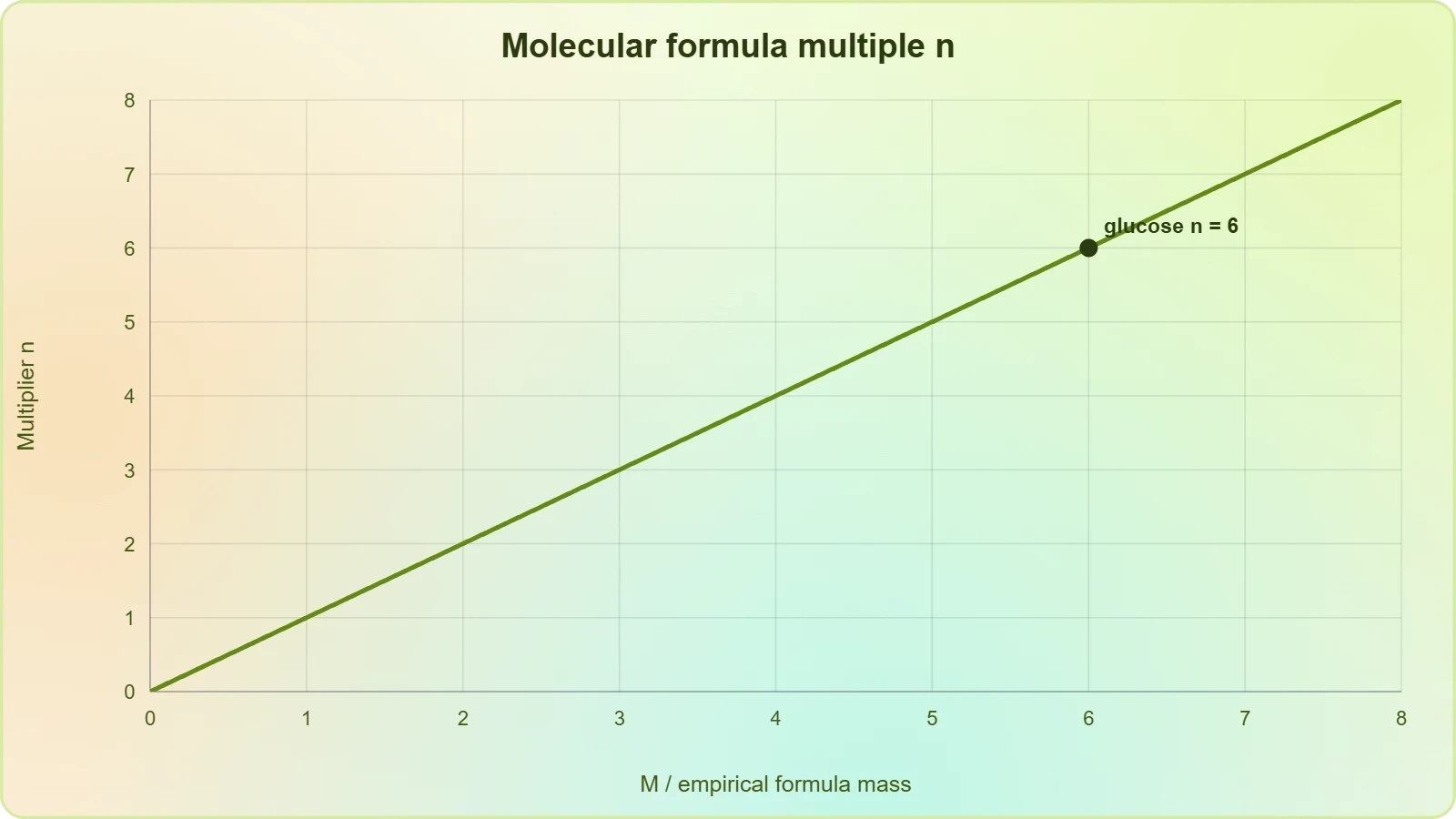
The molecular formula of a compound tells us the actual number of atoms of each element in one molecule, while the empirical formula gives the simplest whole-number ratio of those atoms. Glucose has the molecular formula C₆H₁₂O₆ and the empirical formula CH₂O. The molecular mass of glucose is 180.16 u, and the empirical formula mass is 30.03 u. The ratio of molecular mass to empirical formula mass is six, which tells us that the molecular formula contains six empirical formula units. This relationship is the key to determining molecular formulas from experimental data, a skill that becomes central in later lessons on composition and formula determination.
The general relationship can be expressed as a simple equation. If the molecular formula is a whole-number multiple of the empirical formula, then the molecular mass is the same multiple of the empirical formula mass. In mathematical notation, we can write the relationship as follows, where ##n## is the multiplier:
Rearranging gives ##n = \dfrac{\text{Molecular mass}}{\text{Empirical formula mass}}##, and the molecular formula is obtained by multiplying every subscript in the empirical formula by ##n##. For glucose, ##n = \dfrac{180.16}{30.03} \approx 6##, so the molecular formula is (CH₂O)₆, or C₆H₁₂O₆. This procedure is used routinely in organic chemistry, where combustion analysis provides the empirical formula and mass spectrometry provides the molecular mass, allowing the true molecular formula to be deduced.
Worked Example: Determining a Molecular Formula
Suppose a compound is found to contain 40.0 percent carbon, 6.7 percent hydrogen, and 53.3 percent oxygen by mass, and its molecular mass is determined to be 180.16 u. Dividing each percentage by the atomic mass gives the mole ratio: carbon 40.0 ÷ 12.011 equals 3.33, hydrogen 6.7 ÷ 1.008 equals 6.65, and oxygen 53.3 ÷ 16.00 equals 3.33. Dividing by the smallest value, 3.33, gives the ratio 1:2:1, so the empirical formula is CH₂O with an empirical formula mass of 30.03 u. The multiplier ##n## is 180.16 ÷ 30.03, which equals 6, and the molecular formula is C₆H₁₂O₆, confirming glucose.
This example illustrates the power of molecular mass as a bridge between composition data and structural information. Without the molecular mass, we could only determine the empirical formula, which for glucose would be CH₂O—a formula shared by formaldehyde, acetic acid, and many other compounds. The molecular mass distinguishes among these possibilities and pins down the true molecular formula. In practice, modern chemists obtain molecular masses from mass spectrometry, which can measure the mass of individual molecules with extraordinary precision, but the underlying logic is the same as the classical approach described here.
Relative Molecular Mass Versus Molecular Mass
The terms molecular mass and relative molecular mass are often used interchangeably, but there is a subtle distinction worth understanding. Molecular mass is a quantity with units, expressed in unified atomic mass units, representing the actual mass of a molecule on the atomic scale. Relative molecular mass, often denoted ##M_r##, is a dimensionless ratio: the mass of a molecule relative to one-twelfth the mass of a carbon-12 atom. Because the unified atomic mass unit is defined as exactly one-twelfth the mass of carbon-12, the numerical values of molecular mass in u and relative molecular mass are identical. The difference lies in the units and the conceptual framing.
For most practical purposes, the distinction is invisible: a molecular mass of 18.02 u corresponds to a relative molecular mass of 18.02. But in careful writing, particularly in physical chemistry, the distinction matters. Relative molecular mass is a pure number, while molecular mass carries units. The same relationship holds for formula mass and relative formula mass. Understanding this distinction prepares students for the mole concept, where molar mass in grams per mole is numerically equal to relative molecular mass but carries different units and a different physical meaning.
We Also Published
Precision, Significant Figures, and Measurement Uncertainty
Every molecular and formula mass calculation inherits the precision of the atomic masses used. If atomic masses are quoted to three decimal places, the result should generally be reported to the same precision, though the rules of significant figures in addition require attention to decimal places rather than significant digits. When adding 72.066, 12.096, and 96.000, all three values have three decimal places, so the sum 180.162 is reported with three decimal places. If one value were known only to one decimal place, the sum would be limited to one decimal place. This discipline prevents the illusion of precision that plagues careless calculations.
The reference material's calculation for glucose uses atomic masses of 12.011 u, 1.008 u, and 16.00 u, yielding 180.162 u. Notice that the oxygen contribution, 6 × 16.00, gives 96.00 with two decimal places, while the carbon contribution gives 72.066 with three. The sum is limited by the least precise addend, which is oxygen at two decimal places, so strictly the answer should be 180.16 u. In practice, many textbooks report 180.162 u, accepting a slight over-precision for consistency with the input data. Students should be aware of this convention and follow their instructor's guidance.
Propagation of Uncertainty
When molecular masses are used in further calculations, uncertainties propagate. If a molecular mass is known to ±0.01 u and is used to compute a number of moles, the relative uncertainty in the result is at least 0.01 divided by the molecular mass. For a molecule of mass 180 u, this is about 0.006 percent, which is negligible for most purposes. But for small molecules such as water, with a mass of 18.02 u, the same absolute uncertainty corresponds to a relative uncertainty of about 0.06 percent, which can matter in high-precision work. Understanding this propagation helps chemists decide how many significant figures to carry through a multi-step calculation.
A useful rule of thumb is to carry one extra digit through intermediate steps and round only at the end. This avoids the accumulation of rounding errors without pretending to a precision that the data do not support. In examinations, the convention is usually to report the final answer to the same number of decimal places as the least precise atomic mass provided. For most problems involving molecular mass, this means reporting to two decimal places, which is sufficient for nearly all practical purposes and aligns with the precision of standard atomic mass tables.
Practical Applications in the Laboratory
Molecular and formula masses are used constantly in the laboratory, even before the mole concept is formally introduced. When a chemist weighs out a sample of sodium chloride, the formula mass of 58.5 u tells them the mass of one formula unit, and scaling up by Avogadro's number gives the molar mass of 58.5 g/mol. When a biochemist studies a protein, the molecular mass determined by mass spectrometry guides the interpretation of its structure and function. When an environmental chemist measures atmospheric carbon dioxide, the molecular mass of 44.01 u underpins the conversion between mass concentration and mixing ratio.
In materials science, formula masses of macromolecular substances guide the design of ceramics, semiconductors, and catalysts. Silicon carbide, with a formula mass of 40.096 u, is valued for its hardness and thermal stability, and its formula mass enters calculations of yield and composition during synthesis. Silica, with a formula mass of 60.085 u, is the basis of glass, cement, and countless other materials. In each case, the formula mass is the bridge between the atomic-scale composition and the macroscopic properties that engineers and scientists seek to control.
From Molecular Mass to Molar Mass: A Bridge to the Next Lesson
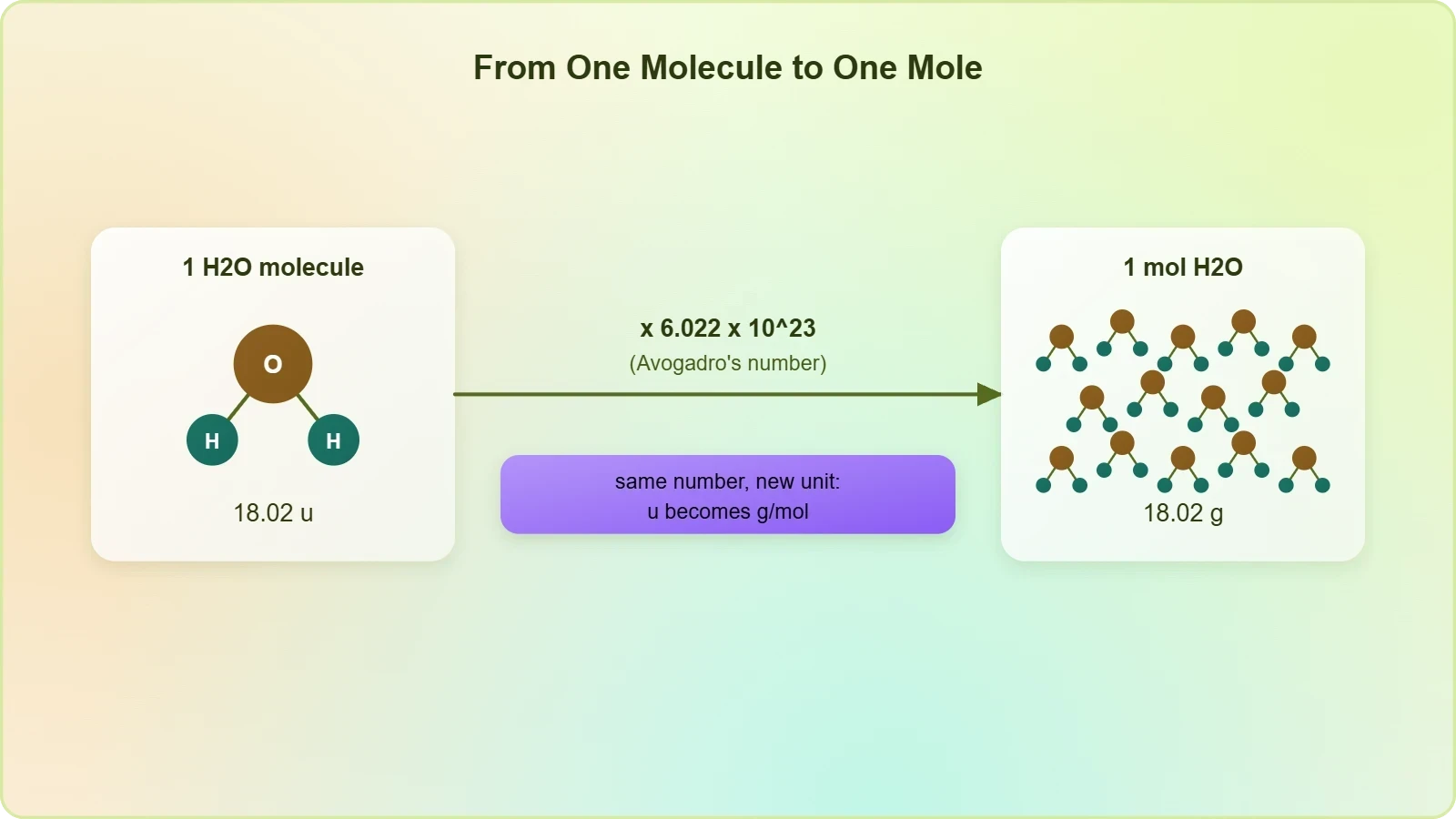
The molecular mass and formula mass developed in this lesson lead naturally to the concept of molar mass, which will occupy the next lesson. The molar mass of a substance is the mass of one mole of its entities, expressed in grams per mole, and its numerical value is identical to the molecular or formula mass in unified atomic mass units. The reference material states this explicitly: the molar mass of water is 18.02 g/mol, and the molar mass of sodium chloride is 58.5 g/mol. This numerical identity is not a coincidence but a consequence of how the mole and the unified atomic mass unit are defined.
The bridge between the two concepts is Avogadro's number, approximately 6.022 × 10²³ entities per mole. If one molecule of water has a mass of 18.02 u, then one mole of water molecules has a mass of 18.02 u multiplied by 6.022 × 10²³, which equals approximately 18.02 grams. The arithmetic works because the unified atomic mass unit is defined such that Avogadro's number of atomic mass units equals one gram. This elegant relationship is what makes the mole such a powerful unit: it allows chemists to weigh out macroscopic quantities that correspond to precise numbers of microscopic particles.
Looking Ahead to the Mole Concept
The next lesson will develop the mole concept in full, introducing Avogadro's number as the fixed numerical value of the Avogadro constant when expressed in reciprocal moles. It will show how the mole serves as a counting unit for atoms, molecules, ions, electrons, and formula units, and how molar mass connects mass to amount of substance. The calculations practiced here—summing atomic masses to obtain molecular or formula mass—will become the first step in every stoichiometric problem, from determining the yield of a reaction to preparing a solution of known concentration.
Students who master the distinction between molecular mass and formula mass, and who understand why ionic and macromolecular substances require the latter, will find the mole concept much easier to absorb. They will recognize that one mole of sodium chloride contains Avogadro's number of formula units, not molecules, and that one mole of diamond contains Avogadro's number of carbon atoms arranged in a continuous network. These distinctions, established here, will pay dividends throughout the remainder of the course and in every subsequent chemistry course they take.
Summary of Key Relationships
The relationships developed in this lesson can be summarized compactly. For a covalent compound with molecular formula, the molecular mass is the sum of atomic masses of all atoms in the molecule. For an ionic compound or macromolecular substance, the formula mass is the sum of atomic masses of all atoms in the empirical formula unit. The molecular formula is a whole-number multiple of the empirical formula, and the multiplier is the ratio of molecular mass to empirical formula mass. The molar mass in grams per mole is numerically equal to the molecular or formula mass in unified atomic mass units, a relationship that will be formalized in the next lesson.
These relationships form a coherent framework that connects the atomic scale to the laboratory scale. Mastery of this framework requires not only arithmetic skill but also conceptual clarity about the nature of the particles being counted. A student who can explain why sodium chloride has a formula mass rather than a molecular mass, and who can calculate both quantities accurately, is well prepared for the quantitative reasoning that dominates the rest of chemistry. The worked examples and tables in this lesson provide ample practice, and the common mistakes highlighted serve as a checklist for self-assessment.
Advanced Considerations and Problem-Solving Strategies
Advanced learners should recognize that molecular mass calculations become more intricate when isotopes are considered explicitly. The average atomic mass used in routine calculations is a weighted average over natural isotopic abundance, but in isotope-labelled experiments, the mass of a specific isotopologue may be required. For example, deuterated water, D₂O, has a molecular mass of 2 × 2.014 u plus 16.00 u, or 20.028 u, rather than 18.02 u. Mass spectrometry routinely resolves such differences, and interpreting the resulting spectra requires a firm grasp of how isotopic composition affects molecular mass.
Another advanced consideration involves the distinction between nominal mass, monoisotopic mass, and average mass. Nominal mass is the sum of the integer mass numbers of the most abundant isotopes, monoisotopic mass is the sum of the exact masses of the most abundant isotopes, and average mass is the abundance-weighted average. For small molecules, these values are close, but for large molecules such as proteins, they can differ substantially. A protein with a nominal mass of 10,000 Da may have an average mass several daltons higher because of the contribution of carbon-13 and other heavy isotopes.
Problem-Solving Checklist
A reliable problem-solving strategy begins with identifying whether the substance is covalent, ionic, or macromolecular. For covalent substances, use the molecular formula and compute molecular mass. For ionic and macromolecular substances, use the empirical formula and compute formula mass. Expand parentheses carefully, count atoms methodically, and use atomic masses to the precision given in the problem. Carry one extra digit through intermediate steps, round at the end, and state the unit as u. Check the answer for plausibility: a molecule with many heavy atoms should have a larger mass than one with few light atoms.
When determining a molecular formula from composition data, first compute the empirical formula by dividing percentage compositions by atomic masses and reducing to the simplest ratio. Then compute the empirical formula mass and divide the given molecular mass by it to obtain the multiplier ##n##. Multiply the empirical formula by ##n## to obtain the molecular formula. Verify that the resulting molecular mass matches the given value. This checklist, applied consistently, eliminates most errors and builds the confidence needed for more complex stoichiometric problems in later lessons.
Connecting to Broader Chemical Reasoning
Molecular and formula masses are not isolated computational tools; they are entry points to broader chemical reasoning. They allow chemists to compare the masses of reactants and products, to determine the composition of mixtures, and to design syntheses with predictable yields. They underpin the periodic table's logic, since atomic masses are the foundation of periodicity. They connect to thermodynamics through molar masses in energy calculations, to kinetics through the masses of colliding species, and to spectroscopy through the masses of fragments in mass spectra. A student who sees these connections understands chemistry as a unified discipline rather than a collection of isolated facts.
The historical development of these concepts, from Dalton's atomic theory through Avogadro's hypothesis to modern mass spectrometry, illustrates how careful measurement and bold theorizing combine to produce scientific progress. The reference material's account of Avogadro's number, with its twenty-four-digit expansion, reminds us of the extraordinary scale of the microscopic world and the ingenuity required to measure it. Molecular mass and formula mass are the practical tools that make this scale manageable, translating the invisible into the weighable and the countable.
Consolidation: Worked Problems and Self-Assessment
Consolidating the material in this lesson requires practice with a range of problems. Consider calcium carbonate, CaCO₃, an ionic compound. Its formula mass is 40.08 u plus 12.011 u plus 3 × 16.00 u, which equals 100.09 u. Consider sulfuric acid, H₂SO₄, a covalent compound. Its molecular mass is 2 × 1.008 u plus 32.06 u plus 4 × 16.00 u, which equals 98.08 u. Consider urea, CO(NH₂)₂, a covalent compound with a more complex formula. Expanding the parentheses gives one carbon, one oxygen, two nitrogen, and four hydrogen atoms, so the molecular mass is 12.011 u plus 16.00 u plus 2 × 14.007 u plus 4 × 1.008 u, which equals 60.056 u.
These examples illustrate the importance of careful formula reading. Urea is a particularly instructive case because the parentheses enclose an amino group that appears twice, and a careless reading might count only one nitrogen or two hydrogens. Practicing with such formulas builds the attentional discipline that advanced chemistry demands. Students should work through each example independently, compare their answers with the worked solutions, and identify any discrepancies before moving on to the self-assessment questions that follow.
Self-Assessment Questions
Test your understanding with the following questions. First, calculate the molecular mass of ethanol, C₂H₅OH, and explain why the formula can be written in this way rather than as C₂H₆O. Second, calculate the formula mass of potassium permanganate, KMnO₄, and explain why the term formula mass is appropriate. Third, a compound has an empirical formula of CH and a molecular mass of 78.11 u; determine its molecular formula. Fourth, explain why diamond has a formula mass rather than a molecular mass, and calculate that formula mass. Fifth, distinguish between molecular mass and relative molecular mass, giving an example of each.
Answers to these questions can be derived from the principles developed throughout the lesson. Ethanol's molecular mass is 2 × 12.011 u plus 6 × 1.008 u plus 16.00 u, or 46.07 u, and the formula C₂H₅OH emphasizes the hydroxyl group. Potassium permanganate's formula mass is 39.098 u plus 54.938 u plus 4 × 16.00 u, or 158.04 u, and the term formula mass is appropriate because KMnO₄ is ionic. The compound with empirical formula CH and molecular mass 78.11 u has ##n = 78.11 ÷ 13.02 \approx 6##, so its molecular formula is C₆H₆, which is benzene. Diamond's formula mass is 12.011 u, and it lacks discrete molecules because it is a covalent network.
Preparing for the Next Lesson
With molecular and formula masses firmly in hand, you are ready for the mole concept and Avogadro's number. The next lesson will show how these masses connect to countable numbers of particles through the mole, and how molar mass serves as the conversion factor between mass and amount of substance. Review the worked examples in this lesson, ensure you can distinguish molecular from formula mass, and practice the self-assessment questions until you can answer them confidently. The conceptual foundation laid here will support every quantitative calculation in the remainder of the course.
As a final exercise, reflect on the unity of the subject. The same arithmetic that gives the molecular mass of water gives the formula mass of sodium chloride and the formula mass of diamond. What changes is the interpretation of the particle being counted, not the calculation itself. This unity is one of chemistry's great strengths: a small set of principles, applied with care, explains an enormous range of substances and transformations. Carry this perspective forward, and the mole concept will feel like a natural extension of ideas you already understand rather than a new and separate topic.
From our network :
- 98% of Global MBA Programs Now Prefer GRE Over GMAT Focus EditionExplore why 98% of global MBA programs now prefer the GRE over GMAT Focus. Learn about the shorter GRE format, verbal logic importance, and strategic versatility for students.
- Where to Put Your Wireless Router for Better CoverageA practical, physics-grounded guide to router placement: why the centre of the home beats the corner, how walls and metal sap signal, and how to run a simple survey that proves the improvement.
- Do You Need a New Router or Is Your Internet Plan the Problem?A practical comparison of the signs that point to router limits versus signs your broadband speed or provider is the bottleneck, so you can decide what to replace before spending money.
- EV 2.0: The Solid-State Battery Breakthrough and Global Factory ExpansionDiscover the impact of the Solid-State Battery Breakthrough on the EV market. Learn about CATL and BYD stock growth, global factory expansion in Europe, and the future of EV 2.0 technology.
- AI-Powered 'Precision Diagnostic' Replaces Standard GRE Score ReportsDiscover the new GRE Precision Diagnostic. Learn how AI-powered behavioral analytics and time-to-solve tracking are replacing standard GRE score reports to empower students.
- 10 Physics Numerical Problems with Solutions for IIT JEEPrepare for IIT JEE with 10 physics numerical problems, complete with detailed solutions and conceptual explanations. Ideal for mastering kinematics, thermodynamics, electromagnetism, and optics.
- How to Print Cheaply: Cutting the Cost per PageA practical, measured guide to lowering what each printed page costs — duplex and draft modes, third-party ink, yield mathematics, and knowing when a new printer beats refills.
- Analyzing Trump Deportation Numbers Insights Into The 2026 Immigration Crackdown
- Trump Political Strategy How Geopolitical Stunts Serve As Media Diversions
RESOURCES
- What is the difference between molecular mass and formula mass?reddit.comJun 26, 2018 ... Formula tells you what atoms and how many are in the molecule. Mass tells you how much the molecule weighs.…
- 6.2: Molecular Mass and Formula Mass - Chemistry LibreTextschem.libretexts.orgApr 17, 2023 ... The mass of a formula unit is called its formula mass. The formula mass is calculated summing the masses of…
- Molecular Mass and Formula Mass — Overview & Calculations - Expiiexpii.comMolecular mass is the sum of the atomic masses of the atoms that make up a covalent compound. Formula mass is the same calculation,…
- Molar mass - Wikipediaen.wikipedia.orgMolecular masses are calculated from the atomic masses of each nuclide, while molar masses are calculated from the standard atomic weights of each element.…
- 4.8: Formula Mass, Molecular Mass, and Molar Masschem.libretexts.orgJul 31, 2025 ... The formula mass of a substance is the sum of the average atomic masses of each atom represented in the…
- Molecular Weight Calculator (Molar Mass) - Lenntechlenntech.comCalculate approximate molar mass and elemental mass percentages from chemical formulas. Includes hydrate input guidance, examples, units and mole ...
- How to Determine Molar Mass by SEC-MALS - Wyatt Technologywyatt.comMulti-Angle static Light Scattering (MALS) measures molar mass directly, in solution. Combined with a fractionation technique like SEC or FFF, MALS determines ...
- Molar Mass Calculator Tool | Cayman Chemicalcaymanchem.comEnter a valid molecular formula and press the calculate button to determine the correct molar mass. Atomic mass values for individual elements can be…
- Molecular formula finder from monoisotopic mass - ChemCalcchemcalc.orgFind every possible molecular formula for a monoisotopic mass, filtered by element ranges, ionization mode, ppm precision and degree of unsaturation.
- Molecular Mass Calculator - BMRBbmrb.ioEnter the molecular formula of the molecule. Examples: C6H12O6, PO4H2(CH2)12CH3. Calculate molecular mass by: Supported by the National Institute of General ...
- 3.1 Formula Mass and the Mole Concept | Chemistrycourses.lumenlearning.comLikewise, the molecular mass of an aspirin molecule, C9H8O4, is the sum of the atomic masses of nine carbon atoms, eight hydrogen atoms, and…
- Molarity Calculator (formerly Tocris Molarity Calculator) - R&D Systemsrndsystems.comIn general, the molecular mass, molecular weight, molar mass, or formula weight of a chemical compound can be used when using a molarity or…
- Chemistry I Worksheet Name Calculating Formula Mass Referencewww2.american-usa.com- Formula Mass: The sum of atomic masses for the atoms in a chemical formula, expressed per molecule or formula unit. - Molar Mass:…
- Formula Mass - UCalgary Chemistry Textbookchem-textbook.ucalgary.caThe molecular formula of chloroform indicates that a single molecule contains one carbon atom, one hydrogen atom, and three chlorine atoms. The average ...
- 3.1 Formula Mass and the Mole Concept - Chemistry 2e | OpenStaxopenstax.orgFeb 14, 2019 ... Explain the relation between mass, moles, and numbers of atoms or molecules, and perform calculations deriving these quantities from one…