Dimensional analysis, often called the factor-label method or unit-factor method, is the disciplined arithmetic of measurement itself. It rests on a single, elegant insight: any equality between two units can be turned into a fraction equal to one, and multiplying a quantity by one never changes its value, only its appearance. When a metal rod measures 3 inches, we are not changing the rod by rewriting its length as 7.62 centimetres; we are translating the same physical reality into a different vocabulary. This translation skill is the quiet engine behind every reliable calculation in chemistry, physics, engineering, and medicine.
The method matters because chemistry is an intensely quantitative discipline, and quantities without units are meaningless. A reported mass of 2.5 tells us nothing until we know whether it is grams, kilograms, or tonnes. Dimensional analysis enforces intellectual honesty: it forces every number to carry its identity, and it catches errors that arithmetic alone would hide. If a calculation yields seconds when you expected moles, the units have just saved you from a costly mistake. This lesson builds directly on the previous discussion of precision and accuracy, extending that care for measurement into the mechanics of conversion.
Beyond mere bookkeeping, the factor-label method is a reasoning strategy. It lets you chain equivalences in series, converting days to seconds in a single flowing expression, or litres to cubic metres by cubing a length ratio. It also prepares the ground for the laws of chemical combination that follow, where masses and volumes must be compared in consistent units before any proportion can be trusted. Mastery here means you can look at any unfamiliar conversion and construct the path yourself, rather than memorising isolated formulas.
On This Page
- The Logic of Unit Factors and Conversion Equivalences
- Dimensional Homogeneity and the Grammar of Equations
- SI and Non-SI Conversions in Global Practice
- Dimensional Analysis in Medicine and Dosage Safety
- Units in Computation and the Cost of Silent Mismatch
- Precision, Rounding, and Reporting Converted Results
- From Conversions to Chemical Laws: Preparing the Next Step
The Logic of Unit Factors and Conversion Equivalences
Every conversion begins with an equivalence statement, a simple declaration that two expressions describe the same physical amount. The statement ##1\ \text{in} = 2.54\ \text{cm}## is not a formula to memorise but a relationship to exploit. From it we can manufacture two reciprocal fractions, ##\dfrac{1\ \text{in}}{2.54\ \text{cm}}## and ##\dfrac{2.54\ \text{cm}}{1\ \text{in}}##, each of which equals exactly one. Because multiplying by one leaves a quantity unchanged, we may attach either fraction to any measurement, choosing whichever orientation cancels the unit we wish to eliminate and leaves the unit we desire.
The selection rule is beautifully mechanical: arrange the fraction so the unwanted unit appears in the denominator and the wanted unit in the numerator. Converting 3 inches to centimetres, we multiply by ##\dfrac{2.54\ \text{cm}}{1\ \text{in}}##, the inches cancel, and the answer emerges as ##3 \times 2.54 = 7.62\ \text{cm}##. Units behave like algebraic symbols throughout: they may be cancelled, divided, multiplied, squared, or cubed, exactly as numerical factors are. This algebraic freedom is what makes the method so powerful across arbitrarily complex problems.

Building Chains of Conversion Factors
Real problems rarely need a single step. To find how many seconds lie in two days, we link equivalences in series: one day equals 24 hours, one hour equals 60 minutes, and one minute equals 60 seconds. Writing the chain as a single product, ##2\ \text{day} \times \dfrac{24\ \text{h}}{1\ \text{day}} \times \dfrac{60\ \text{min}}{1\ \text{h}} \times \dfrac{60\ \text{s}}{1\ \text{min}}##, every intermediate unit cancels in turn, leaving only seconds. The arithmetic then reduces to ##2 \times 24 \times 60 \times 60 = 172800\ \text{s}##. Notice how the structure of the expression mirrors the logic of the journey from days to seconds.
This chaining technique scales gracefully. Whether you are converting light-years to metres, kilowatt-hours to joules, or molarity to parts per million, the discipline is identical: identify the bridge equivalences, orient each fraction to cancel the current unit, and multiply. The only genuine difficulty lies in knowing the equivalences, and those are reference knowledge rather than reasoning skill. Once the bridges are known, the factor-label method guarantees the route.
Handling Powers, Areas, and Volumes
Units raised to powers demand special care, because the conversion factor must be raised to the same power. A jug holding 2 litres contains ##2 \times 1000 = 2000\ \text{cm}^3##, since one litre equals one thousand cubic centimetres. To express this in cubic metres, we use the equivalence ##1\ \text{m} = 100\ \text{cm}## and cube the resulting factor, giving ##\left(\dfrac{1\ \text{m}}{100\ \text{cm}}\right)^3 = \dfrac{1\ \text{m}^3}{10^6\ \text{cm}^3}##. Multiplying, ##2000\ \text{cm}^3 \times \dfrac{1\ \text{m}^3}{10^6\ \text{cm}^3} = 2 \times 10^{-3}\ \text{m}^3##.
The commonest error here is forgetting to cube or square the numerical part of the factor. A student who converts cubic centimetres to cubic metres using 100 rather than ##10^6## will be wrong by a factor of ten thousand, an error large enough to sink an engineering design. Always ask whether the unit is linear, squared, or cubed, and apply the exponent to the entire conversion factor, not merely to the unit symbol.
Dimensional Homogeneity and the Grammar of Equations
Dimensional homogeneity is the principle that every valid physical equation must have identical dimensions on both sides. You cannot add a length to a time, nor equate a mass to a velocity, any more than you can add apples to seconds. This principle acts as a grammatical rule for physics: it tells us which equations are even candidates for truth before we test them numerically. When an equation fails dimensional analysis, no amount of experimental data can rescue it, because the statement is structurally incoherent.
The technique also constrains the form of unknown relationships. If a period of oscillation depends on length and gravitational acceleration, dimensional reasoning alone suggests the combination ##\sqrt{L/g}##, since only that grouping yields a time. This is the foundation of the method of dimensions, used by physicists to guess scaling laws before deriving them rigorously. It is a first-pass filter that eliminates nonsense and narrows the search space for correct formulas.
Checking Equations Before Solving Them
Consider the kinematic relation ##v^2 = u^2 + 2as##. Each term carries dimensions of velocity squared, ##[L^2T^{-2}]##, so the equation is homogeneous and dimensionally admissible. By contrast, an expression such as ##s = ut + \dfrac{1}{2}at## fails immediately, because the second term has dimensions of velocity rather than length. A student who habitually checks dimensions catches such slips before substituting numbers, saving time and preventing the propagation of errors through a long calculation.
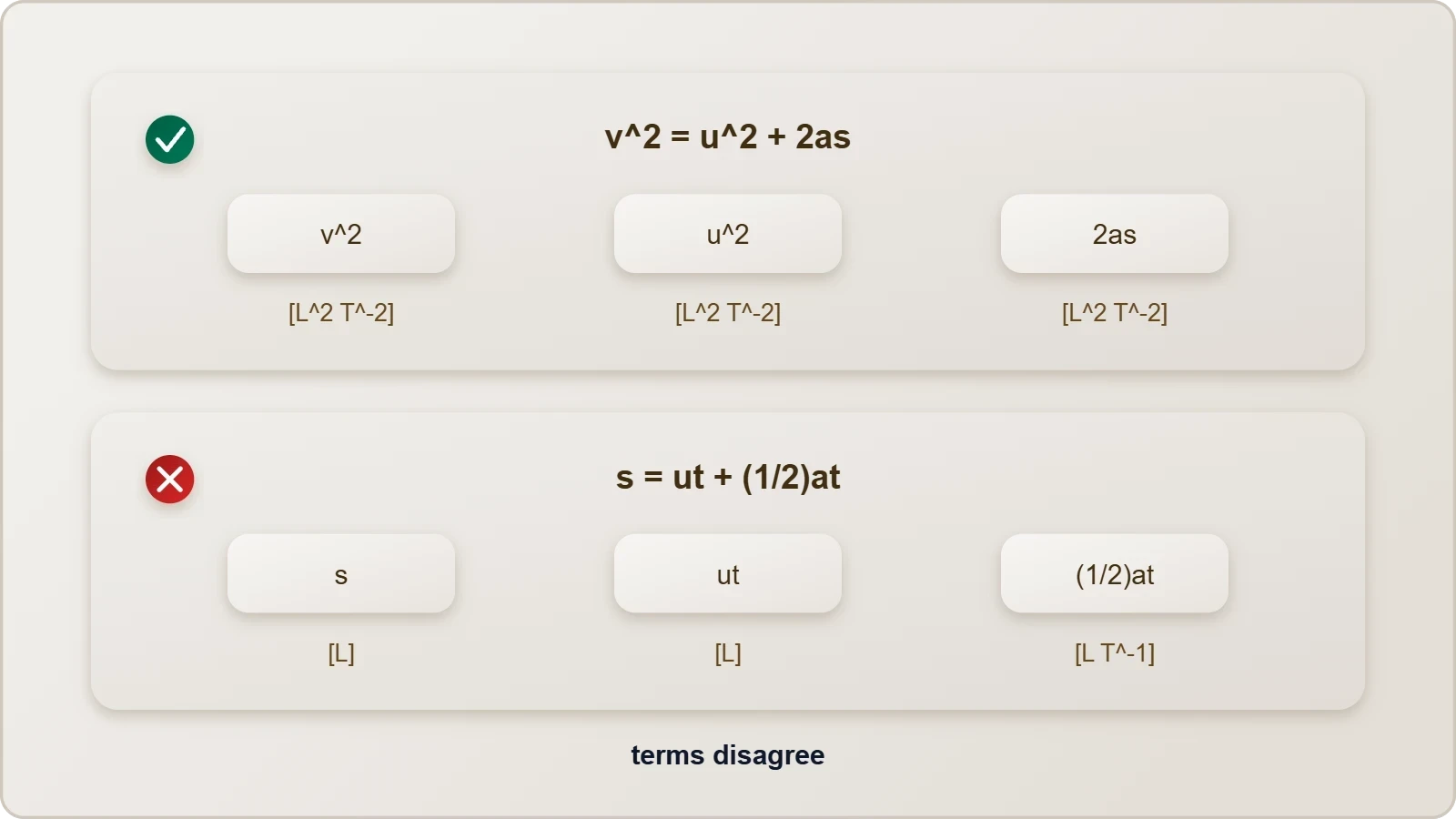
Dimensional analysis cannot determine dimensionless constants, however. The factor of ##\dfrac{1}{2}## in the correct kinematic equation is invisible to dimensional reasoning, because pure numbers carry no dimensions. This limitation is important: dimensional homogeneity is a necessary condition for a correct equation, never a sufficient one. It filters candidates but does not certify them, and experimental verification remains the final arbiter of physical truth.
Applications Across Physics and Engineering
Engineers lean on dimensional reasoning constantly. In fluid mechanics, the Reynolds number ##Re = \dfrac{\rho v D}{\mu}## is dimensionless, a pure ratio that predicts whether flow is laminar or turbulent regardless of the fluid or pipe size. Because it carries no units, the same critical value applies to water in a pipe and air over a wing. This dimensionless grouping is the practical payoff of dimensional thinking: it reveals universal behaviour hidden beneath the diversity of specific systems.

In structural design, dimensional checks catch unit mismatches between stress in pascals, force in newtons, and area in square metres. A beam calculation that mixes millimetres and metres without conversion can produce a deflection estimate wrong by a factor of a thousand, with consequences ranging from cosmetic to catastrophic. The habit of tracking units through every step is therefore not academic pedantry but a professional safeguard embedded in engineering practice.
SI and Non-SI Conversions in Global Practice
The International System of Units provides a coherent framework, but the world still speaks in pounds, miles, gallons, and degrees Fahrenheit. Converting between these systems is a daily necessity in trade, travel, medicine, and science. A mass of 150 pounds becomes ##150 \times 0.453592 = 68.04\ \text{kg}##, and a distance of 26.2 miles becomes ##26.2 \times 1.609 = 42.16\ \text{km}##. These are not exotic operations; they are the routine grammar of international communication.
The danger lies in approximate factors used casually. Treating a kilogram as 2.2 pounds is fine for estimating luggage, but unacceptable for dosing medication or calibrating an aircraft. The precision of the conversion factor must match the precision required by the application, a principle that echoes the earlier lesson on significant figures. Choosing the right factor is itself a judgement about acceptable uncertainty.
Worked Conversions Between Systems
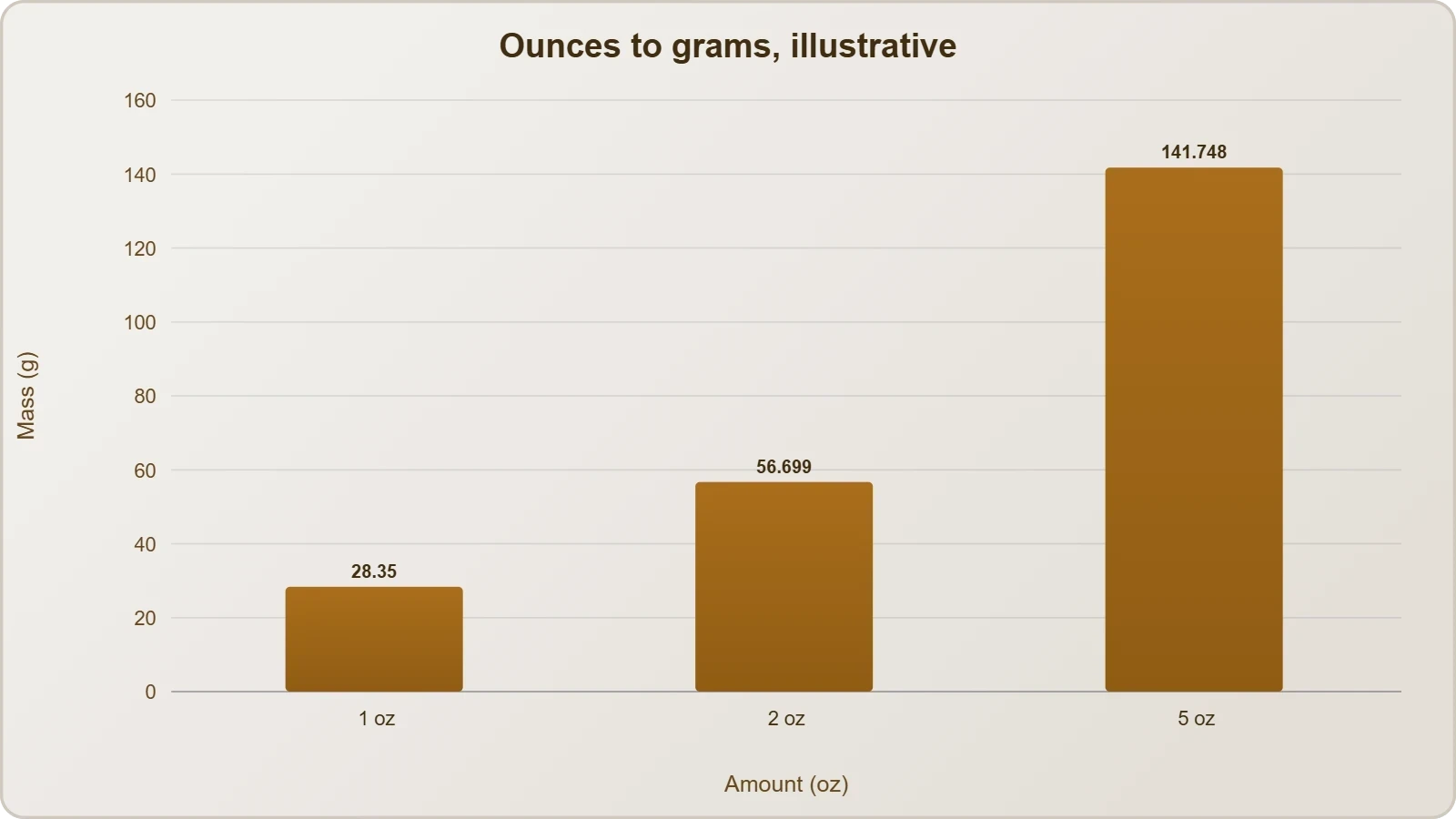
Suppose a laboratory protocol specifies 5.0 ounces of a reagent, and the balance reads in grams. Using ##1\ \text{oz} = 28.3495\ \text{g}##, we compute ##5.0 \times 28.3495 = 141.7\ \text{g}##, which, respecting two significant figures in the original measurement, is reported as ##1.4 \times 10^2\ \text{g}##. The conversion is trivial; the discipline of matching significant figures to the input is what separates a careful chemist from a careless one.
Temperature conversions require an offset as well as a factor, which makes them a special case. The relation ##T_F = \dfrac{9}{5}T_C + 32## cannot be expressed as a simple unit factor because the two scales have different zero points. Recognising when a conversion is multiplicative and when it is affine is an important subtlety that pure factor-label thinking can obscure.
Why Approximate Factors Cause Trouble
Approximate factors accumulate error in chained calculations. If three successive conversions each carry a 0.5 percent approximation, the compounded error can approach 1.5 percent, enough to shift a result across a specification boundary. In pharmaceutical manufacturing, where active ingredient content must fall within tight tolerances, such drift is unacceptable. The remedy is to use exact or high-precision factors internally and round only at the final reporting step.
This practice mirrors the significant-figure rules for multiplication and division, where the result is limited by the least precise measurement. A conversion factor is itself a measurement of sorts, carrying its own uncertainty. Treating it as infinitely precise when it is not is a quiet source of systematic error, and the professional habit is to know the provenance and precision of every factor you employ.
Dimensional Analysis in Medicine and Dosage Safety
Nowhere is unit conversion more consequential than in clinical medicine. Drug doses are expressed in milligrams per kilogram of body weight, micrograms per minute, or international units, and a misplaced decimal can be lethal. A patient weighing 70 kg prescribed 5 mg/kg requires ##70 \times 5 = 350\ \text{mg}##, and if the available formulation is 250 mg per 5 mL, the volume to administer is ##350 \times \dfrac{5}{250} = 7\ \text{mL}##. Each step is a factor-label conversion, and each must be verified.
Paediatric dosing amplifies the risk because children's masses span a wide range and doses are often calculated per kilogram. A tenfold error in a conversion factor, the classic decimal slip, can turn a therapeutic dose into a toxic one. This is why clinical protocols mandate independent double-checks of dose calculations, and why dimensional analysis is taught in nursing and pharmacy curricula as a safety skill rather than a mathematical nicety.
Stepwise Dose Calculation
Consider an infusion ordered at 0.1 mg/kg/h for a 60 kg patient, with a bag containing 50 mg in 250 mL. The hourly dose is ##0.1 \times 60 = 6\ \text{mg/h}##. The concentration is ##\dfrac{50}{250} = 0.2\ \text{mg/mL}##, so the required rate is ##\dfrac{6}{0.2} = 30\ \text{mL/h}##. Every step cancels units cleanly, and the final answer carries the expected dimensions of volume per time, a reassuring consistency check.
The factor-label structure makes the logic auditable. A colleague reviewing the calculation can follow each cancellation and confirm that no unit was inverted. This transparency is valuable in high-stakes settings, where the reasoning must be inspectable, not merely the answer correct. Dimensional analysis thus doubles as a communication tool among clinical teams.
Unit Errors as Patient-Safety Events
Documented cases of medication error frequently trace to unit confusion: milligrams mistaken for micrograms, or a concentration expressed per millilitre administered as if per litre. These are not arithmetic failures but dimensional ones, and they are preventable by the same cancellation discipline used in the chemistry laboratory. Regulatory bodies now treat unit mislabeling as a reportable safety event, reflecting how seriously the profession regards dimensional integrity.
The lesson for students is direct: the habit of writing units at every step, and cancelling them explicitly, is a transferable safety practice. It costs a few seconds and prevents errors that can cost far more. Chemistry's insistence on units is not fussiness; it is the same protective instinct that governs the hospital ward.
Units in Computation and the Cost of Silent Mismatch
Software systems inherit the same dimensional obligations as physical experiments, yet they often discard units entirely. A variable named length holding the value 3 tells the compiler nothing about whether it means metres or feet. When two such values are added, the program happily produces a number that is physically meaningless. This silent failure mode is one reason engineering teams increasingly adopt unit-aware libraries that attach dimensions to values and raise errors on incompatible operations.
Programming languages offer various approaches. Some, like F#, support units of measure natively in the type system, so that adding a metre to a second is a compile-time error. Others rely on disciplined naming conventions or third-party libraries. The principle is the same as in chemistry: make the unit part of the value's identity, and let the system enforce compatibility rather than trusting human vigilance.
Writing Unit-Safe Conversion Code
A simple conversion function can encode the factor-label logic directly. The following Python snippet converts miles to kilometres and demonstrates how a named constant documents the equivalence, making the code self-explanatory and auditable.
KM_PER_MILE = 1.609344

def miles_to_km(miles: float) -> float:
    """Convert a distance in miles to kilometres."""
    if miles < 0:
        raise ValueError("Distance cannot be negative")
    return miles * KM_PER_MILE

print(miles_to_km(26.2))  # 42.1648128
Notice how the constant name itself carries the dimensional information, and the function signature documents the expected input and output. In larger systems, a dedicated units library such as pint in Python allows quantities to be multiplied and divided with automatic cancellation, raising exceptions when incompatible units meet. This mirrors the manual cancellation a chemist performs on paper, but at machine speed and without fatigue.
The Mars Climate Orbiter and the Price of a Missing Unit
In 1999, NASA's Mars Climate Orbiter was lost during orbital insertion. The root cause was a unit mismatch: one team supplied thruster impulse data in pound-force seconds, while the navigation software expected newton-seconds. The discrepancy, roughly a factor of 4.45, went undetected until the spacecraft entered the Martian atmosphere too low and was destroyed. The mission cost approximately 125 million dollars, and the failure is now a canonical case study in engineering education.
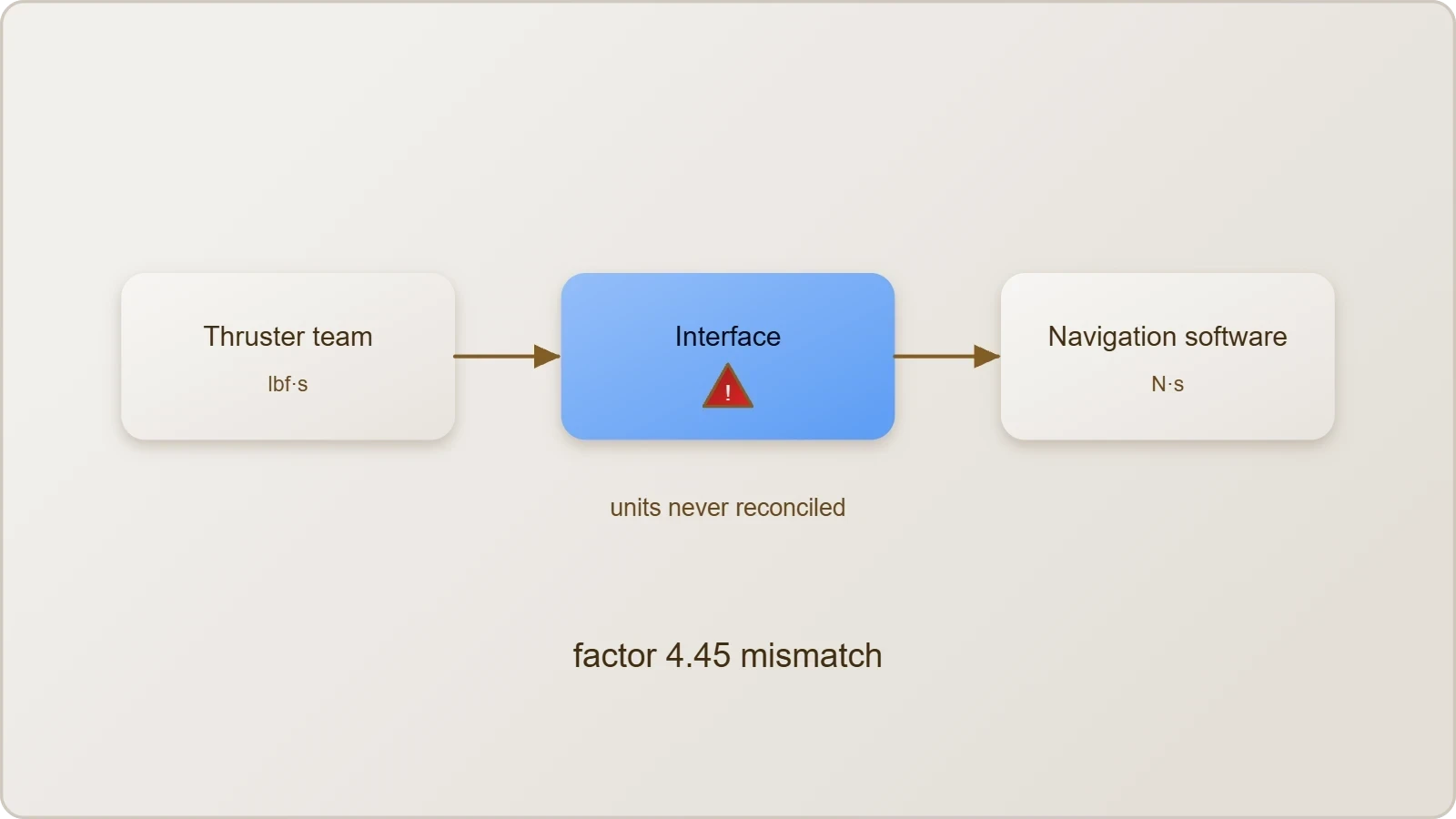
The episode illustrates that dimensional analysis is not a classroom formality but a systems-engineering requirement. Interfaces between teams, between software modules, and between organisations must specify units explicitly, and automated checks should verify them. The orbiter's loss was preventable by a single conversion factor applied at the right boundary, a sobering reminder that units are load-bearing components of any technical system.
We Also Published
Precision, Rounding, and Reporting Converted Results
Conversion does not suspend the rules of significant figures; it applies them. When multiplying or dividing, the result carries no more significant figures than the least precise input, so ##2.5 \times 1.25 = 3.125## is reported as 3.1 because 2.5 has only two significant figures. When adding or subtracting, the result is limited by the position of the decimal point, so the sum of 12.11, 18.0, and 1.012 is reported as 31.1, since 18.0 fixes the tenths place. These rules govern every converted value you report.
Rounding follows the conventional half-to-even rule. If the digit removed exceeds five, the preceding digit increases; if it is less than five, the preceding digit stays; if it is exactly five, the preceding digit is left unchanged when even and increased when odd. Thus 6.35 rounds to 6.4, while 6.25 rounds to 6.2. Applying this consistently prevents the slow drift that accumulates when rounding is done arbitrarily.
Carrying Significant Figures Through Conversions
Exact numbers, such as counted objects or defined conversion factors, carry infinite significant figures. Two balls are exactly two, and the defined equivalence ##1\ \text{in} = 2.54\ \text{cm}## is exact by international agreement. Such factors never limit the precision of a result. Only measured quantities do. Distinguishing exact from measured numbers is essential, because treating an exact factor as if it had two significant figures would needlessly degrade a precise calculation.
In scientific notation, every digit is significant, so ##4.01 \times 10^2## has three and ##8.256 \times 10^{-3}## has four. When a converted result is very large or very small, scientific notation communicates both magnitude and precision unambiguously. Reporting 172800 seconds as ##1.728 \times 10^5\ \text{s}## makes clear which digits are meaningful and avoids the ambiguity of trailing zeros.
Common Pitfalls and How to Avoid Them
The most frequent error is inverting the unit factor, which produces a result with the wrong dimensions. The safeguard is to write the cancellation explicitly and confirm that the unwanted unit disappears. A second pitfall is forgetting to raise factors to the appropriate power for squared or cubed units. A third is mixing approximate and exact factors without tracking which is which. Each is caught by the simple habit of writing units at every step.
Another subtle trap is the affine conversion, such as temperature, where a simple multiplicative factor is insufficient. Recognising that Celsius and Fahrenheit differ in zero point as well as scale prevents the error of applying a pure ratio. Finally, students sometimes round intermediate results too early, losing precision that later steps require. Carrying extra digits through the calculation and rounding only at the end is the professional standard.
From Conversions to Chemical Laws: Preparing the Next Step
The skills developed here are the precondition for everything that follows. The law of conservation of mass, articulated by Lavoisier in 1789, asserts that matter is neither created nor destroyed in chemical change, and verifying it requires masses measured in consistent units. Proust's law of definite proportions, demonstrated with natural and synthetic cupric carbonate showing identical compositions of 51.35 percent copper, 9.74 percent carbon, and 38.91 percent oxygen, depends on comparing percentages computed from properly converted masses.
Dalton's law of multiple proportions, where 2 g of hydrogen combines with 16 g of oxygen to form water and with 32 g to form hydrogen peroxide, reveals a simple 1:2 ratio only when both masses are expressed in the same unit. Gay-Lussac's observation that 100 mL of hydrogen combines with 50 mL of oxygen to yield 100 mL of water vapour, a 2:1 volume ratio, requires consistent volume units. Avogadro's law, that equal volumes of gases at the same temperature and pressure contain equal numbers of molecules, completes the bridge from measurement to molecular reasoning.
Connecting Units to Stoichiometric Reasoning
Each of these laws is a statement about ratios, and ratios are only meaningful when the underlying quantities share units. A student who converts carelessly will find that the elegant integer relationships of chemical combination dissolve into numerical noise. Conversely, a student fluent in dimensional analysis will see the laws as natural consequences of careful measurement, not as arbitrary rules to memorise. The factor-label method is thus the grammar in which the laws of chemistry are written.
Looking ahead, the mole concept will introduce Avogadro's number as a conversion factor of its own, linking countable particles to measurable masses. Molar mass, expressed in grams per mole, is a unit factor in exactly the sense developed here. Stoichiometric calculations are chains of such factors, and the student who has internalised cancellation will find them transparent rather than intimidating. The path from inches to moles is continuous, paved with unit factors.
A Final Checklist for Every Calculation
Before reporting any converted result, verify four things: that the units cancel to leave the desired dimension, that the conversion factors are correctly oriented, that powers are applied to squared or cubed units, and that the final significant figures match the least precise input. These four checks catch the overwhelming majority of errors. They are quick, mechanical, and reliable, and they transform dimensional analysis from a technique into a habit.
The deeper lesson is that measurement is a conversation between number and meaning, and units are the language of that conversation. A quantity stripped of its unit is a word without definition, capable of being misread in dangerous ways. The chemist who respects units respects the physical world they describe. That respect, cultivated through the factor-label method, will serve you through every subsequent lesson and every professional calculation beyond the classroom.
From our network :
- How to Print Cheaply: Cutting the Cost per PageA practical, measured guide to lowering what each printed page costs — duplex and draft modes, third-party ink, yield mathematics, and knowing when a new printer beats refills.
- 10 Physics Numerical Problems with Solutions for IIT JEEPrepare for IIT JEE with 10 physics numerical problems, complete with detailed solutions and conceptual explanations. Ideal for mastering kinematics, thermodynamics, electromagnetism, and optics.
- Analyzing Trump Deportation Numbers Insights Into The 2026 Immigration Crackdown
- AI-Powered 'Precision Diagnostic' Replaces Standard GRE Score ReportsDiscover the new GRE Precision Diagnostic. Learn how AI-powered behavioral analytics and time-to-solve tracking are replacing standard GRE score reports to empower students.
- Where to Put Your Wireless Router for Better CoverageA practical, physics-grounded guide to router placement: why the centre of the home beats the corner, how walls and metal sap signal, and how to run a simple survey that proves the improvement.
- Trump Political Strategy How Geopolitical Stunts Serve As Media Diversions
- 98% of Global MBA Programs Now Prefer GRE Over GMAT Focus EditionExplore why 98% of global MBA programs now prefer the GRE over GMAT Focus. Learn about the shorter GRE format, verbal logic importance, and strategic versatility for students.
- EV 2.0: The Solid-State Battery Breakthrough and Global Factory ExpansionDiscover the impact of the Solid-State Battery Breakthrough on the EV market. Learn about CATL and BYD stock growth, global factory expansion in Europe, and the future of EV 2.0 technology.
- Do You Need a New Router or Is Your Internet Plan the Problem?A practical comparison of the signs that point to router limits versus signs your broadband speed or provider is the bottleneck, so you can decide what to replace before spending money.
RESOURCES
- Unit Conversion Using Dimensional Analysis Tutorial (Factor Label ...youtube.comAug 4, 2014 ... Step by step how to set up dimensional analysis calculations, explained from a single to multi-step calculations for unit conversion ...
- 1.6: Dimensional Analysis (Unit Conversions) - Chemistry LibreTextschem.libretexts.orgJun 5, 2019 ... Performing dimensional analysis begins with finding the appropriate conversion factors. Then, you simply multiply the values together such that ...
- Dimensional Analysis – Introductory Chemistryuen.pressbooks.pubSome of the common ones include mass (ton, pounds, ounces, grains, grams), length (yard, feet, inches, meters), and energy (Joule, erg, kcal, eV). Since…
- [College Chemistry/Math] How to do Dimensional Analysis - Redditreddit.comSep 9, 2016 ... In my general chemistry class, we are supposed to know how to do dimensional analysis when doing unit conversions.
- Module 4: Dimensional Analysis and Unit Conversionskbcc.cuny.eduDimensional analysis is widely used in chemistry, physics, biology, and earth science. Developing skill with this method will help students solve many types of ...
- 1.6: Dimensional Analysis - Chemistry LibreTextschem.libretexts.orgJul 7, 2023 ... ... the equivalent amount of six packs or cases). Using Dimensional Analysis to Convert Units. Consider the conversion in Equation…
- Dimensional Analysis and Unit Conversions in Chemistry | Notespearson.comDimensional analysis is a fundamental technique in chemistry used to convert between different units and solve problems involving measurements. Mastery of unit ...
- SI Conversions & Dimensional Analysis Quiz - ChemQuiz.netchemquiz.netSI Conversions & Dimensional Analysis Quiz ; SI units: Common chemistry units only (g, m, L, J, Pa) Common physics units only (g, m,…
- Chemistry Textbook: Dimensional Analysis - Library Guidesgeorgiasouthern.libguides.comThis method can be applied to computations ranging from simple unit conversions to more complex, multi-step calculations involving several different quantities.
- Dimensional Analysis - Carolina Knowledge Centerknowledge.carolina.com... unit) to another dimension (or unit), typically using conversion factors. A ... You may also use balanced chemical equations and molecular weights as…
- Dimensional Analysis and Unit Conversions in Chemistry - Pearsonpearson.comDimensional Analysis and Unit Conversions in Chemistry. NotesPracticeVideo lessons. Study Guide - Learn with Videos. Curated lessons matched to your ...
- Unit Conversions: The good, the bad and the ugly - ChemEd Xchemedx.orgAug 31, 2016 ... ... unit conversions. Students come into my class with all ... Do you teach dimensional analysis in honors chemistry or…
- 1.6 Mathematical Treatment of Measurement Results - Chemistry 2eopenstax.orgFeb 14, 2019 ... ... unit conversions to more complex, multi-step calculations involving several different quantities. Conversion Factors and Dimensional Analysis.
- Unit Conversion Dimensional Analysis Math Science Chemistry ...teacherspayteachers.comMake unit conversion math competitive and fun with this Dimensional Analysis Task Card Game! Perfect for Middle School or High School Math and Chemistry ...
- Where can I find Dimensional Analysis in the OpenSciEd Chemistry ...openscied.orgThe choice was made to use unit conversion terminology as it matches the terminology of the NGSS science and engineering practice, using mathematics and ...