Relative motion is the quiet engine behind almost every intuitive judgment we make about movement. A passenger walking down the aisle of a moving train feels perfectly ordinary to themselves, yet to someone standing on the platform they are racing forward at the train's speed plus their own stride. This lesson, the twenty-third in a thirty-part course on motion in a plane, takes that everyday observation and turns it into a precise mathematical instrument. We begin by revisiting the one-dimensional case, where relative velocity reduces to simple signed addition, and then extend the reasoning into two dimensions, where vector subtraction becomes the central operation.
The conceptual pivot is deceptively simple: every velocity must be measured with respect to a stated frame of reference, and changing frames means subtracting one velocity vector from another. Once that idea is secure, problems that once looked tangled — a boat crossing a river with a current, an aircraft drifting in wind, rain falling at an angle against a moving car — collapse into clean vector arithmetic. Because the previous lesson closed with non-uniform circular motion, we now step back from acceleration along curved paths and rebuild the toolkit for comparing motions observed from different vantage points.
This material also prepares the ground for the next lesson on dot and cross products. Relative motion problems are the most natural place to feel why vector subtraction matters geometrically, and they set up the algebraic habits that vector products will later formalize. Work through each derivation slowly, sketch every vector triangle, and treat the frame of reference as a deliberate choice rather than an afterthought.
On This Page
- Frames of Reference and the Meaning of Relative Velocity
- Relative Motion in One Dimension: Signed Scalars
- Extending to Two Dimensions: Vector Subtraction in Practice
- River Crossing and Wind Drift: Classic Applications
- Rain, Trains, and Everyday Frame Shifts
- Problem-Solving Discipline and Common Pitfalls
- From Relative Motion Toward Vector Products
Frames of Reference and the Meaning of Relative Velocity
A frame of reference is any coordinate system from which positions and velocities are recorded, and physics insists that no frame is privileged without justification. When we say a car travels at ##60\ \text{km/h}##, we silently mean relative to the road. Change the observer, and the number changes, even though the physical situation has not altered at all.
Why Every Velocity Needs an Observer
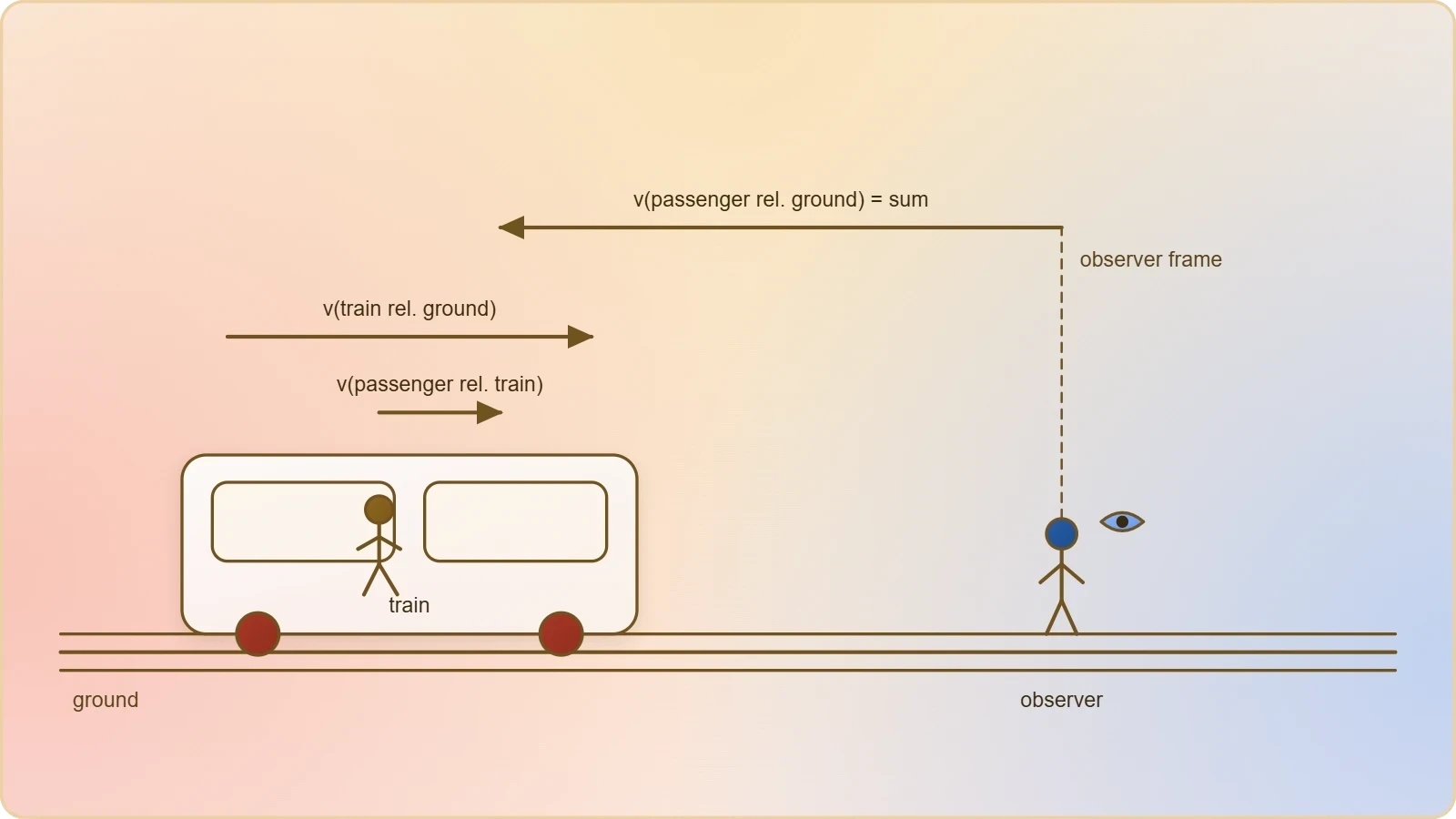
Consider two cyclists riding side by side at identical speeds. Each sees the other as stationary, yet a pedestrian on the pavement sees both rushing past. The velocities differ because the observers occupy different frames, and both descriptions are equally correct. Relative velocity is therefore not a property of an object alone but of an object paired with an observer.
Formally, if observer B moves with velocity ##\vec{v}_{B}## relative to the ground and object A moves with ##\vec{v}_{A}##, then the velocity of A as measured by B is written ##\vec{v}_{AB}##. The subscript order matters enormously: the first letter names the object being observed, the second names the observer. Reversing the order reverses the sign of the result, a symmetry worth memorizing early.
The Subtraction Rule in Vector Form
The governing relation is compact and universal. The velocity of A relative to B equals the velocity of A relative to the ground minus the velocity of B relative to the ground, expressed as a single vector subtraction rather than two separate scalar operations.
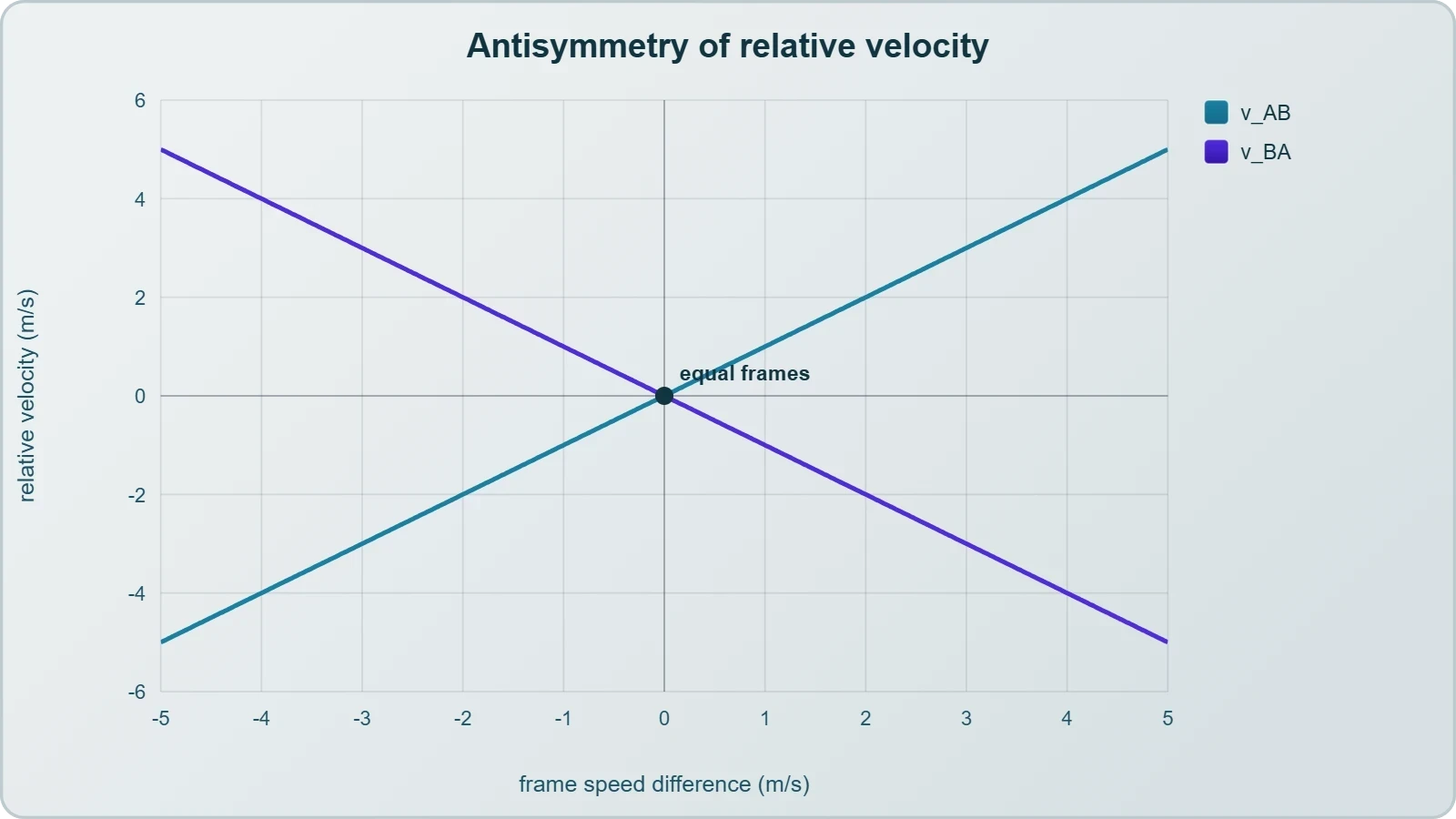
Equivalently, ##\vec{v}_{AB} = -\vec{v}_{BA}##, so the two reciprocal descriptions always point in opposite directions with equal magnitude. This antisymmetry is the algebraic signature of relative motion and reappears in every two-dimensional problem we solve below.
Relative Motion in One Dimension: Signed Scalars
In one dimension, vectors shrink to signed scalars, and the subtraction rule becomes ordinary arithmetic with careful attention to direction. Choose a positive axis, assign signs consistently, and the entire problem reduces to adding and subtracting numbers. This simplicity is a gift, and it builds the confidence needed before two dimensions complicate the picture.
Trains, Tracks, and Closing Speeds
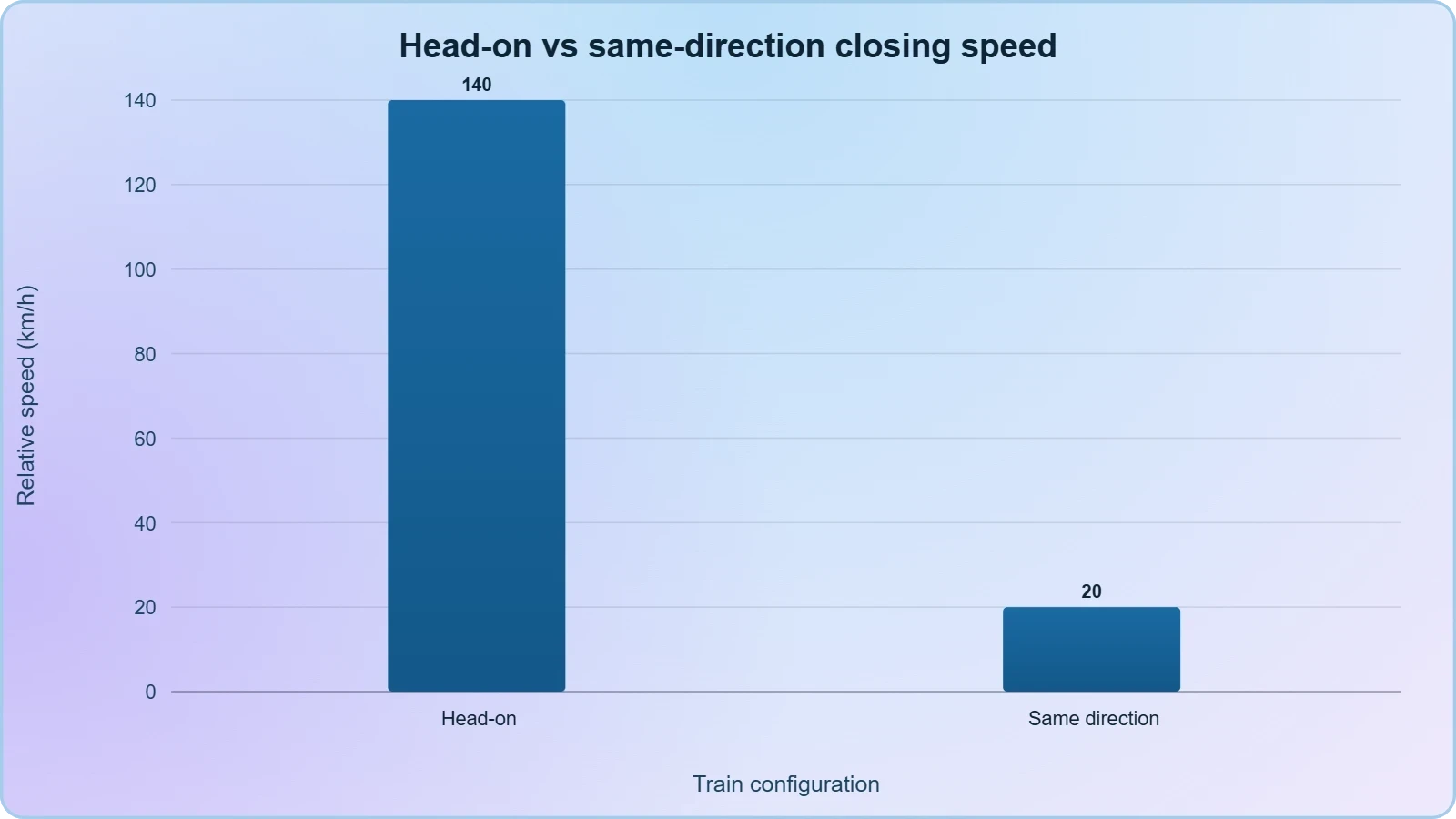
Two trains approach each other on parallel tracks, one at ##80\ \text{km/h}## and the other at ##60\ \text{km/h}##, both measured against the ground. Taking the first train's direction as positive, the second train's velocity is ##-60\ \text{km/h}##, so the relative velocity of the second with respect to the first is ##-60 - 80 = -140\ \text{km/h}##. The negative sign confirms they close on each other.
Had they been traveling in the same direction, the relative velocity would be ##-60 - 80 = -140## only if signs were mishandled; correctly, it becomes ##60 - 80 = -20\ \text{km/h}##, a gentle drift rather than a dramatic approach. This contrast between head-on and same-direction motion is the single most common source of sign errors in student work, and it deserves deliberate practice.
Reading the Sign as Direction, Not Speed
The magnitude of a relative velocity is a speed, always non-negative, while the sign encodes direction along the chosen axis. A relative velocity of ##-140\ \text{km/h}## means the separation shrinks at ##140\ \text{km/h}## in the negative direction. Confusing the two leads to nonsensical answers such as negative speeds, which should always trigger a recheck of the setup.
One-dimensional relative motion also clarifies the idea of a moving walkway or escalator. A person walking with the belt at ##1.5\ \text{m/s}## while the belt moves at ##1.0\ \text{m/s}## has a ground speed of ##2.5\ \text{m/s}##, but a speed of only ##0.5\ \text{m/s}## relative to the belt itself. Every such device is a small laboratory for frame-shifting.
Extending to Two Dimensions: Vector Subtraction in Practice
Two-dimensional relative motion keeps the same subtraction rule but demands geometric reasoning, because velocities now have independent components. The standard method resolves each velocity into ##x## and ##y## components, subtracts component by component, and then reconstructs the resultant magnitude and direction. Vector triangles drawn to scale offer a powerful visual check on the algebra.
Component-by-Component Subtraction
Suppose object A moves with velocity components ##(v_{Ax}, v_{Ay})## and observer B moves with ##(v_{Bx}, v_{By})##, all relative to the ground. The relative velocity components follow immediately, and the magnitude and angle are recovered with the Pythagorean theorem and inverse tangent.
The magnitude is ##|\vec{v}_{AB}| = \sqrt{(v_{Ax}-v_{Bx})^2 + (v_{Ay}-v_{By})^2}##, and the direction angle satisfies ##\tan\theta = \dfrac{v_{Ay}-v_{By}}{v_{Ax}-v_{Bx}}##. Always place the angle in the correct quadrant by inspecting the signs of both components rather than trusting the raw arctangent output.
Geometric Interpretation and the Vector Triangle
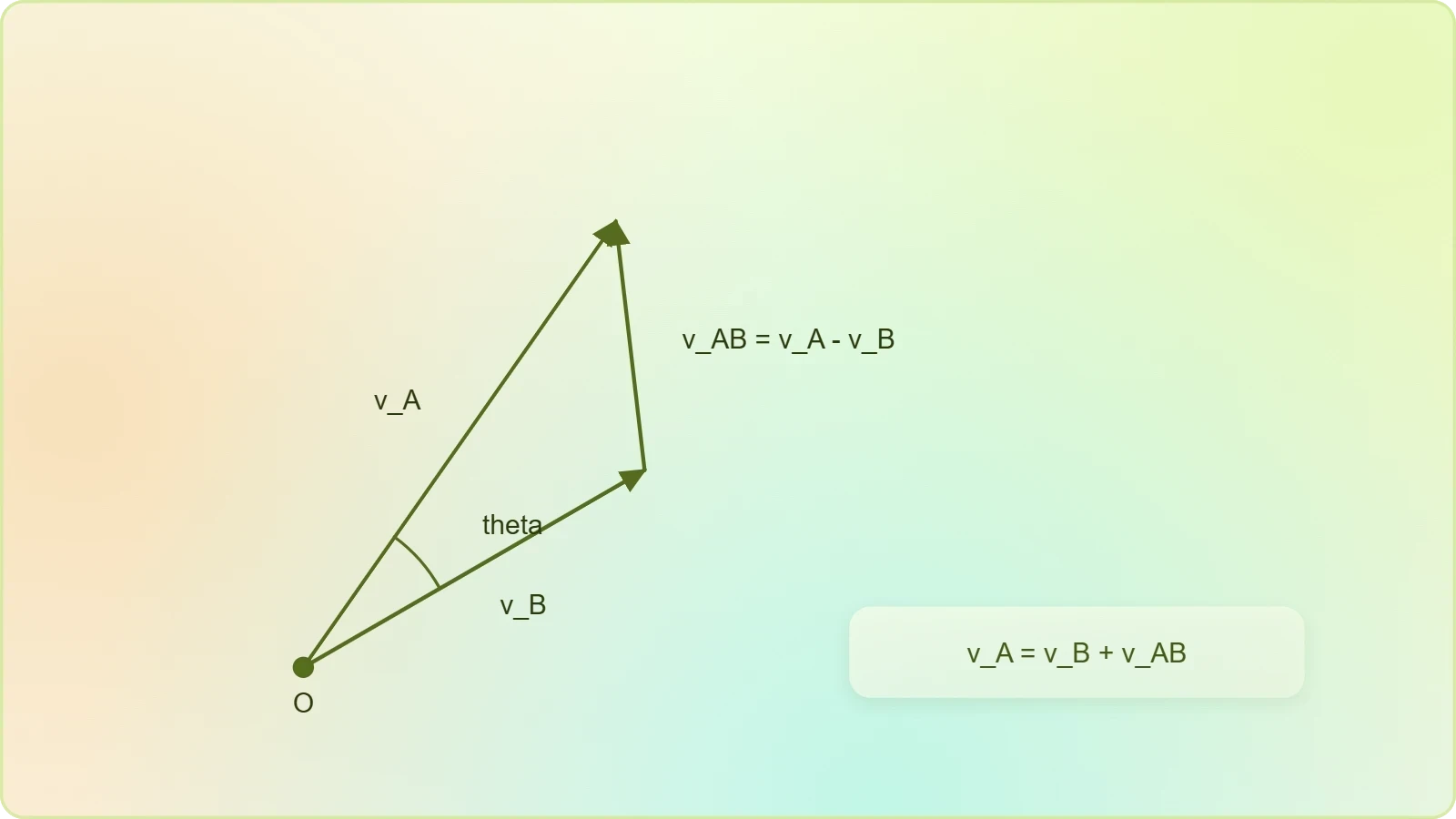
Graphically, ##\vec{v}_{AB}## is the vector drawn from the tip of ##\vec{v}_{B}## to the tip of ##\vec{v}_{A}## when both are placed tail to tail at a common origin. This construction turns subtraction into a directed segment, and the triangle's third side is precisely the relative velocity we seek. Sketching it first often reveals the answer's rough size before any calculation begins.
The triangle also exposes a useful identity: ##\vec{v}_{A} = \vec{v}_{B} + \vec{v}_{AB}##, which reads as "the ground velocity of A equals the observer's velocity plus the relative velocity." This additive form is frequently easier to apply when the relative velocity is known and the ground velocity is the unknown, as in river-crossing problems.
River Crossing and Wind Drift: Classic Applications
River-crossing problems are the canonical test of two-dimensional relative motion, and they reward careful frame selection. A boat's speed relative to the water, the current's speed relative to the bank, and the boat's speed relative to the bank form a right triangle whose sides obey the subtraction rule. Every variant of the problem is a different choice of which two sides are known.
Crossing a Flowing River
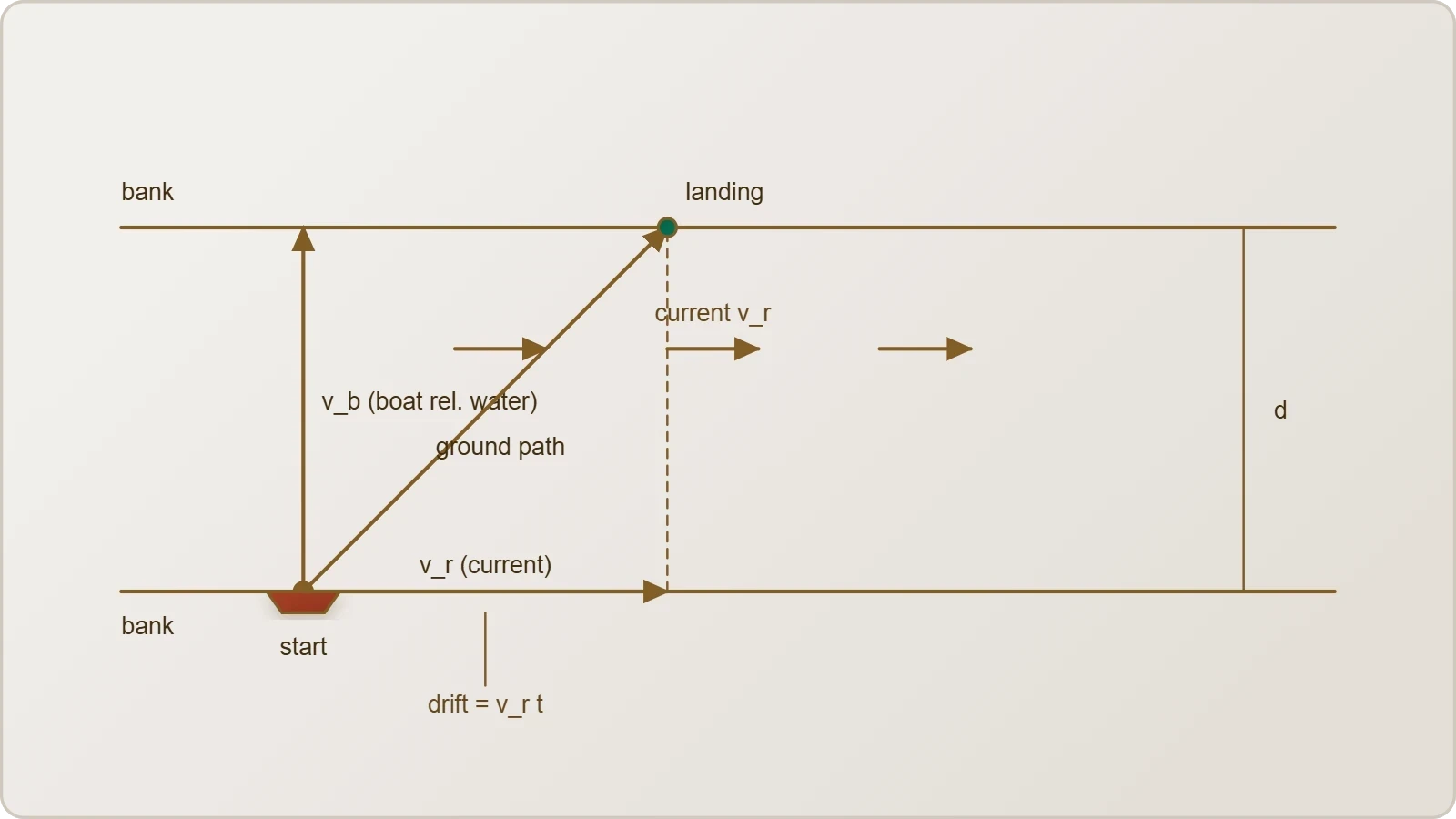
If a boat heads straight across a river of width ##d## at speed ##v_{b}## relative to the water, while the current flows at ##v_{r}##, the boat's ground velocity has components ##(v_{r}, v_{b})##. The crossing time is simply ##t = d / v_{b}##, unaffected by the current, because the current acts perpendicular to the crossing direction.
The boat nevertheless lands downstream by a distance ##v_{r} t = d\, v_{r}/v_{b}##, a result that surprises many learners until they see the independence of perpendicular components. To land directly opposite the starting point, the boat must aim upstream at an angle ##\theta## satisfying ##\sin\theta = v_{r}/v_{b}##, which requires ##v_{b} > v_{r}## for a solution to exist.
Aircraft Drift in a Crosswind
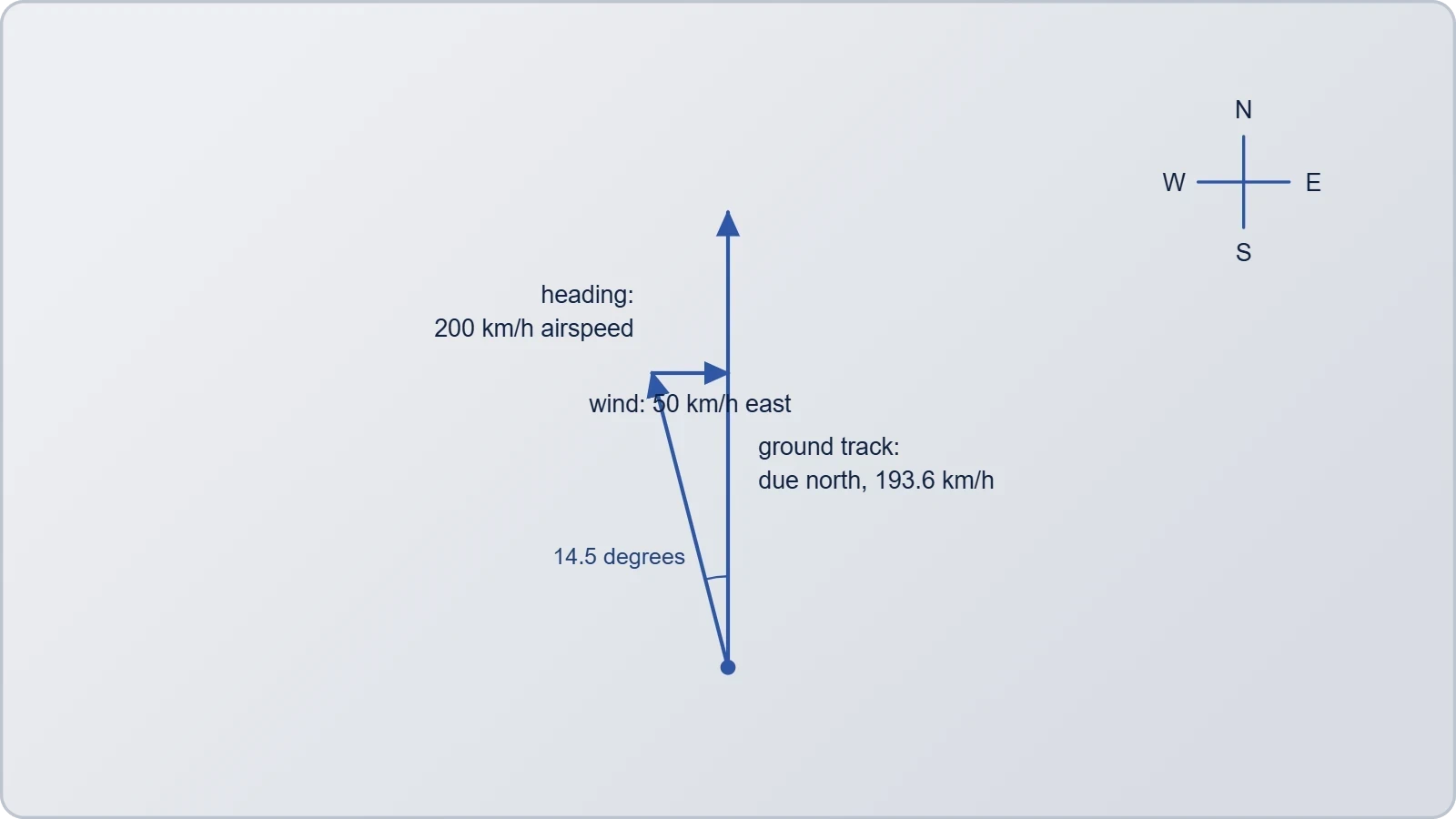
An aircraft with airspeed ##\vec{v}_{a}## flying through wind ##\vec{w}## has a ground velocity ##\vec{v}_{g} = \vec{v}_{a} + \vec{w}##, the same additive identity encountered earlier. Pilots must therefore aim into the wind to hold a desired ground track, a correction known as the wind triangle. The mathematics is identical to the river problem, only the vocabulary changes.
For a pilot wishing to fly due north at ##200\ \text{km/h}## while a wind blows east at ##50\ \text{km/h}##, the required heading is west of north by ##\arcsin(50/200) \approx 14.5^\circ##. The resulting ground speed is ##\sqrt{200^2 - 50^2} \approx 193.6\ \text{km/h}##, slightly less than the airspeed because part of the thrust now fights the crosswind.
Rain, Trains, and Everyday Frame Shifts
Some of the most memorable relative-motion puzzles involve rain falling vertically while an observer moves horizontally. The observer perceives the rain as slanted, and the angle of that slant depends on the ratio of the observer's speed to the rain's fall speed. This is the same vector triangle again, merely rotated into a new orientation.
The Slant of Falling Rain
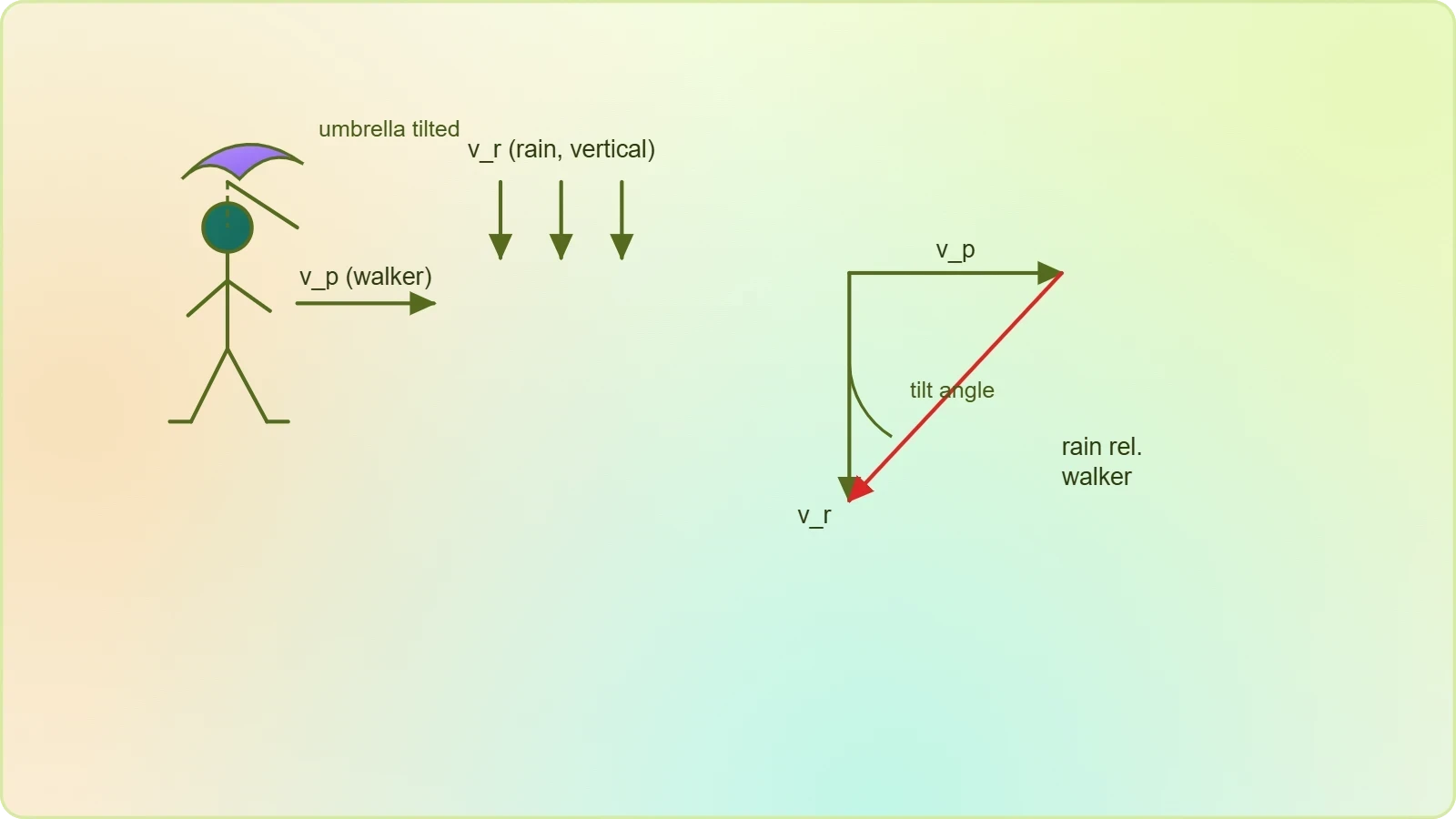
Rain falls at ##v_{r}## vertically while a person walks at ##v_{p}## horizontally. The velocity of the rain relative to the person is ##(0, -v_{r}) - (v_{p}, 0) = (-v_{p}, -v_{r})##, which points down and backward. The rain therefore appears to strike the walker from the front, at an angle ##\theta## from the vertical given by ##\tan\theta = v_{p}/v_{r}##.
To keep dry, the walker should tilt an umbrella forward by exactly that angle. Running faster increases ##v_{p}## and therefore increases the tilt, which is why sprinting through a downpour rarely keeps the front of your clothing dry. The physics is unforgiving and pleasantly intuitive once the vector picture is clear.
Overtaking and Being Overtaken
On a highway, a car traveling at ##100\ \text{km/h}## overtaking a truck at ##80\ \text{km/h}## closes the gap at only ##20\ \text{km/h}## relative to the truck. The overtaking maneuver therefore takes far longer than the absolute speeds suggest, a fact that explains why highway passing lanes feel so slow. Relative speed, not absolute speed, governs the encounter.
Conversely, two cars approaching head-on at ##100\ \text{km/h}## each have a relative speed of ##200\ \text{km/h}##, which is why head-on collisions are so much more violent than rear-end impacts at the same individual speeds. The kinetic energy released scales with the square of the relative speed, a sobering consequence of simple vector subtraction.
Problem-Solving Discipline and Common Pitfalls
Relative motion rewards a disciplined routine: define the frames explicitly, write the subtraction equation, resolve into components, and only then substitute numbers. Skipping the frame definition is the single most common cause of wrong answers, because the subscript order silently determines every sign that follows. A short written declaration of frames prevents most errors before they occur.
A Reliable Four-Step Routine
First, name the ground frame and every moving observer. Second, write the vector equation with subscripts in the correct order. Third, resolve each velocity into components along chosen axes. Fourth, compute the resultant and check its direction against a rough sketch. This sequence is mechanical, and its reliability is precisely the point.
Learners often rush to the calculator before sketching, then discover an answer pointing in an impossible direction. A thirty-second freehand diagram catches such mistakes instantly. Treat the sketch as part of the calculation, not as decoration, and the algebra will cooperate far more often.
Sign Errors, Subscript Reversals, and Unit Slips
Three errors dominate student work: reversing the subscript order, forgetting that subtraction applies to vectors rather than magnitudes, and mixing units such as ##\text{km/h}## with ##\text{m/s}##. Each is preventable with a moment's care. The subscript reversal is especially insidious because the magnitude comes out correct while the direction is exactly backward.
Subtracting magnitudes directly, as in ##|\vec{v}_{A}| - |\vec{v}_{B}|##, is valid only when the velocities are collinear and point the same way. In two dimensions it is simply wrong, and the resulting number has no physical meaning. Always subtract components, never magnitudes, unless collinearity has been explicitly established.
From Relative Motion Toward Vector Products
This lesson closes the loop on frame-shifting and sets the stage for the algebraic tools that follow. Relative motion has shown that vector subtraction is not an abstract formality but a physical operation with immediate geometric meaning. The next lesson on dot and cross products will generalize that intuition, asking what happens when vectors are multiplied rather than subtracted.
What the Next Lesson Will Build On
The dot product will measure how much one vector points along another, which is exactly the question hidden inside component resolution. The cross product will measure perpendicularity and rotation, echoing the perpendicular components that made river-crossing problems tractable. Both products inherit the component-wise habits cultivated here.
Keep the vector triangle in mind as you move forward. Every product of vectors can be read geometrically, and the skill of translating between algebra and picture is the durable takeaway from this entire sequence of lessons. Relative motion is where that translation first becomes second nature.
Consolidation Exercises
A boat capable of ##4\ \text{m/s}## in still water crosses a river flowing at ##3\ \text{m/s}##. Compute the crossing time for a ##120\ \text{m}## wide river when heading straight across, and the downstream drift. Then determine the heading required to land directly opposite, and compare the two crossing times.
An aircraft flies at ##250\ \text{km/h}## in still air through a wind of ##60\ \text{km/h}## blowing from the southwest. Find the ground velocity when the aircraft heads due north, and the heading needed to maintain a due-north ground track. Verify each answer with a scale drawing before trusting the numbers.
Also Read
- No links available.
From our network :
- Mastering DB2 LUW v12 Tables: A Comprehensive Technical GuideComprehensive guide on DB2 LUW v12 tables. Explore CREATE TABLE syntax, BLU Acceleration, range partitioning, data types, and security features for IBM DB2 LUW v12.
- Analyzing Trump Deportation Numbers Insights Into The 2026 Immigration Crackdown
- AI-Powered 'Precision Diagnostic' Replaces Standard GRE Score ReportsDiscover the new GRE Precision Diagnostic. Learn how AI-powered behavioral analytics and time-to-solve tracking are replacing standard GRE score reports to empower students.
- Trump Political Strategy How Geopolitical Stunts Serve As Media Diversions
- Vite 6/7 'Cold Start' Regression in Massive Module GraphsIn-depth analysis of Vite 6/7 cold start regressions in massive module graphs. Learn about barrel file issues, pre-bundling optimizations, and how to improve Vite dev server performance.
- 98% of Global MBA Programs Now Prefer GRE Over GMAT Focus EditionExplore why 98% of global MBA programs now prefer the GRE over GMAT Focus. Learn about the shorter GRE format, verbal logic importance, and strategic versatility for students.
- EV 2.0: The Solid-State Battery Breakthrough and Global Factory ExpansionDiscover the impact of the Solid-State Battery Breakthrough on the EV market. Learn about CATL and BYD stock growth, global factory expansion in Europe, and the future of EV 2.0 technology.
- 10 Physics Numerical Problems with Solutions for IIT JEEPrepare for IIT JEE with 10 physics numerical problems, complete with detailed solutions and conceptual explanations. Ideal for mastering kinematics, thermodynamics, electromagnetism, and optics.
- Mastering DB2 12.1 Instance Design: A Technical Deep Dive into Modern Database ArchitectureComprehensive guide to DB2 12.1 Instance Design. Explore architectural components, HADR setup, buffer pool tuning, and security policies for IBM DB2 12.1. Includes 10 functional SQL and Shell samples.
RESOURCES
- 4.6: Relative Motion in One and Two Dimensions - Physics LibreTextsphys.libretexts.orgTo discuss relative motion in one or more dimensions, we first introduce the concept of reference frames. When we say an object has a…
- 4.5 Relative Motion in One and Two Dimensions - Lumen Learningcourses.lumenlearning.comTo discuss relative motion in one or more dimensions, we first introduce the concept of reference frames. When we say an object has a…
- 4.5 Relative Motion in One and Two Dimensions - UCF Pressbookspressbooks.online.ucf.eduTo discuss relative motion in one or more dimensions, we first introduce the concept of reference frames. When we say an object has a…
- Relative motion - BYJU'Sbyjus.comRelative Motion in One Dimension ... In one-dimensional motion, objects move in a straight line. So, there are only two possible cases: ... Again…
- Relative Motion | Relative Velocity in One & Two Dimensions - AceJEEacejee.comJul 23, 2021 ... Relative motion typically refers to either the relative position of one object measured from the other or the relative velocity…
- Understanding Relative Velocity in 2D | PDF - Scribdscribd.comIt defines relative velocity as the velocity of one object from the perspective of another object. It provides an equation to calculate relative velocity…
- Relative Velocity in One and Two Dimensions – HSC Physicsscienceready.com.auIn two-dimensional scenarios, relative velocity becomes a bit more complex. We need to consider the velocities of the objects in both the x- and…
- Relative motion in 1D & 2D | PPTX - Slideshareslideshare.netRelative motion The motion of an object with respect to other moving or stationary object is · Relative motion in one dimension Frame -…
- Relative Motion in Two Dimensions - Physics Stack Exchangephysics.stackexchange.comOct 11, 2020 ... To understand why this happens, you must know what you mean by relative velocity . Suppose two bodies A and…
- The forward rate of binding of surface-tethered reactants - PubMedpubmed.ncbi.nlm.nih.govThe encounter duration is obtained from the theory of first passage times. We find that the binding rate increases with relative velocity between the…
- Relative Motion | 3.3 General Physics - YouTubeyoutube.comSep 14, 2023 ... ... relative motion physics problems involving relative velocity in one and two-dimensional motion. He begins with a couple of 1-dimensional ...
- How to Calculate Relative Velocity in 1D and 2Dphysicsfundamentals.orgJul 27, 2026 ... The relative velocity formula in one dimension, and how to handle sign conventions correctly · Relative velocity in two dimensions…
- 2. Relative and Circular Motioncourses.physics.illinois.eduB) Relative Motion in One Dimension. In the last unit we discovered that two-dimensional projectile motion can be described as the superposition of two ...
- 8.8: Relative Motion Systems - Engineering LibreTextseng.libretexts.orgAug 17, 2024 ... Analysis of relative motion in multi-object systems, in one and two dimensions. Includes worked examples.
- Effect of Relative Motion between Two Surfaces - ScienceDirect.comsciencedirect.comThe reaction of molecules confined to two dimensions is of interest in ... relative motion, such that the Peclet number is order one or…