Centripetal acceleration is the quiet architect of every curved path in the physical world. A car rounding a bend, a satellite tracing its orbit, a stone whirled on a string, and a cyclist leaning into a turn all obey the same geometric and kinematic logic: velocity changes direction continuously, and that directional change is itself an acceleration. Where the previous lesson established that uniform circular motion means constant speed along a circular path, this lesson isolates the acceleration that makes such motion possible, examining its magnitude, its direction, and its dependence on speed and radius.
Understanding centripetal acceleration requires abandoning a stubborn intuition. Learners often assume that because the speedometer reads a steady value, no acceleration exists. In two-dimensional motion, however, velocity is a vector, and a vector changes whenever either its magnitude or its direction shifts. On a circular path the direction of motion rotates at every instant, so the velocity vector is perpetually renewed even when its length never varies. The resulting acceleration points toward the centre of the circle, perpendicular to the instantaneous velocity, and its size scales with the square of the speed divided by the radius.
This lesson builds directly on the vocabulary of uniform circular motion and prepares the ground for centripetal force, where Newton's second law will connect this acceleration to the physical pull, tension, or gravity responsible for it. Expect careful derivations, geometric reasoning with similar triangles, worked numerical examples, and a set of data tables that organise the relationships for quick reference. The treatment remains accessible to beginners while offering the rigour that intermediate learners and examination candidates require.
On This Page
The Geometric Origin of Centripetal Acceleration
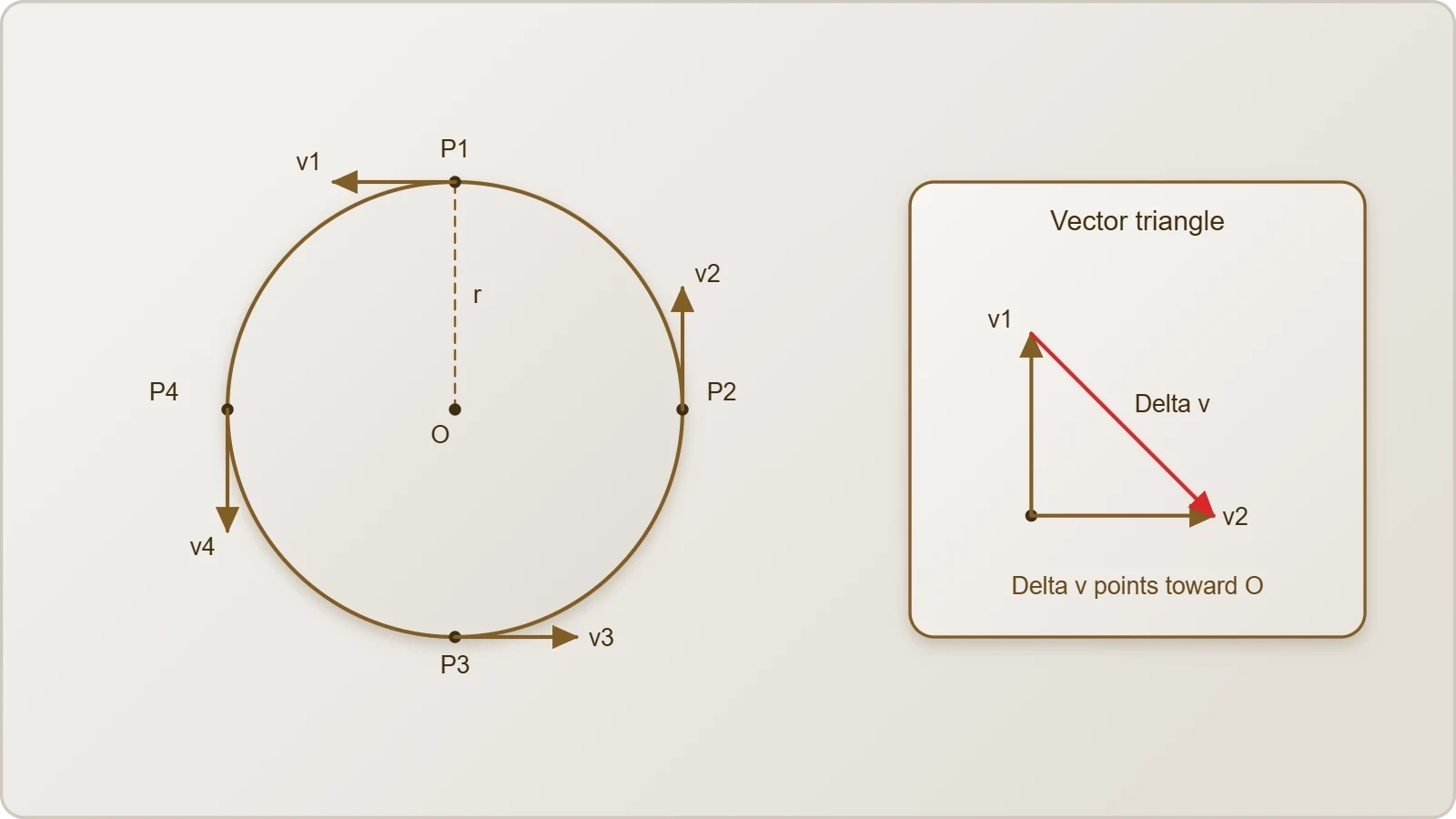
Acceleration is defined as the rate of change of velocity, and in circular motion that change is purely directional. To see why, imagine two nearby positions of a particle on a circle, separated by a small angle. The velocity vectors at these points have equal length but different orientations, and subtracting them yields a small vector that points inward toward the centre. Dividing this velocity difference by the elapsed time produces an acceleration directed toward the centre of the circle.
Similar Triangles and the Velocity Triangle
The classical derivation rests on a similarity between two triangles. The first triangle is formed by the circle's centre and the two positions of the particle, with two radii and a chord. The second is the velocity triangle, whose sides are the two velocity vectors and their difference. Because the velocity vectors are perpendicular to their respective radii, the angle between the radii equals the angle between the velocities, making the triangles similar.
Similarity gives the proportion that links the chord length to the velocity change. If the particle moves through a small angle ##\Delta\theta## in time ##\Delta t##, the chord is approximately ##r\Delta\theta## and the velocity change is approximately ##v\Delta\theta##. Dividing the velocity change by the time interval and recognising that ##v = r\omega## completes the derivation, yielding the familiar result for the magnitude of centripetal acceleration.

Direction: Always Toward the Centre
The direction of centripetal acceleration is radial and inward at every instant. It is never tangential, because a tangential acceleration would change the speed rather than merely redirect it. This perpendicular relationship between velocity and acceleration is the defining signature of uniform circular motion, and it explains why the speed remains constant while the velocity vector rotates continuously around the circle.
Because the acceleration vector rotates along with the particle, it is not constant even though its magnitude is. This distinction matters when applying Newton's second law: the net force must also point toward the centre and rotate with the particle. The word centripetal, from Latin roots meaning centre-seeking, captures precisely this inward orientation without implying any particular physical agent.

Magnitude, Speed, and Radius: Reading the Formula
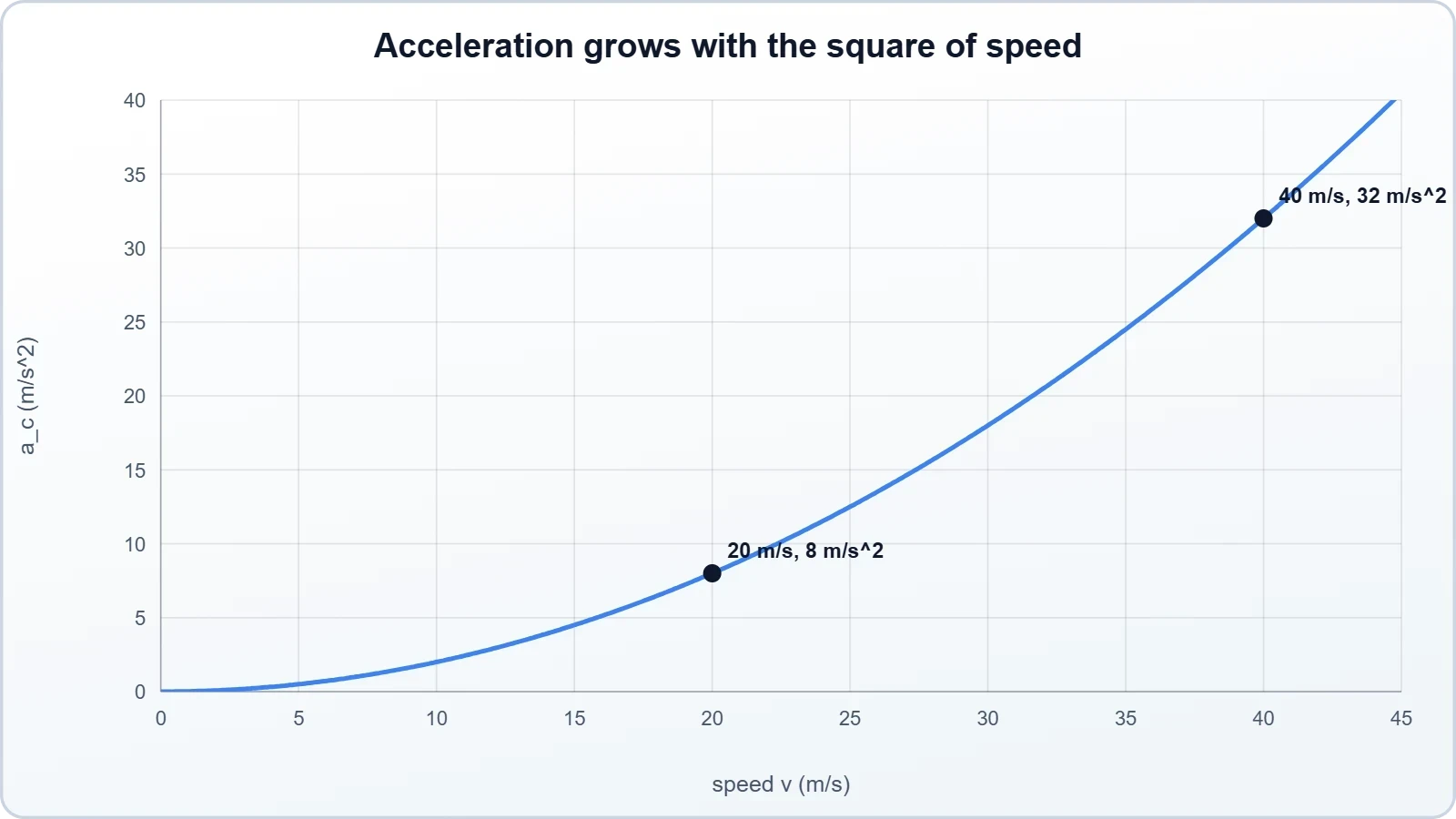
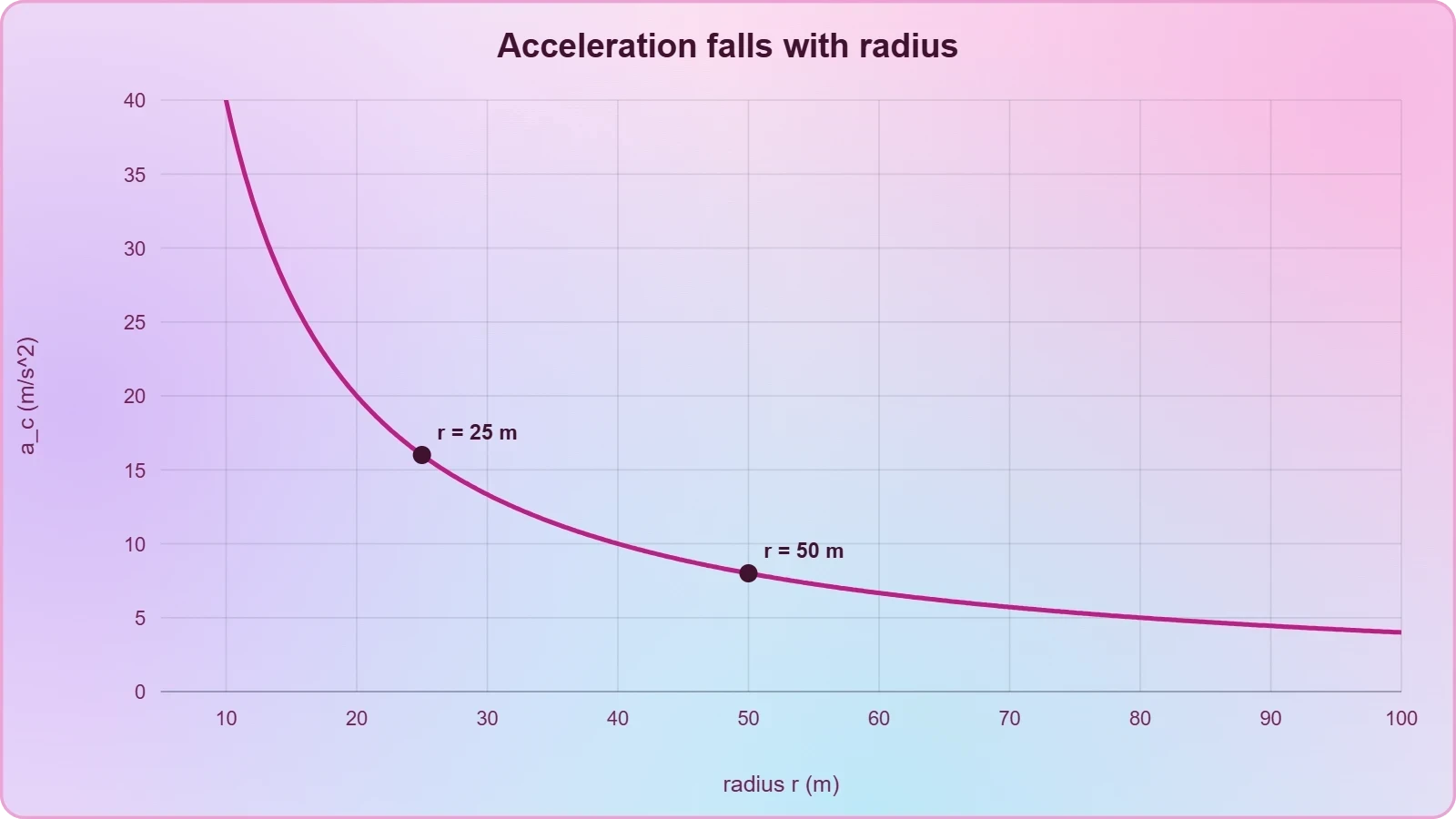
The expression ##a_c = v^2/r## encodes two distinct sensitivities. Acceleration grows with the square of the speed, so doubling the speed quadruples the required acceleration. It varies inversely with the radius, so tightening a turn at constant speed demands a larger inward acceleration. These two dependencies explain a great deal of everyday experience, from the discomfort of fast cornering to the design of highway curves and railway transitions.
The Quadratic Dependence on Speed
The squared term is the more dramatic of the two. A vehicle travelling at twice the speed around the same bend needs four times the centripetal acceleration, a fact that underpins speed limits on curved roads. The same logic governs a centrifuge, where high rotational speeds generate enormous accelerations that separate materials of differing density with remarkable efficiency.
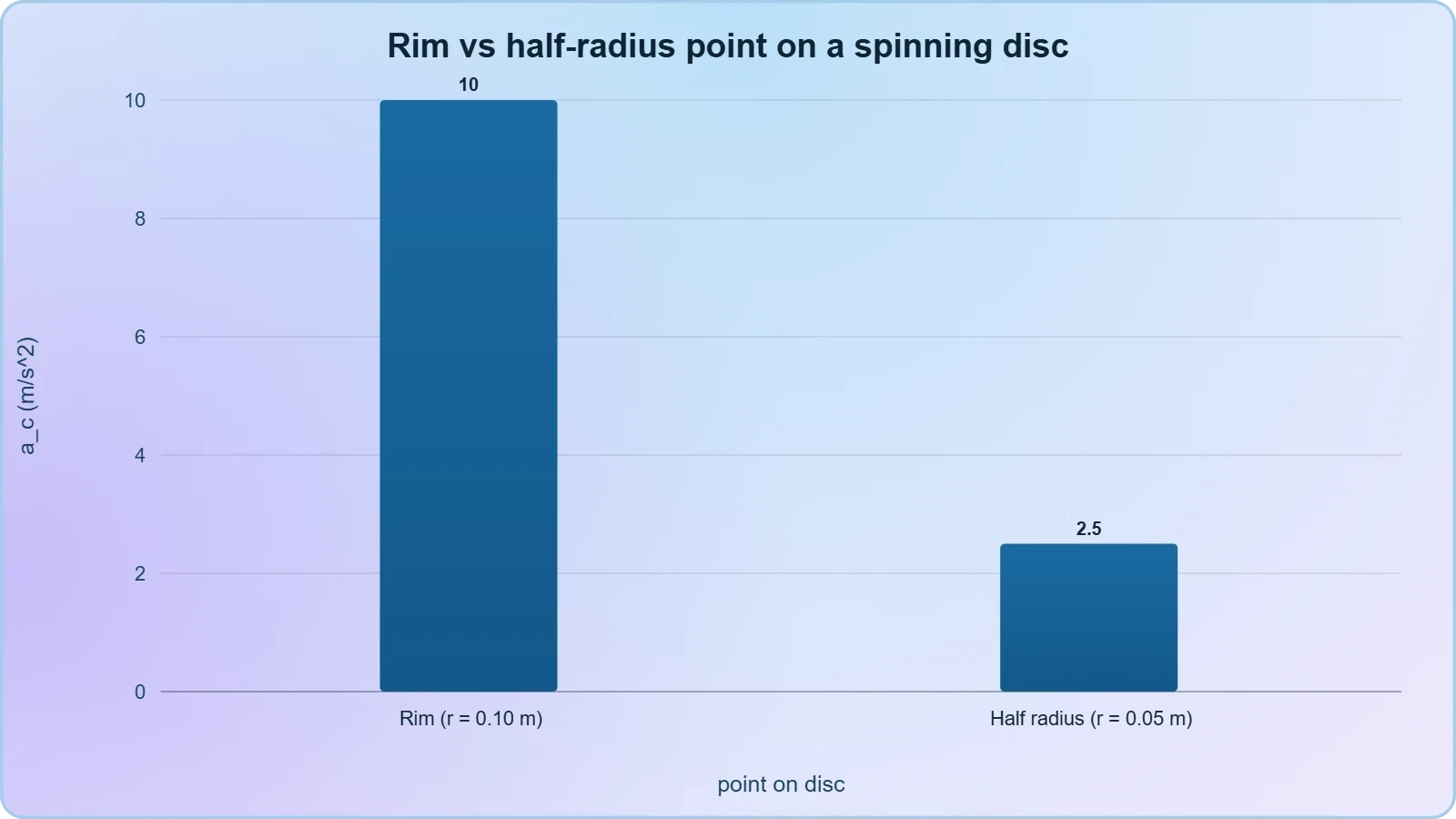
Expressed in angular terms, the acceleration becomes ##a_c = r\omega^2##, revealing a linear dependence on radius for a fixed angular velocity. This form is convenient for rotating machinery, where angular speed is often the controlled variable. A point on the rim of a spinning disc therefore experiences greater acceleration than a point nearer the axis, a principle central to the design of turbines and flywheels.
The Inverse Dependence on Radius
For a fixed linear speed, a smaller radius produces a larger acceleration. This is why a sharp turn is more demanding than a gentle sweep and why racing lines on a track deliberately maximise the radius through a corner. The inverse relationship also appears in orbital mechanics, where satellites at lower altitudes experience stronger centripetal acceleration than those in higher orbits.
Combining the two dependencies gives a compact design rule: acceleration is proportional to ##v^2## and inversely proportional to ##r##. Engineers exploit this trade-off constantly, choosing larger radii where speed cannot be reduced and reducing speed where geometry is constrained. The formula is therefore not merely descriptive but prescriptive, guiding the safe construction of roads, tracks, and rotating systems.
Angular and Periodic Forms of the Expression
Linear speed is not always the most convenient variable. When a body rotates at a known angular velocity or completes a revolution in a known period, alternative forms of the centripetal acceleration expression become more practical. These equivalent representations are mathematically identical but suit different problem contexts, from laboratory turntables to planetary orbits.
Working with Angular Velocity
Substituting ##v = r\omega## into the basic formula gives ##a_c = r\omega^2##. This version is especially useful for rigid bodies rotating about a fixed axis, where every point shares the same angular velocity but experiences acceleration proportional to its distance from the axis. A point twice as far from the centre undergoes twice the centripetal acceleration.
Consider a disc spinning at a steady angular velocity. A point on the rim and a point halfway to the centre complete each revolution in the same time, yet the rim point travels a longer arc and therefore moves faster. The angular form of the acceleration formula captures this neatly, showing that the radial acceleration grows linearly with radius when angular velocity is held constant.
Working with the Period of Revolution
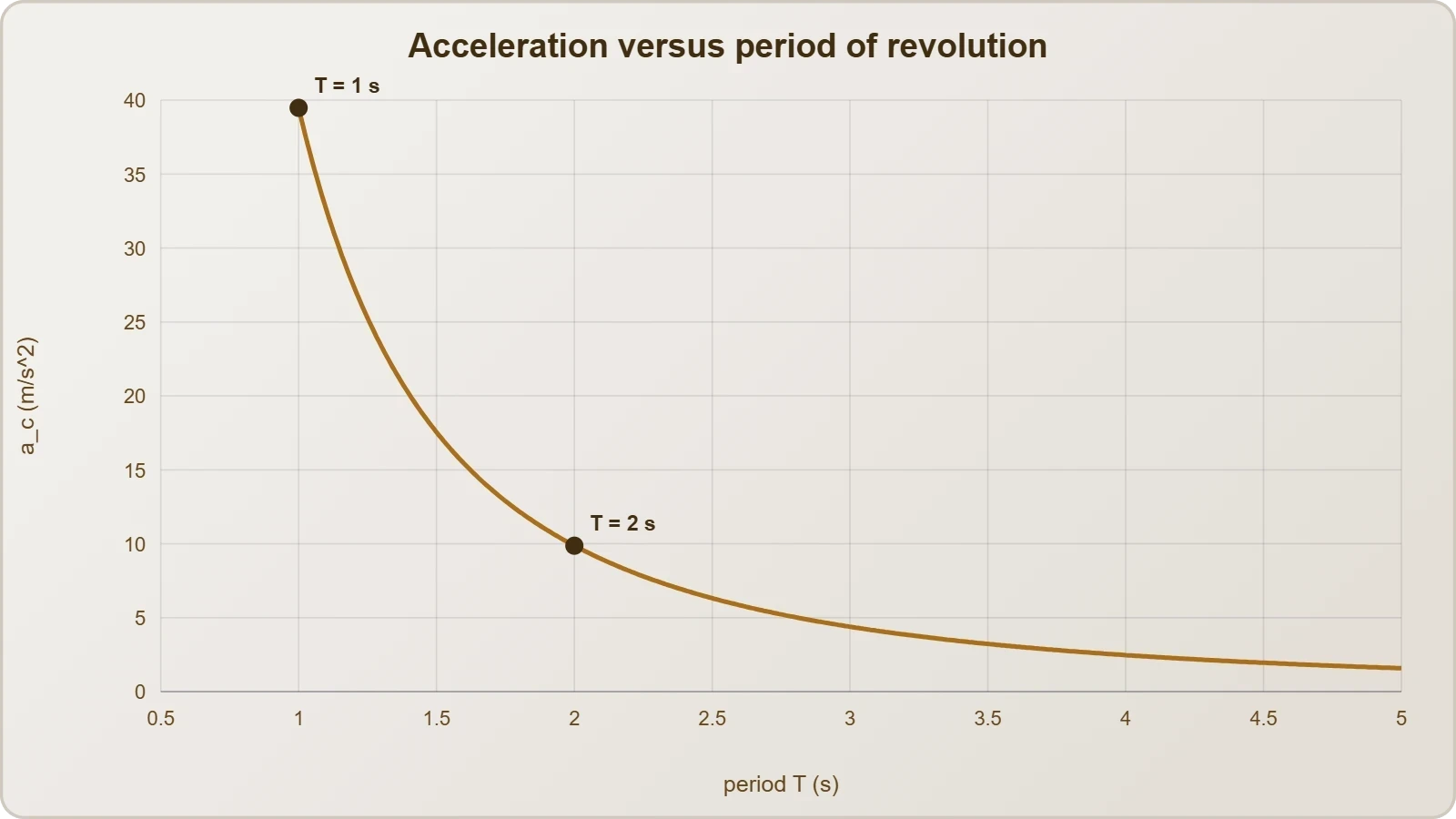
Since ##\omega = 2\pi/T##, the acceleration can also be written as ##a_c = 4\pi^2 r / T^2##. This form is indispensable in astronomy and orbital mechanics, where the period of revolution is often the directly measured quantity. It allows the centripetal acceleration of a satellite or planet to be computed from its orbital radius and orbital period alone.
The periodic form also reveals a striking inverse-square dependence on the period. Halving the time taken for one revolution multiplies the acceleration by four. This relationship connects naturally to the study of gravitation, where the same period-based reasoning leads toward Kepler's laws and the dynamics of planetary orbits.
Worked Examples and Numerical Reasoning
Numerical practice consolidates conceptual understanding. The following examples apply the centripetal acceleration formula to situations of increasing complexity, moving from a simple car turn to a rotating laboratory device. Each solution emphasises unit consistency and the physical interpretation of the result, since a number without meaning is of little value in physics.
A Car Negotiating a Curve
Suppose a car travels at ##20\,\text{m/s}## around a curve of radius ##50\,\text{m}##. Applying ##a_c = v^2/r## gives ##400/50 = 8\,\text{m/s}^2##, roughly four-fifths of the acceleration due to gravity. The direction is horizontal and toward the centre of the curve, supplied in practice by friction between the tyres and the road surface.
If the driver doubles the speed to ##40\,\text{m/s}##, the required acceleration rises to ##32\,\text{m/s}^2##, a value far beyond what ordinary tyre friction can provide. This calculation explains why speed limits on tight bends are set conservatively and why wet conditions, which reduce available friction, demand even lower speeds.
A Rotating Laboratory Centrifuge
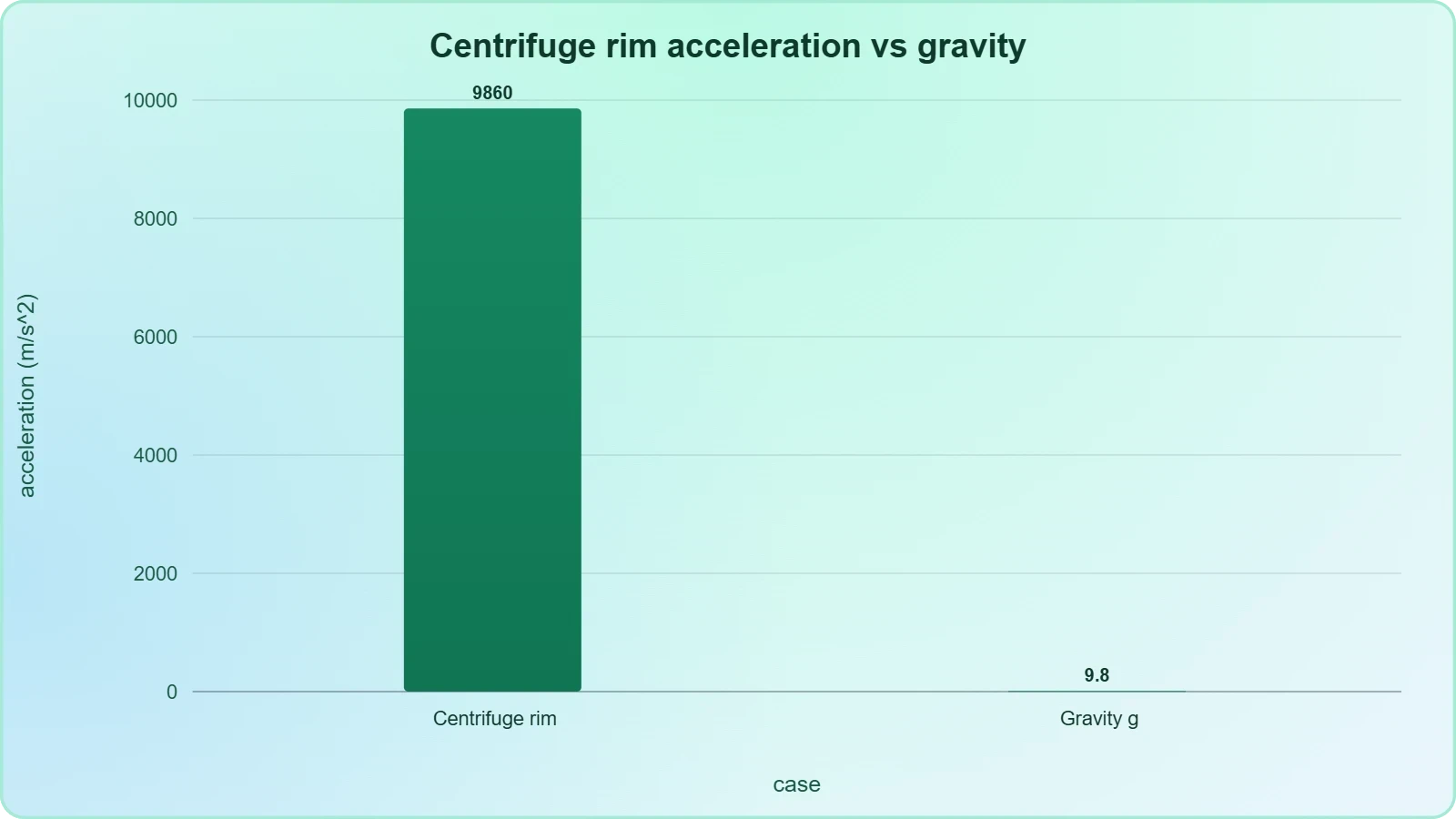
A centrifuge rotor of radius ##0.10\,\text{m}## spins at ##3000## revolutions per minute. Converting to angular velocity gives ##\omega = 2\pi(50) \approx 314\,\text{rad/s}##, and the rim acceleration becomes ##r\omega^2 \approx 0.10 \times 98{,}596 \approx 9860\,\text{m/s}^2##, about a thousand times gravity.
Such enormous accelerations are precisely the point of a centrifuge, driving denser components of a sample outward while lighter ones remain nearer the axis. The calculation demonstrates how the squared angular term amplifies modest rotational speeds into accelerations capable of separating microscopic particles in minutes rather than days.
Common Misconceptions and Conceptual Pitfalls
Several persistent misconceptions surround centripetal acceleration, and addressing them explicitly strengthens understanding. The most common is the belief that an object moving at constant speed cannot be accelerating. Others include the notion that a centrifugal force pushes outward, or that acceleration points along the direction of motion. Each misconception dissolves once the vector nature of velocity is taken seriously.
Constant Speed Does Not Mean Zero Acceleration
Speed is a scalar, while velocity is a vector. Uniform circular motion preserves the magnitude of velocity but continuously alters its direction, and any change in velocity constitutes acceleration. The acceleration is perpendicular to the motion, so it does no work and leaves the speed unchanged, yet it remains a genuine acceleration in every kinematic sense.
This distinction is frequently tested in examinations. A particle moving on a circle at constant speed has zero tangential acceleration but non-zero radial acceleration. Recognising that the two components are independent is the key insight, and it prepares learners for non-uniform circular motion, where both components may be present simultaneously.
Centripetal Versus Centrifugal Language
The term centrifugal force describes an outward sensation experienced in a rotating frame of reference, not a real force in an inertial frame. In the inertial description, the only horizontal force on a turning car is friction acting inward, and this force provides the centripetal acceleration. The outward feeling arises from inertia, the tendency of the body to continue in a straight line.
Careful language matters in physics. Referring to centripetal acceleration keeps attention on the inertial frame and on the real forces responsible for the motion. The next lesson on centripetal force will formalise this connection through Newton's second law, showing that the net inward force equals mass times centripetal acceleration.
Applications and the Bridge to Centripetal Force
Centripetal acceleration appears wherever motion curves, from the microscopic to the astronomical. Its formula guides the design of roadways, the operation of centrifuges, the analysis of satellite orbits, and the understanding of atomic models. Recognising the same ##v^2/r## pattern across these domains reveals the unifying power of two-dimensional kinematics.
Engineering and Everyday Contexts
Highway engineers bank curves so that a component of the normal force supplies part of the required centripetal acceleration, reducing reliance on friction. Washing machines spin clothes at high angular velocity, using the large radial acceleration to drive water outward through perforations. Even a simple bicycle turn involves the rider leaning to align the resultant force with the required inward acceleration.
In each case the magnitude of the acceleration determines the demands placed on materials and surfaces. A curve with too small a radius at too high a speed will exceed the available friction, and the vehicle will skid. The formula thus serves as a design constraint, translating kinematic requirements into concrete choices about geometry and speed limits.
Preparing for Centripetal Force
Acceleration is only half the story. Newton's second law insists that acceleration requires a net force, and the next lesson identifies the physical agents that provide it: tension in a string, friction on a road, gravity in an orbit, or the normal force on a banked track. The relationship ##F_c = mv^2/r## follows directly from the acceleration derived here.
Mastering the present lesson therefore ensures a smooth transition. Learners who understand why the acceleration points inward and how its magnitude depends on speed and radius will readily grasp why the corresponding force must do the same. The conceptual scaffolding built here supports the quantitative force analysis that follows.
Also Read
- No links available.
From our network :
- 98% of Global MBA Programs Now Prefer GRE Over GMAT Focus EditionExplore why 98% of global MBA programs now prefer the GRE over GMAT Focus. Learn about the shorter GRE format, verbal logic importance, and strategic versatility for students.
- Mastering DB2 12.1 Instance Design: A Technical Deep Dive into Modern Database ArchitectureComprehensive guide to DB2 12.1 Instance Design. Explore architectural components, HADR setup, buffer pool tuning, and security policies for IBM DB2 12.1. Includes 10 functional SQL and Shell samples.
- Mastering DB2 LUW v12 Tables: A Comprehensive Technical GuideComprehensive guide on DB2 LUW v12 tables. Explore CREATE TABLE syntax, BLU Acceleration, range partitioning, data types, and security features for IBM DB2 LUW v12.
- 10 Physics Numerical Problems with Solutions for IIT JEEPrepare for IIT JEE with 10 physics numerical problems, complete with detailed solutions and conceptual explanations. Ideal for mastering kinematics, thermodynamics, electromagnetism, and optics.
- Trump Political Strategy How Geopolitical Stunts Serve As Media Diversions
- EV 2.0: The Solid-State Battery Breakthrough and Global Factory ExpansionDiscover the impact of the Solid-State Battery Breakthrough on the EV market. Learn about CATL and BYD stock growth, global factory expansion in Europe, and the future of EV 2.0 technology.
- Vite 6/7 'Cold Start' Regression in Massive Module GraphsIn-depth analysis of Vite 6/7 cold start regressions in massive module graphs. Learn about barrel file issues, pre-bundling optimizations, and how to improve Vite dev server performance.
- AI-Powered 'Precision Diagnostic' Replaces Standard GRE Score ReportsDiscover the new GRE Precision Diagnostic. Learn how AI-powered behavioral analytics and time-to-solve tracking are replacing standard GRE score reports to empower students.
- Analyzing Trump Deportation Numbers Insights Into The 2026 Immigration Crackdown
RESOURCES
- Centripetal Acceleration | Physics - Lumen Learningcourses.lumenlearning.comAcceleration is in the direction of the change in velocity ... We can express the magnitude of centripetal acceleration using either of two equations:.
- 6.2: Centripetal Acceleration - Physics LibreTextsphys.libretexts.orgBecause r is given, we can use the second expression in the equation a c = v 2 r ; a c = r…
- A simple derivation of the Centripetal Acceleration Formula?physics.stackexchange.comJul 12, 2015 ... Now consider the velocity vector of this object: it can also be represented by a vector of constant length that…
- Centripetal force - Wikipediaen.wikipedia.orgApart from any acceleration that might occur in the direction of the path ... "A Derivation of the Formulas for Centripetal Acceleration". PhysicsLAB ...
- How does centripetal acceleration have direction/vector and ...physics.stackexchange.comMar 9, 2019 ... Radius is scalar quantity. What is the direction in the formula which shows direction toward the center of circle v2=v⋅v=scalar.…
- How do I develop my understanding of how centripetal acceleration ...reddit.comJul 6, 2023 ... For mathematical intuition, remember that velocity is a vector with magnitude and direction. And that acceleration is the rate of…
- Centripetal acceleration review (article) - Khan Academykhanacademy.orgReview the key concepts, equations, and skills for centripetal motion, including intuition for the direction of centripetal acceleration.
- Can someone explain what centripetal acceleration is? - Redditreddit.comOct 25, 2021 ... The bigger the centripetal acceleration is, the faster the velocity's direction is changing. ... Centrifugal/Centripetal Acceleration Formula.
- Why is there a negative sign in the centripetal acceleration formula?quora.comSep 19, 2018 ... The problem is that people attempt to include some element of vectors (direction) in scalar calculations. So we end up…
- Centripetal Force Calculatoromnicalculator.comAccording to Newton's second law, a = v² / r is the centripetal acceleration formula. ... direction – the centripetal force;. In a non-inertial…
- 6.2 Uniform Circular Motion - Physics | OpenStaxopenstax.orgMar 26, 2020 ... Now that we know that the direction of centripetal acceleration is ... Recall that the equation for centripetal acceleration is…
- Centripetal Acceleration Formula - SoftSchools.comsoftschools.comWhen an object moves along a circular path, the direction of the object's velocity must constantly change. A changing velocity means that there must…
- 5.4 Centripetal and Tangential Accelerations - Physics Bootcampphysicsbootcamp.orgWe have already seen the formula for the centripetal acceleration ... centripetal acceleration is zero and tangential is pointed in the vertically down direction.
- Centripetal Acceleration | Definition, Equation & Formula - Lessonstudy.comWhile tangent acceleration measures the rate of change in a velocity magnitude, centripetal acceleration measures this change in the velocity direction.
- Difference between radial and centripetal acceleration?physicsforums.comApr 5, 2018 ... Homework Equations. ar = -ac = -v2/r. The Attempt at a Solution. So what i know is radial acceleration goes…