Projectile motion problems reward students who stop hunting for a single magic formula and start reading the physics carefully. Every launch involves two independent stories happening at once: steady horizontal drift and vertically accelerated fall, bound together only by the shared clock of time. Once you internalize that separation, even intimidating questions about cliffs, towers, and non-zero launch heights collapse into two tidy one-dimensional problems you already know how to solve.
This lesson builds directly on angled launches by turning concepts into strategy. You will learn a repeatable solving routine, master the quadratic that governs landing below the launch point, and practice interpreting answers rather than merely computing them. The emphasis throughout is on judgment: choosing the right equation, tracking signs honestly, and recognizing when a result is physically absurd before it ever reaches your teacher's desk.
Because projectile questions appear in nearly every mechanics examination, from board papers to competitive entrance tests, fluency here pays dividends far beyond this course. The habits you form now, decomposing vectors, isolating components, and validating answers, will resurface when uniform circular motion introduces centripetal acceleration in the very next lesson.
On This Page
The Anatomy of Every Projectile Problem
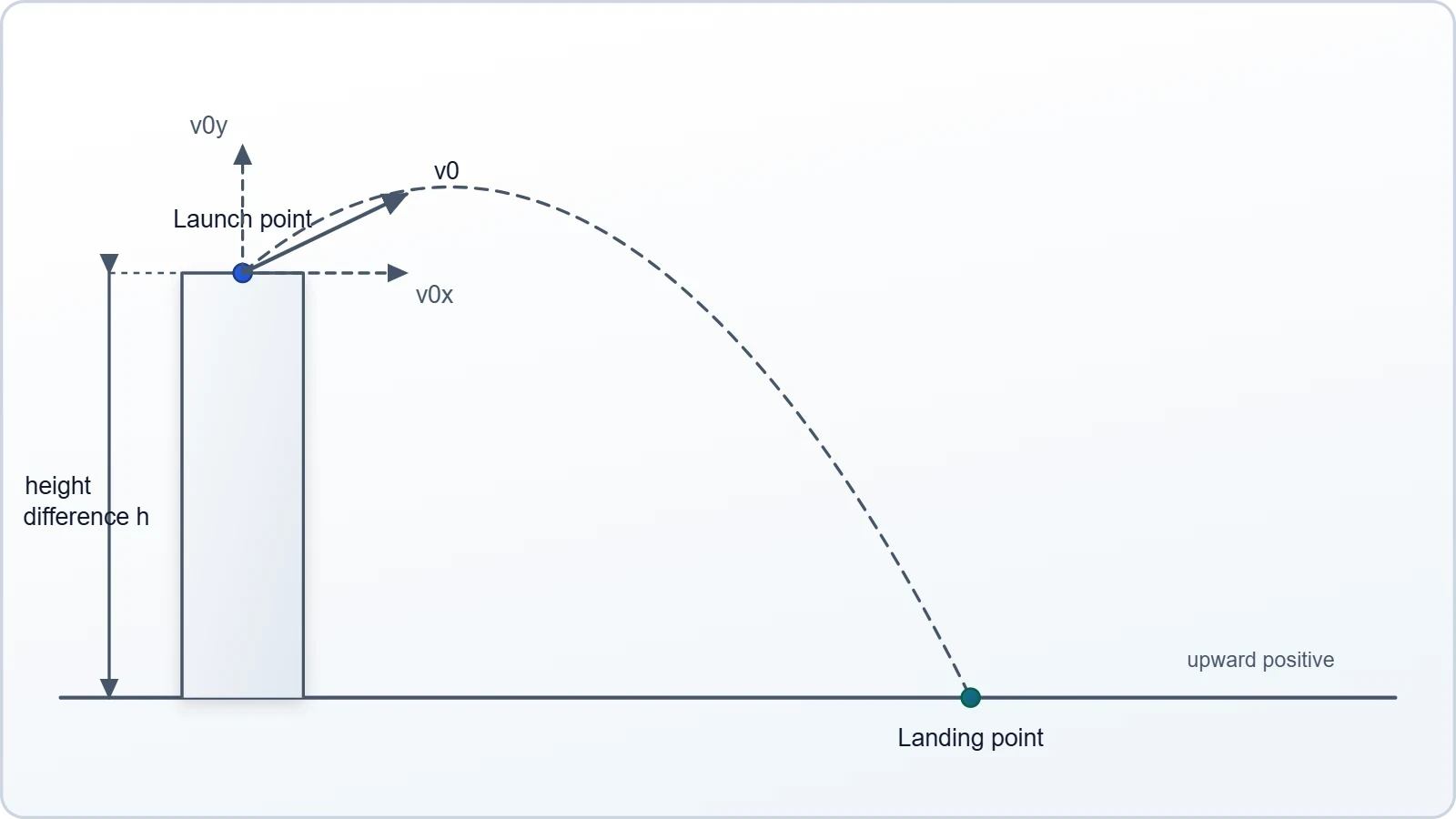
Before touching numbers, a solver must map the terrain of the problem. Identify the launch point, the landing point, the initial velocity vector, and any height difference between them. These four facts determine everything else, and most errors trace back to misreading one of them under time pressure.
Separating Horizontal and Vertical Motion
Horizontal motion carries no acceleration once the object leaves the launcher, so horizontal velocity remains constant throughout the flight. Vertical motion, by contrast, feels gravity at roughly ##9.8\ \text{m/s}^2## downward, changing vertical velocity every instant. Treating these as two separate problems connected by a common time is the central insight of the entire topic.
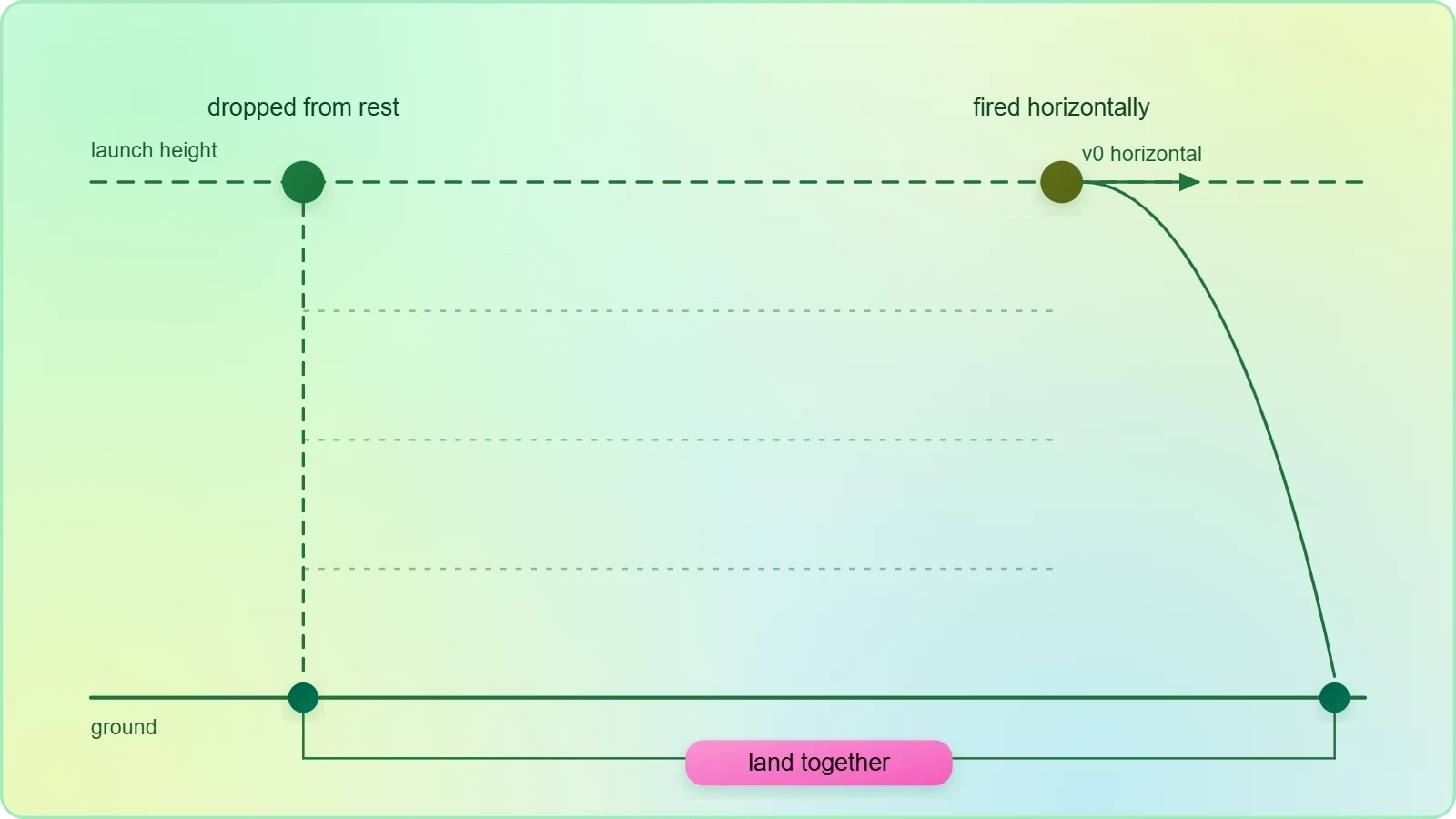
This independence means a bullet fired horizontally and a bullet dropped from the same height strike the ground simultaneously, a result that surprises nearly every beginner. The horizontal bullet simply travels farther while falling for exactly the same duration. Recognizing this symmetry builds intuition that no formula sheet can provide on its own.
Choosing a Coordinate System Deliberately
Adopt upward as positive and the launch point as the origin unless the problem suggests otherwise. With this convention, gravity contributes ##a_y = -9.8\ \text{m/s}^2##, and any landing below the launch point simply carries a negative displacement. Consistency matters more than the specific choice, because mixed conventions generate sign errors relentlessly.
When a projectile lands on a cliff below its launch, the vertical displacement becomes negative, which is precisely what makes the quadratic equation appear. Students who fix their coordinate system before writing anything rarely stumble here. Those who improvise mid-solution often discover a sign mistake only after three lines of algebra.
A Repeatable Strategy for Solving Projectile Problems
Strong problem solvers follow a disciplined sequence rather than chasing equations. The routine below converts messy word problems into orderly calculations, and it works equally well for horizontal launches, angled launches, and landings at different elevations. Practice it until the steps become automatic.
The Five-Step Solving Routine
First, sketch the trajectory and label knowns. Second, resolve the initial velocity into components using ##v_{0x} = v_0\cos\theta## and ##v_{0y} = v_0\sin\theta##. Third, decide which direction offers the easier route to time. Fourth, solve for time, then substitute it into the other direction. Fifth, check units and plausibility.
Step three deserves special attention because it separates novices from experts. If the vertical information is complete, solve vertically for time first. If the horizontal range and speed are known instead, extract time horizontally. Choosing the path of least algebra saves minutes on timed examinations.
Worked Example: Launch from a Cliff
Consider a ball thrown horizontally at ##15\ \text{m/s}## from a ##20\ \text{m}## cliff. Vertical motion gives ##-20 = -\tfrac{1}{2}(9.8)t^2##, so ##t \approx 2.02\ \text{s}##. Horizontal motion then yields a range of roughly ##30.3\ \text{m}## from the cliff base.

Notice how the horizontal speed never entered the time calculation. That is the payoff of independence: each direction supplies what it knows best. The same logic extends to angled launches from height, where the vertical equation simply gains an initial velocity term.
Handling Non-Zero Initial Height
Cliffs, towers, and tabletop launches break the comfortable symmetry of level-ground problems. The projectile now lands below its starting elevation, so the vertical displacement is negative and the flight time exceeds the time to reach maximum height. This asymmetry is the defining feature of the category.
Deriving the Governing Quadratic
Starting from the vertical position equation, we set the final height to the negative of the drop distance. The resulting expression is a quadratic in time whose positive root gives the physical flight duration. Negative roots are mathematical artifacts and must be discarded without ceremony.
Rearranged into standard form, the equation reads ##\tfrac{1}{2}gt^2 - v_{0y}t - h = 0##, where ##h## is the height of the launch above the landing surface. The quadratic formula then delivers the flight time directly, with the positive root representing the moment of impact.

Worked Example: Angled Launch from a Tower
A stone leaves a ##45\ \text{m}## tower at ##20\ \text{m/s}## directed ##30^\circ## above horizontal. The vertical component is ##10\ \text{m/s}##, and solving ##4.9t^2 - 10t - 45 = 0## gives ##t \approx 4.2\ \text{s}##. Horizontal range follows at roughly ##72.7\ \text{m}##.
Compare this with the level-ground flight time for the same launch, about ##2.04\ \text{s}##. The extra height more than doubles the airborne duration, which is why cliff problems so often produce surprisingly large ranges. Intuition sharpens quickly once you compare such cases side by side.
Common Errors and How to Avoid Them
Most lost marks in projectile questions come from a small set of recurring mistakes rather than conceptual gaps. Naming these errors explicitly helps you intercept them before they corrupt an otherwise sound solution. Vigilance during the setup phase prevents nearly all of them.
Sign, Unit, and Component Slips
Mixing positive and negative directions mid-calculation ranks first among errors. Assigning ##g## a positive value while treating upward displacement as positive guarantees contradictions. Write the sign convention at the top of your page and honor it without exception throughout the solution.

Unit confusion follows closely behind, especially when speeds arrive in kilometers per hour. Convert everything to meters and seconds before substituting. A quick dimensional check at the end catches most remaining slips, since a time answer in meters per second is instantly suspicious.
Misreading the Question's Target
Students frequently compute range when the question asked for maximum height, or find flight time when impact speed was requested. Underline the requested quantity before beginning. Impact speed, in particular, requires recombining both velocity components rather than reporting either one alone.
Remember that impact speed uses the Pythagorean combination ##v = \sqrt{v_x^2 + v_y^2}##, with the vertical component carrying its sign into the square. Reporting only the vertical impact velocity is a partial answer that examiners penalize consistently.
Building a Computational Checker for Practice
Hand calculations build understanding, but a small script lets you generate dozens of practice cases and verify your answers instantly. Writing the solver yourself forces you to confront every assumption, from sign conventions to root selection. The exercise doubles as an introduction to computational thinking.
Encoding the Physics in Python
The function below accepts launch speed, angle, and height, then returns flight time, range, and impact speed. It solves the quadratic explicitly and selects the positive root, mirroring the hand procedure exactly. Compare its output against your own worked solutions as a self-check.
import math

def projectile(v0, angle_deg, height=0.0, g=9.8):
    theta = math.radians(angle_deg)
    vx = v0 * math.cos(theta)
    vy = v0 * math.sin(theta)
    # Solve 0.5*g*t^2 - vy*t - height = 0
    a, b, c = 0.5 * g, -vy, -height
    disc = b**2 - 4 * a * c
    t = (-b + math.sqrt(disc)) / (2 * a)
    rng = vx * t
    vy_impact = vy - g * t
    speed = math.hypot(vx, vy_impact)
    return round(t, 2), round(rng, 2), round(speed, 2)

print(projectile(20, 30, 45))  # tower example
Running the tower example reproduces the hand result of about ##4.2\ \text{s}## and ##72.7\ \text{m}##, confirming the algebra. Change the height to zero and the function recovers the familiar level-ground case. Such cross-checks build confidence faster than repetition alone.

Interpreting Outputs Physically
Numbers from a solver still require physical judgment. If a computed range exceeds a kilometer for a modest throw, suspect a unit error rather than celebrating. Always ask whether the magnitude and direction of every answer could plausibly occur in the real world.
Impact speed should always exceed launch speed when landing below the launch point, since gravity has added kinetic energy. If your output violates this expectation, the sign handling is wrong somewhere. These sanity checks transform raw computation into genuine understanding.
Practice Set with Guided Solutions
Deliberate practice converts strategy into reflex. The problems below escalate gently, each adding one new wrinkle to the previous case. Attempt every question independently before reading the guidance, and record where your reasoning hesitates.
Three Graded Problems
First, a ball rolls off a ##1.2\ \text{m}## table at ##3\ \text{m/s}##; find the landing distance. Second, a football leaves the ground at ##18\ \text{m/s}## and ##40^\circ##; determine maximum height and range. Third, a diver launches at ##6\ \text{m/s}## and ##25^\circ## from a ##10\ \text{m}## platform; compute total flight time.
Work each using the five-step routine, writing the coordinate convention first. The first problem needs only vertical time; the second invites the range formula; the third demands the quadratic. Notice how the same routine adapts without modification across all three.
Checking Your Answers
Expected results are approximately ##1.49\ \text{m}##, then ##6.8\ \text{m}## and ##32.5\ \text{m}##, then ##1.75\ \text{s}##. Small differences from rounding are acceptable; large discrepancies signal a setup error. Revisit the sign convention before redoing the algebra.

If a problem resists solution, redraw the diagram and relabel every known quantity. Most stalls dissolve once the sketch honestly reflects the physical situation. Persistence with the routine, not memorized formulas, is what ultimately builds reliable problem-solving skill.
From Projectiles to Circular Motion
Projectile problem solving trains a specific mental discipline: decompose, isolate, solve, and verify. That discipline transfers almost unchanged to the next lesson, where an object moves along a curved path at constant speed yet still accelerates. The mathematics shifts, but the analytical habits remain identical.
What Carries Forward
Vector resolution, sign conventions, and dimensional checking all reappear in circular motion analysis. Centripetal acceleration points toward the center rather than downward, but the reasoning pattern of identifying forces and directions is the same. Students who mastered the routine here will recognize it immediately.
The deeper lesson concerns independence of components, which becomes independence of tangential and radial descriptions. Motion along a curve can be understood by separating what changes speed from what changes direction. That conceptual bridge makes the transition to uniform circular motion feel natural rather than abrupt.
Preparing for the Next Lesson
Before moving on, ensure you can solve a non-zero-height projectile problem without consulting notes. Fluency with the quadratic and confidence in sign handling are prerequisites, not optional extras. Review the worked examples if either still feels uncertain.
Uniform circular motion introduces period, frequency, and centripetal force, all built on the vector foundations established here. Arriving prepared means the new material lands on solid ground. The trajectory you have been plotting throughout this course now curves into its next chapter.
Also Read
- No links available.
From our network :
- Trump Political Strategy How Geopolitical Stunts Serve As Media Diversions
- Vite 6/7 'Cold Start' Regression in Massive Module GraphsIn-depth analysis of Vite 6/7 cold start regressions in massive module graphs. Learn about barrel file issues, pre-bundling optimizations, and how to improve Vite dev server performance.
- AI-Powered 'Precision Diagnostic' Replaces Standard GRE Score ReportsDiscover the new GRE Precision Diagnostic. Learn how AI-powered behavioral analytics and time-to-solve tracking are replacing standard GRE score reports to empower students.
- Mastering DB2 LUW v12 Tables: A Comprehensive Technical GuideComprehensive guide on DB2 LUW v12 tables. Explore CREATE TABLE syntax, BLU Acceleration, range partitioning, data types, and security features for IBM DB2 LUW v12.
- EV 2.0: The Solid-State Battery Breakthrough and Global Factory ExpansionDiscover the impact of the Solid-State Battery Breakthrough on the EV market. Learn about CATL and BYD stock growth, global factory expansion in Europe, and the future of EV 2.0 technology.
- 10 Physics Numerical Problems with Solutions for IIT JEEPrepare for IIT JEE with 10 physics numerical problems, complete with detailed solutions and conceptual explanations. Ideal for mastering kinematics, thermodynamics, electromagnetism, and optics.
- Analyzing Trump Deportation Numbers Insights Into The 2026 Immigration Crackdown
- 98% of Global MBA Programs Now Prefer GRE Over GMAT Focus EditionExplore why 98% of global MBA programs now prefer the GRE over GMAT Focus. Learn about the shorter GRE format, verbal logic importance, and strategic versatility for students.
- Mastering DB2 12.1 Instance Design: A Technical Deep Dive into Modern Database ArchitectureComprehensive guide to DB2 12.1 Instance Design. Explore architectural components, HADR setup, buffer pool tuning, and security policies for IBM DB2 12.1. Includes 10 functional SQL and Shell samples.
RESOURCES
- Projectile Motion Problems | Solutions & Explanationsproblemsphysics.comAn object is launched at a velocity of 20 m/s 20 text{ m/s} 20 m/s at an angle of 2 5 ∘ 25^circ 25∘…
- Physics Tutorial - Horizontally Launched Projectiles - Problem-Solvingphysicsclassroom.comThe two sets of three equations above are the kinematic equations that will be used to solve projectile motion problems. Solving Projectile Problems. To ...
- Projectile Motion | Physics - Lumen Learningcourses.lumenlearning.comApply the principle of independence of motion to solve projectile motion problems. Projectile motion is the motion of an object thrown or projected into…
- Projectile Motion Problems and Solutions | PDF | Acceleration - Scribdscribd.comThe time in the air is calculated by the vertical motion: h = 1/2 g t^2, where h = 5 meters and g =…
- Section 1 Projectile Motion: Practice Problemsrushwjhs.weebly.comSOLUTION: 6. CHALLENGE A rock is thrown from a 50.0-m- high cliff with an initial velocity of 7.0 m/s at an ...
- 3.3: Projectile Motion - Physics LibreTextsphys.libretexts.orgSolving Problems. In projectile motion, an object moves in parabolic path; the path the object follows is called its trajectory. learning objectives.
- 3.4 Projectile Motion - College Physics 2e | OpenStaxopenstax.orgJul 13, 2022 ... The problem solving procedures here are the same as for one-dimensional kinematics and are illustrated in the solved examples below.…
- Developmental changes in children's understanding of horizontal ...pubmed.ncbi.nlm.nih.govThis study investigated 5- to 13-year-old children's performance in solving horizontal projectile motion problems, in which they predicted the trajectory of ...
- Projectile Motion Problems – Practice - ScienceFlipscienceflip.com.auProjectile Motion Problems – Practice ... Questions: 1) A ball is kicked with an initial velocity of 12m/s at angle of 50° to the…
- Projectiles problem solving - kinematics - Physics Stack Exchangephysics.stackexchange.comFeb 27, 2011 ... They come from Newton's laws of motion. Thats all you need, together for some assumptions about the air, gravity and…
- Pre-Service Physics Teachers' Problem-solving Skills in Projectile ...iopscience.iop.orgPre-Service Physics Teachers' Problem-solving Skills in Projectile Motion Concept, Sutarno, S, Setiawan, A, Kaniawati, I, Suhandi, A.
- How to solve this projectile motion physics problem in a book I'm ...physics.stackexchange.comFeb 7, 2018 ... To solve for b, you can use the initial velocity and angle to create a function of height with respect…
- Still learning how to solve projectile motion problems after 20 years ...quantumprogress.wordpress.comFeb 16, 2012 ... And there's even more—we can solve the gnarliest of projectile motion problems—those that used to require the dreaded quadratic formula.…
- Projectile Motion Problem Solving ( Read ) | Physics - CK-12ck12.orgFeb 24, 2012 ... Students will learn how to use the equations of motion in two dimensions in order to solve problems for projectiles.
- How should one manage knowns vs unknowns when solving a ...matheducators.stackexchange.comJun 22, 2015 ... Suppose I am considering a projectile motion problem in physics. The ... problem down into sub-problems and solving them to…