Motion rarely confines itself to a single straight line. A leaf drifts sideways as it falls, a footballer curls a shot around a wall, and a satellite traces a slow arc above the equator. Each of these events unfolds in a plane, and describing them demands a language richer than simple distance and speed. That language is built from two distinct families of quantities: scalars, which carry magnitude alone, and vectors, which carry both magnitude and direction. Grasping this distinction is the intellectual hinge on which all of two-dimensional kinematics turns.
This lesson sits deliberately between the opening survey of motion in a plane and the graphical techniques of vector addition that follow. Here we establish vocabulary, notation, and geometric intuition rather than computational machinery. You will learn why temperature and mass behave differently from displacement and force, how arrows encode direction, and why a vector's position on the page matters far less than its length and orientation. These foundations will make the parallelogram and triangle methods of the next lesson feel inevitable rather than arbitrary.
Because the course assumes only beginner-level preparation, every idea is introduced through concrete physical situations before any abstraction appears. The emphasis throughout is conceptual clarity: a student who truly understands what a vector is will handle projectile problems and circular motion with far greater confidence than one who merely memorises formulas. Treat this lesson as the grammar of motion in a plane, the rules that make every later sentence intelligible.
On This Page
Defining Scalars and Vectors with Physical Precision
Physics classifies every measurable quantity by the information required to specify it completely. Some quantities are fully described by a number paired with a unit; others remain ambiguous until a direction is supplied as well. This classification is not a matter of convenience but reflects deep structural differences in how these quantities combine, transform, and behave under changes of reference frame.
The Scalar Family and Its Everyday Members
A scalar is a quantity possessing magnitude only, expressed as a real number with an appropriate unit. Mass, time, temperature, speed, distance, energy, work, and electric charge all belong to this family. Telling a friend the room is 25 degrees Celsius conveys everything needed; asking which way the temperature points would be meaningless.
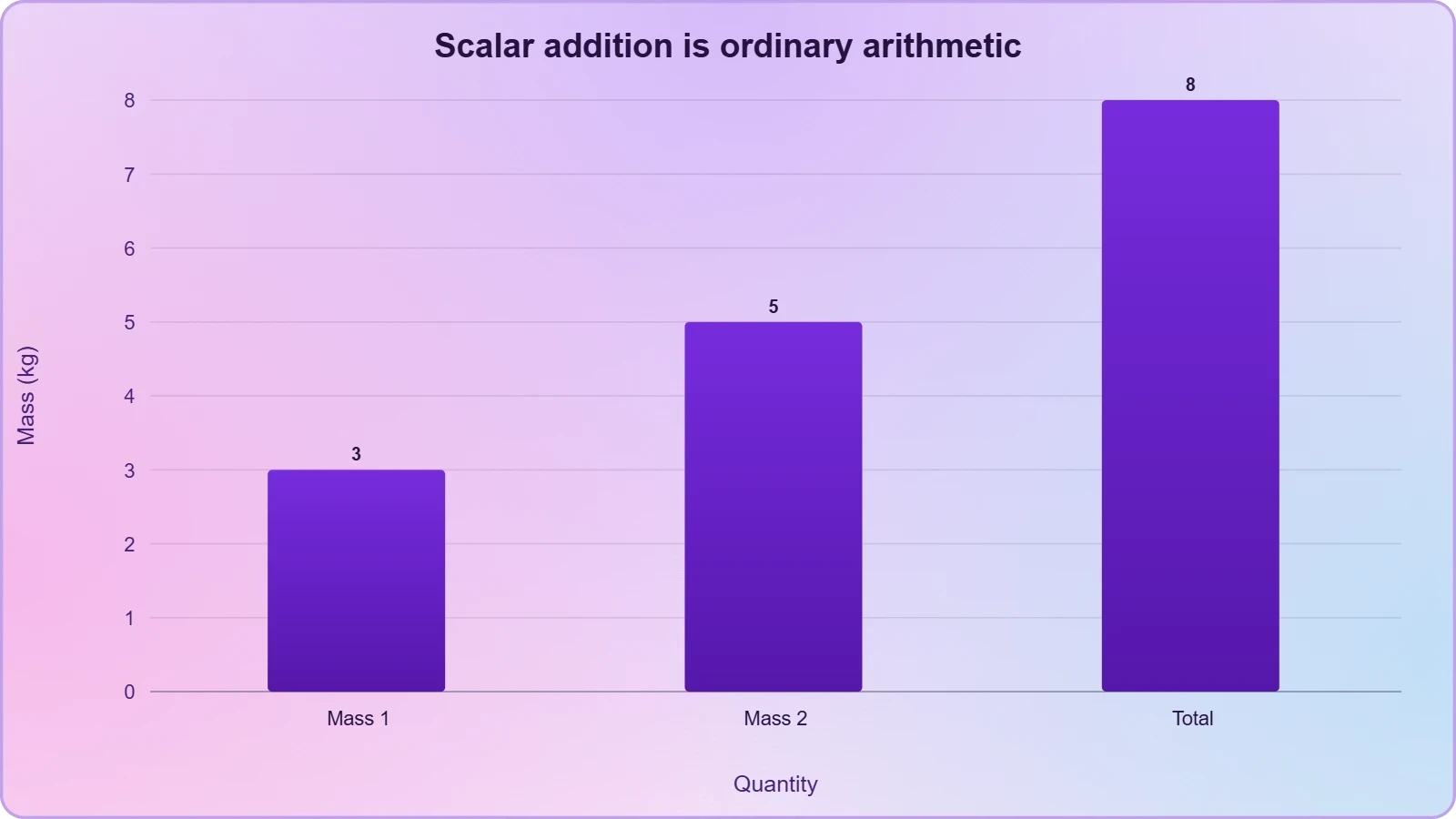
Scalars obey the ordinary rules of arithmetic. Two masses of 3 kg and 5 kg combine to give 8 kg regardless of how they are oriented in space, and the total energy of a system is the simple algebraic sum of its parts. This additive simplicity makes scalar quantities comparatively easy to handle, and it explains why introductory physics begins with them.
Yet scalars are not trivial. Density, power, and electric potential all carry rich physical meaning while remaining directionless. The key test is whether the quantity can be meaningfully rotated: a scalar is invariant under rotation of the coordinate axes, a property that will later prove invaluable when we analyse motion from different viewpoints.
Vector Quantities and the Necessity of Direction
A vector requires both magnitude and direction for complete specification. Displacement, velocity, acceleration, force, momentum, and electric field intensity are the canonical examples. Saying a car travels at 60 km/h describes its speed; saying it travels at 60 km/h due north describes its velocity, a genuinely different statement.
The physical consequences of this distinction are immediate. Two forces of equal magnitude acting on a body can produce wildly different accelerations depending on their relative orientation. When the forces align, they reinforce; when opposed, they cancel. No scalar framework can capture this behaviour, which is precisely why vectors were invented.
Vectors also transform in a specific way under rotation of axes. Their components change, but their magnitude and direction in physical space remain fixed. This covariance is the mathematical signature of a vector, distinguishing it from any arbitrary ordered list of numbers that might superficially resemble one.
Vector Notation and Symbolic Conventions
Clear notation prevents confusion before it begins. Physicists have settled on a small set of conventions that signal, at a glance, whether a symbol denotes a scalar or a vector. Adopting these conventions early spares students considerable grief when equations grow longer and subscripts multiply in later lessons on projectiles and circular motion.
Arrows, Boldface, and Magnitude Bars
The most common convention places a small arrow above the symbol, writing ##\vec{A}## for a vector quantity. In printed textbooks, boldface type such as **A** often serves the same purpose, while handwritten work almost always favours the arrow because boldface is difficult to produce by hand.
The magnitude of a vector, a scalar by definition, is written with vertical bars: ##|\vec{A}|##, or simply ##A## in italic type. This distinction matters enormously. The equation ##\vec{A} = \vec{B}## asserts equality of both magnitude and direction, whereas ##A = B## claims only that the two lengths match.
Unit vectors extend the notation further. A hat above a symbol, as in ##\hat{i}##, ##\hat{j}##, and ##\hat{k}##, denotes a vector of unit length pointing along a coordinate axis. These building blocks allow any vector to be decomposed into components, a technique central to the algebraic methods introduced later in the course.
Representing Vectors Geometrically as Arrows
Geometrically, a vector is drawn as a straight arrow. Its length, measured against a chosen scale, represents magnitude; its orientation indicates direction; and the arrowhead fixes the sense. A displacement of 5 km northeast becomes an arrow of appropriate length tilted at 45 degrees.
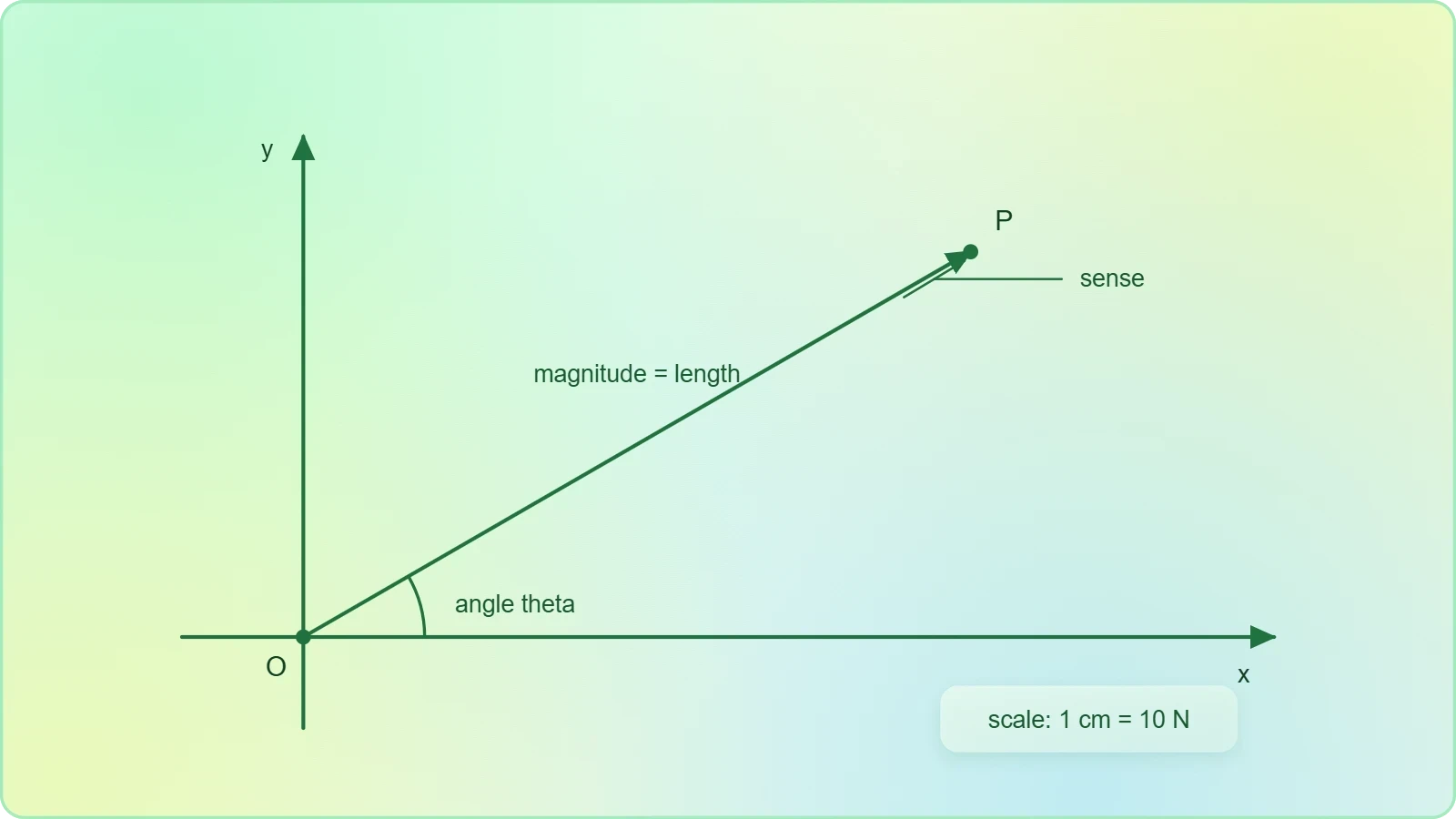
Crucially, a vector is a free object. Translating an arrow across the page without rotating or stretching it produces the same vector, because only length and orientation carry meaning. This freedom underlies the graphical addition methods of the next lesson, where arrows are slid head-to-tail to construct resultants.
Two vectors are equal precisely when their arrows share length and direction, regardless of where they sit. They are opposite when equal in length but reversed in sense. Recognising this geometric equivalence is the first step toward manipulating vectors fluently in diagrams and free-body sketches.
Magnitude, Direction, and the Geometry of Arrows
Every vector carries two independent pieces of information, and the arrow diagram encodes both simultaneously. Magnitude appears as length, direction as orientation, and sense as the side toward which the arrowhead points. Reading these features correctly is a skill that improves rapidly with deliberate practice on simple diagrams.
Length, Orientation, and Sense
Length is always measured against a stated scale. A diagram might decree that one centimetre represents ten newtons, so a four-centimetre arrow denotes a force of forty newtons. Without the scale, a drawing conveys only relative magnitudes, which is often sufficient for qualitative reasoning about equilibrium.
Orientation is specified by an angle measured from a reference direction, conventionally the positive x-axis. A vector pointing at 30 degrees above the horizontal differs from one at 30 degrees below, even though their lengths match. Sense distinguishes these two cases, and it is the arrowhead that resolves the ambiguity.
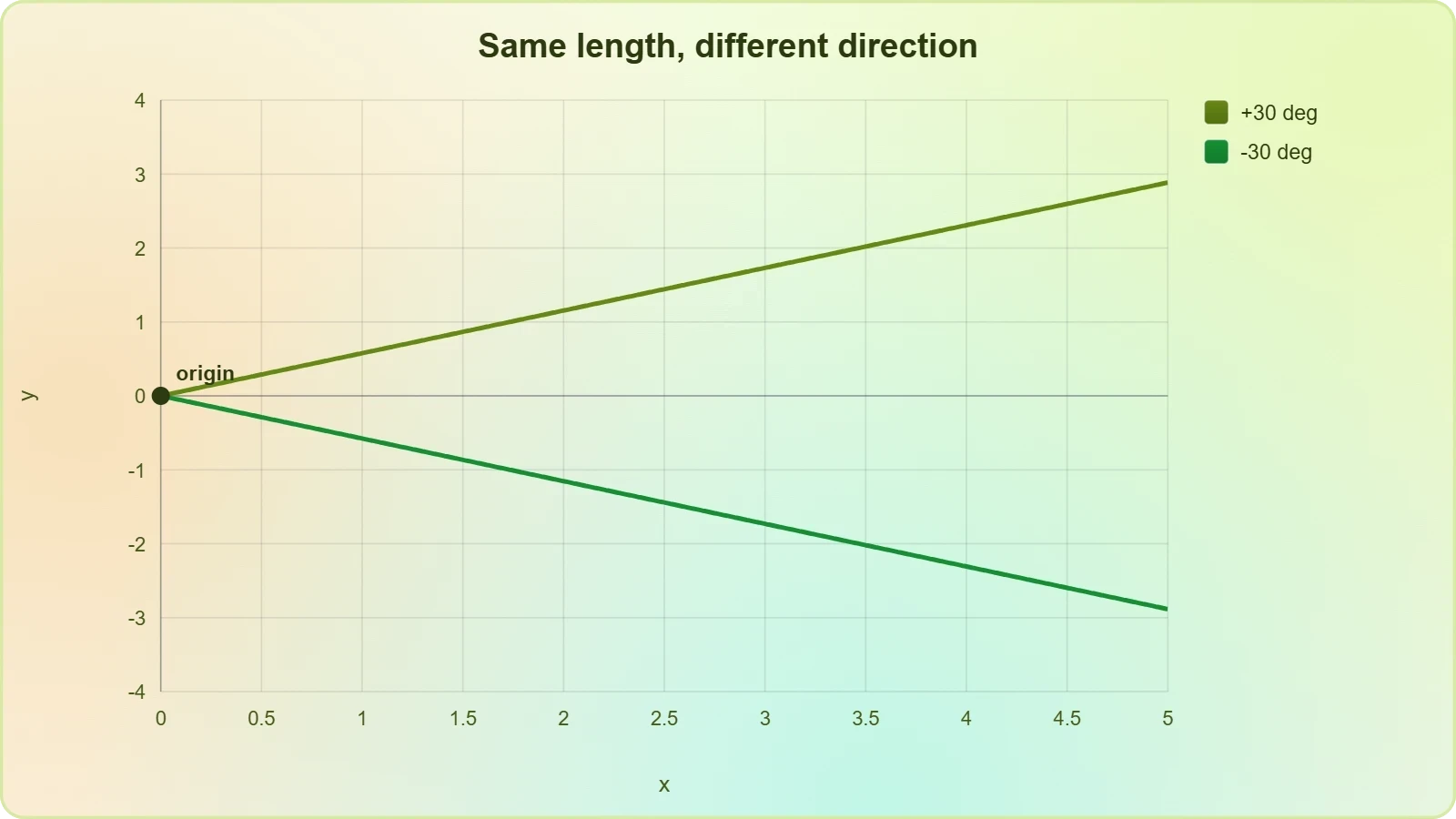
Together, length and orientation define the vector completely. This is why a single arrow can replace a paragraph of description. The geometric picture also reveals relationships that algebra obscures, such as when two vectors are perpendicular or when one is a scaled copy of another.
Equality, Negatives, and Free Translation
Equality of vectors demands identical magnitude and identical direction. Position on the page is irrelevant, a property called free translation. An arrow representing the velocity of a car in Delhi and one representing the velocity of a car in Mumbai are equal if both point north at 60 km/h.
The negative of a vector, written ##-\vec{A}##, has the same length but the opposite sense. Subtracting a vector is therefore equivalent to adding its negative, a manoeuvre that will simplify the graphical subtraction techniques introduced in the following lesson on vector addition.
Scalar multiplication stretches or shrinks a vector without altering its direction, unless the scalar is negative, in which case the sense reverses. Doubling a force doubles its arrow length; multiplying by minus one flips it entirely. These operations form the arithmetic of vectors.
Why Direction Changes Everything in Two Dimensions
The shift from one-dimensional to two-dimensional motion is not merely an increase in bookkeeping. It introduces genuinely new physics, because direction becomes a variable in its own right. A body can accelerate without changing speed, simply by turning, and this insight is the seed from which circular motion grows later in the course.
Speed versus Velocity in Practice
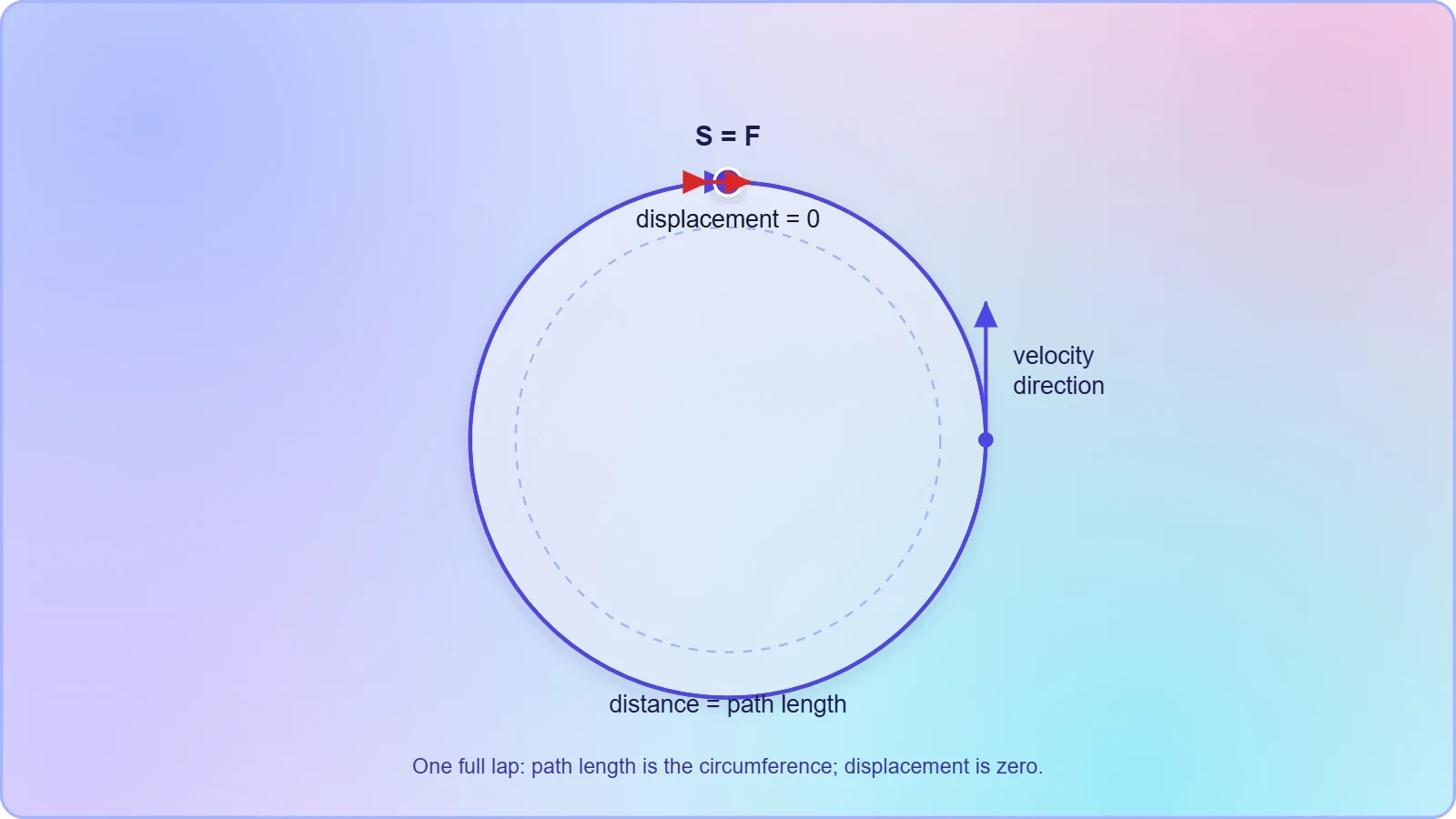
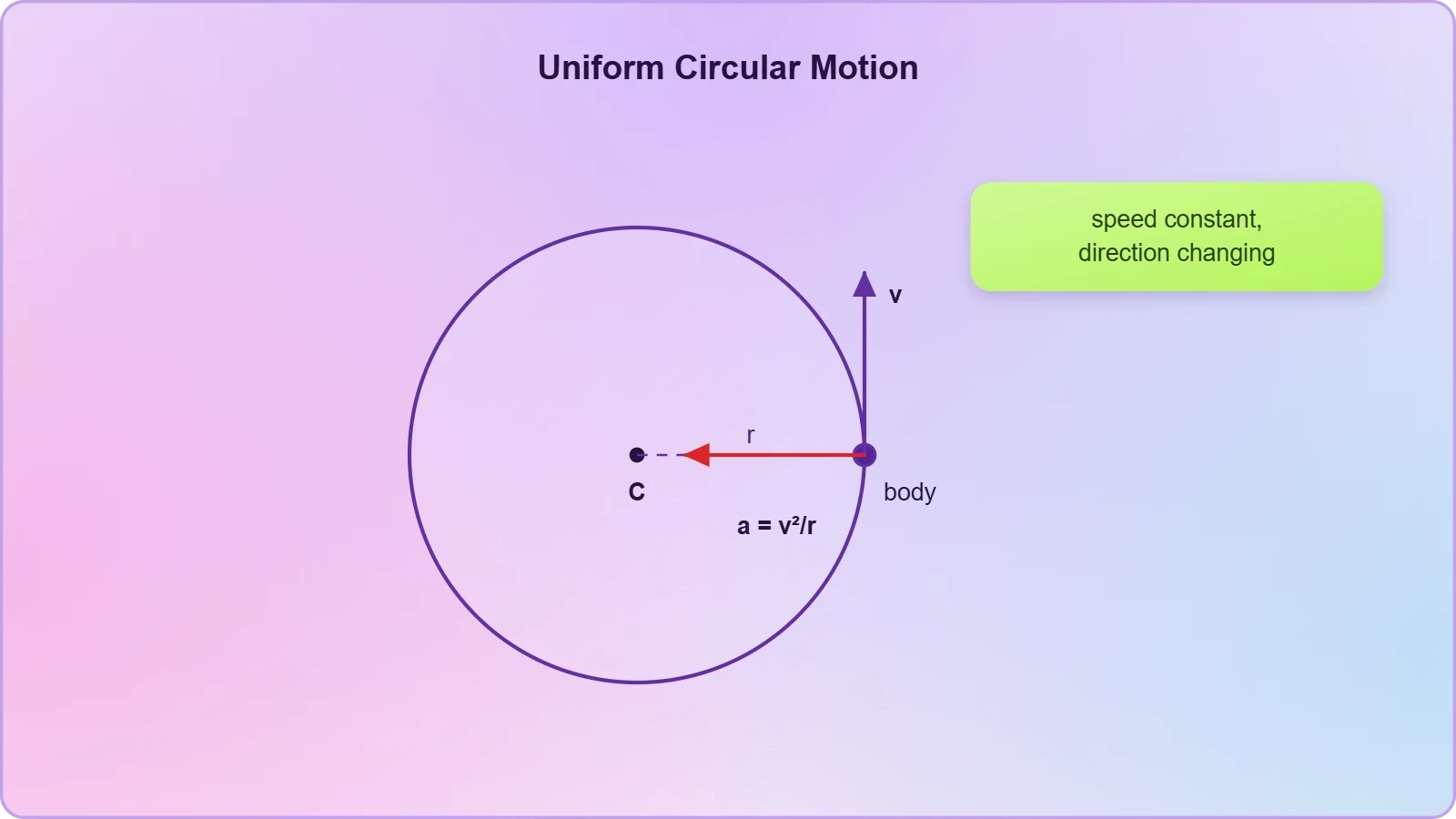
A cyclist completing a lap of a velodrome at constant speed has a continuously changing velocity, because the direction of travel rotates around the track. The distinction between speed and velocity is therefore not pedantic; it determines whether the cyclist is accelerating, and the answer is yes.
Average velocity divides total displacement, a vector, by the elapsed time. Average speed divides total distance, a scalar, by the same interval. On a closed loop, the displacement returns to zero, so the average velocity vanishes while the average speed remains substantial. These contrasting results illuminate the conceptual gap.
Instantaneous velocity is the limit of average velocity as the time interval shrinks toward zero. Formally, ##\vec{v} = \lim_{\Delta t \to 0} \dfrac{\Delta \vec{s}}{\Delta t}##, a definition that respects the vector character of displacement throughout. Speed is simply the magnitude of this instantaneous velocity.
Acceleration as a Vector
Acceleration is likewise a vector, defined as the rate of change of velocity. Because velocity itself has direction, acceleration arises whenever either the speed or the direction of motion changes. A car rounding a bend at steady speed is accelerating toward the centre of the curve.
This realisation prepares the ground for uniform circular motion, where the acceleration points radially inward and has magnitude ##a = v^2/r##. Students who treat acceleration as a scalar invariably stumble here, wondering how a constant-speed motion can involve acceleration at all.
In projectile problems, the acceleration is the constant vector ##\vec{g}## directed vertically downward. The horizontal component of velocity remains unchanged while the vertical component evolves linearly with time, a separation that only makes sense once vectors are understood as directional quantities.
Components, Unit Vectors, and the Bridge to Algebra
Geometry offers intuition, but algebra offers precision. The bridge between them is the resolution of a vector into perpendicular components, a technique that converts a single directional quantity into two independent scalar quantities. This decomposition is arguably the most useful computational habit in all of two-dimensional kinematics.
Resolving a Vector into Perpendicular Parts
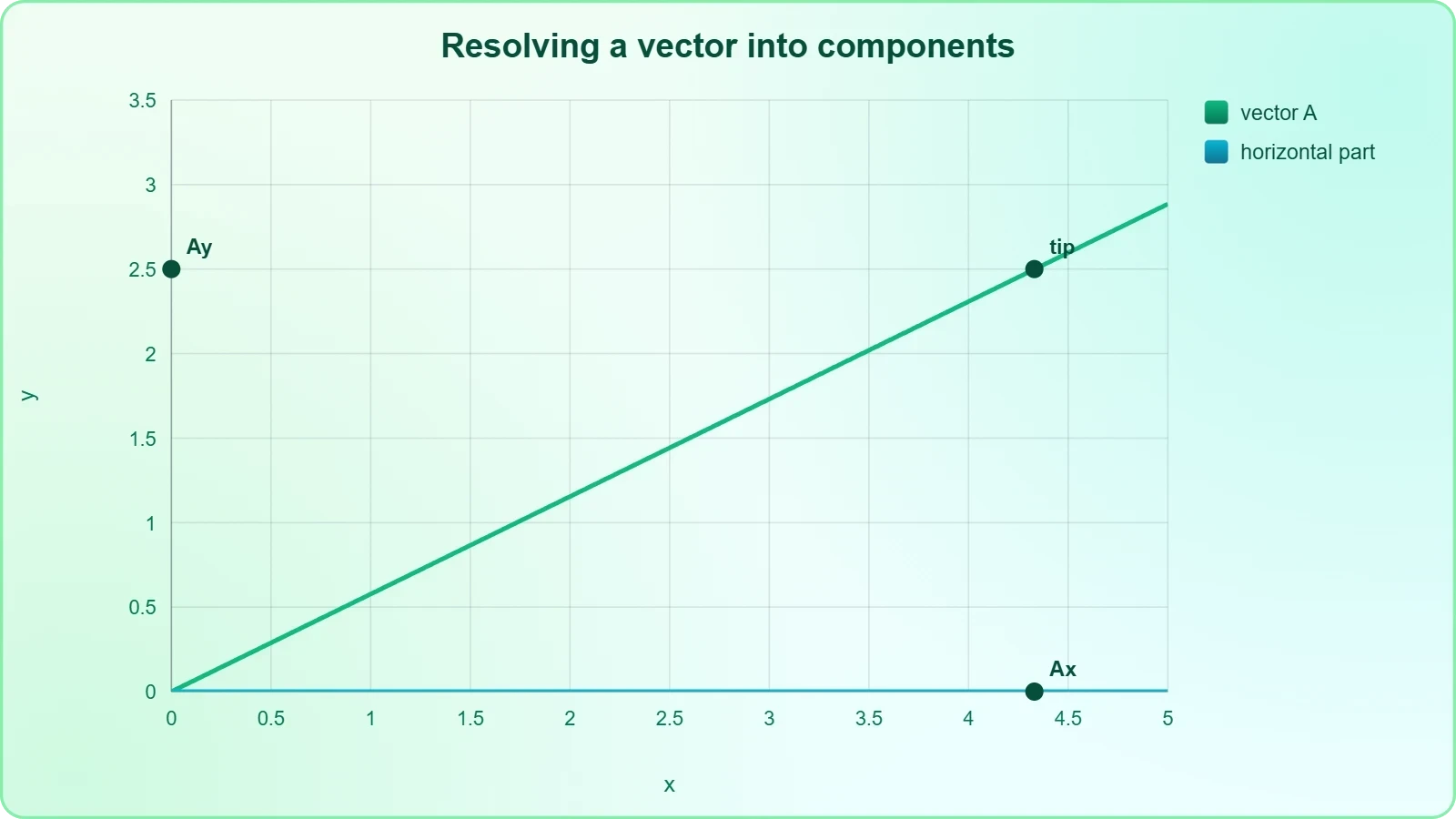
Any vector in a plane can be written as the sum of a horizontal part and a vertical part. If ##\vec{A}## makes an angle ##\theta## with the positive x-axis, its components are ##A_x = A\cos\theta## and ##A_y = A\sin\theta##, where ##A## is the magnitude.
The reverse operation recovers the magnitude and direction from the components. The magnitude follows from the Pythagorean relation, and the direction from the inverse tangent. Together these two equations form a complete translation between geometric and algebraic descriptions of the same vector.
Care is needed with the inverse tangent, because the standard arctangent function returns values only between minus ninety and plus ninety degrees. The quadrant of the vector must be determined separately from the signs of the components, then the angle adjusted accordingly.
Unit Vectors and Component Form
Unit vectors provide a compact bookkeeping device. Writing ##\vec{A} = A_x\hat{i} + A_y\hat{j}## expresses the vector as a weighted sum of the two axis directions. The coefficients are scalars, so ordinary algebra applies to them, and vector problems reduce to pairs of scalar equations.
This representation will dominate the remainder of the course. Projectile motion splits into independent horizontal and vertical problems, and circular motion is analysed by resolving forces along radial and tangential directions. Mastering component form now pays dividends in every subsequent lesson.
A short computational exercise reinforces the translation between forms. The snippet below converts a magnitude and angle into components and back again, illustrating the round trip numerically.
import math

def to_components(magnitude, angle_deg):
    theta = math.radians(angle_deg)
    return magnitude * math.cos(theta), magnitude * math.sin(theta)

def to_polar(ax, ay):
    magnitude = math.hypot(ax, ay)
    angle = math.degrees(math.atan2(ay, ax))
    return magnitude, angle

ax, ay = to_components(10, 30)
print(round(ax, 3), round(ay, 3))
print(to_polar(ax, ay))
Common Misconceptions and a Practical Checklist
Beginners stumble in predictable places, and naming those pitfalls in advance saves considerable frustration. The errors below recur in examinations and laboratory reports alike, and each stems from a partial grasp of the scalar-vector distinction rather than from carelessness. Recognising them is half the remedy.
Where Students Typically Go Wrong
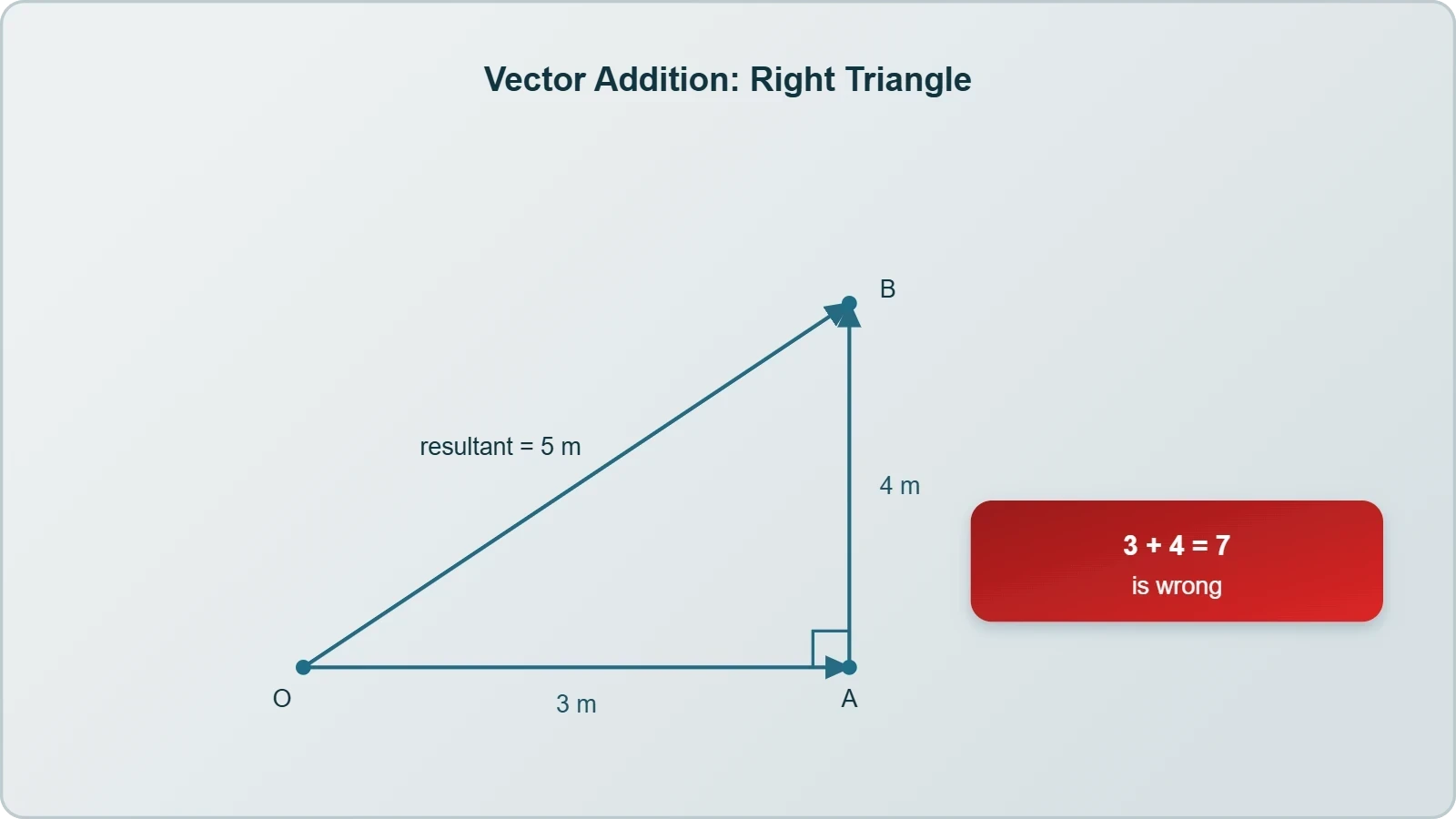
The most frequent error treats magnitude as the whole story, adding vector magnitudes arithmetically as though direction were irrelevant. Two perpendicular displacements of 3 m and 4 m do not sum to 7 m; their resultant is 5 m, a fact that follows directly from the Pythagorean theorem.
A second trap confuses the negative sign with a reduction in magnitude. Writing ##-\vec{A}## does not shrink the vector; it reverses its sense while preserving length. Students who conflate the two misread force diagrams and velocity graphs with equal regularity.
A third misconception holds that a vector's position on a diagram carries physical meaning. In free-body diagrams, arrows are conventionally drawn from the body's centre, but this is a drawing convention, not a claim about where the force is applied in every context.
A Working Checklist Before Solving Problems
Before substituting numbers, confirm that every quantity has been classified as scalar or vector. Then choose a coordinate system and state the reference direction explicitly. Resolve each vector into components, keeping signs consistent with the chosen axes throughout the calculation.
Finally, sanity-check the result. A magnitude should never be negative, and a direction should fall within the expected quadrant. If a computed speed exceeds the speed of light or a projectile lands behind its launch point without cause, the error usually lies in a sign convention applied inconsistently.
These habits carry directly into the next lesson, where arrows are combined head-to-tail to construct resultants. The graphical methods there rest entirely on the free-translation property established here, and the algebraic methods that follow depend on the component decomposition practised above.
Also Read
- No links available.
From our network :
- Vite 6/7 'Cold Start' Regression in Massive Module GraphsIn-depth analysis of Vite 6/7 cold start regressions in massive module graphs. Learn about barrel file issues, pre-bundling optimizations, and how to improve Vite dev server performance.
- 98% of Global MBA Programs Now Prefer GRE Over GMAT Focus EditionExplore why 98% of global MBA programs now prefer the GRE over GMAT Focus. Learn about the shorter GRE format, verbal logic importance, and strategic versatility for students.
- Mastering DB2 12.1 Instance Design: A Technical Deep Dive into Modern Database ArchitectureComprehensive guide to DB2 12.1 Instance Design. Explore architectural components, HADR setup, buffer pool tuning, and security policies for IBM DB2 12.1. Includes 10 functional SQL and Shell samples.
- Trump Political Strategy How Geopolitical Stunts Serve As Media Diversions
- Mastering DB2 LUW v12 Tables: A Comprehensive Technical GuideComprehensive guide on DB2 LUW v12 tables. Explore CREATE TABLE syntax, BLU Acceleration, range partitioning, data types, and security features for IBM DB2 LUW v12.
- Analyzing Trump Deportation Numbers Insights Into The 2026 Immigration Crackdown
- AI-Powered 'Precision Diagnostic' Replaces Standard GRE Score ReportsDiscover the new GRE Precision Diagnostic. Learn how AI-powered behavioral analytics and time-to-solve tracking are replacing standard GRE score reports to empower students.
- EV 2.0: The Solid-State Battery Breakthrough and Global Factory ExpansionDiscover the impact of the Solid-State Battery Breakthrough on the EV market. Learn about CATL and BYD stock growth, global factory expansion in Europe, and the future of EV 2.0 technology.
- 10 Physics Numerical Problems with Solutions for IIT JEEPrepare for IIT JEE with 10 physics numerical problems, complete with detailed solutions and conceptual explanations. Ideal for mastering kinematics, thermodynamics, electromagnetism, and optics.
RESOURCES
- Physics Tutorial - Language of Kinematics - Scalars and Vectorsphysicsclassroom.comScalars are quantities that are fully described by a magnitude (or numerical value) alone. Vectors are quantities that are fully described by both a…
- Learn and try: Scalars and vectors (article) - Khan Academykhanacademy.orgScalars include magnitude only. Vectors include both magnitude and direction. Let's take a closer look at these two types of quantities. Scalars.
- 1.2: Scalars and Vectors Part 1 - Physics LibreTextsphys.libretexts.orgJun 24, 2025 ... Vectors have magnitude and direction, scalars only have magnitude. The fact that magnitude occurs for both scalars and vectors can…
- 2.1 Scalars and Vectors - University Physics Volume 1 | OpenStaxopenstax.orgSep 19, 2016 ... Vectors can be multiplied by scalars, added to other vectors, or subtracted from other vectors. We can illustrate these vector…
- Scalars and Vectors in Physics | PDF - Scribdscribd.comThis document summarizes key concepts about scalars and vectors from a physics textbook chapter: - Scalars have magnitude only, while vectors have both ...
- Scalars and Vectors - NASAgrc.nasa.govA quantity which does not depend on direction is called a scalar quantity. Vector quantities have two characteristics, a magnitude and a direction. Scalar ...
- 20.1 Introduction to vectors and scalars - Siyavulasiyavula.comScalars and vectors (ESAGI). Scalars are physical quantities which have only a number value or a size (magnitude). A scalar tells you how much…
- SCALARS AND VECTORShome.cc.umanitoba.caDetermine whether a scalar quantity, a vector quantity or neither would be appropriate to describe each of the following situations. a. The outside temperature ...
- 2.1 Scalars and Vectors | University Physics Volume 1courses.lumenlearning.comTwo or more vectors can be added to form another vector. The vector sum is called the resultant vector. We can add vectors to…
- Vectors and scalars - National 5 Physics Revision - BBC Bitesizebbc.co.ukScalars have a size, while vectors have both size and direction. When adding vector quantities, it is possible to find the size and direction…
- Scalars & vectors | PPTX - Slideshareslideshare.netScalars are physical quantities with only magnitude, while vectors have both magnitude and direction. It also covers vector operations, including addition, ...
- Vector And Scalar Quantities - BYJU'Sbyjus.comDifference Between Scalar and Vector Quantity ; Scalar Quantity. Vector Quantity ; It has magnitude only, It has both magnitude and the direction ;…
- Why is area considered a vector in Physics but a scalar in Math?reddit.comDec 9, 2024 ... Area under a graph can be either. Area under a Force vs displacement graph is Work ( scalar). Area under…
- Providing an intuitive description of scalar and vector quantities in ...physics.stackexchange.comJul 29, 2016 ... Closed 10 years ago. Improve this question. Often the standard introduction to the concept of scalars and vectors in physics…
- ELI5: What are vectors and scalars? : r/explainlikeimfive - Redditreddit.comAug 9, 2019 ... Comments Section ; Scalar Nature of Charge. 0. 6 ; Miledown Physics Anki Correction. 21. 3 ; ELI5 What does…