Motion rarely confines itself to a single straight line. A leaf drifting on a breeze, a cricket ball arcing toward the boundary, or a satellite tracing its orbit all describe paths that bend and curve through space, demanding a richer language than the one-dimensional kinematics of earlier study. This opening lesson of the course establishes why two-dimensional motion deserves its own framework, and why the humble vector becomes the indispensable tool for describing it with precision.
The central insight is deceptively simple: when an object moves across a plane rather than along a line, its position, velocity, and acceleration each acquire direction as well as magnitude. Treating these quantities as mere numbers collapses under the weight of reality, because a velocity of ten metres per second tells us nothing until we know where the object is heading. Recognising this distinction is the first genuine step from elementary mechanics into the analytical geometry of motion.
Across the sections that follow, we will contrast planar motion with its one-dimensional predecessor, examine everyday trajectories that illustrate the difference, and preview how vectors will soon formalise what intuition already suspects. The treatment stays deliberately conceptual, preparing the ground for the next lesson on scalars and vectors without trespassing on its territory. By the close, you should see the plane not as a complication but as the natural stage on which most real motion unfolds.
On This Page
Why Motion in a Plane Demands a New Framework
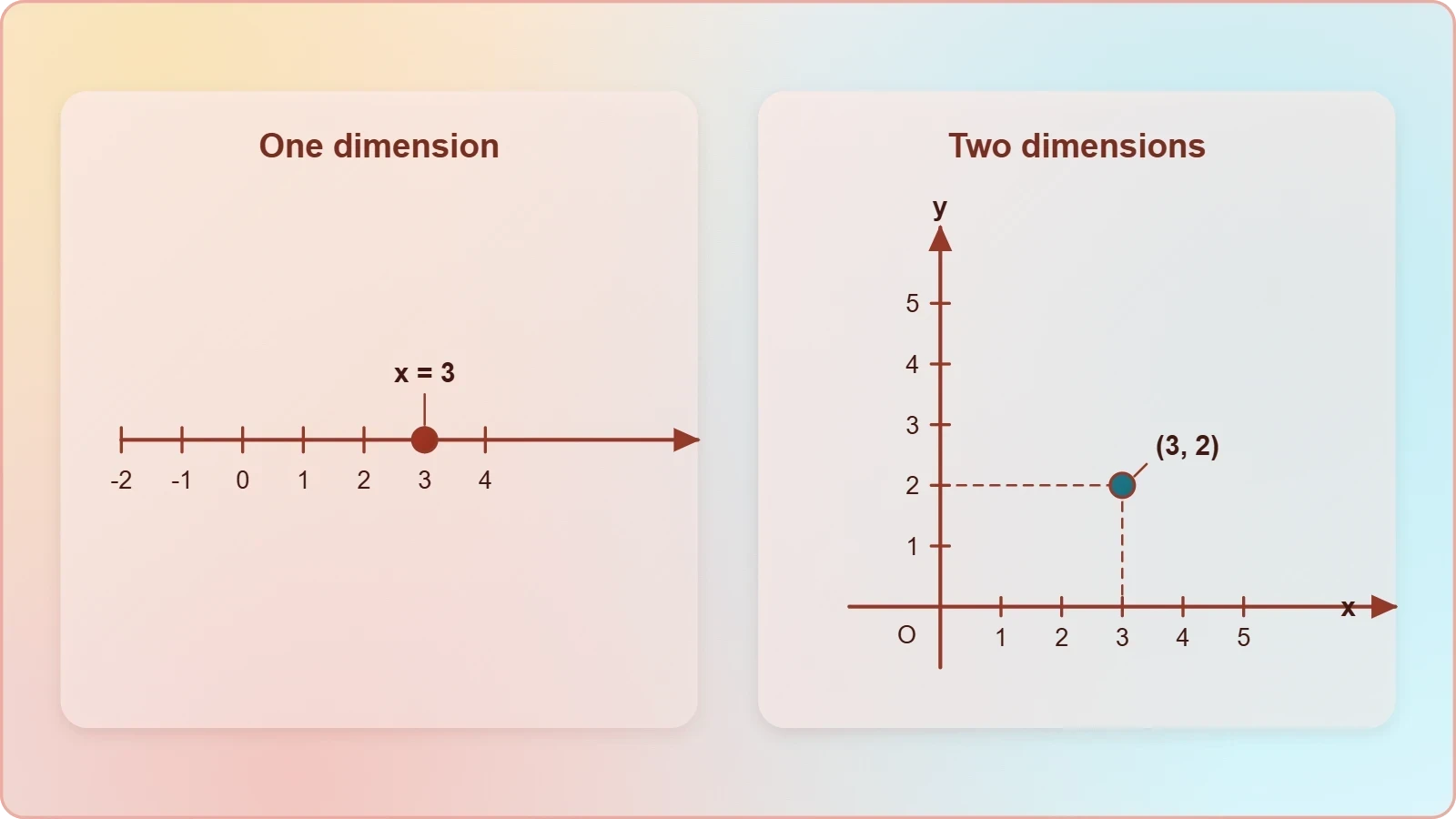
One-dimensional kinematics succeeds because a single coordinate axis captures everything that matters. An object is either ahead or behind, moving forward or backward, and a signed number records its state completely. The moment motion escapes that line, however, a solitary number can no longer pin down where the object sits or where it is going next.
The Limits of a Single Coordinate
Consider a boat crossing a river while the current pushes sideways. Its progress downstream and its progress across the channel happen simultaneously, and neither can be expressed through the other. A single axis would force us to discard one component of the motion entirely, which is plainly unacceptable when both determine whether the boat reaches its intended landing point.
This limitation is not a technicality but a conceptual wall. Position in a plane requires two independent pieces of information, and velocity requires two as well. The mathematics of one dimension simply lacks the vocabulary to hold both at once, so a richer descriptive system becomes unavoidable rather than optional.
Independence of Perpendicular Components
The saving grace of planar motion is that perpendicular directions behave independently. Horizontal and vertical motions proceed without interfering with one another, a principle Galileo first articulated and every projectile problem quietly exploits. This independence lets us decompose a complicated curved path into two straightforward straight-line problems solved side by side.
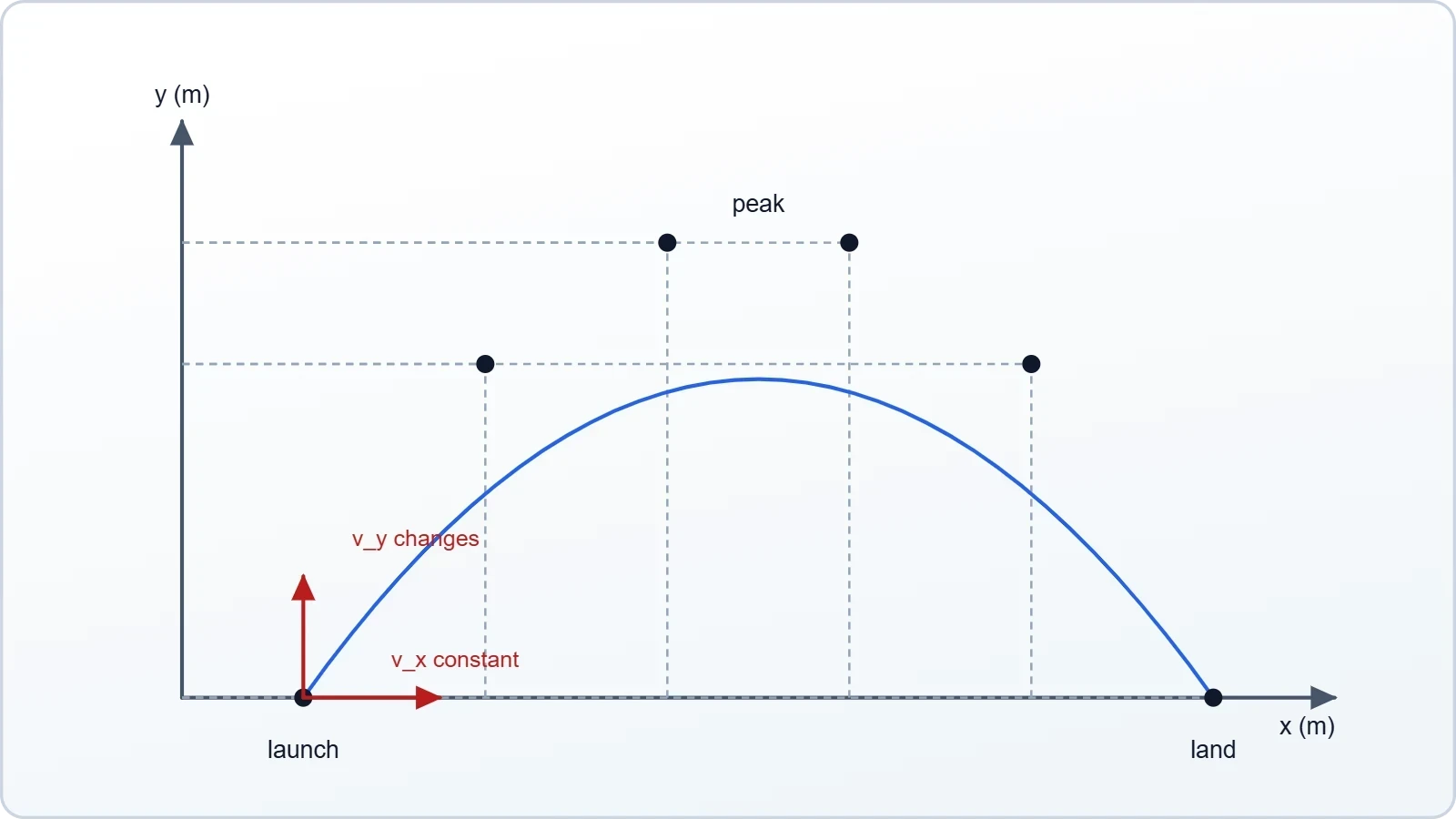
Understanding this separability early pays enormous dividends later. It explains why a bullet fired horizontally and a ball dropped from the same height strike the ground simultaneously, a result that astonishes students until the independence principle makes it obvious. The plane is complex, but its complexity factorises neatly.
Everyday Trajectories That Reveal the Plane
Abstract definitions acquire meaning through observation. Long before formal vectors enter the picture, ordinary experience supplies abundant evidence that planar motion behaves differently from linear motion, and that its description requires attention to direction as much as to speed. The examples below anchor the coming theory in scenes any learner can visualise.
Projectiles and Curved Paths
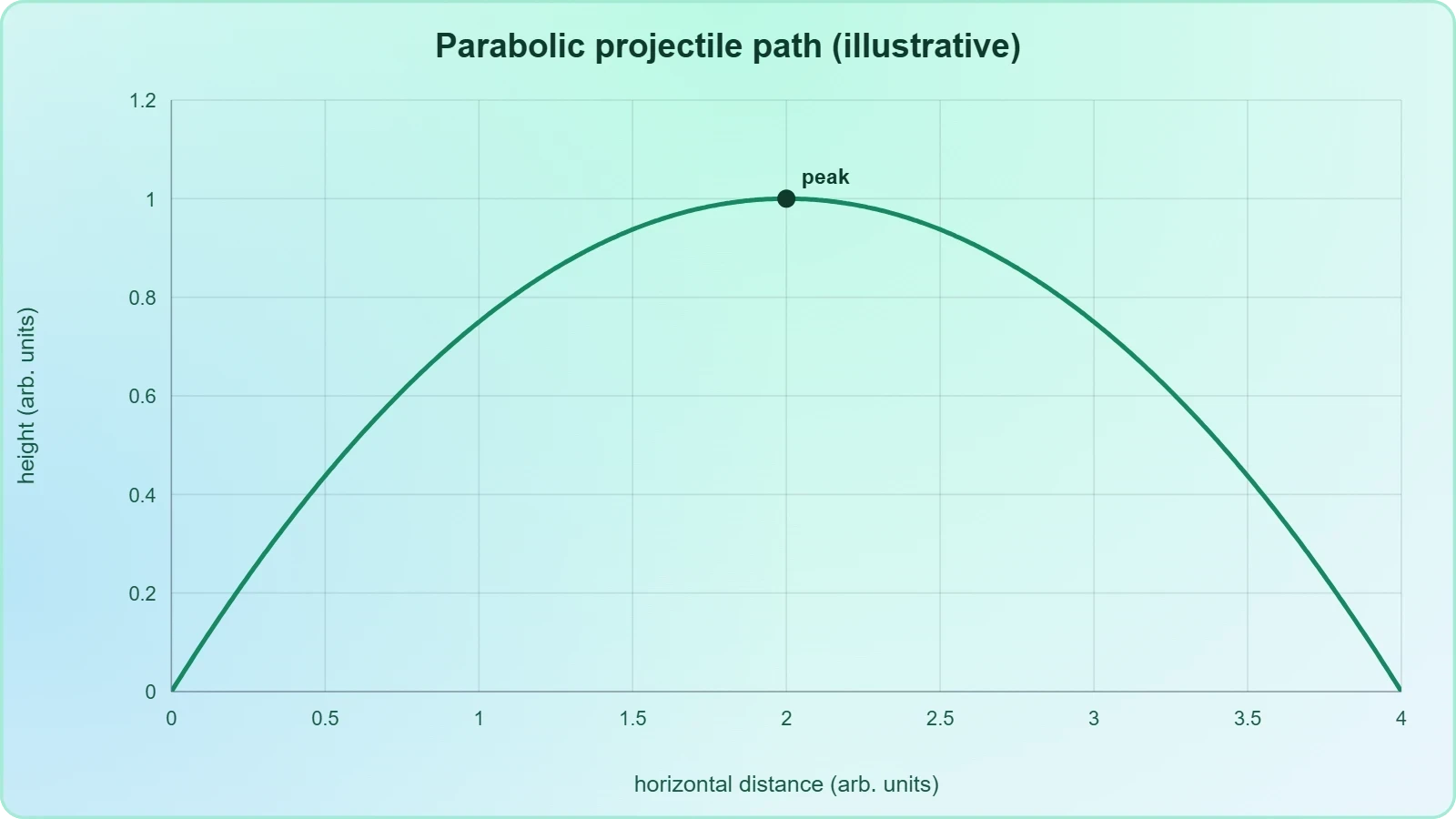
A thrown ball rises, slows, pauses at its peak, then descends along a symmetric arc. No single number describes this flight, because the ball's horizontal progress continues steadily while its vertical speed changes continuously under gravity. The curve itself is the visible signature of two independent motions superimposed.
This parabolic trajectory is the archetype of planar motion and will occupy an entire later lesson. For now, it suffices to notice that the ball's path cannot be captured by one coordinate, and that its velocity points along the tangent to the curve at every instant, constantly changing direction.
Circular and Turning Motion
A car rounding a bend, a rider on a Ferris wheel, a stone whirled on a string: each traces a circle, and each demonstrates that direction can change even when speed remains constant. This distinction between speed and velocity becomes vivid only in two dimensions, where turning alone constitutes acceleration.
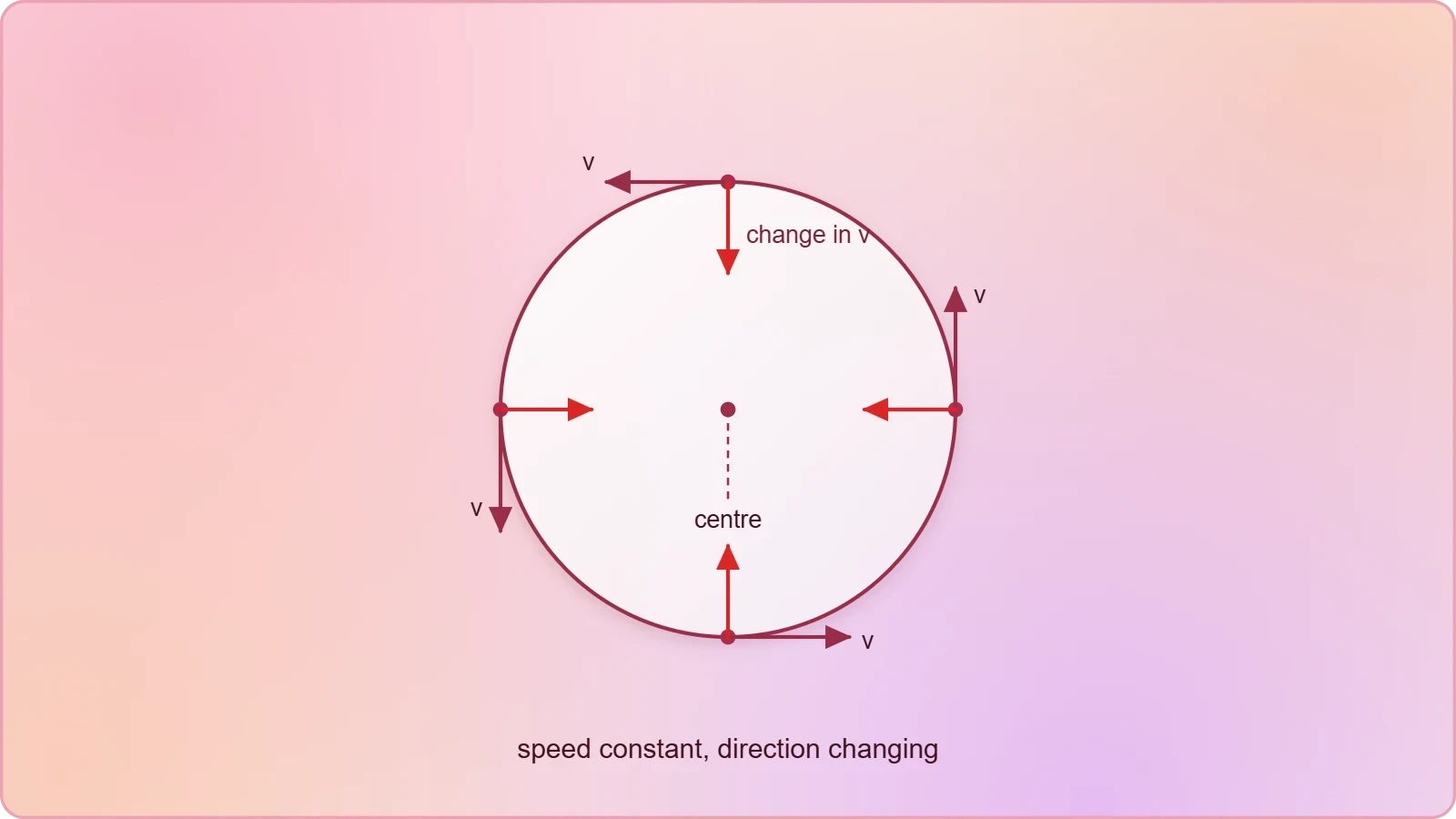
Uniform circular motion will receive its own detailed treatment later in the course. Here it serves as a reminder that the plane admits motions far richer than straight-line travel, and that a complete description must track orientation continuously, not merely distance covered.
Position, Displacement, and the Plane as a Stage
Describing where something is precedes describing how it moves. In a plane, location is fixed by a pair of coordinates, conventionally written as an ordered pair, and displacement becomes the straight arrow joining the starting point to the finishing point. This arrow, not the winding path actually travelled, is what kinematics tracks.
Coordinates and Ordered Pairs
Choosing axes is a modelling decision, not a physical truth. We might align the horizontal axis with the ground and the vertical with gravity, or tilt both to suit an inclined surface. Once chosen, however, the axes must remain consistent, because every subsequent calculation inherits their orientation.
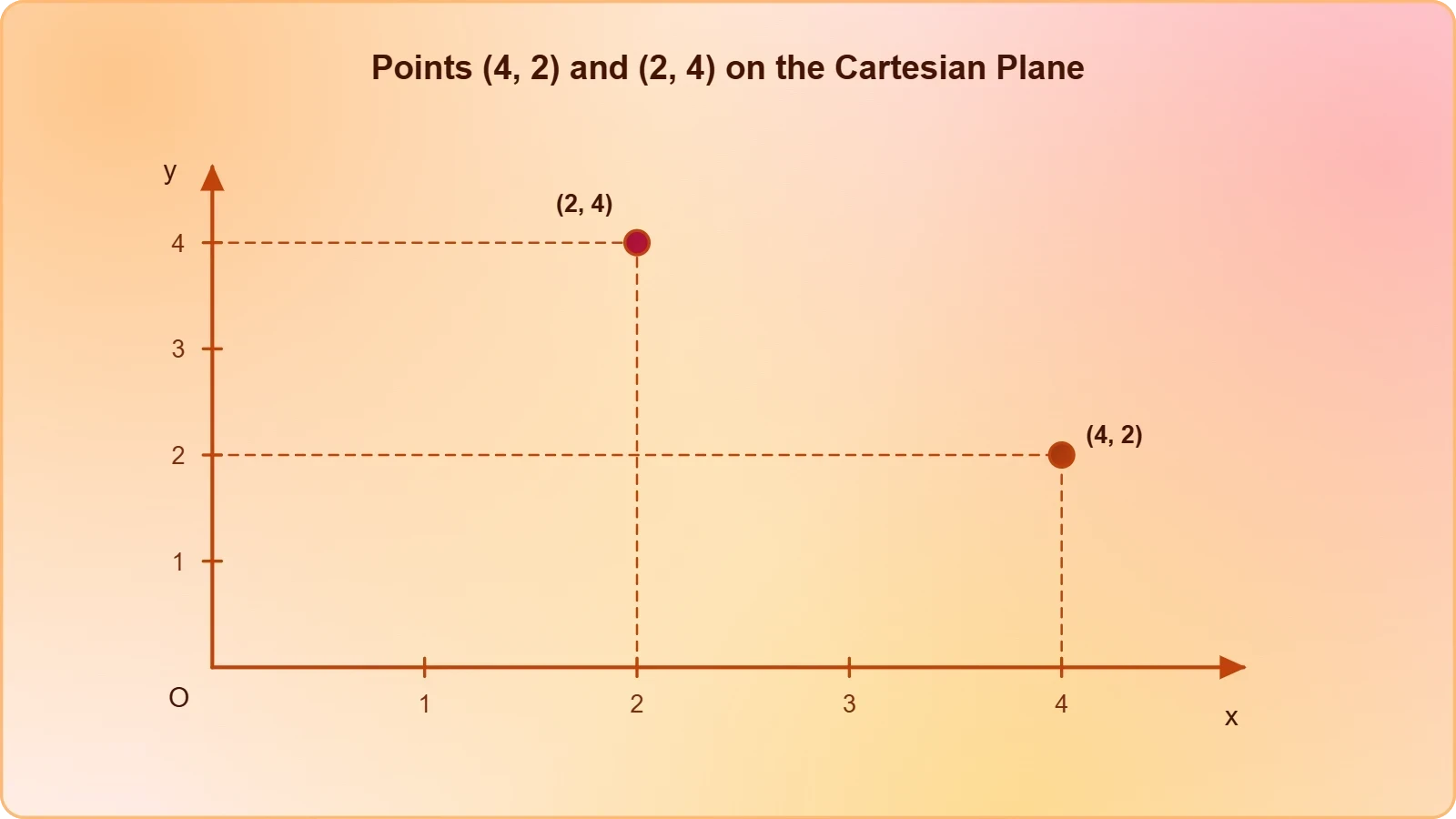
The position of a point in the plane is then written as ##(x, y)##, an ordered pair whose order matters absolutely. Swapping the entries describes a different location entirely, a small detail that trips up many beginners when they first plot trajectories by hand.
Displacement as a Directed Arrow
Displacement measures the net change in position, computed by subtracting initial coordinates from final ones along each axis. Its magnitude is the straight-line distance between the two points, given by the Pythagorean relation, while its direction is the angle that line makes with the chosen reference axis.
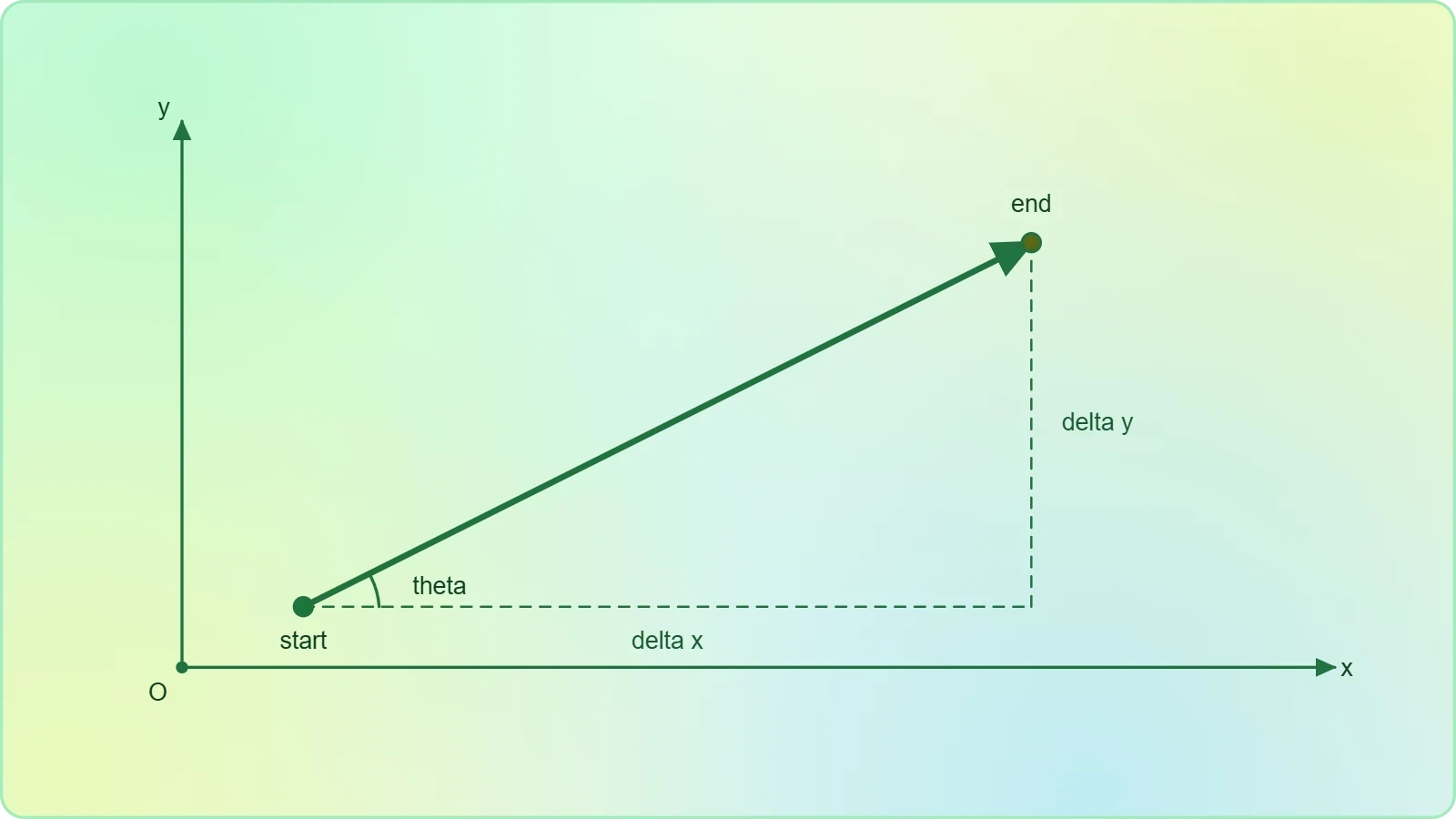
This formula already hints at the vector machinery to come. The displacement depends only on endpoints, never on the route taken, so a winding walk and a direct stride between the same two points share an identical displacement despite covering very different distances.
Velocity and Acceleration Acquire Direction
Once position lives in a plane, its rates of change inherit the same two-dimensional character. Velocity becomes the rate at which displacement changes, carrying direction along with magnitude, and acceleration becomes the rate at which velocity itself changes. Both quantities now require arrows rather than bare numbers, and both can change in ways one dimension never permitted.
Speed Versus Velocity
Speed is a scalar, the magnitude of the velocity arrow, and it says nothing about heading. Velocity is the arrow itself, and two cars travelling at identical speeds around opposite sides of a roundabout possess entirely different velocities. This distinction, trivial on a straight road, becomes central on any curved path.
Average velocity over an interval divides displacement by elapsed time, while instantaneous velocity is the limit of that quotient as the interval shrinks. The limiting process is precisely the derivative, connecting kinematics directly to the calculus of rates.
Changing Direction as Acceleration
Acceleration in a plane arises from any change in the velocity arrow, whether its length alters, its direction alters, or both. A car maintaining constant speed around a bend is nonetheless accelerating, because its velocity vector rotates continuously. This realisation often unsettles beginners, yet it follows directly from the definition.
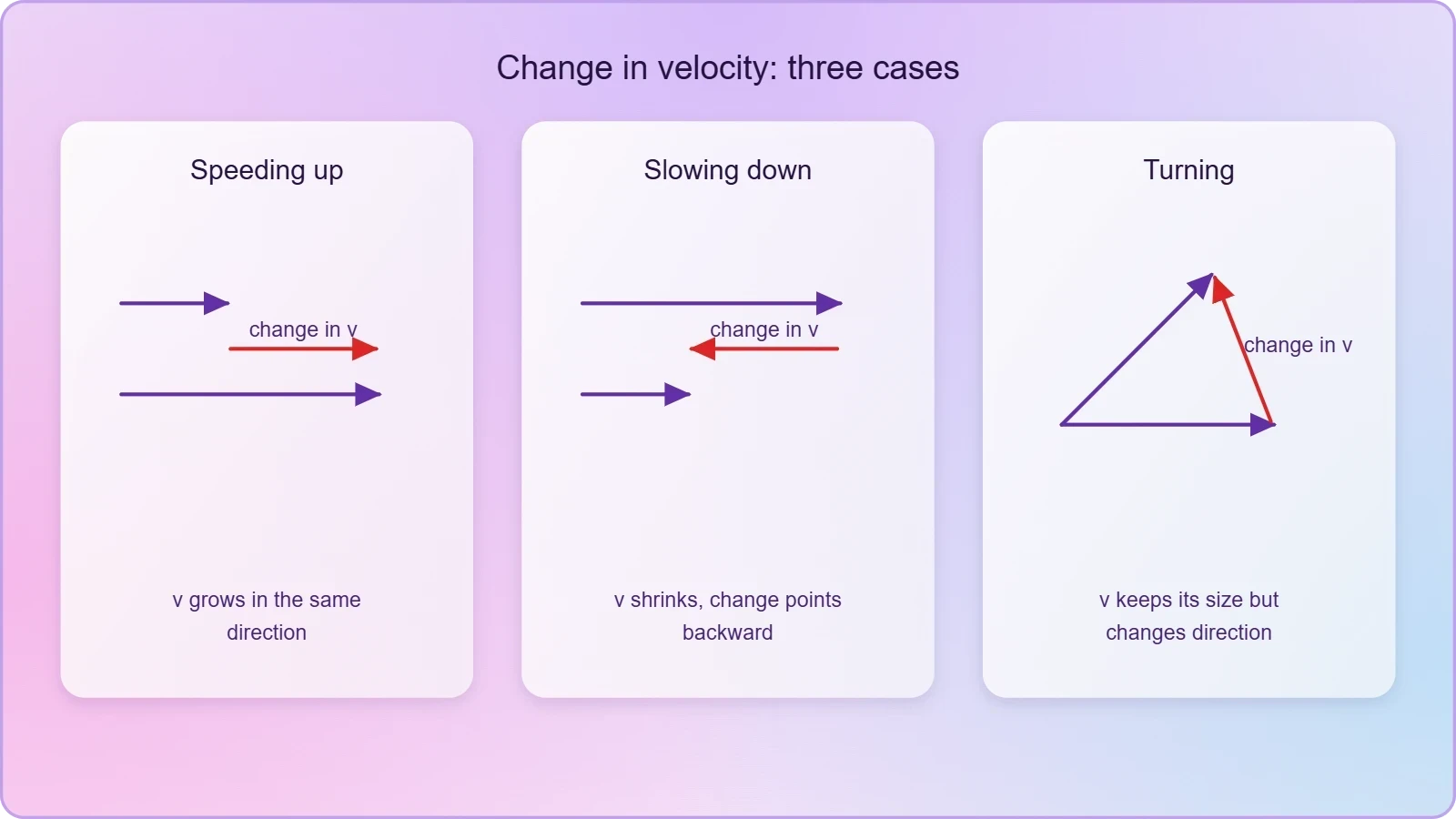
The consequence is profound: circular motion at steady speed is accelerated motion, and therefore requires a net force. That force, directed toward the centre, will be examined in detail when uniform circular motion arrives later in the course.
Setting Up Axes and Solving Plane Problems
Practical success in planar kinematics depends less on memorised formulas than on disciplined setup. Choosing sensible axes, resolving every quantity into components, and treating each axis as an independent one-dimensional problem converts intimidating curves into manageable arithmetic. This procedural habit will serve throughout the course.
Choosing a Convenient Coordinate System
Axes should be aligned with whatever simplifies the mathematics. For projectile problems, horizontal and vertical axes usually win because gravity acts purely downward. For motion along an incline, tilting the axes so one lies along the slope eliminates unnecessary trigonometry from the equations.
Once the frame is fixed, every position, velocity, and acceleration is expressed in its components. Consistency matters more than cleverness: mixing frames midway through a calculation produces errors that are difficult to trace and easy to avoid through careful initial choices.
Resolving Quantities into Components
Any vector in the plane splits into perpendicular parts using elementary trigonometry. A velocity of magnitude ##v## at angle ##\theta## to the horizontal contributes ##v\cos\theta## horizontally and ##v\sin\theta## vertically, and these components can then be handled separately.
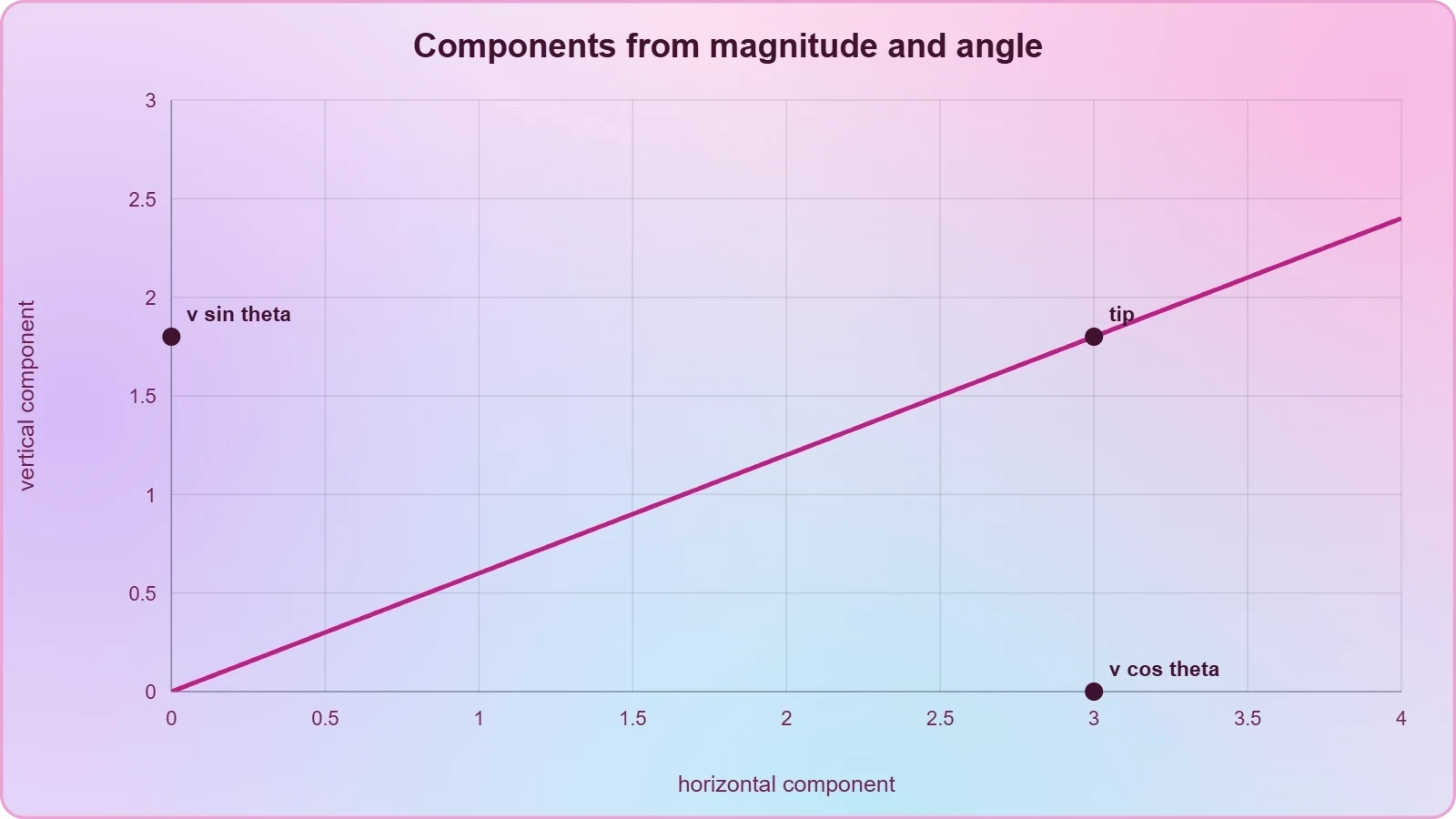
A short computational routine makes the decomposition concrete and reusable. The snippet below accepts a magnitude and angle, returning the two components, and illustrates how naturally this step translates into code.
import math

def components(magnitude, angle_degrees):
    theta = math.radians(angle_degrees)
    vx = magnitude * math.cos(theta)
    vy = magnitude * math.sin(theta)
    return round(vx, 2), round(vy, 2)

print(components(20, 30))  # horizontal and vertical parts
Preparing the Ground for Vectors
Everything discussed so far gestures toward a single unifying idea: quantities in the plane must be handled as directed entities obeying their own algebra. The next lesson formalises this intuition, distinguishing scalars from vectors and introducing the rules for adding, subtracting, and scaling them. This lesson has prepared the conceptual soil for that formal cultivation.
What the Next Lesson Will Formalise
We have spoken loosely of arrows, components, and directions without yet defining vector addition or the parallelogram law. Those definitions arrive next, together with the notation that will carry us through projectiles and circular motion. The examples gathered here will reappear as illustrations of those formal rules.
Students who grasp why direction matters before learning how to manipulate it invariably find the algebra less arbitrary. The sequence is deliberate: intuition first, formalism second, application third. Skipping the first stage leaves the second feeling like arbitrary bookkeeping rather than a natural language.
Common Misconceptions to Abandon
Several habits from one-dimensional study must be shed. Treating velocity as a number, assuming acceleration implies speeding up, and confusing distance with displacement all cause trouble in the plane. Each misconception dissolves once direction is granted equal standing with magnitude in every quantity.
A final caution concerns signs. In one dimension, a minus sign indicated reversal along a single axis. In two dimensions, signs merely locate a component relative to the chosen axes, and the same physical direction can appear positive or negative depending on orientation. Vigilance here prevents silent errors.
Also Read
- No links available.
From our network :
- Vite 6/7 'Cold Start' Regression in Massive Module GraphsIn-depth analysis of Vite 6/7 cold start regressions in massive module graphs. Learn about barrel file issues, pre-bundling optimizations, and how to improve Vite dev server performance.
- EV 2.0: The Solid-State Battery Breakthrough and Global Factory ExpansionDiscover the impact of the Solid-State Battery Breakthrough on the EV market. Learn about CATL and BYD stock growth, global factory expansion in Europe, and the future of EV 2.0 technology.
- Mastering DB2 12.1 Instance Design: A Technical Deep Dive into Modern Database ArchitectureComprehensive guide to DB2 12.1 Instance Design. Explore architectural components, HADR setup, buffer pool tuning, and security policies for IBM DB2 12.1. Includes 10 functional SQL and Shell samples.
- Trump Political Strategy How Geopolitical Stunts Serve As Media Diversions
- Analyzing Trump Deportation Numbers Insights Into The 2026 Immigration Crackdown
- Mastering DB2 LUW v12 Tables: A Comprehensive Technical GuideComprehensive guide on DB2 LUW v12 tables. Explore CREATE TABLE syntax, BLU Acceleration, range partitioning, data types, and security features for IBM DB2 LUW v12.
- 98% of Global MBA Programs Now Prefer GRE Over GMAT Focus EditionExplore why 98% of global MBA programs now prefer the GRE over GMAT Focus. Learn about the shorter GRE format, verbal logic importance, and strategic versatility for students.
- AI-Powered 'Precision Diagnostic' Replaces Standard GRE Score ReportsDiscover the new GRE Precision Diagnostic. Learn how AI-powered behavioral analytics and time-to-solve tracking are replacing standard GRE score reports to empower students.
- 10 Physics Numerical Problems with Solutions for IIT JEEPrepare for IIT JEE with 10 physics numerical problems, complete with detailed solutions and conceptual explanations. Ideal for mastering kinematics, thermodynamics, electromagnetism, and optics.
RESOURCES
- Motion in a Plane – Study Notes (College Physics, Chapter 3)pearson.comIntroduction to Two-Dimensional Motion. Motion in a plane involves analyzing the movement of objects in two dimensions, typically using Cartesian coordinates (x ...
- Equations of Motion for an Airplane – Introduction to Aerospace ...eaglepubs.erau.eduTo analyze an airplane's in-flight performance, the equations describing its motion must first be expressed in terms of lift, weight, drag, and propulsive force ...
- Introduction to motion in a plane - BYJU'Sbyjus.comJun 29, 2020 ... What is motion in a plane? Motion in a plane means motion in a two-dimensional plane which includes x-axis and…
- Motion in a Plane - NCERTncert.nic.in3.1 INTRODUCTION. In the last chapter we developed the concepts of position, displacement, velocity and acceleration that are needed to describe the motion ...
- Rapid cooling of the in-plane motion of two-dimensional ion crystals ...link.aps.orgFeb 27, 2024 ... Introduction. Identifying routes to control systems with a large number of degrees of freedom is a crucial step in scaling…
- Motion in a plane | KA Physics Class 11 | Science - Khan Academykhanacademy.orgWith a little bit of trigonometry, we can think about whether a baseball can clear the "green monster" at Fenway Park. Introduction to vectors…
- Spin wave driven domain wall motion in easy-plane ferromagnetslink.aps.orgJul 25, 2022 ... Introduction. Magnetic domain wall motion is widely used in manipulating the magnetic information for both storage and processing [1–3]
- Motion in a plane | NCERT Physics Class 11 - Khan Academykhanacademy.orgUnit 3: Motion in a plane · About this unit · Scalars and Vectors · Introduction to vectors and two-dimensional motion · Analyzing vectors…
- Introduction to Aircraft Stability and Control Course Notes for M&AE ...courses.cit.cornell.edu... for Flight Vehicles. 45. 4.1 Basic Equations of Motion . . . . . . . . . . . . . .…
- Home exercise in the dart-throwing motion plane after distal radius ...pubmed.ncbi.nlm.nih.govIntroduction: During daily functions, our wrist moves through an oblique plane, named the dart-throwing motion (DTM) plane. This plane is considered a more ...
- ME 519 Kinematic Analysis of Mechanisms - Courseocw.metu.edu.trThese are also available on YouTube. Course Content. 0. Introduction & Review. 1. Canonical Representation of Plane Motion. 2. Curvature Theory: Infinitesimal ...
- Ch. 5 Introduction - Physics | OpenStaxopenstax.orgMar 26, 2020 ... Once we're able to work with two-dimensional vectors, we can then apply these skills to problems of projectile motion, inclined…
- Introduction to Aircraft Flight Mechanics: Performance, Static Stability ...ftp.idu.ac.idUltimately, we want to adequately predict an aircraft's motion. An under- standing of lift, drag, and thrust is essential to this end. This chapter…
- A Comprehensive Motion Compensation Method for In-Plane and ...sciencedirect.comIntroduction. Contrast-enhanced ultrasound (CEUS) is a widely used imaging modality for characterization of focal liver lesions (FLLs). In CEUS, microbubble ...
- Newton's Laws of Motion | Glenn Research Center - NASAwww1.grc.nasa.govJun 27, 2024 ... Momentum is defined to be the mass m of an object times its velocity V. Newtons second law diagram. Let…