The pancreas occupies a curious position in the architecture of human physiology: it is at once a digestive organ and a regulator of the body's internal chemistry. Where the adrenal gland of the previous lesson poured its catecholamines and corticoids into the bloodstream in response to stress, the pancreas works quietly and continuously, fine-tuning the concentration of glucose that circulates through every vessel. Understanding this gland means appreciating how a single structure can serve two entirely different systems without either interfering with the other.
This lesson examines the pancreas as a composite gland, one that acts as both an exocrine and an endocrine organ. We will look closely at the Islets of Langerhans, the small clusters of tissue that represent only one to two per cent of the pancreatic mass yet exercise outsized control over metabolism. From there we move to the two principal cell types of the islet, the alpha cells and the beta cells, and to the hormones they secrete: glucagon and insulin, the hyperglycemic and hypoglycemic hormones whose opposing actions hold blood sugar within a narrow, life-sustaining range.
The final portion of the lesson turns to what happens when that balance fails. Prolonged hyperglycemia produces diabetes mellitus, a complex disorder marked by glucose escaping into the urine and by the formation of harmful ketone bodies. Because this lesson builds directly on the adrenal gland and prepares the ground for the gonads that follow, it keeps the endocrine thread continuous: gland, hormone, target, effect, and consequence.
On This Page
The Pancreas as a Composite Gland
The pancreas is described as a composite gland because it performs two distinct secretory functions within a single anatomical structure. One portion of its tissue produces digestive secretions that travel through ducts, while another portion releases hormones directly into the blood. This dual identity is what makes the pancreas such a useful study in chemical coordination: it demonstrates that the endocrine and exocrine modes of secretion are not separate worlds but can coexist within one organ, each with its own cell populations and its own output.
What matters for this lesson is the endocrine component, the portion of the gland that behaves like the other endocrine organs already studied. The pancreas therefore belongs on the same list as the adrenal gland, the thyroid, and the pituitary, even though its exocrine role places it alongside the digestive system. Keeping both roles in view prevents the common mistake of imagining the pancreas as purely a hormone factory or purely a digestive accessory.
The Exocrine and Endocrine Division of Labour
The exocrine pancreas releases its products into ducts, which is the defining feature of exocrine secretion. The endocrine pancreas does the opposite: it releases its products into the bloodstream, allowing hormones to reach distant target cells. The two systems share the same organ but not the same destination, and this division of labour is the first fact to fix in mind when reasoning about pancreatic function.
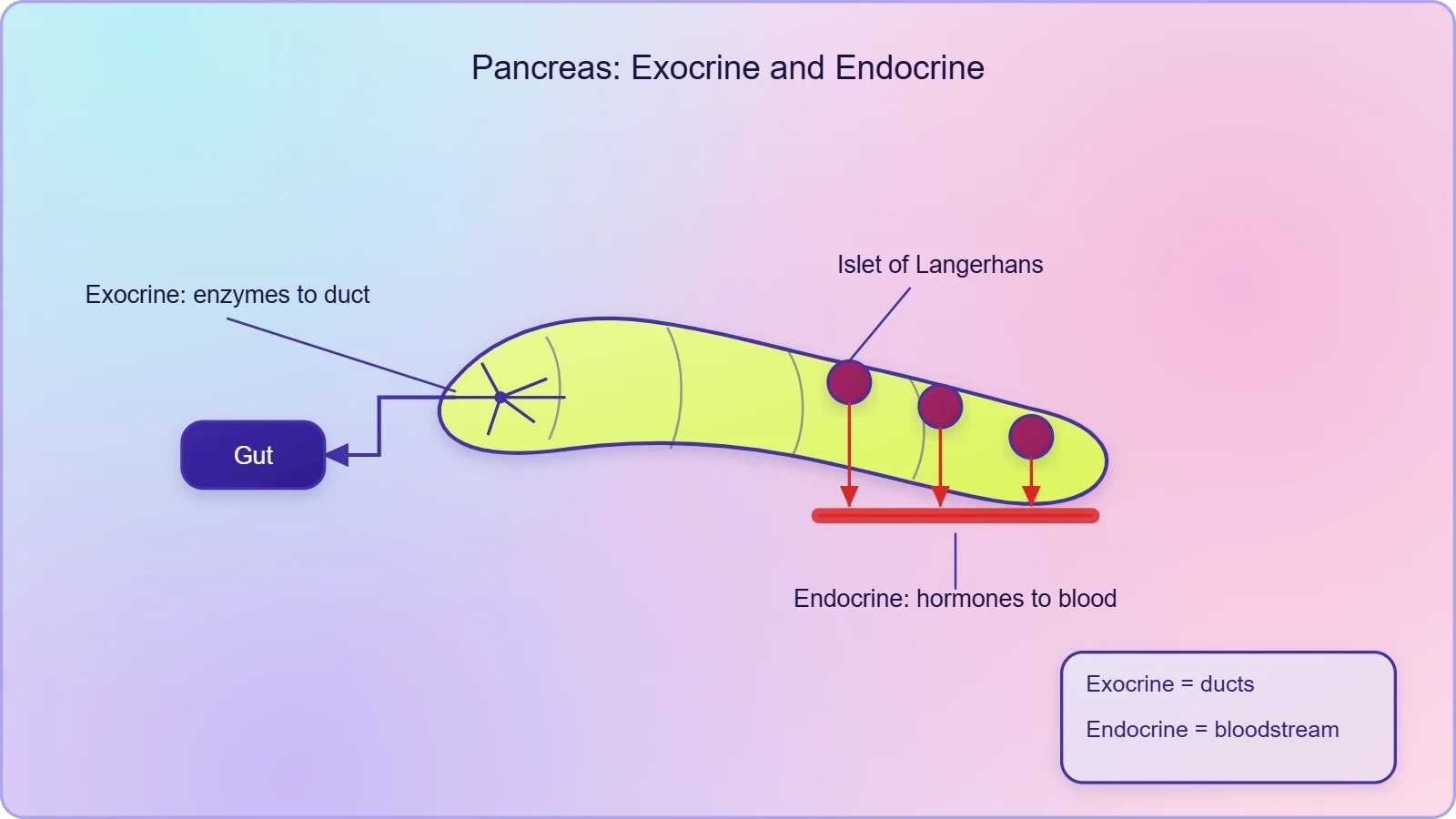
Because the endocrine tissue is dispersed in small clusters rather than gathered into one solid mass, the pancreas illustrates how endocrine cells can be scattered through an organ dominated by another tissue type. The hormonal output is small in volume but precise in effect, and it is this precision, rather than bulk, that gives the endocrine pancreas its physiological importance.
Why the Composite Arrangement Matters
A composite gland allows the body to coordinate digestion and metabolism from a single location. The exocrine secretions handle the breakdown of food in the gut, while the endocrine secretions manage how the products of that digestion, especially glucose, are stored, released, and used. The arrangement is economical: one organ, two outputs, each matched to a different kind of need.
For the learner, the composite nature of the pancreas is also a conceptual bridge. It connects the study of glands to the study of metabolism, and it prepares the way for understanding how hormones regulate the concentration of substances in the blood. That regulatory theme will reappear in the lessons on the testis and the ovary, where steroid hormones govern long-term developmental processes rather than moment-to-moment fuel balance.
The Islets of Langerhans
The endocrine pancreas consists of the Islets of Langerhans, named clusters of cells embedded within the pancreatic tissue. A normal human pancreas contains about one to two million of these islets, and together they represent only one to two per cent of the pancreatic tissue. The numbers are worth pausing over: a tiny fraction of the organ carries the entire endocrine responsibility, which is why damage to such a small population of cells can produce such serious disease.
Within each islet, two main types of cells are recognised. The alpha cells secrete a hormone called glucagon, while the beta cells secrete insulin. These two cell types, sitting side by side in the same microscopic cluster, produce hormones with opposite effects on blood glucose. The islet is therefore a miniature balancing mechanism, a place where the body's need to raise and lower blood sugar is negotiated continuously.
Alpha Cells and Beta Cells
The alpha cells are the source of glucagon, and the beta cells are the source of insulin. This simple division of labour is the foundation of everything that follows in the lesson. When blood glucose falls, the alpha cells respond by releasing glucagon; when blood glucose rises, the beta cells respond by releasing insulin. The two cell populations are partners in regulation, not rivals, and their proximity within the islet allows the system to respond quickly to changing conditions.
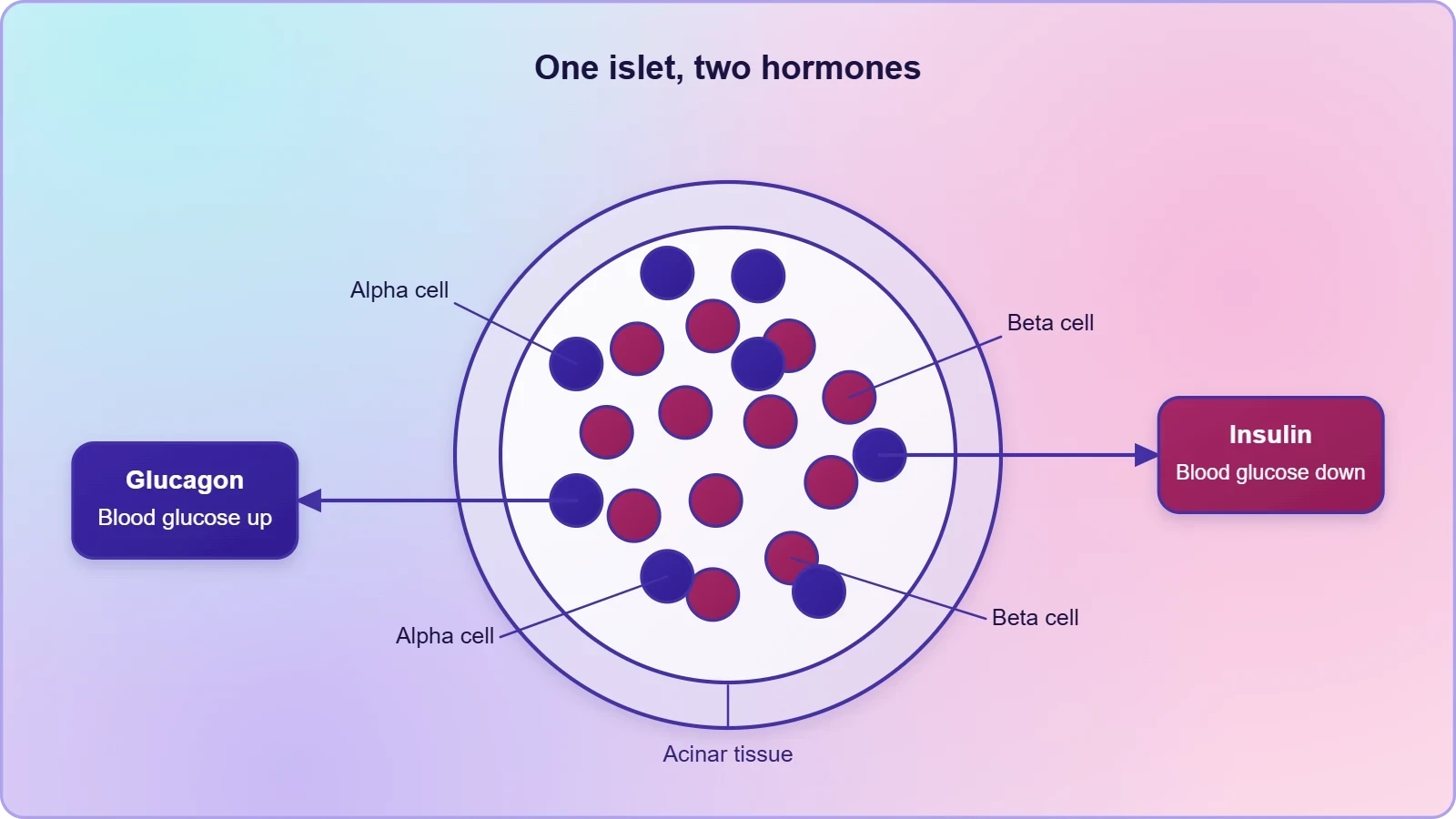
It is useful to remember the pairing as a matter of direction: alpha cells push glucose upward, beta cells pull it downward. The names of the hormones reinforce the point, since glucagon is described as a hyperglycemic hormone and insulin as a hypoglycemic one. Once this pairing is secure, the detailed mechanisms of each hormone become easier to organise.
The Scale of the Endocrine Pancreas
The figure of one to two million islets, representing one to two per cent of pancreatic tissue, conveys the disproportion between anatomical size and physiological power. A structure that occupies a sliver of the organ governs the fuel supply of the entire body. This is a recurring lesson in endocrinology: the significance of a gland is measured by its effects, not by its mass.
That disproportion also explains why pancreatic endocrine failure can be so consequential. When the beta cells can no longer supply adequate insulin, the consequences are systemic rather than local, affecting glucose handling, fat metabolism, and the chemistry of the blood. The smallness of the islets makes their proper function all the more remarkable and their dysfunction all the more serious.
Glucagon: The Hyperglycemic Hormone
Glucagon is a peptide hormone, and it plays an important role in maintaining normal blood glucose levels. Its principal target is the liver, where it acts on the hepatocytes, the liver cells. When glucagon reaches these cells, it stimulates glycogenolysis, the breakdown of stored glycogen, and the result is an increased concentration of sugar in the blood, a condition called hyperglycemia. This is the defining action of the hormone and the reason it is labelled hyperglycemic.
The hormone does not stop there. Glucagon also stimulates gluconeogenesis, the synthesis of new glucose from non-carbohydrate precursors, and this process contributes further to the rise in blood sugar. In addition, glucagon reduces the cellular uptake and utilisation of glucose, so that less sugar is drawn out of the blood by the body's cells. Three actions, all pointing in the same direction, make glucagon a powerful instrument for raising blood glucose when it falls too low.
Actions on the Liver
The liver is the central stage for glucagon's work. Glycogenolysis releases glucose from the glycogen stores that the liver holds, and gluconeogenesis manufactures additional glucose when those stores are insufficient. Because the liver is positioned to receive blood from the digestive tract and to release glucose back into the circulation, it is the natural site for this kind of metabolic correction. Glucagon acts mainly on hepatocytes, and the liver's response is rapid.
The reduction of cellular glucose uptake and utilisation completes the picture. By discouraging cells from consuming glucose at the same time as the liver is releasing it, glucagon ensures that the sugar remains available in the blood for tissues that depend on it. The coordination of release and conservation is what makes the hyperglycemic response effective rather than merely wasteful.
Gluconeogenesis and the Rise in Blood Sugar
Gluconeogenesis is the production of glucose from sources other than glycogen, and it becomes important when glycogen reserves are depleted. Glucagon stimulates this pathway, and the newly formed glucose enters the blood, reinforcing the hyperglycemia produced by glycogenolysis. The two processes together give the body a layered defence against falling blood sugar, one that works first from stored fuel and then from fresh synthesis.
This layered response is a good example of how a single hormone can orchestrate several biochemical pathways at once. Glucagon does not simply switch on one reaction; it shifts the balance of liver metabolism toward output. The result is a coordinated increase in blood glucose that serves the body's immediate energy needs.
Insulin: The Hypoglycemic Hormone
Insulin is a peptide hormone, and it plays a major role in the regulation of glucose homeostasis. Its principal targets are the hepatocytes and the adipocytes, the cells of adipose tissue. Insulin enhances cellular glucose uptake and utilisation, and as a result glucose moves rapidly from the blood into these cells, lowering the concentration of sugar in the blood, a condition called hypoglycemia. Where glucagon raises blood glucose, insulin lowers it, and the two together maintain the balance.
Insulin also stimulates the conversion of glucose to glycogen, a process called glycogenesis, within the target cells. This conversion stores the incoming glucose in a form that can be drawn upon later, and it prevents the sugar from accumulating to harmful levels in the circulation. The combination of increased uptake and increased storage gives insulin its characteristic hypoglycemic effect and makes it the body's principal anabolic signal for glucose.
Targets in Liver and Adipose Tissue
The choice of hepatocytes and adipocytes as principal targets is significant. The liver is the body's central metabolic warehouse, and adipose tissue is its long-term energy reserve. By directing glucose into these two sites, insulin ensures that surplus sugar is stored rather than left circulating. The movement of glucose from blood to cell is rapid, and the effect on blood glucose is correspondingly swift.
This targeting also explains why insulin deficiency produces such widespread disturbance. When the hormone is absent or ineffective, glucose remains in the blood instead of entering the cells that would normally store it, and the body's fuel economy is thrown out of balance. The consequences extend beyond blood sugar alone, reaching into fat metabolism and the chemistry of the blood.
Glycogenesis and Glucose Homeostasis
Glycogenesis, the conversion of glucose to glycogen, is the storage arm of insulin's action. It complements the uptake of glucose by ensuring that what enters the cell is retained in a usable form. The process is stimulated by insulin in the target cells, and it represents the body's way of banking surplus fuel against future need. Without it, the rapid influx of glucose would overwhelm the cell's capacity to use it.
Glucose homeostasis in the blood is thus maintained jointly by the two hormones, insulin and glucagon. Neither alone can hold the balance; it is the interplay between them that keeps blood glucose within a narrow range. This joint maintenance is the central concept of the lesson, and everything else about the endocrine pancreas serves to explain how it works.
Glucose Homeostasis and the Balance of Blood Sugar
Glucose homeostasis is the maintenance of blood glucose within a narrow and stable range, and it is achieved jointly by insulin and glucagon. The two hormones pull in opposite directions, one raising blood sugar and the other lowering it, and the balance between them determines the concentration that the tissues actually experience. This is a classic example of antagonistic hormonal control, and it shows how the endocrine system can regulate a variable without a single master switch.
The logic of the arrangement is straightforward. When blood glucose rises after a meal, insulin is the appropriate response, moving sugar into cells and storing it as glycogen. When blood glucose falls, glucagon is the appropriate response, releasing stored sugar and manufacturing more. The body does not need to choose between the two hormones; it needs both, available in the right proportion at the right moment.
Antagonistic Hormonal Control
Antagonistic control means that two hormones produce opposite effects on the same variable, and the variable settles at a level determined by their relative strength. Insulin and glucagon fit this description precisely. Their opposing actions on glucose uptake, glycogen metabolism, and gluconeogenesis mean that the blood glucose level reflects the balance of their secretion rather than the influence of either one in isolation.
This design has an important advantage: it allows fine adjustment in both directions. A single hormone could only push the variable one way, leaving the return to baseline to some other mechanism. With two antagonists, the system can correct deviations upward or downward with equal precision, which is exactly what a variable as critical as blood glucose requires.
What Happens When the Balance Fails
When the balance fails, the consequences are immediate and systemic. Prolonged hyperglycemia leads to a complex disorder called diabetes mellitus, which is associated with loss of glucose through urine and the formation of harmful compounds known as ketone bodies. The loss of glucose through urine is a direct sign that the blood concentration has exceeded what the kidney can retain, and the ketone bodies signal a deeper disturbance in fuel metabolism.
Diabetic patients are successfully treated with insulin therapy, which restores the missing hypoglycemic signal and allows glucose to re-enter the cells. The success of this treatment is itself evidence for the central role of insulin in glucose homeostasis. It also shows how a precise understanding of hormonal mechanism can translate directly into clinical practice.
Diabetes Mellitus: When Homeostasis Breaks Down
Prolonged hyperglycemia leads to a complex disorder called diabetes mellitus. The name describes a condition in which glucose is lost through the urine, and the loss is a direct consequence of blood glucose rising beyond the kidney's capacity to reclaim it. Alongside this loss, harmful compounds known as ketone bodies are formed, signalling that the body's fuel metabolism has shifted onto an abnormal footing. The disorder is therefore both a glucose problem and a broader metabolic one.
The material is careful to describe diabetes mellitus as complex, and the word is well chosen. The condition is not a single malfunction but a cascade of consequences that follow from the failure of glucose homeostasis. Loss of glucose through urine, formation of ketone bodies, and the underlying disturbance of insulin action together define the clinical picture that the lesson presents.
Loss of Glucose Through Urine
Glucose appearing in the urine is one of the classical signs of diabetes mellitus, and it follows directly from prolonged hyperglycemia. When the concentration of glucose in the blood remains high, the kidney's ability to retain it is exceeded, and sugar escapes into the urine. The loss represents both a waste of fuel and a marker of the underlying hormonal failure, and it is one of the reasons the disorder was recognised long before its hormonal basis was understood.
For the learner, this sign is a useful reminder that hormonal regulation operates at the level of the whole organism. A defect in a small cluster of pancreatic cells can produce a measurable change in the composition of the urine, because the hormone's influence extends to every organ that handles glucose. The islets are small, but their reach is systemic.
Ketone Bodies and Insulin Therapy
The formation of ketone bodies is the second consequence the lesson identifies. These compounds are harmful when produced in excess, and their appearance indicates that the body's handling of fuel has departed from the normal pattern. Together with the loss of glucose through urine, they mark diabetes mellitus as a disorder with effects well beyond the simple concentration of sugar in the blood.
Diabetic patients are successfully treated with insulin therapy, which supplies the hormone that the body is failing to provide in sufficient quantity or effectiveness. The therapy is a direct application of the lesson's central principle: insulin is the hypoglycemic hormone, and restoring it restores the balance. The success of the treatment confirms both the mechanism and the clinical importance of the endocrine pancreas.
Connecting the Pancreas to the Wider Endocrine System
The pancreas does not stand alone in the endocrine system, and placing it beside the adrenal gland clarifies what is distinctive about it. The adrenal medulla releases catecholamines in response to stress, producing rapid, short-lived effects on heart rate, respiration, and glycogen breakdown. The pancreatic islets, by contrast, operate continuously, adjusting glucose handling moment by moment. Both glands use hormones to coordinate metabolism, but they serve different rhythms of need.
The adrenal cortex offers a further point of comparison. Its glucocorticoids stimulate gluconeogenesis and raise blood glucose, while its mineralocorticoids regulate sodium, water, and electrolyte balance. The pancreas shares the glucose-raising theme through glucagon, but it also supplies the opposing hormone that the adrenal cortex lacks. The comparison shows how the endocrine system distributes related functions across several glands rather than concentrating them in one.
From Adrenal Catecholamines to Pancreatic Hormones
The previous lesson established that catecholamines stimulate the breakdown of glycogen, raising blood glucose as part of the fight-or-flight response. Glucagon produces a similar rise, but through a different route and for a different purpose. The adrenal response is episodic and tied to emergency, while the pancreatic response is continuous and tied to the ordinary cycle of feeding and fasting. Recognising this difference prevents the two mechanisms from being conflated.
Both systems converge on the liver, which is the shared target of glycogen breakdown. The convergence is a reminder that hormonal pathways often meet at the same organ, and that the final metabolic outcome depends on which signals are dominant at a given moment. The liver integrates these inputs, and the balance of hormones determines whether it releases or stores glucose.
Preparing for the Gonads
The next lesson turns to the testis and the ovary, glands that produce steroid hormones rather than peptides. The contrast with the pancreas is instructive: insulin and glucagon are peptides acting on cell-surface targets, while testosterone, estrogen, and progesterone are steroids with broad developmental effects. The pancreas regulates a fast-moving variable, blood glucose, while the gonads govern slower processes of maturation and reproduction.
Keeping this contrast in mind helps organise the endocrine system as a whole. Each gland has its own chemistry, its own targets, and its own timescale, yet all of them contribute to chemical coordination. The pancreas, with its tiny islets and its two opposing hormones, remains one of the clearest illustrations of how that coordination is achieved.
Going further
The exocrine part of the pancreas releases digestive enzymes into ducts, while the endocrine islets release hormones into the blood. This division explains why the same organ can serve digestion and metabolic regulation without conflict: the two products travel by different routes to different destinations. Insulin therapy is a standard treatment for diabetes mellitus, as the material notes, and it remains one of the clearest examples of a hormone replacement that directly corrects a defined endocrine deficiency.
Also Read
- No links available.
From our network :
- Analyzing Trump Deportation Numbers Insights Into The 2026 Immigration Crackdown
- Mastering DB2 LUW v12 Tables: A Comprehensive Technical GuideComprehensive guide on DB2 LUW v12 tables. Explore CREATE TABLE syntax, BLU Acceleration, range partitioning, data types, and security features for IBM DB2 LUW v12.
- EV 2.0: The Solid-State Battery Breakthrough and Global Factory ExpansionDiscover the impact of the Solid-State Battery Breakthrough on the EV market. Learn about CATL and BYD stock growth, global factory expansion in Europe, and the future of EV 2.0 technology.
- 98% of Global MBA Programs Now Prefer GRE Over GMAT Focus EditionExplore why 98% of global MBA programs now prefer the GRE over GMAT Focus. Learn about the shorter GRE format, verbal logic importance, and strategic versatility for students.
- Mastering DB2 12.1 Instance Design: A Technical Deep Dive into Modern Database ArchitectureComprehensive guide to DB2 12.1 Instance Design. Explore architectural components, HADR setup, buffer pool tuning, and security policies for IBM DB2 12.1. Includes 10 functional SQL and Shell samples.
- Vite 6/7 'Cold Start' Regression in Massive Module GraphsIn-depth analysis of Vite 6/7 cold start regressions in massive module graphs. Learn about barrel file issues, pre-bundling optimizations, and how to improve Vite dev server performance.
- 10 Physics Numerical Problems with Solutions for IIT JEEPrepare for IIT JEE with 10 physics numerical problems, complete with detailed solutions and conceptual explanations. Ideal for mastering kinematics, thermodynamics, electromagnetism, and optics.
- Trump Political Strategy How Geopolitical Stunts Serve As Media Diversions
- AI-Powered 'Precision Diagnostic' Replaces Standard GRE Score ReportsDiscover the new GRE Precision Diagnostic. Learn how AI-powered behavioral analytics and time-to-solve tracking are replacing standard GRE score reports to empower students.
RESOURCES
- Pancreatic regulation of glucose homeostasis - PMC - NIHpmc.ncbi.nlm.nih.govIntra-islet insulin suppresses glucagon release via GABA-GABAA receptor system. ... glucose-stimulated insulin secretion from mouse islets of Langerhans. Islets ...
- Physiology, Pancreas - StatPearls - NCBI Bookshelf - NIHncbi.nlm.nih.govThe endocrine pancreas produces several hormones that work together to regulate glucose homeostasis, energy storage, and metabolism. Insulin, glucagon, amylin, ...
- Mechanisms controlling pancreatic islet cell function in insulin ... - PMCpmc.ncbi.nlm.nih.gov... islets of Langerhans have important roles in the regulation of ... Intra-islet glucagon signaling is critical for maintaining glucose homeostasis.
- Glucagon Physiology - Endotext - NCBI Bookshelf - NIHncbi.nlm.nih.govJul 16, 2019 ... Glucagon secreted from pancreatic alpha cells in the islet of Langerhans plays an important role in maintaining glucose homeostasis by ...
- Islet beta-cell secretion determines glucagon release from ... - PubMedpubmed.ncbi.nlm.nih.govHomeostasis of blood glucose is maintained by hormone secretion from the pancreatic islets of Langerhans. Glucose stimulates insulin secretion from ...
- Pancreatic alpha cells and glucagon secretion - ScienceDirect.comsciencedirect.comStill, insulin has attracted much more attention than glucagon. Glucagon is released from alpha cells in the islets of Langerhans in response to low…
- Glucagon-like peptide-1 induces cell proliferation and pancreatic ...pubmed.ncbi.nlm.nih.govGlucose homeostasis in mammals is maintained by insulin secretion from the beta-cells of the islets of Langerhans. Type 2 diabetes results either from ...
- The Central Role of Glucokinase in Glucose Homeostasis - Frontiersfrontiersin.org... insulin secretion and glucose induced suppression of glucagon release from islets ... ). Pancreatic islet glucose metabolism and regulation of insulin secretion ...
- Pancreatic Islet Cell Hormones: Secretion, Function, and Diabetes ...onlinelibrary.wiley.comSep 6, 2025 ... The pancreatic islets of Langerhans, which are composed of α, β, δ, ε, and PP cells, orchestrate systemic glucose homeostasis…
- The Cells of the Islets of Langerhans - MDPImdpi.comMar 12, 2018 ... The concerted regulation of glucagon and insulin ... Ghrelin is a physiological regulator of insulin release in pancreatic islets and…
- Neuronal-ILC2 interactions regulate pancreatic glucagon ... - Sciencescience.orgJan 17, 2025 ... ... glucose metabolic homeostasis by releasing the pancreatic hormones insulin and glucagon. ... pancreatic islets of Langerhans, where glucagon ...
- Physiology of the pancreatic α-cell and glucagon secretionjournals.bioscientifica.comJul 31, 2008 ... ... islet of Langerhans along with insulin-secreting β-cells. The islet ... glucose induced glucagon response in isolated islets of Langerhans.
- Dynamic insulin/glucagon measurements from human islet perifusionjournals.lww.comIntroduction: The islets of Langerhans of the pancreas (multicellular ... glucose homeostasis via two primary hormones, insulin, and glucagon. Insulin ...