The human endocrine system is best understood as a distributed network rather than a single organ sitting in one place. It is made up of the classical endocrine glands together with hormone-producing diffused tissues and cells scattered across different parts of the body, and these two components work in concert to regulate growth, metabolism, reproduction, stress responses and internal stability. Recognising this dual architecture is the first step towards reading the endocrine system correctly, because it explains why hormones can originate from organs that are not conventionally described as glands at all.
This lesson, the second in a sequence on chemical coordination and integration, maps that architecture and then narrows its focus onto the hypothalamus, the region of the forebrain that sits at the top of the endocrine hierarchy. It lists the organised endocrine bodies of the body, distinguishes them from the diffuse hormone-secreting tissues found in the gastrointestinal tract, liver, kidney and heart, and then examines how the hypothalamus produces releasing and inhibiting hormones that govern pituitary output. The relationship between the hypothalamus and the pituitary is treated here as a control system, with its two anatomically distinct routes of influence.
Because the previous lesson established what endocrine glands and hormones are, the discussion here builds directly on that foundation and prepares the ground for the detailed treatment of the pituitary gland that follows. Learners should leave this lesson able to name the organised endocrine bodies, explain the two categories of hypothalamic hormones with named examples, and describe how hypothalamic secretions reach the anterior pituitary through a portal circulatory system while the posterior pituitary is governed by direct neural regulation.
On This Page
The Composition of the Human Endocrine System
The endocrine system is defined by its components rather than by a single anatomical location. It consists of the endocrine glands and the hormone-producing diffused tissues and cells that are located in different parts of the body, and it is this combination that gives the system its reach. A learner who pictures only discrete glands will miss a substantial fraction of the body's hormonal signalling, because diffuse endocrine cells embedded in other organs contribute meaningfully to chemical coordination and integration across the whole organism.
Two categories therefore need to be held in mind simultaneously. The first is the set of organised endocrine bodies, discrete structures whose primary purpose is hormone secretion. The second is the set of other organs that produce hormones alongside their other duties, such as the gastrointestinal tract, liver, kidney and heart. Keeping these categories distinct prevents the common error of assuming that a hormone must come from a gland, and it clarifies why the endocrine system is described as a system of tissues and cells rather than a list of organs alone.
The Organised Endocrine Bodies
The organised endocrine bodies in the human body are the pituitary, pineal, thyroid, adrenal, pancreas, parathyroid, thymus and the gonads, with the testis in males and the ovary in females. Each of these is a recognisable structure with a defined location, and each is treated in turn in the sections that follow in the wider course. For the purposes of this lesson, the important point is the completeness of the list: these eight entries constitute the organised endocrine bodies, and learners should be able to reproduce them without reference to a diagram.
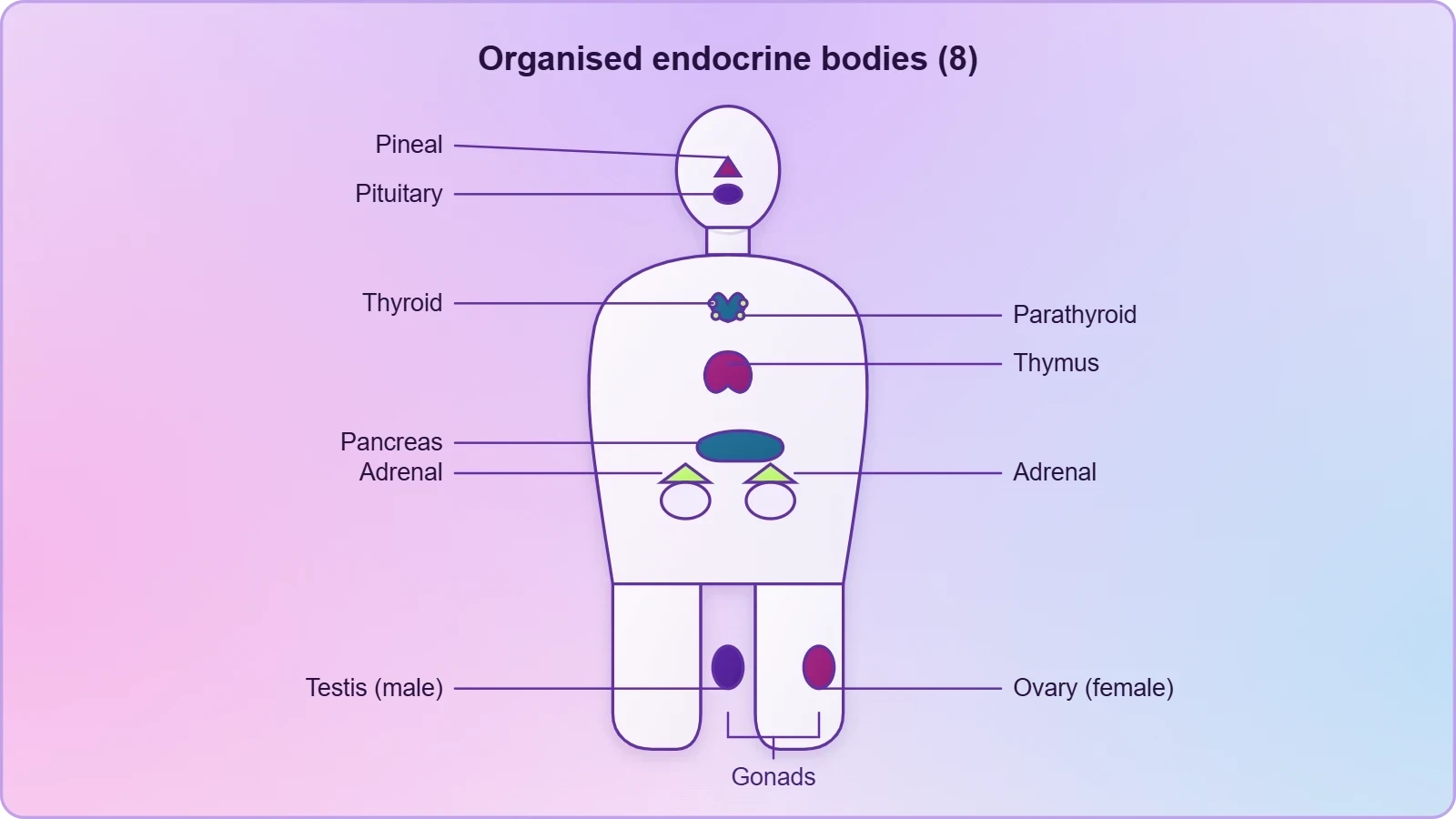
Note that the gonads appear as a single entry with two forms, the testis in males and the ovary in females. This is not a trivial detail. It reflects the fact that the same functional role, the production of sex hormones and gametes, is served by different organs depending on sex, and it prepares the learner for the later discussion of reproductive hormones. The pancreas likewise deserves attention because it combines endocrine function with a major exocrine role, a duality that becomes important when its hormones are studied in detail.
Diffused Hormone-Producing Tissues and Cells
Beyond the organised bodies, several other organs produce hormones. The gastrointestinal tract, liver, kidney and heart are named explicitly as examples of organs that secrete hormones in addition to their other functions. These are not endocrine glands in the classical sense, yet their hormonal contributions are real and integrated into the body's chemical coordination. The gastrointestinal tract, for instance, releases hormones that influence digestion and appetite, while the heart and kidney produce hormones tied to cardiovascular and fluid regulation.
The phrase diffused tissues and cells is deliberate. It signals that in some cases the hormone-producing cells are scattered within an organ rather than gathered into a discrete glandular mass. This scattered arrangement makes the endocrine system harder to map anatomically but no less important functionally. For a beginner, the practical consequence is that the endocrine system cannot be fully enumerated by pointing at glands on a diagram; some of its activity is embedded in organs whose principal identity lies elsewhere.
The Hypothalamus as the Basal Forebrain Regulator
The hypothalamus is the basal part of the diencephalon of the forebrain, and it regulates a wide spectrum of body functions. Its position is significant: sitting at the base of the forebrain, it is anatomically poised to connect neural input with hormonal output, and it is functionally positioned above the pituitary in the endocrine hierarchy. For a learner moving from general glandular anatomy into control mechanisms, the hypothalamus is the natural starting point because it explains how pituitary activity is itself governed rather than spontaneous.
Structurally, the hypothalamus contains several groups of neurosecretory cells called nuclei which produce hormones. The term neurosecretory is worth pausing over, because it captures the dual identity of these cells: they are neurons, capable of receiving and conducting signals, yet they secrete hormones into the blood. This is the cellular basis for the hypothalamus acting as an interface between the nervous and endocrine systems, and it explains why hypothalamic control can be both rapid and sustained in its effects on the body.
Neurosecretory Nuclei and Their Products
The nuclei of the hypothalamus are groups of neurosecretory cells, and each group produces particular hormones. These hypothalamic hormones do not act on distant target tissues in the way that thyroid hormone or cortisol does; instead, their principal role is to regulate the synthesis and secretion of pituitary hormones. This makes the hypothalamus a regulator of a regulator, a tier of control that determines how much of each pituitary hormone is made and released, and thereby shapes the entire downstream cascade of endocrine activity.
The concept of nuclei as functional groups is important for beginners. A nucleus here is not the nucleus of a single cell but a cluster of neurons sharing a secretory product and a role. Different clusters produce different hormones, which is why the hypothalamus can exert selective control over distinct pituitary outputs. The arrangement allows a small region of the brain to coordinate a remarkably broad set of endocrine functions through a limited number of chemical signals delivered to a single downstream gland.
Regulation of Pituitary Synthesis and Secretion
The hormones produced by the hypothalamus regulate the synthesis and secretion of pituitary hormones. Both words matter. Synthesis refers to the production of the pituitary hormone within its cells, and secretion refers to its release into the circulation. Hypothalamic signals can influence either or both, which means the hypothalamus can adjust the size of the pituitary hormone reserve as well as the rate at which it is discharged, giving fine control over the endocrine response to changing conditions.
This regulatory relationship is the reason the hypothalamus is treated before the pituitary in any systematic account of the endocrine system. Understanding that pituitary output is commanded from above prevents the misconception that the pituitary is an autonomous master gland. It is better understood as a relay and amplifier, receiving hypothalamic instructions and translating them into hormonal signals that act on peripheral glands such as the thyroid, adrenal cortex and gonads, or on target tissues directly.
Releasing and Inhibiting Hormones
The hormones produced by the hypothalamus are of two types. Releasing hormones stimulate the secretion of pituitary hormones, while inhibiting hormones inhibit the secretions of pituitary hormones. This binary scheme is elegantly simple and gives the hypothalamus both an accelerator and a brake for each pituitary output it controls. The existence of both types means hypothalamic regulation is bidirectional, capable of increasing or decreasing pituitary activity rather than merely permitting it, which is essential for stable control of hormone levels.
Learners should treat this two-type classification as a framework rather than a list to memorise in isolation. Once the framework is secure, individual hormones can be placed within it according to whether they promote or suppress a pituitary secretion. The named examples that follow illustrate each type, and they are chosen because they act on pituitary outputs with clear and well-known downstream consequences, making the logic of the control system easy to follow.
Releasing Hormones: The Example of GnRH
A hypothalamic hormone called gonadotrophin releasing hormone, or GnRH, stimulates the pituitary synthesis and release of gonadotrophins. The name itself encodes the logic: a releasing hormone that causes the release of gonadotrophins. Gonadotrophins are the pituitary hormones that act on the gonads, so GnRH sits at the top of a three-tier axis running from hypothalamus to pituitary to testis or ovary. This example shows how a single hypothalamic signal can initiate a cascade with effects on reproduction.
The GnRH example also illustrates the meaning of the word stimulate in this context. GnRH does not itself act on the gonads; it acts on the pituitary, instructing it to synthesise and release gonadotrophins. The gonadal effects are indirect, mediated by the pituitary hormones. Keeping the levels of the axis straight is a common difficulty for beginners, and the cleanest way to avoid confusion is to ask, for each hormone, which gland produces it and which gland it acts upon.
Inhibiting Hormones: The Example of Somatostatin
Somatostatin from the hypothalamus inhibits the release of growth hormone from the pituitary. This is the counterpart to GnRH: where GnRH stimulates, somatostatin suppresses. The existence of somatostatin demonstrates that hypothalamic control is not limited to switching pituitary secretion on. The hypothalamus can actively restrain a pituitary output, which is functionally just as important as promoting one, because many hormonal systems require a tonic brake to prevent overproduction and to allow levels to fall when demand declines.
Placing GnRH and somatostatin side by side makes the two-type scheme concrete. One releasing hormone and one inhibiting hormone, each acting on a different pituitary output, together show the full logic of hypothalamic regulation. A learner who can state both examples, identify each as releasing or inhibiting, and name the pituitary hormone affected has grasped the core of this section and is well prepared for the detailed pituitary pharmacology that follows in later study.
How Hypothalamic Hormones Reach the Pituitary
Hormones originating in the hypothalamic neurons pass through axons and are released from their nerve endings. This is a neurosecretory delivery mechanism: the hormone is made in the neuronal cell body, travels down the axon, and is discharged at the terminal. The anatomical route matters because it explains how a brain region can deliver chemical signals to a gland without those signals first entering the general circulation and being diluted or degraded before reaching their target.
From their release points, these hormones reach the pituitary gland through a portal circulatory system and regulate the functions of the anterior pituitary. The portal arrangement is the key structural fact of this section. It provides a dedicated vascular route from the hypothalamic region to the anterior pituitary, so that hypothalamic releasing and inhibiting hormones arrive at their target in concentrated form. This is why the anterior pituitary is described as under humoral control from the hypothalamus.
Axonal Transport and Release at Nerve Endings
The journey begins in the hypothalamic neurons, where the hormones are produced. They then pass through the axons of these neurons and are released from the nerve endings. This is a directed, intracellular transport process rather than simple diffusion, and it ensures that hormone release occurs at a specific location suited to the vascular arrangement that follows. The axon thus serves as a conduit linking the site of synthesis in the brain to the site of discharge near the pituitary.
For learners, the important distinction is between where a hormone is made and where it is released. In the hypothalamic system these are different places connected by the axon. This is a general principle of neurosecretion and it recurs in the posterior pituitary, where hormones made in hypothalamic neurons are released from nerve endings in the gland itself. Recognising the pattern here makes the posterior pituitary arrangement, described next, immediately intelligible rather than a separate fact to memorise.
The Portal Circulatory Route to the Anterior Pituitary
Through the portal circulatory system, hypothalamic hormones reach the pituitary and regulate the functions of the anterior pituitary. The word portal denotes a vascular arrangement in which blood passes from one capillary bed to another before returning to the heart. Here it carries hypothalamic hormones directly to the anterior pituitary, so that the gland receives a concentrated signal rather than a diluted systemic one. This is the structural basis for the hypothalamus acting as the controlling influence over anterior pituitary secretion.
The functional consequence is selectivity and efficiency. Because the hypothalamic hormones are delivered by a dedicated route, small quantities can exert effective control over anterior pituitary cells. The anterior pituitary then releases its own hormones into the general circulation to act on peripheral glands and tissues. The portal system therefore marks the boundary between the hypothalamic control tier and the pituitary output tier, and it is the anatomical reason the two tiers can be described as distinct stages of a single axis.
Neural Control of the Posterior Pituitary
The posterior pituitary is under the direct neural regulation of the hypothalamus. This is the second of the two control routes and it stands in deliberate contrast to the portal route serving the anterior pituitary. Where the anterior lobe receives hormonal instructions through the blood, the posterior lobe receives neural instructions through nerve fibres. The two lobes of a single gland are therefore governed by two different mechanisms, and this is one of the most instructive contrasts in endocrine anatomy.
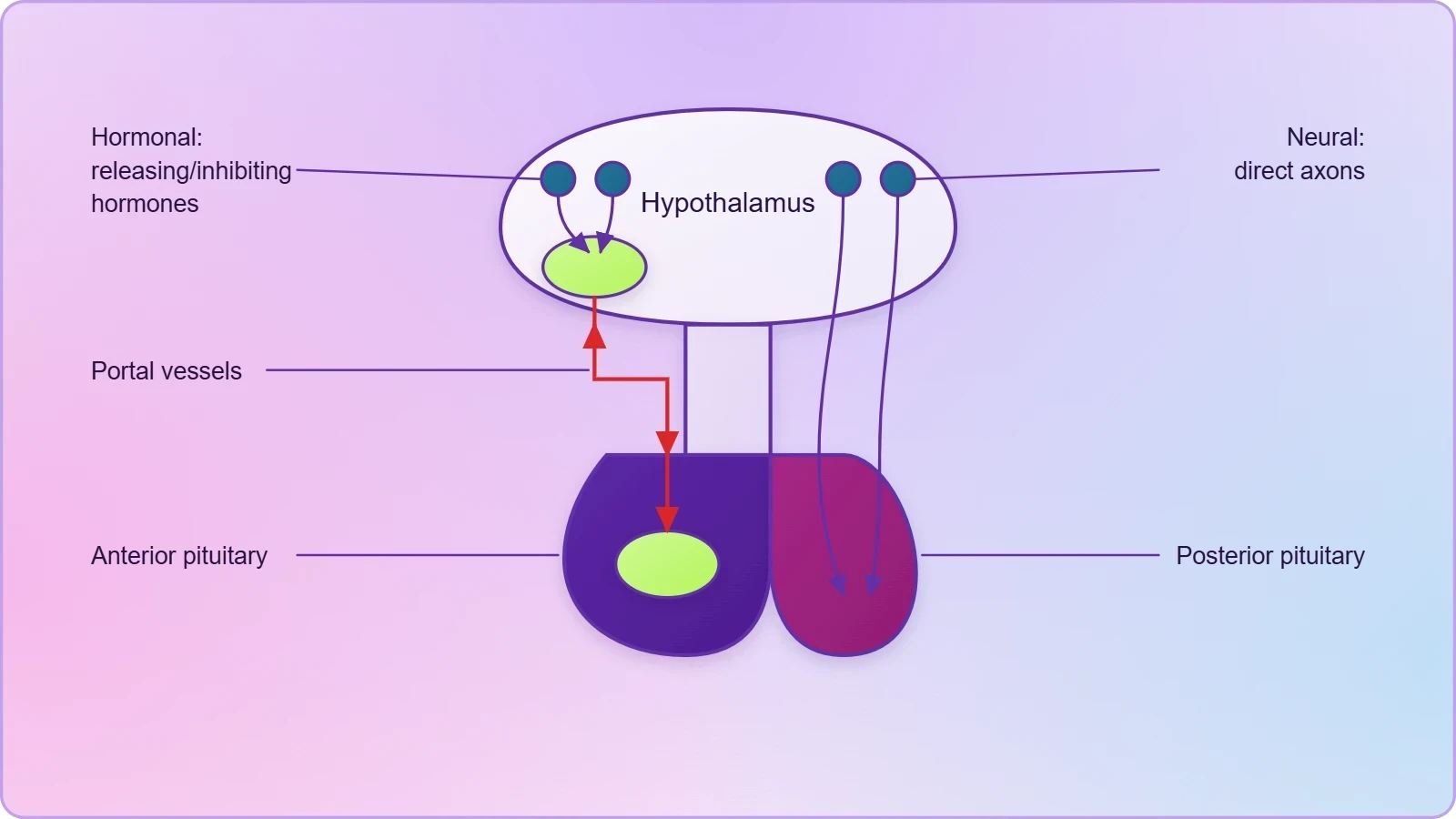
The contrast is worth stating plainly because it prevents a common conflation. It is tempting to assume that because the hypothalamus controls the pituitary, it must do so in one uniform way. The material makes clear that it does not. The anterior pituitary is regulated by hypothalamic hormones delivered through a portal circulatory system, while the posterior pituitary is regulated directly by neural signals. A learner who can articulate both routes, and assign each to the correct lobe, has understood the central structural point of this lesson.
Contrasting Humoral and Neural Control
Humoral control and neural control differ in their medium and their speed. The anterior pituitary is influenced by hormones carried in a dedicated blood route, so its regulation is chemical and depends on the secretion of releasing and inhibiting hormones from hypothalamic neurons. The posterior pituitary is influenced by direct neural regulation, so its control is electrical and chemical along nerve fibres. Both are hypothalamic, but they operate through different channels, and this difference is the reason the two lobes are treated separately in any account of pituitary function.
For the learner, the practical value of this contrast is diagnostic. If asked how a given pituitary lobe is controlled, the answer follows from the lobe rather than from the gland as a whole. Anterior means portal, hormonal, releasing and inhibiting. Posterior means neural, direct. This simple mapping is a reliable memory aid and it prepares the ground for the next lesson, which examines the pituitary gland itself and the hormones of each lobe in detail.
Preparing for the Pituitary Gland
This lesson has established the hypothalamic tier of endocrine control: its location in the basal diencephalon, its neurosecretory nuclei, its two types of hormone, and its two routes of influence over the pituitary. The next lesson takes up the pituitary gland itself, and the material here is designed to make that transition smooth. Knowing that anterior pituitary function is regulated by hypothalamic releasing and inhibiting hormones delivered through a portal system means the pituitary hormones can be studied as outputs of a controlled system rather than as isolated secretions.
The same applies to the posterior lobe. Knowing that it is under direct neural regulation of the hypothalamus means its hormones can be understood as extensions of hypothalamic neuronal activity rather than as products of the gland in which they are released. With this framework in place, the detailed treatment of pituitary hormones becomes an exercise in filling in specifics within a structure that is already understood, which is precisely the advantage of studying the hypothalamus before the pituitary.
Going Further: The Neuroendocrine Interface
The hypothalamus links the nervous system and the endocrine system, which is why it is described as a neuroendocrine organ. This description follows from the nature of its neurosecretory cells: they receive neural input and respond by secreting hormones, converting an electrical signal into a chemical one. The hypothalamus is therefore not merely a gland that happens to sit in the brain, but a genuine junction between two major control systems, and this is the conceptual reason it occupies the top of the endocrine hierarchy.
A portal circulatory system carries blood directly from one capillary bed to another, allowing hypothalamic hormones to reach the pituitary without first passing through the general circulation. This background detail explains the efficiency of the anterior pituitary control route described in the material. Because the blood passes from the hypothalamic capillary bed to the pituitary capillary bed, hypothalamic hormones arrive at the anterior pituitary in high concentration, and the dilution that would occur in the systemic circulation is avoided.
Consolidating the Lesson
The endocrine system is constituted by the endocrine glands together with hormone-producing diffused tissues and cells located in different parts of the body. Its organised endocrine bodies are the pituitary, pineal, thyroid, adrenal, pancreas, parathyroid, thymus and gonads, with the testis in males and the ovary in females. In addition, organs such as the gastrointestinal tract, liver, kidney and heart produce hormones. This two-part composition is the foundation on which every subsequent lesson in the course builds, and it should be secure before moving on.
The hypothalamus is the basal part of the diencephalon of the forebrain and regulates a wide spectrum of body functions. Its neurosecretory nuclei produce hormones of two types: releasing hormones that stimulate pituitary secretion, exemplified by GnRH acting on gonadotrophins, and inhibiting hormones that suppress it, exemplified by somatostatin acting on growth hormone. These hormones pass through axons, are released from nerve endings, and reach the pituitary through a portal circulatory system to regulate the anterior pituitary, while the posterior pituitary is under direct neural regulation.
Self-Check Questions
Can you list the organised endocrine bodies without reference to a diagram, and name the gonads correctly for each sex? Can you name two organs that produce hormones without being organised endocrine bodies? Can you state the location of the hypothalamus in the forebrain and explain what its neurosecretory nuclei do? Can you define releasing and inhibiting hormones and give one named example of each with the pituitary hormone it affects? Can you describe the two routes by which the hypothalamus influences the pituitary, and assign each route to the correct lobe?
If any of these questions cannot be answered confidently, return to the relevant section before proceeding. The next lesson examines the pituitary gland in detail, and it assumes fluency with the hypothalamic tier established here. The questions are deliberately phrased to test recall of the material's own terminology, because that terminology is the shared language in which the rest of the course is written, and precision in using it will pay dividends as the endocrine glands are studied one by one.
Key Terms to Retain
Retain the following terms with their meanings as given: endocrine system, organised endocrine bodies, diffused tissues and cells, hypothalamus, diencephalon, neurosecretory cells, nuclei, releasing hormones, inhibiting hormones, gonadotrophin releasing hormone, somatostatin, gonadotrophins, growth hormone, axons, nerve endings, portal circulatory system, anterior pituitary, posterior pituitary, and neural regulation. Each term carries a specific meaning in this lesson, and using them loosely will cause confusion later when the pituitary hormones and their targets are introduced in detail.
The term portal circulatory system deserves particular attention because it is the structural key to anterior pituitary control. The term neural regulation deserves equal attention because it is the structural key to posterior pituitary control. Together they express the central contrast of the lesson: one lobe governed by blood-borne hypothalamic hormones, the other by direct neural signals. Holding both in mind, with their named examples and their anatomical routes, is the measure of having learned this lesson well and being ready for the next.
Also Read
- No links available.
From our network :
- Vite 6/7 'Cold Start' Regression in Massive Module GraphsIn-depth analysis of Vite 6/7 cold start regressions in massive module graphs. Learn about barrel file issues, pre-bundling optimizations, and how to improve Vite dev server performance.
- EV 2.0: The Solid-State Battery Breakthrough and Global Factory ExpansionDiscover the impact of the Solid-State Battery Breakthrough on the EV market. Learn about CATL and BYD stock growth, global factory expansion in Europe, and the future of EV 2.0 technology.
- AI-Powered 'Precision Diagnostic' Replaces Standard GRE Score ReportsDiscover the new GRE Precision Diagnostic. Learn how AI-powered behavioral analytics and time-to-solve tracking are replacing standard GRE score reports to empower students.
- Mastering DB2 12.1 Instance Design: A Technical Deep Dive into Modern Database ArchitectureComprehensive guide to DB2 12.1 Instance Design. Explore architectural components, HADR setup, buffer pool tuning, and security policies for IBM DB2 12.1. Includes 10 functional SQL and Shell samples.
- Trump Political Strategy How Geopolitical Stunts Serve As Media Diversions
- Mastering DB2 LUW v12 Tables: A Comprehensive Technical GuideComprehensive guide on DB2 LUW v12 tables. Explore CREATE TABLE syntax, BLU Acceleration, range partitioning, data types, and security features for IBM DB2 LUW v12.
- 10 Physics Numerical Problems with Solutions for IIT JEEPrepare for IIT JEE with 10 physics numerical problems, complete with detailed solutions and conceptual explanations. Ideal for mastering kinematics, thermodynamics, electromagnetism, and optics.
- 98% of Global MBA Programs Now Prefer GRE Over GMAT Focus EditionExplore why 98% of global MBA programs now prefer the GRE over GMAT Focus. Learn about the shorter GRE format, verbal logic importance, and strategic versatility for students.
- Analyzing Trump Deportation Numbers Insights Into The 2026 Immigration Crackdown
RESOURCES
- Hypothalamus: What It Is, Function, Conditions & Disordersmy.clevelandclinic.orgMar 16, 2022 ... The hypothalamus is a structure deep within your brain. It's the main link between your endocrine system and your nervous…
- Overview of the Endocrine System | US EPAepa.govJun 10, 2026 ... Where are endocrine glands located in the human body? Why are ... The hypothalamus drives the endocrine system. Pituitary gland…
- A review of the endocrine disrupting effects of micro and nano ... - PMCpmc.ncbi.nlm.nih.govHypothalamus is an essential part of the endocrine system that connects the nervous system ... endocrine disruptors in human and wildlife: A possible ...
- Endocrine System: What It Is, Function, Organs & Diseasesmy.clevelandclinic.orgNov 22, 2023 ... ... glands of the endocrine system, including the pituitary gland, adrenal glands ... gland at the base of your brain…
- Pathophysiology of the Effects of Alcohol Abuse on the Endocrine ...pmc.ncbi.nlm.nih.gov... endocrine system; hypothalamus; pituitary gland; hormones; hormonal disturbances; endocrine pancreas; endocrine adipose tissue; immune system; humans; animal ...
- Estrogen receptor-alpha distribution in the human hypothalamus in ...pubmed.ncbi.nlm.nih.govEndocrine System / physiology*; Estrogen Receptor alpha; Female; Humans; Hypothalamus / anatomy & histology*; Hypothalamus / cytology; Hypothalamus / metabolism ...
- Physiology, Hypothalamus - StatPearls - NCBI Bookshelfncbi.nlm.nih.govThe hypothalamus is the region in the ventral brain which coordinates the endocrine system ... 2. Braak H, Braak E. Anatomy of the human…
- A Hormone Cell Atlas maps the human endocrine system ... - Sciencescience.orgWithin these loops, the widespread expression of steroid and thyroid hormone receptors, including in hypothalamic and pituitary endocrine cells, suggests ...
- Physiology, Stress Reaction - StatPearls - NCBI Bookshelfncbi.nlm.nih.govMay 7, 2024 ... The endocrine system ... 10. Bao AM, Meynen G, Swaab DF. The stress system in depression and neurodegeneration: focus on…
- Endocrine system - Wikipediaen.wikipedia.orgIn vertebrates, the hypothalamus is the neural control center for all endocrine systems. Endocrine system. Main glands of the human endocrine system. Details.
- Brain Hormones | Endocrine Societyendocrine.orgJan 24, 2022 ... Together, the hypothalamus and pituitary tell the other endocrine glands ... Should I see an endocrinologist about my condition? Human…
- Human endocrine system | Description, Function, Glands, & Hormonesbritannica.comThe human endocrine system is a network of ductless glands that produce and secrete chemical substances called hormones. These hormones travel through the ...
- Hypothalamus: Function, hormones, and disordersmedicalnewstoday.comThese diseases can be hard to pinpoint and diagnose because the hypothalamus has a wide range of roles in the endocrine system. ... The…
- What is the Endocrine System? - US EPA19january2017snapshot.epa.govAug 30, 2016 ... Where are endocrine glands located in the human body? How can ... The hypothalamus drives the endocrine system. Pituitary gland…
- The Endocrine System: Hypothalamus and Pituitary - Visible Bodyvisiblebody.comJan 2, 2015 ... Secrete human growth hormone (hGH), aka somatotropin, which stimulates tissues to secrete hormones that stimulate body growth and regulate ...