Every kidney in the human body sits beneath a small, triangular cap of tissue that quietly governs how we respond to fear, how we manage sugar and salt, and how our bodies endure sustained pressure. That cap is the adrenal gland, and it is one of the most strategically placed organs in the endocrine system. Its position above each kidney is no accident of anatomy: the gland sits at the crossroads of fluid regulation, cardiovascular control and metabolic mobilisation, releasing chemical signals that reach nearly every tissue in the body within seconds or minutes.
What makes the adrenal gland genuinely fascinating is that it is really two glands fused into one capsule. The inner core, the adrenal medulla, behaves like a rapid-response unit that floods the bloodstream with catecholamines during emergencies. The outer shell, the adrenal cortex, works on a slower, more sustained timescale, secreting steroid hormones that shape carbohydrate metabolism, electrolyte balance and even the growth of body hair during puberty. Understanding this division is the key to understanding everything the gland does.
This lesson examines the adrenal gland in the order the subject naturally unfolds: first its structure and dual tissue composition, then the emergency hormones of the medulla, then the three layered zones of the cortex and the corticoids they produce, and finally the clinical consequences when cortical output falls short. It builds directly on the parathyroid and thymus discussion and prepares the ground for the pancreas, where the theme of metabolic control continues.
On This Page
Structure and Position of the Adrenal Glands
The body possesses one pair of adrenal glands, each positioned directly above a kidney. This simple anatomical fact carries real functional weight, because the gland's hormones act heavily on renal function, blood volume and vascular tone. The proximity allows mineralocorticoids such as aldosterone to act on the renal tubules with immediate relevance to the organ sitting just below, while glucocorticoids circulate systemically to influence liver, muscle and immune tissue. The gland is small, but its strategic location makes it a central node in the body's chemical coordination network.
Each gland is composed of two distinct types of tissue, and this duality is the defining structural feature of the organ. The centrally located tissue is called the adrenal medulla, while outside this lies the adrenal cortex. These two regions differ in origin, in the chemistry of their secretions and in the speed with which they act. The medulla releases amine hormones stored in advance and ready for instant discharge, whereas the cortex synthesises steroid hormones that require enzymatic conversion and act over longer horizons. Recognising this two-part architecture prevents the common mistake of treating the adrenal gland as a single uniform secretory unit.
The Two Tissues of a Single Gland
Diagrammatic representations of the adrenal gland typically show two views: the intact gland perched above the kidney, and a sectioned gland revealing the two parts. In the section, the adrenal cortex forms the outer rind and the adrenal medulla occupies the centre. This arrangement means that cortical tissue surrounds medullary tissue like a shell around a core, and the two regions receive different regulatory inputs even though they share a blood supply. The structural separation is the anatomical basis for the functional separation that dominates the rest of this lesson.
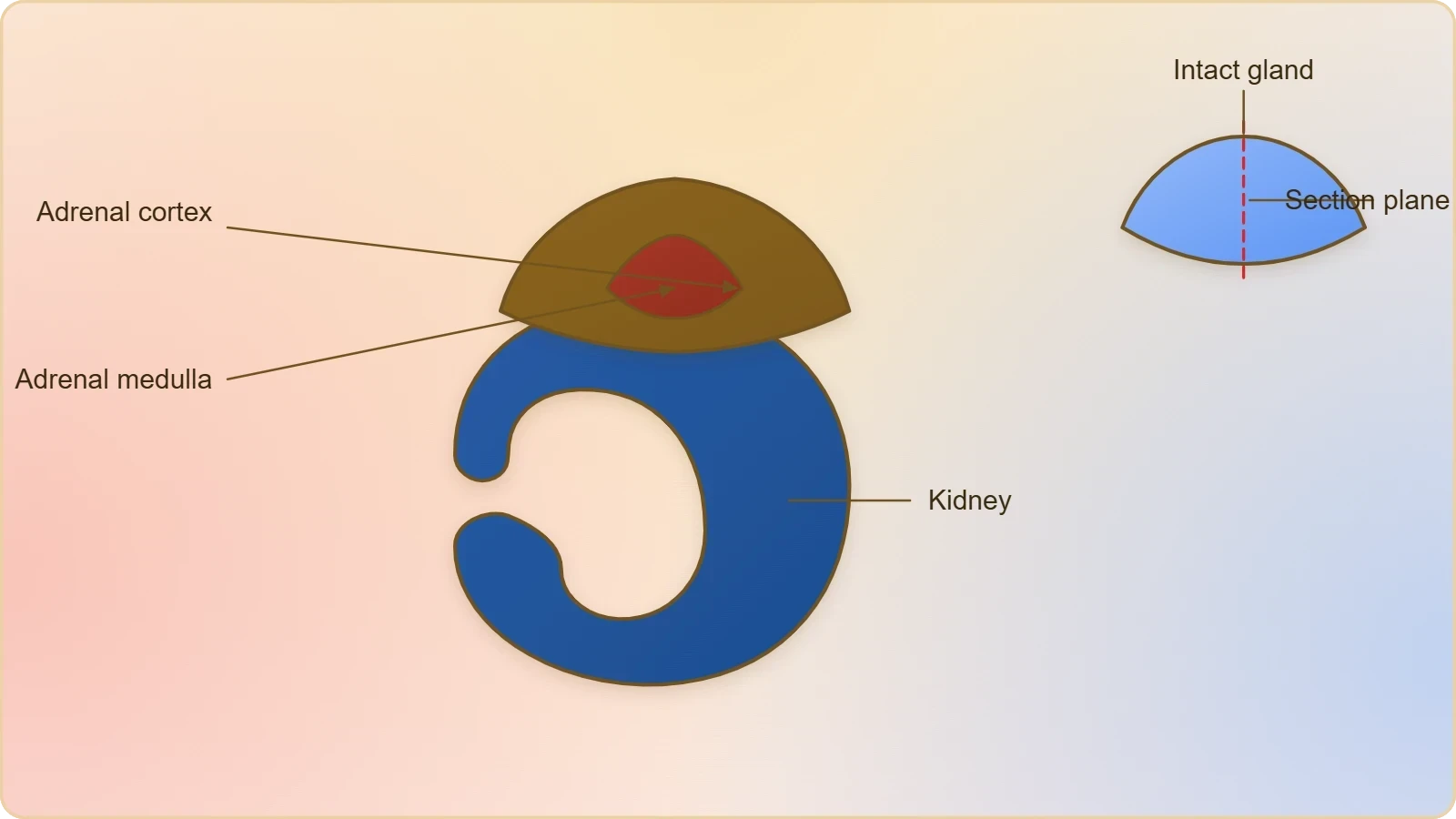
Because the two tissues are distinct, a disorder affecting one need not affect the other. A deficit in medullary catecholamines produces a very different clinical picture from a deficit in cortical steroids. This principle of compartmentalised function is worth holding onto as the lesson proceeds, since it explains why the emergency actions of adrenaline and the metabolic actions of cortisol, though both arise from the same small organ, belong to entirely separate physiological conversations.
Why Position Matters
The placement of the adrenal glands above the kidneys reflects a functional partnership rather than mere proximity. Aldosterone, the principal mineralocorticoid, acts mainly at the renal tubules, and its effects on sodium reabsorption, water retention and potassium excretion are executed directly in the kidney beneath it. The gland therefore sits at the top of a regulatory loop whose effector organ lies immediately downstream, a neat arrangement that keeps the control point and the target tissue anatomically adjacent.
This partnership extends to blood pressure regulation. By adjusting sodium and water handling in the kidney, the cortex influences body fluid volume, osmotic pressure and ultimately blood pressure. The adrenal gland thus participates in cardiovascular homeostasis not through direct action on the heart, but through its influence on the kidney's handling of electrolytes and water. Position and function reinforce one another in a way that makes the adrenal gland a compact illustration of endocrine integration.
The Adrenal Medulla and the Emergency Hormones
The adrenal medulla secretes two hormones called adrenaline, or epinephrine, and noradrenaline, or norepinephrine. These are commonly called catecholamines. Their defining characteristic is speed: adrenaline and noradrenaline are rapidly secreted in response to stress of any kind and during emergency situations, which is why they are called emergency hormones, or hormones of fight or flight. The medulla therefore functions as the body's fast channel, delivering a chemical alarm that prepares every major organ system for immediate action.
The effects of these catecholamines are widespread and coordinated. They increase alertness, pupillary dilation, piloerection, which is the raising of hairs, and sweating. Both hormones increase the heartbeat, the strength of heart contraction and the rate of respiration. Catecholamines also stimulate the breakdown of glycogen, resulting in an increased concentration of glucose in the blood. In addition, they stimulate the breakdown of lipids and proteins. Every one of these actions serves the same purpose: to mobilise energy and sharpen the senses so the organism can meet a sudden demand.
Fight or Flight in Physiological Detail
The fight-or-flight response is best understood as a coordinated redeployment of the body's resources. Alertness and pupillary dilation sharpen sensory intake. Increased heart rate and stronger cardiac contraction push more blood to muscles and brain. Faster respiration improves oxygen supply. Sweating supports thermoregulation during exertion. Piloerection, though of limited practical value in humans, is a vestige of the same response seen in furred animals. Together these changes convert a resting body into one primed for immediate physical action.
The metabolic dimension is equally important. By stimulating glycogen breakdown, catecholamines release stored glucose into the blood, providing fuel for muscles and brain. The simultaneous breakdown of lipids and proteins extends the fuel supply beyond carbohydrate reserves. This is why the emergency hormones are described as raising blood glucose concentration: the body is provisioning itself for sustained effort. The medulla thus couples a rapid behavioural readiness with a rapid metabolic mobilisation, ensuring that the response to stress is both fast and fuelled.
Rapid Secretion and Its Consequences
The phrase "rapidly secreted" captures the essential design of the medulla. Unlike steroid hormones, which must be synthesised on demand, catecholamines are stored in advance and released within moments of a stress signal. This allows the body to respond to a sudden threat before slower hormonal and metabolic adjustments can take effect. The medulla is, in effect, the first responder of the endocrine system, buying time for the cortex and other glands to mount their more sustained responses.
Because the medulla responds to stress of any kind, its activation is not limited to physical danger. Psychological stress, cold, pain and exertion can all trigger catecholamine release. The hormones do not distinguish between a predator and a deadline; they simply prepare the body for action. This generality is one reason the fight-or-flight concept has become such a durable framework for understanding how the body handles acute challenge, and it sets the stage for the slower cortical hormones that follow.
The Adrenal Cortex and Its Three Layers
The adrenal cortex can be divided into three layers: the zona reticularis, the inner layer; the zona fasciculata, the middle layer; and the zona glomerulosa, the outer layer. This concentric arrangement is not merely descriptive. Each zone specialises in particular secretory products, so the layered structure maps onto a layered chemistry. The cortex secretes many hormones, commonly called corticoids, and the two major functional families among them are the glucocorticoids, involved in carbohydrate metabolism, and the mineralocorticoids, which regulate the balance of water and electrolytes in the body.
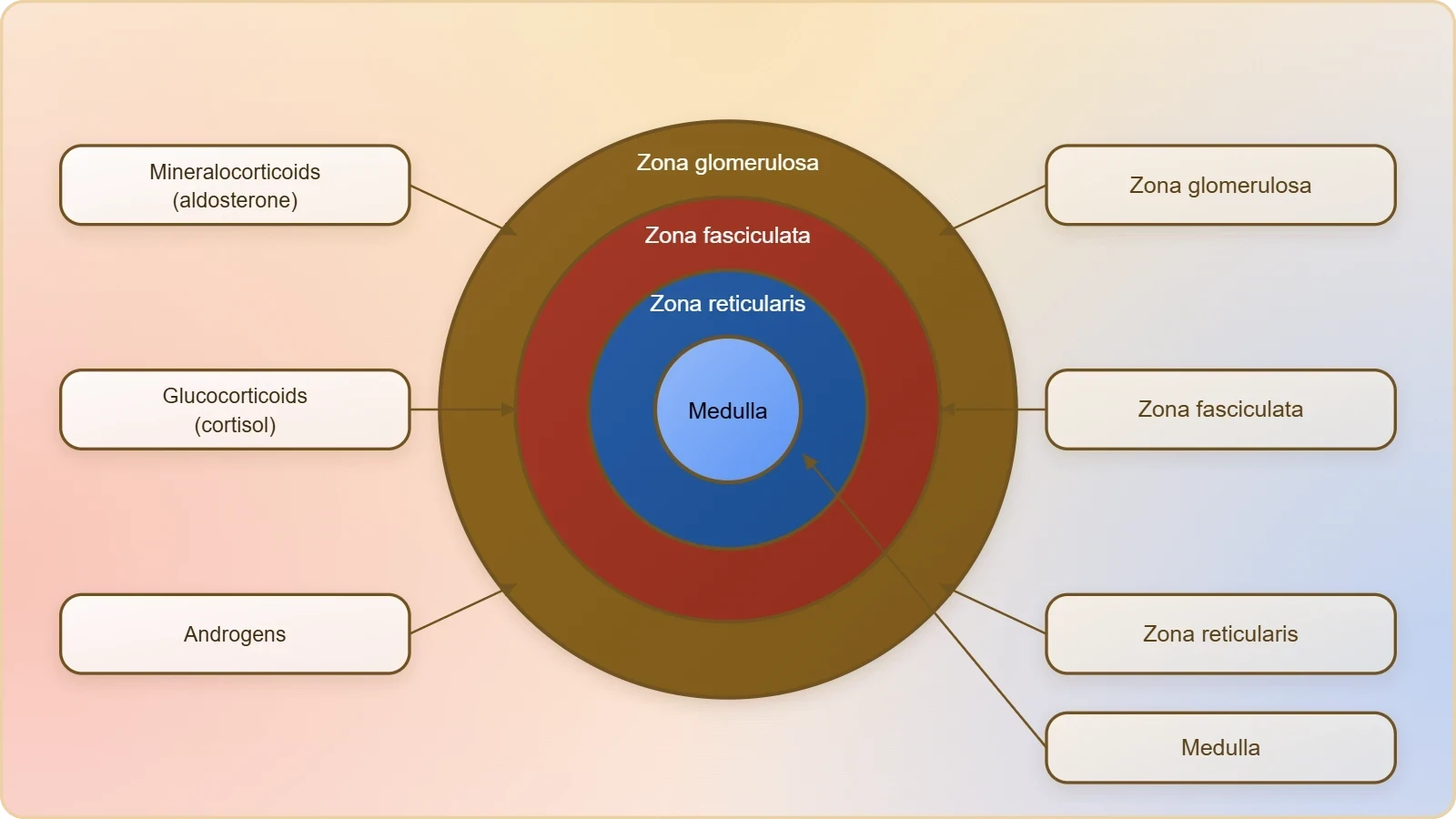
In our body, cortisol is the main glucocorticoid, and aldosterone is the main mineralocorticoid. These two names anchor the entire discussion of cortical function. Cortisol governs the metabolic, anti-inflammatory and immune-suppressive actions of the cortex, while aldosterone governs the renal handling of sodium, water and potassium. Alongside these, small amounts of androgenic steroids are also secreted by the adrenal cortex, playing a role in the growth of axial hair, pubic hair and facial hair during puberty. The cortex is therefore a compact factory with three distinct product lines.
Zones and Their Secretory Roles
The three zones of the cortex are conventionally associated with different outputs. The outer zona glomerulosa is the principal source of mineralocorticoids, chiefly aldosterone. The middle zona fasciculata is the main source of glucocorticoids such as cortisol. The inner zona reticularis produces the androgenic steroids. This zonal division helps explain why cortical disorders can be selective: a problem in one layer may spare the functions of the others, producing a clinical picture dominated by whichever hormone family is most affected.
Understanding the zones also clarifies the logic of the cortex's regulatory inputs. Aldosterone secretion responds primarily to signals reflecting electrolyte status and blood volume, while cortisol secretion follows a different rhythm tied to stress and daily cycles. The layered anatomy thus reflects a layered control system, in which each zone listens to a different set of physiological cues and responds with its own characteristic hormone. The cortex is a single gland, but it behaves like three coordinated ones.
Glucocorticoids and Mineralocorticoids Defined
The definitional distinction between the two corticoid families is straightforward and worth stating precisely. Corticoids involved in carbohydrate metabolism are called glucocorticoids, and cortisol is the main glucocorticoid in our body. Corticoids that regulate the balance of water and electrolytes are called mineralocorticoids, and aldosterone is the main mineralocorticoid. These definitions are functional rather than structural: they classify hormones by what they do, not by which zone makes them, although the zones and functions broadly align.
This functional classification is the organising principle for the next two sections. Glucocorticoid actions centre on glucose production, fat and protein breakdown, cardiovascular and renal support, inflammation and immunity, and red blood cell production. Mineralocorticoid actions centre on the renal tubules and the handling of sodium, water, potassium and phosphate. Keeping the two families distinct prevents confusion, because their target tissues, their timescales and their clinical consequences differ substantially.
Glucocorticoids: Cortisol and Metabolic Control
Glucocorticoids stimulate gluconeogenesis, lipolysis and proteolysis, and inhibit cellular uptake and utilisation of amino acids. Cortisol, the main glucocorticoid in our body, is also involved in maintaining the cardiovascular system as well as the kidney functions. Glucocorticoids, particularly cortisol, produce anti-inflammatory reactions and suppress the immune response. Cortisol stimulates the RBC production. This combination of metabolic, cardiovascular, immune and haematological actions makes cortisol one of the most broadly influential hormones in the body.
The metabolic actions deserve careful attention because they explain the name. Gluconeogenesis is the synthesis of glucose from non-carbohydrate precursors, and by stimulating it cortisol raises blood glucose. Lipolysis breaks down lipids, releasing fatty acids as fuel. Proteolysis breaks down proteins, supplying amino acids that can feed gluconeogenesis. The inhibition of cellular uptake and utilisation of amino acids channels these building blocks away from protein synthesis and toward glucose production. The net effect is a mobilisation of stored reserves in service of sustained energy supply.
Anti-inflammatory and Immune Actions
Cortisol's anti-inflammatory and immune-suppressive actions are among its most clinically significant properties. By producing anti-inflammatory reactions and suppressing the immune response, glucocorticoids dampen the body's defensive overreactions. This is physiologically useful in moderating inflammation, but it also means that sustained high cortisol can leave an organism more vulnerable to infection. The same property underlies the therapeutic use of glucocorticoid-like drugs in inflammatory conditions, where the aim is precisely to suppress an excessive immune response.
These actions illustrate a broader principle of endocrine control: hormones rarely do one thing. Cortisol simultaneously mobilises fuel, supports the cardiovascular system, maintains kidney function, moderates inflammation, restrains immunity and stimulates red blood cell production. The body accepts this bundling because the actions are coherent in context: a sustained stressor demands energy, circulatory support and a calibrated immune posture. The breadth of cortisol's reach is why glucocorticoid excess or deficiency produces such wide-ranging effects.
Cardiovascular, Renal and Haematological Roles
Beyond metabolism and immunity, cortisol maintains the cardiovascular system and kidney functions, and it stimulates the production of red blood cells. These roles are easy to overlook because they are less dramatic than the metabolic actions, but they matter greatly for overall physiological stability. A hormone that supports vascular tone, renal function and red cell production is effectively underwriting the body's capacity to deliver oxygen and maintain circulation under demanding conditions.
The haematological action is particularly instructive. By stimulating RBC production, cortisol supports oxygen-carrying capacity, which complements its metabolic mobilisation of fuel. The cardiovascular and renal roles similarly complement the metabolic ones: energy mobilisation is useless without circulation to distribute it and kidneys to manage fluid and electrolyte balance. Cortisol thus acts as an integrative hormone, coordinating several systems toward the common goal of sustaining function under stress.
Mineralocorticoids: Aldosterone and Electrolyte Balance
Aldosterone acts mainly at the renal tubules and stimulates the reabsorption of sodium and water and the excretion of potassium and phosphate ions. Through these actions, aldosterone helps in the maintenance of electrolytes, body fluid volume, osmotic pressure and blood pressure. This is a compact but powerful statement of function: a single hormone, acting at a single target site, regulates four interconnected properties of the internal environment. The elegance of the system lies in how tightly these properties are coupled.
The logic is straightforward once the renal actions are understood. Reabsorbing sodium and water expands body fluid volume, which supports blood pressure. Excreting potassium and phosphate removes ions that would otherwise accumulate. The resulting balance of electrolytes preserves osmotic pressure, ensuring that water moves between compartments as it should. Aldosterone is therefore the cortex's principal instrument for maintaining the internal environment, and its target, the renal tubule, is precisely where the kidney exercises its regulatory discretion.
Renal Tubules as the Target Site
The renal tubules are the site where the kidney decides what to retain and what to discard, and aldosterone acts directly on this decision-making apparatus. By stimulating sodium and water reabsorption, it instructs the tubules to hold onto fluid. By stimulating potassium and phosphate excretion, it instructs them to release ions that are in excess. The hormone thus acts as a tuning signal, adjusting the kidney's handling of electrolytes in line with the body's needs.
This targeted action explains why aldosterone's effects are so tightly linked to the kidney beneath the adrenal gland. The anatomical proximity noted earlier now makes functional sense: the gland sits above the organ whose tubules it regulates. The relationship is a clear example of endocrine coordination, in which a small gland releases a hormone that travels a short distance to act on a specific tissue, producing systemic consequences in fluid volume, osmotic pressure and blood pressure.
Electrolytes, Fluid Volume and Blood Pressure
The maintenance of electrolytes, body fluid volume, osmotic pressure and blood pressure is not four separate functions but one integrated outcome. Sodium is the principal extracellular cation, so its reabsorption determines how much water is retained and how much fluid fills the vascular space. Potassium and phosphate excretion keeps their concentrations within safe limits. Osmotic pressure follows from the balance of solutes and water. Blood pressure follows from fluid volume and vascular tone. Aldosterone adjusts the first link in this chain and the rest follow.
This integration is why mineralocorticoid function is so consequential for cardiovascular health. A hormone that governs sodium retention and fluid volume is effectively governing blood pressure, and sustained alterations in aldosterone action can shift the entire system. The cortex's role in blood pressure regulation is thus indirect but fundamental, operating through the kidney rather than through direct action on blood vessels. It is a reminder that endocrine control often works by adjusting the settings of other organs.
Addison's Disease and the Androgenic Steroids
Underproduction of hormones by the adrenal cortex alters carbohydrate metabolism, causing acute weakness and fatigue and leading to a disease called Addison's disease. This is the clinical consequence of cortical insufficiency, and it follows logically from everything the cortex does. If glucocorticoids are deficient, carbohydrate metabolism is disturbed and the body cannot mobilise fuel effectively, producing the characteristic weakness and fatigue. The disease is a direct demonstration that the cortex's metabolic role is not optional but essential to normal function.
Addison's disease also illustrates the value of the two-tissue model introduced at the start of the lesson. The condition is specifically a cortical disorder, not a medullary one, and its features reflect the loss of cortical hormones. This is why the distinction between the adrenal medulla and the adrenal cortex matters clinically as well as anatomically: a patient's symptoms point to the tissue involved, and the tissue involved determines which hormone family is missing. The lesson's structural framework thus pays diagnostic dividends.
Recognising Cortical Underproduction
The hallmark features of Addison's disease, as described, are acute weakness and fatigue arising from altered carbohydrate metabolism. These symptoms are non-specific in isolation, which is precisely why understanding the underlying endocrine logic is valuable. When the cortex underproduces hormones, the metabolic support that cortisol normally provides is withdrawn, and the body's capacity for sustained energy mobilisation is compromised. The result is a pervasive sense of exhaustion that reflects a genuine physiological deficit rather than mere tiredness.
Recognising cortical underproduction therefore requires connecting the clinical picture to the hormonal function. The weakness and fatigue are not random; they are the predictable consequence of losing a hormone that stimulates gluconeogenesis and mobilises stored reserves. This is the same principle that runs through the entire lesson: each hormone's actions explain the consequences of its absence. Addison's disease is the clearest illustration of that principle in the adrenal context, and it reinforces the importance of the cortex's metabolic role.
Androgenic Steroids and Pubertal Hair Growth
Small amounts of androgenic steroids are also secreted by the adrenal cortex, and these play a role in the growth of axial hair, pubic hair and facial hair during puberty. This is a modest but meaningful contribution. The adrenal androgens supplement the larger output of the gonads, contributing to the development of secondary hair patterns at the appropriate stage of maturation. Their inclusion in the cortical repertoire reminds us that the cortex is not solely concerned with metabolism and electrolytes.
The androgenic contribution also completes the picture of the cortex as a three-product gland. Glucocorticoids handle carbohydrate metabolism and much else; mineralocorticoids handle water and electrolytes; androgens handle a specific developmental feature of puberty. Each product line has its own significance, and together they justify the cortex's reputation as a versatile endocrine tissue. The small quantity of androgens should not obscure their developmental role, which is real even if modest.
Going Further
The adrenal medulla is sometimes described as a modified sympathetic ganglion because it releases catecholamines into the blood. This description captures something important about the medulla's design: rather than releasing neurotransmitter at a local synapse, it discharges its hormones into the circulation, allowing a single signal to reach the entire body at once. The result is a systemic, coordinated response rather than a localised one, which is exactly what an emergency demands. The medulla thus functions as a broadcast station for the sympathetic message.
Cortisol is widely known as a stress hormone, consistent with the account of glucocorticoid actions given here. Its metabolic mobilisation of glucose, fat and protein, its cardiovascular and renal support, and its modulation of inflammation and immunity all fit the profile of a hormone that helps the body endure sustained challenge. Recognising cortisol in this light connects the detailed physiology of the cortex to the everyday experience of stress, and it prepares the ground for the pancreas, where the theme of metabolic control continues.
Also Read
- No links available.
From our network :
- Vite 6/7 'Cold Start' Regression in Massive Module GraphsIn-depth analysis of Vite 6/7 cold start regressions in massive module graphs. Learn about barrel file issues, pre-bundling optimizations, and how to improve Vite dev server performance.
- Mastering DB2 LUW v12 Tables: A Comprehensive Technical GuideComprehensive guide on DB2 LUW v12 tables. Explore CREATE TABLE syntax, BLU Acceleration, range partitioning, data types, and security features for IBM DB2 LUW v12.
- Analyzing Trump Deportation Numbers Insights Into The 2026 Immigration Crackdown
- EV 2.0: The Solid-State Battery Breakthrough and Global Factory ExpansionDiscover the impact of the Solid-State Battery Breakthrough on the EV market. Learn about CATL and BYD stock growth, global factory expansion in Europe, and the future of EV 2.0 technology.
- AI-Powered 'Precision Diagnostic' Replaces Standard GRE Score ReportsDiscover the new GRE Precision Diagnostic. Learn how AI-powered behavioral analytics and time-to-solve tracking are replacing standard GRE score reports to empower students.
- 98% of Global MBA Programs Now Prefer GRE Over GMAT Focus EditionExplore why 98% of global MBA programs now prefer the GRE over GMAT Focus. Learn about the shorter GRE format, verbal logic importance, and strategic versatility for students.
- Trump Political Strategy How Geopolitical Stunts Serve As Media Diversions
- 10 Physics Numerical Problems with Solutions for IIT JEEPrepare for IIT JEE with 10 physics numerical problems, complete with detailed solutions and conceptual explanations. Ideal for mastering kinematics, thermodynamics, electromagnetism, and optics.
- Mastering DB2 12.1 Instance Design: A Technical Deep Dive into Modern Database ArchitectureComprehensive guide to DB2 12.1 Instance Design. Explore architectural components, HADR setup, buffer pool tuning, and security policies for IBM DB2 12.1. Includes 10 functional SQL and Shell samples.
RESOURCES
- Adrenal Gland: What It Is, Function, Symptoms & Disordersmy.clevelandclinic.orgMay 13, 2022 ... They produce many important hormones, including cortisol, aldosterone and adrenaline. The adrenal hormones help regulate several bodily ...
- Adrenal Glands | Johns Hopkins Medicinehopkinsmedicine.orgAdrenal glands produce hormones that help regulate your metabolism, immune system, blood pressure, response to stress and other essential functions. Adrenal ...
- Adrenal Gland Disorders | Addison's Disease - MedlinePlusmedlineplus.govJan 19, 2024 ... Your adrenal glands are two small organs that sit on top of each kidney. The adrenal glands make different types…
- All About the Adrenal Glandsaace.comBoth parts of the adrenal glands — the cortex and the medulla — perform different functions. The adrenal cortex makes and releases steroid hormones…
- Adrenal Hormones | Endocrine Societyendocrine.orgJan 24, 2022 ... Adrenal glands are making primarily adrenaline and most of the norepinephrine in the blood comes from nerve endings. It plays…
- Adrenal gland hormones | Canadian Cancer Societycancer.caThe adrenal cortex produces several hormones. The most important are aldosterone (a mineralocorticoid), cortisol (a glucocorticoid), and androgens and estrogen ...
- Adrenal Gland Function: Cortisol, Aldosterone & Adrenalineadrenal.comThe function of the adrenal glands is to produce a handful of hormones (cortisol, aldosterone, adrenaline and weak sex hormones) that help maintain blood ...
- Physiology, Adrenal Gland - StatPearls - NCBI Bookshelfncbi.nlm.nih.govThe cortex produces steroid hormones including glucocorticoids, mineralocorticoids, and adrenal androgens, and the medulla produces the catecholamines, ...
- Frequently Asked Questions about Adrenal Gland Healthcolumbiasurgery.orgTheir function is to secrete a variety of hormones that are essential to maintaining bodily functions. How do the Adrenal Glands affect the body?…
- Adrenal gland: Function, hormones, and disordersmedicalnewstoday.comThe adrenal glands sit above the kidneys and produce the hormones cortisol, aldosterone, adrenaline, and noradrenaline that regulate metabolism, blood pressure, ...
- The Endocrine System: An Overview - PMC - NIHpmc.ncbi.nlm.nih.govHormones Produced by the Major Hormone-Producing (i.e., Endocrine) Glands and Their Primary Functions ... The Adrenal Glands and Their Hormones. The adrenal ...
- The adrenal glands and their functions - PubMedpubmed.ncbi.nlm.nih.govThe adrenal glands secrete hormones essential for metabolism, regulation of blood pressure, and sodium and glucose homeostasis. Hypo- or hypersecretion of ...
- Harnessing the power of nutritional antioxidants against adrenal ...pmc.ncbi.nlm.nih.govCommon adrenal hormone disorders include adrenal insufficiency, Cushing's syndrome, and adrenal tumors (19). 3.1. Adrenal insufficiency. When the adrenal glands ...
- Adrenal gland volume in major depression: relationship to basal and ...pubmed.ncbi.nlm.nih.govWe measured adrenal gland volume and both baseline and stimulated pituitary and adrenal cortical hormones in 35 unmedicated, major depressives and 35 ...