Every hormone circulating in the bloodstream is, in effect, a message addressed to a very small audience. It may pass within micrometres of a hundred different cell types, yet it will alter the behaviour of only those cells that carry the correct receptor protein on their surface or within their interior. This selectivity is the foundation of chemical coordination: a hormone is not a fuel that burns wherever it lands, but a key cut for one lock, and the physiological response emerges only where that lock is found. Understanding the mechanism of hormone action therefore means understanding recognition first, and consequence second.
This closing lesson of the course examines that recognition step in detail. It sets out how hormones bind to specific hormone receptors located in target tissues only, how the resulting hormone-receptor complex triggers biochemical change, and why the location of the receptor — on the cell membrane or inside the cell — determines the entire style of the response. From there, the lesson separates hormones into their chemical groups and follows each route: the second messenger pathway used by peptide hormones that never enter the cell, and the gene expression pathway used by steroid and thyroid hormones that do.
Because this is the final lesson, it also draws the course together. The glands studied earlier — pituitary, thyroid, adrenal, pancreas, gonads — and the hormones of the heart, kidney and gastrointestinal tract all converge on the principles described here. The same two pathways account for the action of insulin and glucagon, of cortisol and testosterone, of thyroxine and epinephrine. Mastery of this lesson is therefore not an appendix to the course but its unifying grammar, the point at which anatomy becomes physiology.
On This Page
Receptors as the Determinants of Target Tissue Specificity
Hormones produce their effects on target tissues by binding to specific proteins called hormone receptors, and these receptors are located in the target tissues only. This single sentence carries most of the explanatory weight of the lesson. The bloodstream distributes a hormone indiscriminately, but the response is confined to tissues that express the matching receptor. Specificity therefore resides not in the hormone's chemistry alone but in the receptor's distribution, which is why a single molecule such as cortisol can act on liver, muscle and adipose tissue while leaving cartilage untouched.
The material is equally explicit that each receptor is specific to one hormone only, and hence receptors are specific. This is a two-way lock: the receptor recognises one hormone, and the hormone recognises one receptor class. Binding of a hormone to its receptor leads to the formation of a hormone-receptor complex, and it is this complex — not the free hormone — that carries the signal forward. The complex then produces certain biochemical changes in the target tissue, and through those changes target tissue metabolism, and hence physiological functions, are regulated by hormones.
Membrane-Bound and Intracellular Receptors
Hormone receptors present on the cell membrane of the target cells are called membrane-bound receptors. Receptors present inside the target cell are called intracellular receptors, and these are mostly nuclear receptors, meaning they are present in the nucleus. The distinction is anatomical but its consequences are profound: a membrane-bound receptor can only converse with the cell's interior through intermediaries, whereas a nuclear receptor sits in direct contact with the genome. The location of the receptor is, in practice, decided by the chemistry of the hormone that must reach it.
This pairing of receptor location with hormone chemistry is the organising logic of the whole lesson. Hormones that cannot cross the plasma membrane are served by membrane-bound receptors; hormones that can cross it are served by intracellular receptors. The next sections take each case in turn, first classifying hormones by chemical nature, then tracing the second messenger pathway and the gene expression pathway that follow from the two receptor types.
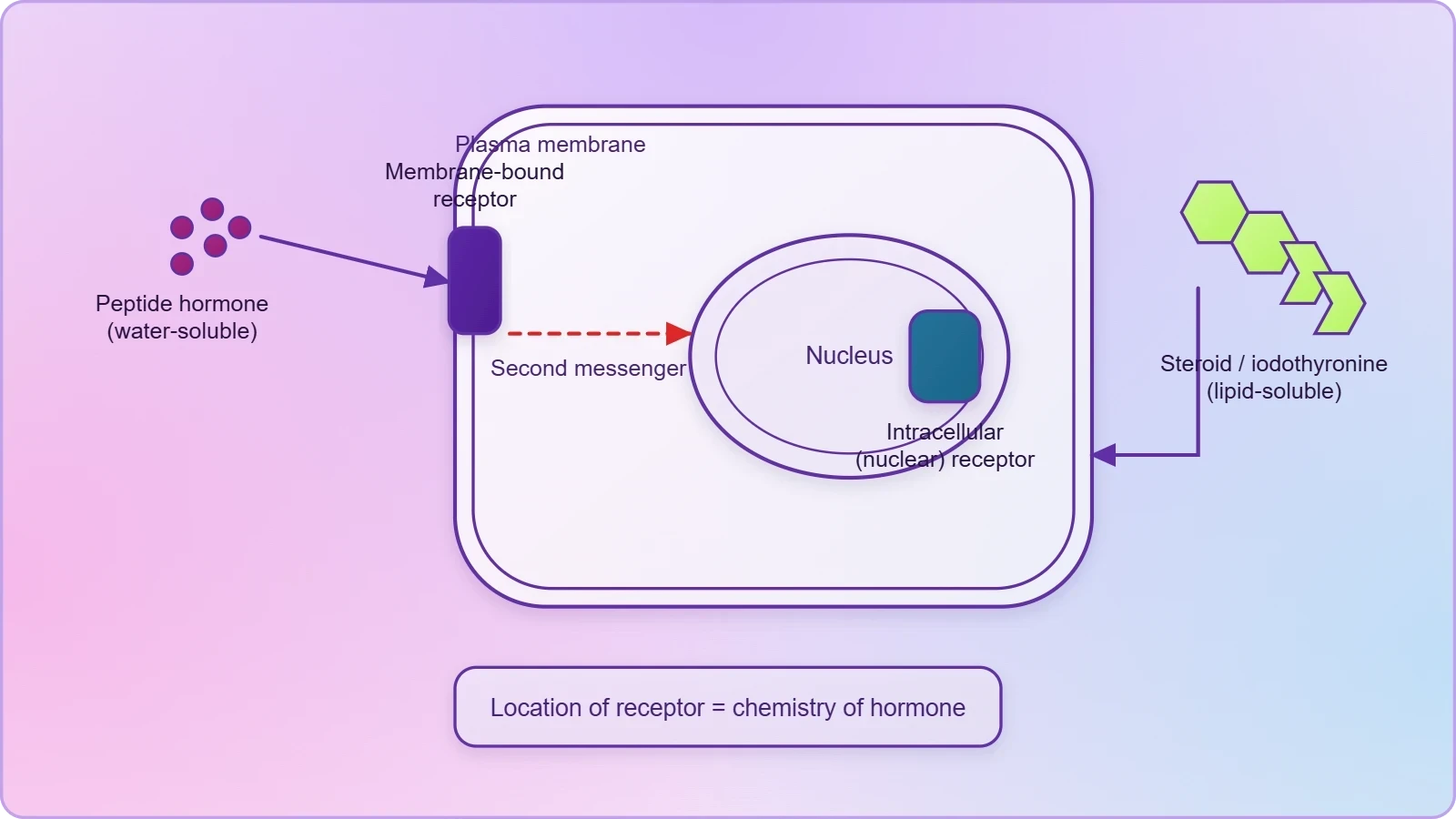
Why Receptor Location Matters
The receptor's position determines whether the hormone ever enters the cell. A hormone bound at the membrane normally does not enter the target cell at all; its influence is exerted from outside, through a relay. A hormone bound to an intracellular receptor has already crossed the membrane and acts from within, ultimately at the level of chromosome function. Two hormones can therefore produce equally dramatic physiological effects while never sharing a single step of their intracellular machinery.
This also explains why the same hormone can produce different effects in different tissues. The biochemical changes triggered by the hormone-receptor complex depend on what the target cell already contains — which enzymes, which second messengers, which genes are poised for transcription. The receptor supplies the recognition; the cell supplies the response. Hormonal regulation is thus a partnership between an endocrine signal and the differentiated state of the tissue that receives it.
The Chemical Groups of Hormones
On the basis of their chemical nature, hormones can be divided into four groups. The first is peptide, polypeptide and protein hormones, with insulin, glucagon, pituitary hormones and hypothalamic hormones as examples. The second is steroids, exemplified by cortisol, testosterone, estradiol and progesterone. The third is iodothyronines, which are the thyroid hormones. The fourth is amino-acid derivatives, of which epinephrine is the given example. This classification is not botanical tidiness; it predicts which receptor type a hormone will use and therefore which pathway its signal will follow.
The grouping also explains why the endocrine system can deploy molecules of very different sizes and solubilities while still achieving coordinated regulation. A small amino-acid derivative such as epinephrine and a large protein such as insulin both act on surface receptors, while the compact steroid skeleton allows cortisol and the sex hormones to reach intracellular receptors. The chemical group is, in effect, a forecast of mechanism, and the remainder of the lesson tests that forecast against the two pathways.
Peptides, Proteins and Amino-Acid Derivatives
Peptide, polypeptide and protein hormones are built from amino acids and are therefore water-soluble and generally unable to diffuse through the lipid bilayer of the plasma membrane. Their receptors are correspondingly membrane-bound. The same logic applies to the amino-acid derivative epinephrine, which interacts with receptors at the cell surface. These hormones act as first messengers outside the cell and depend on a second messenger within it to carry the instruction inward.
The hypothalamic and pituitary hormones named in the material belong to this group, which is significant for the course as a whole. The releasing and trophic hormones of the hypothalamus and pituitary are peptides, so the entire cascade of central endocrine control is conducted through membrane-bound receptors and second messenger relays. The same chemistry that makes these hormones easy to transport in blood makes them dependent on surface reception.
Steroids and Iodothyronines
Steroid hormones — cortisol, testosterone, estradiol and progesterone — share a common structural origin and a common behaviour: they interact with intracellular receptors. The iodothyronines, the thyroid hormones, are grouped with them in the material's account of mechanism, and both are described as regulating gene expression or chromosome function through interaction of the hormone-receptor complex with the genome. The steroid group also connects directly to the previous lesson, where estrogens and progesterone were shown to act on ovarian follicles, secondary sex characters, mammary glands and pregnancy.
Grouping steroids and iodothyronines together is a deliberate analytical choice. Although their biosynthetic origins differ, their mechanism converges: both reach intracellular, mostly nuclear, receptors and both exert their principal influence at the level of gene expression. The result is a slower but often more durable form of regulation than the second messenger route, because altering transcription changes the proteins a cell can make rather than the activity of proteins it already possesses.
The Second Messenger Pathway of Membrane-Bound Receptors
Hormones which interact with membrane-bound receptors normally do not enter the target cell, but generate second messengers which in turn regulate cellular metabolism. The material names cyclic AMP, IP3 and Ca++ as examples of these second messengers. The sequence is therefore: hormone binds receptor at the surface, a hormone-receptor complex forms, and the complex causes the appearance of small intracellular molecules that carry the instruction onward. The hormone itself remains outside; its message does not.
This arrangement has an obvious functional elegance. A hormone that cannot cross the membrane is not disadvantaged, because the cell supplies an internal relay on its behalf. The second messenger can diffuse within the cytoplasm, reach enzymes and other targets, and amplify the original signal in the process. The pathway is the standard route for the peptide, polypeptide and protein hormones of the course — insulin, glucagon, and the hypothalamic and pituitary hormones — as well as for the amino-acid derivative epinephrine.
From Hormone-Receptor Complex to Cellular Response
The formation of the hormone-receptor complex is the pivotal event. Before binding, the hormone is merely present; after binding, the target cell has committed to a response. The complex leads to certain biochemical changes in the target tissue, and those changes are what regulate target tissue metabolism and hence physiological functions. The second messenger is the agent of those changes, converting a surface event into an internal metabolic adjustment.
Because the messenger is generated rather than imported, the cell retains control over the strength and duration of its own response. The same hormone arriving at the same receptor can produce a modest or a vigorous effect depending on the cell's internal state. This is one reason hormonal regulation is described as integration rather than simple instruction: the endocrine signal proposes, and the target tissue's biochemistry disposes.
Reading the Pathway as a Signal Chain
The pathway can be written as a simple chain of events, which helps fix the order of ideas. The hormone (##H##) binds its membrane receptor (##R##) to form a complex, and the complex generates a second messenger (##M##) that regulates metabolism:
Here ##M## stands for a second messenger such as cyclic AMP, IP3 or Ca++. The equation is deliberately schematic: it records the material's claim that the hormone-receptor complex is the intermediate that produces the messenger, and that the messenger is what regulates cellular metabolism. Nothing in the chain requires the hormone to enter the cell, which is precisely the point the pathway is designed to make.
The Gene Expression Pathway of Intracellular Receptors
Hormones which interact with intracellular receptors — steroid hormones and iodothyronines are the examples given — mostly regulate gene expression or chromosome function by the interaction of the hormone-receptor complex with the genome. The pathway therefore begins inside the cell and ends at the chromosome. Where the second messenger route adjusts the activity of existing cellular machinery, this route changes the instructions the cell will follow, altering which proteins it produces and in what quantity.
The material's phrase "mostly regulate gene expression or chromosome function" is carefully chosen. It acknowledges that the principal outcome is transcriptional, while leaving room for other nuclear effects. The essential sequence remains constant: hormone enters, binds an intracellular receptor, forms a complex, and that complex interacts with the genome. The cumulative biochemical actions of many such events result in physiological and developmental effects, which is why steroid and thyroid hormones are so often associated with growth, differentiation and long-term change.
The Hormone-Receptor Complex at the Genome
The interaction of the hormone-receptor complex with the genome is the defining step of this pathway. The receptor, being mostly nuclear, is already positioned where the genetic material is read, and the hormone's arrival converts it into an active complex capable of influencing chromosome function. The consequence is a change in gene expression, and through that change a change in the cell's capabilities rather than merely its current activity.
This explains the developmental reach of the hormones involved. Estrogens and progesterone, studied in the previous lesson, regulate ovarian follicles, secondary sex characters, mammary gland development, alveoli formation and milk secretion — outcomes that require sustained changes in tissue behaviour, not a momentary metabolic flicker. The gene expression pathway is the mechanism equal to that task, and it is why the steroid hormones of the reproductive system are grouped with the thyroid hormones in this account.
Comparing the Two Pathways
Set side by side, the two pathways differ in entry, intermediary and endpoint. The membrane route keeps the hormone outside and uses a second messenger to regulate cellular metabolism; the intracellular route admits the hormone and uses the hormone-receptor complex to regulate gene expression. Both begin with specific binding, both proceed through a hormone-receptor complex, and both end in physiological and developmental effects. The unity of mechanism beneath the diversity of hormones is the lesson's central claim.
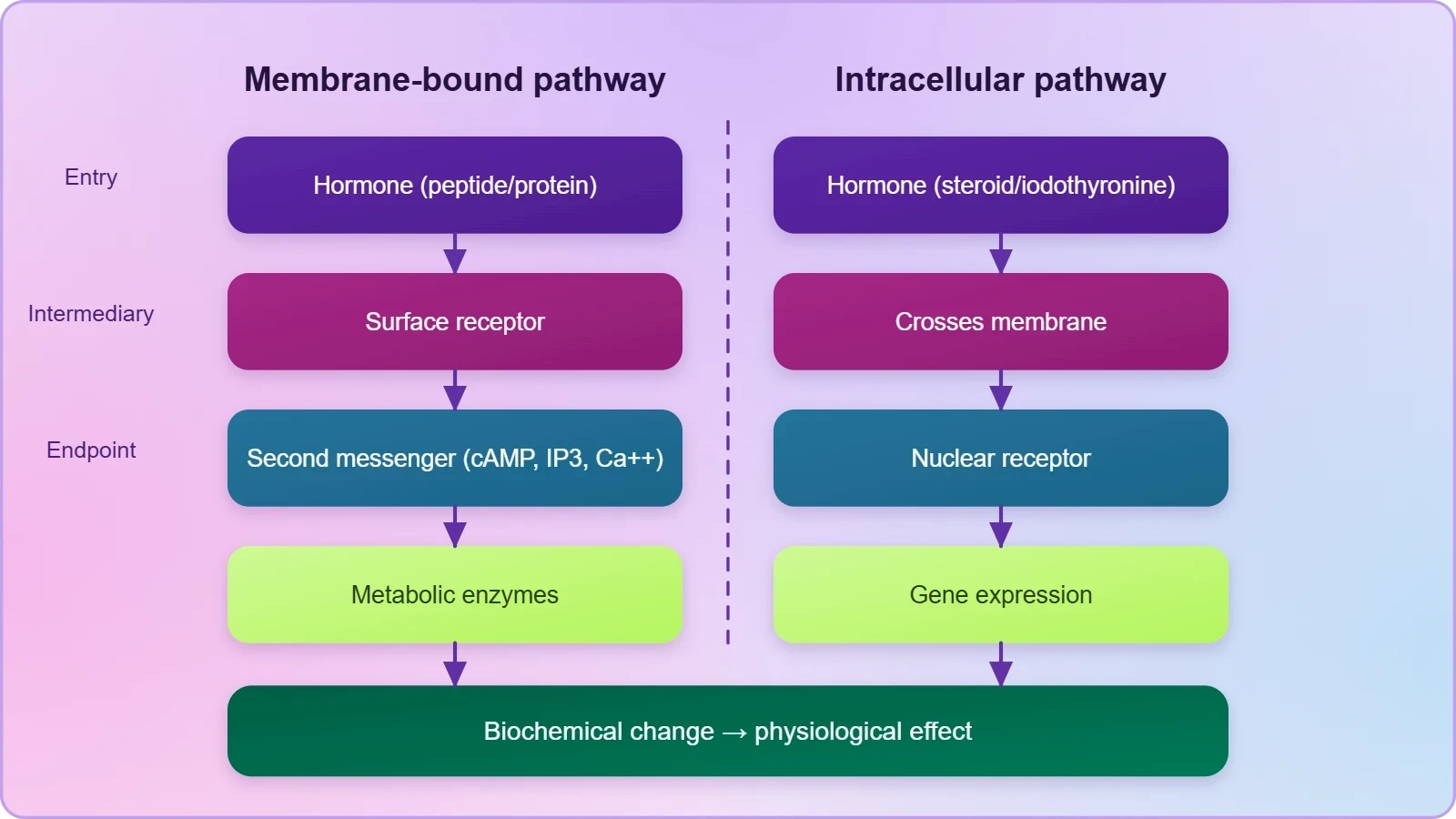
The comparison also clarifies why the chemical classification matters. Knowing that a hormone is a peptide predicts a surface receptor and a second messenger; knowing that it is a steroid or an iodothyronine predicts an intracellular receptor and a genomic effect. The four chemical groups are thus not a list to be memorised but a diagnostic key, allowing the mechanism to be inferred from the molecule's chemistry before any experiment is performed.
From Biochemical Change to Physiological Effect
The material closes its mechanism section with a statement that deserves emphasis: cumulative biochemical actions result in physiological and developmental effects. No single binding event explains a hormone's role in the body. It is the accumulation of many such events, across many cells and over time, that produces the regulated metabolism, growth and development described throughout the course. The mechanism of hormone action is therefore a bridge between molecular recognition and whole-organism physiology.
This perspective also explains why hormones can regulate the endocrine glands themselves as well as distant tissues. The summary of the course notes that hormones regulate metabolism, growth and development of our organs, the endocrine glands or certain cells. Feedback within the endocrine system depends on exactly the mechanisms described here: a hormone acting on a gland through receptors, altering that gland's output, and thereby adjusting the whole network. Chemical coordination is, in the end, a system of receptors responding to messengers.
Integration with the Endocrine System as a Whole
The endocrine system is composed of the hypothalamus, pituitary and pineal, thyroid, adrenal, pancreas, parathyroid, thymus and gonads, and in addition some other organs — the gastrointestinal tract, kidney and heart — also produce hormones. Every one of these sources depends on the receptor logic of this lesson. The pituitary's six trophic hormones from the pars distalis, the hormones of the heart, kidney and gut studied previously, and the gonadal steroids all reach their targets through specific receptors and one of the two pathways.
Seen from this height, the course resolves into a single argument. Glands produce hormones; hormones travel; hormones bind specific receptors in target tissues only; the hormone-receptor complex triggers biochemical change; and cumulative change becomes physiology. The anatomical detail of the earlier lessons supplies the sources, and this final lesson supplies the mechanism that makes those sources effective. The two halves of chemical coordination and integration are thus joined.
Going further
Second messengers are small intracellular molecules that relay a signal from a receptor to the cell's machinery. This description sharpens the material's account: cyclic AMP, IP3 and Ca++ are not themselves the response but the couriers that carry the instruction from the membrane inward, which is why the pathway is named after them. Steroid hormones, meanwhile, are lipid-soluble, which helps them cross the cell membrane to reach intracellular receptors. This property explains why the steroid route can begin inside the cell at all, and it complements the material's statement that hormones acting at membrane-bound receptors normally do not enter the target cell.
Consolidating the Lesson: Key Points and Self-Check
The lesson can be reduced to a compact set of propositions, each drawn directly from the material. Hormones act on target tissues by binding to specific hormone receptors located in the target tissues only. Receptors on the cell membrane are membrane-bound; receptors inside the cell are intracellular, mostly nuclear. Binding forms a hormone-receptor complex, and each receptor is specific to one hormone only. The complex produces biochemical changes that regulate target tissue metabolism and hence physiological functions. Hormones fall into four chemical groups, and the group predicts the pathway.
Hormones acting at membrane-bound receptors normally do not enter the target cell but generate second messengers such as cyclic AMP, IP3 and Ca++, which regulate cellular metabolism. Hormones acting at intracellular receptors, notably steroids and iodothyronines, mostly regulate gene expression or chromosome function through interaction of the complex with the genome. Cumulative biochemical actions then yield physiological and developmental effects. These propositions, taken together, constitute the mechanism of hormone action and complete the course's account of chemical coordination and integration.
Checking Understanding
A useful self-check is to take any hormone named in the course and predict its pathway from its chemistry. Insulin and glucagon are peptides, so expect membrane-bound receptors and second messengers. Cortisol, testosterone, estradiol and progesterone are steroids, so expect intracellular receptors and genomic effects. Thyroxine belongs to the iodothyronines and follows the intracellular route. Epinephrine, an amino-acid derivative, acts at the membrane. If the prediction matches the material's account, the classification and the mechanism have been understood together rather than separately.
A second check is to explain why a hormone can affect one tissue and not another despite reaching both. The answer lies in receptor distribution: only target tissues carry the specific receptor. A third check is to state what the hormone-receptor complex does in each pathway — generates second messengers in one case, interacts with the genome in the other. These three questions cover the lesson's essential content and prepare the learner to revisit the earlier lessons with the mechanism in view.
Closing the Course
With this lesson the course on chemical coordination and integration reaches its end. The journey began with the nature of endocrine glands and hormones and the endocrine system as a whole, proceeded through the major glands and their hormones, extended to the hormones of the heart, kidney and gastrointestinal tract, and now concludes with the mechanism by which every one of those hormones acts. The final message is one of unity: diverse glands, diverse chemistries, diverse targets, but a shared logic of specific receptors and two great signalling pathways.
Learners who can move confidently between the anatomical survey and the molecular mechanism possess the full picture the course was designed to build. They can name the glands, list their hormones, classify those hormones chemically, and predict how each will act on its target tissue. That integration of structure, chemistry and function is the substance of chemical coordination, and it is the appropriate note on which to close.
Also Read
- No links available.
From our network :
- EV 2.0: The Solid-State Battery Breakthrough and Global Factory ExpansionDiscover the impact of the Solid-State Battery Breakthrough on the EV market. Learn about CATL and BYD stock growth, global factory expansion in Europe, and the future of EV 2.0 technology.
- Analyzing Trump Deportation Numbers Insights Into The 2026 Immigration Crackdown
- Trump Political Strategy How Geopolitical Stunts Serve As Media Diversions
- 98% of Global MBA Programs Now Prefer GRE Over GMAT Focus EditionExplore why 98% of global MBA programs now prefer the GRE over GMAT Focus. Learn about the shorter GRE format, verbal logic importance, and strategic versatility for students.
- Mastering DB2 12.1 Instance Design: A Technical Deep Dive into Modern Database ArchitectureComprehensive guide to DB2 12.1 Instance Design. Explore architectural components, HADR setup, buffer pool tuning, and security policies for IBM DB2 12.1. Includes 10 functional SQL and Shell samples.
- Mastering DB2 LUW v12 Tables: A Comprehensive Technical GuideComprehensive guide on DB2 LUW v12 tables. Explore CREATE TABLE syntax, BLU Acceleration, range partitioning, data types, and security features for IBM DB2 LUW v12.
- AI-Powered 'Precision Diagnostic' Replaces Standard GRE Score ReportsDiscover the new GRE Precision Diagnostic. Learn how AI-powered behavioral analytics and time-to-solve tracking are replacing standard GRE score reports to empower students.
- Vite 6/7 'Cold Start' Regression in Massive Module GraphsIn-depth analysis of Vite 6/7 cold start regressions in massive module graphs. Learn about barrel file issues, pre-bundling optimizations, and how to improve Vite dev server performance.
- 10 Physics Numerical Problems with Solutions for IIT JEEPrepare for IIT JEE with 10 physics numerical problems, complete with detailed solutions and conceptual explanations. Ideal for mastering kinematics, thermodynamics, electromagnetism, and optics.
RESOURCES
- luteinizing hormone receptors and second-messenger pathwayspubmed.ncbi.nlm.nih.govThe mechanism of action of LH includes stimulation of multiple signal transduction effector systems, including adenylyl cyclase (AC) and inositol phospholipid- ...
- mechanism of hormone action peptide and steroid hormones pptcetaf.orgOct 13, 2026 ... ... receptors on the exterior of the target cell. * Second-messenger mechanism of peptide hormones action: Once a peptide binds…
- Mechanism of Action: Hormones with Cell Surface Receptorsvivo.colostate.eduThe second messengers then trigger a series of molecular interactions that alter the physiologic state of the cell. Another term used to describe this…
- Mechanism of Hormone action, Role of Secondary Messengers ...slideshare.netSecondary messengers relay signals from cell surface receptors to target molecules inside the cell, amplifying the signal strength and causing changes in cell ...
- Looking for the Mechanism of Action of Thyroid Hormone - PMC - NIHpmc.ncbi.nlm.nih.govDiscovery of cyclic AMP by Sutherland and the concept of “second messenger” ... The establishment of two distinct receptors for thyroid hormone, TRα and…
- Endocrine System: Hormone Action & Second Messenger - Studocustudocu.comDr. Vatnick Worksheet endocrine system: mechanism of hormone action: second messenger system proteins such as _peptides__ and bind to receptors located ...
- One hundred years of hormones - PMC - NIHpmc.ncbi.nlm.nih.govHormone receptors now occupy a central role in our current concepts of signalling mechanisms. ... Sutherland EW (1972) Studies on the mechanism of hormone…
- The Nobel Prize in Physiology or Medicine 1971 - Press releasenobelprize.org... mechanism of action of epinephrine and of many other hormones. The newly ... Cyclic AMP was discovered as the “second messenger” in relation…
- Mechanism of Hormone Action | CK-12 Foundationflexbooks.ck12.orgSep 9, 2025 ... Steroid and thyroid hormones use intracellular receptors. · Second messenger pathways allow for rapid amplification of hormonal signals, while ...
- Classification of Hormonal Effects - Basic Neurochemistry - NCBI - NIHncbi.nlm.nih.govHormonal actions on target neurons are classified in terms of cellular mechanisms ... A: Activation of cell-surface receptors and coupled second-messenger systems ...
- 7.7: Mechanisms of Hormone Action - Medicine LibreTextsmed.libretexts.orgMar 19, 2025 ... Mechanisms Involving Cell Membrane Hormone Receptors · adenylyl cyclase, · cyclic AMP ( · (cAMP) as a secondary messenger, and…
- Endocrine System: Structure, Function, and Clinical Aspects - Pearsonpearson.comWater-soluble hormones act on plasma membrane receptors and are often coupled via G proteins to second messengers. cAMP mechanism: Hormone binds receptor → G ...
- MECHANISMS OF HORMONE ACTION - ScienceDirect.comsciencedirect.comCyclic AMP has been identified as the second messenger for glucagon action on the liver and adrenaline action on muscle. By contrast, the protein…
- The Nature of Intracrine Peptide Hormone Action | Hypertensionahajournals.org... second messengers as binding of hormone to cell-surface receptors. Yet ... receptor regulation and other established mechanisms influencing cellular ...
- Regulation By Second Messengers - MCAT Content - Jack Westinjackwestin.com... Mechanisms Of Hormone Action / Regulation By Second Messengers. Regulation by ... hormones to a receptor that causes a cascade of changes that…