The human body runs two distinct communication networks, and neither one is sufficient on its own. The neural system delivers signals with remarkable speed, firing along nerve fibres to produce point-to-point coordination among organs, yet that speed comes at a cost: neural responses are short-lived, and nerve fibres do not innervate every cell of the body. Since cellular functions require continuous regulation, a second, slower but more sustained form of control must exist alongside the nervous system. That role belongs to hormones, the chemical messengers secreted by endocrine glands, which together with the neural system jointly coordinate and regulate the physiological functions of the body.
This opening lesson of the course establishes the conceptual foundation on which everything else builds. It explains why chemical coordination is needed at all, introduces endocrine glands as ductless glands whose secretions are hormones, and traces the shift from the classical definition of a hormone to the current scientific one. That shift matters because the modern definition admits many more molecules than the organised glands alone produce. The lesson then compares the endocrine systems of invertebrates and vertebrates, showing that simplicity in one group and richness in the other reflect very different strategies of chemical integration.
Because this is the first lesson of ten, it deliberately stays at the level of definitions, distinctions and broad architecture. The glands themselves, the hypothalamus, the hormones of the heart, kidney and gastrointestinal tract, and the mechanism of hormone action all belong to the lessons that follow. What you should carry forward from here is a precise vocabulary and a clear picture of the two coordinating systems working in concert, so that later detail has somewhere to attach.
On This Page
- Why the Body Needs Chemical Coordination Alongside Neural Coordination
- Endocrine Glands: The Ductless Glands
- Defining a Hormone: From Classical to Current Science
- Invertebrate and Vertebrate Endocrine Systems
- Reading the Vocabulary Precisely
- Going Further: Two Consequences Worth Holding
- Consolidating Lesson One
Why the Body Needs Chemical Coordination Alongside Neural Coordination
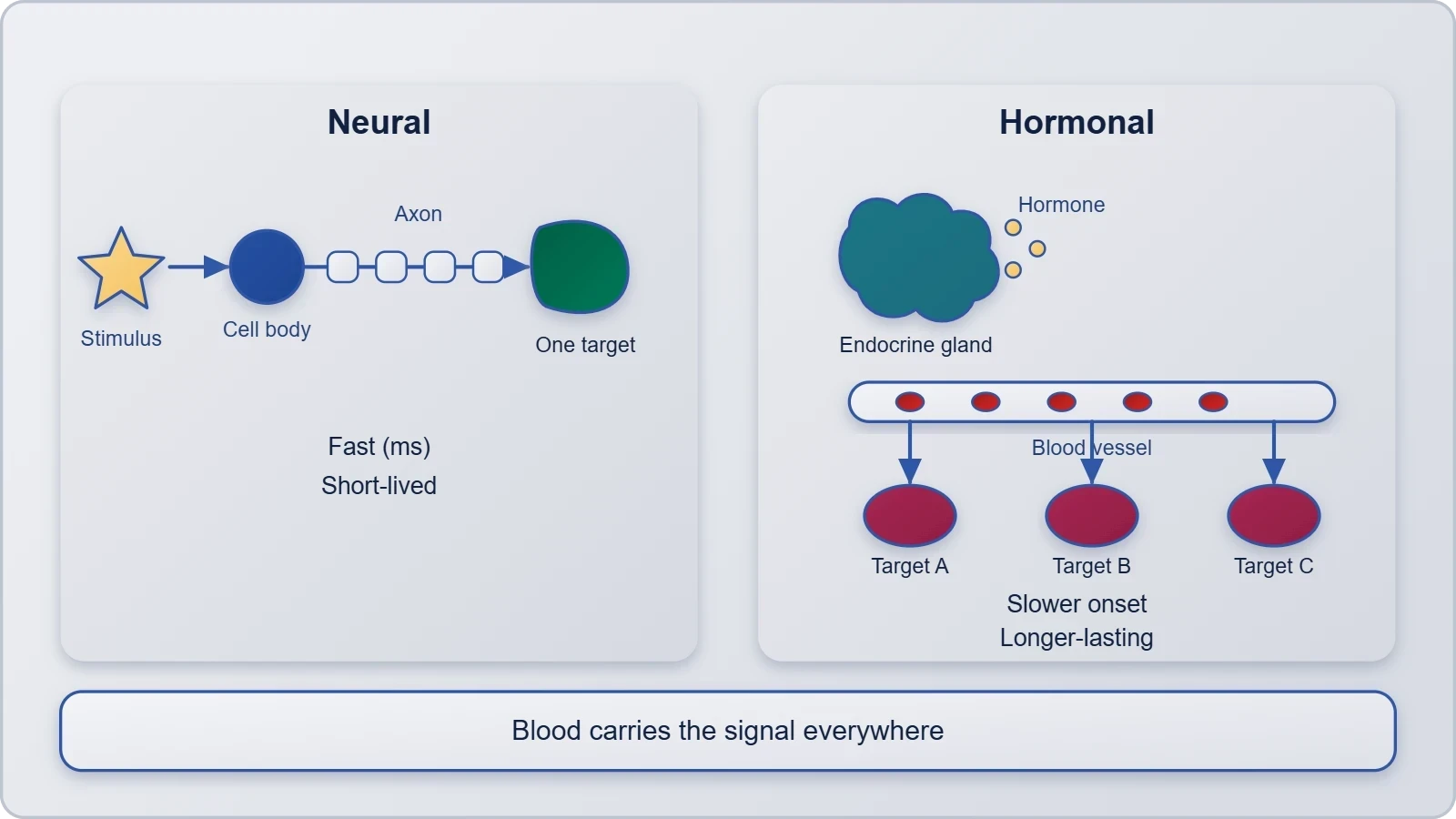
The starting point of the entire subject is a limitation. Neural coordination is fast, but it is short-lived, and it operates point to point rather than everywhere at once. Nerve fibres simply do not reach every cell in the body, yet cellular functions must be regulated continuously, not in brief bursts of impulse activity. A special kind of coordination and integration therefore has to be provided, and that function is carried out by hormones. The neural system and the endocrine system jointly coordinate and regulate physiological functions, each compensating for what the other cannot supply.
The Speed and Reach of Neural Signalling
Nerve impulses travel quickly along defined pathways, which is precisely why the nervous system excels at rapid, targeted responses. A stimulus can produce a response in milliseconds because the signal is electrical and the route is anatomical. But this design has a structural consequence: the signal reaches only the cells that the fibres innervate. Organs and tissues outside that wiring receive nothing. The neural system is therefore a precision instrument for fast action, not a general regulator of the slow, continuous housekeeping that every cell requires to remain in balance.
The Enduring, Body-Wide Action of Hormones
Hormones solve the reach problem by travelling in the blood, which circulates to essentially every tissue. Their action is slower to begin than a nerve impulse, but it lasts far longer, making them suited to sustained regulation rather than momentary response. Because the two systems overlap in function, physiologists describe them as jointly coordinating and regulating the body's physiological functions. Neither is subordinate to the other; they are complementary channels, one swift and localised, the other deliberate and body-wide, and health depends on both operating in step.
Endocrine Glands: The Ductless Glands
Endocrine glands are defined by an anatomical absence: they lack ducts, and are therefore called ductless glands. A gland with a duct delivers its secretion to a surface or into a cavity, but an endocrine gland releases its secretion directly into the surrounding fluid and hence into the blood. Their secretions are called hormones. This single structural fact explains the whole logic of endocrine signalling, because a secretion that enters the bloodstream is carried wherever the circulation goes, rather than being confined to the site where a duct would have delivered it.
Structure and the Absence of Ducts
The ductless condition is not a deficiency but a design. Because no duct channels the secretion to a fixed destination, the gland can release its product continuously into the internal environment, and the blood then distributes it. This is why endocrine glands are described as glands of internal secretion, in contrast with those that secrete onto an epithelial surface. The absence of ducts also means the rate of release can be adjusted smoothly by the gland itself, responding to the body's needs rather than to the mechanics of a ducted outflow.
Secretion Directly into the Blood
Once released, a hormone enters the blood and is transported to a distantly located target organ, the phrasing used in the classical definition. The target is distant in the sense that it lies away from the gland of origin, not adjacent to it. This arrangement allows a small gland in one part of the body to influence an organ in another, which is the essence of chemical integration. The bloodstream becomes the common carrier, and every hormone released into it is a message addressed to whichever tissue possesses the means to receive it.
Defining a Hormone: From Classical to Current Science
The word hormone has carried more than one meaning, and the change between them is one of the most instructive episodes in the subject. The classical definition describes a hormone as a chemical produced by endocrine glands, released into the blood, and transported to a distantly located target organ. The current scientific definition is broader and more functional: hormones are non-nutrient chemicals which act as intercellular messengers and are produced in trace amounts. Each element of that sentence carries weight, and together they admit molecules the older definition could not accommodate.
The Classical Definition and Its Limits
The classical definition is tied to anatomy. It assumes a hormone is made by an organised endocrine gland, enters the blood, and acts on a distant target organ. This picture is accurate for the classical hormones, but it is too narrow, because it makes the gland the defining feature rather than the messenger function. Once signalling molecules were found to be produced outside organised glands, the anatomical criterion became a constraint rather than a description. The definition had to be revised so that the function of chemical messaging, not the site of production, became decisive.
The Current Definition: Non-Nutrient Intercellular Messengers in Trace Amounts
The current definition rests on three claims. Hormones are non-nutrient chemicals, meaning they are not consumed as fuel or building material but serve purely as signals. They act as intercellular messengers, carrying information from one cell to another. And they are produced in trace amounts, so the quantity required is minute. The new definition covers a number of new molecules in addition to the hormones secreted by the organised endocrine glands. The functional criterion replaces the anatomical one, and the scope of the subject expands accordingly.
Invertebrate and Vertebrate Endocrine Systems
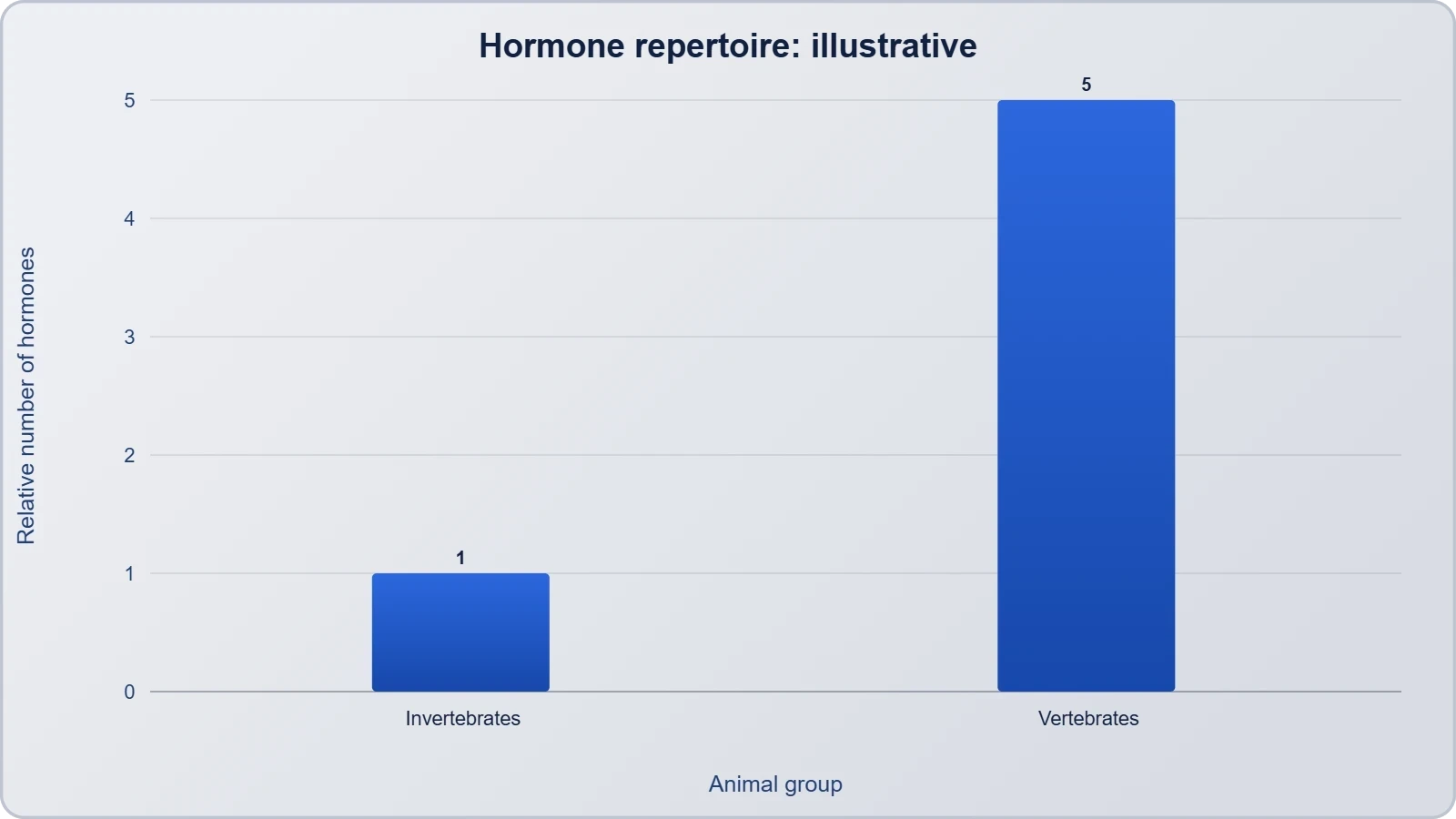
The endocrine systems of animals differ markedly in complexity, and the contrast is worth stating plainly. Invertebrates possess very simple endocrine systems with few hormones. Vertebrates, by comparison, show a large number of chemicals acting as hormones and providing coordination. The difference is not merely one of count but of architecture: a few messengers suffice for the simpler body plans, while the vertebrate organisation demands a far richer chemical vocabulary. The human endocrine system, described in the lessons that follow, belongs firmly to the vertebrate pattern.
The Simple Endocrine Systems of Invertebrates
Invertebrate endocrine systems are described as very simple, with few hormones. Simplicity here means a small repertoire of chemical messengers rather than an absence of chemical coordination. A limited set of hormones can regulate the physiological functions of an organism whose tissues and organs make fewer and less varied demands on long-range integration. The invertebrate case is useful precisely because it is minimal: it shows that chemical coordination does not require an elaborate system, only a reliable one, and it throws the vertebrate expansion into relief.
The Rich Hormonal Coordination of Vertebrates
In vertebrates, a large number of chemicals act as hormones and provide coordination, and this abundance is the defining feature of the vertebrate endocrine landscape. The human endocrine system is the example developed in this course, and it illustrates the vertebrate pattern in full. The breadth of chemical signalling in vertebrates is what makes the subject demanding: many messengers, many sources, and many targets, all requiring precise regulation. The lessons ahead take up this system gland by gland, beginning with the hypothalamus and the organisation of the human endocrine system.
Reading the Vocabulary Precisely
Precision with terms pays dividends throughout this course, because later lessons assume the definitions established here. Three phrases deserve particular care: ductless gland, target organ, and trace amounts. Each is a compressed statement of a mechanism. A ductless gland secretes internally; a target organ is distant from the source; trace amounts mean the messenger is effective in minute quantity. Learners who hold these phrases exactly will find the material on the human endocrine system far easier to organise, and they will avoid the common error of treating hormones as nutrients or as locally acting substances.
Terms That Carry the Argument
The phrase non-nutrient chemicals is easy to skim past, yet it does real work. It separates hormones from food-derived substances that the body consumes, and it places them among signals rather than supplies. Similarly, intercellular messengers locates the action between cells, not inside a single cell. And produced in trace amounts signals that quantity is not the measure of importance. These are not decorative words; each one excludes a possible misunderstanding, and together they define the modern concept more tightly than any single sentence could.
Common Misreadings to Avoid
Two misreadings recur. The first treats the classical definition as wrong rather than incomplete; it is accurate for the organised endocrine glands but too narrow for the full range of hormonal molecules. The second assumes that because hormones act in trace amounts, their effects must be slight. The opposite is true: a minute quantity of a messenger can produce a substantial physiological response, which is why the body regulates secretion so carefully. Keeping the definitions distinct, and the quantities in perspective, prevents both errors from taking root.
Going Further: Two Consequences Worth Holding
Two well-established points, offered as background rather than as part of the core material, help make sense of why hormones are so effective. The first concerns transport: because hormones travel in the blood, their effects can reach target organs far from where they are made. The second concerns quantity: because hormones act in trace amounts, small changes in their secretion can have large effects on the body. Neither point contradicts the definitions above; both extend them, and both prepare the ground for the mechanism of hormone action treated later in the course.
Transport in the Blood Extends the Reach
The circulatory system is the reason a gland can influence an organ on the other side of the body. A hormone released into the blood is carried wherever the circulation goes, so distance between source and target is no obstacle. This is the physical basis of the phrase distantly located target organ in the classical definition. It also explains why the endocrine system can coordinate functions that no single nerve pathway could reach, and why the two systems are described as jointly regulating the body's physiological functions rather than duplicating each other.
Trace Amounts, Large Effects
Because hormones are produced in trace amounts, the body's regulation of their secretion must be sensitive and precise. A very small shift in the quantity released can alter the response of target tissues appreciably, which is why the endocrine system is often described as a system of fine adjustment. This sensitivity is a strength, allowing subtle control, but it also means that the mechanisms governing secretion deserve close attention. Those mechanisms, and the glands that operate them, form the substance of the lessons that follow this introduction.
Consolidating Lesson One
The lesson can be reduced to a chain of connected claims. Neural coordination is fast but short-lived, and nerve fibres do not innervate all cells, so continuous regulation of cellular functions requires a special kind of coordination and integration, carried out by hormones. Endocrine glands lack ducts and are therefore ductless, and their secretions are hormones. The classical definition, a chemical produced by endocrine glands, released into the blood and transported to a distant target organ, gives way to the current definition: non-nutrient chemicals acting as intercellular messengers, produced in trace amounts. Invertebrates have simple endocrine systems with few hormones; vertebrates have many.
A Short Self-Check
Before moving on, test the definitions against your own words. Can you state, without notes, why the neural system alone cannot regulate all cellular functions? Can you explain what makes a gland endocrine rather than ducted? Can you give the current definition of a hormone and identify the three claims it contains? Can you say what the new definition covers that the classical one did not? If each answer comes readily, the foundation is secure, and the next lesson on the human endocrine system and the hypothalamus will read as an extension rather than a fresh start.
Preparing for the Next Lesson
The next lesson turns from general principles to the human endocrine system and the hypothalamus, the organising centre from which much of the system is directed. Everything established here, the ductless gland, the hormone as intercellular messenger in trace amounts, the distinction between neural and chemical coordination, will be assumed rather than restated. Read the definitions once more with that in mind, and the architecture of the human system will fall into place more easily when the glands themselves are introduced one by one in the lessons that follow.
Also Read
- No links available.
From our network :
- EV 2.0: The Solid-State Battery Breakthrough and Global Factory ExpansionDiscover the impact of the Solid-State Battery Breakthrough on the EV market. Learn about CATL and BYD stock growth, global factory expansion in Europe, and the future of EV 2.0 technology.
- Mastering DB2 12.1 Instance Design: A Technical Deep Dive into Modern Database ArchitectureComprehensive guide to DB2 12.1 Instance Design. Explore architectural components, HADR setup, buffer pool tuning, and security policies for IBM DB2 12.1. Includes 10 functional SQL and Shell samples.
- 98% of Global MBA Programs Now Prefer GRE Over GMAT Focus EditionExplore why 98% of global MBA programs now prefer the GRE over GMAT Focus. Learn about the shorter GRE format, verbal logic importance, and strategic versatility for students.
- Mastering DB2 LUW v12 Tables: A Comprehensive Technical GuideComprehensive guide on DB2 LUW v12 tables. Explore CREATE TABLE syntax, BLU Acceleration, range partitioning, data types, and security features for IBM DB2 LUW v12.
- AI-Powered 'Precision Diagnostic' Replaces Standard GRE Score ReportsDiscover the new GRE Precision Diagnostic. Learn how AI-powered behavioral analytics and time-to-solve tracking are replacing standard GRE score reports to empower students.
- Analyzing Trump Deportation Numbers Insights Into The 2026 Immigration Crackdown
- Trump Political Strategy How Geopolitical Stunts Serve As Media Diversions
- Vite 6/7 'Cold Start' Regression in Massive Module GraphsIn-depth analysis of Vite 6/7 cold start regressions in massive module graphs. Learn about barrel file issues, pre-bundling optimizations, and how to improve Vite dev server performance.
- 10 Physics Numerical Problems with Solutions for IIT JEEPrepare for IIT JEE with 10 physics numerical problems, complete with detailed solutions and conceptual explanations. Ideal for mastering kinematics, thermodynamics, electromagnetism, and optics.
RESOURCES
- Endocrine glands and their hormones - Healthdirecthealthdirect.gov.auThe endocrine (hormonal) system is a network of glands that release hormones to regulate processes such as growth, metabolism and reproduction.
- Hormones and the Endocrine System | Johns Hopkins Medicinehopkinsmedicine.orgThe endocrine system uses hormones to control and coordinate your body's internal metabolism (or homeostasis) energy level, reproduction, growth and ...
- The Endocrine System: An Overview - PMC - NIHpmc.ncbi.nlm.nih.govWhat Are Hormones? Hormones are molecules that are produced by endocrine glands, including the hypothalamus, pituitary gland, adrenal glands, gonads, (i.e. ...
- Endocrine System: What It Is, Function, Organs & Diseasesmy.clevelandclinic.orgNov 22, 2023 ... The main function of your endocrine system is to release hormones into your blood while continuously monitoring the levels. Hormones…
- Physiology, Endocrine Hormones - StatPearls - NCBI Bookshelf - NIHncbi.nlm.nih.govHormones of the endocrine system are a vast topic with numerous hormones involved, affecting virtually every organ in the human body. Human physiologic ...
- Endocrine Glands & Their Hormones - SEER Training Modulestraining.seer.cancer.govThe endocrine system is made up of the endocrine glands that secrete hormones. Although there are eight major endocrine glands scattered throughout the body, ...
- Overview of the Endocrine System | US EPAepa.govJun 10, 2026 ... Where are Endocrine Glands Located in the Human Body? · Hypothalamus - The hypothalamus links our endocrine and nervous systems…
- The endocrine system and hormones | Canadian Cancer Societycancer.caThe endocrine system is a group of glands and cells in the body that make hormones and release them into the blood. Hormones are…
- Glands and Hormones - Genes and Disease - NCBI Bookshelf - NIHncbi.nlm.nih.govHormones are the chemical signaling molecules produced by the endocrine glands and secreted directly into the bloodstream. They travel through the blood to ...
- Aging changes in hormone production - MedlinePlusmedlineplus.govJul 15, 2024 ... The endocrine system is made up of organs and tissues that produce hormones. Hormones are natural chemicals produced in one…
- Hormones and Your Endocrine System - Stanford Children's Healthstanfordchildrens.orgHormones and Your Endocrine System. The endocrine system makes hormones. These are chemicals that control and coordinate many things in your body.
- Hormonal (endocrine) system | Better Health Channelbetterhealth.vic.gov.auEndocrine glands secrete hormones straight into the bloodstream. Hormones help to control many body functions, such as growth, repair and reproduction.
- The human skin as a hormone target and an endocrine glandpubmed.ncbi.nlm.nih.govHormones influence the development and function of human skin which also produces and releases hormones. Recently attention has been focused on identifying ...
- The endocrine system and associated disordersbritishjournalofnursing.comMar 24, 2022 ... The endocrine system and the hormones it produces control a range of processes in the body, as well as helping…
- Hormones and Endocrine Functionendocrine.orgJan 24, 2022 ... The endocrine system is a series of glands that produce and secrete hormones that the body uses for a wide…