Blood transfusion safety rests on a principle that most donors never think about: the surface of a red blood cell is a chemical identity card, and the immune system reads it with unforgiving precision. The ABO system is the most famous entry on that card, but it is not the only one. A second antigen, discovered through work with Rhesus monkeys and therefore named the Rh antigen, appears on the red cells of roughly 80 per cent of humans. Its presence or absence divides every population into Rh positive and Rh negative individuals, and that single distinction governs transfusion matching, pregnancy care, and the prevention of one of the most serious immune conflicts in medicine.
This lesson examines the Rh antigen on its own terms, building directly on the donor compatibility rules established for the ABO system. It explains why an Rh negative person who receives Rh positive blood will manufacture specific antibodies against the Rh antigen, and why every unit of blood must therefore be matched for Rh as well as ABO. From there the discussion turns to the special case of Rh incompatibility between an Rh negative mother and an Rh positive foetus, tracing how a first pregnancy usually escapes harm, how exposure during delivery sensitises the maternal immune system, and how later pregnancies can end in erythroblastosis foetalis, a condition that destroys foetal red cells and may prove fatal.
The clinical resolution of that conflict is elegantly simple: anti-Rh antibodies administered to the mother immediately after the delivery of her first child. Understanding this sequence requires careful attention to timing, because the entire protective strategy depends on the interval between exposure and immune memory. By the end of the lesson, learners should be able to define Rh positive and Rh negative status, justify Rh matching before transfusion, describe the mechanism of erythroblastosis foetalis in the order the events actually occur, and explain the rationale behind anti-Rh prophylaxis.
On This Page
The Rh Antigen and the Meaning of Rh Status
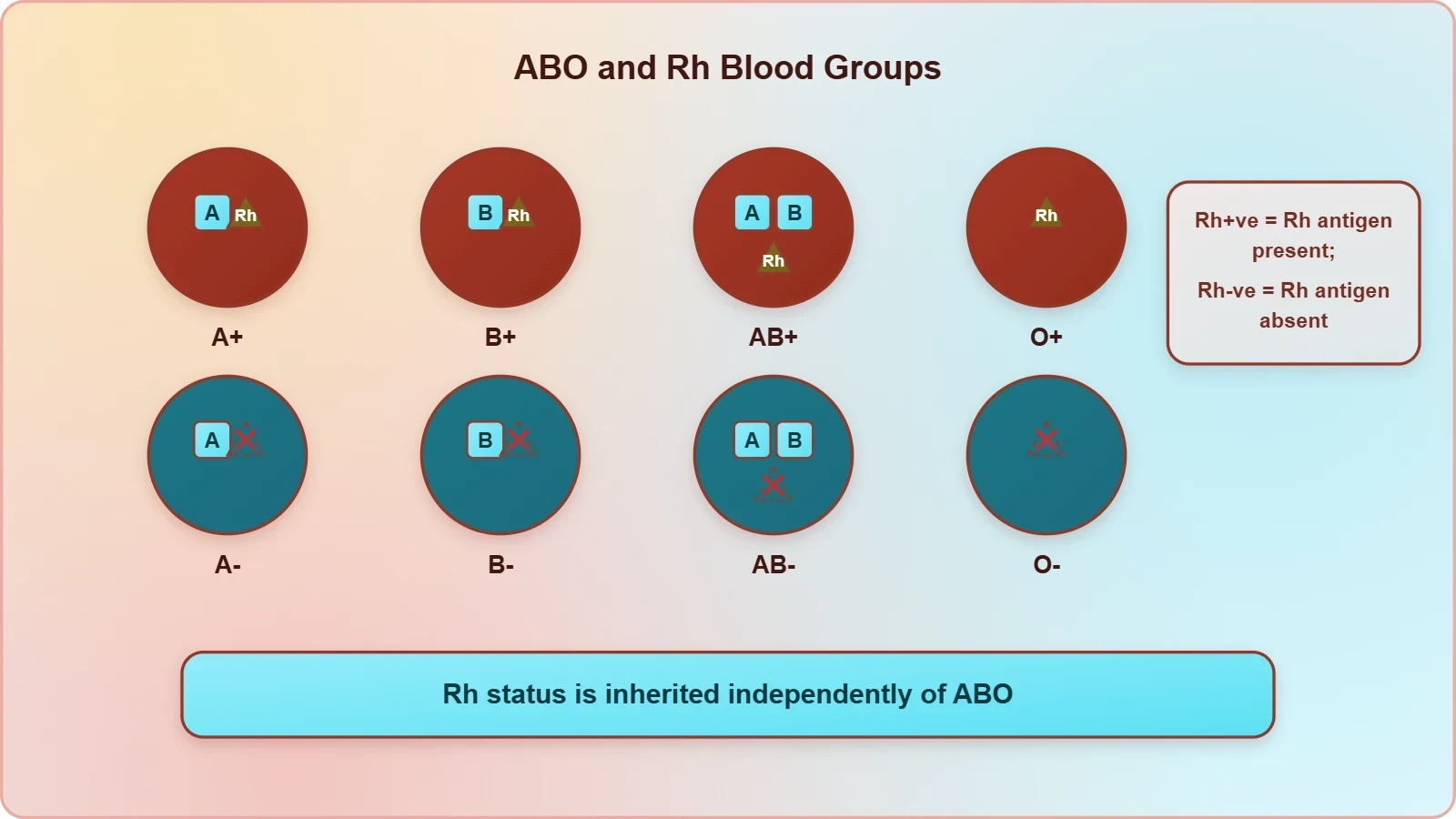
Beyond the familiar A and B antigens, red blood cells carry a further surface marker known as the Rh antigen, so named because it resembles an antigen first identified in Rhesus monkeys. This antigen is observed on the surface of red blood cells in the majority of humans, nearly 80 per cent. Individuals whose cells display it are called Rh positive, written Rh+ve, while those in whom the antigen is absent are called Rh negative, written Rh-ve. The distinction is inherited and stable, and it operates independently of ABO status, so a person may be A positive, O negative, or any other combination of the two systems.
Rh status matters because the immune system treats the Rh antigen as foreign when it encounters it in an Rh negative body. An Rh-ve person who is exposed to Rh+ve blood will form specific antibodies against the Rh antigens. This is the same principle of antigen recognition that underpins ABO compatibility, applied to a second marker. The practical consequence is immediate and clinical: the Rh group should also be matched before transfusions, in addition to the ABO group. A unit labelled O negative is not interchangeable with O positive blood for an Rh negative recipient, because the recipient's immune system will respond to the Rh antigen even though the ABO labels agree.
Why the Second Match Is Not Optional
The requirement to match Rh as well as ABO follows directly from the antibody response described above. Once an Rh-ve individual has formed anti-Rh antibodies, a later exposure to Rh+ve cells provokes a rapid and destructive reaction, because the immune system already holds the memory of the antigen. Matching both systems before transfusion prevents that sensitisation from occurring in the first place. In practice, blood banks label every unit with both its ABO group and its Rh status, and cross-matching procedures verify compatibility across both systems before any unit is released for transfusion.
Learners sometimes assume that Rh matching is a refinement rather than a requirement, perhaps because Rh negative blood is less common. The material is unambiguous on this point: Rh group should also be matched before transfusions. The word "also" is doing real work, signalling that Rh matching sits alongside ABO matching rather than replacing or subordinating it. A transfusion that respects ABO but ignores Rh can sensitise an Rh negative recipient, creating risk for every future transfusion and, in women of childbearing age, for future pregnancies as well.
Reading Rh Status Alongside ABO Status
Because the two systems are inherited independently, the population divides into eight common combinations of ABO group and Rh status. Each combination carries its own compatibility profile, and the Rh component behaves identically across all of them. An Rh negative recipient of any ABO group must not receive Rh positive cells, while an Rh positive recipient may receive Rh positive cells without immune consequence from the Rh antigen. The table below sets out the practical matching logic that follows from combining the two systems, using the Rh principle established in this lesson.
Rh Incompatibility Between Mother and Foetus
The transfusion setting is not the only place where Rh status creates conflict. A special case of Rh incompatibility has been observed between the Rh-ve blood of a pregnant mother and the Rh+ve blood of the foetus. Here the two immune systems are not strangers meeting through a needle but two circulations separated by the placenta, and the timing of their contact determines the outcome. The material describes this situation with care, distinguishing the first pregnancy from subsequent ones, because the entire clinical picture depends on when exposure occurs and when antibodies are ready to act.
In the first pregnancy, the Rh antigens of the foetus do not get exposed to the Rh-ve blood of the mother, because the two bloods are well separated by the placenta. The barrier holds, and the maternal immune system remains unaware of the foreign antigen on the foetal cells. This is why a first pregnancy in an Rh negative mother carrying an Rh positive foetus usually proceeds without immune attack on the foetus. The danger lies not in the pregnancy itself but in the moment of birth, when the placental separation that ends the pregnancy can breach the barrier that protected it.
The Sensitising Event at Delivery
During the delivery of the first child, there is a possibility of exposure of the maternal blood to small amounts of the Rh+ve blood from the foetus. The volume involved may be tiny, but the immune system does not require a large dose to begin its response. In such cases, the mother starts preparing antibodies against the Rh antigen in her blood. This process is called sensitisation: the maternal immune system has now met the antigen, recognised it as foreign, and begun the work of manufacturing specific antibodies directed against it. The first child, already born, is unaffected by this development.
The critical feature of sensitisation is that it leaves a lasting record. The mother's blood now contains anti-Rh antibodies, and her immune system retains the capacity to produce them. Nothing about this first exposure harms the baby who triggered it, because the antibody response develops after delivery. But the immunological memory persists, and it will shape every subsequent pregnancy in which the foetus inherits Rh positive status from the father. The interval between the first delivery and the next pregnancy is therefore a period of quiet preparation on the maternal side, invisible but consequential.
Erythroblastosis Foetalis in Later Pregnancies
In the case of subsequent pregnancies, the Rh antibodies from the mother, who is Rh-ve, can leak into the blood of the foetus, who is Rh+ve, and destroy the foetal red blood cells. The placenta that once kept the circulations apart does not exclude antibodies, and the maternal immune system now has a weapon it lacked in the first pregnancy. The destruction of foetal red cells produces the condition called erythroblastosis foetalis. The material states the consequences plainly: this could be fatal to the foetus, or it could cause severe anaemia and jaundice to the baby.
The name of the condition reflects its mechanism. The foetus, losing red cells to antibody-mediated destruction, attempts to compensate by releasing immature red cell precursors, the erythroblasts, into the circulation, and the disease takes its name from their appearance. Anaemia follows from the loss of mature red cells, and jaundice follows from the breakdown products of the destroyed haemoglobin. The severity varies with the volume of maternal antibody that crosses the placenta, which is why the material describes the outcome as a possibility rather than a certainty. The table below traces the sequence of events across two pregnancies.
Preventing Erythroblastosis Foetalis
The sequence just traced suggests an obvious point of intervention. If the danger begins when the mother starts preparing antibodies after the first delivery, then the logical strategy is to prevent that preparation from occurring at all. The material states the solution directly: erythroblastosis foetalis can be avoided by administering anti-Rh antibodies to the mother immediately after the delivery of the first child. The word "immediately" carries the weight of the entire method, because the antibodies must reach the maternal circulation before her own immune system has committed to making its own.
The logic of prophylaxis is a form of interception. The administered anti-Rh antibodies bind the Rh antigens from the foetal cells that have entered the maternal blood, clearing them before the mother's immune system can recognise them as foreign. Deprived of the antigenic stimulus, the maternal immune system does not begin manufacturing its own antibodies, and the memory that would endanger later pregnancies is never formed. The mother receives passive antibodies rather than producing her own, and the protection is temporary, which is why the intervention must be repeated with each subsequent Rh incompatible delivery.
Why Timing Determines Success
The effectiveness of anti-Rh administration depends entirely on its position in the sequence of events. Given immediately after the first delivery, the antibodies intercept the antigen before sensitisation occurs. Given later, once the maternal immune system has already begun producing its own antibodies, the intervention cannot undo the memory that has been established. This is why the material specifies the timing so precisely. The clinical window is narrow, and the entire preventive strategy is built around closing it before the immune response has had time to consolidate.
Learners should notice how this mirrors the transfusion principle established earlier in the lesson. In both settings, the goal is to keep Rh negative blood from meeting Rh positive antigens in a way that provokes antibody formation. In transfusion, the meeting is prevented by matching the donor unit to the recipient's Rh status. In pregnancy, the meeting cannot be prevented, because the foetus inherits its Rh status independently, so the antigen is cleared after the fact instead. The two strategies are different applications of the same underlying immunology.
Connecting Rh Prophylaxis to Transfusion Practice
The same antibody logic that protects a pregnancy also explains why Rh negative blood is carefully conserved in blood banks. An Rh negative recipient who has never been exposed can safely receive Rh negative blood, and an Rh negative woman of childbearing age is a priority recipient for that limited supply, precisely because sensitisation would compromise her future pregnancies. The material's instruction that Rh group should also be matched before transfusions thus carries consequences that extend well beyond the immediate transfusion, reaching into obstetric care and the long-term health of families.
This connection also clarifies why the Rh system is taught immediately after ABO grouping rather than as an isolated curiosity. Both systems are antigen systems on the red cell surface, both provoke specific antibodies when mismatched, and both require matching before transfusion. The difference lies in the natural route of exposure: ABO antibodies are present from early life, while Rh antibodies arise only after exposure to Rh positive blood, whether through transfusion or through pregnancy. That distinction explains why Rh incompatibility produces its characteristic pattern across successive pregnancies rather than at first contact.
Reading the Rh Story as a Lesson in Immune Memory
The Rh system rewards careful study because it makes an abstract immunological principle visible in a clinical sequence. An antigen appears on the red cell surface. An immune system that lacks it recognises the antigen as foreign. Antibodies are manufactured, and memory is established. A later encounter produces a faster and more destructive response. Every step of this sequence is observable in the Rh story, from the transfusion recipient who becomes sensitised to the mother whose second pregnancy is endangered by antibodies raised after her first. The lesson is not merely about blood groups but about how the immune system learns.
That learning is what makes the timing of anti-Rh prophylaxis so consequential. The intervention works by denying the immune system its lesson. If the antigen is cleared before recognition occurs, no memory forms, and the later encounter never produces the destructive response. The elegance of the strategy lies in its use of the body's own tools, passive antibodies, to prevent the body from making its own. Learners who grasp this point will find that the same logic recurs throughout immunology, wherever passive immunity is used to interrupt a sequence that active immunity would otherwise complete.
Common Misconceptions Worth Correcting
A frequent error is to assume that the first pregnancy is safe because the foetus is Rh negative. In fact, the foetus may well be Rh positive, and the protection comes from the placental separation of the two circulations, not from the absence of the antigen. Another error is to suppose that the mother's antibodies harm the first child. They do not, because they are manufactured after delivery. A third is to treat anti-Rh administration as a treatment for the baby rather than a preventive measure for the mother's future pregnancies. The antibodies are given to the mother, and their purpose is to protect pregnancies that have not yet begun.
These misconceptions share a common root: a failure to track the order of events. The Rh story is fundamentally chronological, and each stage depends on the one before it. The first pregnancy is safe because exposure has not yet occurred. The delivery is the point of possible exposure. Sensitisation follows exposure. Later pregnancies are at risk because sensitisation has occurred. Prophylaxis works because it intervenes between exposure and sensitisation. Once the sequence is clear, the clinical recommendations follow naturally, and the reasons behind each one become apparent rather than arbitrary.
Preparing for Coagulation
The next lesson turns from the antigens on the red cell surface to the mechanism that seals a wound. Coagulation is a cascade of linked enzymic reactions, and it shares with the Rh story a dependence on precise sequence: factors activate factors in order, and the timing of each step determines the outcome. The same habit of tracing events chronologically, which makes erythroblastosis foetalis intelligible, will make the clotting cascade intelligible as well. Learners who have followed the Rh sequence carefully are well prepared for the ordered reactions that produce a fibrin clot.
There is also a thematic continuity worth noting. The Rh lesson concerns the body's response to foreign antigens on red cells; the coagulation lesson concerns the body's response to injury and the prevention of excessive blood loss. Both are protective mechanisms, and both can malfunction in ways that endanger health. The transition from one to the other marks a shift from immune recognition to haemostatic response, but the underlying discipline of following a mechanism step by step remains the same, and it is that discipline which the Rh lesson has been quietly building.
Going further
The name Rh carries a history worth knowing. The antigen was first described in the Rhesus monkey, and the label has remained attached to it ever since, even though the human antigen is not identical to the monkey one but merely similar to it. This is why the material describes the Rh antigen as similar to one present in Rhesus monkeys rather than identical. The naming convention is a reminder that scientific labels often preserve the circumstances of discovery rather than the full biology of the molecule, and learners should treat the name as a historical marker rather than a precise description.
Erythroblastosis foetalis is also known clinically as a form of haemolytic disease of the newborn. The broader category includes other causes of red cell destruction in the foetus and neonate, but the Rh incompatibility described in this lesson is the classic and most familiar example. Recognising the condition as part of this wider family helps place the lesson in context: the mechanism of antibody-mediated red cell destruction is shared, and the principles of prevention explored here apply, with appropriate modification, across the group. The specific details of Rh matching and anti-Rh prophylaxis remain as stated in the material.
Consolidating the Lesson Through Practice
A lesson on Rh grouping is best consolidated by working through the sequence in order and testing each link. The questions below follow the material's own progression, from the definition of Rh status through transfusion matching to the mechanism of erythroblastosis foetalis and its prevention. Learners should attempt each one without consulting the text first, then return to the relevant section to check their reasoning. The value lies not in the answers alone but in the habit of tracing cause and effect through the correct sequence of events.
Several questions deliberately probe the timing that makes the clinical picture intelligible. Why is the first pregnancy usually safe? Why does the danger appear in later pregnancies? Why must anti-Rh antibodies be given immediately after delivery rather than at any later point? These are not separate facts to be memorised but consequences of a single chronological structure. A learner who can reconstruct that structure from first principles will answer all of them correctly and will also be able to explain the reasoning to someone else, which is the surest test of understanding.
Self-Assessment Questions
What is the Rh antigen, and why does it carry that name? State the approximate proportion of humans who are Rh positive and define the terms Rh+ve and Rh-ve. Explain why an Rh-ve person exposed to Rh+ve blood forms specific antibodies, and why the Rh group should also be matched before transfusions. Describe the special case of Rh incompatibility between an Rh-ve mother and an Rh+ve foetus, including the role of the placenta in the first pregnancy and the significance of delivery as a point of possible exposure. Finally, explain how erythroblastosis foetalis can be avoided.
For each answer, identify the exact point in the sequence at which the event occurs. A response that places sensitisation before delivery, or prophylaxis after the maternal immune response has begun, reveals a gap in understanding that should be repaired before moving to the next lesson. The questions are designed to be answered in the material's own terminology, using the terms Rh positive, Rh negative, Rh incompatibility, and erythroblastosis foetalis precisely as defined. Precision of language here reflects precision of mechanism, and the two reinforce each other.
Looking Ahead to Coagulation
The next lesson examines coagulation of blood, the mechanism by which the body prevents excessive loss of blood from an injury. Where the Rh lesson concerned antigens on the red cell surface and the antibodies raised against them, the coagulation lesson concerns a cascade of linked enzymic reactions involving factors present in the plasma in an inactive state. The transition is natural: both topics require the learner to follow a sequence of events in which each step depends on the one before, and both reward attention to the order in which things happen rather than to isolated facts.
Learners should carry forward the discipline of asking when each event occurs and what must precede it. In the Rh story, the answer to that question explains why the first pregnancy is safe and why prophylaxis must be immediate. In the coagulation story, the same question will explain why a deficiency in one factor of the cascade can disrupt the entire process. The habit of chronological reasoning, once established, transfers readily from one mechanism to the next, and it is the most durable outcome of this lesson.
Also Read
- No links available.
From our network :
- EV 2.0: The Solid-State Battery Breakthrough and Global Factory ExpansionDiscover the impact of the Solid-State Battery Breakthrough on the EV market. Learn about CATL and BYD stock growth, global factory expansion in Europe, and the future of EV 2.0 technology.
- 10 Physics Numerical Problems with Solutions for IIT JEEPrepare for IIT JEE with 10 physics numerical problems, complete with detailed solutions and conceptual explanations. Ideal for mastering kinematics, thermodynamics, electromagnetism, and optics.
- Analyzing Trump Deportation Numbers Insights Into The 2026 Immigration Crackdown
- Mastering DB2 12.1 Instance Design: A Technical Deep Dive into Modern Database ArchitectureComprehensive guide to DB2 12.1 Instance Design. Explore architectural components, HADR setup, buffer pool tuning, and security policies for IBM DB2 12.1. Includes 10 functional SQL and Shell samples.
- Trump Political Strategy How Geopolitical Stunts Serve As Media Diversions
- Mastering DB2 LUW v12 Tables: A Comprehensive Technical GuideComprehensive guide on DB2 LUW v12 tables. Explore CREATE TABLE syntax, BLU Acceleration, range partitioning, data types, and security features for IBM DB2 LUW v12.
- AI-Powered 'Precision Diagnostic' Replaces Standard GRE Score ReportsDiscover the new GRE Precision Diagnostic. Learn how AI-powered behavioral analytics and time-to-solve tracking are replacing standard GRE score reports to empower students.
- Vite 6/7 'Cold Start' Regression in Massive Module GraphsIn-depth analysis of Vite 6/7 cold start regressions in massive module graphs. Learn about barrel file issues, pre-bundling optimizations, and how to improve Vite dev server performance.
- 98% of Global MBA Programs Now Prefer GRE Over GMAT Focus EditionExplore why 98% of global MBA programs now prefer the GRE over GMAT Focus. Learn about the shorter GRE format, verbal logic importance, and strategic versatility for students.
RESOURCES
- Erythroblastosis Fetalis: Causes, Symptoms & Treatmentmy.clevelandclinic.orgDec 3, 2024 ... Blood type refers to these antigens made on the surface of the red blood cells. The most common blood types…
- Rh Incompatibility - Erythroblastosis Fetalis - MedlinePlusmedlineplus.govJul 2, 2025 ... During your next pregnancy, the antibodies can cross the placenta (the organ that grows in the uterus to provide oxygen…
- does it have a role in the treatment of severe erythroblastosis fetalis?pubmed.ncbi.nlm.nih.gov... / therapy*; Rh-Hr Blood-Group System / immunology. Substances. Immunoglobulin G; Immunoglobulins, Intravenous; Kell Blood-Group System; Rh-Hr Blood-Group ...
- Hemolytic Disease of the Fetus and Neonate - MSD Manualsmsdmanuals.com(RhD Alloimmunization; Rh Incompatibility; Erythroblastosis Fetalis). Full ... Rh antigens. The larger the fetomaternal hemorrhage, the more antibodies ...
- Hemolytic Disease of the Fetus and Newborn - StatPearls - NCBI - NIHncbi.nlm.nih.govIn Rh incompatibility, fetal blood carries paternal Rh-positive antigens and ... Diamond in 1932 when he wrote about erythroblastosis fetalis in newborns based on ...
- An overview of recent advances in the prevention of erythroblastosis ...pmc.ncbi.nlm.nih.govErythroblastosis fetalis is one of the leading causes of death among ... The Rh blood grouping system categorizes RBCs based on the presence or…
- Erythroblastosis fetalis | Causes, Symptoms & Treatment - Britannicabritannica.comOct 8, 2026 ... The fetus also is protected from Rh hemolytic disease if an ABO blood group incompatibility exists concurrently; protection is conferred…
- Alloimmune Hemolytic Disease of the Fetus and Newborn ...glowm.comTHE Rh SYSTEM. The Rh blood group system is still the most important factor in erythroblastosis fetalis. It is made up of a family…
- Hemolytic disease of the newborn - NCBIncbi.nlm.nih.govIn addition, in contrast to the Rh antigens, the ABO blood group antigens ... erythroblastosis fetalis. A complication of severe HDN is hydrops fetalis,…
- Hemolytic disease of the newborn - Wikipediaen.wikipedia.org... erythroblastosis fetalis (British English: erythroblastosis foetalis ). ... ABO blood group system and the D antigen of the Rhesus (Rh) blood group system…
- Rh Blood Group, Rh Factor & Erythroblastosis Fetalis - Study.comstudy.comUse this quiz and worksheet to test your understanding of the Rh factor and how it can affect pregnancy. Practice questions will ask you…
- THE USE OF EXCHANGE TRANSFUSION FOR THE TREATMENT ...sciencedirect.comGrouping and Rh-Hr tests done on the prospective parents and the first ... Polayes S.H.. Erythroblastosis fetalis unrelated to the Rh factor. Am. J.…
- Hemolytic Disease of the Newborn - Medscapeemedicine.medscape.comJun 3, 2024 ... Routine use of Rh IgG prophylaxis resulted in a significant decline in the incidence of RhD alloimmunization, and erythroblastosis fetalis…
- ON CERTAIN VARIATIONS IN ERYTHROBLASTOSIS FETALISsciencedirect.comWe have included 1woman in this group who denied previous pregnancy, transfusion, or blood injection, but who had an anti-Rh antibody in her blood…
- PATHOGENESIS OF PASSIVE RH ISOSENSITIZATION IN THE ...jamanetwork.comPATHOGENESIS OF PASSIVE RH ISOSENSITIZATION IN THE NEWBORN (ERYTHROBLASTOSIS FETALIS) ... group of familial conditions in the newborn characterized by ...