Blood occupies a singular position among the body's tissues: it is the only one that is liquid, and that liquidity is precisely what allows it to move. Every living cell depends on a continuous supply of nutrients and oxygen, and on the equally continuous removal of waste and harmful substances, so an efficient transport mechanism is not a luxury but a condition of healthy tissue function. Different animal groups solved this problem differently — sponges and coelenterates simply circulate surrounding water through their body cavities — but more complex organisms, humans included, use specialised internal fluids. Blood is the most commonly used of these fluids among higher organisms, and lymph assists it in transporting certain substances.
This lesson examines the first half of that transport system: the nature of blood as a tissue and the composition of its fluid matrix, plasma. Blood is classified as a special connective tissue, and the classification is exact rather than decorative — like other connective tissues it consists of cells suspended in a matrix, but here the matrix is a fluid, plasma, and the cells are the formed elements. Plasma alone accounts for nearly 55 per cent of blood volume, a straw-coloured and viscous fluid that is overwhelmingly water yet carries proteins, minerals, nutrients and the inactive factors required for clotting. Understanding plasma is the necessary foundation for everything that follows about the cells it carries.
The treatment here stays close to the chapter's own definitions, terminology and figures, and it builds deliberately on the previous lesson's account of why body fluids and circulation are needed at all. It stops short of the formed elements, which belong to the next lesson, and it does not stray into lymph, circulatory pathways or cardiac activity. A short closing block, clearly separated from the main material, adds two well-established points of background that help the numbers make sense.
On This Page
Blood as a Special Connective Tissue
The chapter opens its treatment of blood with a definition that repays close reading: blood is a special connective tissue consisting of a fluid matrix, plasma, and formed elements. Each part of that sentence carries weight. It is a tissue, not merely a fluid; it is connective tissue, sharing with bone, cartilage and adipose tissue the basic architecture of cells embedded in a matrix; and it is special because the matrix is liquid rather than solid or gel-like. That single structural fact explains why blood can be pumped, why it can reach every tissue through vessels of decreasing calibre, and why its composition can be sampled and analysed so readily.
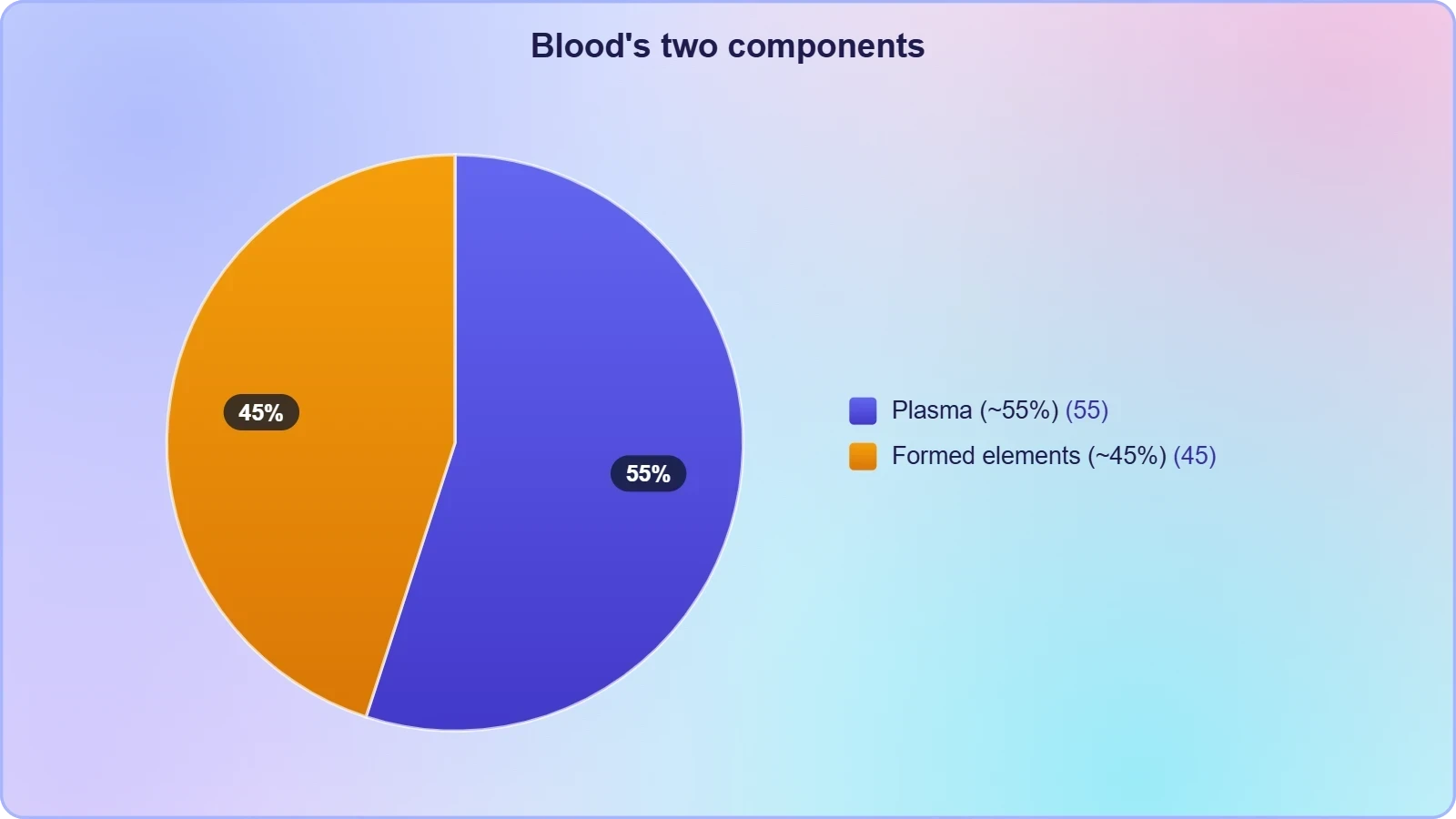
The division of blood into two components — plasma and formed elements — is the organising principle for the whole section. Plasma is the fluid matrix; the formed elements are the cells and cell fragments suspended within it. The chapter assigns approximate proportions to each: plasma constitutes nearly 55 per cent of the blood, while the formed elements collectively constitute nearly 45 per cent. These are volume proportions, and they establish a useful habit of thought: when we speak of blood, we are speaking of a suspension in which the liquid phase is actually the majority.
The Fluid Matrix and Its Proportion
Calling plasma a matrix rather than simply a solvent is deliberate. A matrix is the ground substance in which the characteristic cells of a tissue are set, and plasma performs exactly that role for erythrocytes, leucocytes and platelets. Because it is fluid, it also performs a second function no solid matrix could: it flows, carrying its suspended cells and its dissolved cargo through the vascular system. The figure of nearly 55 per cent is worth committing to memory, because it frames the counterintuitive point that blood is more plasma than cell by volume.
This proportion is also a reminder that blood is not a homogeneous liquid. It is a suspension, and like any suspension it can be separated. Left to stand, or spun in a centrifuge, blood resolves into a pale upper layer and a denser lower layer, and the relative heights of the two layers correspond to the 55 and 45 per cent figures the chapter gives. The composition of the upper layer is the subject of the next section.
Why the Matrix Must Be Liquid
The transport requirements set out at the start of the chapter — nutrients and oxygen to the cells, waste and harmful substances away from them — impose hard demands on the transport medium. It must flow through narrow vessels, it must dissolve and carry a wide variety of chemical species, and it must be able to seal itself when a vessel is breached. A liquid matrix satisfies the first two demands directly; the third is met by the clotting factors that plasma carries in inactive form, ready to be activated when needed.
A solid matrix could support cells and hold them in place, but it could not circulate them. This is why blood sits alongside lymph as one of the body's two circulating fluids, and why the chapter treats the composition of the fluid before the mechanism of its circulation. The properties of the medium constrain what the system can do; the system's requirements, in turn, explain why the medium has the composition it does.
Plasma: Composition and Physical Character
Plasma is described as a straw-coloured, viscous fluid constituting nearly 55 per cent of the blood. Both adjectives matter. The colour is pale and yellowish, distinct from the red of whole blood, and it reflects the absence of haemoglobin in the fluid phase. The viscosity is greater than that of water, and it is largely attributable to the proteins dissolved in it. These physical characteristics are not incidental details; they are the observable consequences of the composition that follows, and they are what one would note on examining a sample of separated plasma.
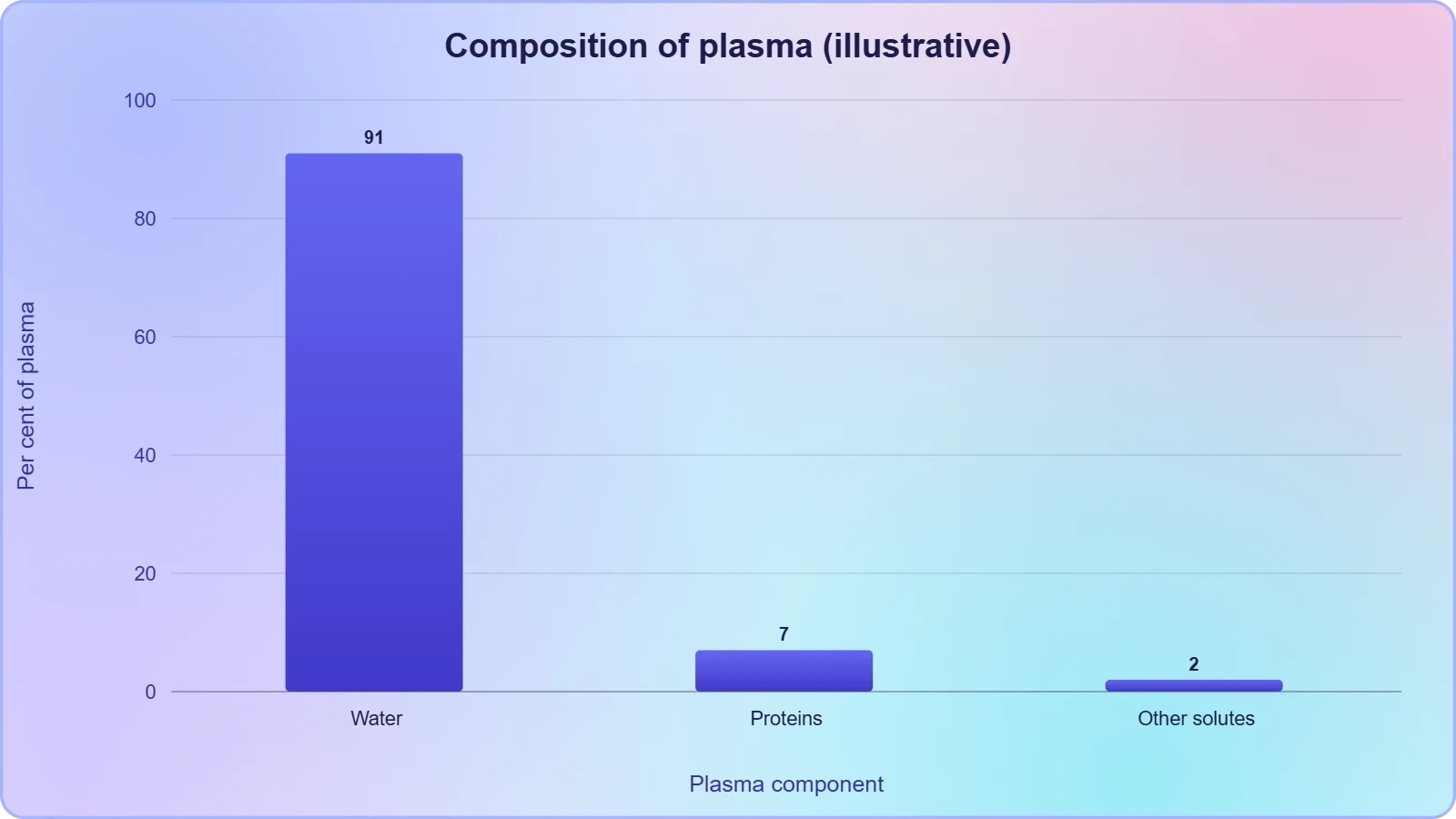
The composition is given in percentages that are easy to remember because they are so lopsided. Between 90 and 92 per cent of plasma is water. Proteins contribute 6 to 8 per cent. The remainder — a small but functionally critical fraction — consists of minerals, nutrients and other dissolved substances. Water is the solvent; the proteins and solutes are the dissolved load. The chapter's order of presentation moves from the solvent to the proteins to the minor constituents, and that order is a sensible one to follow when revising.
Water: The Dominant Solvent
At 90 to 92 per cent, water is so dominant that plasma is best thought of as water with things dissolved in it rather than as a solution in which water happens to be the solvent. This dominance is functionally necessary. Water is an excellent solvent for the ionic and polar substances that must be carried — sodium, calcium, magnesium, bicarbonate, chloride, glucose, amino acids — and its thermal properties allow it to absorb and distribute heat with only modest changes in temperature. It is also the medium in which the plasma proteins are dispersed.
The water content is not fixed. It fluctuates with hydration and with the movement of fluid between plasma and the tissue spaces, and those fluctuations are precisely what the plasma proteins help to regulate. For the purposes of this lesson, the key point is the proportion itself: roughly nine parts water to one part everything else, with proteins forming the bulk of that remaining part.
Proteins and Minor Constituents
Proteins make up 6 to 8 per cent of plasma, and the chapter names three major classes: fibrinogen, globulins and albumins. Each has a distinct role. Fibrinogens are needed for clotting or coagulation of blood. Globulins are primarily involved in the defence mechanisms of the body. Albumins help in osmotic balance. The three names, and the one-line function attached to each, are the core of this part of the lesson and should be learned as a set.
Beyond the proteins, plasma contains small amounts of minerals — sodium, calcium, magnesium, bicarbonate and chloride ions are the ones the chapter lists — together with glucose, amino acids and lipids. These are present because they are always in transit in the body, moving from sites of absorption or release to sites of use or storage. The chapter's phrasing, that they are always in transit, captures the essential point: plasma is a corridor, not a warehouse.
The Three Major Plasma Proteins
The chapter identifies fibrinogen, globulins and albumins as the major proteins of plasma, and attaches a single defining function to each. Fibrinogens are needed for clotting or coagulation of blood. Globulins are primarily involved in the defence mechanisms of the body. Albumins help in osmotic balance. This three-part scheme is compact, and it is worth resisting the temptation to expand it beyond what the material supports. The functions named are the ones the lesson requires; the proteins themselves are distinguished by name and by role, not by molecular detail.
What unites the three is that all are dissolved in the aqueous phase and all contribute to the viscosity of plasma. What separates them is the physiological job each performs: one builds the clot, one defends the body, one holds fluid in the vessels by osmotic means. Together they account for the 6 to 8 per cent of plasma that is protein, and together they illustrate a general principle of physiology — that a small fraction of a fluid's composition can carry a disproportionate share of its function.
Fibrinogen and the Clotting System
Fibrinogen is named for what it becomes. It is the soluble precursor of fibrin, the insoluble protein that forms the mesh of a blood clot, and the chapter's statement that fibrinogens are needed for clotting or coagulation of blood is the essential point. Crucially, the clotting factors present in plasma are there in an inactive form. This is a design of considerable elegance: the machinery of coagulation circulates continuously, ready to act, yet does not act until the sequence is triggered.
The presence of these inactive factors has a direct consequence for the definition of serum, which the chapter supplies in the same section. Plasma without the clotting factors is called serum. The distinction is not a technicality; it is the reason serum and plasma are not interchangeable terms, and it follows directly from the fact that clotting consumes or removes the factors involved.
Globulins, Albumins and Osmotic Balance
Globulins are primarily involved in the defence mechanisms of the body. The word primarily is well chosen, because it signals that defence is the principal but not necessarily the sole association of this class. For this lesson, the defence role is the one to retain. Albumins, by contrast, help in osmotic balance. They are the most abundant of the plasma proteins and, being relatively small and numerous, they exert a colloid osmotic effect that draws fluid back into the vascular compartment.
The pairing of these two functions — defence and osmotic balance — shows how the protein fraction of plasma serves both as a chemical defence system and as a physical regulator of fluid distribution. Neither role is visible in a simple description of plasma as a straw-coloured fluid, yet both are essential to the circulation the later lessons will describe.
Minerals, Nutrients and Substances in Transit
Plasma also contains small amounts of minerals, and the chapter lists them explicitly: sodium, calcium, magnesium, bicarbonate and chloride ions. These are the dissolved electrolytes of the fluid phase, and their presence in ionic form is what allows plasma to conduct the electrical activity that the electrocardiogram, in a later lesson, will record. The list is short and specific, and it is best learned as given rather than expanded with ions the material does not name.
Alongside the minerals, plasma carries glucose, amino acids and lipids. The chapter's explanation for their presence is that they are always in transit in the body. This is the key idea of the section. These substances are not stored in plasma; they are passing through it, moving from the gut or from storage sites to the tissues that will use them. Plasma is therefore a snapshot of the body's traffic at any moment, and its composition reflects what is being carried rather than what is being kept.
Electrolytes and Their Significance
The mineral ions named — Na⁺, Ca²⁺, Mg²⁺, HCO₃⁻ and Cl⁻ — are present in small amounts, but small is not the same as unimportant. Calcium and magnesium are involved in the excitability and contraction of muscle, including cardiac muscle, and bicarbonate is central to the buffering of the blood. The chapter does not elaborate these roles here, and this lesson does not need to; the point is that the mineral fraction, though small, is a functional component of plasma rather than an incidental impurity.
It is worth noting how the chapter presents these ions: as a list of examples introduced by the phrase small amounts of minerals like. The phrasing signals that the list is illustrative rather than exhaustive, which is a useful caution. For examination purposes, however, the named ions are the ones to reproduce, and they should be associated with the mineral fraction of plasma rather than with the proteins or the formed elements.
Transit Substances and the Meaning of Transport
Glucose, amino acids and lipids are the clearest illustration of what transport means in this context. Each is absorbed or released somewhere and used somewhere else, and plasma is the medium of the interval between those two points. The phrase always in transit is precise: at any moment some of each is present, because the traffic never stops, but none of it is there permanently. This is why plasma composition can change with meals, with exercise and with fasting.
This understanding prepares the ground for the next lesson. The formed elements — erythrocytes, leucocytes and platelets — are the cells that plasma carries, and the erythrocytes in particular are the carriers of the respiratory gases that the chapter's opening paragraph identified as an essential cargo. Plasma dissolves and transports; the cells, as the next lesson shows, specialise in particular kinds of transport.
Plasma and Serum: The Clotting Distinction
The chapter closes its account of plasma with a definition that is short, exact and frequently examined: plasma without the clotting factors is called serum. The definition is best understood as a statement about what happens when blood clots. Plasma contains clotting factors in an inactive form; when clotting is triggered, those factors are consumed in the formation of the clot, and the fluid that remains — the fluid left after the clot has formed — is serum. Serum is therefore not a different fluid from plasma but the same fluid minus the factors that clotting removed.
This distinction has practical consequences. When a blood sample is allowed to clot and is then separated, the fluid obtained is serum; when clotting is prevented and the cells are separated, the fluid obtained is plasma. The two differ by the clotting factors, and that difference is the reason the terms are not interchangeable. The chapter's definition is the anchor for this section, and the table below sets the two fluids side by side.
Why the Clotting Factors Are Inactive
The chapter states that factors for coagulation or clotting of blood are present in the plasma in an inactive form. The reason is not spelled out, but the logic is clear enough from the definition of serum: if the factors circulated in active form, clotting would occur continuously within the vessels. Keeping them inactive until needed allows the system to be permanently ready without being permanently active. The activation step, and the cascade it initiates, belong to the later lesson on coagulation; here the point is simply the state in which the factors are carried.
This is also why the definition of serum is placed where it is. It follows directly from the statement about inactive clotting factors, and it depends on it. Read in sequence, the two sentences form a single argument: the factors are present but inactive; clotting activates and consumes them; the fluid left behind is serum.
Distinguishing Plasma from Serum
The distinction is easiest to hold in mind as a subtraction. Plasma is the fluid matrix of blood as it circulates, complete with its inactive clotting factors. Serum is that same fluid after clotting has occurred, and therefore without those factors. Everything else — the water, the albumins, the globulins, the minerals, the nutrients — is common to both. The difference is confined to the clotting system, but it is decisive for how the two fluids are named and used.
For revision, the safest formulation is the chapter's own: plasma without the clotting factors is called serum. It is short, it is exact, and it avoids the common error of treating serum as a synonym for plasma. The table below summarises the comparison.
Working with the Numbers: A Quantitative View
The figures in this section are few but they are precise, and they are the kind that examination questions test directly. Plasma is nearly 55 per cent of blood; formed elements are nearly 45 per cent. Plasma is 90 to 92 per cent water and 6 to 8 per cent protein. These percentages are not independent facts to be memorised in isolation; they are linked, and working through the arithmetic makes the links visible. A student who can move between the percentages and the underlying quantities has understood the composition rather than merely recorded it.
Consider a sample of blood of known volume. The plasma fraction is nearly 55 per cent of it, and within that plasma the water fraction is 90 to 92 per cent. Multiplying the two proportions gives the water content of whole blood, and the result is a useful check on intuition: water is the single largest constituent of blood by a wide margin, even though blood is red and appears to be dominated by its cells. The calculations below make this explicit.
Proportions and Their Arithmetic
If plasma is 55 per cent of blood and water is 91 per cent of plasma, then water is approximately 0.55 × 0.91 of whole blood, or about 50 per cent. The protein fraction of whole blood follows the same logic: 0.55 × 0.07 is roughly 0.04, or about 4 per cent. These are approximations, but they are the right order of magnitude, and they show that the plasma proteins, though only 6 to 8 per cent of plasma, are still a measurable fraction of whole blood.
The same arithmetic can be reversed. If a sample contains a known mass of plasma protein, the volume of plasma from which it came can be estimated by dividing by the protein fraction. Such calculations are the basis of many laboratory determinations, and they illustrate why the percentages are given with ranges rather than single values: biological quantities vary between individuals and with physiological state.
Reading the Ranges Correctly
The ranges in the chapter — 90 to 92 per cent water, 6 to 8 per cent protein — are not imprecision. They reflect genuine biological variation, and they should be quoted as ranges rather than collapsed to a single figure. A student who writes that plasma is 91 per cent water is not wrong, but a student who writes 90 to 92 per cent is faithful to the material. The same applies to the 55 and 45 per cent split between plasma and formed elements, which the chapter qualifies with nearly.
This habit of preserving the stated range is worth cultivating early. Later lessons give counts of cells per cubic millimetre and masses of haemoglobin per 100 millilitres, and those too are given as ranges. The discipline of quoting the range, and of understanding why a range rather than a point value is appropriate, is part of learning physiology rather than merely memorising it.
Going Further
Two points of well-established background help the material above make fuller sense, and they are offered here separately so that they are not confused with the chapter's own statements. The first concerns the size of the plasma proteins. These molecules are large enough that they do not readily pass through the walls of capillaries, and their retention within the vessels is one of the reasons fluid is held in the vascular compartment rather than draining away into the tissues. This is the physical basis of the osmotic role the chapter attributes to albumins.
The second point concerns serum. Because serum is what remains after blood has clotted, it lacks fibrinogen along with the other clotting factors consumed in the process. This is consistent with the chapter's definition — plasma without the clotting factors is called serum — and it explains why serum, rather than plasma, is the fluid commonly used when a clotted sample is required for analysis. Neither point alters the material; both clarify why the material is framed as it is.
Protein Size and Fluid Retention
The capillary wall is permeable to water and to small solutes but not, to any great extent, to large proteins. When plasma proteins remain inside the vessel, they exert an osmotic pull that opposes the outward filtration of fluid. Albumins, being relatively abundant and comparatively small among the plasma proteins, contribute substantially to this effect, which is why the chapter associates them with osmotic balance. The point is a helpful extension rather than a correction.
This also explains why the protein fraction, though only 6 to 8 per cent of plasma, matters so much for fluid distribution. A small change in plasma protein concentration can shift the balance of fluid between the vessels and the tissues, and the clinical consequences of such shifts are considerable. For this lesson, the takeaway is simply that the osmotic function named in the material has a clear physical explanation.
Serum as the Post-Clotting Fluid
Once blood has clotted, the fluid that can be expressed or separated from the clot is serum. It contains the albumins and globulins, the minerals and the nutrients, but not the fibrinogen that has been converted and incorporated into the clot. This is why serum and plasma, though often mentioned together, are not the same fluid, and why the chapter's definition is worth learning verbatim. The distinction will recur when coagulation is treated in detail.
For the present lesson, the two background points serve a single purpose: they show that the definitions and proportions given in the material are not arbitrary. They follow from the physical chemistry of large molecules in a confined space and from the biochemistry of clotting. A student who sees that connection will find the later lessons on coagulation and on capillary exchange considerably easier to follow.
Also Read
- No links available.
From our network :
- Analyzing Trump Deportation Numbers Insights Into The 2026 Immigration Crackdown
- Trump Political Strategy How Geopolitical Stunts Serve As Media Diversions
- AI-Powered 'Precision Diagnostic' Replaces Standard GRE Score ReportsDiscover the new GRE Precision Diagnostic. Learn how AI-powered behavioral analytics and time-to-solve tracking are replacing standard GRE score reports to empower students.
- EV 2.0: The Solid-State Battery Breakthrough and Global Factory ExpansionDiscover the impact of the Solid-State Battery Breakthrough on the EV market. Learn about CATL and BYD stock growth, global factory expansion in Europe, and the future of EV 2.0 technology.
- 98% of Global MBA Programs Now Prefer GRE Over GMAT Focus EditionExplore why 98% of global MBA programs now prefer the GRE over GMAT Focus. Learn about the shorter GRE format, verbal logic importance, and strategic versatility for students.
- Vite 6/7 'Cold Start' Regression in Massive Module GraphsIn-depth analysis of Vite 6/7 cold start regressions in massive module graphs. Learn about barrel file issues, pre-bundling optimizations, and how to improve Vite dev server performance.
- Mastering DB2 12.1 Instance Design: A Technical Deep Dive into Modern Database ArchitectureComprehensive guide to DB2 12.1 Instance Design. Explore architectural components, HADR setup, buffer pool tuning, and security policies for IBM DB2 12.1. Includes 10 functional SQL and Shell samples.
- Mastering DB2 LUW v12 Tables: A Comprehensive Technical GuideComprehensive guide on DB2 LUW v12 tables. Explore CREATE TABLE syntax, BLU Acceleration, range partitioning, data types, and security features for IBM DB2 LUW v12.
- 10 Physics Numerical Problems with Solutions for IIT JEEPrepare for IIT JEE with 10 physics numerical problems, complete with detailed solutions and conceptual explanations. Ideal for mastering kinematics, thermodynamics, electromagnetism, and optics.
RESOURCES
- Physiology, Blood Plasma - StatPearls - NCBI Bookshelfncbi.nlm.nih.govJul 15, 2026 ... Blood is a specialized connective tissue composed of cellular elements suspended in a fluid matrix. Plasma is the fluid component…
- What Is Plasma in Blood? - Cleveland Clinicmy.clevelandclinic.orgMar 14, 2025 ... The components that make up human blood, including plasma, white blood cells and red blood cells. What is plasma? Plasma…
- Proteins and antibodies in serum, plasma, and whole blood—size ...pmc.ncbi.nlm.nih.govMay 29, 2018 ... ... composition as plasma with the exception that the fibrinogens and clotting factors are absent. The protein concentration in plasma/serum…
- The Composition of Hyperacute Serum and Platelet-Rich Plasma Is ...pubmed.ncbi.nlm.nih.govFeb 8, 2019 ... Autologous blood derived products, such as platelet-rich plasma (PRP) and platelet-rich fibrin (PRF) are widely applied in regenerative ...
- Changes in total plasma and serum N-glycome composition ... - Naturenature.comAug 9, 2016 ... In the present work we found that the plasma N-glycome undergoes significant changes after major abdominal surgery using two independent…
- The Comparison between the Composition of 100% Autologous ...pubmed.ncbi.nlm.nih.govApr 25, 2023 ... Purpose: The aim of the study was to compare the difference in composition between 100% autologous serum (AS) and 100%…
- Blood Plasma Components and Function - News-Medicalnews-medical.netOct 10, 2018 ... The proteins in plasma include the antibody proteins, coagulation factors, and the proteins albumin and fibrinogen which maintain serum osmotic ...
- Blood plasma - Wikipediaen.wikipedia.orgContents · Volume · Plasma proteins · Color · Plasma vs. serum in medical diagnostics · History · Plasma donation · Synthetic blood plasma.
- Fatty acid composition of the plasma lipids in Greenland Eskimossciencedirect.comThe effect on human serum lipids of a dietary fat, highly unsaturated, but poor in essential fatty acids. Lancet, 1 (1959), p. 115. View…
- What's the Difference Between Serum and Plasma? | Charles Rivercriver.comNov 2, 2020 ... Serum is the liquid that remains after the blood has clotted. Plasma is the liquid that remains when clotting is…
- Analysis of major fatty acids from matched plasma and serum ...sciencedirect.comThis study analyzed the individual FA content of matched plasma and serum samples in both absolute (μg/mL) and relative percent (%) composition. Analyses were ...
- s guide to study extracellular vesicles in human blood plasma and ...isevjournals.onlinelibrary.wiley.comJan 9, 2024 ... 1 COMPOSITION OF BLOOD. Blood and its derivatives plasma and serum are the most commonly studied body fluid for extracellular…
- Distribution of Novel and Well-Known Poly- and Perfluoroalkyl ...pubs.acs.orgOct 22, 2017 ... The median relative PFAS compositions (ng mL–1) in serum, plasma, and whole blood were all dominated by PFOS, followed by…