Every cut that stops bleeding on its own is a small demonstration of one of the body's most tightly regulated defence systems. Blood does not simply thicken when it leaves a vessel; it converts a soluble plasma protein into an insoluble mesh that seals the breach, and it does so through a carefully ordered sequence of activations rather than a single chemical event. This lesson examines that sequence as it is presented in the chapter on body fluids and circulation, beginning with the visible clot itself and then working backwards through the enzymic steps that produce it.
The material establishes a clear chain of cause and effect. Injury or trauma stimulates platelets to release certain factors, and tissues at the site of injury release factors of their own; these initiate coagulation. The end product is a clot, or coagulum, formed mainly of a network of threads called fibrins, in which dead and damaged formed elements of blood are trapped. Fibrins arise from inactive fibrinogens in the plasma under the action of the enzyme thrombin, and thrombins in turn are formed from another inactive plasma substance, prothrombin, with an enzyme complex called thrombokinase required for that reaction.
Because this lesson follows the treatment of Rh grouping and precedes the study of lymph, it deliberately stays with the clotting mechanism and its participants. The Rh discussion concerned antigens on the surface of red cells and the antibodies that may form against them; here the focus shifts to plasma proteins, platelets, tissue factors and calcium ions. The next lesson turns to tissue fluid and lymph, so the closing sections prepare the ground by showing how plasma composition and vessel integrity connect to the fluid that escapes into tissues.
On This Page
The Clot as a Visible Endpoint of Injury Response
A wound that stops bleeding after some time is displaying coagulation, or clotting, in response to injury or trauma. The chapter frames this plainly as a mechanism to prevent excessive loss of blood from the body. What a learner observes at the site of a cut or injury over a period of time is a dark reddish brown scum, and this is the clot or coagulum itself. Recognising that scum as a structured object rather than mere dried blood is the first conceptual step, because everything that follows in the lesson explains how that object is assembled from plasma proteins and cellular debris.
Composition of the Coagulum
The clot is described as being formed mainly of a network of threads called fibrins, in which dead and damaged formed elements of blood are trapped. Two features of this definition deserve attention. First, the structural element is a protein fibre network, not the cells; the cells are passengers caught within it. Second, the trapped elements are specifically dead and damaged formed elements, which is consistent with the site of an injury where cells have been disrupted. The fibrin mesh therefore acts as a scaffold and a net simultaneously, holding the mass together while physically obstructing further escape of blood.
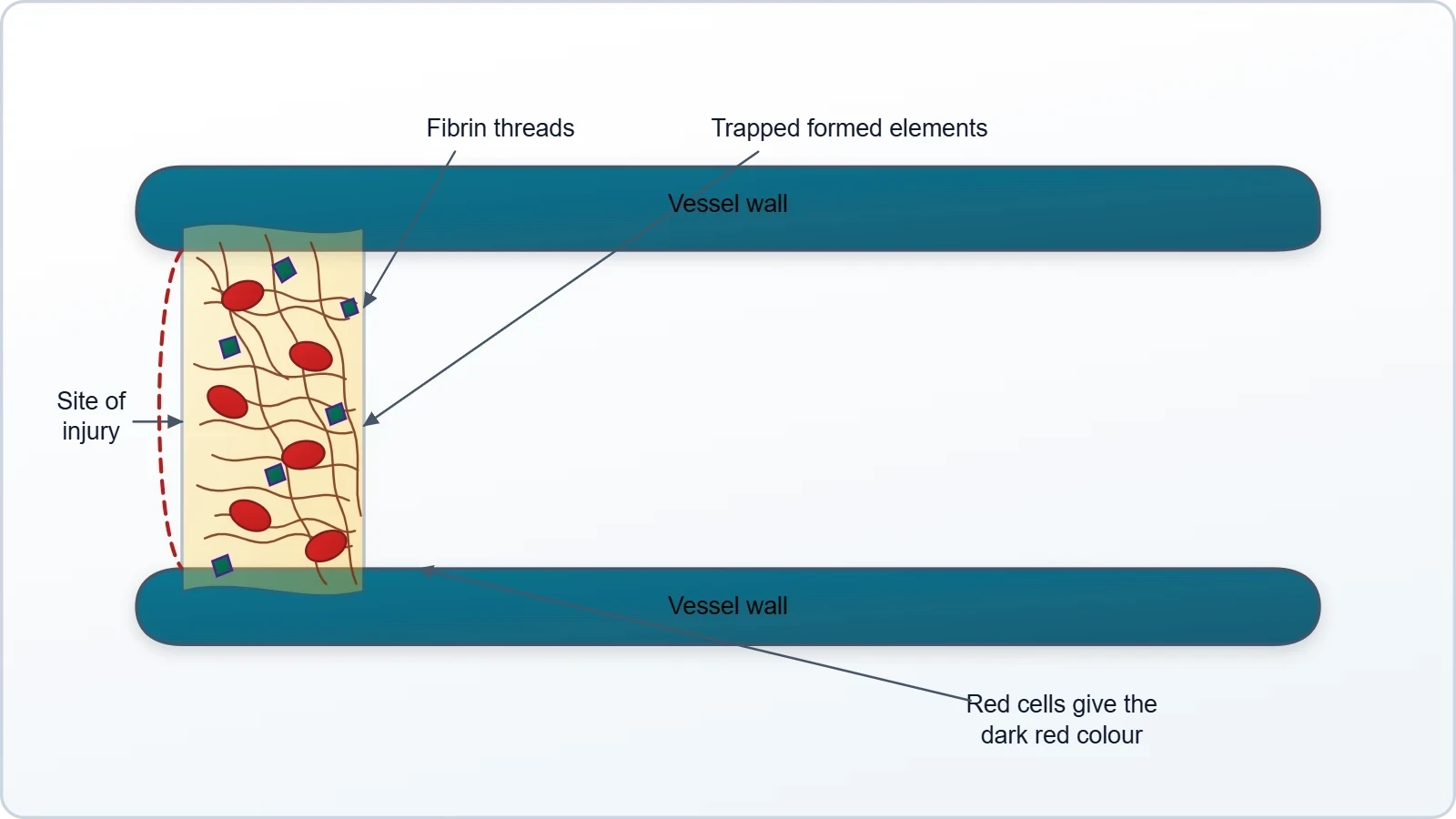
This description also clarifies why the clot appears dark reddish brown. The trapped formed elements include red cells, and their pigment persists within the coagulum as it forms and retracts. The chapter does not elaborate on clot retraction or serum expression, and this lesson does not add them to the core account. What matters for examination purposes is the precise wording: a network of fibrin threads trapping dead and damaged formed elements. Learners should be able to reproduce that definition and to distinguish the fibrin network from the cells it encloses.
Why Clotting Must Be Localised
The chapter presents coagulation as a response to injury or trauma, which implies that the process is triggered by circumstances associated with damage rather than occurring continuously. The initiating events it names are the release of certain factors by stimulated platelets and the release of factors by tissues at the site of injury. Both sources are located at the breach, so the response is anchored where it is needed. This localisation is the reason a cut seals while the blood remaining inside intact vessels continues to flow, and it is the point at which the lesson's later discussion of inactive precursors becomes intelligible.
Fibrinogen, Fibrin and the Action of Thrombin
The central transformation in the chapter's account is the conversion of inactive fibrinogens in the plasma into fibrins by the enzyme thrombin. Fibrinogen is a plasma protein that circulates in a form that does not aggregate; fibrin is the thread-like material that constitutes the clot's network. The enzyme responsible for this conversion is thrombin, and the chapter is explicit that thrombin acts on a precursor rather than on the formed elements. This single sentence carries most of the lesson's explanatory weight, because it establishes that clotting is a proteolytic conversion of a soluble substrate into an insoluble product.
Substrate and Product
Learners should hold the pair firmly: fibrinogen is the inactive substance present in the plasma, and fibrin is the thread network formed from it. The chapter's phrasing, that fibrins are formed by the conversion of inactive fibrinogens in the plasma by the enzyme thrombin, gives the substrate, its location and the catalyst in one statement. The location matters, because it tells us the raw material is already dissolved in the fluid that is escaping from the wound. Nothing needs to be imported to the site; the precursor arrives with the blood and is converted where the enzyme is generated.
The product differs from the substrate in physical behaviour rather than in origin. Fibrin threads assemble into a network, and that network is what gives the clot its mechanical continuity. The chapter does not describe the polymerisation chemistry, and this lesson does not require it. What is required is the directional logic: fibrinogen to fibrin, catalysed by thrombin, producing a mesh that traps dead and damaged formed elements. Any answer that reverses the direction, or that makes fibrin the precursor, misrepresents the material and should be corrected immediately.
Why the Enzyme Must Be Generated Locally
Thrombin is not described as a constitutive plasma enzyme but as something formed from another inactive substance, prothrombin. The chapter's sequence therefore has two successive activation steps: prothrombin becomes thrombin, and thrombin converts fibrinogen to fibrin. Because the enzyme is produced at the point of need rather than circulating in an active state, the conversion of fibrinogen is confined to the region where the preceding step has occurred. This is the structural reason the response remains local, and it is the reason the lesson treats the two steps as a linked pair rather than as independent reactions.
Thrombokinase and the Cascade Process
The formation of thrombin from prothrombin requires an enzyme complex called thrombokinase. The chapter is careful to describe this complex as something formed by a series of linked enzymic reactions, a cascade process, involving a number of factors present in the plasma in an inactive state. This is the most demanding idea in the lesson, because it replaces a single reaction with an ordered sequence. Each step in the sequence depends on the one before it, and the factors involved are not pre-activated but are drawn from a pool of inactive plasma precursors. The cascade is therefore both a chain of causation and a mechanism of amplification.
Reading the Cascade Correctly
A cascade, in this context, means linked enzymic reactions in which the product of one step enables the next. The chapter does not enumerate the individual factors, and this lesson does not invent them. What learners must grasp is the architecture: thrombokinase is not a simple molecule but a complex assembled through the cascade, and that complex is what the conversion of prothrombin requires. The practical consequence is that interference anywhere along the chain can prevent the final step, which is why the chapter's emphasis on inactive precursors is not a technicality but the basis of the whole mechanism.
It is worth noting how the cascade relates to the initiating events already described. An injury or trauma stimulates the platelets in the blood to release certain factors which activate the mechanism of coagulation, and certain factors released by the tissues at the site of injury can also initiate coagulation. These released factors are the entry points into the linked reactions. The cascade then runs forward to generate thrombokinase, thrombokinase enables thrombin formation, and thrombin converts fibrinogen to fibrin. The order of ideas in the chapter follows exactly this direction, and answers should preserve it.
Platelets, Tissue Factors and the Trigger
Two distinct sources of initiation are named. Platelets in the blood release certain factors when stimulated by injury or trauma, and tissues at the site of injury release factors that can also initiate coagulation. The chapter does not rank these sources or specify which dominates, and the lesson should not do so either. What can be said confidently is that both are associated with damage, so the mechanism is engaged by the event that requires it. This dual initiation is consistent with the local character of clotting discussed earlier and prepares the learner for the regulatory considerations raised in the closing block.
The Role of Calcium Ions in Clotting
The chapter closes its account of coagulation with a single, emphatic statement: calcium ions play a very important role in clotting. No quantity, concentration or specific step is attached to this claim, and the lesson should respect that restraint while making the point memorable. Calcium is not a structural component of the fibrin mesh and it is not the enzyme that converts fibrinogen; it is a participant whose presence the process requires. Placing it at the end of the sequence, as the chapter does, signals that the mechanism is not complete without it, even though the preceding steps have been described in full.
What the Chapter Does and Does Not Claim
The claim is deliberately general. Learners should be able to state that calcium ions play a very important role in clotting, and should resist the temptation to specify a single reaction as the sole calcium-dependent step. The chapter's wording supports the broader reading: calcium is important to clotting as a process. This is also the safest formulation for examination answers, because it matches the source exactly. Where a question asks for the role of calcium, the correct response is the chapter's own statement, optionally supported by the background note in the closing block rather than by invented detail.
Connecting Calcium to the Cascade
Because the cascade is described as a series of linked enzymic reactions involving plasma factors in an inactive state, and because calcium is said to be very important to clotting, the natural inference is that calcium participates within that linked sequence rather than after it. The chapter does not spell out the individual steps, so the inference should be presented as an inference. What can be asserted without qualification is that any account of clotting which omits calcium is incomplete. Learners preparing for assessment should treat calcium as a named requirement of the mechanism, alongside thrombokinase, thrombin and fibrinogen.
Working Through the Sequence in Order
The chapter presents the mechanism in a definite order of ideas, and reproducing that order is the surest way to answer questions accurately. Injury or trauma stimulates platelets to release certain factors, and tissue factors at the site can also initiate coagulation. The cascade of linked enzymic reactions then assembles the enzyme complex thrombokinase. Thrombokinase is required for the formation of thrombin from prothrombin. Thrombin converts inactive fibrinogens in the plasma into fibrins. The fibrin threads form a network in which dead and damaged formed elements are trapped, producing the clot or coagulum that stops further loss of blood.
A Written Walkthrough
When writing the sequence under examination conditions, it helps to keep the participants in a fixed order and to name the catalyst at each step. The following pseudocode is not biology but a discipline for the answer: it forces the writer to state the trigger, the cascade, the enzyme complex, the two conversions and the final structure without skipping a link. Learners who can reproduce this skeleton can then add the descriptive detail about the dark reddish brown scum and the trapped formed elements, which is where many marks are lost through omission rather than error.
def coagulation_sequence():
    trigger = "injury or trauma"
    initiators = ["factors released by stimulated platelets",
                  "factors released by tissues at the site of injury"]
    cascade = "series of linked enzymic reactions"
    thrombokinase = "enzyme complex assembled by the cascade"
    thrombin = convert("prothrombin", catalyst=thrombokinase)
    fibrin = convert("fibrinogen", catalyst=thrombin)
    clot = "network of fibrin threads trapping dead and damaged formed elements"
    return clot

def convert(precursor, catalyst):
    assert precursor in ("prothrombin", "fibrinogen")
    return f"{precursor} becomes its active product via {catalyst}"
Common Errors to Avoid
Several mistakes recur in answers on this topic. Some learners make fibrin the precursor and fibrinogen the product, reversing the chapter's direction. Others treat thrombokinase as the enzyme that converts fibrinogen, when the chapter assigns that role to thrombin and reserves thrombokinase for the formation of thrombin from prothrombin. A third error is to describe the clot as consisting of cells, when the chapter makes the fibrin network the main structural component and the formed elements the trapped material. A fourth is to omit calcium altogether. Each of these can be corrected by returning to the chapter's own sentences.
Going Further
The core account above is complete as the chapter gives it. Two pieces of well-established background help explain why the mechanism is built the way it is, and they are offered here separately so that they are not confused with the chapter's own statements. Neither contradicts the material; both extend it. Learners should be able to distinguish clearly between what the chapter asserts and what is added for understanding, particularly when writing answers that will be marked against the source.
Inactive Precursors and the Prevention of Internal Clotting
Clotting factors circulate in an inactive form so that blood does not clot inside vessels. This is the functional reason the chapter describes prothrombin, fibrinogen and a number of plasma factors as inactive substances present in the plasma. If the active enzymes circulated freely, the conversion of fibrinogen would proceed throughout the vascular system rather than at a wound. Keeping the participants inactive until the cascade is triggered at a site of injury confines the reaction to where it is needed, and it explains why the initiating factors released by platelets and injured tissue are the decisive event in starting the process.
Calcium at Several Steps of the Cascade
Calcium ions are needed at several steps of the clotting cascade, not merely at one. This background point is consistent with the chapter's general statement that calcium ions play a very important role in clotting, and it explains why the statement is phrased so broadly. It also indicates why the chapter places calcium alongside the cascade rather than attaching it to a single conversion. For learners, the practical implication is that calcium should be treated as a requirement of the mechanism as a whole, and that any description of clotting which leaves it out is incomplete.
Preparing for Lymph and Tissue Fluid
The clotting mechanism described here operates within plasma, and plasma is the fluid that will occupy the next lesson. Understanding that fibrinogen and prothrombin are plasma proteins held in an inactive state makes it easier to appreciate what tissue fluid is: the portion of plasma that leaves the vessels and bathes the cells, from which the larger plasma proteins are largely excluded. The contrast between the protein-rich plasma inside vessels and the fluid outside them is the conceptual bridge to the study of lymph, and it follows naturally from the material on coagulation.
What to Carry Forward
Three ideas from this lesson should travel into the next. First, plasma contains inactive precursors that become active only under specific conditions, which is a general principle of plasma chemistry rather than a peculiarity of clotting. Second, the integrity of the vessel wall is what keeps those precursors and their products in the right place, so any discussion of fluid movement must begin with the vessel. Third, the formed elements are distinct from the plasma proteins, and the clot demonstrates this by trapping the former within a mesh built from the latter. Each of these points will recur when tissue fluid and lymph are examined.
A Brief Consolidation
Before moving on, learners should be able to state the whole sequence without prompts: injury or trauma, platelet and tissue factors, the cascade, thrombokinase, thrombin from prothrombin, fibrin from fibrinogen, and a clot of fibrin threads trapping dead and damaged formed elements, with calcium ions playing a very important role throughout. They should also be able to explain why the dark reddish brown scum appears at a cut, and why the process does not normally occur inside intact vessels. Mastery of these points is the intended outcome of this lesson and the foundation for the material that follows.
Also Read
- No links available.
From our network :
- Analyzing Trump Deportation Numbers Insights Into The 2026 Immigration Crackdown
- 98% of Global MBA Programs Now Prefer GRE Over GMAT Focus EditionExplore why 98% of global MBA programs now prefer the GRE over GMAT Focus. Learn about the shorter GRE format, verbal logic importance, and strategic versatility for students.
- Mastering DB2 12.1 Instance Design: A Technical Deep Dive into Modern Database ArchitectureComprehensive guide to DB2 12.1 Instance Design. Explore architectural components, HADR setup, buffer pool tuning, and security policies for IBM DB2 12.1. Includes 10 functional SQL and Shell samples.
- Vite 6/7 'Cold Start' Regression in Massive Module GraphsIn-depth analysis of Vite 6/7 cold start regressions in massive module graphs. Learn about barrel file issues, pre-bundling optimizations, and how to improve Vite dev server performance.
- Mastering DB2 LUW v12 Tables: A Comprehensive Technical GuideComprehensive guide on DB2 LUW v12 tables. Explore CREATE TABLE syntax, BLU Acceleration, range partitioning, data types, and security features for IBM DB2 LUW v12.
- 10 Physics Numerical Problems with Solutions for IIT JEEPrepare for IIT JEE with 10 physics numerical problems, complete with detailed solutions and conceptual explanations. Ideal for mastering kinematics, thermodynamics, electromagnetism, and optics.
- Trump Political Strategy How Geopolitical Stunts Serve As Media Diversions
- AI-Powered 'Precision Diagnostic' Replaces Standard GRE Score ReportsDiscover the new GRE Precision Diagnostic. Learn how AI-powered behavioral analytics and time-to-solve tracking are replacing standard GRE score reports to empower students.
- EV 2.0: The Solid-State Battery Breakthrough and Global Factory ExpansionDiscover the impact of the Solid-State Battery Breakthrough on the EV market. Learn about CATL and BYD stock growth, global factory expansion in Europe, and the future of EV 2.0 technology.
RESOURCES
- Physiology, Coagulation Pathways - StatPearls - NCBI Bookshelfncbi.nlm.nih.govJun 2, 2025 ... Factor IIa (thrombin) activates fibrinogen into fibrin. Thrombin also activates other factors in the intrinsic pathway (factor XI), cofactors V ...
- The Clotting Cascade | National Bleeding Disorders Foundationbleeding.orgFactor 2(II) (Prothrombin): When activated, it changes into thrombin, which later helps fibrinogen become fibrin. We find this factor in the common pathway ...
- Coagulation Cascade: Pathways & Factors, Made Simple - Osmosisosmosis.org6 days ago ... Factor VIII is found circulating in the blood and is often activated by thrombin (i.e., factor IIa). ... fibrin, forming…
- How it all starts: initiation of the clotting cascade - PMC - NIHpmc.ncbi.nlm.nih.govThe plasma coagulation system in mammalian blood consists of a cascade ... The final common pathway of blood clotting then leads to thrombin generation…
- The role of thrombin in haemostasis - PubMedpubmed.ncbi.nlm.nih.govApr 1, 2022 ... The last enzyme in the coagulation cascade is thrombin, with the ... A natural anticoagulant pathway that supplies regulation of…
- Mechanism Action of Platelets and Crucial Blood Coagulation ... - PMCpmc.ncbi.nlm.nih.govOct 1, 2017 ... ... coagulation cascade to generate thrombin. Thrombin ... process of forming blood clots by catalyzing the conversion of Fib to…
- Coagulation - Wikipediaen.wikipedia.orgCoagulation, also known as clotting, is the process by which blood changes from a liquid to a gel forming a blood clot. The process…
- In silico analysis of patient specific coagulation and flow effects on ...nature.comApr 5, 2026 ... The 0D model reproduced TG data, while 1D simulations matched TD outcomes for clot size, fibrin growth, and thrombin wave…
- Monitoring the Formation of Fibrin Clots as Part of the Coagulation ...pubs.acs.orgMay 2, 2023 ... ... coagulation cascade, fibrin clots, fibrinogen, thrombin. 1. Introduction. Blood coagulation is an important defense mechanism against bleeding.
- Fibrin-bound thrombin determines clot structure and blood ...haematologica.orgFeb 5, 2026 ... Coagulation operates as a cascade-based process that involves intricate interplays of coagulant and anticoagulant factors in blood plasma as ...
- The effects of pseudoserum on thrombin-induced fibrin networkssciencedirect.comPPP samples were analysed with thromboelastography (Table 2) which assesses almost the entire coagulation cascade in the context of clotting factors (without ...
- Tissue Factor in Coagulation and Inflammation - Scripps Researchscripps.eduOct 13, 2003 ... ... coagulation—the process of blood clotting. Years of research in many laboratories across the world have described this process and…
- Coagulation Clotting Mechanisms - MCAT Content - Jack Westinjackwestin.comSeveral components of the coagulation cascade, including both cellular (e.g. platelets) and protein (e.g. fibrin) components, are involved in blood vessel ...