Disorders of the circulatory system represent the point where the elegant machinery of blood, vessels and cardiac muscle begins to fail under measurable, clinical conditions. This fourteenth lesson in the body fluids and circulation sequence moves from the healthy regulation of cardiac activity into the pathological states that arise when that regulation is overwhelmed or when the vessels themselves are compromised. The material treats four conditions in a deliberate order: hypertension, coronary artery disease, angina and heart failure. Each is defined with precision, each is tied to a specific anatomical target, and each is carefully distinguished from the others so that learners do not blur conditions that are clinically and conceptually distinct.
The lesson builds directly on the preceding discussion of regulation, where the medulla oblongata, the autonomic nervous system and adrenal medullary hormones were shown to modulate heart rate and cardiac output. That background matters here, because hypertension is precisely a failure of pressure regulation, and heart failure is a failure of output. By anchoring each disorder to a normal value or a normal function, the material gives learners a reference point against which abnormality can be judged. The normal blood pressure of 120/80 mm Hg, the effective pumping of blood to meet the body's needs, and the adequate oxygen supply to cardiac muscle all become the standards against which disease is measured.
What follows is a structured treatment of each disorder, with attention to definitions, mechanisms, affected organs and the distinctions that examiners and clinicians both insist upon. The lesson closes with a short "Going further" block that adds well-established background on how blood pressure is recorded and why lung congestion accompanies congestive heart failure, kept clearly separate from the core material so that the backbone of the lesson remains intact and uncontradicted.
On This Page
- Hypertension: When Blood Pressure Exceeds the Normal Range
- Coronary Artery Disease and the Narrowing Lumen
- Angina Pectoris: The Signal of Oxygen Shortfall
- Heart Failure: When Output Cannot Meet Demand
- Connecting the Disorders to Cardiac Regulation
- Going Further: Recording Pressure and Reading Congestion
- Clinical Vocabulary and the Precision It Demands
Hypertension: When Blood Pressure Exceeds the Normal Range
Hypertension is the term for blood pressure that is higher than normal, and the material fixes that normal at 120/80. In this measurement, 120 mm Hg is the systolic, or pumping, pressure, and 80 mm Hg is the diastolic, or resting, pressure. The definition is operational rather than vague: if repeated checks of an individual's blood pressure read 140/90 or higher, hypertension is indicated. The emphasis on repeated checks is important, because a single elevated reading is not the same as a diagnosis, and the threshold of 140/90 marks the boundary between normal variation and a sustained pathological state.
The Systolic and Diastolic Components
Understanding hypertension requires understanding what the two numbers represent. Systolic pressure is the pressure generated when the ventricles contract and drive blood into the arteries; diastolic pressure is the pressure that remains in the arteries during relaxation, when the heart is refilling. The notation 120/80 therefore encodes two distinct phases of the cardiac cycle, and both are measured in millimetres of mercury. A rise in either component contributes to the hypertensive reading, and the 140/90 threshold applies to the pair as recorded, not to an isolated figure taken out of context.
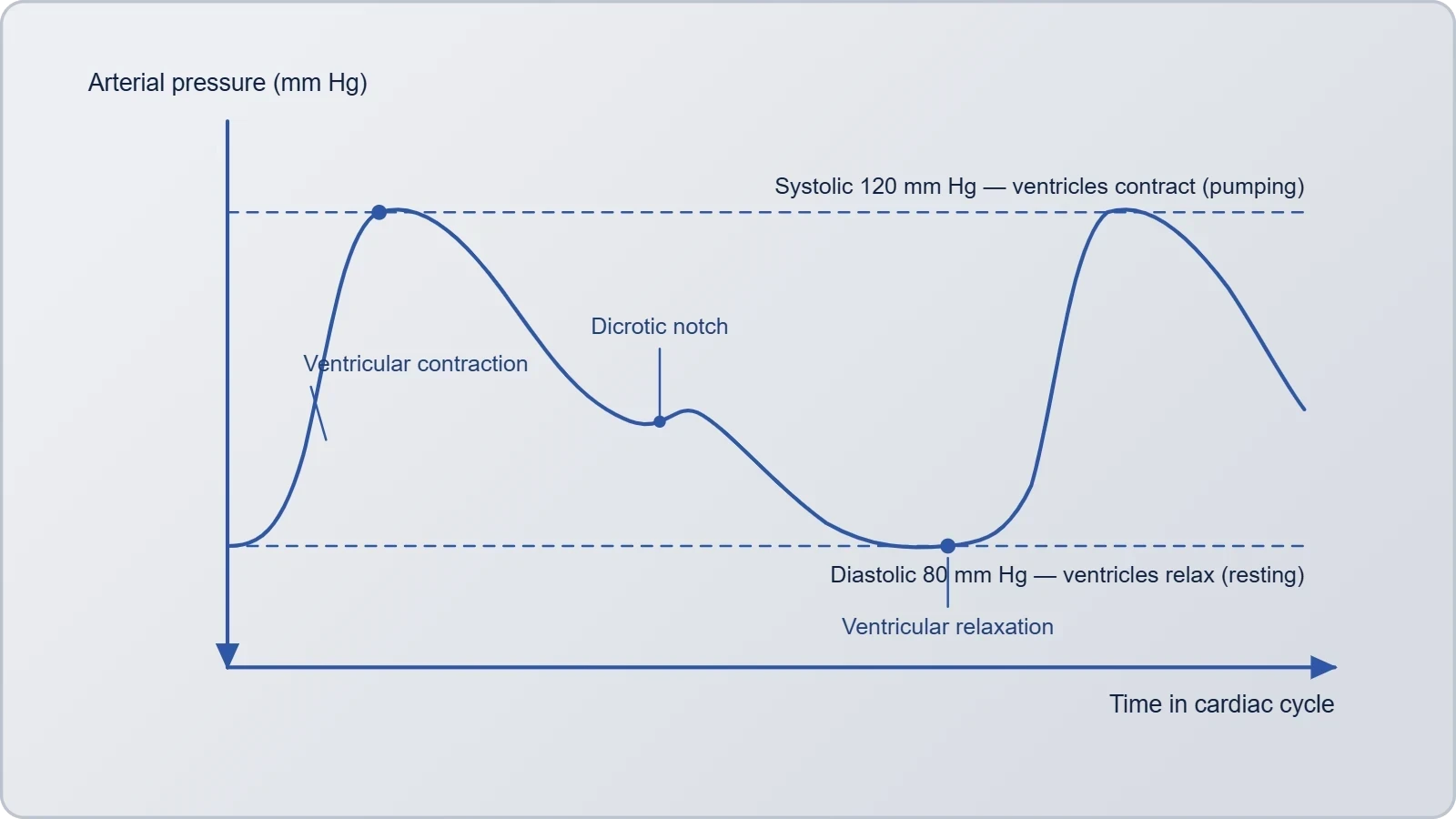
The material presents these values without embellishment, and that restraint is deliberate. Learners should be able to state the normal figure, state the hypertensive threshold, and explain which number corresponds to pumping and which to resting. This is the kind of precise, quotable knowledge that the chapter rewards. It also prepares the ground for the next two subsections, because hypertension is not an isolated curiosity: it is the entry point into a chain of consequences that reaches the heart, the brain and the kidney.
Consequences for the Heart, Brain and Kidney
High blood pressure leads to heart diseases and also affects vital organs like the brain and kidney. The material states this plainly, and the plainness is the point: hypertension is a systemic condition whose damage is distributed across organ systems rather than confined to the vessels alone. The heart must work against elevated pressure, the brain's vasculature is exposed to the same sustained load, and the kidney, whose function depends on delicate filtration pressure, is similarly vulnerable. Learners should be able to name all three target organs and connect each to the underlying elevation of pressure.
This systemic view is what distinguishes a biological understanding of hypertension from a merely numerical one. A learner who can recite 140/90 has memorised a threshold; a learner who can explain why that threshold matters has understood the disorder. The material's order of ideas supports this progression, moving from definition to measurement to consequence. The next section turns to a disorder of the vessels themselves, where the problem is not pressure but the narrowing of the lumen that supplies the heart muscle.
Coronary Artery Disease and the Narrowing Lumen
Coronary artery disease, often referred to as atherosclerosis, affects the vessels that supply blood to the heart muscle. The material is careful to identify both the name and the mechanism: deposits of calcium, fat, cholesterol and fibrous tissues accumulate and make the lumen of the arteries narrower. The coronary vessels are the dedicated supply line to the cardiac musculature, so their narrowing has direct consequences for the muscle they serve. This is a disease of the vessel wall, not of the pump itself, and that distinction organises everything that follows in the lesson.
Composition of the Deposits
The deposits are described as a mixture of calcium, fat, cholesterol and fibrous tissues. Each component contributes to the physical narrowing of the lumen, and the material lists them together rather than isolating a single culprit. Learners should be able to reproduce this list accurately, because it captures the composite nature of atherosclerotic plaque as the chapter presents it. The narrowing is the functional consequence: a reduced lumen means reduced flow, and reduced flow to the cardiac musculature means the muscle's oxygen supply is placed under strain, especially when demand rises.
It is worth noting how the material frames the relationship between coronary artery disease and atherosclerosis. The two terms are presented as closely linked, with atherosclerosis describing the underlying process that affects the vessels supplying the heart muscle. This framing keeps the lesson anchored to the circulatory system rather than drifting into a general discussion of arterial disease. The next subsection connects this narrowing to its most characteristic symptom, chest pain, and explains the conditions under which that pain appears.
From Narrowed Vessels to Reduced Supply
A narrowed lumen does not produce symptoms continuously; it produces them when the balance between oxygen supply and demand is disturbed. The material sets up this logic by describing coronary artery disease as a condition of the vessels that supply the heart muscle, then moving directly to angina as the symptom of inadequate oxygen reaching that muscle. The sequence is deliberate: structural change first, functional consequence second. Learners who follow this order will understand why angina is described as a symptom rather than a disease in its own right, and why it is tied to conditions that affect blood flow.
The coronary system, introduced earlier in the chapter as a special arrangement of vessels exclusively serving the cardiac musculature, now becomes the site of pathology. That earlier anatomical detail pays off here, because the learner can visualise the specific vessels involved rather than treating "coronary artery disease" as an abstract label. The lesson does not repeat the anatomy of the coronary system; it assumes it and builds on it, which is exactly the progression a well-sequenced course should follow.
Angina Pectoris: The Signal of Oxygen Shortfall
Angina, also called angina pectoris, is a symptom of acute chest pain that appears when not enough oxygen is reaching the heart muscle. The material is precise about its status: angina is a symptom, not a disease, and it occurs due to conditions that affect the blood flow. It can occur in men and women of any age, but it is more common among the middle-aged and elderly. This demographic detail is part of the material and should be retained, because it links the symptom to the populations in which it most often appears.
Chest Pain as a Symptom
The defining feature of angina is acute chest pain arising from an oxygen shortfall in the cardiac muscle. The material does not describe radiation of pain or other clinical subtleties; it keeps the definition tight and functional. The pain is the body's signal that the muscle is not receiving enough oxygen, and the underlying cause is a condition affecting blood flow. Learners should be able to state the definition, identify the symptom as chest pain, and explain that it reflects inadequate oxygen delivery rather than damage to the muscle itself.
This distinction matters because it separates angina from the more severe events discussed later. Angina is a warning signal; a heart attack, by contrast, involves sudden damage to the heart muscle from inadequate blood supply. The material draws this line explicitly in its discussion of heart failure, and the lesson preserves it. Keeping the categories distinct is one of the central intellectual tasks of this lesson, and angina is the first place where that task becomes visible.
Who Is Affected
Angina can occur in men and women of any age, but it is more common among the middle-aged and elderly. The material states this without further qualification, and the lesson should not overinterpret it. The key points are that no age group is exempt and that prevalence rises with age. This is a modest epidemiological observation, but it reinforces the connection between angina and the cumulative vascular changes described under coronary artery disease. Older individuals are more likely to have accumulated the deposits that narrow the lumen, which makes the age pattern biologically coherent.
For learners preparing for examinations, the demographic sentence is easy to overlook and easy to reproduce incorrectly. The safe formulation is that angina affects both sexes and all ages but is more common in the middle-aged and elderly. Nothing in the material suggests a sex-specific mechanism, and the lesson should not invent one. The next section moves to heart failure, where the material takes particular care to distinguish three conditions that are often confused.
Heart Failure: When Output Cannot Meet Demand
Heart failure means the state of the heart when it is not pumping blood effectively enough to meet the needs of the body. The definition is functional rather than structural: the criterion is whether output suffices, not whether any particular vessel or valve is diseased. It is sometimes called congestive heart failure because congestion of the lungs is one of the main symptoms of this disease. The material then draws a crucial set of distinctions, separating heart failure from cardiac arrest and from a heart attack, and these distinctions are the heart of the lesson's final conceptual demand.
Congestive Heart Failure and Lung Congestion
The alternative name, congestive heart failure, is explained by the material itself: congestion of the lungs is one of the main symptoms. This is a useful example of terminology that encodes a clinical observation. When the heart fails to pump effectively, blood does not move forward as it should, and the consequences are felt in the pulmonary circulation. Learners should be able to state both names and explain why the congestive label applies. The material does not elaborate the mechanism beyond this, and the lesson should not overreach; the symptom is named, and that is sufficient for the level.
The functional definition also implies that heart failure is a state rather than a single event. It describes the heart's condition when its output is inadequate, which can be a sustained situation rather than a sudden crisis. This is precisely why the material insists on distinguishing it from cardiac arrest and heart attack, both of which are acute events. The contrast between a state and an event is the conceptual key, and the next subsection makes the three-way distinction explicit.
Heart Failure, Cardiac Arrest and Heart Attack Distinguished
Heart failure is not the same as cardiac arrest, which is when the heart stops beating, or a heart attack, which is when the heart muscle is suddenly damaged by an inadequate blood supply. The material states all three definitions in a single sentence, and the compactness is worth preserving. Cardiac arrest is a cessation of beating; a heart attack is sudden damage from inadequate supply; heart failure is inadequate pumping. Each has a different temporal character and a different underlying problem, and conflating them is one of the most common errors in this topic.
For learners, the safest approach is to memorise the three definitions as a set and to practise distinguishing them in writing. A useful check is to ask whether the condition describes a state of inadequate output, a stopping of the heart, or sudden damage to the muscle. The material's phrasing supports exactly this kind of discrimination, and the lesson's tables and summaries reinforce it. The final section consolidates the four disorders into a single comparative framework before the course moves to its closing summary.
Connecting the Disorders to Cardiac Regulation
The four disorders gain coherence when read against the regulatory mechanisms covered in the previous lesson. The heart is myogenic, auto-regulated by nodal tissue, and moderated by the medulla oblongata through the autonomic nervous system. Sympathetic signals raise heart rate, ventricular contraction strength and cardiac output, while parasympathetic signals lower heart rate and conduction speed. Adrenal medullary hormones can also increase cardiac output. Hypertension and heart failure both represent failures within this regulatory economy, and seeing them in that light turns a list of conditions into a connected physiological narrative.
Pressure, Output and the Limits of Regulation
Cardiac output is the product of stroke volume and heart rate, and the material gives the approximate figure of five litres per minute. When the heart cannot pump effectively enough to meet the body's needs, that product has fallen short of demand, which is the definition of heart failure. Hypertension, by contrast, is a failure at the pressure end of the system, where the reading exceeds the normal 120/80 and reaches 140/90 or higher on repeated checks. Both conditions can be described in the same quantitative language the chapter has already established, which is why the earlier lessons on cardiac output and the cardiac cycle matter here.
This continuity is pedagogically valuable. Learners who understand stroke volume, heart rate and cardiac output can reason about heart failure rather than merely reciting its definition. Likewise, learners who understand systolic and diastolic pressure can interpret the 140/90 threshold as a statement about the pumping and resting phases of the cycle. The lesson does not repeat those earlier derivations; it uses them. The next subsection consolidates the four disorders into a comparative table that learners can use for revision.
A Comparative View of the Four Disorders
Placing hypertension, coronary artery disease, angina and heart failure side by side clarifies what each one is and what each one is not. Hypertension is a pressure disorder with systemic consequences; coronary artery disease is a vessel disorder defined by deposits narrowing the lumen; angina is a symptom of oxygen shortfall; heart failure is a state of inadequate output. The four are related but not interchangeable, and the material's order of presentation moves from pressure to vessel to symptom to pump failure, which is a logical clinical progression rather than an arbitrary sequence.
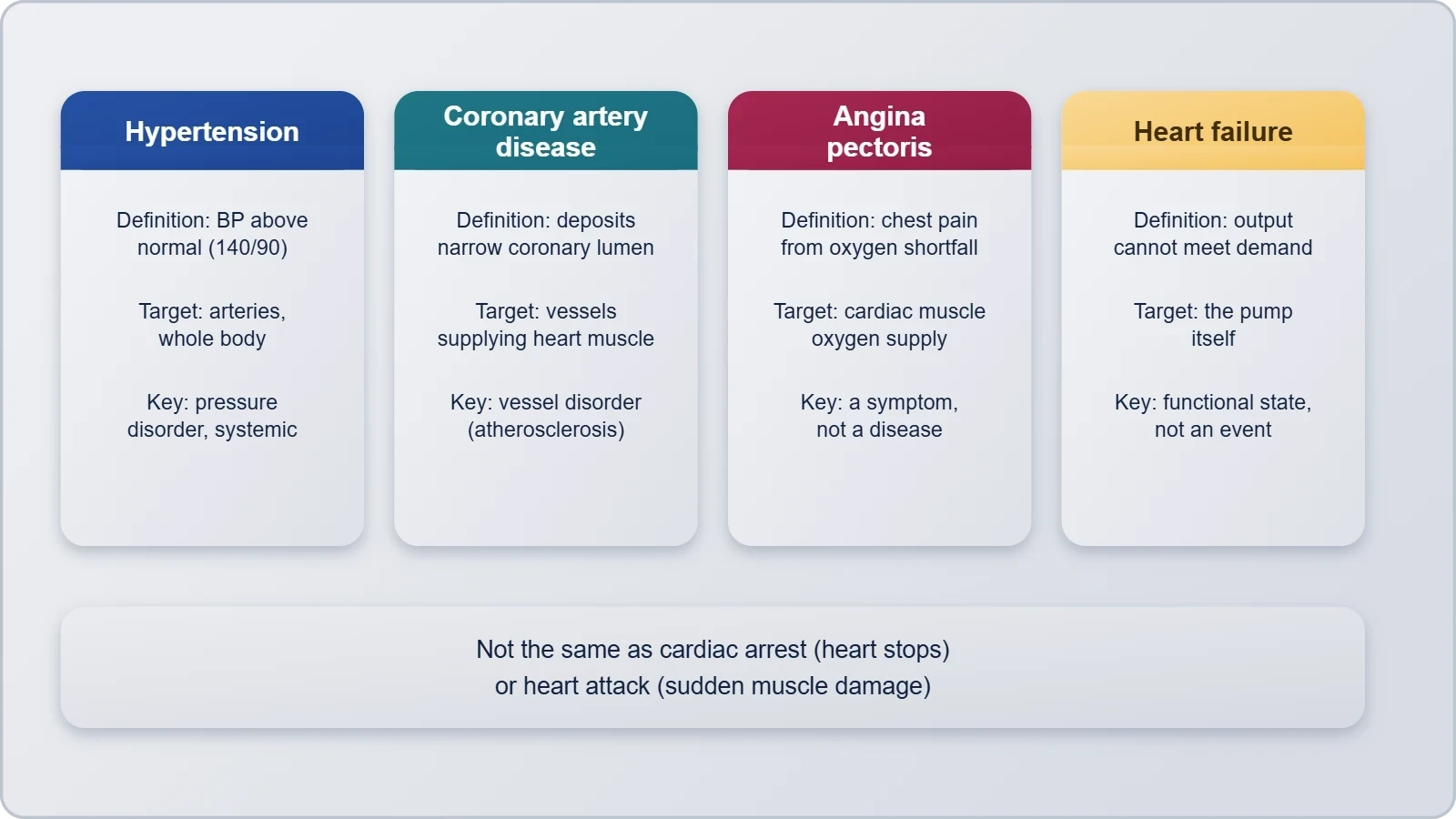
For revision, learners should be able to fill in a table with the definition, the target structure and the key distinguishing feature for each disorder. The exercise is simple but diagnostic: if a learner cannot state why angina is a symptom and heart failure is a state, the distinction has not yet been secured. The comparative table below is designed for exactly this purpose, and it can be used as a self-test before the chapter summary that follows in the next lesson.
Going Further: Recording Pressure and Reading Congestion
Two pieces of well-established background help the material sit more comfortably in a learner's mind, and both are kept here, clearly apart from the core content. The first concerns how blood pressure is recorded. The reading is written as systolic over diastolic pressure, in millimetres of mercury, so that 120/80 means a systolic pressure of 120 mm Hg and a diastolic pressure of 80 mm Hg. The unit reflects the historical use of mercury columns in pressure measurement, and the convention of writing the higher figure first is universal in clinical practice.
Why the Systolic-Over-Diastolic Convention Matters
Writing pressure as a pair rather than a single number preserves information about both phases of the cardiac cycle. A reading of 140/90 tells the clinician that both the pumping and resting pressures are elevated, whereas a reading with only one elevated component would tell a different story. The material's threshold of 140/90 is therefore a statement about the pair, and learners should read it that way. The convention is simple, but it prevents a common error: treating blood pressure as a single quantity rather than two related measurements taken in the same cycle.
The second piece of background concerns congestive heart failure. Congestion of the lungs is one of the main symptoms, and the reason is straightforward: when the heart fails to pump effectively, blood backs up in the pulmonary circulation, and fluid accumulates in the lungs. This is why the condition is called congestive, and it explains why breathlessness is such a prominent feature in clinical descriptions. The material names the symptom without elaborating the mechanism, and this short block supplies the missing link without altering the chapter's definitions.
Preparing for the Chapter Summary
The next lesson revisits blood, lymph and circulation as a whole, so the present lesson should leave learners with a clean set of distinctions rather than a pile of new vocabulary. The four disorders, their definitions and their target structures are the essential residue. If a learner can state the normal and hypertensive blood pressure values, list the components of the deposits in coronary artery disease, define angina as a symptom of oxygen shortfall, and separate heart failure from cardiac arrest and heart attack, the lesson has done its work and the summary that follows will consolidate rather than confuse.
It is also worth noting what this lesson deliberately does not do. It does not extend into treatment, prognosis or epidemiological detail beyond the material's brief demographic note on angina. That restraint keeps the lesson aligned with the chapter's scope and leaves room for the summary to gather the threads. The disorders are presented as consequences of the circulatory system's normal operation going wrong, which is the most durable way to remember them and the most useful frame for the examination questions that follow.
Clinical Vocabulary and the Precision It Demands
The vocabulary of this lesson rewards precision because each term carries a specific claim. Hypertension is not merely "high blood pressure" in casual speech; it is a defined threshold reached on repeated checks. Coronary artery disease is not any heart problem; it is a disease of the vessels supplying the cardiac musculature, caused by deposits that narrow the lumen. Angina is not a disease at all but a symptom, and heart failure is not a stoppage but a state of inadequate output. Learners who internalise these boundaries will answer examination questions accurately and will read clinical writing with better comprehension.
Terms That Are Often Confused
The most persistent confusion in this topic is the trio of heart failure, cardiac arrest and heart attack. The material addresses it directly, and the lesson has reinforced it with a dedicated table. A second confusion concerns angina and heart attack: both involve the heart and both involve oxygen supply, but angina is a symptom of shortfall while a heart attack involves sudden damage to the muscle. A third concerns hypertension and coronary artery disease: the first is a pressure disorder, the second a vessel disorder, and while they can coexist, they are not the same condition.
Keeping these distinctions sharp is not pedantry. Each term points to a different mechanism, a different target structure and a different clinical response, and blurring them obscures the physiology the chapter is trying to teach. The material's careful phrasing, with its repeated "not the same as" constructions, is a model of how to write definitions that prevent confusion rather than invite it. Learners should imitate that care in their own answers, using the same contrastive structure when they define the three cardiac events.
Reading the Material's Structure as a Guide
The order of ideas in the material is itself instructive. It moves from pressure to vessel to symptom to pump failure, which mirrors a plausible clinical progression: sustained hypertension stresses the vasculature, coronary disease narrows the supply line, angina signals the shortfall, and heart failure marks the point at which output can no longer meet demand. Whether or not every patient follows that sequence, the ordering gives learners a logical thread to hold onto. It also explains why the material places the three-way distinction at the end, where it can gather the preceding definitions into a single clarifying contrast.
For teaching purposes, this structure suggests a simple revision strategy: reconstruct the sequence from memory, then attach the definition and the key number or feature to each stage. The numbers are few but important, namely 120/80 and 140/90, and the features are equally few, namely the deposit composition, the oxygen shortfall and the inadequate output. A learner who can reproduce the sequence with these anchors has mastered the lesson's content in the form the material presents it, and is ready for the chapter summary that follows.
Also Read
- No links available.
From our network :
- Analyzing Trump Deportation Numbers Insights Into The 2026 Immigration Crackdown
- EV 2.0: The Solid-State Battery Breakthrough and Global Factory ExpansionDiscover the impact of the Solid-State Battery Breakthrough on the EV market. Learn about CATL and BYD stock growth, global factory expansion in Europe, and the future of EV 2.0 technology.
- 10 Physics Numerical Problems with Solutions for IIT JEEPrepare for IIT JEE with 10 physics numerical problems, complete with detailed solutions and conceptual explanations. Ideal for mastering kinematics, thermodynamics, electromagnetism, and optics.
- Vite 6/7 'Cold Start' Regression in Massive Module GraphsIn-depth analysis of Vite 6/7 cold start regressions in massive module graphs. Learn about barrel file issues, pre-bundling optimizations, and how to improve Vite dev server performance.
- 98% of Global MBA Programs Now Prefer GRE Over GMAT Focus EditionExplore why 98% of global MBA programs now prefer the GRE over GMAT Focus. Learn about the shorter GRE format, verbal logic importance, and strategic versatility for students.
- Mastering DB2 12.1 Instance Design: A Technical Deep Dive into Modern Database ArchitectureComprehensive guide to DB2 12.1 Instance Design. Explore architectural components, HADR setup, buffer pool tuning, and security policies for IBM DB2 12.1. Includes 10 functional SQL and Shell samples.
- AI-Powered 'Precision Diagnostic' Replaces Standard GRE Score ReportsDiscover the new GRE Precision Diagnostic. Learn how AI-powered behavioral analytics and time-to-solve tracking are replacing standard GRE score reports to empower students.
- Mastering DB2 LUW v12 Tables: A Comprehensive Technical GuideComprehensive guide on DB2 LUW v12 tables. Explore CREATE TABLE syntax, BLU Acceleration, range partitioning, data types, and security features for IBM DB2 LUW v12.
- Trump Political Strategy How Geopolitical Stunts Serve As Media Diversions
RESOURCES
- Circulatory System Diseases: Risk Factors & Symptomsmy.clevelandclinic.orgJul 17, 2022 ... Circulatory system diseases affect your heart and blood vessels. Common conditions include atherosclerosis, heart failure and heart valve ...
- Infectious and inflammatory disorders of the circulatory system as ...pubmed.ncbi.nlm.nih.govObjective: To report on the role of infectious and inflammatory disorders as risk factors for stroke in a prospective and retrospective cohort of Saudi ...
- MDC 05 Diseases & Disorders of the Circulatory System - CMScms.govMDC 5 Diseases & Disorders of the Circulatory System. MDC 5 Assignment of Diagnosis Codes. Surgical DRGs. O.R.Procedure of ... Other Heart Assist System…
- Life expectancy and death by diseases of the circulatory system in ...pubmed.ncbi.nlm.nih.govJun 24, 2013 ... The aim of this study was to compare the mortality by diseases of the circulatory system among patients with bipolar…
- Cardiovascular diseases (CVDs) - World Health Organization (WHO)who.intJul 31, 2025 ... Cardiovascular diseases (CVDs) are a group of disorders of the heart and blood vessels. They include: ... Heart attacks and…
- Life Expectancy and Death by Diseases of the Circulatory System in ...pmc.ncbi.nlm.nih.govJun 24, 2013 ... Most studies find that cardiovascular disorder is the leading cause of death in both disorders. On average the excess mortality…
- 7 Circulatory System Diseases: Symptoms, Risks, and Morehealthline.comCirculatory System Diseases: What You Should Know · High blood pressure · Atherosclerosis and coronary artery disease · Heart attacks · Heart failure ·…
- Alcohol's Effects on the Cardiovascular System - PMC - NIHpmc.ncbi.nlm.nih.govAlcohol use has complex effects on cardiovascular (CV) health. The associations between drinking and CV diseases such as hypertension, coronary heart disease, ...
- Venous disease: when the circulatory system is affected - Servierservier.comChronic venous disease (CVD) affects a large number of people worldwide. It is caused by the inflammation of the veins. CVD most often begins…
- Diseases of the circulatory system - ICD-10 Codes- Codify by AAPCaapc.comThe ICD-10 code range for Diseases of the circulatory system I00-I99 is medical classification list by the World Health Organization (WHO).
- 4.00 - Cardiovascular - Adult | Disability | SSAssa.govWhat do we mean by a cardiovascular disorder? a. We mean any disorder that affects the proper functioning of the heart or the circulatory…
- Circulatory system health problems: Symptoms and risk factorsmedicalnewstoday.comWhat diseases affect the circulatory system? · Atherosclerosis · Heart attack · Mitral valve prolapse · Mitral valve regurgitation · Mitral valve stenosis ...
- 104.00 Cardiovascular Disorders - Childhood | Disability | SSAssa.govWhat do we mean by a cardiovascular disorder? a. We mean any disorder that affects the proper functioning of the heart or the circulatory…
- Types of Disorders in the Circulatory System - BYJU'Sbyjus.comNov 29, 2019 ... Types of Disorders in the Circulatory System · Smoking. · High blood pressure. · High cholesterol. · Diabetes or insulin…
- Producer Price Index by Industry: General Medical and Surgical ...fred.stlouisfed.org... Diseases and Disorders of the Circulatory System (DISCONTINUED) (PCU62211062211010503) from Dec 1992 to Jun 2008 about disease, surgical, hospitals, medical ...