Hormones are not the exclusive property of the classical endocrine glands. Some of the body's most consequential chemical messengers are secreted by ordinary tissues that sit quietly inside organs with entirely different primary jobs — the muscular wall of the heart, the specialised cells of the kidney, and the diffuse endocrine cells scattered along the lining of the gastrointestinal tract. Recognising this broadens the definition of chemical coordination itself: any tissue capable of releasing a specific signalling molecule into the blood can participate in endocrine regulation, provided a receptive target tissue exists to receive it.
This lesson examines four such sources of hormonal signals. The atrial wall of the heart releases atrial natriuretic factor, a peptide that lowers blood pressure by dilating blood vessels. The juxtaglomerular cells of the kidney produce erythropoietin, which stimulates the formation of red blood cells. The endocrine cells of the gastrointestinal tract secrete four major peptide hormones — gastrin, secretin, cholecystokinin and gastric inhibitory peptide — each with a distinct digestive role. Finally, numerous non-endocrine tissues release growth factors that sustain normal tissue growth, repair and regeneration.
These examples matter because they reveal how tightly the circulatory, excretory and digestive systems are woven into the endocrine network. A rise in blood pressure triggers a cardiac hormone; a fall in oxygen availability prompts a renal hormone; the arrival of food in the gut releases a cascade of intestinal hormones. Each signal is produced where it is needed and acts on targets that are often close at hand, yet the logic is identical to that of the major glands studied earlier. The lesson prepares the ground for the next topic, the mechanism of hormone action, by showing how diverse the sources of hormonal signals can be.
On This Page
Hormones Beyond the Classical Endocrine Glands
The endocrine system is often pictured as a set of discrete glands — pituitary, thyroid, adrenal, pancreas, gonads — each dedicated to hormone production. That picture is accurate but incomplete. Hormones are also secreted by tissues that are not endocrine glands, tissues whose principal function lies elsewhere but which nonetheless release peptide signals into the bloodstream. The heart, the kidney and the gastrointestinal tract all fall into this category, and their hormonal contributions are essential rather than incidental.
What unites these tissues is the principle of local production serving systemic or regional needs. The atrial wall of the heart secretes atrial natriuretic factor in response to rising blood pressure. The juxtaglomerular cells of the kidney produce erythropoietin to drive red blood cell formation. Endocrine cells distributed through the gastrointestinal tract release four major peptide hormones that orchestrate digestion. Growth factors from many non-endocrine tissues complete the picture, sustaining growth, repair and regeneration throughout the body.
The Atrial Wall of the Heart and Atrial Natriuretic Factor
The atrial wall of the heart secretes a very important peptide hormone called atrial natriuretic factor, commonly abbreviated ANF. Its principal action is to decrease blood pressure. When blood pressure is increased, ANF is secreted, and it causes dilation of the blood vessels. This vasodilation reduces the blood pressure, restoring it toward a normal range. The hormone therefore links the mechanical state of the circulation to a chemical response generated by the heart itself.
The logic of ANF is elegantly self-regulating. The heart is both the sensor and the source: the atrial wall responds to elevated pressure by releasing the peptide, and the peptide acts on blood vessels to relieve that pressure. No separate gland intervenes. This arrangement illustrates how a stretch-sensitive tissue can function as an endocrine organ, converting a mechanical stimulus into a hormonal output that feeds back on the very variable it monitors.
The Kidney and Erythropoietin
The juxtaglomerular cells of the kidney produce a peptide hormone called erythropoietin, which stimulates erythropoiesis — the formation of red blood cells. These specialised cells sit within the kidney tissue and release the hormone into the circulation, from where it reaches the bone marrow and promotes the production of new erythrocytes. The kidney thus contributes directly to the regulation of blood composition, not merely to the filtration and excretion of waste.
Erythropoietin demonstrates that endocrine function can be embedded within an organ whose primary role is excretory. The kidney's juxtaglomerular cells are not organised into a discrete gland; they are a functional cluster within a larger organ. Yet their hormonal output is indispensable for maintaining an adequate supply of oxygen-carrying red cells. The example reinforces the lesson's central theme: hormonal signalling arises wherever specialised cells possess the capacity to release a specific messenger into the blood.
The Four Gastrointestinal Peptide Hormones
Endocrine cells present in different parts of the gastro-intestinal tract secrete four major peptide hormones: gastrin, secretin, cholecystokinin (CCK) and gastric inhibitory peptide (GIP). These cells are scattered along the gut lining rather than gathered into a single gland, yet together they coordinate the sequence of secretion, digestion and absorption that follows a meal. Each hormone has a defined target and a defined effect, and the four act in a coordinated rather than isolated fashion.
The gastrointestinal hormones illustrate a general principle of endocrine organisation: the stimulus is often the presence of food or its breakdown products in the lumen, and the response is a secretion that prepares the next stage of digestion. Gastrin primes the stomach; secretin and CCK prepare the pancreas and biliary system; GIP restrains gastric activity once nutrients have moved onward. The result is an orderly progression rather than a simultaneous, undifferentiated response.
Gastrin, Secretin, Cholecystokinin and GIP
Gastrin acts on the gastric glands and stimulates the secretion of hydrochloric acid and pepsinogen. Secretin acts on the exocrine pancreas and stimulates secretion of water and bicarbonate ions. CCK acts on both pancreas and gall bladder, stimulating the secretion of pancreatic enzymes and bile juice respectively. GIP inhibits gastric secretion and motility. Each hormone therefore has a precise target tissue and a precise secretory output, and the four together cover the stomach, the pancreas, the gall bladder and the regulation of gastric activity.
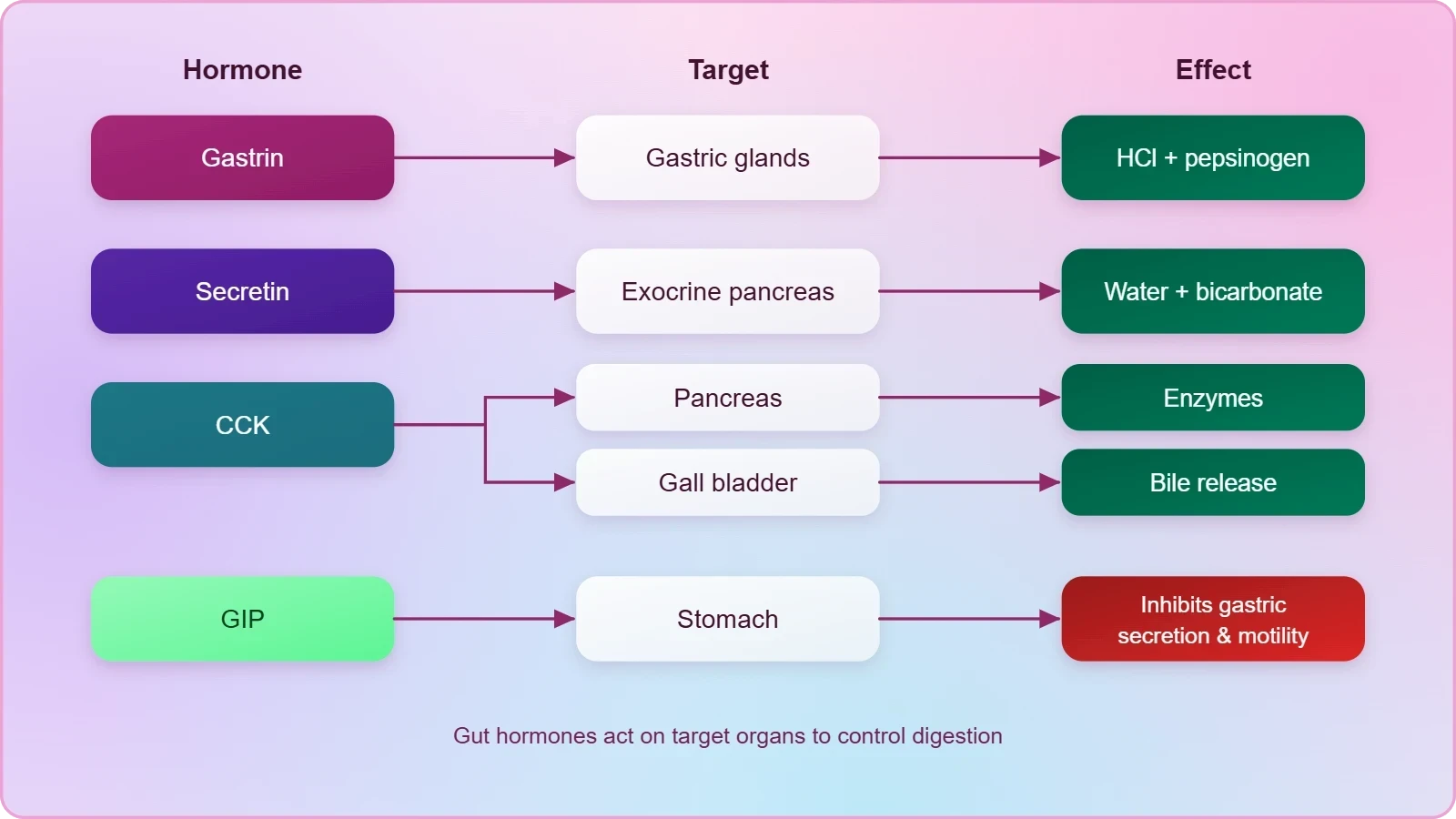
The pairing of targets is worth noting. Secretin and CCK both act on the pancreas, but secretin promotes the watery, bicarbonate-rich component while CCK promotes the enzyme-rich component. CCK additionally acts on the gall bladder to release bile. Gastrin works upstream at the stomach, and GIP works as a brake, inhibiting gastric secretion and motility. This division of labour allows the digestive system to match the composition and timing of its secretions to the food actually present.
How the Gut Hormones Coordinate Digestion
Read as a sequence, the four hormones describe the journey of a meal. Gastrin, released in response to food in the stomach, drives acid and pepsinogen secretion that begin protein digestion. As acidic chyme enters the small intestine, secretin stimulates the exocrine pancreas to release water and bicarbonate, neutralising the acid. CCK then prompts the pancreas to release enzymes and the gall bladder to release bile, completing the chemical preparation of fats and proteins. GIP finally inhibits gastric secretion and motility, slowing the onward flow of chyme.
This coordination is a clear example of chemical integration. The gut does not rely on a single master signal; it uses several peptide hormones, each triggered by a different aspect of luminal contents and each acting on a different target. The hormones overlap in time and reinforce one another, producing a smooth, staged response. For the learner, the gut hormones are the clearest demonstration that endocrine signalling can be distributed, local and yet highly organised.
Growth Factors from Non-Endocrine Tissues
Several other non-endocrine tissues secrete hormones called growth factors. These factors are essential for the normal growth of tissues and their repairing and regeneration. Unlike the gut hormones, which act on distant digestive organs, growth factors typically act on the tissues that produce them or on neighbouring cells, supporting the continuous turnover and repair that every living tissue requires. Their inclusion in the endocrine chapter is deliberate: they are hormones in the functional sense, even though their reach is often local.
The concept of growth factors completes the lesson's argument. Hormones are not confined to glands, and they are not confined to long-range signalling. A tissue that needs to grow, repair damage or regenerate lost cells can release peptide factors that promote those processes. The distinction between endocrine, paracrine and autocrine signalling becomes a matter of distance rather than of kind, and the chemical coordination of the body emerges as a continuum of local and systemic signals.
Repair, Regeneration and Tissue Maintenance
Growth factors are essential for the normal growth of tissues and their repairing and regeneration. This brief statement carries substantial weight. Every tissue experiences wear and turnover; growth factors provide the chemical instruction that tells cells to divide, differentiate or migrate as needed. Without them, repair would stall and regeneration would fail. They are therefore not a peripheral curiosity but a fundamental component of tissue maintenance, operating alongside the classical hormones that regulate metabolism, growth and reproduction.
For the learner, growth factors are best understood as the local arm of chemical coordination. They share the defining features of hormones — specific peptide messengers, specific receptors, specific responses — but their sphere of action is the tissue itself. This makes them a natural bridge to the next lesson, where the mechanism of hormone action is examined in detail. The same principles of receptor binding and target specificity apply, whether the signal travels across the body or merely across a few cell widths.
Placing These Hormones in the Endocrine System
The hormones of the heart, kidney and gastrointestinal tract, together with growth factors, extend the endocrine system beyond the classical glands. They show that chemical coordination is a property of many tissues, not a privilege of a few. The heart regulates blood pressure through ANF; the kidney regulates red cell formation through erythropoietin; the gut regulates digestion through gastrin, secretin, CCK and GIP; and tissues throughout the body regulate their own growth and repair through growth factors.
This broader view has practical value. It explains why disorders of the heart, kidney or gut can produce hormonal symptoms, and why the endocrine system is best studied as an integrated network rather than a list of glands. It also prepares the learner for the mechanism of hormone action, where the focus shifts from where hormones come from to how they produce their effects on target tissues through specific receptors.
Going Further: Feedback and Oxygen Sensing
Two well-established observations deepen the material without altering it. First, ANF is released when blood pressure rises, so it acts as part of a negative feedback loop that lowers blood pressure. The elevated pressure is the stimulus; ANF is the response; vasodilation reduces the pressure and thereby removes the stimulus. This is a textbook negative feedback arrangement, and it explains why ANF secretion is self-limiting: once pressure falls, the atrial wall stops releasing the peptide.
Second, erythropoietin is also known as EPO and is produced by the kidney in response to low oxygen levels. When oxygen delivery to the kidney falls, erythropoietin secretion rises, red cell production increases, and oxygen-carrying capacity is restored. This is another negative feedback loop, this time centred on oxygen rather than pressure. Together, the two examples show that the heart and kidney hormones are not isolated curiosities but integral parts of the body's homeostatic machinery.
Negative Feedback in Cardiac and Renal Hormones
Negative feedback is the organising principle behind both ANF and erythropoietin. In each case, a deviation from the normal range triggers a hormonal response that opposes the deviation. Raised blood pressure triggers ANF, which lowers pressure. Low oxygen triggers erythropoietin, which raises oxygen-carrying capacity. The hormone is the corrective signal, and its secretion ceases once the deviation is corrected. This pattern is the same one encountered in the classical endocrine glands, reinforcing the unity of chemical coordination across the body.
Recognising the feedback structure helps the learner predict hormonal behaviour. If blood pressure is artificially lowered, ANF secretion should fall. If oxygen availability is reduced, erythropoietin secretion should rise. These predictions follow directly from the feedback logic and are consistent with the material's statement that ANF is secreted when blood pressure is increased and that erythropoietin stimulates erythropoiesis. The feedback framing is an interpretive aid, not a replacement for the stated facts.
Clinical and Everyday Relevance
The hormones of the heart, kidney and gut appear in everyday clinical contexts. Erythropoietin is widely associated with the management of anaemia in kidney disease, because the kidney is the principal source of the hormone. ANF is studied in relation to blood pressure regulation and heart failure. The gut hormones are relevant to digestive disorders and to the understanding of how the pancreas and gall bladder are coordinated. Growth factors underpin much of regenerative medicine and tissue repair research.
For the learner, these connections make the material memorable. The lesson is not a list of obscure peptides but an account of how three familiar organs — heart, kidney and gut — participate in chemical coordination. The next lesson turns to the mechanism of hormone action, where the focus shifts to receptors, hormone-receptor complexes and the biochemical changes that follow binding. The diversity of sources covered here prepares the learner for the unifying principles that apply to all of them.
Consolidating the Lesson
The lesson has covered four groups of hormones from non-endocrine tissues. The atrial wall of the heart secretes atrial natriuretic factor, which decreases blood pressure by dilating blood vessels when pressure rises. The juxtaglomerular cells of the kidney produce erythropoietin, which stimulates erythropoiesis. Endocrine cells of the gastro-intestinal tract secrete gastrin, secretin, cholecystokinin and gastric inhibitory peptide, each with a defined target and effect. Several other non-endocrine tissues secrete growth factors essential for normal growth, repair and regeneration.
These facts should be learned as a connected set rather than as isolated items. The heart, kidney and gut each contribute a hormonal signal tied to their own physiological role: pressure regulation, red cell formation and digestion respectively. Growth factors extend the principle to tissue maintenance generally. The unifying idea is that chemical coordination is distributed across the body, and that any tissue with the right cells can join the endocrine conversation.
Key Terms and Definitions
Atrial natriuretic factor (ANF) is a peptide hormone secreted by the atrial wall of the heart that decreases blood pressure by causing dilation of the blood vessels. Erythropoietin is a peptide hormone produced by the juxtaglomerular cells of the kidney that stimulates erythropoiesis, the formation of red blood cells. Gastrin acts on the gastric glands to stimulate secretion of hydrochloric acid and pepsinogen. Secretin acts on the exocrine pancreas to stimulate secretion of water and bicarbonate ions.
Cholecystokinin (CCK) acts on both pancreas and gall bladder, stimulating secretion of pancreatic enzymes and bile juice respectively. Gastric inhibitory peptide (GIP) inhibits gastric secretion and motility. Growth factors are hormones secreted by several non-endocrine tissues that are essential for normal growth of tissues and their repairing and regeneration. These definitions should be reproduced precisely, since the terminology is examinable and the distinctions between the four gut hormones are easily confused.
Preparing for the Mechanism of Hormone Action
The next lesson examines how hormones produce their effects on target tissues. Hormones bind to specific proteins called hormone receptors located in the target tissues only. Receptors on the cell membrane are membrane-bound receptors; receptors inside the target cell are intracellular receptors, mostly nuclear receptors present in the nucleus. Binding forms a hormone-receptor complex, and each receptor is specific to one hormone only. The complex then leads to biochemical changes in the target tissue.
The diversity of hormones covered in this lesson makes that mechanism easier to appreciate. ANF, erythropoietin, the four gut hormones and growth factors are all peptides, and peptides typically act through membrane-bound receptors. The principle of receptor specificity explains why ANF affects blood vessels but not the pancreas, and why gastrin affects gastric glands but not the heart. The next lesson supplies the general framework; this lesson has supplied the varied examples that the framework must accommodate.
Also Read
- No links available.
From our network :
- 10 Physics Numerical Problems with Solutions for IIT JEEPrepare for IIT JEE with 10 physics numerical problems, complete with detailed solutions and conceptual explanations. Ideal for mastering kinematics, thermodynamics, electromagnetism, and optics.
- AI-Powered 'Precision Diagnostic' Replaces Standard GRE Score ReportsDiscover the new GRE Precision Diagnostic. Learn how AI-powered behavioral analytics and time-to-solve tracking are replacing standard GRE score reports to empower students.
- Vite 6/7 'Cold Start' Regression in Massive Module GraphsIn-depth analysis of Vite 6/7 cold start regressions in massive module graphs. Learn about barrel file issues, pre-bundling optimizations, and how to improve Vite dev server performance.
- 98% of Global MBA Programs Now Prefer GRE Over GMAT Focus EditionExplore why 98% of global MBA programs now prefer the GRE over GMAT Focus. Learn about the shorter GRE format, verbal logic importance, and strategic versatility for students.
- Analyzing Trump Deportation Numbers Insights Into The 2026 Immigration Crackdown
- Mastering DB2 12.1 Instance Design: A Technical Deep Dive into Modern Database ArchitectureComprehensive guide to DB2 12.1 Instance Design. Explore architectural components, HADR setup, buffer pool tuning, and security policies for IBM DB2 12.1. Includes 10 functional SQL and Shell samples.
- EV 2.0: The Solid-State Battery Breakthrough and Global Factory ExpansionDiscover the impact of the Solid-State Battery Breakthrough on the EV market. Learn about CATL and BYD stock growth, global factory expansion in Europe, and the future of EV 2.0 technology.
- Mastering DB2 LUW v12 Tables: A Comprehensive Technical GuideComprehensive guide on DB2 LUW v12 tables. Explore CREATE TABLE syntax, BLU Acceleration, range partitioning, data types, and security features for IBM DB2 LUW v12.
- Trump Political Strategy How Geopolitical Stunts Serve As Media Diversions
RESOURCES
- Hormones of Heart, Kidney and Gastrointestinal Tract - BYJU'Sbyjus.comGastrin, secretin, cholecystokinin (CCK) and gastric inhibitory peptide (GIP) are four peptide hormones secreted by endocrine cells of the gastrointestinal ...
- Hormones of Heart, Kidney and Gastrointestinal Tract - GeeksforGeeksgeeksforgeeks.orgMay 25, 2026 ... Besides the major endocrine glands, certain organs like the heart, kidneys, and gastrointestinal tract also perform endocrine functions by ...
- Gastrointestinal–Renal Axis: Role in the Regulation of Blood Pressureahajournals.orgMar 6, 2017 ... These suggest that intestinal NHE3 and ENaC blockade could be new treatment strategies for hypertension. Gut‐Derived Hormones, Secreted in ...
- Organ cross-talk: molecular mechanisms, biological functions ... - PMCpmc.ncbi.nlm.nih.govJan 6, 2026 ... Sepsis, a hyperinflammatory state, triggers simultaneous heart and kidney failure, with gut ... kidneys influence gut physiology through hormonal ...
- Gut Hormones in Heart Failure | Circulationahajournals.orgNov 5, 2024 ... However, there is growing evidence of direct cardiac effects of several hormones secreted from the gastrointestinal tract. For instance, GLP-1…
- Transthyretin amyloidosis - Genetics - MedlinePlusmedlineplus.govNov 8, 2023 ... Other areas of amyloidosis include the heart, kidneys, eyes, and gastrointestinal tract. The age at which symptoms begin to develop…
- CHEMICAL COORDINATION AND INTEGRATION - NCERTncert.nic.in19.3 HORMONES OF HEART, KIDNEY AND GASTROINTESTINAL TRACT. Now you know about the endocrine glands and their hormones. However, as mentioned earlier ...
- Physiology, Parathyroid Hormone - StatPearls - NCBI Bookshelf - NIHncbi.nlm.nih.gov... renal failure, gastrointestinal malabsorption, or simply a vitamin D deficiency. ... gastrointestinal (GI) tract, uterus, and bladder. Its presence is also ...
- Scleroderma | Fact Sheets - Yale Medicineyalemedicine.orgSystemic scleroderma, also called systemic sclerosis, affects the skin and internal organs, such as the heart, lungs, gastrointestinal tract, kidneys, and blood ...
- Physiology, Catecholamines - StatPearls - NCBI Bookshelf - NIHncbi.nlm.nih.govDec 11, 2024 ... ... gastrointestinal tract, slowing digestion during stress responses. ... Role of Vasoactive Hormone-Induced Signal Transduction in Cardiac ...
- Hormones of Heart and Kidney Functions | PDF - Scribdscribd.comThe document discusses hormones produced by the heart, kidney, and gastrointestinal tract. Atrial natriuretic factor (ANF) lowers blood pressure by dilating ...
- National Institute of Diabetes and Digestive and Kidney Diseases ...niddk.nih.govAs an Institute within NIH, NIDDK conducts and supports research on many of the most common, costly, and chronic conditions to improve health.
- Hormones of Heart Kidney and GIT Functions - Vedantuvedantu.comFAQs on Hormones Secreted by Heart Kidney and Gastrointestinal Tract · Adrenaline increases heart rate and cardiac output. · Aldosterone increases sodium and ...
- Organs with Secondary Endocrine Functions - Lumen Learningcourses.lumenlearning.comFor example, the walls of the atria of the heart produce the hormone atrial natriuretic peptide (ANP), the gastrointestinal tract produces the hormones gastrin, ...