Blood appears uniform to the eye, yet beneath that deceptive sameness lies one of the most consequential distinctions in human biology: the molecular identity card carried on the surface of every red blood cell. The ABO blood grouping system, alongside the Rh system, is one of the two classifications used worldwide to sort human blood, and it rests on a disarmingly simple principle. Red blood cells may or may not display two specific surface antigens, labelled A and B, while the plasma of different individuals carries two corresponding natural antibodies. The particular combination of antigens present and antibodies absent defines a person's blood group, and that definition governs whether a transfusion will save a life or trigger a dangerous reaction.
This lesson examines the four groups — A, B, AB and O — with the precision the subject demands, because the stakes are clinical rather than academic. Before any transfusion, the blood of a donor must be carefully matched with the blood of a recipient to avoid severe problems of clumping, the destruction of red blood cells that follows an incompatible match. The compatibility rules that emerge from the antigen-antibody distribution are not arbitrary conventions but direct consequences of immunology, and they explain why group O individuals are called universal donors and group AB individuals universal recipients. Understanding the logic behind those labels matters far more than memorising them.
Building on the previous lesson's account of erythrocytes, leucocytes and platelets, this treatment moves from the formed elements themselves to the markers they carry. It also sets the stage for the Rh system that follows, since ABO and Rh together form the practical foundation of transfusion medicine. Learners should leave this lesson able to state the antigens and antibodies of each group, justify every donor-recipient pairing in the compatibility table, and explain in immunological terms why mismatched blood clumps. Each of these abilities will be tested again, in a different context, when erythroblastosis foetalis enters the discussion.
On This Page
The Antigenic Identity of Red Blood Cells
Every red blood cell presents a chemical signature on its membrane, and in the ABO system that signature consists of two surface antigens designated A and B. An antigen, in the precise sense used here, is a chemical that can induce an immune response; the body's defence machinery recognises it as foreign when it arrives from another individual and mobilises against it. The presence or absence of these two antigens on the red cell surface is the sole criterion on which ABO grouping is based. This is a remarkably economical system — two markers, four possible combinations — yet it generates the entire framework of transfusion compatibility that hospitals rely upon daily.
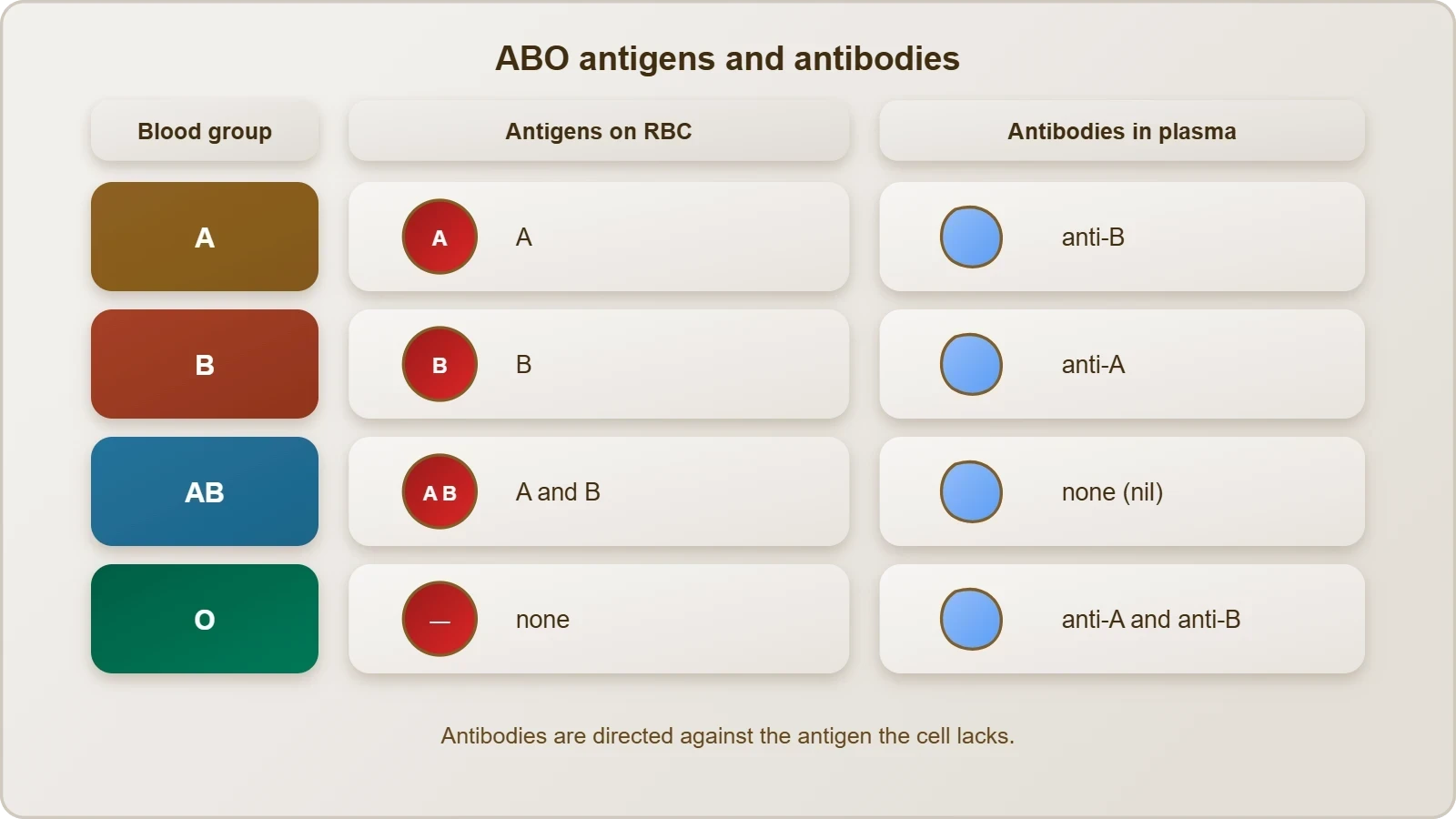
The complementary half of the picture lies in the plasma, which contains two natural antibodies, proteins produced in response to antigens. Crucially, the plasma of any individual carries antibodies directed against whichever antigen their own red cells lack. A person whose cells display antigen A possesses anti-B antibodies; a person with antigen B possesses anti-A; a person with both antigens possesses neither antibody; and a person with neither antigen possesses both. This reciprocal arrangement is the engine of the whole system, and it explains why the four groups behave so differently when blood is mixed. The table below sets out the complete distribution exactly as the material presents it.
Antigens as Surface Markers
The term antigen deserves careful attention because it carries a functional meaning, not merely a descriptive one. An antigen is a chemical capable of inducing an immune response, and the A and B antigens sit on the outer surface of the red blood cell where circulating antibodies can encounter them. Their position is everything: a marker buried inside the cell would be immunologically invisible, but a surface marker is exposed to the plasma and therefore available for recognition. This is why the ABO system is described as being based on surface antigens specifically. The two antigens are chemically distinct entities, and the immune system treats each as a separate target with its own dedicated antibody response.
Because the antigens are inherited and stable, they function as a permanent identity label on the cell. The plasma, meanwhile, contains antibodies that have been produced in response to antigens, and in the ABO context these are present naturally rather than arising from a prior transfusion. The pairing is always antagonistic: the plasma never carries an antibody against an antigen the person's own cells display. Were it otherwise, the individual's own red cells would be under constant immunological attack. This self-tolerance is the quiet assumption on which the entire compatibility system rests, and it is worth stating explicitly because students often overlook it.
Natural Antibodies in Plasma
The plasma antibodies of the ABO system are described as natural antibodies, proteins produced in response to antigens and present without any preceding transfusion. Their distribution follows an inverse logic: group A plasma holds anti-B, group B plasma holds anti-A, group AB plasma holds neither, and group O plasma holds both anti-A and anti-B. The material records group O as carrying "anti-A, B," meaning both specificities are present simultaneously. This inverse relationship is the single most useful pattern to internalise, because once a learner knows which antigens a person's cells carry, the antibody profile follows automatically without further memorisation.
These antibodies are the agents of trouble in a mismatched transfusion. When donor cells bearing an antigen meet recipient plasma carrying the corresponding antibody, the antibody binds the foreign cells and initiates their destruction. The severity of the resulting clumping depends on which antibody meets which antigen, and this is precisely why compatibility must be established before transfusion rather than assumed. The antibodies are not passive bystanders in the blood; they are an active surveillance system that will act swiftly against anything it recognises as foreign. Their presence in every group except AB is what makes that group so permissive as a recipient.
The Four Blood Groups and Their Logic
The four groups emerge from the two-by-two possibilities of antigen presence and absence, and each has a distinct immunological personality. Group A carries antigen A with anti-B in plasma; group B carries antigen B with anti-A; group AB carries both antigens and no antibodies; group O carries neither antigen and both antibodies. These four profiles exhaust the combinations available within the ABO system, and every person falls into exactly one of them. The elegance of the scheme lies in its completeness: there is no fifth possibility, no ambiguous middle ground, and no group that escapes the reciprocal antigen-antibody rule. From these four profiles, all transfusion compatibility follows.
What distinguishes the groups practically is not the antigens alone but the combination of antigens and antibodies considered together. A group A recipient has anti-B circulating, so any donor blood bearing antigen B will be attacked. A group AB recipient has no circulating antibodies at all, so no ABO antigen can provoke a response. A group O recipient has both antibodies, so only cells bearing neither antigen will survive. The compatibility column of the reference table is therefore not a list to be memorised but a conclusion to be derived: for each recipient, ask which donor antigens their plasma antibodies would attack, and exclude those donors. The next two subsections apply this reasoning to the two groups that earn special names.
Group O as Universal Donor
Group O blood can be donated to persons with any other blood group, and the material states this directly as the basis for calling O group individuals universal donors. The reason is visible in the table: group O red cells carry neither antigen A nor antigen B, so they present no ABO target for the recipient's plasma antibodies. Whatever antibodies the recipient possesses — anti-A, anti-B, or both — there is nothing on the donor cell for them to recognise. The donor cells can therefore circulate without immunological challenge from the ABO system. This is a statement about the donor cells specifically, and it is the cells that matter in transfusion, since it is the red cells whose destruction causes harm.
The universal donor label is a statement of ABO compatibility and should be understood within those bounds. The material's claim is precise: group O blood can be donated to persons with any other blood group because its cells lack both antigens. It does not claim that group O plasma is equally universal, and learners should note that group O plasma carries both anti-A and anti-B. The practical significance of the universal donor concept is immense in emergency medicine, where a patient's group may not yet be known and the risk of delay may exceed the risk of transfusion. In such circumstances, cells that cannot be attacked on ABO grounds are the safest available option.
Group AB as Universal Recipient
Persons with AB group can accept blood from persons with AB as well as the other groups of blood, and for this reason they are called universal recipients. The table shows why: group AB plasma contains no antibodies, recorded as nil, so there is no ABO antibody available to attack donor cells bearing antigen A, antigen B, or both. A group AB recipient can therefore receive A, B, AB or O blood without ABO incompatibility. The absence of circulating antibodies is the whole explanation, and it is a cleaner one than any rule of thumb. Where the donor lacks antigens, the recipient lacks antibodies; group AB is the recipient in whom that absence is total.
It is worth contrasting the two universal labels to see that they are mirror images rather than parallel claims. The universal donor is defined by what its cells lack — no antigens — while the universal recipient is defined by what its plasma lacks — no antibodies. One concerns the gift, the other the reception. This symmetry is a useful check on understanding: a learner who can explain both labels from first principles has grasped the system rather than memorised its vocabulary. The table below restates the compatibility logic in terms of the immunological reason behind each pairing, which is the form in which the knowledge becomes genuinely usable.
Clumping: The Consequence of Mismatch
During blood transfusion, any blood cannot be used; the blood of a donor has to be carefully matched with the blood of a recipient before any transfusion to avoid severe problems of clumping, described in the material as the destruction of RBC. Clumping is the visible endpoint of an immunological collision. When donor cells carrying an antigen meet recipient plasma carrying the matching antibody, the antibody binds the cells and causes them to aggregate and be destroyed. The word itself is descriptive: the cells clump together rather than circulating freely, and in doing so they cease to perform their function of carrying oxygen. The severity of the consequence is what justifies the care taken in matching.
The logic of matching can be expressed as a simple condition. A transfusion is safe, on ABO grounds, when no antibody in the recipient's plasma recognises any antigen on the donor's red cells. If we let ##A_d## denote the set of antigens on the donor cells and ##Ab_r## the set of antibodies in the recipient plasma, compatibility requires that no antibody in ##Ab_r## be directed against any antigen in ##A_d##. Because the ABO antibodies are specific — anti-A against A, anti-B against B — this reduces to checking two possible confrontations. The condition can be written compactly as:
Applying this condition to the four recipient groups reproduces the compatibility column exactly, which is a satisfying confirmation that the table is a theorem rather than a convention. For a group A recipient, ##Ab_r = \{\text{anti-}B\}##, so any donor cell bearing B is excluded, leaving A and O. For group O, ##Ab_r = \{\text{anti-}A, \text{anti-}B\}##, so any cell bearing either antigen is excluded, leaving only O. The formalism adds nothing the table does not already contain, but it makes the reasoning transparent and portable, which is valuable when the Rh system introduces a second, independent axis of compatibility in the next lesson.
Antigen-Antibody Reaction in Practice
The destruction of red cells in a mismatched transfusion is not a vague misfortune but a specific immunological event. The recipient's natural antibodies recognise the donor's surface antigens as foreign, bind to them, and mark the cells for destruction; the cells then clump and are broken down. This is the antigen-antibody reaction operating exactly as it does against any invading substance, except that here the "invader" is a therapeutic gift of red cells. The material's phrase — clumping, the destruction of RBC — captures both the visible aggregation and its fatal outcome for the cell. Every compatibility rule in the table exists to prevent this single event from occurring.
Understanding the mechanism clarifies why the direction of transfusion matters so much. The donor's plasma is diluted in the recipient's circulation and its antibodies are correspondingly less consequential, whereas the donor's cells are the object of the recipient's antibodies and are present in quantity. This asymmetry is why compatibility is assessed primarily from the recipient's antibody perspective against the donor's antigens, exactly as the table's donor column is constructed. It also explains why the universal donor and universal recipient labels attach to cells and plasma respectively. The practical lesson is that matching protects the donor cells from the recipient's immune system, and that is the confrontation the table is designed to avoid.
Reading the Compatibility Column
The donor's group column in the reference table repays close reading because it encodes the entire system in four short entries. Group A accepts A and O; group B accepts B and O; group AB accepts all four; group O accepts only O. Notice that every recipient can receive their own group, which is the trivial baseline of compatibility, and that group O appears in every row, which is the universal donor property expressed in tabular form. Notice also that group AB appears only in its own row, which is the universal recipient property seen from the donor side. These patterns are not coincidences but necessary consequences of the antigen-antibody distribution.
A useful exercise is to reconstruct the column from the antigen and antibody entries alone, without consulting it. Take each recipient in turn, identify the antibodies in their plasma, and strike out every donor group whose cells carry the corresponding antigen. The result will match the table in every case, and the act of reconstruction fixes the reasoning far more securely than repetition. Learners preparing for examinations should be able to perform this derivation quickly and to state, for any pairing, whether it is compatible and why. The table below offers a compact self-check format for that kind of rapid recall.
Going Further: The Immunology Behind the Rules
The material states that mismatched transfusion produces clumping, the destruction of RBC, and it is worth adding a few sentences of well-established background to explain what that destruction actually involves. Clumping in a mismatched transfusion is an antigen-antibody reaction: the recipient's natural antibodies bind the donor's surface antigens, cross-link adjacent red cells into aggregates, and the resulting complexes are broken down. The red cells are destroyed in the process, which is why the material equates clumping with destruction. This is the same class of reaction the immune system uses against pathogens, redirected here against transfused cells. Nothing in this explanation departs from the material; it simply names the mechanism behind the outcome the material describes.
A second point of background concerns the description of ABO antibodies as natural antibodies present in plasma. The material uses this term deliberately, distinguishing these antibodies from those that arise only after exposure to a foreign antigen. Their presence in plasma without any preceding transfusion is a defining feature of the ABO system and the reason compatibility can be predicted from the group alone. Learners should treat "natural antibodies" as a precise technical label rather than a casual phrase, because it explains why the antibody profile is a stable property of the individual rather than a variable acquired through medical history. The table below summarises the background points alongside the material's own statements.
Why the Mechanism Matters for Learning
Knowing that clumping is an antigen-antibody reaction converts a list of rules into a single principle with four applications. Instead of asking whether group A can donate to group B, a learner asks whether any antibody in the recipient's plasma will find its antigen on the donor's cells. The answer follows mechanically, and the compatibility table becomes a record of the answers rather than a separate fact to be stored. This shift from recall to reasoning is what distinguishes a student who can handle unfamiliar transfusion scenarios from one who can only reproduce memorised pairings. The mechanism is the same in every case; only the specific antigen and antibody change.
The mechanism also prepares the ground for the next lesson. The Rh system introduces a second antigen, independent of A and B, and the same logic of antigen recognition and antibody response will apply to it. A learner who has internalised the ABO reasoning will find the Rh material familiar in structure even though its clinical consequences — including erythroblastosis foetalis — are distinct. The habit of asking which antigen meets which antibody is the transferable skill, and it is worth carrying forward deliberately. The final table below frames the lesson's key terms for revision before that transition.
Consolidating the Lesson
The ABO system reduces to a single reciprocal rule: antigens on the cell, antibodies in the plasma, each directed against what the other lacks. From that rule the four groups follow, and from the four groups the compatibility table follows in turn. Group O, lacking both antigens, can donate to anyone and is the universal donor; group AB, lacking both antibodies, can receive from anyone and is the universal recipient. Between these two extremes, groups A and B accept their own group and O. Every entry in the table can be derived rather than memorised, and the derivation is the more durable form of the knowledge.
The clinical purpose of the whole apparatus is the avoidance of clumping, the destruction of red cells that occurs when donor antigens meet recipient antibodies. Matching donor to recipient before transfusion is therefore not a formality but the central safeguard of the procedure. Learners should be able to state the antigens and antibodies of each group, justify each compatibility pairing, explain the two universal designations from first principles, and describe clumping as an antigen-antibody reaction. With these abilities secured, the next lesson's treatment of the Rh system and erythroblastosis foetalis will extend a familiar logic rather than introduce an unrelated one.
Preparing for the Rh System
The ABO grouping is one of two classifications widely used all over the world, and the second — the Rh system — is the subject of the next lesson. Where ABO rests on two antigens, the Rh system introduces its own antigen and its own compatibility questions, and the reasoning developed here transfers directly. The habit of asking which antigen meets which antibody, and of predicting the consequence before consulting a table, is precisely what the Rh material will require. Learners who have mastered the reciprocal logic of ABO will find the transition natural, and those who have merely memorised the table will need to rebuild their understanding on firmer ground.
The clinical stakes also carry forward. Just as ABO incompatibility produces clumping, Rh incompatibility produces its own distinct consequences, including the condition of erythroblastosis foetalis that gives the next lesson its title. The present lesson has deliberately confined itself to ABO, leaving the Rh antigen and its antibodies untouched so that each system can be understood on its own terms before being combined. That separation is pedagogically sound: two independent axes of compatibility are easier to master one at a time than together. The foundation laid here — antigens, natural antibodies, clumping, and the two universal designations — is the platform on which the next lesson builds.
Also Read
- No links available.
From our network :
- 10 Physics Numerical Problems with Solutions for IIT JEEPrepare for IIT JEE with 10 physics numerical problems, complete with detailed solutions and conceptual explanations. Ideal for mastering kinematics, thermodynamics, electromagnetism, and optics.
- EV 2.0: The Solid-State Battery Breakthrough and Global Factory ExpansionDiscover the impact of the Solid-State Battery Breakthrough on the EV market. Learn about CATL and BYD stock growth, global factory expansion in Europe, and the future of EV 2.0 technology.
- 98% of Global MBA Programs Now Prefer GRE Over GMAT Focus EditionExplore why 98% of global MBA programs now prefer the GRE over GMAT Focus. Learn about the shorter GRE format, verbal logic importance, and strategic versatility for students.
- Mastering DB2 12.1 Instance Design: A Technical Deep Dive into Modern Database ArchitectureComprehensive guide to DB2 12.1 Instance Design. Explore architectural components, HADR setup, buffer pool tuning, and security policies for IBM DB2 12.1. Includes 10 functional SQL and Shell samples.
- Mastering DB2 LUW v12 Tables: A Comprehensive Technical GuideComprehensive guide on DB2 LUW v12 tables. Explore CREATE TABLE syntax, BLU Acceleration, range partitioning, data types, and security features for IBM DB2 LUW v12.
- AI-Powered 'Precision Diagnostic' Replaces Standard GRE Score ReportsDiscover the new GRE Precision Diagnostic. Learn how AI-powered behavioral analytics and time-to-solve tracking are replacing standard GRE score reports to empower students.
- Vite 6/7 'Cold Start' Regression in Massive Module GraphsIn-depth analysis of Vite 6/7 cold start regressions in massive module graphs. Learn about barrel file issues, pre-bundling optimizations, and how to improve Vite dev server performance.
- Trump Political Strategy How Geopolitical Stunts Serve As Media Diversions
- Analyzing Trump Deportation Numbers Insights Into The 2026 Immigration Crackdown
RESOURCES
- Blood Types Explained - A, B, AB and O | Red Cross Blood Servicesredcrossblood.orgNot all blood is alike. Learn about blood typing and the rarest and most common types of blood and how they can impact your…
- Heart transplantation from donors of different ABO blood typepubmed.ncbi.nlm.nih.govAbstract. Introduction: ABO blood group compatibility between donors and recipients of heart transplants is required to reduce the risk of hyperacute rejection.
- ABO Blood Grouping Mismatch in Hematopoietic Stem Cell ... - PMCpmc.ncbi.nlm.nih.gov... compatible with donor's blood group (Table2). Table2. Recommended transfusion support for recipients of ABO incompatible HSCT. Recipient, Donor, RBC and
- Component compatibility | Australian Red Cross Lifebloodlifeblood.com.au... group AB donors and supplies. National Statement for the Emergency Use of Group A Clinical Plasma-final.PDF. Patient ABO blood type, First choice, Second ...
- The impact of ABO compatibility/incompatibility between donor and ...pubmed.ncbi.nlm.nih.govAbstract. Background: ABO blood group mismatch between donor and recipients is not considered as a major contraindication to allogeneic hematopoietic stem cell ...
- ABO Blood Group System - StatPearls - NCBI Bookshelfncbi.nlm.nih.govApr 26, 2025 ... Type AB plasma is compatible with all other ABO blood types. ... ABO incompatibility between the donor and recipient blood…
- Impact of sensitization and ABO blood types on the opportunity of ...nature.comFeb 1, 2024 ... In contrast, AB-type candidates are biologically compatible with A, B, and O donors, expanding their potential donor pool. In the…
- Blood types - NHS Blood Donationblood.co.ukYou can also receive blood from a donor with a compatible blood type. ... There are four main blood groups in the ABO group…
- Impact of ABO compatibility on outcomes after allogeneic ...sciencedirect.comIt has been estimated that approximately 40–50% of all HCT procedures are ABO blood donor-recipient incompatible given that ABO blood type, located on ...
- Does ABO and RhD matching matter for platelet transfusion?ashpublications.orgDec 4, 2020 ... Platelets are also suspended in roughly 1 unit of donor plasma, which contains the ABO antibodies predicted by the donor…
- ABO Compatibility and Acceptable Substitutions | Blood.cablood.caHospitals will be notified before any order substitutions are shipped. Red Blood Cells. Recipient Group, Compatible Donor ...
- Blood Types: What They Are and What They Mean for Your Healthmy.clevelandclinic.orgSep 1, 2026 ... But keep in mind that all the less common non-ABO blood group antigen systems need to be compatible. ... You…
- ABO incompatibility: MedlinePlus Medical Encyclopediamedlineplus.govMay 1, 2026 ... ... blood transfusion or have an organ transplant. The blood types must be compatible to avoid an ABO incompatibility reaction.…
- Incompatible Blood Types and Paired Exchange Programskidney.orgBlood type compatibility is crucial for kidney transplants. Paired exchange ... donor: donors with O blood are compatible with any other blood type). So ...
- Identical versus compatible blood typing: investigating best practices ...frontierspartnerships.orgMay 22, 2026 ... ... ABO compatible donors were used compared to the ABO identical group. When comparing all lung transplants across the board,…