Pteridophytes occupy a decisive position in the story of plant life on land, because they are evolutionarily the first terrestrial plants to possess vascular tissues — xylem and phloem. This single innovation changed everything about how a plant could live: it allowed the plant body to grow larger, to transport water and food across real distances, and to stand upright away from permanently wet ground. Horsetails and ferns are the familiar members of this group, and they are also used for medicinal purposes, as soil-binders, and frequently grown as ornamentals.
Where bryophytes placed the gametophyte at the centre of the life cycle, pteridophytes reverse the emphasis. The main plant body here is a sporophyte, differentiated into true root, stem and leaves, and these organs possess well-differentiated vascular tissues. That shift in dominance, from a small thalloid gametophyte to a robust vascular sporophyte, is the conceptual hinge of this lesson, and it prepares the ground for the seed habit examined in later groups.
This lesson builds directly on the liverworts and mosses already studied, and it deliberately stops short of the classification of pteridophytes into their four classes, which belongs to the next lesson. Here the focus stays on form, reproduction, life cycle and importance: microphylls and macrophylls, sporangia borne on sporophylls, strobili or cones, the free-living prothallus, the need for water for fertilisation, and the distinction between homosporous and heterosporous plants.
On This Page
- Why Pteridophytes Are Called the First Terrestrial Vascular Plants
- The Sporophyte Body: Root, Stem, Leaves and Their Forms
- The Prothallus and the Water-Dependent Sexual Cycle
- Homosporous and Heterosporous Pteridophytes
- Economic Uses and Ecological Role of Pteridophytes
- Going Further: Reading the Vascular Advance and the Prothallus
- Consolidating the Lesson Before Classification
Why Pteridophytes Are Called the First Terrestrial Vascular Plants
The defining claim about pteridophytes is evolutionary rather than merely descriptive: they are the first terrestrial plants to possess vascular tissues, namely xylem and phloem. Everything else about their biology — their size, their organ differentiation, their dominance of the sporophyte — follows from that possession. Understanding this claim properly means seeing vascular tissue as the enabling condition for a terrestrial plant body.
The Vascular Tissues and What They Permit
Xylem and phloem are conducting tissues, and their presence is what separates pteridophytes from the bryophytes studied earlier. The sporophyte of a pteridophyte is differentiated into true root, stem and leaves, and these organs possess well-differentiated vascular tissues. This is a structural advance, not a cosmetic one, because conduction allows organs to specialise.
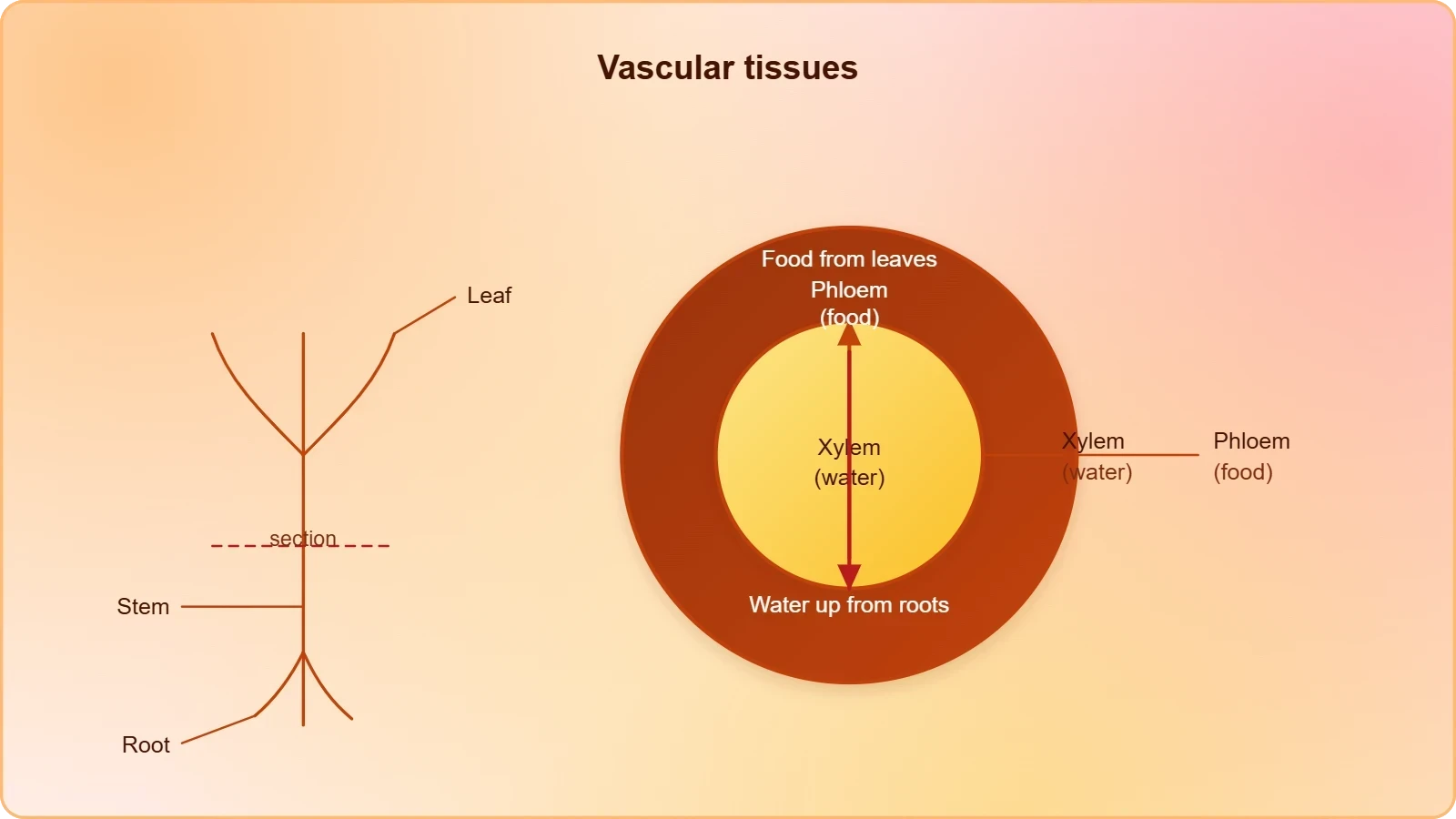
Habitat tells the same story from the other direction. Pteridophytes are found in cool, damp, shady places, though some may flourish well in sandy-soil conditions. The restriction is real but partial: vascular tissue widens the range of tolerable environments, yet reproduction still ties these plants to moisture, a tension explored in the sections that follow.
Sporophyte Dominance Compared with Bryophytes
In bryophytes the dominant phase in the life cycle is the gametophytic plant body. In pteridophytes, by contrast, the main plant body is a sporophyte, differentiated into true root, stem and leaves. The gametophyte is reduced to a small, inconspicuous but multicellular structure. This inversion of dominance is the central contrast between the two groups.
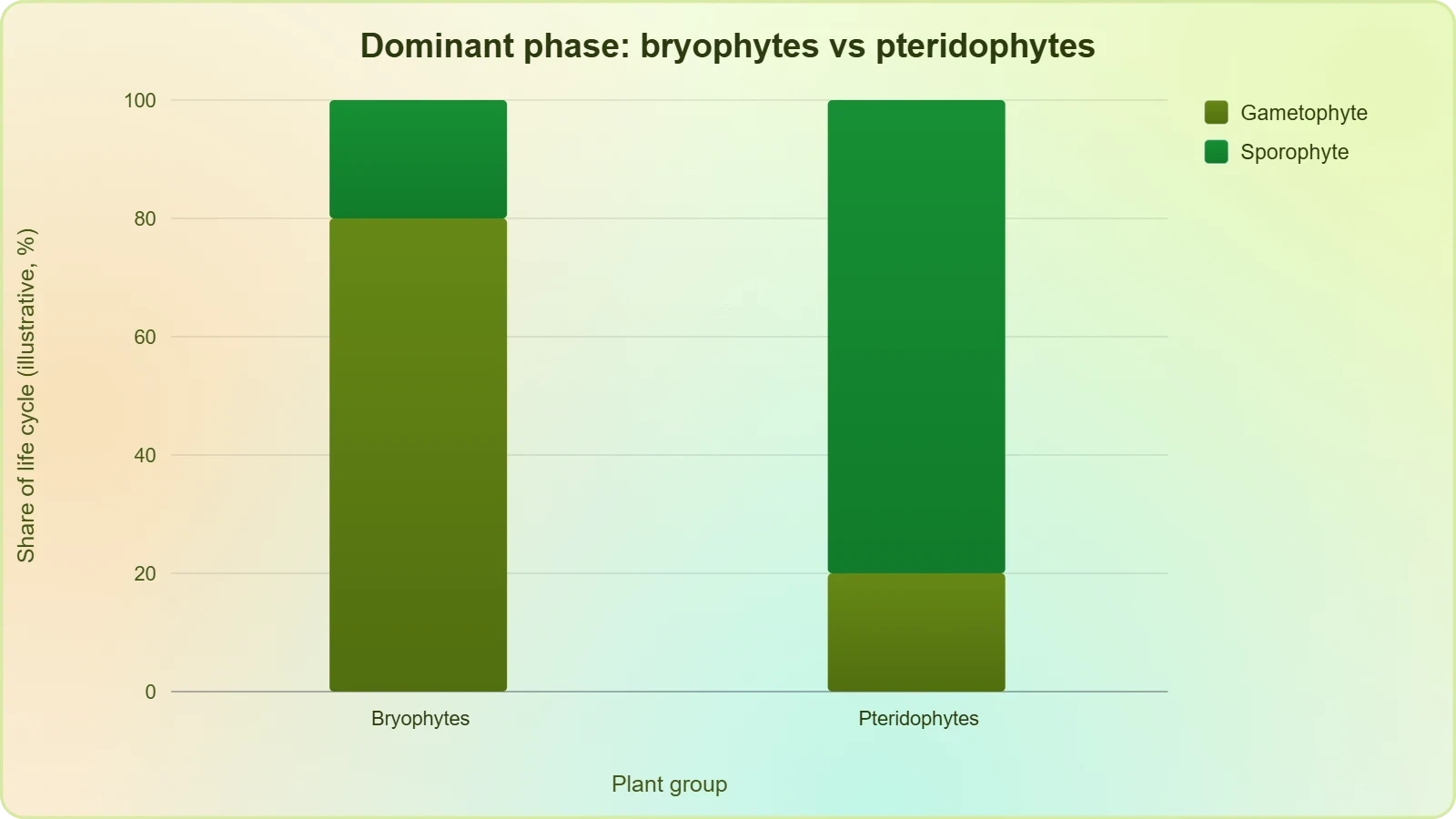
The consequence is a change in what the plant invests in. The sporophyte, being diploid and vascular, can support more elaborate organs and a longer life, while the gametophyte becomes a short-lived, dependent-looking phase. Recognising this inversion makes the pteridophyte life cycle far easier to follow than a list of stages would suggest.
The Sporophyte Body: Root, Stem, Leaves and Their Forms
The pteridophyte sporophyte is differentiated into true root, stem and leaves, and these organs possess well-differentiated vascular tissues. This is the body you actually see when you look at a fern or a horsetail. Its architecture — how leaves are sized, how sporangia are borne, how stems branch — supplies most of the descriptive vocabulary of the group.
Microphylls and Macrophylls
Leaves in pteridophytes are of two kinds. They are small, called microphylls, as in Selaginella, or large, called macrophylls, as in ferns. The distinction is one of leaf form and size within the group, and it is worth fixing firmly because it recurs whenever pteridophytes are classified.
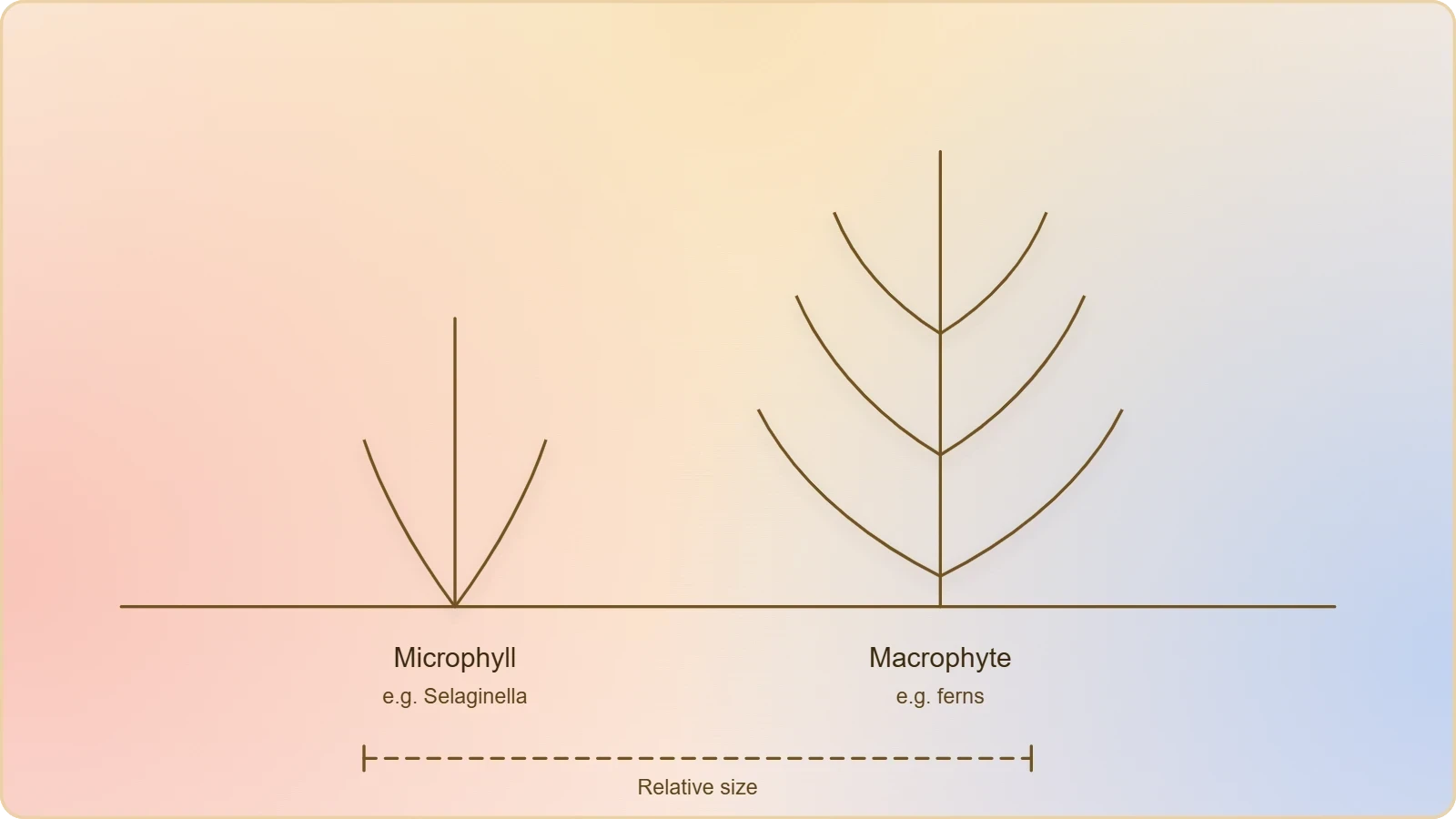
Beyond size, the sporophyte shows other structural variety. In Equisetum the stem is visibly jointed, with nodes and internodes, branches arising at nodes, and a rhizome below ground. In Selaginella the branching habit differs again. These differences in stem and leaf form are what make the group recognisable in the field.
Sporangia, Sporophylls and Strobili
The sporophytes bear sporangia that are subtended by leaf-like appendages called sporophylls. In some cases sporophylls may form distinct compact structures called strobili or cones, as in Selaginella and Equisetum. The sporangia are the sites of spore formation, and the sporophyll is the leaf that carries them.
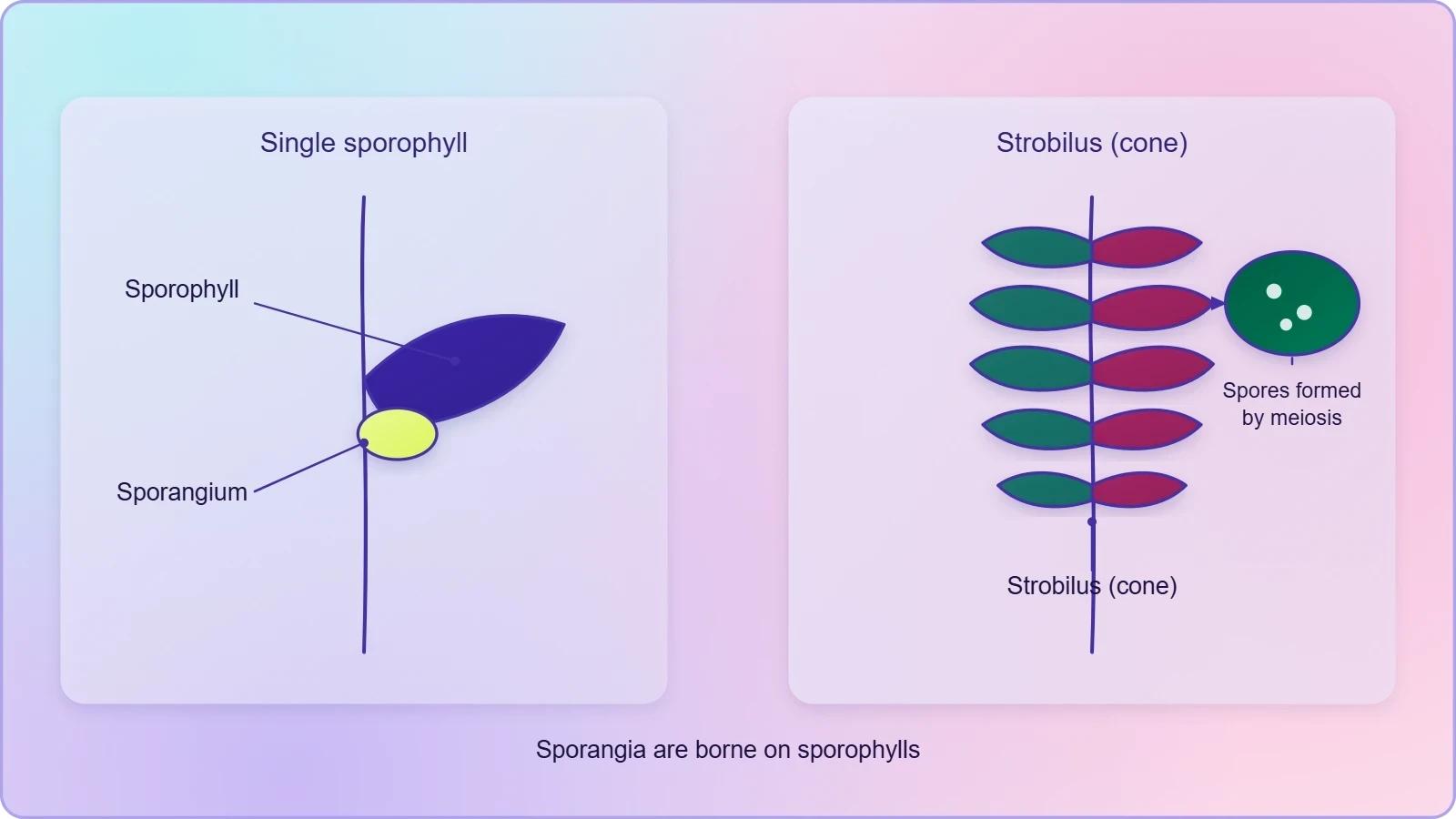
Inside the sporangia, spores are produced by meiosis in spore mother cells. This detail matters because meiosis is what restores the haploid condition before the gametophyte generation begins. The strobilus, where present, is simply a compact arrangement of sporophylls, not a separate organ with a separate function.
The Prothallus and the Water-Dependent Sexual Cycle
Spores germinate to give rise to inconspicuous, small but multicellular, free-living, mostly photosynthetic thalloid gametophytes called prothallus. This modest structure carries the entire sexual phase of the pteridophyte life cycle. Its requirements are narrow, and those narrow requirements explain much about where pteridophytes can and cannot live.
Structure and Habitat of the Gametophyte
The prothallus is free-living and mostly photosynthetic, but it is small and inconspicuous compared with the sporophyte. These gametophytes require cool, damp, shady places to grow. Because of this specific restricted requirement, the spread of living pteridophytes is limited and restricted to narrow geographical regions.
The gametophytes bear male and female sex organs called antheridia and archegonia, respectively. Both organs sit on the same small thalloid body, which keeps the distances involved in fertilisation short. Short distances, however, do not remove the need for a liquid medium, and that need is decisive.
Fertilisation and the Return to the Sporophyte
Water is required for transfer of antherozoids, the male gametes released from the antheridia, to the mouth of the archegonium. Fusion of the male gamete with the egg present in the archegonium results in the formation of a zygote. The zygote thereafter produces a multicellular, well-differentiated sporophyte, which is the dominant phase.
The cycle therefore closes on itself: a dominant vascular sporophyte produces spores by meiosis, the spores germinate into a small free-living gametophyte, water carries the male gametes, and the zygote rebuilds the sporophyte. Each stage depends on the one before it, and the water requirement is the point of maximum vulnerability.
Homosporous and Heterosporous Pteridophytes
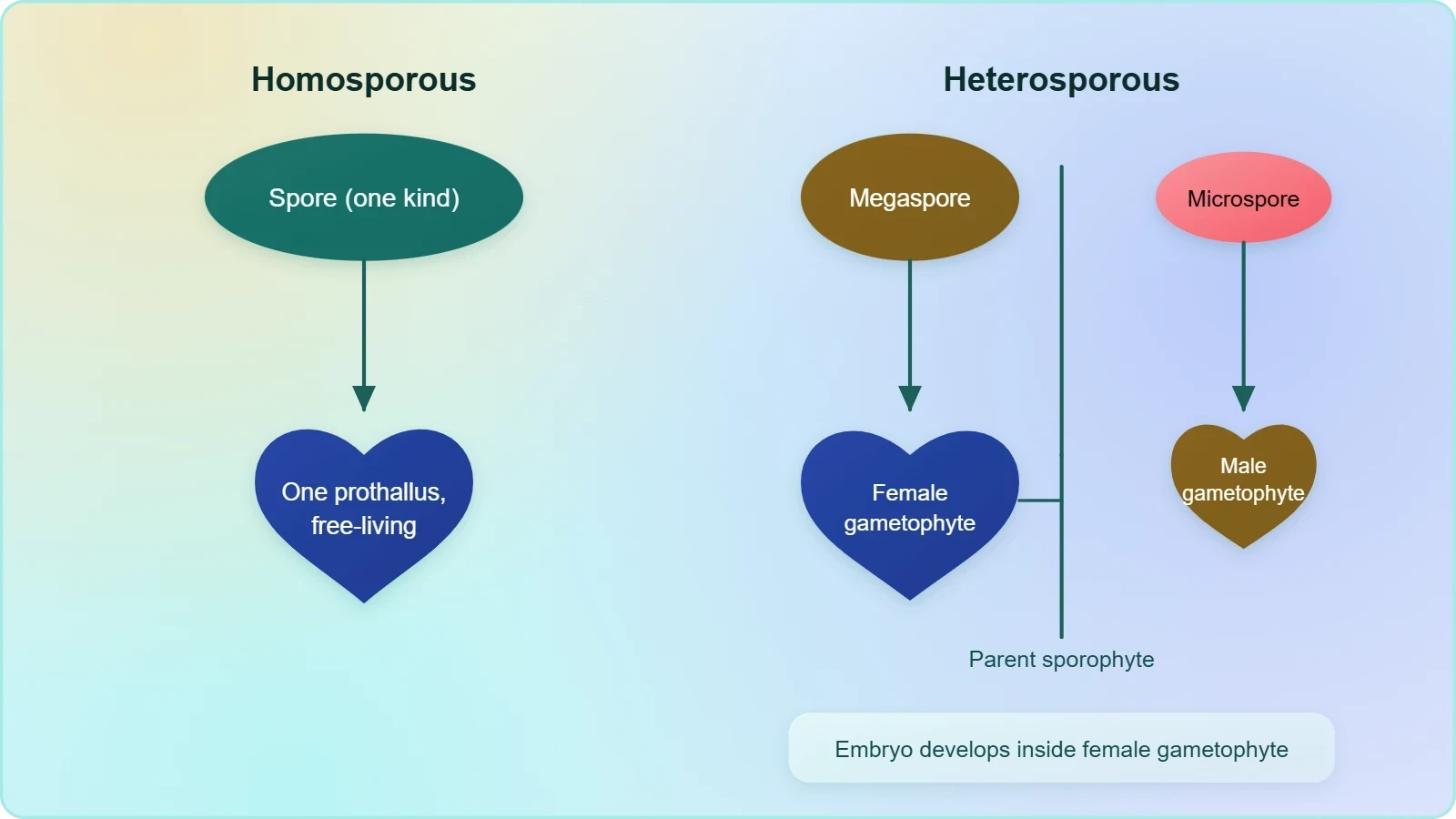
In the majority of the pteridophytes all the spores are of similar kinds, and such plants are called homosporous. A minority depart from this pattern. Genera like Selaginella and Salvinia, which produce two kinds of spores, macro (large) and micro (small) spores, are known as heterosporous. The distinction is simple to state and far-reaching in its consequences.
Two Kinds of Spores, Two Kinds of Gametophyte
The megaspores and microspores germinate and give rise to female and male gametophytes, respectively. In heterosporous plants, then, the single prothallus type of the homosporous condition is replaced by two separate gametophyte forms, each specialised for one sexual function. This division of labour is the practical meaning of heterospory.
The female gametophytes in these plants are retained on the parent sporophytes for variable periods. Retention changes the relationship between the generations: the female gametophyte is no longer fully free-living, and the young embryo develops in a protected position rather than on open ground.
The Precursor to the Seed Habit
The development of the zygotes into young embryos takes place within the female gametophytes. This event is a precursor to the seed habit, considered an important step in evolution. The wording deserves attention: heterospory and gametophyte retention are treated as steps toward the seed habit, not as the seed habit itself.
Keeping that distinction sharp prevents a common confusion. Pteridophytes do not produce seeds; the gymnosperms and angiosperms that follow do. What pteridophytes supply is the logical groundwork — spores of two sizes, a retained female gametophyte, and an embryo that begins life inside parental tissue.
Economic Uses and Ecological Role of Pteridophytes
Pteridophytes are used for medicinal purposes and as soil-binders, and they are also frequently grown as ornamentals. These three uses are stated plainly and should be remembered as such, without embellishment. They also connect the group's biology to practical human concerns, which is why the lesson closes on them rather than on structure alone.
Medicinal Use, Soil Binding and Ornamental Value
Soil-binding is a direct consequence of the plant's habit: a vascular root system that holds ground in place. Ornamental use follows from the visual appeal of ferns and their relatives. Medicinal use reflects a long record of practical application, and the lesson records it as one of the group's recognised uses.
These uses are worth setting beside the habitat note. Pteridophytes are found in cool, damp, shady places, though some may flourish well in sandy-soil conditions. The sandy-soil tolerance is relevant to soil binding, since loose ground is precisely where a binding root system earns its keep.
Where Pteridophytes Fit in the Plant Kingdom
Within Kingdom Plantae, pteridophytes sit between the bryophytes and the seed plants. They carry vascular tissue, which bryophytes lack, but they still depend on water for fertilisation, which the seed plants largely escape. That intermediate position is the reason the group repays close study.
The lesson has deliberately left the internal classification of pteridophytes untouched. The four classes — Psilopsida, Lycopsida, Sphenopsida and Pteropsida — belong to the next lesson, where Psilotum, Selaginella, Lycopodium, Equisetum, Dryopteris, Pteris and Adiantum are sorted into their groups. Here the group is treated as a whole.
Going Further: Reading the Vascular Advance and the Prothallus
Two ideas repay a little extra attention, because they turn a list of facts into a coherent picture. The first concerns what vascular tissue actually does; the second concerns why the prothallus is so particular about where it grows. Neither idea contradicts the material above; both simply explain it more fully.
What Xylem and Phloem Actually Do
Xylem and phloem are the vascular tissues that conduct water and food through a plant, which is why their presence marks pteridophytes as the first terrestrial vascular plants. Conduction is the function; the evolutionary label follows from it. Once a plant can move water upward and food downward, a larger body becomes workable.
This is also why the sporophyte can be the dominant phase. A conducting system supports true root, stem and leaves as specialised organs rather than as a single undifferentiated thallus. The vascular advance and the change in dominance are two descriptions of the same underlying shift.
Why the Prothallus Needs Cool, Damp, Shady Places
A prothallus is a small, free-living, usually photosynthetic gametophyte, which is why it needs cool, damp, shady places to grow. It has no vascular supply of its own and little capacity to buffer water loss, so it depends on its immediate surroundings. Shade reduces evaporative demand; dampness supplies the water that fertilisation also requires.
This explains the geographical restriction noted earlier. Because of this specific restricted requirement and the need for water for fertilisation, the spread of living pteridophytes is limited and restricted to narrow geographical regions. The limitation is not a failure of the group but a direct consequence of its reproductive biology.
Consolidating the Lesson Before Classification
The lesson can be held together by a single thread: vascular tissue arrives, and the sporophyte takes over. Pteridophytes are evolutionarily the first terrestrial plants to possess xylem and phloem; their main plant body is a sporophyte with true root, stem and leaves; and their gametophyte is reduced to a small free-living prothallus that still needs water for fertilisation.
A Short Self-Check
Can you state why pteridophytes are called the first terrestrial vascular plants, and name the two tissues involved? Can you distinguish microphylls from macrophylls, and explain what a sporophyll and a strobilus are? Can you describe the prothallus and say why water is required for fertilisation? These questions cover the core of the lesson.
A further check concerns heterospory. Can you explain what Selaginella and Salvinia do differently from the majority of pteridophytes, and why embryo development within the female gametophyte is described as a precursor to the seed habit? Answering this well shows that the evolutionary argument has been understood, not merely memorised.
Preparing for the Classes of Pteridophytes
The next lesson takes up the classification of pteridophytes into four classes: Psilopsida, Lycopsida, Sphenopsida and Pteropsida. The genera already met here — Selaginella, Equisetum, Salvinia and the ferns — will reappear there as members of those classes. Nothing in this lesson needs to be unlearned to follow that step.
What matters now is that the group as a whole is secure: its vascular status, its sporophyte dominance, its organ differentiation, its spore-bearing structures, its water-dependent sexual cycle, and its homosporous and heterosporous conditions. With that foundation in place, the internal divisions of the pteridophytes become a matter of sorting rather than of new principle.
Also Read
- No links available.
From our network :
- Analyzing Trump Deportation Numbers Insights Into The 2026 Immigration Crackdown
- Mastering DB2 LUW v12 Tables: A Comprehensive Technical GuideComprehensive guide on DB2 LUW v12 tables. Explore CREATE TABLE syntax, BLU Acceleration, range partitioning, data types, and security features for IBM DB2 LUW v12.
- Trump Political Strategy How Geopolitical Stunts Serve As Media Diversions
- 98% of Global MBA Programs Now Prefer GRE Over GMAT Focus EditionExplore why 98% of global MBA programs now prefer the GRE over GMAT Focus. Learn about the shorter GRE format, verbal logic importance, and strategic versatility for students.
- 10 Physics Numerical Problems with Solutions for IIT JEEPrepare for IIT JEE with 10 physics numerical problems, complete with detailed solutions and conceptual explanations. Ideal for mastering kinematics, thermodynamics, electromagnetism, and optics.
- Mastering DB2 12.1 Instance Design: A Technical Deep Dive into Modern Database ArchitectureComprehensive guide to DB2 12.1 Instance Design. Explore architectural components, HADR setup, buffer pool tuning, and security policies for IBM DB2 12.1. Includes 10 functional SQL and Shell samples.
- EV 2.0: The Solid-State Battery Breakthrough and Global Factory ExpansionDiscover the impact of the Solid-State Battery Breakthrough on the EV market. Learn about CATL and BYD stock growth, global factory expansion in Europe, and the future of EV 2.0 technology.
- Vite 6/7 'Cold Start' Regression in Massive Module GraphsIn-depth analysis of Vite 6/7 cold start regressions in massive module graphs. Learn about barrel file issues, pre-bundling optimizations, and how to improve Vite dev server performance.
- AI-Powered 'Precision Diagnostic' Replaces Standard GRE Score ReportsDiscover the new GRE Precision Diagnostic. Learn how AI-powered behavioral analytics and time-to-solve tracking are replacing standard GRE score reports to empower students.
RESOURCES
- which group of plant is regarded as first terrestrial plants? why?brainly.inJun 20, 2017 ... It is believed that the pteridophytes are the 'first group of plants' that have survived on Earth. · This is…
- Pteridophytes & Alternation of Generations | NCERT Class 11 ...facebook.comJul 18, 2026 ... Pteridophytes & Alternation of Generations | NCERT Class 11 Biology Did you know that ferns were among the first vascular…
- About Ferns - American Fern Societyamerfernsoc.orgLeptosporangiate ferns appear to be the only group of vascular plants that ... The origin and early diversification of land plants a cladistic study.
- Why are pteridophytes considered the first successful vascular land ...facebook.comJul 18, 2026 ... Pteridophytes & Alternation of Generations | NCERT Class 11 Biology Did you know that ferns were among the first vascular…
- Editorial: Microbial symbionts of lower plants - PMCpmc.ncbi.nlm.nih.govNov 3, 2025 ... ... land plants adapt to and thrive in the challenging terrestrial ... Pteridophytes were the first terrestrial lineage to have…
- No evidence of general CO 2 insensitivity in ferns: one stomatal ...nph.onlinelibrary.wiley.comMay 23, 2016 ... There are currently two conflicting models describing the nature of stomatal regulation across terrestrial vascular plants: the first is ...
- Pteridophytes as first vascular plants | PPTX - Slideshareslideshare.netPteridophytes were the first vascular plants to evolve, originating around 400 million years ago. They are characterized by having well-developed vascular ...
- The origin and early evolution of vascular plant shoots and leavesroyalsocietypublishing.orgDec 18, 2017 ... The earliest land plants arose about 470 million years ago and are evidenced in the fossil record as spores or…
- Origin and early evolution of land plants: Problems and considerationspmc.ncbi.nlm.nih.govIn fact, gametophytes of liverworts and some vascular plants (Equisetum, lycopods, certain ferns) retain a similar pattern of parenchymatous growth. Coleochaete ...
- [Solved] Which of the following are the first terrestrial plants to ptestbook.comThe Correct answer is Pteridophyte. Key Points Pteridophytes are known as the first terrestrial plants to possess vascular tissues, which include xylem and.
- Mycorrhizal association and its relation with pteridophytes - Frontiersfrontiersin.orgJul 10, 2024 ... ... first land plants colonized the ... Pteridophytes are among the first vascular plants that invaded the terrestrial system after…
- Fern - Wikipediaen.wikipedia.orgFerns (Polypodiopsida or Polypodiophyta) are a group of vascular plants that reproduce via spores and have neither seeds nor flowers.
- Exploring the plant growth promoting attributes of pteridophyte ...pubmed.ncbi.nlm.nih.govFeb 12, 2025 ... Pteridophytes, encompassing ferns and fern allies, are integral components of terrestrial ... pteridophytes, which are the first vascular plants.
- Pteridophyte - Wikipediaen.wikipedia.orgPteridophytes (ferns and lycophytes) are free-sporing vascular plants that have ... The Origin and Early Diversification of Land Plants: A Cladistic Study.
- " Comment "FERN" to get the PDF link! @povncert ... - Instagraminstagram.comJun 7, 2026 ... ... Pteridophytes are among the most important topics in Plant Kingdom because they represent the first terrestrial plants to develop…