Bryophytes occupy one of the most instructive positions in the plant kingdom, standing between the water-bound algae that preceded them and the vascular plants that followed. This fourth lesson of the plant kingdom series examines mosses and liverworts as the amphibians of the plant kingdom, organisms that live on land yet remain tethered to water for their sexual reproduction. The lesson traces their thallus-like plant body, their anchoring rhizoids, the gametophyte that serves as the dominant plant, and the dependent sporophyte that grows from it.
The material moves carefully through the reproductive architecture of these plants, describing the multicellular antheridium that releases biflagellate antherozoids and the flask-shaped archegonium that shelters a single egg. It then follows the zygote as it develops into a multicellular sporophyte, still attached to the photosynthetic gametophyte and drawing nourishment from it, until meiosis produces haploid spores that germinate into new gametophytes. Ecological and economic importance closes the lesson, from rock colonisation to peat formation by Sphagnum.
Because this lesson builds directly on the three classes of algae studied earlier, it assumes familiarity with oogamous sexual reproduction and post-fertilisation development. It also prepares the ground for the next lesson, which separates liverworts and mosses into their distinct forms. Learners should read the material as a connected argument about how plants solved the problem of reproduction on dry land without yet solving the problem of transport.
On This Page
The Amphibian Identity of Bryophytes
Bryophytes are called amphibians of the plant kingdom for a precise reason: they can live in soil, but they depend on water for sexual reproduction. This dual dependence defines their habitat, their anatomy and their life cycle. They usually occur in damp, humid and shaded localities, commonly growing in moist shaded areas in the hills, where a film of water is reliably present for at least part of the year.
Habitat and the Meaning of the Amphibian Label
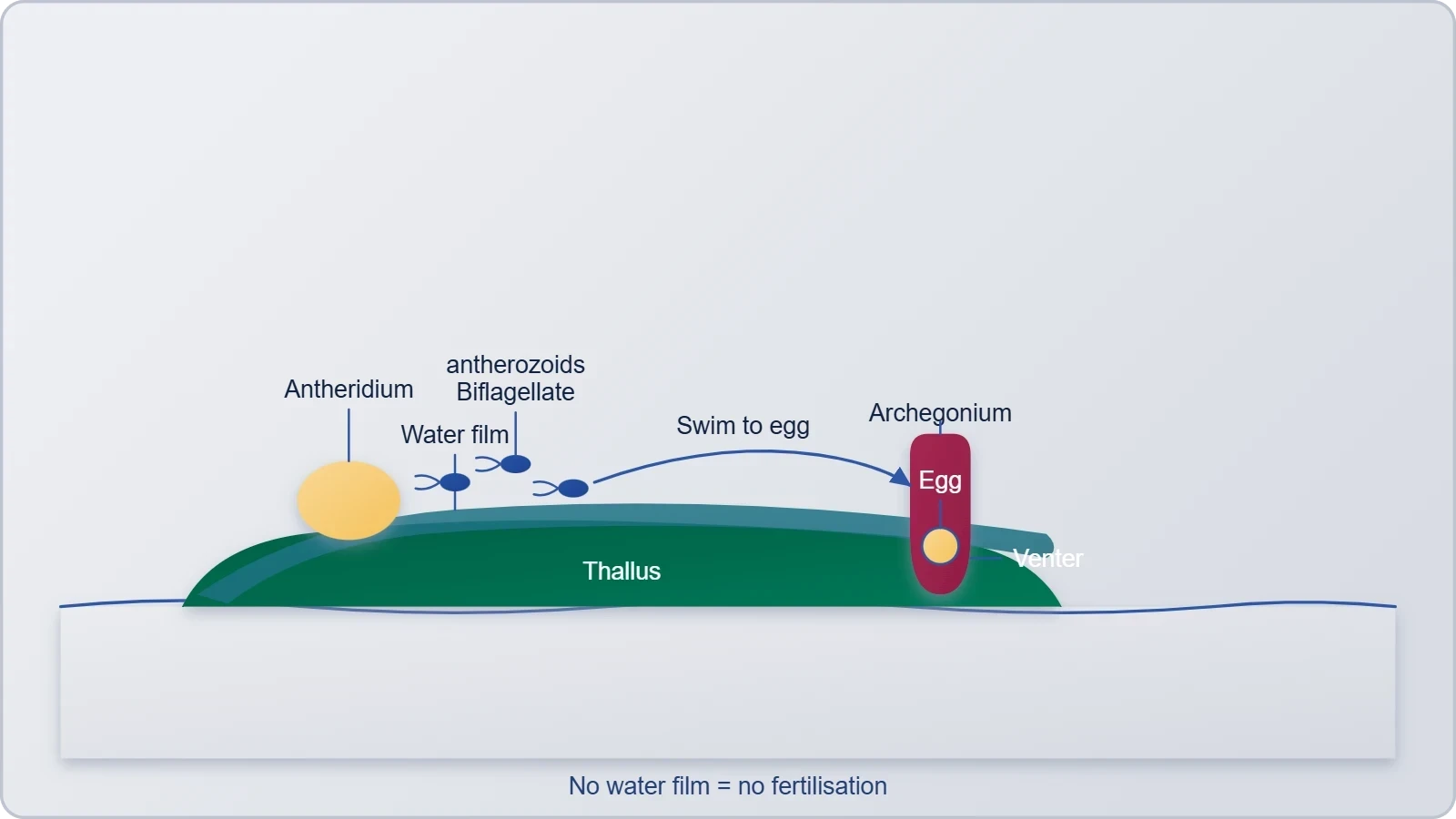
The amphibian comparison is not decorative. A bryophyte spends its vegetative life anchored to soil, rock or bark, yet its male gametes must swim through water to reach the egg. Without external water, fertilisation cannot occur, and the sexual cycle stalls. This is why bryophytes cluster in damp, humid and shaded localities rather than in open, dry terrain.
The label also carries an ecological meaning. Bryophytes play an important role in plant succession on bare rocks and soil, arriving early where little else can establish. Their presence begins the conversion of raw mineral surfaces into substrates that higher plants can later occupy, a role they share with lichens in the colonisation of rock.
Where Bryophytes Grow and Why Location Matters
Moist shaded areas in the hills are the classic bryophyte habitat, and the reason is straightforward. Shade slows evaporation, and moisture retained in soil, bark and rock crevices supplies the water film that swimming antherozoids require. Move a bryophyte into full sun and dry air, and its reproductive cycle becomes impossible even if the plant body survives.
This habitat preference explains the dense mats mosses form on damp soil and shaded rock. Those mats are not incidental; they trap moisture, moderate temperature at the surface, and create the microclimate in which the next generation of gametophytes can develop. Habitat and life cycle are therefore inseparable in any account of bryophytes.
The Plant Body: Thallus, Rhizoids and Differentiation
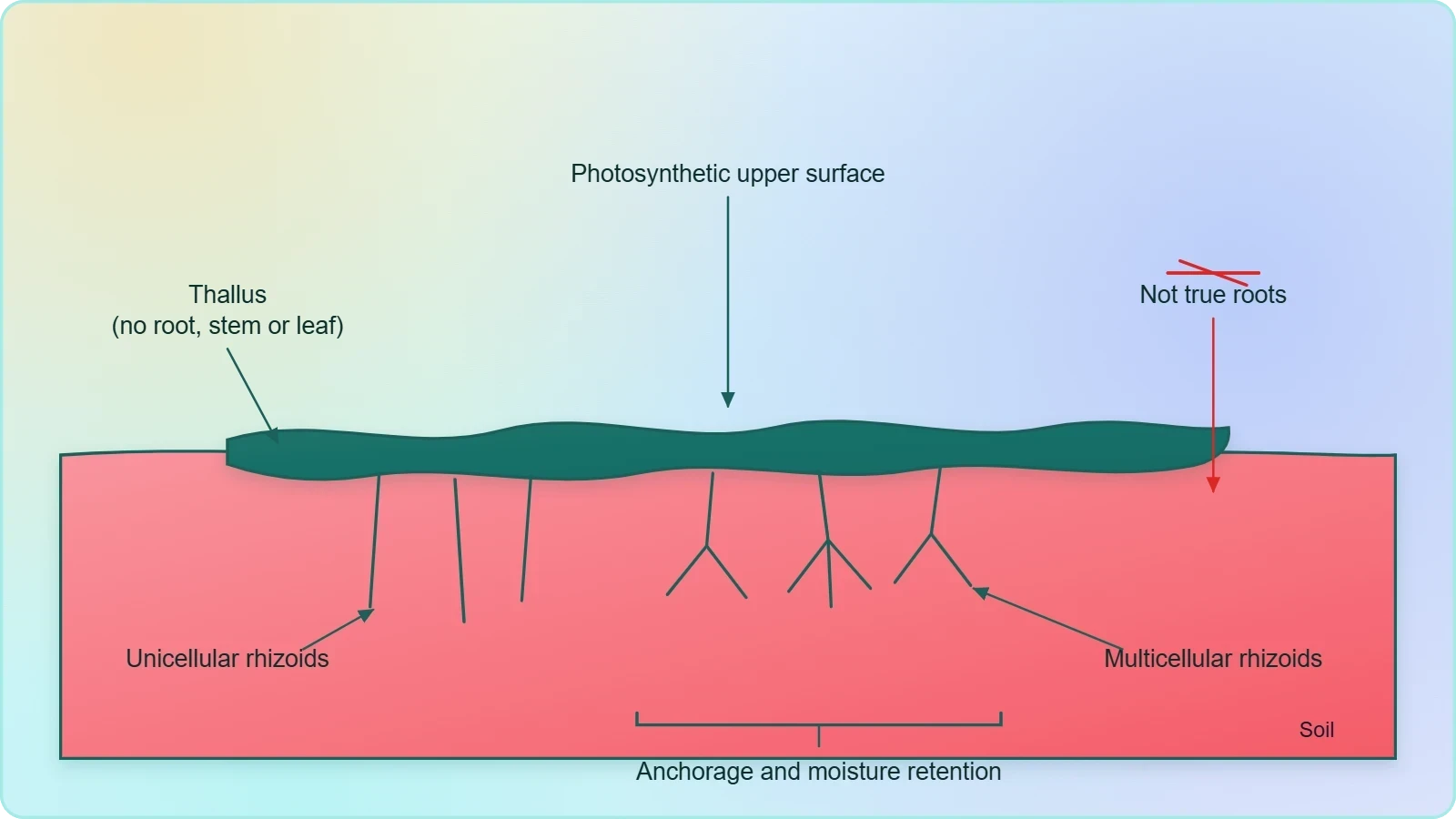
The plant body of bryophytes is more differentiated than that of algae, yet it stops short of the true organs found in higher plants. It is thallus-like and prostrate or erect, attached to the substratum by unicellular or multicellular rhizoids. Bryophytes lack true roots, stem or leaves, though they may possess root-like, leaf-like or stem-like structures that perform comparable functions without the internal organisation of vascular plants.
Structure of the Thallus and the Work of Rhizoids
A thallus is a plant body not differentiated into root, stem and leaf, and in liverworts such as Marchantia it is dorsiventral, closely appressed to the substrate. The upper surface carries the photosynthetic tissue while the lower surface bears rhizoids. This flat, spreading habit maximises light capture in shaded habitats where illumination arrives at low intensity.
Rhizoids anchor the thallus to soil, rock or bark and assist in holding moisture close to the plant surface. They may be unicellular or multicellular, and they are not roots: they lack the vascular tissue and absorptive architecture of true roots. Their function is anchorage and surface contact rather than long-distance transport.
Gametophyte as the Dominant Plant Body
The main plant body of the bryophyte is haploid, and because it produces gametes it is called a gametophyte. This is the plant you actually see when you look at a moss cushion or a liverwort thallus. The diploid phase is reduced to the sporophyte, which never becomes independent of the gametophyte that bears it.
This dominance of the haploid generation is the central structural fact of bryophyte biology. In algae the situation varies, and in higher plants the sporophyte dominates, so bryophytes sit at a transitional point. Recognising which generation is photosynthetic and free-living is the key to reading their entire life cycle correctly.
Sex Organs: Antheridium and Archegonium
The sex organs in bryophytes are multicellular, a decisive advance over the single-celled gametangia of simpler forms. The male sex organ is called the antheridium, and it produces biflagellate antherozoids. The female sex organ, called the archegonium, is flask-shaped and produces a single egg. Both are borne on the gametophyte, which is why the gametophyte is the reproductive as well as the vegetative plant.
The Antheridium and Biflagellate Antherozoids
An antheridium is a multicellular structure that manufactures biflagellate antherozoids, each equipped with two flagella for swimming. When mature, the antheridium releases these motile male gametes into a film of water. The flagella are the reason water is indispensable: without a liquid medium, the antherozoids cannot travel from antheridium to archegonium.
In liverworts such as Marchantia, antheridia are borne on specialised upright structures called antheridiophores, while archegonia sit on archegoniophores. This separation of male and female structures on distinct branches of the thallus is visible in the familiar umbrella-like forms of the genus. The arrangement ensures gametes are released close to the water film that will carry them.
The Flask-Shaped Archegonium and the Single Egg
The archegonium is flask-shaped, with a narrow neck and a swollen venter that houses a single egg. Its shape is functional: the neck presents a channel through which antherozoids can enter, and the venter protects the egg until fertilisation. Each archegonium yields only one egg, so each successful fertilisation produces one zygote.
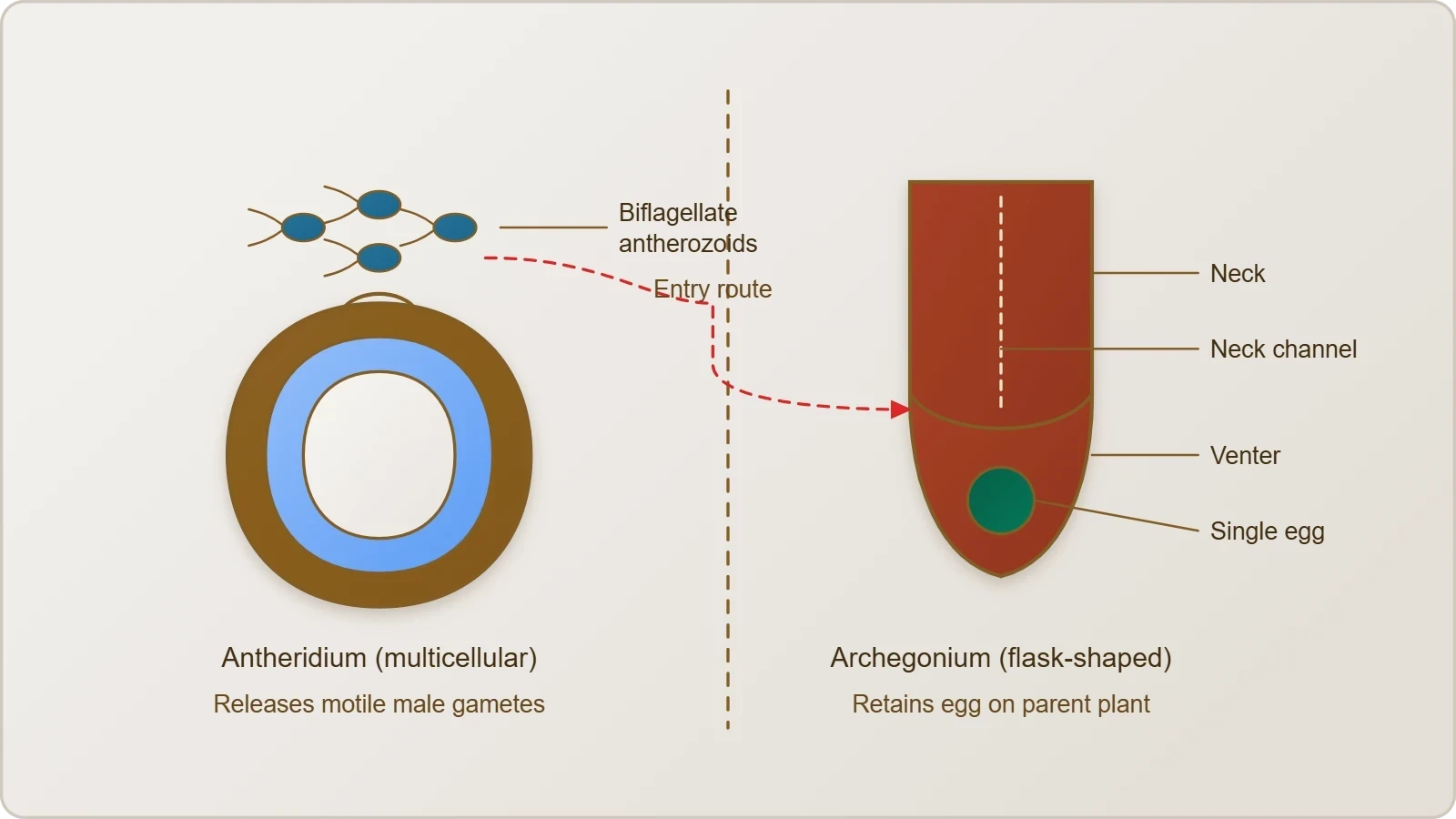
Because the egg is retained within the archegonium on the parent gametophyte, fertilisation and early development occur inside maternal tissue. This retention is a significant departure from the release of gametes into open water seen in many algae. It protects the developing zygote and links the sporophyte physically to the gametophyte from its very first cell division.
Fertilisation and the Dependent Sporophyte
Fertilisation begins when antherozoids are released into water and come in contact with the archegonium. An antherozoid fuses with the egg to produce the zygote. Crucially, zygotes do not undergo reduction division immediately; instead they produce a multicellular body called a sporophyte. This delay is what allows a diploid generation to exist at all in the bryophyte life cycle.
From Zygote to Multicellular Sporophyte
The zygote divides mitotically to build the multicellular sporophyte, which remains attached to the photosynthetic gametophyte and derives nourishment from it. The sporophyte is therefore not free-living. In mosses such as Funaria, the sporophyte is visibly differentiated into a seta and a capsule, with the capsule borne aloft on the stalk above the leafy gametophyte.
This nutritional dependence is the defining limitation of bryophytes. The sporophyte cannot photosynthesise enough to sustain itself independently, so it parasitises the gametophyte that produced it. In this respect bryophytes differ sharply from vascular plants, where the sporophyte is the dominant, self-supporting generation.
Meiosis, Spores and the Return to the Gametophyte
Some cells of the sporophyte undergo reduction division, or meiosis, to produce haploid spores. These spores germinate to produce the gametophyte, completing the cycle. The sporophyte therefore serves one essential purpose: it is the only diploid stage, and it is where meiosis occurs to restore the haploid condition.
The cycle can be summarised as a haploid gametophyte producing gametes, a zygote forming after fertilisation, a diploid sporophyte developing on the gametophyte, and meiosis in the sporophyte yielding haploid spores. Each stage is bounded by a ploidy change, and each change is tied to a specific structure in the plant.
Ecological and Economic Importance
Bryophytes in general are of little economic importance, but their ecological role is considerable. Some mosses provide food for herbaceous mammals, birds and other animals. Species of Sphagnum, a moss, provide peat that has long been used as fuel and as packing material for trans-shipment of living material because of their capacity to hold water. These uses are modest in scale yet historically persistent.
Colonisers of Rock and Builders of Soil
Mosses along with lichens are the first organisms to colonise rocks, and hence are of great ecological importance. They decompose rocks, making the substrate suitable for the growth of higher plants. This is the mechanism behind their role in plant succession on bare rocks and soil, converting inert mineral surfaces into biologically usable ground.
The process is slow and cumulative. Acids released by the plants and the physical retention of moisture gradually break down rock surfaces, while dead bryophyte material accumulates as organic matter. Over time the substrate deepens and enriches, allowing vascular plants to establish where bryophytes first took hold.
Soil Erosion Control and the Value of Peat
Since mosses form dense mats on the soil, they reduce the impact of falling rain and prevent soil erosion. The mat intercepts raindrops, spreads their energy across a broad surface, and holds water that would otherwise run off. This protective function is a direct consequence of the growth habit described earlier.
Sphagnum deserves particular attention because its water-holding capacity underpins two distinct uses. Peat formed from these mosses serves as fuel, and the same absorptive property makes the moss valuable as packing material for trans-shipment of living material. The plant's anatomy thus translates directly into practical utility.
Going Further: Reading the Cycle with Precision
Two points reward closer attention because they explain why the bryophyte cycle works as it does. The first concerns meiosis, the second concerns the physical property of peat. Neither contradicts the material above; both clarify the reasoning behind statements that might otherwise be memorised without understanding.
Why Meiosis Makes the Spores Haploid
Meiosis is reduction division, which is why the spores produced by the sporophyte are haploid and grow into the haploid gametophyte. The sporophyte is diploid, so its cells carry two sets of chromosomes. Reduction division halves that complement, and each spore receives one set, restoring the haploid condition that defines the gametophyte.
This is precisely why the zygote must not undergo reduction division immediately. If it did, the diploid sporophyte generation would never exist. By delaying meiosis until the sporophyte is multicellular, bryophytes maintain a diploid phase that can produce large numbers of spores through many meiotic divisions.
Why Sphagnum Peat Holds Water So Well
Peat formed by Sphagnum holds water, which explains its long use as packing material for trans-shipment of living material. The moss absorbs and retains moisture far in excess of its own mass, keeping packed specimens damp during transport. This same retention underlies the use of peat as fuel, since the material burns once dried.
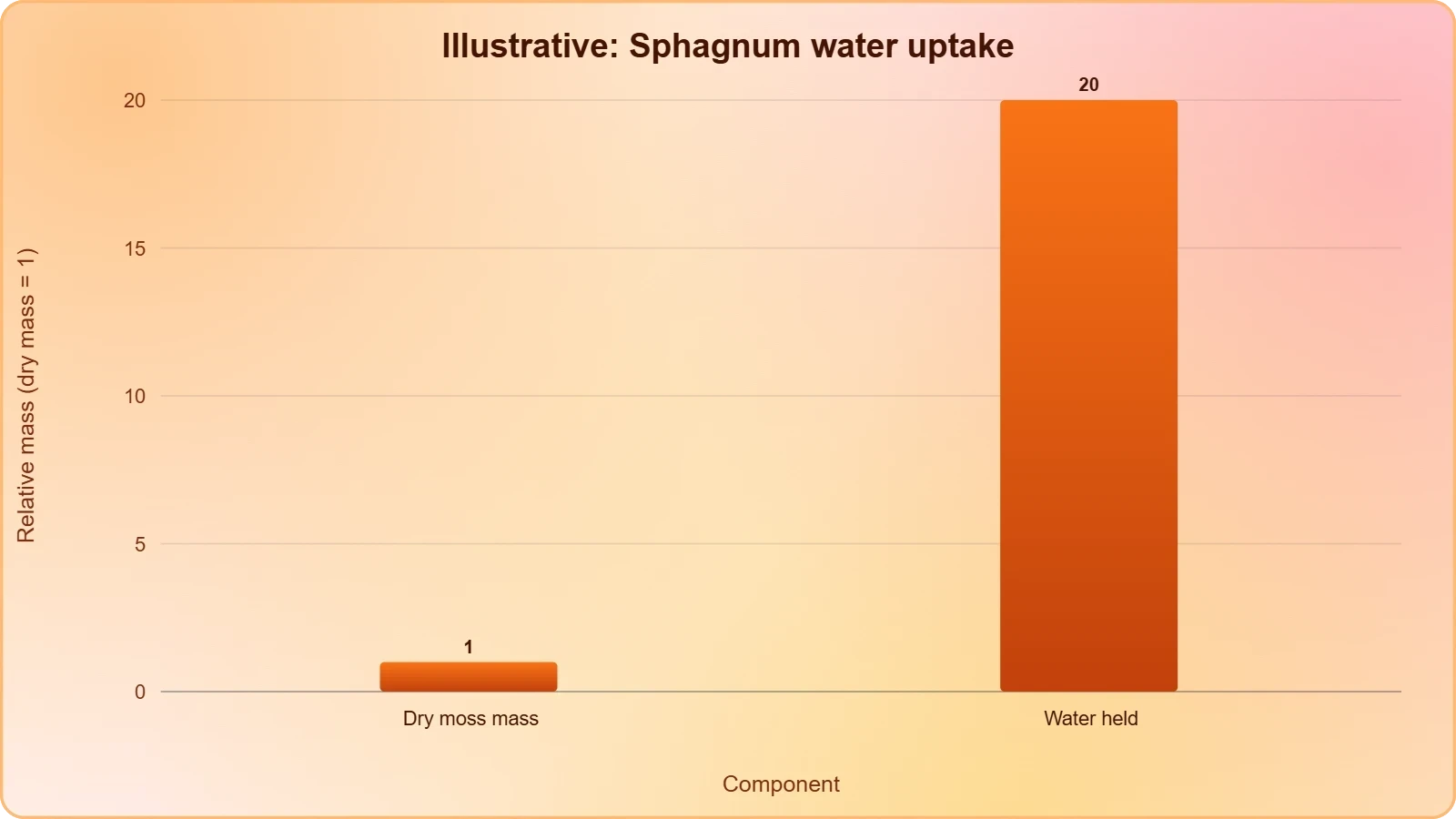
The water-holding property also connects to the erosion-control function described earlier. A dense moss mat acts as a sponge, slowing runoff and holding moisture at the soil surface. Understanding this single physical trait therefore illuminates several of the practical roles bryophytes play.
The lesson closes where the material closes: bryophytes are divided into liverworts and mosses. That division, and the distinctive forms of Marchantia and Funaria, belongs to the next lesson. What should remain from this one is the logic of a plant that conquered land without abandoning water, and a life cycle in which the haploid gametophyte carries the diploid sporophyte rather than the reverse.
Also Read
- No links available.
From our network :
- Analyzing Trump Deportation Numbers Insights Into The 2026 Immigration Crackdown
- AI-Powered 'Precision Diagnostic' Replaces Standard GRE Score ReportsDiscover the new GRE Precision Diagnostic. Learn how AI-powered behavioral analytics and time-to-solve tracking are replacing standard GRE score reports to empower students.
- 98% of Global MBA Programs Now Prefer GRE Over GMAT Focus EditionExplore why 98% of global MBA programs now prefer the GRE over GMAT Focus. Learn about the shorter GRE format, verbal logic importance, and strategic versatility for students.
- Trump Political Strategy How Geopolitical Stunts Serve As Media Diversions
- EV 2.0: The Solid-State Battery Breakthrough and Global Factory ExpansionDiscover the impact of the Solid-State Battery Breakthrough on the EV market. Learn about CATL and BYD stock growth, global factory expansion in Europe, and the future of EV 2.0 technology.
- Mastering DB2 LUW v12 Tables: A Comprehensive Technical GuideComprehensive guide on DB2 LUW v12 tables. Explore CREATE TABLE syntax, BLU Acceleration, range partitioning, data types, and security features for IBM DB2 LUW v12.
- 10 Physics Numerical Problems with Solutions for IIT JEEPrepare for IIT JEE with 10 physics numerical problems, complete with detailed solutions and conceptual explanations. Ideal for mastering kinematics, thermodynamics, electromagnetism, and optics.
- Vite 6/7 'Cold Start' Regression in Massive Module GraphsIn-depth analysis of Vite 6/7 cold start regressions in massive module graphs. Learn about barrel file issues, pre-bundling optimizations, and how to improve Vite dev server performance.
- Mastering DB2 12.1 Instance Design: A Technical Deep Dive into Modern Database ArchitectureComprehensive guide to DB2 12.1 Instance Design. Explore architectural components, HADR setup, buffer pool tuning, and security policies for IBM DB2 12.1. Includes 10 functional SQL and Shell samples.
RESOURCES
- why are Bryophytes called the Amphibians of the plant kingdom?brainly.inDec 9, 2016 ... Bryophytes live on soil but need water for sexual reproduction. Hence, they are called amphibians of the plant kingdom since…
- Bryophytes :Amphibians of Plant Kingdom | PPTX - Slideshareslideshare.netBryophytes are small, nonvascular plants that lack true roots, stems, and leaves. They reproduce both sexually and asexually.
- Why bryophytes are called amphibians of plant kingdom brainly?brainly.inMar 31, 2019 ... Bryophytes are known as amphibians of the plant kingdom because they use water during sexual reproduction even though they live…
- Why are Bryophytes called Amphibians of the Plant Kingdomunacademy.comAnswer: Bryophytes are also known as amphibians of the plant kingdom since they can live in soil but need water to reproduce sexually.
- plant kingdom chapter 3 - NCERTncert.nic.inBryophytes are also called amphibians of the plant kingdom because these ... Plant kingdom includes algae, bryophytes, pteridophytes, gymnosperms and angiosperms.
- Habitat of Bryophytes - BYJU'Sbyjus.comBryophytes are called “amphibians of the plant kingdom” because they are terrestrial plants, but require water to complete their life cycle at the time…
- Bryophytes – Amphibians of the Plant Kingdom Non ... - Instagraminstagram.comJul 20, 2025 ... Bryophytes – Amphibians of the Plant Kingdom ✨ Non-vascular, small, green land plants Need water for reproduction (motile sperm swim ...
- Bryophytes: Amphibians of Plant Kingdom | PDF - Scribdscribd.comBryophytes are a group of non-vascular plants commonly called the "amphibians of the plant kingdom". They are the simplest and most primitive plant groups, ...
- Bryophytes as amphibians of the plant kingdom - Facebookfacebook.comJul 6, 2026 ... Living on land... but tied to the water . Bryophytes are the amphibians of the plant kingdom #biologicdecoded #biologyconcept #biology.
- Assertion Bryophytes are the amphibians of plant kingdom. Reason ...allen.inBryophytes are the dwellers of transitional habitat between the aquatic ( e. g. algae) and terrestrial (e. g.spermatophytes) habitats.
- Bryophytes: Understanding Liverworts and Mosses in Plant Evolutionfacebook.com3 days ago ... BRYOPHYTES: LIVERWORTS & MOSSES | The Amphibians of the Plant Kingdom! Did you know that some plants can survive on…
- Why are bryophytes called ''Amphibians of plant kingdom'' - Testbooktestbook.comThey are amphibious in nature and are also called ''amphibians of the plant kingdom'' because these plants can live in soil but are dependent…
- Why is Bryophyta called the amphibian of the plant kingdom?homework.study.comMembers of the phylum Bryophyta are sometimes called the amphibians of the plant kingdom because they require constant moisture to survive, and water is…