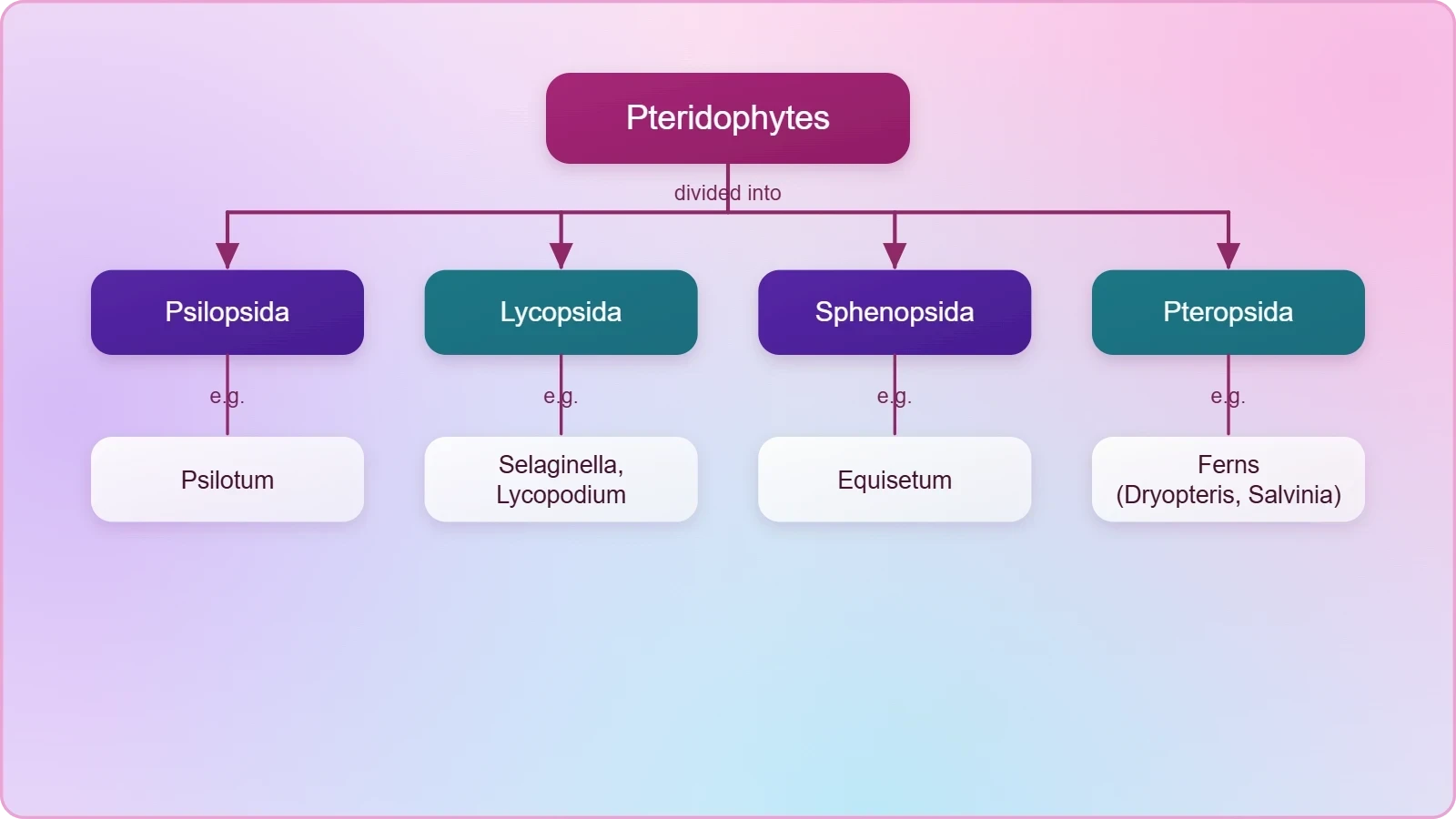
Pteridophytes occupy a distinctive position in the plant kingdom: they are the first true terrestrial plants to possess vascular tissues, yet their reproduction still depends on water. That paradox shapes everything about how botanists organise them. Within this ancient lineage, four recognised classes — Psilopsida, Lycopsida, Sphenopsida and Pteropsida — gather the familiar genera Psilotum, Selaginella, Lycopodium, Equisetum, Dryopteris, Pteris and Adiantum into manageable groups.
This lesson builds directly on the previous discussion of pteridophyte form and life cycle, and it prepares the ground for the gymnosperms that follow. Here the focus narrows to classification: which genera belong to which class, what distinguishes one class from another, and why the heterosporous condition seen in Selaginella and Salvinia matters so much in evolutionary terms. The thread running through the lesson is that spore type and vascular architecture together reveal the direction in which land plants were moving.
Learners at intermediate level will find the material arranged so that each class is examined on its own terms before comparisons are drawn. The lesson also revisits the homosporous–heterosporous distinction, the retention of female gametophytes on the parent sporophyte, and the emergence of the seed habit as a precursor event. These ideas recur throughout the remaining lessons of the course, so a firm grasp here pays dividends later.
On This Page
- The Four Classes of Pteridophytes: An Organising Framework
- Spore Types: Homosporous and Heterosporous Pteridophytes
- Sexual Reproduction and the Dominant Sporophyte
- Reading the Genera: Diagnostic Features Across the Classes
- From Pteridophytes to Gymnosperms: The Evolutionary Threshold
- Going Further: Reading the Class Names
The Four Classes of Pteridophytes: An Organising Framework
Pteridophytes are further classified into four classes: Psilopsida, Lycopsida, Sphenopsida and Pteropsida. Each class is anchored by representative genera, and together they span the range from simple, leafless branching axes to the large, finely divided fronds of ferns. The classification is not merely a list; it reflects genuine differences in vascular organisation, leaf form and reproductive strategy.
Psilopsida and Lycopsida: The Simpler Vascular Bodies
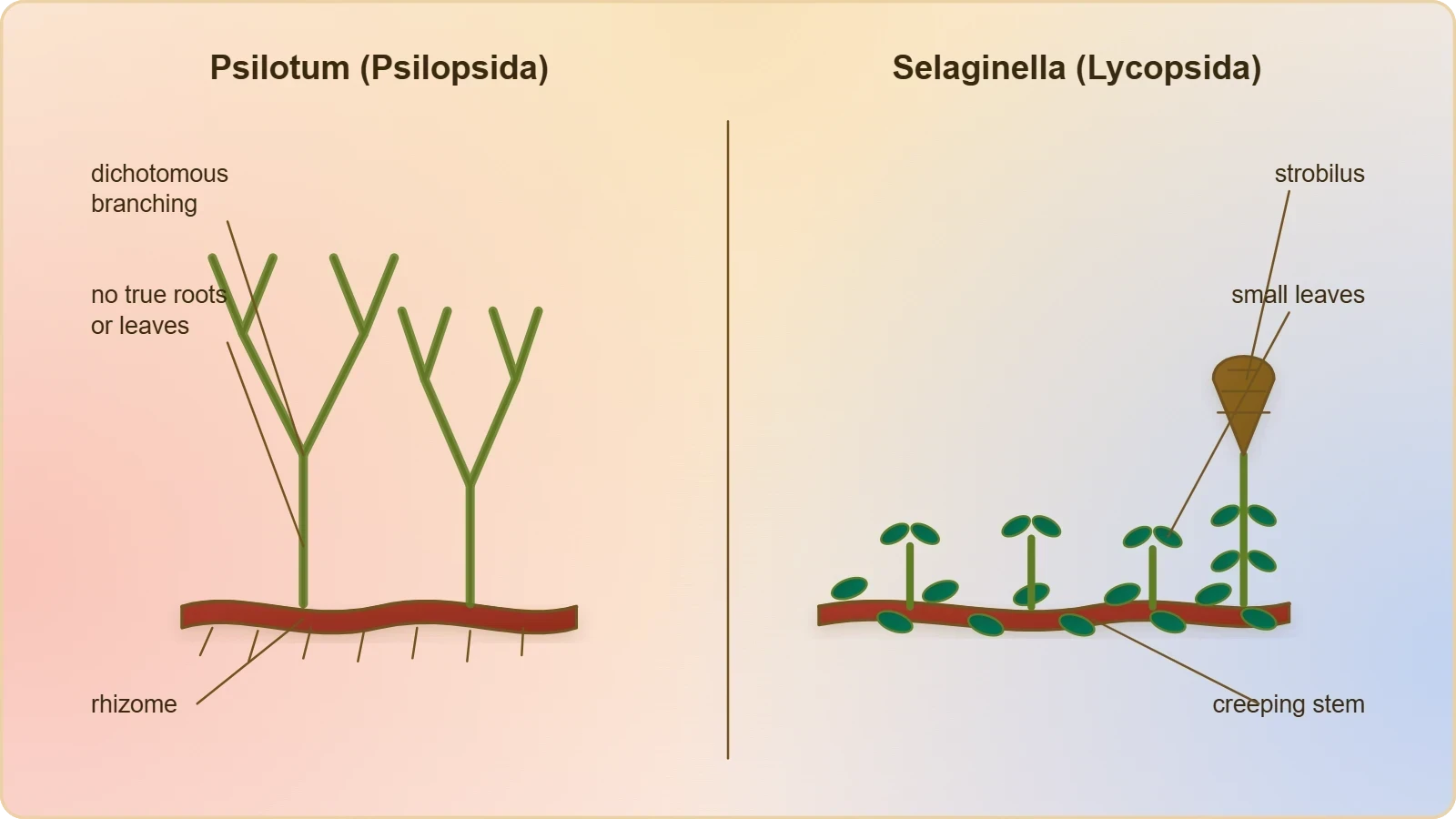
Psilopsida is represented by Psilotum, a genus whose sporophytes lack true roots and leaves, bearing instead dichotomously branching aerial axes arising from a rhizome. Lycopsida contains Selaginella and Lycopodium, plants with small, simple leaves arranged along stems and, in many species, distinct strobili. The strobilus, a compact cone-like structure bearing spore-producing organs, is a conspicuous feature of this class.
The lycopsids are especially significant because Selaginella is heterosporous, producing macrospores and microspores rather than a single uniform spore type. This single fact links the class to the evolutionary narrative of the whole lesson. Lycopodium, by contrast, is homosporous, so the two genera sit side by side as contrasting examples within one class.
Sphenopsida and Pteropsida: Jointed Stems and Fronded Ferns
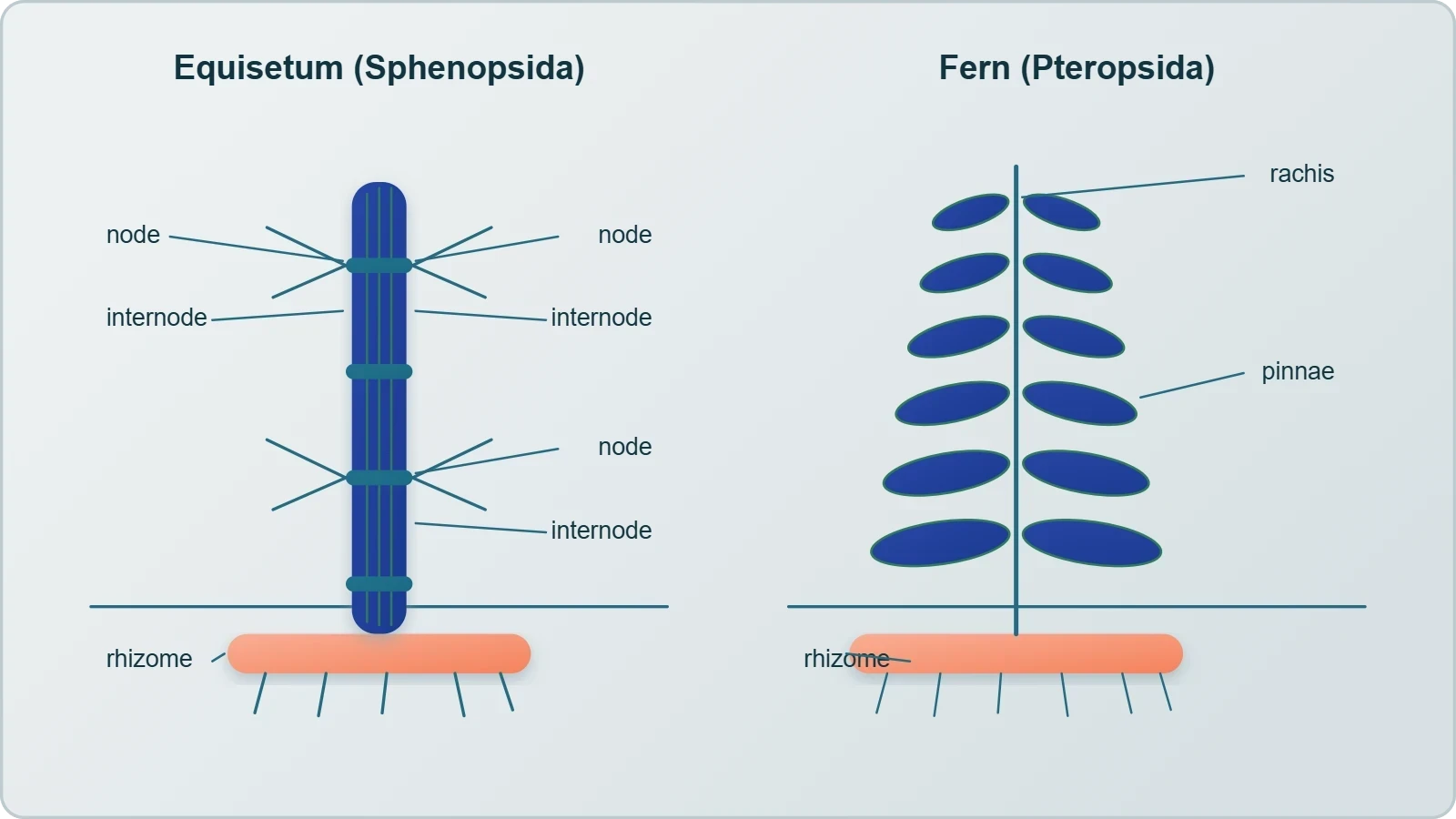
Sphenopsida is represented by Equisetum, distinguished by its jointed architecture: stems are clearly divided into nodes and internodes, with branches arising at the nodes and a rhizome anchoring the plant below ground. Pteropsida gathers the ferns proper — Dryopteris, Pteris and Adiantum — whose conspicuous sporophytes bear large, often compound fronds.
The contrast between the two classes is instructive. Equisetum achieves its form through repeated segmentation of a relatively simple axis, while the pteropsids invest in expansive leaf surface. Both solutions work, and both appear among the most widely distributed pteridophytes encountered in cool, damp, shady habitats where their gametophytes can thrive.
Spore Types: Homosporous and Heterosporous Pteridophytes
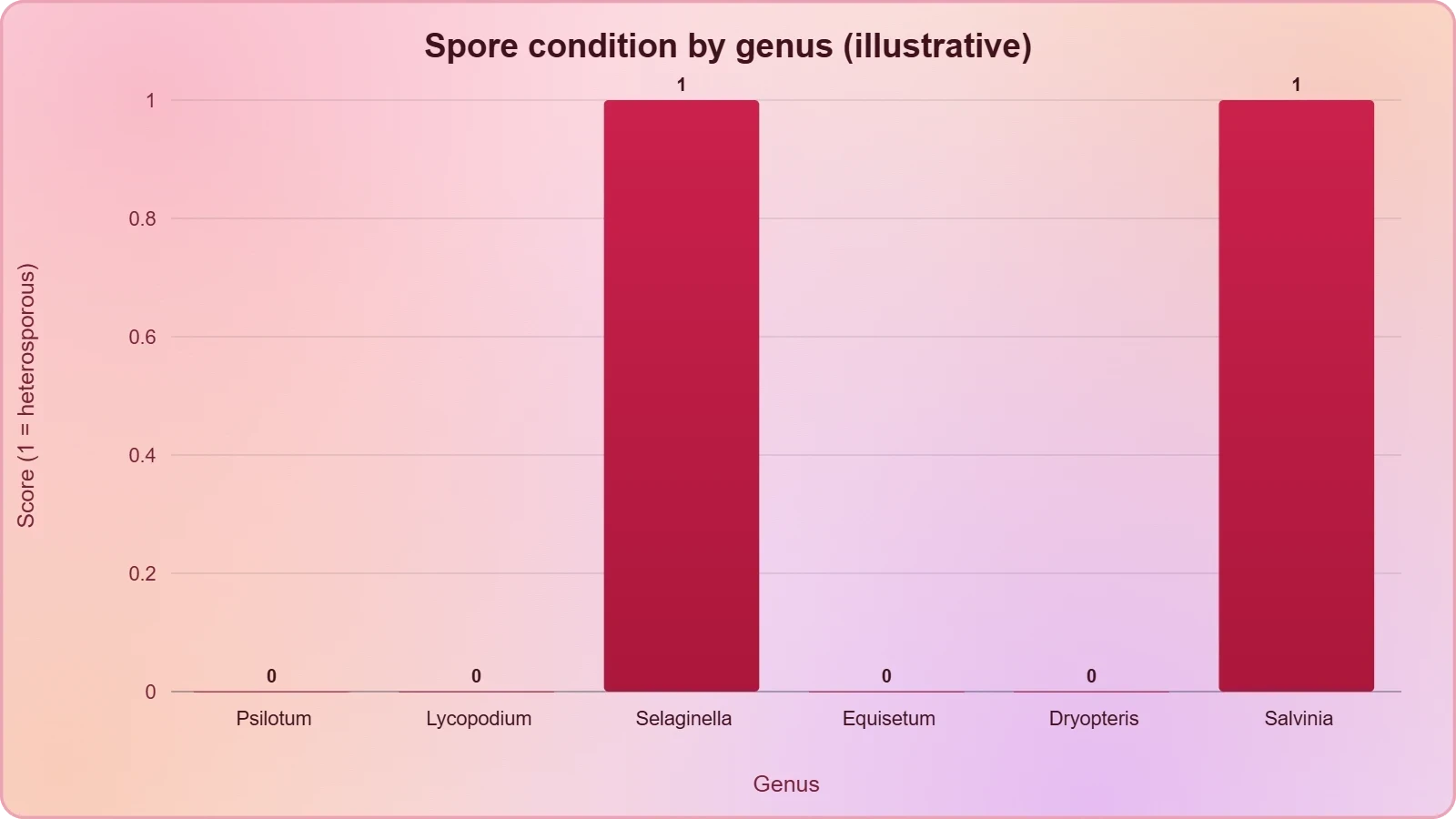
In the majority of pteridophytes all the spores are of similar kinds, and such plants are called homosporous. A minority produce two distinct spore types — macrospores, which are large, and microspores, which are small — and these are termed heterosporous. Genera such as Selaginella and Salvinia illustrate the heterosporous condition clearly.
From Spore to Gametophyte
The megaspores and microspores germinate and give rise to female and male gametophytes respectively. This division of labour is the direct consequence of heterospory: one spore size carries the female function, the other the male. In homosporous plants no such separation exists, and a single spore type yields a gametophyte bearing both antheridia and archegonia.
The gametophytes of pteridophytes are free-living, mostly photosynthetic thalloid bodies called prothallus. They bear male and female sex organs called antheridia and archegonia respectively. These gametophytes require cool, damp, shady places to grow, and because of this specific restricted requirement the spread of living pteridophytes is limited and restricted to narrow geographical regions.
Retention of the Female Gametophyte
In heterosporous plants the female gametophytes are retained on the parent sporophytes for variable periods. This retention is a subtle but consequential shift: the female gametophyte no longer lives independently, but completes its development while still attached to the sporophyte that produced it. The male gametophyte, by contrast, remains free.
The development of the zygotes into young embryos takes place within the female gametophytes. This event is a precursor to the seed habit, considered an important step in evolution. The logic is straightforward: once the embryo begins its life enclosed within parental tissue, the essential architecture of the seed is already in place, awaiting only the addition of a protective coat.
Sexual Reproduction and the Dominant Sporophyte
Water is required for transfer of antherozoids — the male gametes released from the antheridia — to the mouth of the archegonium. Fusion of the male gamete with the egg present in the archegonium results in the formation of a zygote. This dependence on water for fertilisation is the reason pteridophytes remain tied to damp environments despite their vascular sophistication.
The Zygote and the Sporophyte Phase
The zygote thereafter produces a multicellular, well-differentiated sporophyte, which is the dominant phase of the pteridophytes. This dominance is a defining feature of the group and distinguishes it from the bryophytes, where the gametophyte holds sway. The sporophyte carries vascular tissue, and it is this tissue that permits greater size and structural complexity.
Understanding the alternation between gametophyte and sporophyte is essential for interpreting the classes that follow. The prothallus, small and short-lived, gives rise to the conspicuous plant body most people recognise as a fern or a horsetail. The visible plant is therefore the sporophyte generation, and the gametophyte is easily overlooked.
Why the Restricted Distribution Matters
Because the gametophytes require cool, damp, shady places and because water is needed for fertilisation, the spread of living pteridophytes is limited and restricted to narrow geographical regions. This is not a failure of adaptation but a constraint inherent in their reproductive biology. Vascular tissue solved transport on land; it did not solve the problem of moving gametes without water.
The point prepares the transition to gymnosperms, where the ovules are not enclosed by any ovary wall and remain exposed, and where the seed habit removes the dependence on free water for fertilisation. The pteridophyte classes thus stand at a threshold, having achieved vascularity but not yet the seed.
Reading the Genera: Diagnostic Features Across the Classes
Each genus named in the classification carries a set of observable features that make it recognisable in the field. Psilotum presents branching axes without true roots or leaves. Selaginella and Lycopodium show small leaves and, in many cases, strobili. Equisetum displays nodes, internodes, branches and a rhizome. The ferns show large fronds.
Vegetative Structures Worth Noting
The strobilus, node, internode, branch and rhizome are the structural terms that recur in descriptions of pteridophyte sporophytes. A rhizome anchors the plant and gives rise to aerial axes; nodes are the points at which branches and leaves arise; internodes are the stretches between them. The strobilus concentrates spore production in a compact region.
Recognising these structures allows a learner to place an unfamiliar specimen within a class with reasonable confidence. A jointed stem with whorled branches points to Sphenopsida; a creeping axis with small overlapping leaves suggests Lycopsida; a large divided frond indicates Pteropsida. The classification thus has practical diagnostic value.
Heterospory as a Class-Level Marker
Within Lycopsida, Selaginella is heterosporous while Lycopodium is homosporous, so spore type cannot define the class as a whole. Salvinia, a heterosporous genus, is also named in the material alongside Selaginella. The lesson therefore treats heterospory as a condition distributed across genera rather than a single class attribute.
This nuance matters for examination answers. A candidate who writes that all lycopsids are heterosporous would be overstating the case. Precision in describing which genus exhibits which condition is exactly the kind of accuracy the material rewards, and it reinforces the broader point that classification rests on multiple characters rather than one.
From Pteridophytes to Gymnosperms: The Evolutionary Threshold
The heterosporous condition, the retention of female gametophytes on the parent sporophyte, and the development of embryos within those gametophytes together constitute a precursor to the seed habit. The material identifies this sequence as an important step in evolution. The four classes therefore carry more than taxonomic interest; they document a transition.
What the Seed Habit Adds
Gymnosperms are plants in which the ovules are not enclosed by any ovary wall and remain exposed, both before and after fertilisation. The seeds that develop post-fertilisation are not covered, that is, they are naked. This is precisely the condition toward which heterosporous pteridophytes were tending.
Gymnosperms include medium-sized trees or tall trees and shrubs, and one of them, the giant redwood Sequoia, is among the tallest tree species. Their roots are generally tap roots, and in some genera they form mycorrhiza with fungi, as in Pinus, while in others, such as Cycas, small specialised coralloid roots associate with nitrogen-fixing cyanobacteria.
Looking Ahead to the Next Lesson
The stems of gymnosperms are unbranched in Cycas or branched in Pinus and Cedrus, and the leaves may be simple or compound. In Cycas the pinnate leaves persist for a few years. These features will be examined in detail in the next lesson, where naked seeds and cones take centre stage.
For now, the essential continuity should be clear. Pteridophytes achieved vascular tissue and, in heterosporous genera, came close to the seed habit. Gymnosperms complete that trajectory by enclosing the embryo in a seed that is exposed on the parent plant rather than sealed within an ovary. The four classes are the hinge between these two conditions.
Going Further: Reading the Class Names
Class names ending in -opsida are conventional botanical names for major groups of plants, which helps in remembering the four pteridophyte classes. The suffix is a standard ending, and the stem before it usually points to a characteristic genus or group. Recognising the pattern turns four unfamiliar words into a memorable set.
A Small Memory Aid
Psilopsida, Lycopsida, Sphenopsida and Pteropsida share the same ending, so the distinguishing information lies in the stem. Psilotum gives Psilopsida; Lycopodium gives Lycopsida; Equisetum, formerly grouped with sphenophylls, gives Sphenopsida; and the ferns give Pteropsida. The stems are the handles to hold on to.
This convention extends beyond pteridophytes, appearing in the names of other major plant groups, so the habit of reading suffixes pays off across the whole of Kingdom Plantae. It is a small piece of botanical literacy rather than a fact to memorise in isolation, and it makes the classification feel less arbitrary than a bare list of four words.
Consolidating the Lesson
The four classes, their genera, the homosporous and heterosporous conditions, the water-dependent fertilisation, and the retention of female gametophytes together form a coherent picture. Each element supports the others, and the evolutionary argument emerges from their combination rather than from any single fact. Revision should therefore proceed by connecting these elements.
A useful exercise is to take each genus in turn and state its class, its spore condition where specified, and one structural feature. Selaginella, for instance, belongs to Lycopsida, is heterosporous, and bears a strobilus. Equisetum belongs to Sphenopsida and shows nodes and internodes. Building such statements consolidates the material efficiently.
Also Read
- No links available.
From our network :
- Vite 6/7 'Cold Start' Regression in Massive Module GraphsIn-depth analysis of Vite 6/7 cold start regressions in massive module graphs. Learn about barrel file issues, pre-bundling optimizations, and how to improve Vite dev server performance.
- EV 2.0: The Solid-State Battery Breakthrough and Global Factory ExpansionDiscover the impact of the Solid-State Battery Breakthrough on the EV market. Learn about CATL and BYD stock growth, global factory expansion in Europe, and the future of EV 2.0 technology.
- Trump Political Strategy How Geopolitical Stunts Serve As Media Diversions
- 10 Physics Numerical Problems with Solutions for IIT JEEPrepare for IIT JEE with 10 physics numerical problems, complete with detailed solutions and conceptual explanations. Ideal for mastering kinematics, thermodynamics, electromagnetism, and optics.
- Mastering DB2 LUW v12 Tables: A Comprehensive Technical GuideComprehensive guide on DB2 LUW v12 tables. Explore CREATE TABLE syntax, BLU Acceleration, range partitioning, data types, and security features for IBM DB2 LUW v12.
- 98% of Global MBA Programs Now Prefer GRE Over GMAT Focus EditionExplore why 98% of global MBA programs now prefer the GRE over GMAT Focus. Learn about the shorter GRE format, verbal logic importance, and strategic versatility for students.
- AI-Powered 'Precision Diagnostic' Replaces Standard GRE Score ReportsDiscover the new GRE Precision Diagnostic. Learn how AI-powered behavioral analytics and time-to-solve tracking are replacing standard GRE score reports to empower students.
- Mastering DB2 12.1 Instance Design: A Technical Deep Dive into Modern Database ArchitectureComprehensive guide to DB2 12.1 Instance Design. Explore architectural components, HADR setup, buffer pool tuning, and security policies for IBM DB2 12.1. Includes 10 functional SQL and Shell samples.
- Analyzing Trump Deportation Numbers Insights Into The 2026 Immigration Crackdown
RESOURCES
- Pteridophyte Classification: Classes and Examples Study Guidequizlet.comAug 11, 2025 ... Pteridophytes are classified into four main classes: Psilopsida, Lycopsida, Sphenopsida, and Pteropsida, each with distinct characteristics and ...
- pteridophytes: the first vascular plants without seeds! - Facebookfacebook.com3 days ago ... arnsi 食温物大味場 Wan THE FOUR PTERIDOPHYTE CLASSES Antheridia Archegonia Psilopsida ... Psilopsida, B)Lycopsida, C)Sphenopsida, and D)Pteropsida ...
- Overview of Pteridophyte Classes | PDF | Branches Of Botany - Scribdscribd.com... classes: Psilopsida, Lycopsida, Sphenopsida, and Pteropsida. They possess true roots, stems, and leaves, and exhibit a life cycle characterized by ...
- " Comment "FERN" to get the PDF link! @povncert ... - Instagraminstagram.comJun 7, 2026 ... The classification of Pteridophytes into Psilopsida, Lycopsida, Sphenopsida, and Pteropsida is presented in an easy-to-remember format. The ...
- Overview of Pteridophyte Classes | PDF | Spore | Branches Of Botanyscribd.comPteridophyta is classified into four main classes - Psilopsida, Lycopsida, Sphenopsida, and Pteropsida. Key characteristics of pteridophytes include being ...
- Classification of pteridophytes | PPTX - Slideshareslideshare.netPteridophytes are classified into four classes: Psilopsida, Lycopsida, Sphenopsida, and Pteropsida. Psilopsida includes the oldest vascular plants with ...
- Pteridophytes | CK-12 Foundation - FlexBooksflexbooks.ck12.orgClassification of Pteridophytes · Psilopsida (Whisk Ferns) · Lycopsida (Club Mosses) · Sphenopsida (Horsetails) · Pteropsida (Ferns).
- PTERIDOPHYTA Definition & Meaning - Merriam-Webstermerriam-webster.com... coordinate with Bryophyta and Spermatophyta and coextensive with the subdivisions Psilopsida, Lycopsida, Sphenopsida and the class Filicineae of the Pteropsida.
- 11. Pteridophytes and their classification - YaClassyaclass.inClassification of pteridophytes: Pteridophytes are classified into four classes as follows: Psilopsida; Lycopsida; Sphenopsida; Pteropsida. 1. Psilopsida: These ...
- Comprehensive Overview of Pteridophytes: Characteristics ...prepzy.aiSexual Organs. Multicellular antheridia and archegonia ; Spore Types. Homosporous or heterosporous ; Major Classes. Psilopsida, Lycopsida, Sphenopsida, Pteropsida.
- Match the columns I and II , and choose the CORRECT combination ...allen.in**Identify the Classes of Pteridophytes**: - Pteridophytes are classified into four main classes ... classes: - Psilopsida - Lycopsida - Sphenopsida - Pteropsida ...
- Name the four classes of Pteridophyta with one example? - Vedantuvedantu.com- Selaginella bryopteris is an example of Lycopsida. Sphenopsida: The plants of this class are referred to as horsetails as their appearance is similar…
- Pteridophytina - Encyclopedia.comencyclopedia.comPteridophytina (pteridophytes) Subdivision of the plant kingdom, comprising the classes Lycopsida (club mosses), Sphenopsida (horsetails), Psilopsida (but ...
- Pteridophyta - Definition, Characteristics, Classification, Usesgeeksforgeeks.orgJul 23, 2025 ... Classification of Pteridophytes. Pteridophytes are mainly classified into four classes; Psilopsida, Lycopsida, Sphenopsida, and Pteropsida.
- M.Sc. I Semester PTERIDOPHYTES, GYMNOSPERMS AND ... - UOUuou.ac.inThe division Pteridophyta divided into four classes- Psilopsida, Lycopsida, Sphenopsida and Pteropsida. 17. Pteridophytes are economically very important.